

Groyne

Encyclopedia

Hydraulic structure
A hydraulic structure is a structure submerged or partially submerged in any body of water, which disrupts the natural flow of water. They can be used to divert, disrupt or completely stop the flow...
built from an ocean shore (in coastal engineering) or from a bank (in rivers) that interrupts water flow and limits the movement of sediment
Sediment
Sediment is naturally occurring material that is broken down by processes of weathering and erosion, and is subsequently transported by the action of fluids such as wind, water, or ice, and/or by the force of gravity acting on the particle itself....
. In the ocean, groynes create beaches, or avoid having them washed away by longshore drift
Longshore drift
Longshore drift consists of the transportation of sediments along a coast at an angle to the shoreline, which is dependent on prevailing wind direction, swash and backwash. This process occurs in the littoral zone, and in or within close proximity to the surf zone...
. In a river, groynes prevent erosion
Erosion
Erosion is when materials are removed from the surface and changed into something else. It only works by hydraulic actions and transport of solids in the natural environment, and leads to the deposition of these materials elsewhere...
and ice-jamming, which in turn aids navigation. Ocean groynes run generally perpendicular to the shore, extending from the upper foreshore or beach
Beach
A beach is a geological landform along the shoreline of an ocean, sea, lake or river. It usually consists of loose particles which are often composed of rock, such as sand, gravel, shingle, pebbles or cobblestones...
into the water
Water
Water is a chemical substance with the chemical formula H2O. A water molecule contains one oxygen and two hydrogen atoms connected by covalent bonds. Water is a liquid at ambient conditions, but it often co-exists on Earth with its solid state, ice, and gaseous state . Water also exists in a...
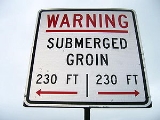
. All of a groyne may be under water, in which case it is a submerged groyne. The areas between groups of groynes are groyne fields. Groynes are generally made of wood, concrete, or rock piles, and placed in groups. They are often used in tandem with seawall
Seawall
A seawall is a form of coastal defence constructed where the sea, and associated coastal processes, impact directly upon the landforms of the coast. The purpose of a seawall is to protect areas of human habitation, conservation and leisure activities from the action of tides and waves...
s. Groynes, however, may cause a shoreline to be perceived as unnatural and unattractive.
In coastal engineering
A groyne's length and elevation, and the spacing between groynes is determined according to local wave energy and beach slope. Groynes that are too long or too high tend to accelerate downdrift erosion because they trap too much sediment. Groynes that are too short, too low, or too permeablePermeability (fluid)
Permeability in fluid mechanics and the earth sciences is a measure of the ability of a porous material to allow fluids to pass through it.- Units :...
are ineffective because they trap too little sediment. Flank
Flank
Flank may refer to:* Flank, the side of either a horse or a military unit*Flanking maneuver in military tactics* Flank , the waveform edge formed when a signal goes high or low...
ing may occur if a groyne does not extend far enough landward.
How groynes work
A groyne creates and maintains a wide area of beach or sediment on its updrift side, and reduces erosion on the other. It is a physical barrier to stop sediment transportSediment transport
Sediment transport is the movement of solid particles , typically due to a combination of the force of gravity acting on the sediment, and/or the movement of the fluid in which the sediment is entrained...
in the direction of longshore transport (also called Longshore Drift). This causes a build-up, which is often accompanied by accelerated erosion of the downdrift beach, which receives little or no sand from longshore drift (this is known as terminal groyne syndrome, as it occurs after the terminal groyne in a group of groynes). Groynes do not add extra material to a beach, but merely retain some of the existing sediment on the updrift side of the groynes. If a groyne is correctly designed, then the amount of material it can hold will be limited, and excess sediment will be free to move on through the system. However, if a groyne is too large it may trap too much sediment, which can cause severe beach erosion on the down-drift side.
In rivers
River groynes (spur dykes or wing dykes) (American English: "dikes") are often constructed nearly perpendicular to the riverbanks, beginning at a riverbank with a root and ending at the regulation line with a head. They maintain a channel to prevent ice jamming, and more generally improve navigation and control over lateral erosion, that would form from meanders. Groynes have a major impact on the river morphologyRiver morphology
The terms river morphology and its synonym fluvial geomorphology are used to describe the shapes of river channels and how they change over time...
: they cause autonomous degradation of the river.
They are also used around bridges to prevent bridge scour
Bridge scour
Bridge scour is the removal of sediment such as sand and rocks from around bridge abutments or piers. Scour, caused by swiftly moving water, can scoop out scour holes, compromising the integrity of a structure....
.
Types

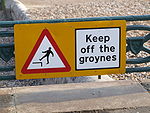
By construction method
Groynes can be permeable, allowing the water to flow through at reduced velocities, or impermeable, blocking and deflecting the current.- Permeable groynes are large rocks, bamboo or timber
- impermeable groynes (solid groynes or rock armour groynes) are constructed using rock, gravel, gabions.
By whether they are submerged
Groynes can be submerged or not under normal conditions. Usually impermeable groynes are non-submerged, since flow over the top of solid groynes may cause severe erosion along the shanks. Submerged groynes, on the other hand, may be permeable depending on the degree of flow disturbance needed.By their effect on stream flow
Groynes can be attracting, deflecting or repelling.- Attracting groynes point downstream, serving to attract the stream flow toward themselves and not repel the flow toward the opposite bank. They tend to maintain deep current close to the bank.
- Deflecting groynes change the direction of flow without repelling it. They are generally short and used for limited, local protection.
- Repelling groynes point upstream; they force the flow away from themselves. A single groyne may have one section, for example, attracting, and another section deflecting.