


Group I catalytic intron

Encyclopedia
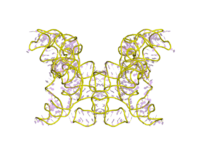
Group I introns are large self-splicing ribozymes. They catalyze
their own excision from mRNA, tRNA and rRNA precursors in a wide range of organisms. The core secondary structure
consists of nine paired regions (P1-P9). These fold to essentially two domains - the P4-P6 domain (formed from the stacking of P5, P4, P6 and P6a helices) and the P3-P9 domain (formed from the P8, P3, P7 and P9 helices). The secondary structure mark-up for this family represents only this conserved core. Group I introns often have long open reading frame
s inserted in loop regions
.
of group I introns is processed by two sequential ester
-transfer reactions. The exogenous
guanosine
or guanosine nucleotide
(exoG) first docks onto the active G-binding site located in P7, and its 3'-OH is aligned to attack the phosphodiester bond
at the 5' splice site located in P1, resulting in a free 3'-OH group at the upstream exon
and the exoG being attached to the 5' end of the intron. Then the terminal G (omega G) of the intron swaps the exoG and occupies the G-binding site to organize the second ester-transfer reaction, the 3'-OH group of the upstream exon in P1 is aligned to attacks the 3' splice site in P10, leading to the ligation
of the adjacent upstream and downstream exons and free of the catalytic intron.

Two-metal-ion mechanism seen in protein polymerases and phosphatases was proposed to be used by group I and group II intron
s to process the phosphoryl transfer reactions, which was unambiguously proven by a recently resolved high-resolution structure of the Azoarcus group I intron.


, and some mechanisms of RNA folding
have been appreciated thus far. It is agreed that the tertiary structure is folded after the formation of the secondary structure. During folding, RNA molecules are rapidly populated into different folding intermediates, the intermediates containing native interactions are further folded into the native structure through a fast folding pathway, while those containing non-native interactions are trapped in metastable or stable non-native conformations, and the process of conversion to the native structure occurs very slowly. It is evident that group I introns differing in the set of peripheral elements display different potentials in entering the fast folding pathway. Meanwhile, cooperative assembly of the tertiary structure is important for the folding of the native structure. Nevertheless, folding of group I introns in vitro encounters both thermodynamic and kinetic
challenges. A few RNA binding proteins and chaperones have been shown to promote the folding of group I introns in vitro and in bacteria by stabilizing the native intermediates, and by destabilizing the non-native structures, respectively.
plants. However, their occurrence in bacteria seems to be more sporadic than in lower
eukaryotes, and they have become prevalent in higher plants. The gene
s that group I
introns interrupt differ significantly: They interrupt rRNA, mRNA and tRNA
genes in bacterial genomes, as well as in mitochondrial and chloroplast
genomes of lower eukaryotes, but only invade rRNA genes in the nuclear genome
of
lower eukaryotes. In higher plants, these introns seem to be restricted to a few
tRNA and mRNA genes of the chloroplasts and mitochondria.
Group I introns are also found inserted into genes of a wide variety of bacteriophages
of Gram-positive bacteria. However, their distribution in the phage of Gram-negative bacteria is mainly limited to the T4
, T-even and T7-like
like bacteriophages.
Both intron-early and intron-late theories have found evidences in explaining the origin of group I introns.
Some group I introns encode homing endonuclease
(HEG), which catalyzes intron mobility. It is proposed that HEGs move the
intron from one location to another, from one organism to another and thus account for the
wide spreading of the selfish group I introns. No biological role has been
identified for group I introns thus far except for splicing of themselves from the precursor
to prevent the death of the host that they live by. A small number of group I introns are
also found to encode a class of proteins called maturases that facilitate the intron
splicing.
Biocatalysis
Biocatalysis is the use of natural catalysts, such as protein enzymes, to perform chemical transformations on organic compounds. Both enzymes that have been more or less isolated and enzymes still residing inside living cells are employed for this task....
their own excision from mRNA, tRNA and rRNA precursors in a wide range of organisms. The core secondary structure
Secondary structure
In biochemistry and structural biology, secondary structure is the general three-dimensional form of local segments of biopolymers such as proteins and nucleic acids...
consists of nine paired regions (P1-P9). These fold to essentially two domains - the P4-P6 domain (formed from the stacking of P5, P4, P6 and P6a helices) and the P3-P9 domain (formed from the P8, P3, P7 and P9 helices). The secondary structure mark-up for this family represents only this conserved core. Group I introns often have long open reading frame
Open reading frame
In molecular genetics, an open reading frame is a DNA sequence that does not contain a stop codon in a given reading frame.Normally, inserts which interrupt the reading frame of a subsequent region after the start codon cause frameshift mutation of the sequence and dislocate the sequences for stop...
s inserted in loop regions
Stem-loop
Stem-loop intramolecular base pairing is a pattern that can occur in single-stranded DNA or, more commonly, in RNA. The structure is also known as a hairpin or hairpin loop. It occurs when two regions of the same strand, usually complementary in nucleotide sequence when read in opposite directions,...
.
Catalysis
SplicingSplicing (genetics)
In molecular biology and genetics, splicing is a modification of an RNA after transcription, in which introns are removed and exons are joined. This is needed for the typical eukaryotic messenger RNA before it can be used to produce a correct protein through translation...
of group I introns is processed by two sequential ester
Ester
Esters are chemical compounds derived by reacting an oxoacid with a hydroxyl compound such as an alcohol or phenol. Esters are usually derived from an inorganic acid or organic acid in which at least one -OH group is replaced by an -O-alkyl group, and most commonly from carboxylic acids and...
-transfer reactions. The exogenous
Exogenous
Exogenous refers to an action or object coming from outside a system. It is the opposite of endogenous, something generated from within the system....
guanosine
Guanosine
Guanosine is a purine nucleoside comprising guanine attached to a ribose ring via a β-N9-glycosidic bond. Guanosine can be phosphorylated to become guanosine monophosphate , cyclic guanosine monophosphate , guanosine diphosphate , and guanosine triphosphate...
or guanosine nucleotide
Nucleotide
Nucleotides are molecules that, when joined together, make up the structural units of RNA and DNA. In addition, nucleotides participate in cellular signaling , and are incorporated into important cofactors of enzymatic reactions...
(exoG) first docks onto the active G-binding site located in P7, and its 3'-OH is aligned to attack the phosphodiester bond
Phosphodiester bond
A phosphodiester bond is a group of strong covalent bonds between a phosphate group and two 5-carbon ring carbohydrates over two ester bonds. Phosphodiester bonds are central to all known life, as they make up the backbone of each helical strand of DNA...
at the 5' splice site located in P1, resulting in a free 3'-OH group at the upstream exon
Exon
An exon is a nucleic acid sequence that is represented in the mature form of an RNA molecule either after portions of a precursor RNA have been removed by cis-splicing or when two or more precursor RNA molecules have been ligated by trans-splicing. The mature RNA molecule can be a messenger RNA...
and the exoG being attached to the 5' end of the intron. Then the terminal G (omega G) of the intron swaps the exoG and occupies the G-binding site to organize the second ester-transfer reaction, the 3'-OH group of the upstream exon in P1 is aligned to attacks the 3' splice site in P10, leading to the ligation
Ligation
Ligation may refer to:* In molecular biology, the covalent linking of two ends of DNA molecules using DNA ligase* In medicine, the making of a ligature * Chemical ligation, the production of peptides from amino acids...
of the adjacent upstream and downstream exons and free of the catalytic intron.
Two-metal-ion mechanism seen in protein polymerases and phosphatases was proposed to be used by group I and group II intron
Group II intron
Group II introns are a large class of self-catalytic ribozymes as well as mobile genetic element found within the genes of all three domains of life. Ribozyme activity can occur under high-salt conditions in vitro. However, assistance from proteins is required for in vivo splicing...
s to process the phosphoryl transfer reactions, which was unambiguously proven by a recently resolved high-resolution structure of the Azoarcus group I intron.
Intron folding
Since early 1990s, scientists started to study how the group I intron achieves its native structure in vitroIn vitro
In vitro refers to studies in experimental biology that are conducted using components of an organism that have been isolated from their usual biological context in order to permit a more detailed or more convenient analysis than can be done with whole organisms. Colloquially, these experiments...
, and some mechanisms of RNA folding
Folding (chemistry)
In chemistry, folding is the process by which a molecule assumes its shape or conformation. The process can also be described as intramolecular self-assembly where the molecule is directed to form a specific shape through noncovalent interactions, such as hydrogen bonding, metal coordination,...
have been appreciated thus far. It is agreed that the tertiary structure is folded after the formation of the secondary structure. During folding, RNA molecules are rapidly populated into different folding intermediates, the intermediates containing native interactions are further folded into the native structure through a fast folding pathway, while those containing non-native interactions are trapped in metastable or stable non-native conformations, and the process of conversion to the native structure occurs very slowly. It is evident that group I introns differing in the set of peripheral elements display different potentials in entering the fast folding pathway. Meanwhile, cooperative assembly of the tertiary structure is important for the folding of the native structure. Nevertheless, folding of group I introns in vitro encounters both thermodynamic and kinetic
Kinetic energy
The kinetic energy of an object is the energy which it possesses due to its motion.It is defined as the work needed to accelerate a body of a given mass from rest to its stated velocity. Having gained this energy during its acceleration, the body maintains this kinetic energy unless its speed changes...
challenges. A few RNA binding proteins and chaperones have been shown to promote the folding of group I introns in vitro and in bacteria by stabilizing the native intermediates, and by destabilizing the non-native structures, respectively.
Distribution, phylogeny and mobility
Group I introns are distributed in bacteria, lower eukaryotes and higherplants. However, their occurrence in bacteria seems to be more sporadic than in lower
eukaryotes, and they have become prevalent in higher plants. The gene
Gene
A gene is a molecular unit of heredity of a living organism. It is a name given to some stretches of DNA and RNA that code for a type of protein or for an RNA chain that has a function in the organism. Living beings depend on genes, as they specify all proteins and functional RNA chains...
s that group I
introns interrupt differ significantly: They interrupt rRNA, mRNA and tRNA
genes in bacterial genomes, as well as in mitochondrial and chloroplast
Chloroplast
Chloroplasts are organelles found in plant cells and other eukaryotic organisms that conduct photosynthesis. Chloroplasts capture light energy to conserve free energy in the form of ATP and reduce NADP to NADPH through a complex set of processes called photosynthesis.Chloroplasts are green...
genomes of lower eukaryotes, but only invade rRNA genes in the nuclear genome
Nuclear gene
A Nuclear gene is a gene located in the cell nucleus of a eukaryote. The term is used to distinguish nuclear genes from the genes in the mitochondrion, and in case of plants, also the chloroplast, which host their own genetic system and can produce proteins from scratch...
of
lower eukaryotes. In higher plants, these introns seem to be restricted to a few
tRNA and mRNA genes of the chloroplasts and mitochondria.
Group I introns are also found inserted into genes of a wide variety of bacteriophages
Bacteriophage
A bacteriophage is any one of a number of viruses that infect bacteria. They do this by injecting genetic material, which they carry enclosed in an outer protein capsid...
of Gram-positive bacteria. However, their distribution in the phage of Gram-negative bacteria is mainly limited to the T4
Enterobacteria phage T4
Enterobacteria phage T4 is a bacteriophage that infects E. coli bacteria. Its DNA is 169–170 kbp long, and is held in an icosahedral head. T4 is a relatively large phage, at approximately 90 nm wide and 200 nm long...
, T-even and T7-like
T7 phage
Bacteriophage T7 is a bacteriophage capable of infecting susceptible bacterial cells. It infects most strains of Escherichia coli Bacteriophage T7 is a bacteriophage capable of infecting susceptible bacterial cells. It infects most strains of Escherichia coli Bacteriophage T7 is a bacteriophage...
like bacteriophages.
Both intron-early and intron-late theories have found evidences in explaining the origin of group I introns.
Some group I introns encode homing endonuclease
Homing endonuclease
The homing endonucleases are a type of restriction enzymes typically encoded by introns or inteins. They act on the cellular DNA of the cells that synthesize them, in the opposite alleles of the genes that encode them.- Origin and mechanism :...
(HEG), which catalyzes intron mobility. It is proposed that HEGs move the
intron from one location to another, from one organism to another and thus account for the
wide spreading of the selfish group I introns. No biological role has been
identified for group I introns thus far except for splicing of themselves from the precursor
to prevent the death of the host that they live by. A small number of group I introns are
also found to encode a class of proteins called maturases that facilitate the intron
splicing.
See also
- Group I Intron Sequence and Structure DatabaseGISSDThe Group I Intron Sequence and Structure Database is a database of Group I catalytic intron....
- Cyclic di-GMP-II riboswitchCyclic di-GMP-II riboswitchCyclic di-GMP-II riboswitches form a class of riboswitches that specifically bind cyclic di-GMP, a second messenger used in multiple bacterial processes such as virulence, motility and biofilm formation...
, where there is an example of a riboswitch acting together with a group I intron to regulate the expression of a gene