

Gronings

Encyclopedia
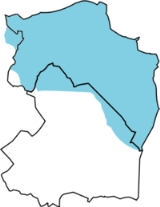
Gronings, in the dialect itself called Grunnegs or Grönnegs, is a collective name for some Friso-Saxon
dialect
s spoken in the province of Groningen
and around the Groningen border in Drenthe
and Friesland
. Gronings and the strongly related varieties
in East-Frisia have a strong Frisian influence and take a remarkable position within the Low Saxon language. The dialect is characterized by a typical accent and vocabulary, which differ strongly from the other Low Saxon dialects.
(Noordenvelds) are so strongly related that most linguists see it as part of Gronings. The dialect of the southeast, called Veenkoloniaals is alike on both sides of the Groningen-Drenthe border. In the Frisian
municipality of Kollumerland, the western dialect called Westerkwartiers is also spoken, as well as a separate Groningen dialect called Kollumerpompsters. The latter is spoken in the Frisian village of Kollumerpomp
and has more West Frisian
influences, while most Groningen dialects have a strong East Frisian influence.
, also called Nedersaksisch in the Netherlands. These words are actually more political than linguistic, because they unite a large group of very differing varieties. Categorizing Gronings as Low German or Low Saxon could be considered correct, but the questioning is about the existence of the linguistic unity called Low Saxon/Low German.
Others, especially German linguists, see Gronings-East Frisian as a separate group of German dialects
. The Frisian influence, the sounds ou, ai and ui and the typical accent are crucial here. Gronings-East Frisian would be categorized as Friso-Saxon
instead of Low Saxon. Other linguists categorize all Gronings-East Frisian dialects as North Low Saxon. In that case, all the other Low Saxon varieties in the Netherlands are categorized as Westphalian
.
Especially Dutch linguists classify Gronings as Dutch Low Saxon
, in Germany also called Westplatt. In this case the Dutch
influence is crucial, while the dialects on the other side of the national border are strongly influenced by High German. These influences concern especially the vocabulary, like the Dutch word "voorbeeld" (example) which is "veurbeeld" in Gronings while the East Frisian dialects use "biespööl", which is related to the High German word "beispiel". In this case there is no separation between Groningen-East Frisian (or North Low Saxon) and Westphalian, but rather a difference between Groningen and East Frisian. The national border would equal the linguistic border.
(East Frisian) and Middle Low German. Frisian was spoken in the Ommelanden
(surrounding lands of the city of Groningen), while the city of Groningen, the surrounding rural area called Gorecht and the eastern lordship of Westerwolde
were Low Saxon. When the city of Groningen developed an important position in the Ommelanden, a switch from Frisian to Saxon occurred, although it was not a complete switch because there are many Frisian influences in the "new" Groningen language. Many Frisian words and grammatic features are still in use today. In less than one century, the same process also started in East Frisia
, from the city of Emden, which was influenced by the Hanseatic League
. This declares the strong relation between both varieties.
In the second half of the 16th century Gronings started to evolve towards Middle Dutch
because of the strong influence of the new standard language. But because of the political, geographical and cultural isolation of Groningen, a strong provincialism in the first half of the 19th century caused Gronings to develop itself in a significant way. The sounds that are used today were formed in this period.
, Veendam
, Stadskanaal
, Delfzijl
and Winschoten
are excluded from this count, the percentage would rise to about 80%. Almost all of the older people use Gronings as their main language. Until the second half of the 20th century, Gronings was more important in Groningen than Dutch. Young people also speak the language frequently, although many pure Gronings words are lost.
Since the second half of the 20th century, the usage of the language is declining. Because of globalization, other languages like Dutch and English are becoming more important. Many parents today chose to raise their children in the Dutch language.
Examples of Gronings magazines are Toal en Taiken (language and signs) and Krödde, which actually means weed
.
There are many Gronings dictionaries as well. The first official dictionary was the "Nieuw Groninger Woordenboek" and was put together by Kornelis ter Laan. This dictionary and the writing system used in the book became the basics of each dictionary and writing system ever since.
More recent is "Zakwoordenboek Gronings - Nederlands / Nederlands - Gronings" by Siemon Reker, which is a little less specific. K. G. Pieterman wrote a dictionary of Gronings alliteration
s which is titled Gezondhaid en Groutnis (sanity and greetings).
At the University of Groningen
it is possible to study the language. In October 2007 Gronings became an official study within the faculty of letteren (language and literature). The new professor, Siemon Reker, had already undergone many studies in the language and is famous for his dictionary.
Another possible way to learn Gronings is taking classes. In the last few years the trend of people taking courses has risen. More and more people, also people from outside who come to live in the area in which Gronings is spoken, are interested in the language and are willing to take courses. There are two types of courses. The first one is understanding and the second one is understanding and speaking.
Every year around March a writing contest is held in every municipality in Groningen.By whom? Everyone can participate and send in a poem or some prose. The winners of the different ages succeed to the provincial round.
(†). Every year the supply of successful artists in regional languages in the Netherlands is rising.
belongs. Both related dialects are characterized by a Frisian influence. Hence other linguists classify Gronings-East Frisian as a separate group of Northwest Low Saxon or Friso-Saxon dialects. The most important similarities are grammar features and the vocabulary. The most important differences are the writing system and the loanwords. The East Frisian writing system is based on High German while Gronings uses many Dutch features. For example the word for “ice skate” is in Gronings “scheuvel” and in East Frisian “Schöfel”, while the pronunciation is almost alike. Here are a few examples of words compared to West Frisian, East Frisian Low Saxon, German, Dutch and English.
The East Frisian combination -oo (for example in Bloot = blood) is pronounced like -ow in the English word “now”([blowt]; Gronings: blowd). In some parts of the Rheiderland
they say blyowt, which is a leftover of Frisian in this area. The East Frisian combination -aa (for example in quaad) is pronounced like –a in the British English word “water”. In Gronings this sound is written like –oa. The word water would be written like “woatah” in Gronings. The pronunciation of the word “quaad” is similar to the Gronings word “kwoad”, which means “angry”. The East Frisian combination -ee and -eei (for example in neet) are pronounced like the –y in the English word “fly” ([nyt]; Gronings: nyt)*.
The pronunciation differs from the writing system. The combination -en is most of the times pronounced like -'n. The Groningen people speak quite fast compared to the Dutch people, with the result that a lot of words are pronounced together as one word. Thus the example sentence is pronounced in English like "doo'estn hyil'eande lu dy-skowfle-low'm kinn". In the word skowfle, the k can also be pronounced like the Dutch -g and the -ow is pronounced like in Australian English ([øw]).
The Dutch pronunciation of that sentence is like "y'I habt hail vail warke'naymers dee cøhna sgahtse", in which the -g- is pronounced as in Dutch itself.
Another reason is the fact that Gronings is a dialect with a lot of own expressions. One third of the language consists of these expressions. In the example sentence n hail ìnde is an example of those expressions. Many of these are given in the 'Nieuwe Groninger Woordenboek' by K. ter Laan published in 1977, (1280pp).
Because of this far distance from Standard Dutch and the official status of the neighbouring Frisian, Grunnegs is considered as a separate language by some of its native speakers, while linguist consider it as part of Dutch Low Saxon
.
Some often used Gronings words.
Friso-Saxon
Friso-Saxon is a collective name for a certain group of dialects belonging to the West Germanic languages. Although they are a variant of the Low Saxon language as a whole, these dialects have undergone strong influences from the Frisian language...
dialect
Dialect
The term dialect is used in two distinct ways, even by linguists. One usage refers to a variety of a language that is a characteristic of a particular group of the language's speakers. The term is applied most often to regional speech patterns, but a dialect may also be defined by other factors,...
s spoken in the province of Groningen
Groningen (province)
Groningen [] is the northeasternmost province of the Netherlands. In the east it borders the German state of Niedersachsen , in the south Drenthe, in the west Friesland and in the north the Wadden Sea...
and around the Groningen border in Drenthe
Drenthe
Drenthe is a province of the Netherlands, located in the north-east of the country. The capital city is Assen. It is bordered by Overijssel to the south, Friesland to the west, Groningen to the north, and Germany to the east.-History:Drenthe, unlike many other parts of the Netherlands, has been a...
and Friesland
Friesland
Friesland is a province in the north of the Netherlands and part of the ancient region of Frisia.Until the end of 1996, the province bore Friesland as its official name. In 1997 this Dutch name lost its official status to the Frisian Fryslân...
. Gronings and the strongly related varieties
Variety (linguistics)
In sociolinguistics a variety, also called a lect, is a specific form of a language or language cluster. This may include languages, dialects, accents, registers, styles or other sociolinguistic variation, as well as the standard variety itself...
in East-Frisia have a strong Frisian influence and take a remarkable position within the Low Saxon language. The dialect is characterized by a typical accent and vocabulary, which differ strongly from the other Low Saxon dialects.
Area
The name Gronings can be perfectly geographically defined. The dialect in the north of the province of DrentheDrenthe
Drenthe is a province of the Netherlands, located in the north-east of the country. The capital city is Assen. It is bordered by Overijssel to the south, Friesland to the west, Groningen to the north, and Germany to the east.-History:Drenthe, unlike many other parts of the Netherlands, has been a...
(Noordenvelds) are so strongly related that most linguists see it as part of Gronings. The dialect of the southeast, called Veenkoloniaals is alike on both sides of the Groningen-Drenthe border. In the Frisian
Friesland
Friesland is a province in the north of the Netherlands and part of the ancient region of Frisia.Until the end of 1996, the province bore Friesland as its official name. In 1997 this Dutch name lost its official status to the Frisian Fryslân...
municipality of Kollumerland, the western dialect called Westerkwartiers is also spoken, as well as a separate Groningen dialect called Kollumerpompsters. The latter is spoken in the Frisian village of Kollumerpomp
Kollumerpomp
Kollumerpomp is a small village in Kollumerland c.a. in the province Friesland of the Netherlands and has around the 440 citizens. There is a restored windmill in the village - De Westermolen.-References:...
and has more West Frisian
West Frisian language
West Frisian is a language spoken mostly in the province of Friesland in the north of the Netherlands. West Frisian is the name by which this language is usually known outside the Netherlands, to distinguish it from the closely related Frisian languages of Saterland Frisian and North Frisian,...
influences, while most Groningen dialects have a strong East Frisian influence.
Dialects
The Gronings language can be subdivided into 8 dialects:| Subdivision of the Groningen dialects |
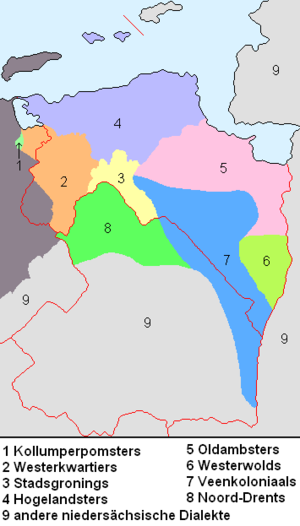 |
| Gronings dialects in the provinces of Groningen, Friesland, and Drenthe |
- Kollumerpompsters
- Westerkwartiers
- Stadjeders
- Hogelandsters
- Oldambtsters
- Westerwolds
- Veenkoloniaals
- Noordenvelds
- Other varieties of Dutch/German Low Saxon
Example
Though there are several differences between the dialects, they form a perfect whole. Most words are written the same way, but the pronunciation can differ. The examples show the pronunciation.- Westerkertiers: t Eenege dat wie niet doun is slik uutdeeln
- Stadsgrunnegs (city): t Oinege dat wie noit doun is baaltjes oetdailn
- Hoogelaandsters: t Ainege dat wie nait dudden is slik oetdijln
- Westerwoolds: t Einege dat wie nich dun is slikkerij uutdeiln
- Veenkelonioals: t Ainege wat wie nait dudden is slikke uutduiln
- East Frisian Low SaxonEast Frisian Low SaxonEast Frisian Low Saxon is a West Low German dialect spoken in the East Frisian peninsula of northwestern Lower Saxony. It is used quite frequently in everyday speech there. About half of the East Frisian population in the coastal region uses Platdüütsk. A number of individuals, despite not being...
: Dat eenzige, dat wi neet doon is Slickeree utdelen. - Northern Low SaxonNorthern Low SaxonNorthern Low Saxon is a West Low German dialect.As such, it covers a great part of the West Low-German-speaking areas of northern Germany, with the exception of the border regions where Eastphalian and Westphalian are spoken...
of Germany: Dat eenzige, dat wi nich doot, (dat) is Snabbelkraam uutdeeln. - Standard DutchDutch languageDutch is a West Germanic language and the native language of the majority of the population of the Netherlands, Belgium, and Suriname, the three member states of the Dutch Language Union. Most speakers live in the European Union, where it is a first language for about 23 million and a second...
: Het enige dat we niet doen is snoep uitdelen. - Standard GermanGerman languageGerman is a West Germanic language, related to and classified alongside English and Dutch. With an estimated 90 – 98 million native speakers, German is one of the world's major languages and is the most widely-spoken first language in the European Union....
: Das einzige, das wir nicht machen, ist Süßigkeiten austeilen. - ScotsScots languageScots is the Germanic language variety spoken in Lowland Scotland and parts of Ulster . It is sometimes called Lowland Scots to distinguish it from Scottish Gaelic, the Celtic language variety spoken in most of the western Highlands and in the Hebrides.Since there are no universally accepted...
: The anerly thing we dinnae dae is gie oot snashters. - EnglishEnglish languageEnglish is a West Germanic language that arose in the Anglo-Saxon kingdoms of England and spread into what was to become south-east Scotland under the influence of the Anglian medieval kingdom of Northumbria...
: The only thing we do not do is hand out sweets.
Classification
There are many uncertainties about the classification and categorization of Gronings. Some linguists see it as a variety of Low GermanLow German
Low German or Low Saxon is an Ingvaeonic West Germanic language spoken mainly in northern Germany and the eastern part of the Netherlands...
, also called Nedersaksisch in the Netherlands. These words are actually more political than linguistic, because they unite a large group of very differing varieties. Categorizing Gronings as Low German or Low Saxon could be considered correct, but the questioning is about the existence of the linguistic unity called Low Saxon/Low German.
Others, especially German linguists, see Gronings-East Frisian as a separate group of German dialects
German dialects
German dialect is dominated by the geographical spread of the High German consonant shift, and the dialect continuum that connects the German with the Dutch language.-German dialects in relation to varieties of standard German:...
. The Frisian influence, the sounds ou, ai and ui and the typical accent are crucial here. Gronings-East Frisian would be categorized as Friso-Saxon
Friso-Saxon
Friso-Saxon is a collective name for a certain group of dialects belonging to the West Germanic languages. Although they are a variant of the Low Saxon language as a whole, these dialects have undergone strong influences from the Frisian language...
instead of Low Saxon. Other linguists categorize all Gronings-East Frisian dialects as North Low Saxon. In that case, all the other Low Saxon varieties in the Netherlands are categorized as Westphalian
Westphalian language
Westphalian is one of the major dialect groups of West Low German. Its most salient feature is the diphthongization . For example, speakers say iEten instead of Eːten for eat...
.
Especially Dutch linguists classify Gronings as Dutch Low Saxon
Dutch Low Saxon
Dutch Low Saxon is a group of Low Saxon, i.e. West Low German dialects spoken in the northeastern Netherlands. In comparison, the remainder of the Netherlands speak a collection of Low Franconian dialects.The class "Dutch Low Saxon" is not unanimous...
, in Germany also called Westplatt. In this case the Dutch
Dutch language
Dutch is a West Germanic language and the native language of the majority of the population of the Netherlands, Belgium, and Suriname, the three member states of the Dutch Language Union. Most speakers live in the European Union, where it is a first language for about 23 million and a second...
influence is crucial, while the dialects on the other side of the national border are strongly influenced by High German. These influences concern especially the vocabulary, like the Dutch word "voorbeeld" (example) which is "veurbeeld" in Gronings while the East Frisian dialects use "biespööl", which is related to the High German word "beispiel". In this case there is no separation between Groningen-East Frisian (or North Low Saxon) and Westphalian, but rather a difference between Groningen and East Frisian. The national border would equal the linguistic border.
Origin
The Gronings dialects are a kind of mix between two languages: Old FrisianOld Frisian
Old Frisian is a West Germanic language spoken between the 8th and 16th centuries in the area between the Rhine and Weser on the European North Sea coast. The Frisian settlers on the coast of South Jutland also spoke Old Frisian but no medieval texts of this area are known...
(East Frisian) and Middle Low German. Frisian was spoken in the Ommelanden
Ommelanden
The Ommelanden are the parts of Groningen province that surround Groningen city. Usually mentioned as synonym for the province in the expression Stad en Ommeland ....
(surrounding lands of the city of Groningen), while the city of Groningen, the surrounding rural area called Gorecht and the eastern lordship of Westerwolde
Westerwolde
Westerwolde is a region in the province Groningen in the north of the Netherlands. The region is located in the most eastern part of the Netherlands, alongside the German border. It is situated around the rivers Mussel Aa, Ruiten Aa, and Westerwoldse Aa, and it contains the villages Bellingwolde,...
were Low Saxon. When the city of Groningen developed an important position in the Ommelanden, a switch from Frisian to Saxon occurred, although it was not a complete switch because there are many Frisian influences in the "new" Groningen language. Many Frisian words and grammatic features are still in use today. In less than one century, the same process also started in East Frisia
East Frisia
East Frisia or Eastern Friesland is a coastal region in the northwest of the German federal state of Lower Saxony....
, from the city of Emden, which was influenced by the Hanseatic League
Hanseatic League
The Hanseatic League was an economic alliance of trading cities and their merchant guilds that dominated trade along the coast of Northern Europe...
. This declares the strong relation between both varieties.
In the second half of the 16th century Gronings started to evolve towards Middle Dutch
Middle Dutch
Middle Dutch is a collective name for a number of closely related West Germanic dialects which were spoken and written between 1150 and 1500...
because of the strong influence of the new standard language. But because of the political, geographical and cultural isolation of Groningen, a strong provincialism in the first half of the 19th century caused Gronings to develop itself in a significant way. The sounds that are used today were formed in this period.
Daily life
Today approximately 65% of people from Groningen can speak and write Gronings. If the larger cities and villages of Groningen, Hoogezand-SappemeerHoogezand-Sappemeer
Hoogezand-Sappemeer is a municipality in the northeastern Netherlands. It is the second largest municipality in the province of Groningen, after the city of Groningen. It is well known for its ship building industry....
, Veendam
Veendam
Veendam is a municipality and a town in the northeastern Dutch province of Groningen.A Holland America Line cruise ship, the MS Veendam, is named after the city.- Population centres :...
, Stadskanaal
Stadskanaal
Stadskanaal is a Canal, municipality and a town in the northeastern Netherlands.The area is known for its peat mining.- Population centres :...
, Delfzijl
Delfzijl
Delfzijl is a municipality and city in the northeast of the Netherlands. It is situated on the left bank of the river Ems estuary, which forms the border with Germany.-Population centres:...
and Winschoten
Winschoten
Winschoten is a former municipality and city in the northeast of the Netherlands.Population : 18.497; area: 22,24 km2.The origin of the name of Winschoten is not known but it has received nicknames. One of these is Molenstad . It has also been known, in living memory, as Sodom...
are excluded from this count, the percentage would rise to about 80%. Almost all of the older people use Gronings as their main language. Until the second half of the 20th century, Gronings was more important in Groningen than Dutch. Young people also speak the language frequently, although many pure Gronings words are lost.
Since the second half of the 20th century, the usage of the language is declining. Because of globalization, other languages like Dutch and English are becoming more important. Many parents today chose to raise their children in the Dutch language.
Media
In the media Gronings is used frequently. For example on the local radio station Radio Noord, Gronings is used by the presenters and listeners. On the local television Gronings is less used. Something that is always in Gronings is the weather forecast. The news is always in Dutch, because not everyone who watches can speak Gronings. In the second half of 2007, the local television broadcast a series in Gronings called Boven Wotter. Another program that is in and about Gronings is Grunnegers, which is actually some kind of education in Gronings.Examples of Gronings magazines are Toal en Taiken (language and signs) and Krödde, which actually means weed
Weed
A weed in a general sense is a plant that is considered by the user of the term to be a nuisance, and normally applied to unwanted plants in human-controlled settings, especially farm fields and gardens, but also lawns, parks, woods, and other areas. More specifically, the term is often used to...
.
There are many Gronings dictionaries as well. The first official dictionary was the "Nieuw Groninger Woordenboek" and was put together by Kornelis ter Laan. This dictionary and the writing system used in the book became the basics of each dictionary and writing system ever since.
More recent is "Zakwoordenboek Gronings - Nederlands / Nederlands - Gronings" by Siemon Reker, which is a little less specific. K. G. Pieterman wrote a dictionary of Gronings alliteration
Alliteration
In language, alliteration refers to the repetition of a particular sound in the first syllables of Three or more words or phrases. Alliteration has historically developed largely through poetry, in which it more narrowly refers to the repetition of a consonant in any syllables that, according to...
s which is titled Gezondhaid en Groutnis (sanity and greetings).
Education and culture
Although Gronings, as part of Low Saxon, is an official language, it is not a mandatory subject in schools. Still, many primary schools in Groningen choose to give attention to the regional language. This attention varies from inviting storytellers to teaching about the language. In secondary schools Gronings does not receive much attention.At the University of Groningen
University of Groningen
The University of Groningen , located in the city of Groningen, was founded in 1614. It is one of the oldest universities in the Netherlands as well as one of its largest. Since its inception more than 100,000 students have graduated...
it is possible to study the language. In October 2007 Gronings became an official study within the faculty of letteren (language and literature). The new professor, Siemon Reker, had already undergone many studies in the language and is famous for his dictionary.
Another possible way to learn Gronings is taking classes. In the last few years the trend of people taking courses has risen. More and more people, also people from outside who come to live in the area in which Gronings is spoken, are interested in the language and are willing to take courses. There are two types of courses. The first one is understanding and the second one is understanding and speaking.
Every year around March a writing contest is held in every municipality in Groningen.By whom? Everyone can participate and send in a poem or some prose. The winners of the different ages succeed to the provincial round.
Music
Well known Groningen musical artists are Wia Buze, Alex Vissering, Eltje Doddema, Pé Daalemmer & Rooie Rinus, Burdy, Hail Gewoon and Ede StaalEde Staal
Ede Ulfert Staal was a Dutch singer-songwriter from the Northern province of Groningen who sang mainly in the Groninger dialect of Dutch.-Early life:...
(†). Every year the supply of successful artists in regional languages in the Netherlands is rising.
Frisian substratum
Some linguists classify Gronings to North Low Saxon, to which also East FrisianEast Frisian Low Saxon
East Frisian Low Saxon is a West Low German dialect spoken in the East Frisian peninsula of northwestern Lower Saxony. It is used quite frequently in everyday speech there. About half of the East Frisian population in the coastal region uses Platdüütsk. A number of individuals, despite not being...
belongs. Both related dialects are characterized by a Frisian influence. Hence other linguists classify Gronings-East Frisian as a separate group of Northwest Low Saxon or Friso-Saxon dialects. The most important similarities are grammar features and the vocabulary. The most important differences are the writing system and the loanwords. The East Frisian writing system is based on High German while Gronings uses many Dutch features. For example the word for “ice skate” is in Gronings “scheuvel” and in East Frisian “Schöfel”, while the pronunciation is almost alike. Here are a few examples of words compared to West Frisian, East Frisian Low Saxon, German, Dutch and English.
| West Frisian West Frisian language West Frisian is a language spoken mostly in the province of Friesland in the north of the Netherlands. West Frisian is the name by which this language is usually known outside the Netherlands, to distinguish it from the closely related Frisian languages of Saterland Frisian and North Frisian,... |
East Frisian East Frisian Low Saxon East Frisian Low Saxon is a West Low German dialect spoken in the East Frisian peninsula of northwestern Lower Saxony. It is used quite frequently in everyday speech there. About half of the East Frisian population in the coastal region uses Platdüütsk. A number of individuals, despite not being... |
Gronings | German German language German is a West Germanic language, related to and classified alongside English and Dutch. With an estimated 90 – 98 million native speakers, German is one of the world's major languages and is the most widely-spoken first language in the European Union.... |
Dutch Dutch language Dutch is a West Germanic language and the native language of the majority of the population of the Netherlands, Belgium, and Suriname, the three member states of the Dutch Language Union. Most speakers live in the European Union, where it is a first language for about 23 million and a second... |
English English language English is a West Germanic language that arose in the Anglo-Saxon kingdoms of England and spread into what was to become south-east Scotland under the influence of the Anglian medieval kingdom of Northumbria... |
| Reed | Schöfel | Scheuvel | Schlittschuh | Schaats | Ice skate |
| Lyts | Lüttje | Lutje | Klein | Klein | Little |
| Foarbyld | Bispööl | Veurbeeld | Beispiel | Voorbeeld | Example |
| Bloet | Bloot [blout] | Bloud | Blut | Bloed | Blood |
The East Frisian combination -oo (for example in Bloot = blood) is pronounced like -ow in the English word “now”([blowt]; Gronings: blowd). In some parts of the Rheiderland
Rheiderland
The Rheiderland is a region of Germany and the Netherlands between the River Ems and the Bay of Dollart. The German part of the Rheiderland lies in East Frisia, west of the Ems. The Dutch part lies in the Dutch province of Groningen and is mostly part of Oldambt...
they say blyowt, which is a leftover of Frisian in this area. The East Frisian combination -aa (for example in quaad) is pronounced like –a in the British English word “water”. In Gronings this sound is written like –oa. The word water would be written like “woatah” in Gronings. The pronunciation of the word “quaad” is similar to the Gronings word “kwoad”, which means “angry”. The East Frisian combination -ee and -eei (for example in neet) are pronounced like the –y in the English word “fly” ([nyt]; Gronings: nyt)*.
Linguistic distance from Standard Dutch
After Limburgish, Gronings is the dialect with the farthest distance from Standard Dutch. Reasons for this are vocabulary and pronunciation. The Gronings vocabulary is quite different from Dutch, for example:- Gronings: Doe hest n hail ìnde luu dij scheuvellopen kinnen
- Dutch: Jij hebt heel veel werknemers die kunnen schaatsen
- English: You have a lot of employees who can ice skate
The pronunciation differs from the writing system. The combination -en is most of the times pronounced like -'n. The Groningen people speak quite fast compared to the Dutch people, with the result that a lot of words are pronounced together as one word. Thus the example sentence is pronounced in English like "doo'estn hyil'eande lu dy-skowfle-low'm kinn". In the word skowfle, the k can also be pronounced like the Dutch -g and the -ow is pronounced like in Australian English ([øw]).
The Dutch pronunciation of that sentence is like "y'I habt hail vail warke'naymers dee cøhna sgahtse", in which the -g- is pronounced as in Dutch itself.
Another reason is the fact that Gronings is a dialect with a lot of own expressions. One third of the language consists of these expressions. In the example sentence n hail ìnde is an example of those expressions. Many of these are given in the 'Nieuwe Groninger Woordenboek' by K. ter Laan published in 1977, (1280pp).
Because of this far distance from Standard Dutch and the official status of the neighbouring Frisian, Grunnegs is considered as a separate language by some of its native speakers, while linguist consider it as part of Dutch Low Saxon
Dutch Low Saxon
Dutch Low Saxon is a group of Low Saxon, i.e. West Low German dialects spoken in the northeastern Netherlands. In comparison, the remainder of the Netherlands speak a collection of Low Franconian dialects.The class "Dutch Low Saxon" is not unanimous...
.
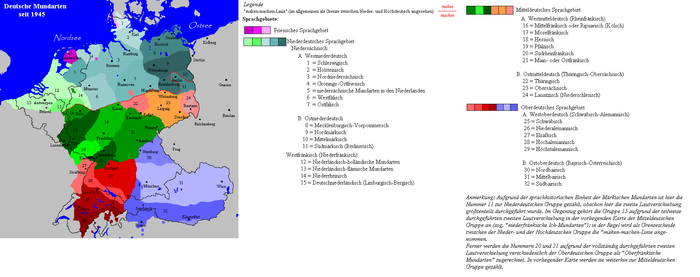 |
German dialects German dialect is dominated by the geographical spread of the High German consonant shift, and the dialect continuum that connects the German with the Dutch language.-German dialects in relation to varieties of standard German:... . Gronings and East Frisian considered as one language. |
Example
Lord’s Prayer- Os Voader in Hemel, (litt. Our Father in Heaven)
- dat Joen Noam haailegd worden zel, (litt. May Thy name be hallowed)
- dat Joen Keunenkriek kommen mag, (litt. May Thy kingdom come)
- dat Joen wil doan wordt (litt. May Thy will be done)
- op Eerd net as in hemel. (litt. On earth, like in heaven)
- t Stoet doar wie verlet om hebben (litt. The bread we need so badly)
- geef os dat vandoag, (litt. give it to us today)
- en reken os nait tou wat wie verkeerd doun, (litt. And do not blame us for the things we do wrong)
- net zo as wie vergeven elk dij os wat aandut. (litt. As we forgive those who trespass against us)
- En breng os nait in verlaaiden, (litt. And lead us not into temptation)
- mor wil van verlaaider ons verlözzen. (litt. But deliver us from the tempter)
- Den Joe binnen t Keunenkriek, (litt. Because Thou art the kingdom)
- de Kracht en de Heerlekhaid. (litt. the Power and the Glory)
- Veur in aiweghaid. (litt. For eternity)
- Amen
Vocabulary
As told before, the Gronings vocabulary is strongly related to East Frisian Low Saxon, Saterfrisian and West Frisian. However, today the pure Gronings vocabulary is in decline. More and more Gronings words are being replaced by “Groningized” Dutch words. For example the word “stevel” (boot, German “Stiefel”) is sometimes replaced by the word “leers” (Dutch “laars”). Although most people do know the pure words, they are less and less used, for example because people think others will not understand them or because they are too long and the Dutch word is much easier. An example of the latter is the word for sock, which is “Hozevörrel” in Gronings. The Dutch word “sok” is much easier, so it is more often used than hozevörrel.Some often used Gronings words.
| Gronings | Dutch | English |
|---|---|---|
| Aingoal | Voortdurend | Continuously |
| Aine | Iemand | Someone |
| Akkenail | Dakkapel | Dormer |
| Beune | Zolder | Loft |
| Boksem | Broek | Trousers |
| Bolle | Stier | Bull |
| Boudel | Boel/Toestand | Mess |
| Bözzem | Schoorsteenmantel | Mantelpiece |
| Dammit | Zometeen | Right away |
| Edik | Azijn | Vinegar |
| Eelsk | Verwaand/Aanstellerig | Affected |
| Eerdappel/Eerpel | Aardappel | Potato |
| Elkenain | Iedereen | Everyone |
| Gounend | Een aantal (mensen) | Some (people) |
| Hounder, tuten | Kippen | Chickens |
| Hupzelen | Bretels | Suspender |
| Jeuzeln | Zeuren/janken | To nag |
| Jirre | Vies water | Dirty liquid |
| Graimen, klaaien | Morsen | To make grimy |
| Kloede | Klont/Dik persoon | Lump/Fat person |
| Koare | Kruiwagen | Wheelbarrow |
| Kopstubber | Ragebol | Round ceiling mop |
| Kribben | Ruzie maken | To wrangle |
| Krudoorns | Kruisbessen | Gooseberry |
| Leeg | Laag | Low |
| Liepen | Huilen | The weeping |
| Loug | Dorp | Village |
| Lutje | Klein | Little |
| Mishottjen | Mislukken | To fail |
| Mous | Boerenkool | Kale |
| Mug | Vlieg | Housefly |
| Neefie | Mug | Winter Crane Fly |
| Om toch! | Daarom! (nietszeggend antwoord op vraag met “waarom”) | "because I say so"(a meaningless answer to a question with “why”) |
| Opoe | Oma | Grandmother |
| Poeppetoon, Woalse boon | Tuinbonen | Broad bean |
| Puut | (plastic) Zak | (plastic) Bag |
| Plof(fiets) | Brommer | Moped |
| Rebait | Rode biet | Red beet |
| Raive | Gereedschap | Tools |
| Schraaien | Huilen | To weep |
| Siepel | Ui | Onion |
| Sikkom | Bijna | Around |
| Slaif | Pollepel | Ladle |
| Slik | Snoep | Candy |
| Slim | Erg | Very badly |
| Smok | Zoen | Kiss |
| Spèren/spijen | Braken, spugen | Vomiting / spewing |
| Stoer | Moeilijk | Difficult |
| Steekruif | Koolraap | Turnip |
| Riepe | Stoep | Sidewalk |
| Verlet hebben van | Nodig hebben | To need (badly) |
| Vernaggeln | Vernielen | To demolish |
| Weg/Vot | Vandaan | From (like in: “Where do you come from~?”) |
| Wicht | Meisje | Girl |
| Wied | Ver | Far |
| Zedel | Folder | Leaflet |
External links
- www.dideldom.com Dideldom
- www.sillius.nl/groningana Groningana
- Kursus Grunnegs Course in Gronings
- Kursus Grunnegs Course in Gronings on line
- Press release http://uk.youtube.com/watch?v=ujY9P7hQjAg Simon Reker has become Regular Chairholder for Gronings at Groningen University
- Press release http://uk.youtube.com/watch?v=4gzSfZ7FUE0&feature=PlayList&p=82762389B59B1A86&index=19 New teaching materials for younger pupils