

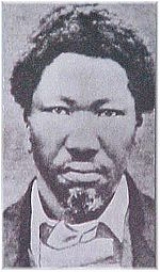
Griqua

Encyclopedia
The Griqua are a subgroup of South Africa
's heterogeneous and multiracial
Coloured
people.
The Griqua are a racially and culturally mixed people who originated in the intermarriages or sexual relations between European colonists in the Cape
and the Khoikhoi
already living there in the 17th and 18th centuries. In 1813 Rev. John Campbell of the London Missionary Society
(LMS) used the term for a mixed group of Chariguriqua (a Cape Khoikhoi group), 'bastaards', Koranna, and Tswana living at the site of present-day Griekwastad (formerly "Klaarwater"). The British found their "proud name", Bastaards, offensive, so the LMS called them Griqua. Because of a common ancestor named Griqua, and shared links to the Chariguriqua (Grigriqua), the people officially changed their name to the Griqua. According to Isaac Tirion, by 1730 the Grigriquas were recognized as a group living in the northeastern section of the Cape Colony.
(VOC) did not intend the Cape Colony at the Southern tip of Africa to become a political entity. As it expanded and became more successful, its leaders did not worry about frontiers. The frontier of the colony was indeterminate and ebbed and flowed at the whim of individuals. While the VOC undoubtedly benefited from the trading and pastoral endeavors of the trekboers, it did little to control or support them in their quest for land. The high proportion of single Dutch men led to their taking indigenous women as wives and companions, and mixed-race children were born. They grew to be a sizeable population who spoke Dutch and were instrumental in developing the colony.
These children did not attain the social or legal status accorded their fathers, mostly because colonial laws recognised only Christian forms of marriage. This group became known as Baster
s, or bastards. The colonists, in their paramilitary response to insurgent resistance from Khoi
and San
people, readily conscripted the Baster
s into commandos
. This ensured the men became skilled in lightly armed, mounted, skirmish tactics. Many recruited to war chose to abandon their paternal society and strike out and live more the way their maternal lines did. The resulting steady stream of disgruntled, Dutch-speaking, trained marksmen leaving the Cape hobbled the Dutch capability to crew their commandos. It also created belligerent, skilled groups of opportunists who harassed the indigenous populations the length of the Orange River
. Once free of the colonies, these groups called themselves the Oorlam. In particular, the group led by Klaas Afrikaner
became notorious. He attracted enough attention from the Dutch authorities to cause him to be rendered
to the colony and banished to Robben Island
in 1761.
One of the most influential of these Oolam groups was the Griqua. In the 19th century, the Griqua controlled several political entities which were governed by Kapteins (Dutch for "Captain", i.e. leader) and their Councils, with their own written constitutions. Adam Kok I, the first Kaptein of the Griqua - a slave who had bought his own freedom - led his people north from the interior of the Cape Colony. Probably because of discrimination against his people, they again moved north; this time outside the Cape, near the Orange River, just west of the Orange Free State
, and on the southern skirts of the Transvaal
. The Griqua had largely adopted the Afrikaans language before their migrations. This area is where most of the tribe settled; some remained nomadic.
Kok's successor, Andries Waterboer
, founded Griqualand West
, and controlled it until the influx of Europeans accompanying the discovery of diamond
s. In 1834, the Cape Colony recognized Waterboer’s rights to his land and people. It signed a treaty with him to ensure payment for the use of the land for mining. Not long after 1843, the competition between the Cape Colony, Orange Free State, and the Transvaal became too much for the Griqua. Led by Adam Kok III, they migrated east to establish Griqualand East
. Griqualand East only existed for months before its annexation by the Cape Colony in 1874.
Both Griqualands, East and West, were dissolved in European colonies. The Griqua were classified as Coloured
under apartheid.
s are a separate ethnic group of similarly mixed origins living in south-central Namibia
; Northern Cape
at Campbell and Griquatown; (the historic territory of Griqualand West); the Western Cape
(around the small le Fleur Griqua settlement at Kranshoek); and at Kokstad.
The total Griqua population is unknown. The people were submerged by a number of factors. The most important factor were the racist policies of the Apartheid era, during which many of the Griqua people took on the mantle of "Coloured" fearing that their Griqua roots might place them at a lower level with the Africans.
Genetic evidence indicates that the majority of the present Griqua population is descended from European, Khoikhoi and Tswana ancestors, with a small percentage of Bushman
ancestry.
The Griqua people are represented in the National Khoisan Consultative Conference (Nasionale Khoe-San Oorlegplegende Konferensie) established in Oudtshoorn in 2001. That represents the Capoid
"first nation peoples" of South Africa. It participates in research and development projects in cooperation with the government of the Western Cape Province and with the University of the Free State
in Bloemfontein
. Especially prominent are members of the influential le Fleur clan.
The Griqua established their own church, the Griqua Church, which is Protestant. It has a strong focus on maintaining the Griqua cultural and ethnic identity.
One of several disputed theories as to the origin of Bloemfontein
's name connects it to the Griqua leader Jan Bloem (1775–1858). This may be a coincidence, as Bloemfontein is Dutch for "spring of bloom," "flower spring," or "fountain of flowers", and the place could have been named for vegetation.
South Africa
The Republic of South Africa is a country in southern Africa. Located at the southern tip of Africa, it is divided into nine provinces, with of coastline on the Atlantic and Indian oceans...
's heterogeneous and multiracial
Multiracial
The terms multiracial and mixed-race describe people whose ancestries come from multiple races. Unlike the term biracial, which often is only used to refer to having parents or grandparents of two different races, the term multiracial may encompass biracial people but can also include people with...
Coloured
Coloured
In the South African, Namibian, Zambian, Botswana and Zimbabwean context, the term Coloured refers to an heterogenous ethnic group who possess ancestry from Europe, various Khoisan and Bantu tribes of Southern Africa, West Africa, Indonesia, Madagascar, Malaya, India, Mozambique,...
people.
The Griqua are a racially and culturally mixed people who originated in the intermarriages or sexual relations between European colonists in the Cape
Cape Colony
The Cape Colony, part of modern South Africa, was established by the Dutch East India Company in 1652, with the founding of Cape Town. It was subsequently occupied by the British in 1795 when the Netherlands were occupied by revolutionary France, so that the French revolutionaries could not take...
and the Khoikhoi
Khoikhoi
The Khoikhoi or Khoi, in standardised Khoekhoe/Nama orthography spelled Khoekhoe, are a historical division of the Khoisan ethnic group, the native people of southwestern Africa, closely related to the Bushmen . They had lived in southern Africa since the 5th century AD...
already living there in the 17th and 18th centuries. In 1813 Rev. John Campbell of the London Missionary Society
London Missionary Society
The London Missionary Society was a non-denominational missionary society formed in England in 1795 by evangelical Anglicans and Nonconformists, largely Congregationalist in outlook, with missions in the islands of the South Pacific and Africa...
(LMS) used the term for a mixed group of Chariguriqua (a Cape Khoikhoi group), 'bastaards', Koranna, and Tswana living at the site of present-day Griekwastad (formerly "Klaarwater"). The British found their "proud name", Bastaards, offensive, so the LMS called them Griqua. Because of a common ancestor named Griqua, and shared links to the Chariguriqua (Grigriqua), the people officially changed their name to the Griqua. According to Isaac Tirion, by 1730 the Grigriquas were recognized as a group living in the northeastern section of the Cape Colony.
History
The Dutch East India CompanyDutch East India Company
The Dutch East India Company was a chartered company established in 1602, when the States-General of the Netherlands granted it a 21-year monopoly to carry out colonial activities in Asia...
(VOC) did not intend the Cape Colony at the Southern tip of Africa to become a political entity. As it expanded and became more successful, its leaders did not worry about frontiers. The frontier of the colony was indeterminate and ebbed and flowed at the whim of individuals. While the VOC undoubtedly benefited from the trading and pastoral endeavors of the trekboers, it did little to control or support them in their quest for land. The high proportion of single Dutch men led to their taking indigenous women as wives and companions, and mixed-race children were born. They grew to be a sizeable population who spoke Dutch and were instrumental in developing the colony.
These children did not attain the social or legal status accorded their fathers, mostly because colonial laws recognised only Christian forms of marriage. This group became known as Baster
Baster
The Basters are the descendants of Cape Colony Dutch and indigenous African women. They largely live in Namibia and are similar to Coloured or Griqua people in South Africa....
s, or bastards. The colonists, in their paramilitary response to insurgent resistance from Khoi
Khoi
Khoi may refer to:*The common name of Siamese Rough Bush, Streblus asper Lour*The Khoikhoi people*One of the Khoe languages*The Khoekhoe language*Khoy, a city in Iran*Khoy County, an administrative subdivision of Iran...
and San
Bushmen
The indigenous people of Southern Africa, whose territory spans most areas of South Africa, Zimbabwe, Lesotho, Mozambique, Swaziland, Botswana, Namibia, and Angola, are variously referred to as Bushmen, San, Sho, Barwa, Kung, or Khwe...
people, readily conscripted the Baster
Baster
The Basters are the descendants of Cape Colony Dutch and indigenous African women. They largely live in Namibia and are similar to Coloured or Griqua people in South Africa....
s into commandos
Commandos
Commandos is a stealth-oriented real-time tactics game series, available for Microsoft Windows and Mac OS X. The game is set in the Second World War and follows the escapades of a fictional British Commandos section. It leans heavily on historical events during WWII to carry the plot...
. This ensured the men became skilled in lightly armed, mounted, skirmish tactics. Many recruited to war chose to abandon their paternal society and strike out and live more the way their maternal lines did. The resulting steady stream of disgruntled, Dutch-speaking, trained marksmen leaving the Cape hobbled the Dutch capability to crew their commandos. It also created belligerent, skilled groups of opportunists who harassed the indigenous populations the length of the Orange River
Orange River
The Orange River , Gariep River, Groote River or Senqu River is the longest river in South Africa. It rises in the Drakensberg mountains in Lesotho, flowing westwards through South Africa to the Atlantic Ocean...
. Once free of the colonies, these groups called themselves the Oorlam. In particular, the group led by Klaas Afrikaner
Klaas Afrikaner
Klaas Afrikaner was the second Captain of the Orlam Afrikaners, first in the Cape Colony, then in South-West Africa...
became notorious. He attracted enough attention from the Dutch authorities to cause him to be rendered
Rendition (law)
In law, rendition is a "surrender" or "handing over" of persons or property, particularly from one jurisdiction to another. For criminal suspects, extradition is the most common type of rendition. Rendition can also be seen as the act of handing over, after the request for extradition has taken...
to the colony and banished to Robben Island
Robben Island
Robben Island is an island in Table Bay, 6.9 km west of the coast of Bloubergstrand, Cape Town, South Africa. The name is Dutch for "seal island". Robben Island is roughly oval in shape, 3.3 km long north-south, and 1.9 km wide, with an area of 5.07 km². It is flat and only a...
in 1761.
One of the most influential of these Oolam groups was the Griqua. In the 19th century, the Griqua controlled several political entities which were governed by Kapteins (Dutch for "Captain", i.e. leader) and their Councils, with their own written constitutions. Adam Kok I, the first Kaptein of the Griqua - a slave who had bought his own freedom - led his people north from the interior of the Cape Colony. Probably because of discrimination against his people, they again moved north; this time outside the Cape, near the Orange River, just west of the Orange Free State
Orange Free State
The Orange Free State was an independent Boer republic in southern Africa during the second half of the 19th century, and later a British colony and a province of the Union of South Africa. It is the historical precursor to the present-day Free State province...
, and on the southern skirts of the Transvaal
South African Republic
The South African Republic , often informally known as the Transvaal Republic, was an independent Boer-ruled country in Southern Africa during the second half of the 19th century. Not to be confused with the present-day Republic of South Africa, it occupied the area later known as the South African...
. The Griqua had largely adopted the Afrikaans language before their migrations. This area is where most of the tribe settled; some remained nomadic.
Kok's successor, Andries Waterboer
Andries Waterboer
Andries Waterboer was a leader of the Griqua people. He was elected as their Kaptijn at Griquatown in 1820....
, founded Griqualand West
Griqualand West
Griqualand West is an area of central South Africa with an area of 40,000 km² that now forms part of the Northern Cape Province. It was inhabited by the Griqua people - a semi-nomadic, Afrikaans-speaking nation of mixed-race origin, who established several states outside the expanding frontier...
, and controlled it until the influx of Europeans accompanying the discovery of diamond
Diamond
In mineralogy, diamond is an allotrope of carbon, where the carbon atoms are arranged in a variation of the face-centered cubic crystal structure called a diamond lattice. Diamond is less stable than graphite, but the conversion rate from diamond to graphite is negligible at ambient conditions...
s. In 1834, the Cape Colony recognized Waterboer’s rights to his land and people. It signed a treaty with him to ensure payment for the use of the land for mining. Not long after 1843, the competition between the Cape Colony, Orange Free State, and the Transvaal became too much for the Griqua. Led by Adam Kok III, they migrated east to establish Griqualand East
Griqualand East
Griqualand East was one of four short-lived Griqua states in Southern Africa from the early 1860s until the late 1870s and was located between the Umzimkulu and Kinira Rivers, south of the Sotho Kingdom.Griqualand East's capital, Kokstad, was the final place of...
. Griqualand East only existed for months before its annexation by the Cape Colony in 1874.
Both Griqualands, East and West, were dissolved in European colonies. The Griqua were classified as Coloured
Coloured
In the South African, Namibian, Zambian, Botswana and Zimbabwean context, the term Coloured refers to an heterogenous ethnic group who possess ancestry from Europe, various Khoisan and Bantu tribes of Southern Africa, West Africa, Indonesia, Madagascar, Malaya, India, Mozambique,...
under apartheid.
Current
Today, BasterBaster
The Basters are the descendants of Cape Colony Dutch and indigenous African women. They largely live in Namibia and are similar to Coloured or Griqua people in South Africa....
s are a separate ethnic group of similarly mixed origins living in south-central Namibia
Namibia
Namibia, officially the Republic of Namibia , is a country in southern Africa whose western border is the Atlantic Ocean. It shares land borders with Angola and Zambia to the north, Botswana to the east and South Africa to the south and east. It gained independence from South Africa on 21 March...
; Northern Cape
Northern Cape
The Northern Cape is the largest and most sparsely populated province of South Africa. It was created in 1994 when the Cape Province was split up. Its capital is Kimberley. It includes the Kalahari Gemsbok National Park, part of an international park shared with Botswana...
at Campbell and Griquatown; (the historic territory of Griqualand West); the Western Cape
Western Cape
The Western Cape is a province in the south west of South Africa. The capital is Cape Town. Prior to 1994, the region that now forms the Western Cape was part of the much larger Cape Province...
(around the small le Fleur Griqua settlement at Kranshoek); and at Kokstad.
The total Griqua population is unknown. The people were submerged by a number of factors. The most important factor were the racist policies of the Apartheid era, during which many of the Griqua people took on the mantle of "Coloured" fearing that their Griqua roots might place them at a lower level with the Africans.
Genetic evidence indicates that the majority of the present Griqua population is descended from European, Khoikhoi and Tswana ancestors, with a small percentage of Bushman
Bushmen
The indigenous people of Southern Africa, whose territory spans most areas of South Africa, Zimbabwe, Lesotho, Mozambique, Swaziland, Botswana, Namibia, and Angola, are variously referred to as Bushmen, San, Sho, Barwa, Kung, or Khwe...
ancestry.
The Griqua people are represented in the National Khoisan Consultative Conference (Nasionale Khoe-San Oorlegplegende Konferensie) established in Oudtshoorn in 2001. That represents the Capoid
Capoid
The Capoid race is a historical racial category proposed in 1962 by anthropologist Carleton S. Coon and named after the Cape of Good Hope; these people had formerly been regarded as a sub-type of the historical racial category Negroid....
"first nation peoples" of South Africa. It participates in research and development projects in cooperation with the government of the Western Cape Province and with the University of the Free State
University of the Free State
The University of the Free State is situated in Bloemfontein, the capital of the Free State, South Africa. The university also has a satellite campus in Qwaqwa that was, until 2003, part of the University of the North.-Academic Divisions:...
in Bloemfontein
Bloemfontein
Bloemfontein is the capital city of the Free State Province of South Africa; and, as the judicial capital of the nation, one of South Africa's three national capitals – the other two being Cape Town, the legislative capital, and Pretoria, the administrative capital.Bloemfontein is popularly and...
. Especially prominent are members of the influential le Fleur clan.
The Griqua established their own church, the Griqua Church, which is Protestant. It has a strong focus on maintaining the Griqua cultural and ethnic identity.
One of several disputed theories as to the origin of Bloemfontein
Bloemfontein
Bloemfontein is the capital city of the Free State Province of South Africa; and, as the judicial capital of the nation, one of South Africa's three national capitals – the other two being Cape Town, the legislative capital, and Pretoria, the administrative capital.Bloemfontein is popularly and...
's name connects it to the Griqua leader Jan Bloem (1775–1858). This may be a coincidence, as Bloemfontein is Dutch for "spring of bloom," "flower spring," or "fountain of flowers", and the place could have been named for vegetation.
Griqualand
Several areas of South Africa became known as Griqualand when the group migrated and settled away from other areas of population.- Griqualand EastGriqualand EastGriqualand East was one of four short-lived Griqua states in Southern Africa from the early 1860s until the late 1870s and was located between the Umzimkulu and Kinira Rivers, south of the Sotho Kingdom.Griqualand East's capital, Kokstad, was the final place of...
is the area around KokstadKokstad, KwaZulu-NatalKokstad is a town in the Sisonke District of KwaZulu-Natal Province, South Africa. Kokstad is named after the Griqua chief Adam Kok III who settled here in 1863. Stad is the Dutch and Afrikaans word for city....
on the frontier between the Eastern CapeEastern CapeThe Eastern Cape is a province of South Africa. Its capital is Bhisho, but its two largest cities are Port Elizabeth and East London. It was formed in 1994 out of the "independent" Xhosa homelands of Transkei and Ciskei, together with the eastern portion of the Cape Province...
and KwaZulu-NatalKwaZulu-NatalKwaZulu-Natal is a province of South Africa. Prior to 1994, the territory now known as KwaZulu-Natal was made up of the province of Natal and the homeland of KwaZulu....
. This area was settled by Adam Kok IIIAdam Kok IIIAdam Kok III was a leader of the Griqua people in South Africa .The son of Adam Kok II, he grew up and was educated in the town of Philippolis in Transorangia...
and over 2,000 Griquas who followed him over the DrakensbergDrakensbergThe Drakensberg is the highest mountain range in Southern Africa, rising to in height. In Zulu, it is referred to as uKhahlamba , and in Sesotho as Maluti...
in 1861. Griqua descendants are now largely centered in Kokstad, where the Griqua Church is a center of the community.
- Griqualand WestGriqualand WestGriqualand West is an area of central South Africa with an area of 40,000 km² that now forms part of the Northern Cape Province. It was inhabited by the Griqua people - a semi-nomadic, Afrikaans-speaking nation of mixed-race origin, who established several states outside the expanding frontier...
is the area around Kimberley, which became significant when diamondDiamondIn mineralogy, diamond is an allotrope of carbon, where the carbon atoms are arranged in a variation of the face-centered cubic crystal structure called a diamond lattice. Diamond is less stable than graphite, but the conversion rate from diamond to graphite is negligible at ambient conditions...
s were discovered there. It has also been known for its rugby union and cricket teams.
External links
- History of the Griquas
- "Children of the Mist - the lost tribe of South Africa"
- Kokstad with historical Griqua images
- Kranshoek - meeting with Griqua Paramount Chief le Fleur
- Griquatown and Campbell with historical Griqua images
- Griquatown - 1812 and today
- The History of Kokstad & East Griqualand