
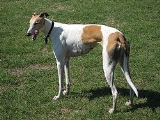
Greyhound
akcgroup = Hound
| akcstd = altname = English Greyhound
| ankcgroup = Group 4
| ankcstd = ckcgroup = Group 2 - Hounds
| ckcstd = country = uncertain; possibly
England or
Egypt
| fcigroup = 10
| fcinum = 158
| fcisection = 3
| fcistd = image = Greyhound.jpg
| image_caption = Greyhound
| kcukgroup = Hound
| kcukstd = name = Greyhound
| nzkcgroup = Hounds
| nzkcstd = ukcgroup = Sighthounds and Pariahs
| ukcstd = End Infobox Dogbreed info. Article Begins Here -->
The Greyhound is a
breed of
dog used for hunting and
racing. It is one of the fastest land mammals; its combination of long, powerful legs, deep chests and aerodynamic build allows it to reach speeds of up to 72 km/h .
Encyclopedia
The
Greyhound is a
breed of
dog used for hunting and
racing. It is one of the fastest land mammals; its combination of long, powerful legs, deep chests and aerodynamic build allows it to reach speeds of up to 72 km/h .
Appearance
Dogs are usually 71 to 76 cm tall at the
withers and weigh around 29 to 36
kg . Bitches tend to be smaller with shoulder heights ranging from 68 to 71 cm and weights from 27 to 31 kg . Greyhounds have very short hair, which is easy to maintain. There are approximately thirty recognized color forms, of which variations of white, brindle, fawn, black, red and blue can appear uniquely or in combination.
Temperament
Although greyhounds are extremely fast, they are not high-energy dogs. They are sprinters, and although they love running, they do not require extensive exercise once they leave the track. Most are quiet, gentle animals. Greyhounds are often referred to as "Forty-five mile per hour couch potatoes."
Greyhounds can make good pets because of their mild and affectionate character. They can get along well with children, dogs and other family pets . Greyhounds are generally loyal, tractable dogs with developed intellects, although their territorial instinct is weak and they make poor guard dogs. Their talents include sighting and coursing. They do not have undercoats and therefore are less likely to trigger people's dog allergies . Most greyhounds that live as pets are adopted after they retire from racing.
Most companion greyhounds are kept on a leash because their hunting background has instilled a strong desire to chase things . Greyhounds can live in an urban setting but require moderate exercise on a regular basis. They enjoy walking and running outside.
An adult greyhound will stay healthy and happy with a daily walk of as little as 20 to 30 minutes.
History
Popularly, the breed's origin is believed to be traced to ancient
Egypt, where a
bas-relief depicting a smooth-coated
Saluki or
Sloughi was found in a
tomb built in 4000 BC. Analyses of
DNA reported in 2004, however, suggest that the greyhound is not closely related to these breeds, but is a close relative to
herding dogs.
Historically, these
sight hounds were used primarily for hunting in the open where their keen
eyesight is valuable. It is believed that they were introduced to
England in the 5th and 6th centuries BC from
Celtic mainland Europe.
The name "greyhound" is generally believed to come from the Old English
grighund. "Hund" is traced to the modern "hound", but the meaning of "grig" is undetermined, other than in reference to dogs in Old English and Norse. Its origin does not appear to have any common root with the modern word "grey" for colour, and indeed the greyhound is seen with a wide variety of coats.
According to Pokorny's Indogermanisches Woerterbuch the English name "greyhound" does not mean "a gray dog/hound", but simply "a fair dog". Subsequent words have been derived from the indoeuropean root *g'her- 'shine, twinkle': Eng. "gray", Old High German "gris" 'grey, old', Old Icelandic "griss" 'piglet, pig', Old Icld. "gryja" 'to dawn', "gryjandi" 'morning twilight', Old Irish "grian" 'sun', Old Church Slavonic "zorja" 'morning twilight, brightness'. The common sense of these words is 'to shine; bright'.
Until the early twentieth century, greyhounds were principally bred and trained for coursing. During the early
1920s, modern greyhound racing was introduced into the United States and introduced into United Kingdom and Ireland in 1926.
See main article at Greyhound racingWelfare
In the late
20th century several
Greyhound adoption groups were formed. The early groups were formed in large part out of a sense of concern about the treatment of the dogs while living on the track. These groups began taking greyhounds from the racetracks when they could no longer compete and placing them in adoptive homes. Previously, in the United States over 20,000 retired greyhounds a year were killed; recent estimates still number in the thousands, with about 90% of National Greyhound Association-registered animals either being adopted, or returned for breeding purposes .
Accidents and disease are also common killers among racing greyhounds. In 2005, an epidemic of respiratory failure killed dozens of dogs and left over 1200
quarantined in the U.S., particularly in
Massachusetts,
Colorado,
Iowa and
Rhode Island.
The vast majority of greyhounds are bred for racing, leading registered American Kennel Club dogs about 150:1, and as such each dog is issued a Bertillon card, which measures 56 distinct identifying traits, and the Bertillon number is
tattooed on the dog's ear, so as to ensure that the dog who races is in fact the dog it is claimed to be. However, not all National Greyhound Association registered dogs race. There are several reasons why some greyhounds never race:
- The dog is too slow.
- The dog has physical defects.
- The dog does not have the required temperament.
- The dog is not raised in a country where racing is popular.
- The dog is bred for showing instead of racing.
Most greyhounds finish racing between two and five years of age. Some retired racing greyhounds have injuries that may follow them for the remainder of their lives.
Veterinary Care
Due to the unique physiology and
anatomy of greyhounds, a
veterinarian who understands the issues relevant to the breed is generally needed when the dogs need treatment, particularly when
anaesthesia is required. Greyhounds demonstrate unusual blood chemistry, which can be misread by veterinarians not familiar with the breed; this can result in an incorrect diagnosis. Also, greyhounds have much less fat than other dogs, and therefore cannot metabolize anesthesia as quickly. Female greyhounds are sometimes administered hormone supplements during their racing career; these can lead to an elevated risk of
cancer . As well, greyhounds have higher levels of
red blood cells than do other breeds: since red blood cells carry oxygen to the muscles, this helps the breed's speed. Veterinary blood services often use greyhounds as many are universal
blood donors..
Miscellaneous
In the media
;Simpson's Santa's Little Helper:
- The most widely recognized greyhound in popular culture is the fictional character Santa's Little Helper
Santa's Little Helper or once known as
Santos L Halper is the Simpson family [i]'s pet dog [i]. ...
from the
Fox Broadcasting Company's animated series,
The Simpsons is an Emmy [i] and Peabody [i]-winning American [i] animated [i] ...
.
- The character Santa's Little Helper exhibits many of the intellectual and behavioural characteristics of the typical greyhound as a pet. He is portrayed as affectionate, tolerant of other household pets , loyal, and not overly active.
;The
Greyhound Lines bus company
- In keeping with their logo, which sports a racing greyhound, Greyhound occasionally airs television commercials starring a talking computer-generated greyhound. The greyhound in these commercial shorts is often noted for his dry, deadpan wit.
Anatomy
An additional peculiarity of greyhounds is that they have a hinged spine, which is unique in the animal world. As a result, greyhounds have a small "divot" in their back, set just behind their shoulder blades.
The racing gait of the greyhound is a double suspension gallop, in which all four feet are off the ground twice during each full stride.
The key to the speed of a greyhound can be found in its streamlined shape, large
lungs,
heart and muscles, the double suspension gallop and the flexibility of the spine.
Sports
- The Greyhound is the mascot of the following college sports teams:
...
Other
- In Australia, racing Greyhounds are commonly known in slang terminology as "Dish Lickers" eg. "I just won 50 bucks at the Dish Lickers".
External links
- Clubs, Associations and Societies
- Comprehensive database of Greyhound pedigrees
See also
| akcstd = altname = Piccolo Levriero Italiano, Miniature Greyhound
...
| akcstd = ankcgroup = Group 4
...
References