

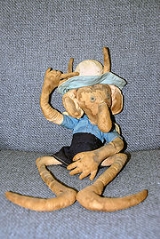
Gremlin

Encyclopedia
A gremlin is an imaginary creature commonly depicted as mischievous and mechanically oriented, with a specific interest in aircraft
. Gremlins' mischievous natures are similar to those of English folkloric
imp
s, while their inclination to damage or dismantle machinery is more modern.
, different fantastical creatures have been referred to as gremlins, bearing varying degrees of resemblance to the originals.
The term "gremlin" denoting a mischievous creature that sabotages aircraft, originates in Royal Air Force
(RAF) slang in the 1920s among the British pilots stationed in Malta
, the Middle East and India
, with the earliest recorded printed use being in a poem published in the journal Aeroplane, in Malta on April 10, 1929. Later sources have sometimes claimed that the concept goes back to World War I
, but there is no print evidence of this.
An early reference to the Gremlin is in aviator
Pauline Gower
s The ATA: Women with Wings (1938) where Scotland is described as "gremlin country", a mystical and rugged territory where scissor-wielding gremlins cut the wires of biplanes when unsuspecting pilots were about.An article by Hubert Griffith in the servicemen's fortnightly Royal Air Force Journal dated April 18, 1942, also chronicles the appearance of gremlins, although the article states the stories had been in existence for several years, with later recollections of it having been told by Battle of Britain
Spitfire
pilots as early as 1940.
This concept of gremlins was popularized during the Second World War among airmen of the UK
's RAF units, in particular the men of the high-altitude Photographic Reconnaissance Units (PRU) of RAF Benson
, RAF Wick and RAF St Eval
. The creatures were responsible for otherwise inexplicable accidents which sometimes occurred during their flights. Gremlins were also thought at one point to have enemy sympathies, but investigations revealed that enemy aircraft had similar and equally inexplicable mechanical problems. As such, gremlins were portrayed as being equal opportunity tricksters, taking no sides in the conflict, and acting out their mischief from their own self-interests. In reality, the gremlins were a form of "buck passing
" or deflecting blame. This led the folklorist John Hazen to note, "Heretofore, the gremlin has been looked on as new phenomenon, a product of the machine age — the age of air."
is credited with getting the gremlins known outside of the Royal Air Force. He would have been familiar with the myth, having carried out his military service in 80 Squadron
of the Royal Air Force in the Middle East. Dahl had his own experience in an accidental crash-landing in the Libyan Desert
. In January, 1942 he was transferred to Washington, D.C.
as Assistant Air attaché
. There he wrote his first children's novel The Gremlins
, in which he described male gremlins as "widgets" and females as "fifinella
s". Dahl showed the finished manuscript to Sidney Bernstein
, the head of the British Information Service. Sidney reportedly came up with the idea to send it to Walt Disney
.
The manuscript arrived in Disney's hands in July 1942, and he considered using it as material for a live action/animated full-length feature film, offering Dahl a contract. The film project was changed to an animated feature and entered pre-production, with characters "roughed out" and storyboards created. Disney managed to have the story published in the December 1942 issue of Cosmopolitan magazine
. At Dahl's urging, in early 1943, a revised version of the story, The Gremlins
was published as a picture book by Random House
(later updated and re-published in 2006 by Dark Horse Comics
).
The publication of The Gremlins by Random House consisted of a 50,000 run for the U.S. market with Dahl ordering 50 copies for himself as promotional material for himself and the upcoming film, handing them out to everyone he knew, including Lord Halifax, and First Lady Eleanor Roosevelt
who read it to her grandchildren. The book was considered an international success with 30,000 more sold in Australia but initial efforts to reprint the book were precluded by a wartime paper shortage. Reviewed in major publications, Dahl was considered a writer-of-note and his appearances in Hollywood to follow up with the film project were met with notices in Hedda Hopper's columns.
The film project was reduced to an animated "short" and eventually cancelled in August 1943, when copyright and RAF rights could not be resolved. Thanks mainly to Disney, the story had its share of publicity which helped in introducing the concept to a wider audience. Issues #33-#41 of Walt Disney's Comics and Stories
published between June 1943 and February 1944 contained a nine-episode series of short silent stories featuring a Gremlin Gus as their star. The first was drawn by Vivie Risto and the rest of them by Walt Kelly
. This served as their introduction to the comic book
audience.
 While Roald Dahl was famous for making gremlins known world wide, many returning Air Servicemen swear they saw creatures tinkering with their equipment. One crewman swore he saw one before an engine malfunction that caused his B-25 Mitchell
bomber
to rapidly lose altitude, forcing the aircraft to return to base. Folklorist Hazen likewise offers his own alleged eyewitness testimony of these creatures, which appeared in an academically praised and peer-reviewed publication, describing an occasion he found "a parted cable which bore obvious tooth marks in spite of the fact that the break occurred in a most inaccessible part of the plane." At this point, Hazen states he heard "a gruff voice" demand, "How many times must you be told to obey orders and not tackle jobs you aren't qualified for? — This is how it should be done." Upon which Hazen heard a "musical twang" and another cable was parted.
Critics of this idea state that the stress of combat and the dizzying heights caused such hallucinations, often believed to be a coping mechanism of the mind to help explain the many problems aircraft faced whilst in combat.
See also Ssh! Gremlins by H.W. illustrated by Ronald Niebour ("Neb" of the Daily Maily), published by H. W. John Crowther Publication, England, in 1942. This booklet featured numerous humorous illustrations describing the gremlins as whimsical but essentially friendly folk. According to "H.W.", contrary to some reports, gremlins are a universal phenomenon and by no means only the friends of flying men.
Not all depictions of gremlins show them on aircraft. Joe Dante
's 1984
movie Gremlins
and its sequel
, Gremlins 2: The New Batch
portray gremlins as malicious creatures whose only goal is to wreak havoc, whether in a small town or in a New York City
skyscraper.
DC Comics
' Stanley and His Monster
depicts a gremlin named Schnitzel, who speaks with a thick German accent and is always trying to avoid an immigration officer, as he is an illegal alien.
American Motors
produced a vehicle called the Gremlin
between 1970 and 1978. A cartoon styled Gremlin icon was featured in advertisements as well as on the cars' gas caps.
Gremlin Trouble Comics were published between 1995 and 2005 by Anti-Ballistic Pixelations. In the 32 issue independent comic, Gremlins were machine spirits generally ambivalent to humans. They would, however work with and help a human they liked. The protagonist was a Storm Fairy who had lost her wings and was subsequently turned into a Gremlin Princess.
Kilroy
the famous piece of graffiti
was identified in Australia
as a gremlin.
----
Aircraft
An aircraft is a vehicle that is able to fly by gaining support from the air, or, in general, the atmosphere of a planet. An aircraft counters the force of gravity by using either static lift or by using the dynamic lift of an airfoil, or in a few cases the downward thrust from jet engines.Although...
. Gremlins' mischievous natures are similar to those of English folkloric
English folklore
English folklore is the folk tradition which has developed in England over a number of centuries. Some stories can be traced back to their roots, while the origin of others is uncertain or disputed...
imp
Imp
An imp is a mythological being similar to a fairy or demon, frequently described in folklore and superstition. The word may perhaps derive from the term ympe, used to denote a young grafted tree.-Folklore:...
s, while their inclination to damage or dismantle machinery is more modern.
Origins
Although their origin is found in myths among airmen, claiming that the gremlins were responsible for sabotaging aircraft, John W. Hazen states that "some people" derive the name from the Old English word gremian, "to vex." Since the Second World WarWorld War II
World War II, or the Second World War , was a global conflict lasting from 1939 to 1945, involving most of the world's nations—including all of the great powers—eventually forming two opposing military alliances: the Allies and the Axis...
, different fantastical creatures have been referred to as gremlins, bearing varying degrees of resemblance to the originals.
The term "gremlin" denoting a mischievous creature that sabotages aircraft, originates in Royal Air Force
Royal Air Force
The Royal Air Force is the aerial warfare service branch of the British Armed Forces. Formed on 1 April 1918, it is the oldest independent air force in the world...
(RAF) slang in the 1920s among the British pilots stationed in Malta
Malta
Malta , officially known as the Republic of Malta , is a Southern European country consisting of an archipelago situated in the centre of the Mediterranean, south of Sicily, east of Tunisia and north of Libya, with Gibraltar to the west and Alexandria to the east.Malta covers just over in...
, the Middle East and India
India
India , officially the Republic of India , is a country in South Asia. It is the seventh-largest country by geographical area, the second-most populous country with over 1.2 billion people, and the most populous democracy in the world...
, with the earliest recorded printed use being in a poem published in the journal Aeroplane, in Malta on April 10, 1929. Later sources have sometimes claimed that the concept goes back to World War I
World War I
World War I , which was predominantly called the World War or the Great War from its occurrence until 1939, and the First World War or World War I thereafter, was a major war centred in Europe that began on 28 July 1914 and lasted until 11 November 1918...
, but there is no print evidence of this.
An early reference to the Gremlin is in aviator
Aviator
An aviator is a person who flies an aircraft. The first recorded use of the term was in 1887, as a variation of 'aviation', from the Latin avis , coined in 1863 by G. de la Landelle in Aviation Ou Navigation Aérienne...
Pauline Gower
Pauline Gower
Pauline Mary de Peauly Gower , married name Pauline Fahie, was a British pilot and writer who headed the female branch of the Air Transport Auxiliary during the Second World War....
s The ATA: Women with Wings (1938) where Scotland is described as "gremlin country", a mystical and rugged territory where scissor-wielding gremlins cut the wires of biplanes when unsuspecting pilots were about.An article by Hubert Griffith in the servicemen's fortnightly Royal Air Force Journal dated April 18, 1942, also chronicles the appearance of gremlins, although the article states the stories had been in existence for several years, with later recollections of it having been told by Battle of Britain
Battle of Britain
The Battle of Britain is the name given to the World War II air campaign waged by the German Air Force against the United Kingdom during the summer and autumn of 1940...
Spitfire
Supermarine Spitfire
The Supermarine Spitfire is a British single-seat fighter aircraft that was used by the Royal Air Force and many other Allied countries throughout the Second World War. The Spitfire continued to be used as a front line fighter and in secondary roles into the 1950s...
pilots as early as 1940.
This concept of gremlins was popularized during the Second World War among airmen of the UK
United Kingdom
The United Kingdom of Great Britain and Northern IrelandIn the United Kingdom and Dependencies, other languages have been officially recognised as legitimate autochthonous languages under the European Charter for Regional or Minority Languages...
's RAF units, in particular the men of the high-altitude Photographic Reconnaissance Units (PRU) of RAF Benson
RAF Benson
RAF Benson is a Royal Air Force station near Benson in South Oxfordshire, England. It is home to the Royal Air Force's support helicopters, the Aérospatiale Puma and the EH-101 Merlin, known as the Puma HC.Mk 1 and the Merlin HC.Mk 3 and Mk 3a....
, RAF Wick and RAF St Eval
RAF St Eval
RAF St Eval was a strategic airbase for the RAF Coastal Command in the Second World War . St Eval's primary role was to provided anti-submarine and anti-shipping patrols off the south west coast of England...
. The creatures were responsible for otherwise inexplicable accidents which sometimes occurred during their flights. Gremlins were also thought at one point to have enemy sympathies, but investigations revealed that enemy aircraft had similar and equally inexplicable mechanical problems. As such, gremlins were portrayed as being equal opportunity tricksters, taking no sides in the conflict, and acting out their mischief from their own self-interests. In reality, the gremlins were a form of "buck passing
Buck passing
Buck passing or passing the buck is the act of attributing another person or group with responsibility for one's own actions. It is also used as a strategy in power politics when the actions of one country/nation are blamed on another, providing an opportunity for war.The latter expression is said...
" or deflecting blame. This led the folklorist John Hazen to note, "Heretofore, the gremlin has been looked on as new phenomenon, a product of the machine age — the age of air."
The Disney version
Author Roald DahlRoald Dahl
Roald Dahl was a British novelist, short story writer, fighter pilot and screenwriter.Born in Wales to Norwegian parents, he served in the Royal Air Force during the Second World War, in which he became a flying ace and intelligence agent, rising to the rank of Wing Commander...
is credited with getting the gremlins known outside of the Royal Air Force. He would have been familiar with the myth, having carried out his military service in 80 Squadron
No. 80 Squadron RAF
No. 80 Squadron RAF was a Royal Flying Corps and Royal Air Force squadron active from 1917 until 1969. It was operative during both World War I and World War II.-Establishment and early service:...
of the Royal Air Force in the Middle East. Dahl had his own experience in an accidental crash-landing in the Libyan Desert
Libyan Desert
The Libyan Desert covers an area of approximately 1,100,000 km2, it extends approximately 1100 km from east to west, and 1,000 km from north to south, in about the shape of a rectangle...
. In January, 1942 he was transferred to Washington, D.C.
Washington, D.C.
Washington, D.C., formally the District of Columbia and commonly referred to as Washington, "the District", or simply D.C., is the capital of the United States. On July 16, 1790, the United States Congress approved the creation of a permanent national capital as permitted by the U.S. Constitution....
as Assistant Air attaché
Air attaché
An air attaché is an Air Force officer who is part of a diplomatic mission; this post is normally filled by a high-ranking officer.An air attaché typically represents the chief of his home air force in the foreign country where he serves. The day-to-day responsibilities include maintaining contacts...
. There he wrote his first children's novel The Gremlins
The Gremlins
The Gremlins is a children's book, written by Roald Dahl and published in 1943. It was Dahl's first children's book, and was written for Walt Disney Productions, as a promotional device for a feature-length animated film that was never made...
, in which he described male gremlins as "widgets" and females as "fifinella
Fifinella
Fifinella was a female gremlin designed by Walt Disney for a proposed film from Roald Dahl's book The Gremlins. During World War II, the Women Airforce Service Pilots asked permission to use the image as their official mascot, and the Disney Company granted them the rights.-Origins:The story of...
s". Dahl showed the finished manuscript to Sidney Bernstein
Sidney Bernstein, Baron Bernstein
Sidney Lewis Bernstein, Baron Bernstein was a British media baron who was known as the founding chairman of the London-based Granada Group and the founder of the Manchester-based Granada Television in 1954....
, the head of the British Information Service. Sidney reportedly came up with the idea to send it to Walt Disney
Walt Disney
Walter Elias "Walt" Disney was an American film producer, director, screenwriter, voice actor, animator, entrepreneur, entertainer, international icon, and philanthropist, well-known for his influence in the field of entertainment during the 20th century. Along with his brother Roy O...
.
The manuscript arrived in Disney's hands in July 1942, and he considered using it as material for a live action/animated full-length feature film, offering Dahl a contract. The film project was changed to an animated feature and entered pre-production, with characters "roughed out" and storyboards created. Disney managed to have the story published in the December 1942 issue of Cosmopolitan magazine
Cosmopolitan (magazine)
Cosmopolitan is an international magazine for women. It was first published in 1886 in the United States as a family magazine, was later transformed into a literary magazine and eventually became a women's magazine in the late 1960s...
. At Dahl's urging, in early 1943, a revised version of the story, The Gremlins
The Gremlins
The Gremlins is a children's book, written by Roald Dahl and published in 1943. It was Dahl's first children's book, and was written for Walt Disney Productions, as a promotional device for a feature-length animated film that was never made...
was published as a picture book by Random House
Random House
Random House, Inc. is the largest general-interest trade book publisher in the world. It has been owned since 1998 by the German private media corporation Bertelsmann and has become the umbrella brand for Bertelsmann book publishing. Random House also has a movie production arm, Random House Films,...
(later updated and re-published in 2006 by Dark Horse Comics
Dark Horse Comics
Dark Horse Comics is the largest independent American comic book and manga publisher.Dark Horse Comics was founded in 1986 by Mike Richardson in Milwaukie, Oregon, with the concept of establishing an ideal atmosphere for creative professionals. Richardson started out by opening his first comic book...
).
The publication of The Gremlins by Random House consisted of a 50,000 run for the U.S. market with Dahl ordering 50 copies for himself as promotional material for himself and the upcoming film, handing them out to everyone he knew, including Lord Halifax, and First Lady Eleanor Roosevelt
Eleanor Roosevelt
Anna Eleanor Roosevelt was the First Lady of the United States from 1933 to 1945. She supported the New Deal policies of her husband, distant cousin Franklin Delano Roosevelt, and became an advocate for civil rights. After her husband's death in 1945, Roosevelt continued to be an international...
who read it to her grandchildren. The book was considered an international success with 30,000 more sold in Australia but initial efforts to reprint the book were precluded by a wartime paper shortage. Reviewed in major publications, Dahl was considered a writer-of-note and his appearances in Hollywood to follow up with the film project were met with notices in Hedda Hopper's columns.
The film project was reduced to an animated "short" and eventually cancelled in August 1943, when copyright and RAF rights could not be resolved. Thanks mainly to Disney, the story had its share of publicity which helped in introducing the concept to a wider audience. Issues #33-#41 of Walt Disney's Comics and Stories
Walt Disney's Comics and Stories
Walt Disney's Comics and Stories, sometimes abbreviated WDC or WDC&S, is an anthology comic book series that has an assortment of Disney characters, including Donald Duck, Scrooge McDuck, Mickey Mouse, Chip 'n Dale, Lil Bad Wolf, Scamp, Bucky Bug, Grandma Duck, Brer Rabbit, Winnie the Pooh, and...
published between June 1943 and February 1944 contained a nine-episode series of short silent stories featuring a Gremlin Gus as their star. The first was drawn by Vivie Risto and the rest of them by Walt Kelly
Walt Kelly
Walter Crawford Kelly, Jr. , or Walt Kelly, was an American animator and cartoonist, best known for the comic strip, Pogo. He began his animation career in 1936 at Walt Disney Studios, contributing to Pinocchio and Fantasia. Kelly resigned in 1941 at the age of 28 to work at Post-Hall Syndicate,...
. This served as their introduction to the comic book
Comic book
A comic book or comicbook is a magazine made up of comics, narrative artwork in the form of separate panels that represent individual scenes, often accompanied by dialog as well as including...
audience.
B-25 Mitchell
The North American B-25 Mitchell was an American twin-engined medium bomber manufactured by North American Aviation. It was used by many Allied air forces, in every theater of World War II, as well as many other air forces after the war ended, and saw service across four decades.The B-25 was named...
bomber
Bomber
A bomber is a military aircraft designed to attack ground and sea targets, by dropping bombs on them, or – in recent years – by launching cruise missiles at them.-Classifications of bombers:...
to rapidly lose altitude, forcing the aircraft to return to base. Folklorist Hazen likewise offers his own alleged eyewitness testimony of these creatures, which appeared in an academically praised and peer-reviewed publication, describing an occasion he found "a parted cable which bore obvious tooth marks in spite of the fact that the break occurred in a most inaccessible part of the plane." At this point, Hazen states he heard "a gruff voice" demand, "How many times must you be told to obey orders and not tackle jobs you aren't qualified for? — This is how it should be done." Upon which Hazen heard a "musical twang" and another cable was parted.
Critics of this idea state that the stress of combat and the dizzying heights caused such hallucinations, often believed to be a coping mechanism of the mind to help explain the many problems aircraft faced whilst in combat.
Aircraft gremlins in film and media
- On December 21, 1942, CBSCBSCBS Broadcasting Inc. is a major US commercial broadcasting television network, which started as a radio network. The name is derived from the initials of the network's former name, Columbia Broadcasting System. The network is sometimes referred to as the "Eye Network" in reference to the shape of...
aired "Gremlins," a story about pilots, on an episode of Ceiling Unlimited, the radio show hosted by Orson WellesOrson WellesGeorge Orson Welles , best known as Orson Welles, was an American film director, actor, theatre director, screenwriter, and producer, who worked extensively in film, theatre, television and radio...
. - In 1943, Bob ClampettBob ClampettRobert Emerson "Bob" Clampett was an American animator, producer, director, and puppeteer best known for his work on the Looney Tunes animated series from Warner Bros., and the television shows Time for Beany and Beany and Cecil...
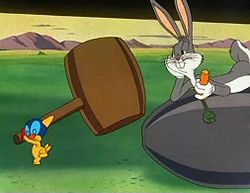
directed Falling HareFalling HareFalling Hare is a 1943 Merrie Melodies cartoon directed by Robert Clampett, starring Bugs Bunny. The title is another play on words. The word "hair" and "hare". As "falling hair" refers to impending baldness, while in this cartoon's climax, the title turns out to be descriptive of Bugs' situation....
, a Merrie MelodiesMerrie MelodiesMerrie Melodies is the name of a series of animated cartoons distributed by Warner Bros. Pictures between 1931 and 1969.Originally produced by Harman-Ising Pictures, Merrie Melodies were produced by Leon Schlesinger Productions from 1933 to 1944. Schlesinger sold his studio to Warner Bros. in 1944,...
cartoon featuring Bugs BunnyBugs BunnyBugs Bunny is a animated character created in 1938 at Leon Schlesinger Productions, later Warner Bros. Cartoons. Bugs is an anthropomorphic gray rabbit and is famous for his flippant, insouciant personality and his portrayal as a trickster. He has primarily appeared in animated cartoons, most...
. With Roald Dahl's book and Walt Disney's proposed film being the inspiration, this short has been one of the early Gremlin stories shown to cinema audiences in which multiple gremlins featured. It features Bugs Bunny in conflict with a gremlin at an airfield. The Bugs Bunny cartoon was followed in 1944 by Russian Rhapsody, another Merrie Melodies short showing Russian gremlins sabotaging an aircraft piloted by Adolf HitlerAdolf HitlerAdolf Hitler was an Austrian-born German politician and the leader of the National Socialist German Workers Party , commonly referred to as the Nazi Party). He was Chancellor of Germany from 1933 to 1945, and head of state from 1934 to 1945...
. The gremlin in "Falling Hare" even has a color scheme that reflects one that was used on U.S. Army Air Forces training aircraft of the time, using dark blue (as on such an aircraft's fuselageFuselageThe fuselage is an aircraft's main body section that holds crew and passengers or cargo. In single-engine aircraft it will usually contain an engine, although in some amphibious aircraft the single engine is mounted on a pylon attached to the fuselage which in turn is used as a floating hull...
) and a deep orange-yellow color (as used on the wings and tail surfacesEmpennageThe empennage , also known as the tail or tail assembly, of most aircraft gives stability to the aircraft, in a similar way to the feathers on an arrow...
). - 1944 also saw animated gremlins playing a role in the romantic comedy starring Simone SimonSimone SimonSimone Thérèse Fernande Simon was a French film actress who began her film career in 1931.-Early life:Born in Béthune, Pas-de-Calais France, she was the daughter of Henri Louis Firmin Champmoynat, a French engineer, airplane pilot in World War II, who died in a concentration camp, and Erma Maria...
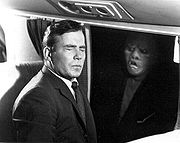
called Johnny Doesn't Live Here Any More. - A 1963 episode of The Twilight ZoneThe Twilight Zone (1959 TV series)The Twilight Zone is an American anthology television series created by Rod Serling, which ran for five seasons on CBS from 1959 to 1964. The series consisted of unrelated episodes depicting paranormal, futuristic, dystopian, or simply disturbing events; each show typically featured a surprising...
, "Nightmare at 20,000 FeetNightmare at 20,000 Feet"Nightmare at 20,000 Feet" is a 1963 episode of the American television anthology series The Twilight Zone, based on the short story of the same name by Richard Matheson.-Plot summary:...
" directed by Richard DonnerRichard DonnerRichard Donner is an American film director, film producer, and comic book writer.The production company The Donners' Company is owned by Donner and his wife, producer Lauren Shuler Donner. After directing the horror film The Omen, Donner became famous for the hailed creation of the first modern...
and based on the short story of the same name by Richard MathesonRichard MathesonRichard Burton Matheson is an American author and screenwriter, primarily in the fantasy, horror, and science fiction genres. He is perhaps best known as the author of What Dreams May Come, Bid Time Return, A Stir of Echoes, The Incredible Shrinking Man, and I Am Legend, all of which have been...
, featured a gremlin attacking an airliner. This episode was remade as a segment of Twilight Zone: The MovieTwilight Zone: The MovieTwilight Zone: The Movie is a 1983 science fiction horror film produced by Steven Spielberg and John Landis as a theatrical version of The Twilight Zone, a 1959 and '60s TV series created by Rod Serling. Those starring in the film are: Dan Aykroyd, Albert Brooks, Vic Morrow, Scatman Crothers,...
(1983). In the original television episode, the gremlin appears as an almost ape-like creature which inspects the aircraft's wing with the curiosity of an animal and then proceeds to damage the wing. William ShatnerWilliam ShatnerWilliam Alan Shatner is a Canadian actor, musician, recording artist, and author. He gained worldwide fame and became a cultural icon for his portrayal of James T...
plays a passenger, just recovered from a mental breakdown, who sees the Gremlin on the aircraft's wing. No one else sees the Gremlin and Shatner's character is removed from the aircraft on a stretcher with symptoms of psychosis. In the movie segment, the gremlin more resembles a troll or a goblin, with green skin and a frightening grin. This incarnation of the gremlin appears to be more intellectual and menacing, and is also shown to be capable of flying. The episode was famous enough to inspire numerous parodies:
-
- A gremlin makes an appearance in a Halloween specialTreehouse of Horror IV"Treehouse of Horror IV" is the fifth episode of The Simpsons fifth season and the fourth episode in the Treehouse of Horror series of Halloween specials. It originally aired on the Fox network in the United States on October 28, 1993, and features three short stories called "The Devil and Homer...
of The SimpsonsThe SimpsonsThe Simpsons is an American animated sitcom created by Matt Groening for the Fox Broadcasting Company. The series is a satirical parody of a middle class American lifestyle epitomized by its family of the same name, which consists of Homer, Marge, Bart, Lisa and Maggie...
paralleling The Twilight ZoneThe Twilight ZoneThe Twilight Zone is an American television anthology series created by Rod Serling. Each episode is a mixture of self-contained drama, psychological thriller, fantasy, science fiction, suspense, or horror, often concluding with a macabre or unexpected twist...
's "Nightmare at 20,000 FeetNightmare at 20,000 Feet"Nightmare at 20,000 Feet" is a 1963 episode of the American television anthology series The Twilight Zone, based on the short story of the same name by Richard Matheson.-Plot summary:...
", (the segment is even named "Terror at 5½ Feet") in which the gremlin attempts to destroy the wheel of Bart's school bus. - A Tiny ToonTiny Toon AdventuresSteven Spielberg Presents Tiny Toon Adventures, usually referred to as Tiny Toon Adventures or simply Tiny Toons, is an American animated television series created by Tom Ruegger and produced by Amblin Entertainment and Warner Bros. Animation. It began production as a result of Warner Bros....
special titled Night Ghoulery (a spoof of Night GalleryNight GalleryNight Gallery is an American anthology series that aired on NBC from 1970 to 1973, featuring stories of horror and the macabre. Rod Serling, who had gained fame from an earlier series, The Twilight Zone, served both as the on-air host of Night Gallery and as a major contributor of scripts, although...
, with Babs presenting in Rod Serling's style) has a segment named "Gremlin on a Wing", which parodies "Nightmare at 20,000 Feet" as well, with Plucky in William Shatner's place, accompanied by Hamton in an aircraft, and a gremlin similar to that which appeared in Bugs' short Falling Hare. In fact, this gremlin is so persistent, he even appears at the end as if he had impersonated the stewardess (who looks remarkably similar to Star TrekStar TrekStar Trek is an American science fiction entertainment franchise created by Gene Roddenberry. The core of Star Trek is its six television series: The Original Series, The Animated Series, The Next Generation, Deep Space Nine, Voyager, and Enterprise...
character Lt. UhuraUhuraNyota Uhura is a character in Star Trek: The Original Series, Star Trek: The Animated Series, the first six Star Trek films, and the 2009 film Star Trek...
). - In Madagascar 2: Escape 2 Africa, Alex has a dream where he sees Mort (Alex calls him a gremlin) messing with the engine and falling off the aircraft.
- In Ace Ventura: When Nature CallsAce Ventura: When Nature CallsAce Ventura: When Nature Calls is the sequel to Ace Ventura: Pet Detective . Jim Carrey reprises his role as the title character Ace Ventura, a detective who specializes in retrieval of tame or captive animals. This is the only sequel to a film starring Carrey in which Carrey reprised his role...
, Jim CarreyJim CarreyJames Eugene "Jim" Carrey is a Canadian-American actor and comedian. He has received two Golden Globe Awards and has also been nominated on four occasions. Carrey began comedy in 1979, performing at Yuk Yuk's in Toronto, Ontario...
's character, Ace, starts a parody gag of The Twilight ZoneThe Twilight ZoneThe Twilight Zone is an American television anthology series created by Rod Serling. Each episode is a mixture of self-contained drama, psychological thriller, fantasy, science fiction, suspense, or horror, often concluding with a macabre or unexpected twist...
's "Nightmare at 20,000 FeetNightmare at 20,000 Feet"Nightmare at 20,000 Feet" is a 1963 episode of the American television anthology series The Twilight Zone, based on the short story of the same name by Richard Matheson.-Plot summary:...
", impersonating William Shatner and insisting that 'there is something on the wing.'
- A gremlin makes an appearance in a Halloween special
- The Real GhostbustersThe Real GhostbustersThe Real Ghostbusters is an American animated television series based on the 1984 film Ghostbusters. The series ran from 1986 to 1991, and was produced by Columbia Pictures Television, DiC Enterprises, and Coca-Cola Telecommunications. "The Real" was added to the title after a dispute with...
episode Don't Forget The Motor City has the Ghostbusters traveling to Detroit to battle gremlins who are sabotaging a factory run by a fictional analog of General MotorsGeneral MotorsGeneral Motors Company , commonly known as GM, formerly incorporated as General Motors Corporation, is an American multinational automotive corporation headquartered in Detroit, Michigan and the world's second-largest automaker in 2010...
. - In Cast a Deadly SpellCast a Deadly SpellCast a Deadly Spell is a Horror/Detective HBO movie with Fred Ward, Julianne Moore, David Warner and Clancy Brown. It was directed by Martin Campbell and written by Joseph Dougherty.-Plot:...
, an HBO TV-movie from 1991, gremlins are said to have been 'brought back from the pacific' to the US in the second world war, and are seen causing car and house damage. - In the Extreme GhostbustersExtreme GhostbustersExtreme Ghostbusters is an animated television series and a follow-up to the animated series Slimer! and the Real Ghostbusters. It is a part of the film/TV Ghostbusters franchise...
episode Grease the Ghostbusters had to capture a gremlin that was damaging New York's machines, while at the same time the FBI believed them to be the cause of the sabotage, and after arresting them, they accidentally released him while on a plane. Surprisingly, the Twilight Zone episode with William Shatner is referenced. - In the Johnny BravoJohnny BravoJohnny Bravo is an American animated television series created by Van Partible for Cartoon Network. The series stars a muscular beefcake young man named Johnny Bravo who dons a pompadour hairstyle and an Elvis Presley-like voice and has a forward, woman-chasing personality...
episode The Man Who Cried Clown, which is part of The Zone Where Normal Things Don't Happen Very Often, Johnny sees an evil clown on the wing of the aircraft and is having difficulty convincing anyone of its existence. When he gets rid of the evil Jacobs, he is informed that it and a good clown were needed to keep the aircraft in balance during flight. - In the cartoon series Eek the CatEek! The CatEek! The Cat is an American and Canadian animated series, created by Savage Steve Holland and Bill Kopp and produced by Fox Kids and Savage Studios with animation by Nelvana, that ran from September 11, 1992, to August 1, 1997.-Premise:Eek! the Cat is about a purple cat named Eek whose motto is...
the episode 'The Eex Files' starts out with Eek on an aircraft beside a man claiming to see someone outside on the wing. Of course, when he looks there is no one there. At the end of the episode, Eek is dropped off by an alien on the wing of the aircraft and meets the gremlin, then promptly offers to help him "find his wallet". The final scene shows the half-crazed man looking out the window and "spazzing out" when he sees them both tearing up the wing. - In the cartoon series American Dragon Jake Long one of the episodes features gremlins who mess with any type of mechanical devices and cause a lot of trouble during the episode until they are put to sleep and captured.
- In disney's Epic MickeyEpic MickeyEpic Mickey is a 2010 Mickey Mouse action-adventure platforming video game designed by Warren Spector and developed by Junction Point Studios for the Wii console...
Gremlins assist Mickey after he releases them.
Other gremlins
Gremlin Americanus: A Scrap Book Collection of Gremlins by artist and pilot Eric Sloane may predate the Roald Dahl publication. Published in 1942 by B.F. Jay & Co, the central characters are characterized as "pixies of the air" and are friends of both RAF and USAAC pilots. The gremlins are mischievous and give pilots a great deal of trouble, but they have never been known to cause fatal accidents but can be blamed for any untoward incident or "bonehead play", qualities that endear them to all flyers.See also Ssh! Gremlins by H.W. illustrated by Ronald Niebour ("Neb" of the Daily Maily), published by H. W. John Crowther Publication, England, in 1942. This booklet featured numerous humorous illustrations describing the gremlins as whimsical but essentially friendly folk. According to "H.W.", contrary to some reports, gremlins are a universal phenomenon and by no means only the friends of flying men.
Not all depictions of gremlins show them on aircraft. Joe Dante
Joe Dante
Joseph "Joe" Dante, Jr. is an American film director and producer of films generally with humorous and science fiction content....
's 1984
1984 in film
-Events:* The Walt Disney Company founds Touchstone Pictures to release movies with subject matter deemed inappropriate for the Disney name.* Tri-Star Pictures, a joint venture of Columbia Pictures, HBO, and CBS, releases its first film....
movie Gremlins
Gremlins
Gremlins is a 1984 American horror comedy film directed by Joe Dante, released by Warner Bros. The film is about a young man who receives a strange creature—called a Mogwai—as a pet, which then spawns other creatures who transform into small, destructive, evil monsters. It was followed by a sequel,...
and its sequel
Sequel
A sequel is a narrative, documental, or other work of literature, film, theatre, or music that continues the story of or expands upon issues presented in some previous work...
, Gremlins 2: The New Batch
Gremlins 2: The New Batch
Gremlins 2: The New Batch is a 1990 American horror comedy film, and the sequel to Gremlins . It was directed by Joe Dante and written by Charles S. Haas, with creature designs by Rick Baker...
portray gremlins as malicious creatures whose only goal is to wreak havoc, whether in a small town or in a New York City
New York City
New York is the most populous city in the United States and the center of the New York Metropolitan Area, one of the most populous metropolitan areas in the world. New York exerts a significant impact upon global commerce, finance, media, art, fashion, research, technology, education, and...
skyscraper.
DC Comics
DC Comics
DC Comics, Inc. is one of the largest and most successful companies operating in the market for American comic books and related media. It is the publishing unit of DC Entertainment a company of Warner Bros. Entertainment, which itself is owned by Time Warner...
' Stanley and His Monster
Stanley and His Monster
Stanley and His Monster was an American comic-book humor feature and later series from DC Comics, about a boy who has a monster as his companion instead of a dog. Created by writer Arnold Drake and artist Winslow Mortimer as a backup feature the funny-animal comic The Fox and the Crow #95 Stanley...
depicts a gremlin named Schnitzel, who speaks with a thick German accent and is always trying to avoid an immigration officer, as he is an illegal alien.
American Motors
American Motors
American Motors Corporation was an American automobile company formed by the 1954 merger of Nash-Kelvinator Corporation and Hudson Motor Car Company. At the time, it was the largest corporate merger in U.S. history.George W...
produced a vehicle called the Gremlin
AMC Gremlin
The AMC Gremlin is a two-door subcompact car produced in the United States and Canada by the American Motors Corporation between 1970 and 1978. AMC reduced its development and manufacturing costs by adapting a shortened Hornet platform with a Kammback-type tail...
between 1970 and 1978. A cartoon styled Gremlin icon was featured in advertisements as well as on the cars' gas caps.
Gremlin Trouble Comics were published between 1995 and 2005 by Anti-Ballistic Pixelations. In the 32 issue independent comic, Gremlins were machine spirits generally ambivalent to humans. They would, however work with and help a human they liked. The protagonist was a Storm Fairy who had lost her wings and was subsequently turned into a Gremlin Princess.
Kilroy
Kilroy
- People :* Alix Kilroy , one of the first two women to have entered the administrative grade of the British Civil Service by examination* Bucko Kilroy , American football player and executive with the New England Patriots...
the famous piece of graffiti
Graffiti
Graffiti is the name for images or lettering scratched, scrawled, painted or marked in any manner on property....
was identified in Australia
Australia
Australia , officially the Commonwealth of Australia, is a country in the Southern Hemisphere comprising the mainland of the Australian continent, the island of Tasmania, and numerous smaller islands in the Indian and Pacific Oceans. It is the world's sixth-largest country by total area...
as a gremlin.
See also
- Femlins, female gremlins featured in Playboy magazine
- FifinellaFifinellaFifinella was a female gremlin designed by Walt Disney for a proposed film from Roald Dahl's book The Gremlins. During World War II, the Women Airforce Service Pilots asked permission to use the image as their official mascot, and the Disney Company granted them the rights.-Origins:The story of...
- Froggy the GremlinFroggy the GremlinFroggy the Gremlin was a character on the Smilin' Ed's Gang radio and TV show and later Andy's Gang TV show in the 1940s and 1950s.Froggy was a troublemaker on the shows...
, a character on an American TV show in the 1950s - Gremlin Graphics, the now defunct video games studio
- GremlinsGremlinsGremlins is a 1984 American horror comedy film directed by Joe Dante, released by Warner Bros. The film is about a young man who receives a strange creature—called a Mogwai—as a pet, which then spawns other creatures who transform into small, destructive, evil monsters. It was followed by a sequel,...
- Machine ElfMachine elfMachine elves is a term coined by the late ethnobotanist, writer and philosopher Terence McKenna to describe the apparent entities that are often reported by individuals using tryptamine-based psychedelic drugs, especially DMT...
External links
- A longer article examining the Gremlin's origins
- The Inducks' list of Gremlin appearances in Disney comics
- More Info on the Dark Horse reprint of Disney and Dahl's Gremlins book
- The Crooked Gremlins (webcomic)
----