
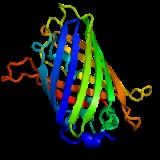
The
green fluorescent protein (
GFP) is a
proteinProteins are biochemical compounds consisting of one or more polypeptides typically folded into a globular or fibrous form, facilitating a biological function. A polypeptide is a single linear polymer chain of amino acids bonded together by peptide bonds between the carboxyl and amino groups of...
composed of 238
amino acidAmino acids are molecules containing an amine group, a carboxylic acid group and a side-chain that varies between different amino acids. The key elements of an amino acid are carbon, hydrogen, oxygen, and nitrogen...
residues (26.9
kDaThe unified atomic mass unit or dalton is a unit that is used for indicating mass on an atomic or molecular scale. It is defined as one twelfth of the rest mass of an unbound neutral atom of carbon-12 in its nuclear and electronic ground state, and has a value of...
) that exhibits bright green
fluorescenceFluorescence is the emission of light by a substance that has absorbed light or other electromagnetic radiation of a different wavelength. It is a form of luminescence. In most cases, emitted light has a longer wavelength, and therefore lower energy, than the absorbed radiation...
when exposed to blue light. Although many other marine organisms have similar green fluorescent proteins, GFP traditionally refers to the protein first isolated from the
jellyfishJellyfish are free-swimming members of the phylum Cnidaria. Medusa is another word for jellyfish, and refers to any free-swimming jellyfish stages in the phylum Cnidaria...
Aequorea victoriaAequorea victoria, also sometimes called the crystal jelly, is a bioluminescent hydrozoan jellyfish, or hydromedusa, that is found off the west coast of North America. This species is thought to be synonymous with Aequorea aequorea of Osamu Shimomura, the discoverer of green fluorescent protein . ...
. The GFP from
A. victoria has a major
excitation peakFluorescence spectroscopy aka fluorometry or spectrofluorometry, is a type of electromagnetic spectroscopy which analyzes fluorescence from a sample. It involves using a beam of light, usually ultraviolet light, that excites the electrons in molecules of certain compounds and causes them to emit...
at a
wavelengthIn physics, the wavelength of a sinusoidal wave is the spatial period of the wave—the distance over which the wave's shape repeats.It is usually determined by considering the distance between consecutive corresponding points of the same phase, such as crests, troughs, or zero crossings, and is a...
of 395 nm and a minor one at 475 nm. Its emission peak is at 509 nm, which is in the lower green portion of the
visible spectrumThe visible spectrum is the portion of the electromagnetic spectrum that is visible to the human eye. Electromagnetic radiation in this range of wavelengths is called visible light or simply light. A typical human eye will respond to wavelengths from about 390 to 750 nm. In terms of...
. The fluorescence
quantum yieldThe quantum yield of a radiation-induced process is the number of times that a defined event occurs per photon absorbed by the system. The "event" may represent a chemical reaction, for example the decomposition of a reactant molecule:...
(QY) of GFP is 0.79. The GFP from the
sea pansyThe Sea pansy is quite frequently found washed ashore on northeast Florida beaches following northeasterly winds or rough surf conditions. It also can often be found living intertidally completely buried in the sand. Its predator is the striped sea slug, Armina tigrina.The Sea pansy is a...
(
Renilla reniformis) has a single major excitation peak at 498 nm. In
cellCell biology is a scientific discipline that studies cells – their physiological properties, their structure, the organelles they contain, interactions with their environment, their life cycle, division and death. This is done both on a microscopic and molecular level...
and
molecular biologyMolecular biology is the branch of biology that deals with the molecular basis of biological activity. This field overlaps with other areas of biology and chemistry, particularly genetics and biochemistry...
, the GFP
geneA gene is a molecular unit of heredity of a living organism. It is a name given to some stretches of DNA and RNA that code for a type of protein or for an RNA chain that has a function in the organism. Living beings depend on genes, as they specify all proteins and functional RNA chains...
is frequently used as a
reporter of expressionIn molecular biology, a reporter gene is a gene that researchers attach to a regulatory sequence of another gene of interest in cell culture, animals or plants. Certain genes are chosen as reporters because the characteristics they confer on organisms expressing them are easily identified and...
. In modified forms it has been used to make
biosensorA biosensor is an analytical device for the detection of an analyte that combines a biological component with a physicochemical detector component.It consists of 3 parts:* the sensitive biological element A biosensor is an analytical device for the detection of an analyte that combines a biological...
s, and many animals have been created that express GFP as a proof-of-concept that a gene can be expressed throughout a given organism. The GFP gene can be introduced into organisms and maintained in their genome through breeding, injection with a
viral vectorViral vectors are a tool commonly used by molecular biologists to deliver genetic material into cells. This process can be performed inside a living organism or in cell culture . Viruses have evolved specialized molecular mechanisms to efficiently transport their genomes inside the cells they infect...
, or cell transformation. To date, the GFP gene has been introduced and expressed in many bacteria, yeast and other fungi, fish (such as zebrafish), plant, fly, and mammalian cells, including human.
Martin ChalfieMartin Chalfie is an American scientist. He is the William R. Kenan, Jr. Professor of Biological Sciences at Columbia University, where he is also chair of the department of biological sciences. He shared the 2008 Nobel Prize in Chemistry along with Osamu Shimomura and Roger Y. Tsien "for the...
,
Osamu Shimomurais a Japanese organic chemist and marine biologist, and Professor Emeritus at Marine Biological Laboratory in Woods Hole, Massachusetts and Boston University Medical School...
, and
Roger Y. TsienRoger Yonchien Tsien is a Chinese American biochemist and a professor at the Department of Chemistry and Biochemistry, University of California, San Diego...
were awarded the 2008
Nobel Prize in ChemistryThe Nobel Prize in Chemistry is awarded annually by the Royal Swedish Academy of Sciences to scientists in the various fields of chemistry. It is one of the five Nobel Prizes established by the will of Alfred Nobel in 1895, awarded for outstanding contributions in chemistry, physics, literature,...
on 10 October 2008 for their discovery and development of the green fluorescent protein.
Wild-type GFP (wtGFP)
In the 1960s and 1970s, GFP, along with the separate luminescent protein
aequorinAequorin is a photoprotein isolated from luminescent jellyfish and a variety of other marine organisms...
, was first purified from
Aequorea victoria and its properties studied by
Osamu Shimomurais a Japanese organic chemist and marine biologist, and Professor Emeritus at Marine Biological Laboratory in Woods Hole, Massachusetts and Boston University Medical School...
. In
A. victoria, GFP fluorescence occurs when
aequorinAequorin is a photoprotein isolated from luminescent jellyfish and a variety of other marine organisms...
interacts with
Ca2+Calcium is the chemical element with the symbol Ca and atomic number 20. It has an atomic mass of 40.078 amu. Calcium is a soft gray alkaline earth metal, and is the fifth-most-abundant element by mass in the Earth's crust...
ions, inducing a blue glow. Some of this luminescent energy is transferred to the GFP, shifting the overall color towards green. However, its utility as a tool for molecular biologists did not begin to be realized until 1992 when
Douglas PrasherDouglas C. Prasher is an American molecular biologist. He is known for his work to clone and sequence the gene for green fluorescent protein and for his proposal to use GFP as a tracer molecule.-Career:...
reported the cloning and nucleotide sequence of wtGFP in
Gene. The funding for this project had run out, so Prasher sent cDNA samples to several labs. The lab of
Martin ChalfieMartin Chalfie is an American scientist. He is the William R. Kenan, Jr. Professor of Biological Sciences at Columbia University, where he is also chair of the department of biological sciences. He shared the 2008 Nobel Prize in Chemistry along with Osamu Shimomura and Roger Y. Tsien "for the...
expressed the coding sequence of wtGFP, with the first few amino acids deleted, in heterologous cells of
E. coli and
C. elegansCaenorhabditis elegans is a free-living, transparent nematode , about 1 mm in length, which lives in temperate soil environments. Research into the molecular and developmental biology of C. elegans was begun in 1974 by Sydney Brenner and it has since been used extensively as a model...
, publishing the results in
Science in 1994. Frederick Tsuji's lab independently reported the expression of the recombinant protein one month later. Remarkably, the GFP molecule folded and was fluorescent at room temperature, without the need for exogenous cofactors specific to the jellyfish. Although this near-wtGFP was fluorescent, it had several drawbacks, including dual peaked excitation spectra, pH sensitivity, chloride sensitivity, poor fluorescence quantum yield, poor photostability and poor folding at 37°C.
The first reported crystal structure of a GFP was that of the S65T mutant by the Remington group in
Science in 1996. One month later, the Phillips group independently reported the wild-type GFP structure in
Nature Biotech. These crystal structures provided vital background on
chromophoreA chromophore is the part of a molecule responsible for its color. The color arises when a molecule absorbs certain wavelengths of visible light and transmits or reflects others. The chromophore is a region in the molecule where the energy difference between two different molecular orbitals falls...
formation and neighboring residue interactions. Researchers have modified these residues by directed and random mutagenesis to produce the wide variety of GFP derivatives in use today.
Martin ChalfieMartin Chalfie is an American scientist. He is the William R. Kenan, Jr. Professor of Biological Sciences at Columbia University, where he is also chair of the department of biological sciences. He shared the 2008 Nobel Prize in Chemistry along with Osamu Shimomura and Roger Y. Tsien "for the...
,
Osamu Shimomurais a Japanese organic chemist and marine biologist, and Professor Emeritus at Marine Biological Laboratory in Woods Hole, Massachusetts and Boston University Medical School...
and
Roger Y. TsienRoger Yonchien Tsien is a Chinese American biochemist and a professor at the Department of Chemistry and Biochemistry, University of California, San Diego...
share the 2008
Nobel Prize in ChemistryThe Nobel Prize in Chemistry is awarded annually by the Royal Swedish Academy of Sciences to scientists in the various fields of chemistry. It is one of the five Nobel Prizes established by the will of Alfred Nobel in 1895, awarded for outstanding contributions in chemistry, physics, literature,...
for their discovery and development of the green fluorescent protein.
GFP derivatives
Due to the potential for widespread usage and the evolving needs of researchers, many different mutants of GFP have been engineered. The first major improvement was a single point mutation (S65T) reported in 1995 in
Nature by
Roger TsienRoger Yonchien Tsien is a Chinese American biochemist and a professor at the Department of Chemistry and Biochemistry, University of California, San Diego...
. This mutation dramatically improved the spectral characteristics of GFP, resulting in increased fluorescence, photostability, and a shift of the major excitation peak to 488 nm, with the peak emission kept at 509 nm. This matched the spectral characteristics of commonly available
FITCFluorescein is a synthetic organic compound available as a dark orange/red powder soluble in water and alcohol. It is widely used as a fluorescent tracer for many applications....
filter sets, increasing the practicality of use by the general researcher. A 37 °C folding efficiency (F64L) point mutant to this scaffold yielding enhanced GFP (EGFP) was discovered in 1995 by the lab of Ole Thastrup. EGFP allowed the practical use of GFPs in mammalian cells. EGFP has an extinction coefficient (denoted ε) of 55,000 M
−1cm
−1. The fluorescence quantum yield (QY) of EGFP is 0.60. The relative brightness, expressed as ε•QY, is 33,000 M
−1cm
−1.
Superfolder GFP, a series of mutations that allow GFP to rapidly fold and mature even when fused to poorly folding peptides, was reported in 2006.
Many other mutations have been made, including color mutants; in particular, blue fluorescent protein (EBFP, EBFP2, Azurite, mKalama1), cyan fluorescent protein (ECFP, Cerulean, CyPet), and
yellow fluorescent proteinYellow Fluorescent Protein is a genetic mutant of green fluorescent protein, derived from Aequorea victoria. Its excitation peak is 514nm and its emission peak is 527nm....
derivatives (YFP, Citrine, Venus, YPet). BFP derivatives (except mKalama1) contain the Y66H substitution. The critical mutation in cyan derivatives is the Y66W substitution, which causes the chromophore to form with an indole rather than phenol component. Several additional compensatory mutations in the surrounding barrel are required to restore brightness to this modified chromophore due to the increased bulk of the indole group. The red-shifted wavelength of the YFP derivatives is accomplished by the T203Y mutation and is due to π-electron stacking interactions between the substituted tyrosine residue and the chromophore. These two classes of spectral variants are often employed for Förster resonance energy transfer (FRET) experiments. Genetically-encoded FRET reporters sensitive to cell signaling molecules, such as calcium or glutamate, protein phosphorylation state, protein complementation, receptor dimerization, and other processes provide highly specific optical readouts of cell activity in real time.
Semirational mutagenesis of a number of residues led to pH-sensitive mutants known as pHluorins, and later super-ecliptic pHluorins. By exploiting the rapid change in pH upon synaptic vesicle fusion, pHluorins tagged to
synaptobrevinSynaptobrevins are small integral membrane proteins of secretory vesicles with molecular weight of 18 kilodalton that are part of the vesicle-associated membrane protein family....
have been used to visualize synaptic activity in neurons.
Redox sensitive versions of GFP (
roGFPThe reduction-oxidation sensitive green fluorescent protein is a redox sensitive biosensor. Two cysteines were introduced into the beta barrel structure of the GFP, the oxidation state of the engineered thiols determines the fluorescence properties of the sensor...
) were engineered by introduction of cysteines into the beta barrel structure. The
redoxRedox reactions describe all chemical reactions in which atoms have their oxidation state changed....
state of the cysteines determines the fluorescent properties of
roGFPThe reduction-oxidation sensitive green fluorescent protein is a redox sensitive biosensor. Two cysteines were introduced into the beta barrel structure of the GFP, the oxidation state of the engineered thiols determines the fluorescence properties of the sensor...
.
The nomenclature of modified GFPs is often confusing due to overlapping mapping of several GFP versions onto a single name. For example,
mGFP often refers to a GFP with an N-terminal
palmitoylationS-Palmitoylation is the covalent attachment of fatty acids, such as palmitic acid, to cysteine residues of membrane proteins. The precise function of palmitoylation depends on the particular protein being considered. Palmitoylation enhances the hydrophobicity of proteins and contributes to their...
that causes the GFP to bind to
cell membraneThe cell membrane or plasma membrane is a biological membrane that separates the interior of all cells from the outside environment. The cell membrane is selectively permeable to ions and organic molecules and controls the movement of substances in and out of cells. It basically protects the cell...
s. However, the same term is also used to refer to
monomerA monomer is an atom or a small molecule that may bind chemically to other monomers to form a polymer; the term "monomeric protein" may also be used to describe one of the proteins making up a multiprotein complex...
ic GFP, which is often achieved by the dimer interface breaking A206K mutation. Wild-type GFP has a weak
dimerIn biochemistry, a dimer is a macromolecular complex formed by two, usually non-covalently bound, macromolecules like proteins or nucleic acids...
ization tendency at concentrations above 5 mg/mL. mGFP also stands for "modified GFP," which has been optimized through amino acid exchange for stable expression in plant cells.
Structure
GFP has a typical
beta barrelA beta barrel is a large beta-sheet that twists and coils to form a closed structure in which the first strand is hydrogen bonded to the last.Beta-strands in beta-barrels are typically arranged in an antiparallel fashion...
structure, consisting of one β-sheet with alpha helix(s) containing the covalently bonded
chromophoreA chromophore is the part of a molecule responsible for its color. The color arises when a molecule absorbs certain wavelengths of visible light and transmits or reflects others. The chromophore is a region in the molecule where the energy difference between two different molecular orbitals falls...
4-(p-hydroxybenzylidene)imidazolidin-5-one (HBI) running through the center. HBI is nonfluorescent in the absence of the properly folded GFP scaffold and exists mainly in the unionized phenol form in wtGFP. Inward-facing sidechains of the barrel induce specific cyclization reactions in the tripeptide Ser65–Tyr66–Gly67 that induce ionization of HBI to the phenolate form and
chromophoreA chromophore is the part of a molecule responsible for its color. The color arises when a molecule absorbs certain wavelengths of visible light and transmits or reflects others. The chromophore is a region in the molecule where the energy difference between two different molecular orbitals falls...
formation. This process of post-translational modification is referred to as
maturation. The hydrogen-bonding network and electron-stacking interactions with these sidechains influence the color, intensity and photostability of GFP and its numerous derivatives. The tightly packed nature of the barrel excludes solvent molecules, protecting the
chromophoreA chromophore is the part of a molecule responsible for its color. The color arises when a molecule absorbs certain wavelengths of visible light and transmits or reflects others. The chromophore is a region in the molecule where the energy difference between two different molecular orbitals falls...
fluorescence from quenching by water.
Use
The availability of GFP and its derivatives has thoroughly redefined fluorescence microscopy and the way it is used in cell biology and other biological disciplines. While most small fluorescent molecules such as
FITCFluorescein is a synthetic organic compound available as a dark orange/red powder soluble in water and alcohol. It is widely used as a fluorescent tracer for many applications....
(fluorescein isothiocyanate) are strongly
phototoxicPhototoxicity is a chemically induced skin irritation requiring light . The skin response resembles an exaggerated sunburn. The involved chemical may enter into the skin by topical administration or it may reach the skin via systemic circulation following ingestion or parenteral administration...
when used in live cells, fluorescent proteins such as GFP are usually much less harmful when illuminated in living cells. This has triggered the development of highly automated live-cell fluorescence microscopy systems, which can be used to observe cells over time expressing one or more proteins tagged with fluorescent proteins. For example, GFP had been widely used in labelling the
spermatozoaA spermatozoon is a motile sperm cell, or moving form of the haploid cell that is the male gamete. A spermatozoon joins an ovum to form a zygote...
of various organisms for identification purposes as in
Drosophila melanogasterDrosophila melanogaster is a species of Diptera, or the order of flies, in the family Drosophilidae. The species is known generally as the common fruit fly or vinegar fly. Starting from Charles W...
, where expression of GFP can be used as a marker for a particular characteristic. GFP can also be expressed in different structures enabling morphological distinction. In such cases, the gene for the production of GFP is spliced into the genome of the organism in the region of the DNA that codes for the target proteins and that is controlled by the same
regulatory sequenceA regulatory sequence is a segment of DNA where regulatory proteins such as transcription factors bind preferentially. These regulatory proteins bind to short stretches of DNA called regulatory regions, which are appropriately positioned in the genome, usually a short distance 'upstream' of the...
; that is, the gene's regulatory sequence now controls the production of GFP, in addition to the tagged protein(s). In cells where the gene is expressed, and the tagged proteins are produced, GFP is produced at the same time. Thus, only those cells in which the tagged gene is expressed, or the target proteins are produced, will fluoresce when observed under fluorescence microscopy. Analysis of such time lapse movies has redefined the understanding of many biological processes including protein folding, protein transport, and RNA dynamics, which in the past had been studied using fixed (i.e., dead) material.
The
Vertico SMIVertico-SMI is currently the fastest light microscope for the 3D analysis of complete cells in the nanometer range. It is based on two technologies developed in 1996, SMI and SPDM...
microscope using the SPDM Phymod technology uses the so-called "reversible photobleaching" effect of fluorescent dyes like GFP and its derivatives to localize them as single molecules in an optical resolution of 10 nm. This can also be performed as a co-localization of two GFP derivatives (2CLM).
Another powerful use of GFP is to express the protein in small sets of specific cells. This allows researchers to optically detect specific types of cells
in vitroIn vitro refers to studies in experimental biology that are conducted using components of an organism that have been isolated from their usual biological context in order to permit a more detailed or more convenient analysis than can be done with whole organisms. Colloquially, these experiments...
(in a dish), or even
in vivoIn vivo is experimentation using a whole, living organism as opposed to a partial or dead organism, or an in vitro controlled environment. Animal testing and clinical trials are two forms of in vivo research...
(in the living organism). Genetically combining several spectral variants of GFP is a useful trick for the analysis of brain circuitry (
BrainbowBrainbow is a term used to describe the process by which individual neurons in the brain can be distinguished from neighboring neurons using fluorescent proteins. By randomly expressing different ratios of red, green, and blue derivatives of green fluorescent protein in individual neurons, it is...
). Other interesting uses of fluorescent proteins in the literature include using FPs as sensors of
neuronA neuron is an electrically excitable cell that processes and transmits information by electrical and chemical signaling. Chemical signaling occurs via synapses, specialized connections with other cells. Neurons connect to each other to form networks. Neurons are the core components of the nervous...
membrane potentialMembrane potential is the difference in electrical potential between the interior and exterior of a biological cell. All animal cells are surrounded by a plasma membrane composed of a lipid bilayer with a variety of types of proteins embedded in it...
, tracking of
AMPAAMPA is a compound that is a specific agonist for the AMPA receptor, where it mimics the effects of the neurotransmitter glutamate....
receptors on cell membranes,
viral entryViral entry is the earliest stage of infection in the viral life cycle, as the virus comes into contact with the host cell and introduces viral material into the cell. The major steps involved in viral entry are shown below. Despite the variation among viruses, the generalities are quite similar...
and the infection of individual
influenzaInfluenza, commonly referred to as the flu, is an infectious disease caused by RNA viruses of the family Orthomyxoviridae , that affects birds and mammals...
viruses and lentiviral viruses, etc.
It has also been found that new lines of transgenic GFP rats can be relevant for gene therapy as well as regenerative medicine. By using "high-expresser" GFP, transgenic rats display high expression in most tissues, and many cells that have not been characterized or have been only poorly characterized in previous GFP-transgenic rats. Through its ability to form internal chromophore without requiring accessory cofactors, enzymes or substrates other than molecular oxygen, GFP makes for an excellent tool in all forms of biology.
GFP has been shown to be useful in
cryobiologyCryobiology is the branch of biology that studies the effects of low temperatures on living things. The word cryobiology is derived from the Greek words "cryo" = cold, "bios" = life, and "logos" = science. In practice, cryobiology is the study of biological material or systems at temperatures below...
as a
viability assayA viability assay is an assay to determine the ability of cells or tissues to maintain or recover its viability. For example, examining the ratio of potassium to sodium in cells indicates viability because if cells do not have high intracellular potassium and low intracellular sodium: the...
. Correlation of viability as measured by
trypan blueTrypan blue is a vital stain used to selectively colour dead tissues or cells blue. It is a diazo dye.Live cells or tissues with intact cell membranes are not coloured. Since cells are very selective in the compounds that pass through the membrane, in a viable cell trypan blue is not absorbed;...
assays were 0.97.
A novel possible use of GFP includes using it as a sensitive monitor of intracellular processes via an eGFP laser system made out of a human embryonic kidney cell line. The first engineered living laser is made by an eGFP expressing cell inside a reflective optical cavity and hitting it with pulses of blue light. At a certain pulse threshold, the eGFP’s optical output becomes brighter and completely uniform in color of pure green with a wavelength of 516 nm. Before being emitted as laser light, the light bounces back and forth within the resonator cavity and passes the cell numerous times. By studying the changes in optical activity, researchers may better understand cellular processes.
GFP in nature
The purpose of both
bioluminescenceBioluminescence is the production and emission of light by a living organism. Its name is a hybrid word, originating from the Greek bios for "living" and the Latin lumen "light". Bioluminescence is a naturally occurring form of chemiluminescence where energy is released by a chemical reaction in...
and GFP
fluorescenceFluorescence is the emission of light by a substance that has absorbed light or other electromagnetic radiation of a different wavelength. It is a form of luminescence. In most cases, emitted light has a longer wavelength, and therefore lower energy, than the absorbed radiation...
in jellyfish is unknown. GFP is co-expressed with
aequorinAequorin is a photoprotein isolated from luminescent jellyfish and a variety of other marine organisms...
in small granules around the rim of the jellyfish bell. The secondary excitation peak (480 nm) of GFP does absorb some of the blue emission of
aequorinAequorin is a photoprotein isolated from luminescent jellyfish and a variety of other marine organisms...
, giving the
bioluminescenceBioluminescence is the production and emission of light by a living organism. Its name is a hybrid word, originating from the Greek bios for "living" and the Latin lumen "light". Bioluminescence is a naturally occurring form of chemiluminescence where energy is released by a chemical reaction in...
a more green hue. The serine 65 residue of the GFP
chromophoreA chromophore is the part of a molecule responsible for its color. The color arises when a molecule absorbs certain wavelengths of visible light and transmits or reflects others. The chromophore is a region in the molecule where the energy difference between two different molecular orbitals falls...
is responsible for the dual-peaked excitation spectra of wild-type GFP. It is conserved in all three GFP isoforms originally cloned by Prasher. Nearly all mutations of this residue consolidate the excitation spectra to a single peak at either 395 nm or 480 nm. The precise mechanism of this sensitivity is complex, but, it seems, involves donation of a hydrogen from serine 65 to glutamate 222, which influences chromophore ionization. Since a single mutation can dramatically enhance the 480 nm excitation peak, making GFP a much more efficient partner of aequorin,
A. victoria appears to evolutionarily prefer the less-efficient, dual-peaked excitation spectrum. Roger Tsien has speculated that varying hydrostatic pressure with depth may effect serine 65's ability to donate a hydrogen to the chromophore and shift the ratio of the two excitation peaks. Thus, the jellyfish may change the color of its bioluminescence with depth. However, a collapse in the population of jellyfish in
Friday HarborFriday Harbor is a town in San Juan County, Washington, United States. The population was 2,162 at 2010 Census. Located on San Juan Island, Friday Harbor is the major commercial center of the San Juan Islands archipelago and is the county seat of San Juan County.-History:In 1845 the Hudson's Bay...
, where GFP was originally discovered, has hampered further study of the role of GFP in the jellyfish's natural environment.
GFP in fine art
Julian Voss-AndreaeJulian Voss-Andreae is a German sculptor living and working in the U.S.Voss-Andreae started out as a painter and later studied experimental physics at the universities of Berlin, Edinburgh and Vienna...
, a German-born artist specializing in "protein sculptures," created sculptures based on the structure of GFP, including the 5'6" (1.70 m) tall "Green Fluorescent Protein" (2004) and the 4'7" (1.40 m) tall "Steel Jellyfish" (2006). The latter sculpture is located at the place of GFP's discovery by
Shimomurais a Japanese organic chemist and marine biologist, and Professor Emeritus at Marine Biological Laboratory in Woods Hole, Massachusetts and Boston University Medical School...
in 1962, the
University of WashingtonUniversity of Washington is a public research university, founded in 1861 in Seattle, Washington, United States. The UW is the largest university in the Northwest and the oldest public university on the West Coast. The university has three campuses, with its largest campus in the University...
's
Friday Harbor LaboratoriesFriday Harbor Laboratories , is a marine biology field station of the University of Washington, located in Friday Harbor, San Juan Island, Washington, USA. FHL was founded in 1904 by University of Washington Zoology Professor Trevor Kincaid...
.
Transgenic pets
AlbaAlba was the name of a genetically modified "glowing" rabbit created as an artistic work by contemporary artist Eduardo Kac based on one of the experiments with rabbits led by French geneticist Louis-Marie Houdebine....
, a green-fluorescent rabbit, was created by a French laboratory commissioned by
Eduardo KacEduardo Kac is an American contemporary artist internationally recognized for his interactive net installations and his bio-art. Kac was born in 1962, in Rio de Janeiro, Brazil. He lives and works in Chicago....
using GFP for purposes of art and social commentary. The US company Yorktown Technologies markets to aquarium shops green fluorescent zebrafish (
GloFishThe GloFish is a patented and trademarked brand of genetically modified fluorescent zebrafish with bright red, green, orange-yellow, blue, and purple fluorescent colors...
) that were initially developed to detect pollution in waterways. NeonPets, a US based company markets green fluorescent mice to the pet industry as NeonMice. Green fluorescent pigs, known as Noels, were bred by a group of researchers led by Wu Shinn-Chih at the Department of Animal Science and Technology at
National Taiwan UniversityNational Taiwan University is a national co-educational university located in Taipei, Republic of China . In Taiwan, it is colloquially known as "Táidà" . Its main campus is set upon 1,086,167 square meters in Taipei's Da'an District. In addition, the university has 6 other campuses in Taiwan,...
. A Japanese-American Team created green-fluorescent cats as proof of concept to use them potentially as model organisms for diseases, particularly
HIVHuman immunodeficiency virus is a lentivirus that causes acquired immunodeficiency syndrome , a condition in humans in which progressive failure of the immune system allows life-threatening opportunistic infections and cancers to thrive...
.
External links
- Video: Roger Tsien Gives Nobel Lecture at UC San Diego
- A comprehensive article on fluorescent proteins at Scholarpedia
- Introduction to fluorescent proteins
- History, uses, and structure of GFP
- Brief summary of landmark GFP papers
- Interactive Java applet demonstrating the chemistry behind the formation of the GFP chromophore
- Tsien Lab @ UCSD
- Video of 2008 Nobel Prize lecture of Roger Tsien on fluorescent proteins
- Excitation and emission spectra for various fluorescent proteins
- Timeline
- Some factoids about Aequorea, the jellyfish source of GFP
- Video introduction to GFP, from the "Secrets of the Sequence" educational video series
- Green Fluorescent Protein Chem Soc Rev themed issue dedicated to the 2008 Nobel Prize winners in Chemistry, Professors Osamu Shimomura
is a Japanese organic chemist and marine biologist, and Professor Emeritus at Marine Biological Laboratory in Woods Hole, Massachusetts and Boston University Medical School...
, Martin ChalfieMartin Chalfie is an American scientist. He is the William R. Kenan, Jr. Professor of Biological Sciences at Columbia University, where he is also chair of the department of biological sciences. He shared the 2008 Nobel Prize in Chemistry along with Osamu Shimomura and Roger Y. Tsien "for the...
and Roger Y. TsienRoger Yonchien Tsien is a Chinese American biochemist and a professor at the Department of Chemistry and Biochemistry, University of California, San Diego...