


Greek Cypriots

Encyclopedia
Greek Cypriots are the ethnic Greek
population of Cyprus
, forming the island's largest ethnolinguistic
community at 77% of the population. Greek Cypriots are mostly members of the Church of Cyprus, an autocephalous
Greek Orthodox Church
within the wider communion of Orthodox Christianity
. In regards to the 1960 Constitution of Cyprus
, the term also includes Arabic
-speaking Maronites
, Armenians
and Latin Rite Catholics
("Latins"), who were given the option of being included in one or other of the two constituent communities (Greek or Turkish
) and voted to join the Greek Cypriot community.
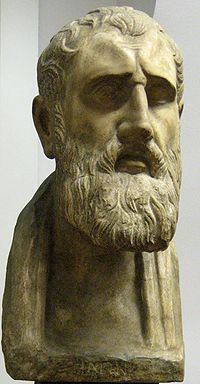
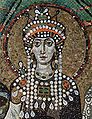
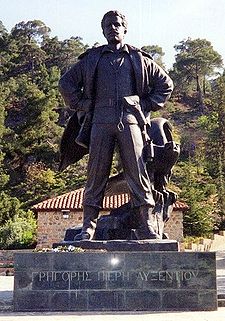 The Greek Cypriots trace their origins to the descendants of the Mycenaean
Greeks who settled on the island during the second half of the second millennium BC. Cyprus is the third largest island in the Mediterranean after Sicily
and Sardinia
, and the largest island in the eastern Mediterranean. Mount Olympus
(also known as Chionistra), the highest point of the Troodos Mountains (1952 m), is the highest point on the island. The island gradually became part of the Hellenic
world as the settlers prospered over the next centuries. Alexander the Great liberated the island from the Persians in 333 BC. After the division of the Roman Empire
in 285 AD, Cypriots enjoyed home rule for almost nine centuries under the jurisdiction of the Byzantine Empire
, something not seen again until 1960. Perhaps the most important event of the early Byzantine period was the local church's independence from the Patriarchate of Antioch and All the East in 431. The bishop of the ancient capital Salamis
(renamed Constantia by Emperor Constantius II
) was constituted metropolitan
by Emperor Zeno
, with the title archbishop
.
The Byzantine era profoundly molded Greek Cypriot culture. The Greek Orthodox Christian legacy bestowed on Greek Cypriots in this period would live on during the succeeding centuries of foreign domination. Because Cyprus was never the final goal of any external ambition, but simply fell under the domination of whichever power was dominant in the eastern Mediterranean, destroying its civilization was never a military objective or necessity.
The Cypriots did however endure the oppressive rule of first the Lusignans and then the Venetians
from the 1190s through to 1570. King Amaury
, who succeeded his brother Guy de Lusignan
in 1194, was particularly intolerant of the Orthodox Church. Greek Cypriot land was appropriated for the Latin churches after they were established in the major towns on the island. In addition, tax collection was also part of the heavy oppressive attitude of the occupiers to the locals of the island, in that it was now being conducted by the Latin churches themselves.
The Ottoman
conquest of Cyprus in 1571 delivered the Greek population from serfdom and servitude to the Latin church. Cypriot Greeks were now able to take control of the land they had been working on for centuries. The local Christians resumed practicing their religion in the only acceptable way they knew. The patriarch serving the Ottoman sultan also acted as ethnarch
, or leader of the Greek nation, thus enabling the local Orthodox representative to practice decidedly secular powers, for instance in adjudicating justice and in the collection of taxes.
Despite the inherent oppression of foreign subjugation, the period of Ottoman rule
(1570-1878) had a limited impact on Greek Cypriot culture. The Ottomans tended to administer their multicultural empire with the help of their subject millet
s, or religious communities. The tolerance of the millet system permitted the Greek Cypriot community to survive, administered on behalf of Constantinople
by the Archbishop of the Church of Cyprus, who became the community's head, or ethnarch. Although religiously tolerant, Ottoman rule was generally harsh and inefficient. Turkish
settlers suffered alongside their Greek Cypriot neighbors, and the two groups together endured centuries of oppressive governance from Constantinople
. A minority of Greek Cypriots converted to Islam
during this period, and are sometimes referred to as "neo-Muslims" by historians.
Cypriot cuisine
, as with Greek cuisine, was imprinted with the spices and herbs made common as a result of extensive trade links within the Ottoman Empire. Names of many dishes came to reflect the sources of the ingredients from the many lands under the Ottoman rule. Coffee houses pervasively spread throughout the island into all major towns and countless villages.
Politically, the concept of enosis
—unification with the Greek "motherland"—became important to literate Greek Cypriots after Greece
declared its independence from the Ottoman Empire in 1821. A movement for the realization of enosis gradually formed, in which the Church of Cyprus played a dominant role (see "Cyprus dispute
").
During British
rule (1878–1960), the British brought an efficient colonial administration, but government and education were administered along ethnic lines, accentuating differences. For example, the education system was organized with two Boards of Education, one Greek and one Turkish, controlled by Athens
and Istanbul
, respectively. The resulting education emphasized linguistic, religious, cultural, and ethnic differences and ignored traditional ties between the two Cypriot communities. The two groups were encouraged to view themselves as extensions of their respective motherlands, and the development of two distinct nationalities with antagonistic loyalties was ensured.
The importance of religion within the Greek Cypriot community was reinforced when the Archbishop of the Church of Cyprus, Makarios III
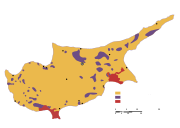
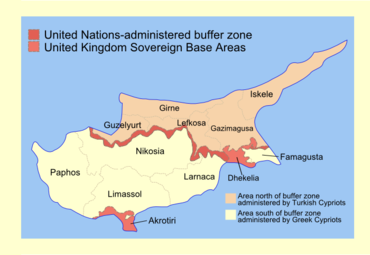
, was elected the first president of the Republic of Cyprus in 1960. For the next decade and a half, enosis was a key issue for Greek Cypriots, and a key cause of events leading up to 1974 when Turkey invaded and occupied the northern part of the island. The island remains divided today, with the two communities almost completely separated. Many Greek Cypriots, most of whom lost their homes, lands and possessions during the Turkish invasion, emigrated mainly to the UK, USA, Australia, South Africa and Europe. There are today estimated to be 335,000 Greek Cypriot emigrants
living in Great Britain. The majority of the Greek Cypriots in Great Britain
currently live in England
; there is an estimate of around 3,000 in Wales
and 1,000 in Scotland
.
By the early 1990s, Greek Cypriot society enjoyed a high standard of living. Economic modernization created a more flexible and open society and caused Greek Cypriots to share the concerns and hopes of other secularized West European societies. The Republic of Cyprus joined the European Union
in 2004, officially representing the entire island, but suspended for the time being in the Turkish occupied north.
 The Greek Cypriot dialect
is a member of the south-eastern group of modern Greek dialects
. It shares common characteristics with the dialects of the Dodecanese islands as well as those of Asia Minor. The dialect does not have a common form but is divided into a number of distinct local varieties.
Greeks
The Greeks, also known as the Hellenes , are a nation and ethnic group native to Greece, Cyprus and neighboring regions. They also form a significant diaspora, with Greek communities established around the world....
population of Cyprus
Cyprus
Cyprus , officially the Republic of Cyprus , is a Eurasian island country, member of the European Union, in the Eastern Mediterranean, east of Greece, south of Turkey, west of Syria and north of Egypt. It is the third largest island in the Mediterranean Sea.The earliest known human activity on the...
, forming the island's largest ethnolinguistic
Ethnolinguistics
Ethnolinguistics is a field of linguistics which studies the relationship between language and culture, and the way different ethnic groups perceive the world. It is the combination between ethnology and linguistics. The former refers to the way of life of an entire community i.e...
community at 77% of the population. Greek Cypriots are mostly members of the Church of Cyprus, an autocephalous
Autocephaly
Autocephaly , in hierarchical Christian churches and especially Eastern Orthodox and Oriental Orthodox churches, is the status of a hierarchical church whose head bishop does not report to any higher-ranking bishop...
Greek Orthodox Church
Greek Orthodox Church
The Greek Orthodox Church is the body of several churches within the larger communion of Eastern Orthodox Christianity sharing a common cultural tradition whose liturgy is also traditionally conducted in Koine Greek, the original language of the New Testament...
within the wider communion of Orthodox Christianity
Christianity
Christianity is a monotheistic religion based on the life and teachings of Jesus as presented in canonical gospels and other New Testament writings...
. In regards to the 1960 Constitution of Cyprus
Constitution of Cyprus
The Constitution of Cyprus is a document, ratified on August 16, 1960, that serves as the framework for the Cypriot government. It was drafted after the country won its independence in 1959....
, the term also includes Arabic
Cypriot Maronite Arabic
Cypriot Arabic, known as Cypriot Maronite Arabic, is a variety of Arabic spoken by the Maronite community of Cyprus. Most speakers are situated in the capital, Nicosia, while others are located in Kormakitis and Limassol...
-speaking Maronites
Maronites in Cyprus
The Maronites in Cyprus are members of the Maronite Church whose ancestors migrated from the Levant during the Middle Ages. They traditionally speak their own variety of Arabic in addition to Greek...
, Armenians
Armenians in Cyprus
Armenians in Cyprus or Armenian-Cypriots are ethnic Armenians that live in Cyprus. Armenian-Cypriots maintain a notable presence of about 3.500 on the island , mostly centred in the capital Nicosia, but also with communities in Larnaca...
and Latin Rite Catholics
Roman Catholicism in Cyprus
The Roman Catholic Church in Cyprus is part of the worldwide Roman Catholic Church, under the spiritual leadership of the Pope and curia in Rome.There are around 10,000 Catholic faithful in Cyprus, corresponding to just over 1% of the total population...
("Latins"), who were given the option of being included in one or other of the two constituent communities (Greek or Turkish
Turkish Cypriots
Turkish Cypriots are the ethnic Turks and members of the Turkish-speaking ethnolinguistic community of the Eastern Mediterranean island of Cyprus. The term is used to refer explicitly to the indigenous Turkish Cypriots, whose Ottoman Turkish forbears colonised the island in 1571...
) and voted to join the Greek Cypriot community.
History
Mycenaean Greece
Mycenaean Greece was a cultural period of Bronze Age Greece taking its name from the archaeological site of Mycenae in northeastern Argolis, in the Peloponnese of southern Greece. Athens, Pylos, Thebes, and Tiryns are also important Mycenaean sites...
Greeks who settled on the island during the second half of the second millennium BC. Cyprus is the third largest island in the Mediterranean after Sicily
Sicily
Sicily is a region of Italy, and is the largest island in the Mediterranean Sea. Along with the surrounding minor islands, it constitutes an autonomous region of Italy, the Regione Autonoma Siciliana Sicily has a rich and unique culture, especially with regard to the arts, music, literature,...
and Sardinia
Sardinia
Sardinia is the second-largest island in the Mediterranean Sea . It is an autonomous region of Italy, and the nearest land masses are the French island of Corsica, the Italian Peninsula, Sicily, Tunisia and the Spanish Balearic Islands.The name Sardinia is from the pre-Roman noun *sard[],...
, and the largest island in the eastern Mediterranean. Mount Olympus
Mount Olympus (Cyprus)
Olympus, or Chionistra, at , is the highest point in Cyprus. It is located in the Troodos Mountains of Cyprus. A British long range radar currently operates at Mount Olympus' peak....
(also known as Chionistra), the highest point of the Troodos Mountains (1952 m), is the highest point on the island. The island gradually became part of the Hellenic
Ancient Greece
Ancient Greece is a civilization belonging to a period of Greek history that lasted from the Archaic period of the 8th to 6th centuries BC to the end of antiquity. Immediately following this period was the beginning of the Early Middle Ages and the Byzantine era. Included in Ancient Greece is the...
world as the settlers prospered over the next centuries. Alexander the Great liberated the island from the Persians in 333 BC. After the division of the Roman Empire
Roman Empire
The Roman Empire was the post-Republican period of the ancient Roman civilization, characterised by an autocratic form of government and large territorial holdings in Europe and around the Mediterranean....
in 285 AD, Cypriots enjoyed home rule for almost nine centuries under the jurisdiction of the Byzantine Empire
Byzantine Empire
The Byzantine Empire was the Eastern Roman Empire during the periods of Late Antiquity and the Middle Ages, centred on the capital of Constantinople. Known simply as the Roman Empire or Romania to its inhabitants and neighbours, the Empire was the direct continuation of the Ancient Roman State...
, something not seen again until 1960. Perhaps the most important event of the early Byzantine period was the local church's independence from the Patriarchate of Antioch and All the East in 431. The bishop of the ancient capital Salamis
Salamis, Cyprus
Salamis was an ancient Greek city-state on the east coast of Cyprus, at the mouth of the river Pedieos, 6 km north of modern Famagusta. According to tradition the founder of Salamis was Teucer, son of Telamon, who could not return home after the Trojan war because he had failed to avenge his...
(renamed Constantia by Emperor Constantius II
Constantius II
Constantius II , was Roman Emperor from 337 to 361. The second son of Constantine I and Fausta, he ascended to the throne with his brothers Constantine II and Constans upon their father's death....
) was constituted metropolitan
Metropolitan bishop
In Christian churches with episcopal polity, the rank of metropolitan bishop, or simply metropolitan, pertains to the diocesan bishop or archbishop of a metropolis; that is, the chief city of a historical Roman province, ecclesiastical province, or regional capital.Before the establishment of...
by Emperor Zeno
Zeno (emperor)
Zeno , originally named Tarasis, was Byzantine Emperor from 474 to 475 and again from 476 to 491. Domestic revolts and religious dissension plagued his reign, which nevertheless succeeded to some extent in foreign issues...
, with the title archbishop
Archbishop
An archbishop is a bishop of higher rank, but not of higher sacramental order above that of the three orders of deacon, priest , and bishop...
.
The Byzantine era profoundly molded Greek Cypriot culture. The Greek Orthodox Christian legacy bestowed on Greek Cypriots in this period would live on during the succeeding centuries of foreign domination. Because Cyprus was never the final goal of any external ambition, but simply fell under the domination of whichever power was dominant in the eastern Mediterranean, destroying its civilization was never a military objective or necessity.
The Cypriots did however endure the oppressive rule of first the Lusignans and then the Venetians
Republic of Venice
The Republic of Venice or Venetian Republic was a state originating from the city of Venice in Northeastern Italy. It existed for over a millennium, from the late 7th century until 1797. It was formally known as the Most Serene Republic of Venice and is often referred to as La Serenissima, in...
from the 1190s through to 1570. King Amaury
Amalric II of Jerusalem
Amalric II of Jerusalem or Amalric I of Cyprus, born Amalric of Lusignan , King of Jerusalem 1197–1205, was an older brother of Guy of Lusignan....
, who succeeded his brother Guy de Lusignan
Guy of Lusignan
Guy of Lusignan was a Poitevin knight, son of Hugh VIII of the prominent Lusignan dynasty. He was king of the crusader state of Jerusalem from 1186 to 1192 by right of marriage to Sibylla of Jerusalem, and of Cyprus from 1192 to 1194...
in 1194, was particularly intolerant of the Orthodox Church. Greek Cypriot land was appropriated for the Latin churches after they were established in the major towns on the island. In addition, tax collection was also part of the heavy oppressive attitude of the occupiers to the locals of the island, in that it was now being conducted by the Latin churches themselves.
The Ottoman
Ottoman Empire
The Ottoman EmpireIt was usually referred to as the "Ottoman Empire", the "Turkish Empire", the "Ottoman Caliphate" or more commonly "Turkey" by its contemporaries...
conquest of Cyprus in 1571 delivered the Greek population from serfdom and servitude to the Latin church. Cypriot Greeks were now able to take control of the land they had been working on for centuries. The local Christians resumed practicing their religion in the only acceptable way they knew. The patriarch serving the Ottoman sultan also acted as ethnarch
Ethnarch
Ethnarch, pronounced , the anglicized form of ethnarches refers generally to political leadership over a common ethnic group or homogeneous kingdom. The word is derived from the Greek words and ....
, or leader of the Greek nation, thus enabling the local Orthodox representative to practice decidedly secular powers, for instance in adjudicating justice and in the collection of taxes.
Despite the inherent oppression of foreign subjugation, the period of Ottoman rule
Cyprus under the Ottoman Empire
The Eyalet of Cyprus was created in 1571, and changed its status frequently. It was a sanjak of the Eyalet of the Archipelago from 1660 to 1703, and again from 1784 onwards; a fief of the Grand Vizier , and again an eyalet for the short period 1745-1748.- Ottoman raids and conquest :Throughout the...
(1570-1878) had a limited impact on Greek Cypriot culture. The Ottomans tended to administer their multicultural empire with the help of their subject millet
Millet (Ottoman Empire)
Millet is a term for the confessional communities in the Ottoman Empire. It refers to the separate legal courts pertaining to "personal law" under which communities were allowed to rule themselves under their own system...
s, or religious communities. The tolerance of the millet system permitted the Greek Cypriot community to survive, administered on behalf of Constantinople
Ecumenical Patriarchate of Constantinople
The Ecumenical Patriarchate of Constantinople , part of the wider Orthodox Church, is one of the fourteen autocephalous churches within the communion of Orthodox Christianity...
by the Archbishop of the Church of Cyprus, who became the community's head, or ethnarch. Although religiously tolerant, Ottoman rule was generally harsh and inefficient. Turkish
Turkish people
Turkish people, also known as the "Turks" , are an ethnic group primarily living in Turkey and in the former lands of the Ottoman Empire where Turkish minorities had been established in Bulgaria, Cyprus, Bosnia and Herzegovina, Georgia, Greece, Kosovo, Macedonia, and Romania...
settlers suffered alongside their Greek Cypriot neighbors, and the two groups together endured centuries of oppressive governance from Constantinople
Constantinople
Constantinople was the capital of the Roman, Eastern Roman, Byzantine, Latin, and Ottoman Empires. Throughout most of the Middle Ages, Constantinople was Europe's largest and wealthiest city.-Names:...
. A minority of Greek Cypriots converted to Islam
Islam in Cyprus
Islam in Cyprus was introduced when Uthman the 3rd Caliph conquered Cyprus in 649. Muslims lived throughout Cyprus but prior to 1974, and since have been concentrated in Northern Cyprus....
during this period, and are sometimes referred to as "neo-Muslims" by historians.
Cypriot cuisine
Cypriot cuisine
Cypriot cuisine is the cuisine of Cyprus and can be described as a blend of Greek cuisines. Greek Cypriot cuisine is another regional Greek cuisine along with Cretan, Ionian, or Attic....
, as with Greek cuisine, was imprinted with the spices and herbs made common as a result of extensive trade links within the Ottoman Empire. Names of many dishes came to reflect the sources of the ingredients from the many lands under the Ottoman rule. Coffee houses pervasively spread throughout the island into all major towns and countless villages.
Politically, the concept of enosis
Enosis
Enosis refers to the movement of the Greek-Cypriot population to incorporate the island of Cyprus into Greece.Similar movements had previously developed in other regions with ethnic Greek majorities such as the Ionian Islands, Crete and the Dodecanese. These regions were eventually incorporated...
—unification with the Greek "motherland"—became important to literate Greek Cypriots after Greece
Greece
Greece , officially the Hellenic Republic , and historically Hellas or the Republic of Greece in English, is a country in southeastern Europe....
declared its independence from the Ottoman Empire in 1821. A movement for the realization of enosis gradually formed, in which the Church of Cyprus played a dominant role (see "Cyprus dispute
Cyprus dispute
The Cyprus dispute is the result of the ongoing conflict between the Republic of Cyprus and Turkey, over the Turkish occupied northern part of Cyprus....
").
"Hellenism is the true contemporary race of the world, Nobody could be found to eliminate it, Nobody, for it is protected from above by my God, If Hellenism is lost, truly the whole world shall weep." |
| Archbishop Kyprianos' response to Kucuk Mehmet's threat to wipe out the Greeks of Cyprus |
During British
United Kingdom
The United Kingdom of Great Britain and Northern IrelandIn the United Kingdom and Dependencies, other languages have been officially recognised as legitimate autochthonous languages under the European Charter for Regional or Minority Languages...
rule (1878–1960), the British brought an efficient colonial administration, but government and education were administered along ethnic lines, accentuating differences. For example, the education system was organized with two Boards of Education, one Greek and one Turkish, controlled by Athens
Athens
Athens , is the capital and largest city of Greece. Athens dominates the Attica region and is one of the world's oldest cities, as its recorded history spans around 3,400 years. Classical Athens was a powerful city-state...
and Istanbul
Istanbul
Istanbul , historically known as Byzantium and Constantinople , is the largest city of Turkey. Istanbul metropolitan province had 13.26 million people living in it as of December, 2010, which is 18% of Turkey's population and the 3rd largest metropolitan area in Europe after London and...
, respectively. The resulting education emphasized linguistic, religious, cultural, and ethnic differences and ignored traditional ties between the two Cypriot communities. The two groups were encouraged to view themselves as extensions of their respective motherlands, and the development of two distinct nationalities with antagonistic loyalties was ensured.
The importance of religion within the Greek Cypriot community was reinforced when the Archbishop of the Church of Cyprus, Makarios III
Makarios III
Makarios III , born Andreas Christodolou Mouskos , was the archbishop and primate of the autocephalous Cypriot Orthodox Church and the first President of the Republic of Cyprus ....
, was elected the first president of the Republic of Cyprus in 1960. For the next decade and a half, enosis was a key issue for Greek Cypriots, and a key cause of events leading up to 1974 when Turkey invaded and occupied the northern part of the island. The island remains divided today, with the two communities almost completely separated. Many Greek Cypriots, most of whom lost their homes, lands and possessions during the Turkish invasion, emigrated mainly to the UK, USA, Australia, South Africa and Europe. There are today estimated to be 335,000 Greek Cypriot emigrants
Greek Cypriot diaspora
The Greek-Cypriot diaspora refers to the Greek Cypriot population of Cyprus, or people who are of Greek Cypriot origins, who live abroad because of either economic reasons, or were part of the Greek population that was uprooted from their homes in Northern Cyprus by the Turkish Invasion of Cyprus...
living in Great Britain. The majority of the Greek Cypriots in Great Britain
Great Britain
Great Britain or Britain is an island situated to the northwest of Continental Europe. It is the ninth largest island in the world, and the largest European island, as well as the largest of the British Isles...
currently live in England
England
England is a country that is part of the United Kingdom. It shares land borders with Scotland to the north and Wales to the west; the Irish Sea is to the north west, the Celtic Sea to the south west, with the North Sea to the east and the English Channel to the south separating it from continental...
; there is an estimate of around 3,000 in Wales
Wales
Wales is a country that is part of the United Kingdom and the island of Great Britain, bordered by England to its east and the Atlantic Ocean and Irish Sea to its west. It has a population of three million, and a total area of 20,779 km²...
and 1,000 in Scotland
Scotland
Scotland is a country that is part of the United Kingdom. Occupying the northern third of the island of Great Britain, it shares a border with England to the south and is bounded by the North Sea to the east, the Atlantic Ocean to the north and west, and the North Channel and Irish Sea to the...
.
By the early 1990s, Greek Cypriot society enjoyed a high standard of living. Economic modernization created a more flexible and open society and caused Greek Cypriots to share the concerns and hopes of other secularized West European societies. The Republic of Cyprus joined the European Union
European Union
The European Union is an economic and political union of 27 independent member states which are located primarily in Europe. The EU traces its origins from the European Coal and Steel Community and the European Economic Community , formed by six countries in 1958...
in 2004, officially representing the entire island, but suspended for the time being in the Turkish occupied north.
Greek Cypriot dialect
Cypriot Greek
The Cypriot dialect of Modern Greek, known as Kypriaka , Cypriot Greek is spoken by 750,000 people in Cyprus and diaspora Greek Cypriots.Cypriot Greek is distinct enough that it can be classified as a distinct dialect of the Standard Greek....
is a member of the south-eastern group of modern Greek dialects
Varieties of Modern Greek
The linguistic varieties of Modern Greek can be classified along two principal dimensions. First, there is a long tradition of sociolectal variation between the natural, popular spoken language on the one hand and archaizing, learned written forms on the other. Second, there is regional variation...
. It shares common characteristics with the dialects of the Dodecanese islands as well as those of Asia Minor. The dialect does not have a common form but is divided into a number of distinct local varieties.
See also
- Greek Cypriot diasporaGreek Cypriot diasporaThe Greek-Cypriot diaspora refers to the Greek Cypriot population of Cyprus, or people who are of Greek Cypriot origins, who live abroad because of either economic reasons, or were part of the Greek population that was uprooted from their homes in Northern Cyprus by the Turkish Invasion of Cyprus...
- Turkish CypriotsTurkish CypriotsTurkish Cypriots are the ethnic Turks and members of the Turkish-speaking ethnolinguistic community of the Eastern Mediterranean island of Cyprus. The term is used to refer explicitly to the indigenous Turkish Cypriots, whose Ottoman Turkish forbears colonised the island in 1571...
- Greek Britons
- List of Cypriots
- Greeks in New ZealandGreeks in New ZealandThere is a community of about 4,500 people of Greek descent in New Zealand.Greek New Zealanders have a heavy concentration in Wellington, and to a lesser extent Christchurch and Auckland...
External links
- Reassessing what we collect website – Greek Cypriot London History of Greek Cypriot London with objects and images
- Cyprus: Historical Setting