


Great Train Raid of 1861

Encyclopedia
Stonewall Jackson
ຄຽשת״ׇׂׂׂׂ֣|birth_place= Clarksburg, Virginia |death_place=Guinea Station, Virginia|placeofburial=Stonewall Jackson Memorial CemeteryLexington, Virginia|placeofburial_label= Place of burial|image=...
operations against the Baltimore and Ohio Railroad
Baltimore and Ohio Railroad
The Baltimore and Ohio Railroad was one of the oldest railroads in the United States and the first common carrier railroad. It came into being mostly because the city of Baltimore wanted to compete with the newly constructed Erie Canal and another canal being proposed by Pennsylvania, which...
in 1861 were aimed at disrupting a critical railroad used by the opposing Union Army
Union Army
The Union Army was the land force that fought for the Union during the American Civil War. It was also known as the Federal Army, the U.S. Army, the Northern Army and the National Army...
as a major supply route and capturing the maximum number of locomotives and cars. During this point in the war, the state of Maryland
Maryland
Maryland is a U.S. state located in the Mid Atlantic region of the United States, bordering Virginia, West Virginia, and the District of Columbia to its south and west; Pennsylvania to its north; and Delaware to its east...
's stance was not yet determined. The B&O Railroad, then owned by the state of Maryland, ran through Maryland and along the Potomac River
Potomac River
The Potomac River flows into the Chesapeake Bay, located along the mid-Atlantic coast of the United States. The river is approximately long, with a drainage area of about 14,700 square miles...
Valley in its pass through the Appalachian Mountains
Appalachian Mountains
The Appalachian Mountains #Whether the stressed vowel is or ,#Whether the "ch" is pronounced as a fricative or an affricate , and#Whether the final vowel is the monophthong or the diphthong .), often called the Appalachians, are a system of mountains in eastern North America. The Appalachians...
, but took a crucial turn at Harpers Ferry and passed south, through Virginia
Virginia
The Commonwealth of Virginia , is a U.S. state on the Atlantic Coast of the Southern United States. Virginia is nicknamed the "Old Dominion" and sometimes the "Mother of Presidents" after the eight U.S. presidents born there...
and Martinsburg
Martinsburg, West Virginia
Martinsburg is a city in the Eastern Panhandle region of West Virginia, United States. The city's population was 14,972 at the 2000 census; according to a 2009 Census Bureau estimate, Martinsburg's population was 17,117, making it the largest city in the Eastern Panhandle and the eighth largest...
while crossing the Shenandoah Valley
Shenandoah Valley
The Shenandoah Valley is both a geographic valley and cultural region of western Virginia and West Virginia in the United States. The valley is bounded to the east by the Blue Ridge Mountains, to the west by the eastern front of the Ridge-and-Valley Appalachians , to the north by the Potomac River...
. The railroad then continued on through much of present-day West Virginia
West Virginia
West Virginia is a state in the Appalachian and Southeastern regions of the United States, bordered by Virginia to the southeast, Kentucky to the southwest, Ohio to the northwest, Pennsylvania to the northeast and Maryland to the east...
, which then was still part of Virginia, meaning that the railroad continued for a major portion of its route through a state which later seceded
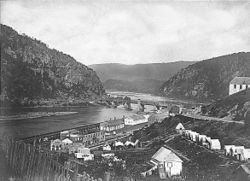
Many historians have written that the events began when the Virginia militia initiated a military raid that started in western Virginia
West Virginia
West Virginia is a state in the Appalachian and Southeastern regions of the United States, bordered by Virginia to the southeast, Kentucky to the southwest, Ohio to the northwest, Pennsylvania to the northeast and Maryland to the east...
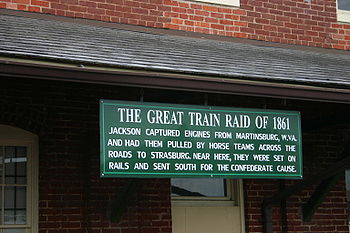
at the end of busy noontime traffic on May 23, 1861,"the eve of Virginia's ratification of her secession ordinance", during the early days of the American Civil War
American Civil War
The American Civil War was a civil war fought in the United States of America. In response to the election of Abraham Lincoln as President of the United States, 11 southern slave states declared their secession from the United States and formed the Confederate States of America ; the other 25...
. Colonel Thomas Jackson had convinced railroad officials to limit their passage through Virginia territory between the hours of 11:00 am to 1:00 pm. Historian James I. Robertson Jr. contests this version of events. He denies that the raid occurred and questions whether the communication between Jackson and railroad officials ever happened. Robertson claims that historians who promote the accuracy of the raid place too much reliance on an 1885 account of the events written by General John D. Imboden, a source that Robertson considers to be unreliable.
In any event, from late May through June Confederate forces controlled the railroad and destroyed track and bridges throughout the Virginia portion of the railroad. Believing that Harper’s ferry was indefensible against a Union advance, General Joseph Johnston was given permission to abandon the post. As part of this retreat, a major bridge was destroyed at Harper’s Ferry and the railroad works at Martinsburg were destroyed. In a major engineering feat, fourteen locomotives from Martinsburg were disassembled and moved across country by horse drawn teams to Strasburg, Virginia. Eventually the locomotives were moved to Richmond where they were put to use by the Confederacy.
Virginia Militia forces deploy and defend Harpers Ferry
Virginia Militia
The Virginia militia is an armed force composed of all citizens of the Commonwealth of Virginia capable of bearing arms. The Virginia militia was established in 1607 as part of the British militia system. Militia service in Virginia was compulsory for all free males...
to strategic points around the state, including the assignment of Col Kenton Harper
Kenton Harper
Kenton Harper was an American printer, soldier, town mayor, banker, newspaper editor, and legislator. He served as an officer in the U.S. Army during the Mexican–American War and later as a Confederate general officer during the American Civil War...
to Virginia's "Forces In and About Harper’s Ferry, Virginia" on April 18.
Hours before Virginia Militia forces from Charlestown, West Virginia and Winchester, Virginia
Winchester, Virginia
Winchester is an independent city located in the northwestern portion of the Commonwealth of Virginia in the USA. The city's population was 26,203 according to the 2010 Census...
arrived on April 18, the Federal troops guarding the arsenal evacuated and burned it. Nine days later, on 27 April, Col Thomas J. (later “Stonewall”) Jackson
Stonewall Jackson
ຄຽשת״ׇׂׂׂׂ֣|birth_place= Clarksburg, Virginia |death_place=Guinea Station, Virginia|placeofburial=Stonewall Jackson Memorial CemeteryLexington, Virginia|placeofburial_label= Place of burial|image=...
, then of the Virginia State Militia, was ordered to relieve Col Harper. He began the task of organizing the defense of Virginia at that location. During his first day commanding forces, on April 27, 1861, Col Jackson's men arrested one of the only four general officers in the regular army at that time, Brigadier General William Selby Harney, at Harpers Ferry, while he was taking a train to Washington, D.C. He was commanding the Department of the West, and was traveling from his headquarters in St. Louis, Missouri. Sometime following this, Col Jackson, while familiarizing himself with the B&O Railroad line, inspected Captain John D. Imboden
John D. Imboden
John Daniel Imboden was a lawyer, teacher, Virginia state legislator. During the American Civil War, he was a Confederate cavalry general and partisan fighter...
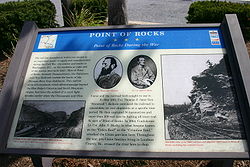
's (later a CSA Brigadier General) assigned post, possessing the bridge across the Potomac River at Point of Rocks, Maryland.
Tensions build in May 1861
For the immediate time being, "B&O trains continued to run, with many interruptions and only with the consent of Virginia." Col Jackson realized that Harper’s Ferry held not only important arms production factories, but was a choke-hold on the Baltimore and Ohio RailroadBaltimore and Ohio Railroad
The Baltimore and Ohio Railroad was one of the oldest railroads in the United States and the first common carrier railroad. It came into being mostly because the city of Baltimore wanted to compete with the newly constructed Erie Canal and another canal being proposed by Pennsylvania, which...
, the Chesapeake and Ohio Canal
Chesapeake and Ohio Canal
The Chesapeake and Ohio Canal, abbreviated as the C&O Canal, and occasionally referred to as the "Grand Old Ditch," operated from 1831 until 1924 parallel to the Potomac River in Maryland from Cumberland, Maryland to Washington, D.C. The total length of the canal is about . The elevation change of...
, and key telegraph trunk lines connecting Baltimore, Maryland and Washington, D.C.
Washington, D.C.
Washington, D.C., formally the District of Columbia and commonly referred to as Washington, "the District", or simply D.C., is the capital of the United States. On July 16, 1790, the United States Congress approved the creation of a permanent national capital as permitted by the U.S. Constitution....
to the Ohio Valley and interior of the United States. As the war approached, the president of the B&O Railroad, John W. Garrett
John W. Garrett
John Work Garrett was an American banker, philanthropist, and president of the Baltimore and Ohio Railroad ....
, who was sympathetic to the Union
Union (American Civil War)
During the American Civil War, the Union was a name used to refer to the federal government of the United States, which was supported by the twenty free states and five border slave states. It was opposed by 11 southern slave states that had declared a secession to join together to form the...
, became "outspoken" against the Confederacy, using "some strong adjectives to lend stress" to the word "rebel". Delagrange notes "As war seemed to be approaching, B&O President John Garrett tried to appear neutral (his sympathies were with the North), a good business practice because people weren’t certain if Maryland would go Union or, even if it did, whether the line could be kept from the Confederates. Also, West Virginia had not separated from Virginia yet, so technically most of the B&O tracks lay in the South."
On May 5, 1861, Federal forces seized control of the B&O Relay House nine miles (14 km) west of Baltimore, so that Brigadier General B. F. Butler
Benjamin Franklin Butler (politician)
Benjamin Franklin Butler was an American lawyer and politician who represented Massachusetts in the United States House of Representatives and later served as the 33rd Governor of Massachusetts....
could "inspect and stop any further freight headed for military forces of Virginia." BF Butler was eager to assume authority in the absence of official instructions and finally occupied all of Baltimore on May 13, shortly before his promotion to Major General on May 16. He "started to arrest citizens known for their open Confederate support" including "Ross Winans
Ross Winans
Ross Winans was an American inventor, mechanic, and builder of locomotives and railroad machinery. He is also noted for design of pioneering cigar-hulled ships. Winans, one of the United States' first multi-millionaires, was involved in politics and was a vehement states' rights advocate...
, long-time inventor and locomotive builder." Political instability began to mount, as martial law was declared in Baltimore
Baltimore
Baltimore is the largest independent city in the United States and the largest city and cultural center of the US state of Maryland. The city is located in central Maryland along the tidal portion of the Patapsco River, an arm of the Chesapeake Bay. Baltimore is sometimes referred to as Baltimore...
, which was a very secession
Secession
Secession is the act of withdrawing from an organization, union, or especially a political entity. Threats of secession also can be a strategy for achieving more limited goals.-Secession theory:...
-sympathetic city.
May 23, 1861 Raid
- The events as described in this section are contested in the "Raid controversy" section below.
Coal
Coal is a combustible black or brownish-black sedimentary rock usually occurring in rock strata in layers or veins called coal beds or coal seams. The harder forms, such as anthracite coal, can be regarded as metamorphic rock because of later exposure to elevated temperature and pressure...
was being shipped in large quantities from the Ohio Valley to Union naval bases
Union Navy
The Union Navy is the label applied to the United States Navy during the American Civil War, to contrast it from its direct opponent, the Confederate States Navy...
in Baltimore that were fueling U.S. Navy warships attempting to blockade the more southern states
Union blockade
The Union Blockade, or the Blockade of the South, took place between 1861 and 1865, during the American Civil War, when the Union Navy maintained a strenuous effort on the Atlantic and Gulf Coast of the Confederate States of America designed to prevent the passage of trade goods, supplies, and arms...
. "During early May, dozens of heavy coal and freight trains were moving daily over the double-track line in the Harpers Ferry area."
About the middle of May Jackson then devised a covert plan to destroy B&O Railroad operations while simultaneously benefiting Virginia and possibly the Confederacy.
Jackson complained to the B&O Railroad that the "noisy night railroad traffic" of the trains disturbed the rest of his troops, and notified John Garrett that trains would only be allowed to pass through Harpers Ferry at first only during daylight hours, but within a few days demanded a tighter timetable restriction between the hours of 11 a.m. and 1 p.m.
in order to ensure their rest was not disturbed. Delagrange notes "He complained strongly that the trains were disturbing the rest of his tired troops at Harper’s Ferry. Garrett agreed to run as many trains as possible through around noon." Thus only two hours in the day, centered around noon, were allowed for train traffic through the Harpers Ferry area after the middle of May. This timetable bottleneck caused the B&O Railroad to pile up trains in yards and along the lines on the double tracks on either side of Harpers Ferry in order to maximize their throughput during this new curfew
Curfew
A curfew is an order specifying a time after which certain regulations apply. Examples:# An order by a government for certain persons to return home daily before a certain time...
.
5th Virginia Infantry
The 5th Virginia Volunteer Infantry Regiment was an infantry regiment raised in Virginia for service in the Confederate States Army during the American Civil War. It fought in the Stonewall Brigade, mostly with the Army of Northern Virginia....
under Kenton Harper
Kenton Harper
Kenton Harper was an American printer, soldier, town mayor, banker, newspaper editor, and legislator. He served as an officer in the U.S. Army during the Mexican–American War and later as a Confederate general officer during the American Civil War...
to Cherry Run, west of Martinsburg, and he sent Captain John D. Imboden
John D. Imboden
John Daniel Imboden was a lawyer, teacher, Virginia state legislator. During the American Civil War, he was a Confederate cavalry general and partisan fighter...
's cavalry to Point of Rocks, east of Harpers Ferry. The 5th Virginia positioned themselves at a bridge spanning the Potomac River near Cherry Run
Cherry Run, West Virginia
Cherry Run is a small unincorporated hamlet located along the CSX Transportation mainline on the Potomac River in Morgan County in the U.S. state of West Virginia. The community is named for the stream, Cherry Run, that meets the Potomac in its vicinity...
, thirty-two miles east of Harpers Ferry on the Potomac River
Potomac River
The Potomac River flows into the Chesapeake Bay, located along the mid-Atlantic coast of the United States. The river is approximately long, with a drainage area of about 14,700 square miles...
north and west of the Baltimore and Ohio Railroad Martinsburg Shops
Baltimore and Ohio Railroad Martinsburg Shops
Baltimore and Ohio Railroad Martinsburg Shops is a historic industrial district in Martinsburg, West Virginia. It is significant both for its railroading architecture by Albert Fink and John Rudolph Niernsee and for its role in the Great Railroad Strike of 1877. It consists of three contributing...
. Imboden's cavalry staged themselves at the signal tower west of Point of Rocks
Point of Rocks, Maryland
Point of Rocks is a community in Frederick County, Maryland. It is named for the striking rock formation on the adjacent Catoctin Mountain, which were formed by the Potomac River cutting through the ridge in a water gap, a typical formation in the Ridge-and-Valley Appalachians...
, twelve miles (19 km) east of Harpers Ferry.
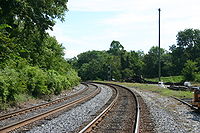
The following morning, May 23, the trains waiting to the east and west of this forty-four mile section "arrived on schedule" and began moving across this curfewed span at 11:00 a.m. "freely entering the zone for an hour after eleven o'clock." This one hour period allowed for just enough time for these trains to make it only part way into their forty-four mile stretch without reaching the other end on the doubled-up tracks of that main stem section. Then, "at the end of the busy noontime traffic," just as all these trains had filled up the east and westbound lanes, practically coupler to coupler, "Imboden and Harper suddenly halted traffic at midday" by emerging forth and not allowing the trains now coming toward each of their positions to pass and get out of this double-track stretch. Thus Col Jackson had now "bagged" the "largest single haul of rolling stock taken intact during the war" on the very first day of the war from Virginia's perspective: May 23, 1861.
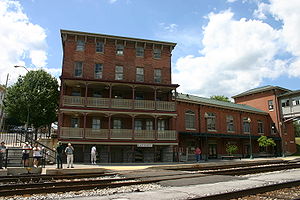
Locomotives and trains were caught in various places all along this section, and this trapped a large quantity of rolling stock
Rolling stock
Rolling stock comprises all the vehicles that move on a railway. It usually includes both powered and unpowered vehicles, for example locomotives, railroad cars, coaches and wagons...
in between, which "was soon concentrated in the big rail yard at Martinsburg, West Virginia
Martinsburg, West Virginia
Martinsburg is a city in the Eastern Panhandle region of West Virginia, United States. The city's population was 14,972 at the 2000 census; according to a 2009 Census Bureau estimate, Martinsburg's population was 17,117, making it the largest city in the Eastern Panhandle and the eighth largest...
." From Harpers Ferry, the Winchester and Potomac Railroad
Winchester and Potomac Railroad
The Winchester and Potomac Railroad was an historic railroad in the Southern United States, which ran from Winchester, Virginia to the Baltimore and Ohio Railroad junction at Harpers Ferry on the Potomac River. The W&P Railroad is now incorporated into the modern CSX Transportation Class I...
ran as a spur off the B&O Railroad mainline south to Winchester, Virginia
Winchester, Virginia
Winchester is an independent city located in the northwestern portion of the Commonwealth of Virginia in the USA. The city's population was 26,203 according to the 2010 Census...
, allowing Jackson an opportunity to try and move his captured rail assets quickly to Winchester. The entire forty-four mile railine between Cherry Run and Harpers Ferry, with the huge railyard at Martinsburg, and the thirty-two mile Winchester spur was now entirely isolated as a whole and separate system of seventy-six miles of railroad, apart from the western and eastern runs of the main B&O Railroad stem.
Initial capture
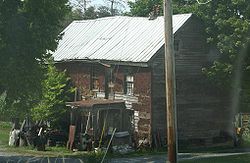
Hungerford writes, “This was real strategy and Jackson undoubtedly would have repeated it, had it not been that Harper’s Ferry was beginning to be untenable for him.” After the evacuation of Harper’s Ferry, beginning on June 20, Jackson fell back to Martinsburg and “forty-two locomotives and their tenders at that important railroad center, in addition to 305 cars, chiefly coal gondolas, were given the torch.”
Railroad historian Thomas Weber presents a different scenario regarding the dates and the events culminating in the capture of significant rail stock. Weber does not mention the May 23 raid but does state that on May 28 Confederate forces occupied 100 miles (160.9 km) of the B&O line. Jackson, reluctant to antagonize Confederate sympathizers in the area, continued to allow the trains to move through the entire area for another two weeks until June 13 when Jackson was ordered to abandon Harper's Ferry. This is when Jackson, according to Weber, decided to “spring the trap” by blocking any trains from leaving a 54 miles (86.9 km) stretch of track after they were allowed, from either end, to enter. This resulted in a large capture of locomotives and cars.
Closure of the railroad
Historian Angus James Johnston, II, "To make sure the trains stayed trapped and to prevent Union armies under George B. McClellan and Robert Patterson from using the road, the Confederates [still officially Virginia Militia] began destroying bridges and track on May 25," taking down seventeen bridges over the next thirty day period. The main stem of the B&O which ran mostly in or near Virginia was severed and cut off from the rest of the line by blasting a "massive rock formation onto the track at Point of Rocks." Johnston made the determination that in fact no rail traffic passed the B&O main stem west of Point of Rocks after the end of May, and west of Opequon Creek Bridge two miles (3 km) east of Martinsburg after June 2.On June 2, 1861, due to a combination of miscommunications and over-zealousness, Confederate forces continued destroying B&O Railroad assets, including the B&O Railroad bridge over Opequon Creek
Opequon Creek
Opequon Creek is a tributary stream of the Potomac River. It flows into the Potomac northeast of Martinsburg in Berkeley County, West Virginia, and its source lies northwest of the community of Opequon at the foot of Great North Mountain in Frederick County, Virginia...
two miles (3 km) east of Martinsburg. Here they lit 50 coal cars on fire and ran them off the destroyed trestle
Trestle
A trestle is a rigid frame used as a support, especially referring to a bridge composed of a number of short spans supported by such frames. In the context of trestle bridges, each supporting frame is generally referred to as a bent...
, "where they burned for two months, the intense heat melting axles and wheels." The 52 remaining locomotives and various rail cars left in Martinsburg were thus left stranded by this uncoordinated action, and this ended the ability to move the remaining locomotives "by rail to the south". "This destruction was carried out in accordance with Lee's order of May 6 to Jackson to destroy the railroad bridges in order to frustrate the Union armies then advancing upon Harper's Ferry", says Johnston referencing Official Records, II, 806.
Historian John F. Stover notes that John W. Garrett, President of the B&O Railroad acknowledged that by May 28 the Virginia forces (called Confederate by Garrett) had taken control of 100 miles (160.9 km) of the main stem from Point of Rocks westward. However, Stover indicates that the destruction of the railroad did not begin until "early June", culminating in the destruction of the "800-foot combined highway-railroad bridge at Harpers Ferry" on June 14. Stover writes, "With this dramatic action, the main line of the B&O was to be effectively closed down for nearly ten months."
Historian Thomas Weber also indicates that the trains continued to run from May 28 for another 17 days until June 14, and gives his account of the raid by Jackson as occurring coincidentally with his view of a June 14 shutdown:
William Prescott Smith, master of transportation for the railroad and the “good man Friday” to Garrett, who notes that at least through June 2 the railroad was still operating through the Virginia stretch:
Secession and Retreat from Harpers Ferry
On May 23, the Commonwealth of Virginia conducted its popular vote, and secession was formally ratified. Immediately Major-General Joseph E. JohnstonJoseph E. Johnston
Joseph Eggleston Johnston was a career U.S. Army officer, serving with distinction in the Mexican-American War and Seminole Wars, and was also one of the most senior general officers in the Confederate States Army during the American Civil War...
, then of the Virginia State Militia, relieved Colonel Jackson and took command at Harpers Ferry on May 24. Shortly afterward, on June 8, all Virginia State troops were transferred to the authority of the Confederate States.
Jackson moves to Martinsburg
The Virginia legislature had ratified the Confederate constitution on May 2, and General Joseph Johnston had been given the Confederate command over the area covering Harper's Ferry. Johnson arrived in Harper's Ferry on the afternoon of the 23rd and informed Jackson of the change. From the beginning Johnson felt that Harper’s Ferry was indefensible, and he soon began pleading his case with Richmond. On June 13, in a telegram from Adjutant General Samuel Cooper, Johnson was authorized, if he felt the enemy “is about to turn [his] position”, to "destroy everything at Harper’s Ferry" and "retire upon the railroad towards Winchester."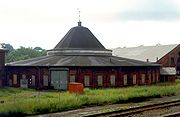
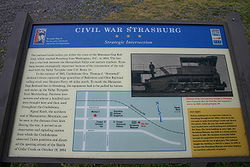
Jackson was conflicted over supervising the destruction of material badly needed by the Confederacy. Within a few days Jackson worked out a plan with the assistance of two railroad employees, Hugh Longust and Thomas R. Sharp, to select the 13 least damaged locomotives, dismantle the engines, and transport overland by forty-horse teams the 38 miles (61.2 km) to Strasburg.
At Martinsburg, as Jackson proceeded with this "wreckage", he started to have doubts as "word [came] from his beloved Southland of the desperate need of locomotives." He noted that “some of these Baltimore and Ohio engines had not been so very badly burned; after all, there is very little about a locomotive that can ever be destroyed by fire.”. Hungerford writes:
Hungerford states that "In this way, fourteen Baltimore and Ohio engines, of every sort and variety, 'made the Gap' that summer of '61."
Jackson's plan was to move these assets down the Winchester and Potomac Railroad
Winchester and Potomac Railroad
The Winchester and Potomac Railroad was an historic railroad in the Southern United States, which ran from Winchester, Virginia to the Baltimore and Ohio Railroad junction at Harpers Ferry on the Potomac River. The W&P Railroad is now incorporated into the modern CSX Transportation Class I...
via Harpers Ferry to Winchester, disassemble them and mount them on special wagons, and move them overland to Strasburg, Virginia
Strasburg, Virginia
Strasburg is a town in Shenandoah County, Virginia, United States, which was founded in 1761 by Peter Stover. It is the largest town, population-wise, in the county and is known for its pottery, antiques, and Civil War history...
, where they were to be reassembled and moved south on the Manassas Gap Railroad
Manassas Gap Railroad
The Manassas Gap Railroad was an historic intrastate railroad in the Southern United States which ran from Mount Jackson, Virginia to the Orange and Alexandria Railroad at a junction called "Manassas Junction", which later became the city of Manassas, Virginia...
. With the assistance of the chief engineer of the Winchester and Potomac Railroad, Thomas R. Sharp, Hugh Longust, an experienced railroad engineer from Richmond, Virginia
Richmond, Virginia
Richmond is the capital of the Commonwealth of Virginia, in the United States. It is an independent city and not part of any county. Richmond is the center of the Richmond Metropolitan Statistical Area and the Greater Richmond area...
, and Joseph Keeler and his son Charles Keeler—wagoneers living near Stephenson's Depot—special carriages and dollies were constructed and used to transport the first four small locomotives south from Winchester along the Valley Turnpike to Strasburg and then to Richmond via the Manassas Gap Railroad
Manassas Gap Railroad
The Manassas Gap Railroad was an historic intrastate railroad in the Southern United States which ran from Mount Jackson, Virginia to the Orange and Alexandria Railroad at a junction called "Manassas Junction", which later became the city of Manassas, Virginia...
. In an incredible and historic feat of engineering, the Virginia militia soldiers pulled the first four locomotives with 40-horse teams, rigged artillery-style, through downtown Winchester south on the Valley Pike to the rail-head at Strasburg. "Colonel Jackson helped himself to four small locomotives not too heavy for the flimsy flat-bar rails of the Winchester & Potomac [Railroad], and had them sent to Winchester whence they were dragged down the Valley turnpike to the nearest railroad at Strasburg", says historian Johnston.

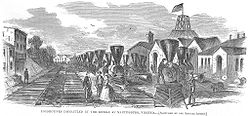
Remaining engines hauled all summer to Strasburg
In the weeks following this, Jackson decided to salvage ten of the burnt locomotives at Martinsburg and move them into the Confederate rail system. The evacuation of any more locomotives or rail cars by the Manassas Gap RailroadManassas Gap Railroad
The Manassas Gap Railroad was an historic intrastate railroad in the Southern United States which ran from Mount Jackson, Virginia to the Orange and Alexandria Railroad at a junction called "Manassas Junction", which later became the city of Manassas, Virginia...
became too risky for potential re-capture by Union forces, and so the those ten locomotives and additional rail cars were moved by the same carriage and dolly method 125 miles (201.2 km) south from Martinsburg through Winchester and on to the Virginia Central Railroad
Virginia Central Railroad
Virginia Central Railroad was chartered as the Louisa Railroad in 1836 by the Virginia Board of Public Works and had its name changed to Virginia Central Railroad in 1850. It connected Richmond with the Orange and Alexandria Railroad at Gordonsville in 1854, and had expanded westward past the Blue...
in Staunton, Virginia
Staunton, Virginia
Staunton is an independent city within the confines of Augusta County in the commonwealth of Virginia. The population was 23,746 as of 2010. It is the county seat of Augusta County....
.
Robert C. Black has yet a different view. He notes that "nine miles of rail" plus "five well-furbished [not burnt] steam locomotives, plus $40,000 worth (U.S.) of machine tools and other materials [were] removed from the Martinsburg shops." The five locomotives presented a "strange procession" that "could be seen moving down the famous Valley Pike" as they "were dragged painfully southward behind multiple teams of horses. Under the direction of Thomas R. Sharp ... the locomotives arrived safely in Strasburg early in September, where they were hoisted onto Confederate rails." Black also mentions the little known Leesburg raid in August, 1862 when "Just before the Alexandria, Loudoun & Hampshire had been swallowed up within the Federal lines, two of its engines had been laboriously salvaged and, appropriately rechristened the General Beauregard and the General Johnston".
80 rail cars moved by end of July
Many of the rail cars that had been captured were hidden in barns and farms throughout the Winchester area, and Confederate forces along with citizens continued to move these up the valley through the summer months of 1861, and for a period of the next two years. By the 25th of July, Captain Thomas Sharp reported that 80 cars had been successfully moved onto Confederate railsEyewitness Julia Chase
One of the pro-Union Winchester diarists, Julia Chase gave the following eyewitness accounts of "secesh" activities concerning these 10 locomotives:and notes that things had been "thrown in the river at Martinsburg" in reference to the destruction of the Opequon Creek B&ORR bridge. Several historians note that the actual quantities of horse involved in pulling any one locomotive varied between 32 and 40.
As late as 1863 many of the railroad cars were still being hauled away up the Shenandoah Valley
Shenandoah Valley
The Shenandoah Valley is both a geographic valley and cultural region of western Virginia and West Virginia in the United States. The valley is bounded to the east by the Blue Ridge Mountains, to the west by the eastern front of the Ridge-and-Valley Appalachians , to the north by the Potomac River...
to Staunton for service on Confederate rail lines all throughout the South
Southern United States
The Southern United States—commonly referred to as the American South, Dixie, or simply the South—constitutes a large distinctive area in the southeastern and south-central United States...
.
Final locomotive moved to Staunton
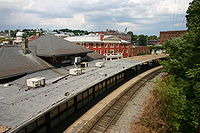
Staunton, Virginia
Staunton is an independent city within the confines of Augusta County in the commonwealth of Virginia. The population was 23,746 as of 2010. It is the county seat of Augusta County....
about the same time that General Johnston was evacuating Manassas in the spring of 1862. Mounting any more of the locomotives at Strasburg for evacuation on the Manassas Gap Railroad
Manassas Gap Railroad
The Manassas Gap Railroad was an historic intrastate railroad in the Southern United States which ran from Mount Jackson, Virginia to the Orange and Alexandria Railroad at a junction called "Manassas Junction", which later became the city of Manassas, Virginia...
had become too risky. The last time that Captain Sharps "railroad corps" moved any of the captured locomotives was when the last of the engines to have been taken from Martinsburg to Strasburg was stranded by Johnston's evacuation. The same night of the evacuation, the B&O camelback Engine number 199 was put on the Manassas Gap Railroad tracks at Strasburg and moved south 25 miles (40.2 km) up the Shenandoah Valley to the very end of the line at Mount Jackson, Virginia
Mount Jackson, Virginia
Mount Jackson is a town in Shenandoah County, Virginia, United States. The population was 1,994 at the 2010 census.-Geography:Mount Jackson is located at in the southern part of Shenandoah County, Virginia at...
. From there it was remounted onto the teamsters heavy duty wagon trucks and hauled overland on the Valley Turnpike again another 70 miles (112.7 km) to Staunton. The trip took four days, and when Engine 199 reached Staunton early in the morning, a majority of the towns population turned out to witness the incredible sight.
Creation of the Confederate States Locomotive Works
All of the locomotives were collected at Richmond, VirginiaRichmond, Virginia
Richmond is the capital of the Commonwealth of Virginia, in the United States. It is an independent city and not part of any county. Richmond is the center of the Richmond Metropolitan Statistical Area and the Greater Richmond area...
until the last one had arrived. The threat imposed on Richmond by Major General McClellan's advance up the Peninsula in May 1862 caused Captain Sharp to direct the movement of the locomotives further south to Allamance County, North Carolina, about fifty miles west of Raleigh, North Carolina
Raleigh, North Carolina
Raleigh is the capital and the second largest city in the state of North Carolina as well as the seat of Wake County. Raleigh is known as the "City of Oaks" for its many oak trees. According to the U.S. Census Bureau, the city's 2010 population was 403,892, over an area of , making Raleigh...
. Here the large shop buildings of the Raleigh and Gaston Railroad were leased, much of the Martinsburg shop equipment installed, and the "Confederate States locomotive shops" were established and began operating, first to refit and repair the locomotives.
B&O Railroad eventually reopens
During the early portions of the summer of 1861, Major General McClellan was able to gain control of the B&O RR northwest of Grafton, West VirginiaGrafton, West Virginia
Grafton is a city in, and county seat of, Taylor County, West Virginia, USA. The population was 5,489 at the 2000 census. The only two national cemeteries in West Virginia are located in Grafton. Mother's Day was founded in Grafton on May 10, 1908; the city is the home to the International Mother's...
and occasionally the B&O would push work crews in to restore and repair portions of the main stem, having considerable bridge repairs to perform. The repair languished, however, and the plight of the B&O "was sufficient to make many recall that the problems of the B&O were helping increase the profits of the Pennsylvania Railroad and the Northern Central, in which [the Secretary of War] Cameron had a major interest."
The total amount of repair work facing the B&O was extraordinary, including 26 bridges (127 spans with a total length of 4,713 feet), 102 miles (164.2 km) of telegraph line and a pair of water stations. "This was in addition to all the rolling stock lost and burnt at Martinsburg."
This initial long term service outage and blow to the B&O Railroad and Union effort finally received more attention from the War Department under Stanton, who placed more interest in restoring the line. By early March 1862 Major General McClellan's advance on the Peninsula was bringing pressure on the Confederate Army of the Potomac to pull back from Centreville, Virginia
Centreville, Virginia
Centreville is an unincorporated community in Fairfax County, Virginia, United States. Recognized by the U.S. Census Bureau as a Census Designated Place , the community population was 71,135 as of the 2010 census and is approximately west of Washington, DC.-Colonial Period:Beginning in the 1760s,...
, who just happened to be using six miles (10 km) of the B&O's rail bars that had been seized in this raid and stored in Winchester, Virginia. The Great Train Raid bounty had supplied the Confederate Army with the materials to build the Centreville Military Railroad
Centreville Military Railroad
The Centreville Military Railroad was a 5.5 mile spur running from the Orange and Alexandria Railroad east of Manassas Junction across Bull Run and up the south side of the Centreville Plateau. Built by the Confederate States Army between November 1861 and February 1862, it was the first...
, where Captain Sharp was once again managing much of the effort. After Centreville was abandoned and the lower Shenandoah Valley was left lightly defended, the B&O Railroad came under Federal control, and B&O work crews were able to repair bridges and lay track during the entire month of March. A new wooden bridge at Harpers Ferry was built on a rushed accelerated schedule and the B&O Railroad officially reopened for service on March 30, 1862, and once again the transportation path from Baltimore to Ohio was finally clear, after ten full months of closure.
In his Annual Report of the B&O Railroad for 1861, President Garrett wrote:
Jackson returned again in October 1862
Jackson returned to Martinsburg in October 1862, following the Battle of SharpsburgBattle of Antietam
The Battle of Antietam , fought on September 17, 1862, near Sharpsburg, Maryland, and Antietam Creek, as part of the Maryland Campaign, was the first major battle in the American Civil War to take place on Northern soil. It was the bloodiest single-day battle in American history, with about 23,000...
in Maryland. This time, not wanting to leave anything of use to the Federals, he ordered the Martinsburg roundhouse and all the shops burned." "The polygonal engine house, the half round engine house, the large and costly machine shops, warehouse, ticket and telegraph offices, the company's hotel and dining and wash house, coalbins, sandhouses, blacksmith shop and tool houses, pumping engine for water station and connecting pipes were all destroyed. The destruction of tracks also commenced and continued ... making a total of 37½ miles of track [destroyed]", including twenty miles (32 km) of track between Harpers Ferry and North Mountain. "This time Jackson's men did not move the torn-up iron south for use on their own lines, but rather heated it over bonfires of ties and fenceposts" so that the rail line could be traced "by a continuous line of fires."
Following the war
Boiler (steam generator)
A boiler or steam generator is a device used to create steam by applying heat energy to water. Although the definitions are somewhat flexible, it can be said that older steam generators were commonly termed boilers and worked at low to medium pressure but, at pressures above this, it is more...
from that engine was installed in a Confederate ironclad, the CSS Neuse
CSS Neuse
The CSS Neuse was an ironclad warship of the Confederate States Navy during the American Civil War. The remains of the ship can now be seen at an exhibit in Kinston, North Carolina as the CSS Neuse State Historic Site and Governor Caswell Memorial...
, which was later destroyed. CSX, the current owner of the B&O Railroad claims that this May 1861 raid was "one of the most notorious raids in railroad history."
Raid controversy
Historian James I. Robertson Jr.James I. Robertson, Jr.
Dr. James I. "Bud" Robertson, Jr., is a noted scholar on the American Civil War and a professor at Virginia Tech.-Early life and academic career:...
in his biography of Stonewall Jackson calls the May 23 raid and the subterfuge engaged in by Jackson as "the most intriguing anecdote of the first weeks of the war." He states, however, that "John. D. Imboden manufactured it, Jackson biographer G. F. R. Henderson gave it credence, and writers over the past century have delighted in recounting it in detail." After reviewing the documentation for the raid, Robertson asserts:
On May 12, 1861 Lee wrote to Jackson, "I am concerned at the feeling evinced in Maryland, & fear it may extend to other points, besides opposite Sheperdstown. It will be necessary, to allay it, if possible to confine yourself to a strictly defensive course." In a May 22, 1861 letter to General Milledge L. Bonham at Manassas Junction, Lee further elaborated Virginia's policy, "But it is proper for me to state to you that the policy of the State at present is strictly defensive. No provocation for attack will therefore be given, but every attack resisted to the extent of your means."
Robertson writes that there is no record in the Official Records
Official Records of the American Civil War
The Official Records of the War of the Rebellion or often more simply the Official Records or ORs, constitute the most extensive collection of primary sources of the history of the American Civil War. Cornell University lists the official title as, "The War of the Rebellion: a Compilation of the...
of this massive capture of railroad stock, although William Prescott Smith's personal records on the war do record a small seizure of a train of cars on May 14 in Harper's Ferry. In analyzing the way the Imboden "fable" has spread, Robertson state that both railroad historians and later general historians used it as their source in their own works. The works Robertson cites as examples are Hungerford's Baltimore & Ohio Railroad, Thomas Weber's The Northern Railroads in the Civil War, Angus James Johnson III's Virginia Railroads in the Civil War, Allen Tate's Stonewall Jackson: The Good Soldier, Burke Davis' They Called Him Stonewall,and Clifford Dowdey
Clifford Dowdey
Clifford Dowdey was an American author of fiction and nonfiction dealing with the American South, Virginia and especially the Civil War era.-Biography:...
's The Land They Fought For.
Robertson writes of the reliability of Imboden as a source for information on the war:
Biographer Byron Farwell echoes Robertson's views, stating the Imboden story is, "A wonderful tale, it illustrates Jackson's aggressiveness. But it almost certainly never happened." He adds:
See also
- Baltimore and Ohio Railroad Martinsburg ShopsBaltimore and Ohio Railroad Martinsburg ShopsBaltimore and Ohio Railroad Martinsburg Shops is a historic industrial district in Martinsburg, West Virginia. It is significant both for its railroading architecture by Albert Fink and John Rudolph Niernsee and for its role in the Great Railroad Strike of 1877. It consists of three contributing...
- Winchester in the American Civil War