


Great Smog of 1952

Encyclopedia
Anticyclone
An anticyclone is a weather phenomenon defined by the United States' National Weather Service's glossary as "[a] large-scale circulation of winds around a central region of high atmospheric pressure, clockwise in the Northern Hemisphere, counterclockwise in the Southern Hemisphere"...
and windless conditions, collected airborne pollutants mostly from the use of coal to form a thick layer of smog over the city. It lasted from Friday 5 to Tuesday 9 December 1952, and then dispersed quickly after a change of weather.
Although it caused major disruption due to the effect on visibility, and even penetrated indoor areas, it was not thought to be a significant event at the time, with London having experienced many smog events in the past, so called "pea soupers"
Pea soup fog
Pea soup, or a pea souper, is a type of visible air pollution, a thick and often yellowish smog caused by the burning of soft coal. Smog, a portmanteau of hi"smoke" and "fog", can be lethal, and even the healthy may be inconvenienced by it.-London:...
. However, medical reports in the following weeks estimated that 4,000 people had died prematurely and 100,000 more were made ill because of the smog's effects on the human respiratory tract
Respiratory tract
In humans the respiratory tract is the part of the anatomy involved with the process of respiration.The respiratory tract is divided into 3 segments:*Upper respiratory tract: nose and nasal passages, paranasal sinuses, and throat or pharynx...
. More recent research suggests that the number of fatalities was considerably greater at about 12,000.
It is considered the worst air pollution event in the history of the United Kingdom
History of the United Kingdom
The history of the United Kingdom as a unified sovereign state began with the political union of the kingdoms of England, which included Wales, and Scotland on 1 May 1707 in accordance with the Treaty of Union, as ratified by the Acts of Union 1707...
, and the most significant in terms of its effect on environmental research, government regulation, and public awareness of the relationship between air quality and health. It led to several changes in practices and regulations, including the Clean Air Act 1956
Clean Air Act 1956
The Clean Air Act 1956 was an Act of the Parliament of the United Kingdom passed in response to London's Great Smog of 1952. It was in effect until 1964, and sponsored by the Ministry of Housing and Local Government in England and the Department of Health for Scotland.The Act introduced a number of...
.
Sources of pollution
The weather preceding and during the smog meant that Londoners were burning more coal than usual to keep warm. Post-war domestic coal tended to be of a relatively low-grade, sulphurous variety (economic necessity meant that better-quality 'hard' coals tended to be exported), which increased the amount of sulphur dioxide in the smoke. There were also numerous coal-fired power stations in the Greater LondonGreater London
Greater London is the top-level administrative division of England covering London. It was created in 1965 and spans the City of London, including Middle Temple and Inner Temple, and the 32 London boroughs. This territory is coterminate with the London Government Office Region and the London...
area, including Battersea
Battersea Power Station
Battersea Power Station is a decommissioned coal-fired power station located on the south bank of the River Thames, in Battersea, South London. The station comprises two individual power stations, built in two stages in the form of a single building. Battersea A Power Station was built first in the...
, Bankside
Bankside Power Station
Bankside Power Station is a former oil-fired power station, located on the south bank of the River Thames, in the Bankside district of London. It generated electricity from 1952 to 1981. Since 2000 the station's building has been used to house the Tate Modern art museum.-History:The station was...
, and Kingston upon Thames
Kingston Power Station, London
Kingston Power Station was a coal-fired generating station on the Thames in Kingston upon Thames, Surrey . It ceased generating in 1980 and has been demolished.-History:...
, all of which added to the pollution. (Research suggests that additional pollution prevention systems fitted at Battersea may have actually worsened the air quality, reducing the output of soot
Soot
Soot is a general term that refers to impure carbon particles resulting from the incomplete combustion of a hydrocarbon. It is more properly restricted to the product of the gas-phase combustion process but is commonly extended to include the residual pyrolyzed fuel particles such as cenospheres,...
at the cost of increased sulphur dioxide, though this is not certain.) Additionally, there was pollution and smoke from vehicle exhaust – particularly from diesel-fueled buses which had replaced the recently abandoned electric tram system – and from other industrial and commercial sources. Prevailing winds had also blown heavily polluted air across the English Channel
English Channel
The English Channel , often referred to simply as the Channel, is an arm of the Atlantic Ocean that separates southern England from northern France, and joins the North Sea to the Atlantic. It is about long and varies in width from at its widest to in the Strait of Dover...
from industrial areas of Europe .
Weather
On 4 December 1952, an anticycloneAnticyclone
An anticyclone is a weather phenomenon defined by the United States' National Weather Service's glossary as "[a] large-scale circulation of winds around a central region of high atmospheric pressure, clockwise in the Northern Hemisphere, counterclockwise in the Southern Hemisphere"...
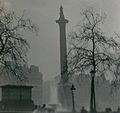
settled over a windless London, causing a temperature inversion with cold, stagnant air trapped under a layer (or "lid") of warm air. The resultant fog, mixed with chimney smoke, particulates such as those from vehicle exhausts, and other pollutants such as sulphur dioxide, formed a persistent smog, which blanketed the capital the following day. The presence of tarry particles of soot gave the smog its yellow-black colour, hence the nickname "peasouper". The absence of significant wind prevented its dispersal and allowed an unprecedented accumulation of pollutants.
Impact on London
Although London was accustomed to heavy fogs, this one was denser and longer-lasting than any previous fog. Visibility was reduced to a few yards ("It's like you were blind", commented one observer), making driving difficult or impossible.Public transport ceased, apart from the London Underground
London Underground
The London Underground is a rapid transit system serving a large part of Greater London and some parts of Buckinghamshire, Hertfordshire and Essex in England...
; and the ambulance service stopped functioning, forcing sick people to transport themselves to hospital. The smog even seeped indoors, resulting in the cancellation or abandonment of concerts and film screenings as visibility decreased in large enclosed spaces, and stages and screens became harder to see from the seats. Outdoor sports events were also affected.
Health impact
There was no panic, as London was renowned for its fog. In the weeks that ensued, however, statistics compiled by medical services found that the fog had killed 4,000 people. Most of the victims were very young, elderly, or had pre-existing respiratory problems. In February 1953, Lieutenant-Colonel LiptonMarcus Lipton
Marcus Lipton OBE was a British Labour Party politician.Lipton was educated at Bede Grammar School, Sunderland, and Merton College, Oxford with a scholarship. He studied law and was called to the Bar in 1926...
suggested in the House of Commons that the fog had caused 6,000 deaths and that 25,000 more people had claimed sickness benefits in London during that period.
Most of the deaths were caused by respiratory tract
Respiratory tract
In humans the respiratory tract is the part of the anatomy involved with the process of respiration.The respiratory tract is divided into 3 segments:*Upper respiratory tract: nose and nasal passages, paranasal sinuses, and throat or pharynx...
infections from hypoxia
Hypoxia (medical)
Hypoxia, or hypoxiation, is a pathological condition in which the body as a whole or a region of the body is deprived of adequate oxygen supply. Variations in arterial oxygen concentrations can be part of the normal physiology, for example, during strenuous physical exercise...
and as a result of mechanical obstruction of the air passages by pus
Pus
Pus is a viscous exudate, typically whitish-yellow, yellow, or yellow-brown, formed at the site of inflammatory during infection. An accumulation of pus in an enclosed tissue space is known as an abscess, whereas a visible collection of pus within or beneath the epidermis is known as a pustule or...
arising from lung infections caused by the smog. The lung infections were mainly bronchopneumonia
Bronchopneumonia
Bronchopneumonia or bronchial pneumonia or "Bronchogenic pneumonia" is the acute inflammation of the walls of the bronchioles...
or acute purulent
Pus
Pus is a viscous exudate, typically whitish-yellow, yellow, or yellow-brown, formed at the site of inflammatory during infection. An accumulation of pus in an enclosed tissue space is known as an abscess, whereas a visible collection of pus within or beneath the epidermis is known as a pustule or...
bronchitis
Bronchitis
Acute bronchitis is an inflammation of the large bronchi in the lungs that is usually caused by viruses or bacteria and may last several days or weeks. Characteristic symptoms include cough, sputum production, and shortness of breath and wheezing related to the obstruction of the inflamed airways...
superimposed upon chronic bronchitis
Bronchitis
Acute bronchitis is an inflammation of the large bronchi in the lungs that is usually caused by viruses or bacteria and may last several days or weeks. Characteristic symptoms include cough, sputum production, and shortness of breath and wheezing related to the obstruction of the inflamed airways...
.
More recent research suggests that the number of fatalities was considerably greater, at about 12,000.
Environmental impact
The death toll formed an important impetus to modern environmentalism, and it caused a rethinking of air pollution, as the smog had demonstrated its lethal potential.New regulations were implemented, restricting the use of dirty fuels in industry and banning black smoke.
During the years that ensued, various pieces of legislation, such as the City of London (Various Powers) Act 1954 and the Clean Air Acts of 1956
Clean Air Act 1956
The Clean Air Act 1956 was an Act of the Parliament of the United Kingdom passed in response to London's Great Smog of 1952. It was in effect until 1964, and sponsored by the Ministry of Housing and Local Government in England and the Department of Health for Scotland.The Act introduced a number of...
and 1968, restricted air pollution greatly.
Further reading
- Bell, Michelle L. and Davis, Devra Lee. Reassessment of the Lethal London Fog of 1952: Novel Indicators of Acute and Chronic Consequences of Acute Exposure to Air Pollution ("Environmental Health Perspectives", June 2001).
- Berridge, Virginia (Ed.). The Big Smoke: Fifty Years After the 1952 London Smog (University of London, Institute of Historical Research, 2005)
- Brimblecombe, Peter. The Big Smoke: A History of Air Pollution in London Since Medieval Times (Routledge Kegan & Paul, 1987).
- Greater London Authority. 50 Years On: The struggle for air quality in London since the great smog of December 1952 (Dec 2002).
External links
- A proper pea-souper. Photos of the 1952 London smog (nickelinthemachine.com).
- The London Smog Disaster of 1952 (Edinburgh University).
- 1952: London fog clears after days of chaos (BBC News, 9 December 1952).
- Days of toxic darkness (BBC News).