


Great Pacific Garbage Patch

Encyclopedia
The Great Pacific Garbage Patch, also described as the Pacific Trash Vortex, is a gyre of marine litter in the central North Pacific Ocean located roughly between 135°W
to 155°W
and 35°N
to 42°N
. The patch extends over an indeterminate area, with estimates ranging very widely depending on the degree of plastic concentration used to define the affected area.
The Patch is characterized by exceptionally high concentrations of pelagic plastic
s, chemical sludge, and other debris
that have been trapped by the currents of the North Pacific Gyre
. Despite its size and density
, the patch is not visible from satellite photography, since it consists primarily of suspended particulates in the upper water column. Since plastics break down to ever smaller polymers, concentrations of submerged particles are not visible from space, nor do they appear as a continuous debris field. Instead, the patch is defined as an area in which the mass of plastic debris in the upper water column is significantly higher than average.
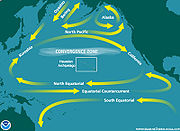 The Great Garbage Patch was predicted in a 1988 paper published by the National Oceanic and Atmospheric Administration
(NOAA) of the United States
. The prediction was based on results obtained by several Alaska-based researchers between 1985 and 1988 that measured neuston
ic plastic in the North Pacific Ocean. This research found high concentrations of marine debris accumulating in regions governed by ocean currents. Extrapolating from findings in the Sea of Japan
, the researchers hypothesized that similar conditions would occur in other parts of the Pacific where prevailing currents were favorable to the creation of relatively stable waters. They specifically indicated the North Pacific Gyre.
Charles J. Moore
, returning home through the North Pacific Gyre after competing in the Transpac
sailing race in 1997, came upon an enormous stretch of floating debris. Moore alerted the oceanographer
Curtis Ebbesmeyer
, who subsequently dubbed the region the "Eastern Garbage Patch" (EGP). The area is frequently featured in media reports as an exceptional example of marine pollution
. Moore's claim of having discovered a large, visible debris field is, however, a mischaracterization of the polluted region overall, since it consists primarily of particles that are generally invisible to the naked eye.
A similar patch of floating plastic debris is found in the Atlantic Ocean. See: North Atlantic Garbage Patch
.
. The garbage patch occupies a large and relatively stationary region of the North Pacific Ocean bound by the North Pacific Gyre (a remote area commonly referred to as the horse latitudes
). The gyre's rotational pattern draws in waste material from across the North Pacific Ocean, including coastal waters off North America and Japan. As material is captured in the currents, wind-driven surface currents gradually move floating debris toward the center, trapping it in the region.
The size of the patch is unknown, as large items readily visible from a boat deck are uncommon. Most debris consists of small plastic particles suspended at or just below the surface, making it impossible to detect by aircraft or satellite. Instead, the size of the patch is determined by sampling. Estimates of size range from 700000 square kilometre to more than 15000000 square kilometre (0.41% to 8.1% of the size of the Pacific Ocean), or, in some media reports, up to "twice the size of the continental United States". Such estimates, however, are conjectural based on the complexities of sampling and the need to assess findings against other areas.
Further, although the size of the patch is determined by a higher-than-normal degree of concentration of pelagic debris, there is no specific standard for determining the boundary between the "normal" and "elevated" levels of pollutants to provide a firm estimate of the affected area.
In August 2009, the Scripps Institution of Oceanography
/Project Kaisei
SEAPLEX survey mission of the Gyre found that plastic debris was present in 100 consecutive samples taken at varying depths and net sizes along a 1700 miles (2,735.9 km) path through the patch. The survey also confirmed that, while the debris field does contain large pieces, it is on the whole made up of smaller items that increase in concentration toward the Gyre's centre, and these 'confetti
-like' pieces are clearly visible just beneath the surface.
in the neustonic layer of water. Unlike debris, which biodegrades
, the photodegraded plastic disintegrates into ever smaller pieces while remaining a polymer
. This process continues down to the molecular level
.
As the plastic flotsam photodegrades into smaller and smaller pieces, it concentrates in the upper water column. As it disintegrates, the plastic ultimately becomes small enough to be ingested by aquatic organisms that reside near the ocean's surface. Thus, plastic waste enters the food chain
through its concentration in the neuston
.
Some plastics decompose within a year of entering the water, leaching potentially toxic chemicals such as bisphenol A
, PCBs
, and derivatives of polystyrene
.
. Assuming each particle of plastic averaged 5 mm x 5 mm, this would amount to only 8 m2 per km2 due to small particulates. Nonetheless, this represents a very high amount with respect to the overall ecology of the neuston. In many of the sampled areas, the overall concentration of plastics was seven times greater than the concentration of zooplankton
. Samples collected at deeper points in the water column found much lower concentrations of plastic particles (primarily monofilament fishing line pieces).
suggests the affected area may be twice the size of Hawaii
, while a recent study concluded that the patch might be smaller. This can be attributed to the fact that there is no specific standard for determining the boundary between the "normal" and "elevated" levels of pollutants and what constitutes being part of the patch. The size is determined by a higher-than-normal degree of concentration of pelagic debris in the water. Recent data collected from Pacific albatross
populations suggest there may be two distinct zones of concentrated debris in the Pacific.
The patch is not easily visible
because it consists of very small pieces, almost invisible to the naked eye , most of its contents are suspended beneath the surface of the ocean, and the relatively low density of the plastic debris at, in one scientific study, 5.1 kilograms of plastic per square kilometer of ocean area.
s and the Black-footed Albatross
. Besides the particles' danger to wildlife, on the microscopic level the floating debris can absorb organic pollutants from seawater, including PCBs
, DDT
, and PAHs
. Aside from toxic effects, when ingested, some of these are mistaken by the endocrine system as estradiol
, causing hormone disruption in the affected animal. These toxin-containing plastic pieces are also eaten by jellyfish
, which are then eaten by larger fish.
On the macroscopic level, the physical size of the plastic kills birds and turtles as the animals digestion
can not break down the plastic.
Many of these fish are then consumed by humans, resulting in their ingestion of toxic chemicals. Marine plastics also facilitate the spread of invasive species that attach to floating plastic in one region and drift long distances to colonize other ecosystems.
Research has shown that this plastic marine debris affects at least 267 species worldwide and a few of the 267 species reside in the North Pacific Gyre.
s from the oceans.
The JUNK raft
project was a trans-Pacific sailing voyage from June to August 2008 made to highlight the plastic in the patch, organized by the Algalita Marine Research Foundation.
Project Kaisei
is a project to study and clean up the garbage patch launched in March 2009. In August 2009, two project vessels, the New Horizon and the Kaisei
, embarked on a voyage to research the patch and determine the feasibility of commercial scale collection and recycling.
The SEAPLEX expedition, a group of researchers from Scripps Institution of Oceanography
, spent 19 days on the ocean in August, 2009 researching the patch. Their primary goal was to describe the abundance and distribution of plastic in the gyre in the most rigorous study to date. Researchers were also looking at the impact of plastic on mesopelagic fish, such as lanternfish
. This group utilized a fully capable dedicated oceanographic research vessel, the 170 ft (51.8 m) long New Horizon .
135th meridian west
The meridian 135° west of Greenwich is a line of longitude that extends from the North Pole across the Arctic Ocean, North America, the Pacific Ocean, the Southern Ocean, and Antarctica to the South Pole....
to 155°W
155th meridian west
The meridian 155° west of Greenwich is a line of longitude that extends from the North Pole across the Arctic Ocean, North America, the Pacific Ocean, the Southern Ocean, and Antarctica to the South Pole....
and 35°N
35th parallel north
The 35th parallel north is a circle of latitude that is 35 degrees north of the Earth's equatorial plane. It crosses Africa, the Mediterranean Sea, Asia, the Pacific Ocean, North America and the Atlantic Ocean....
to 42°N
42nd parallel north
The 42nd parallel north is a circle of latitude that is 42 degrees north of the Earth's equatorial plane. It crosses Europe, the Mediterranean Sea, Asia, the Pacific Ocean, North America, and the Atlantic Ocean....
. The patch extends over an indeterminate area, with estimates ranging very widely depending on the degree of plastic concentration used to define the affected area.
The Patch is characterized by exceptionally high concentrations of pelagic plastic
Plastic
A plastic material is any of a wide range of synthetic or semi-synthetic organic solids used in the manufacture of industrial products. Plastics are typically polymers of high molecular mass, and may contain other substances to improve performance and/or reduce production costs...
s, chemical sludge, and other debris
Debris
Debris is rubble, wreckage, ruins, litter and discarded garbage/refuse/trash, scattered remains of something destroyed, or, in geology, large rock fragments left by a melting glacier etc. The singular form of debris is debris...
that have been trapped by the currents of the North Pacific Gyre
North Pacific Gyre
The North Pacific Gyre, located in the northern Pacific Ocean, is one of the five major oceanic gyres. This gyre comprises most of the northern Pacific Ocean. It is the largest ecosystem on our planet...
. Despite its size and density
Density
The mass density or density of a material is defined as its mass per unit volume. The symbol most often used for density is ρ . In some cases , density is also defined as its weight per unit volume; although, this quantity is more properly called specific weight...
, the patch is not visible from satellite photography, since it consists primarily of suspended particulates in the upper water column. Since plastics break down to ever smaller polymers, concentrations of submerged particles are not visible from space, nor do they appear as a continuous debris field. Instead, the patch is defined as an area in which the mass of plastic debris in the upper water column is significantly higher than average.
Discovery
National Oceanic and Atmospheric Administration
The National Oceanic and Atmospheric Administration , pronounced , like "noah", is a scientific agency within the United States Department of Commerce focused on the conditions of the oceans and the atmosphere...
(NOAA) of the United States
United States
The United States of America is a federal constitutional republic comprising fifty states and a federal district...
. The prediction was based on results obtained by several Alaska-based researchers between 1985 and 1988 that measured neuston
Neuston
right|250px|thumb|Two [[water strider]]s, common neustonsNeuston is the collective term for the organisms that float on the top of water or live right under the surface . Neustons are made up of some species of fish , beetles , protozoans, bacteria and spiders...
ic plastic in the North Pacific Ocean. This research found high concentrations of marine debris accumulating in regions governed by ocean currents. Extrapolating from findings in the Sea of Japan
Sea of Japan
The Sea of Japan is a marginal sea of the western Pacific Ocean, between the Asian mainland, the Japanese archipelago and Sakhalin. It is bordered by Japan, North Korea, Russia and South Korea. Like the Mediterranean Sea, it has almost no tides due to its nearly complete enclosure from the Pacific...
, the researchers hypothesized that similar conditions would occur in other parts of the Pacific where prevailing currents were favorable to the creation of relatively stable waters. They specifically indicated the North Pacific Gyre.
Charles J. Moore
Charles J. Moore
Charles J. Moore is an oceanographer and racing boat captain known for articles that recently brought attention to the 'Great Pacific Garbage Patch', an area of the Pacific Ocean strewn with floating plastic debris which is twice the size of Texas....
, returning home through the North Pacific Gyre after competing in the Transpac
Transpacific Yacht Race
The Transpacific Yacht Race is an offshore yacht race starting off Point Fermin, San Pedro, near Los Angeles, and ending off Diamond Head Lighthouse in Honolulu, a distance of around . Started in 1906, it is one of yachting's premier offshore races and attracts entrants from all over the world...
sailing race in 1997, came upon an enormous stretch of floating debris. Moore alerted the oceanographer
Oceanography
Oceanography , also called oceanology or marine science, is the branch of Earth science that studies the ocean...
Curtis Ebbesmeyer
Curtis Ebbesmeyer
Curtis Charles Ebbesmeyer is an American oceanographer who, in retirement, has studied the movement of flotsam. He came to public attention through his interest in The First Years' rubber ducks a consignment of bath toys washed into the Pacific Ocean in 1992.- Life and career :Ebbesmeyer was born...
, who subsequently dubbed the region the "Eastern Garbage Patch" (EGP). The area is frequently featured in media reports as an exceptional example of marine pollution
Marine pollution
Marine pollution occurs when harmful, or potentially harmful effects, can result from the entry into the ocean of chemicals, particles, industrial, agricultural and residential waste, noise, or the spread of invasive organisms. Most sources of marine pollution are land based...
. Moore's claim of having discovered a large, visible debris field is, however, a mischaracterization of the polluted region overall, since it consists primarily of particles that are generally invisible to the naked eye.
A similar patch of floating plastic debris is found in the Atlantic Ocean. See: North Atlantic Garbage Patch
North Atlantic Garbage Patch
The North Atlantic Garbage Patch is an area of marine debris found floating within the North Atlantic Gyre, originally documented in 1972. The patch is estimated to be hundreds of kilometers across in size, with a density of over 200,000 pieces of debris per square kilometer...
.
Formation
It is thought that, like other areas of concentrated marine debris in the world's oceans, the Great Pacific Garbage Patch formed gradually as a result of marine pollution gathered by oceanic currentsOcean current
An ocean current is a continuous, directed movement of ocean water generated by the forces acting upon this mean flow, such as breaking waves, wind, Coriolis effect, cabbeling, temperature and salinity differences and tides caused by the gravitational pull of the Moon and the Sun...
. The garbage patch occupies a large and relatively stationary region of the North Pacific Ocean bound by the North Pacific Gyre (a remote area commonly referred to as the horse latitudes
Horse latitudes
Horse Latitudes or Subtropical High are subtropical latitudes between 30 and 35 degrees both north and south. This region, under a ridge of high pressure called the subtropical high, is an area which receives little precipitation and has variable winds mixed with calm.The consistently warm, dry...
). The gyre's rotational pattern draws in waste material from across the North Pacific Ocean, including coastal waters off North America and Japan. As material is captured in the currents, wind-driven surface currents gradually move floating debris toward the center, trapping it in the region.
The size of the patch is unknown, as large items readily visible from a boat deck are uncommon. Most debris consists of small plastic particles suspended at or just below the surface, making it impossible to detect by aircraft or satellite. Instead, the size of the patch is determined by sampling. Estimates of size range from 700000 square kilometre to more than 15000000 square kilometre (0.41% to 8.1% of the size of the Pacific Ocean), or, in some media reports, up to "twice the size of the continental United States". Such estimates, however, are conjectural based on the complexities of sampling and the need to assess findings against other areas.
Net-based surveys are less subjective than direct observations but are limited regarding the area that can be sampled (net apertures 1–2 m and ships typically have to slow down to deploy nets, requiring dedicated ship's time). The plastic debris sampled is determined by net mesh size, with similar mesh sizes required to make meaningful comparisons among studies. Floating debris typically is sampled with a neustonNeustonright|250px|thumb|Two [[water strider]]s, common neustonsNeuston is the collective term for the organisms that float on the top of water or live right under the surface . Neustons are made up of some species of fish , beetles , protozoans, bacteria and spiders...
or manta trawlManta trawlA Manta Trawl is a net system for sampling the surface of the ocean. It resembles a manta ray, with metal wings and a broad mouth. The net it pulls is made of thin mesh, and the whole trawl is towed behind a scientific research vessel...
net lined with 0.33 mm mesh. Given the very high level of spatial clumping in marine litter, large numbers of net tows are required to adequately characterize the average abundance of litter at sea. Long-term changes in plastic meso-litter have been reported using surface net tows: in the North Pacific Subtropical Gyre in 1999, plastic abundance was 335 000 items km2 and 5.1 kg km2, roughly an order of magnitude greater than samples collected in the 1980s. Similar dramatic increases in plastic debris have been reported off Japan. However, caution is needed in interpreting such findings, because of the problems of extreme spatial heterogeneity, and the need to compare samples from equivalent water masses, which is to say that, if an examination of the same parcel of water a week apart is conducted, an order of magnitude change in plastic concentration could be observed.
Further, although the size of the patch is determined by a higher-than-normal degree of concentration of pelagic debris, there is no specific standard for determining the boundary between the "normal" and "elevated" levels of pollutants to provide a firm estimate of the affected area.
In August 2009, the Scripps Institution of Oceanography
Scripps Institution of Oceanography
Scripps Institution of Oceanography in La Jolla, California, is one of the oldest and largest centers for ocean and earth science research, graduate training, and public service in the world...
/Project Kaisei
Project Kaisei
Project Kaisei is a scientific and commercial mission to study and clean up the Great Pacific Garbage Patch, a large body of floating debris trapped in the Pacific Ocean by the currents of the North Pacific Gyre. Discovered by NOAA, the patch is estimated to contain 20 times the density of...
SEAPLEX survey mission of the Gyre found that plastic debris was present in 100 consecutive samples taken at varying depths and net sizes along a 1700 miles (2,735.9 km) path through the patch. The survey also confirmed that, while the debris field does contain large pieces, it is on the whole made up of smaller items that increase in concentration toward the Gyre's centre, and these 'confetti
Confetti
Confetti is a multitude of pieces of paper, mylar or metallic material which is usually thrown at parades and celebrations, especially weddings . Confetti is made in a variety of colors, and commercially available confetti is available in imaginative shapes...
-like' pieces are clearly visible just beneath the surface.
Sources of pollutants
There is strong scientific data concerning the origins of pelagic plastics. The figure that an estimated 80% of the garbage comes from land-based sources and 20% from ships is derived from an unsubstantiated estimate. Ship-generated pollution is a source of concern, since a typical 3,000-passenger cruise ship produces over eight tons of solid waste weekly, a major amount of which ends up in the patch, as most of the waste is organic. Pollutants range in size from abandoned fishing nets to micro-pellets used in abrasive cleaners. Currents carry debris from the west coast of North America to the gyre in about six years, and debris from the east coast of Asia in a year or less. An international research project led by Dr. Hideshige Takada of Tokyo University studying plastic pellets, or nurdles, from beaches around the world may provide further clues about the origins of pelagic plastic.Plastic photodegradation in the ocean
The Great Pacific Garbage Patch has one of the highest levels known of plastic particulate suspended in the upper water column. As a result, it is one of several oceanic regions where researchers have studied the effects and impact of plastic photodegradationPhotodegradation
Photodegradation is degradation of a photodegradable molecule caused by the absorption of photons, particularly those wavelengths found in sunlight, such as infrared radiation, visible light, and ultraviolet light. However, other forms of electromagnetic radiation can cause photodegradation...
in the neustonic layer of water. Unlike debris, which biodegrades
Biodegradation
Biodegradation or biotic degradation or biotic decomposition is the chemical dissolution of materials by bacteria or other biological means...
, the photodegraded plastic disintegrates into ever smaller pieces while remaining a polymer
Polymer
A polymer is a large molecule composed of repeating structural units. These subunits are typically connected by covalent chemical bonds...
. This process continues down to the molecular level
Molecule
A molecule is an electrically neutral group of at least two atoms held together by covalent chemical bonds. Molecules are distinguished from ions by their electrical charge...
.
As the plastic flotsam photodegrades into smaller and smaller pieces, it concentrates in the upper water column. As it disintegrates, the plastic ultimately becomes small enough to be ingested by aquatic organisms that reside near the ocean's surface. Thus, plastic waste enters the food chain
Food chain
A food web depicts feeding connections in an ecological community. Ecologists can broadly lump all life forms into one of two categories called trophic levels: 1) the autotrophs, and 2) the heterotrophs...
through its concentration in the neuston
Neuston
right|250px|thumb|Two [[water strider]]s, common neustonsNeuston is the collective term for the organisms that float on the top of water or live right under the surface . Neustons are made up of some species of fish , beetles , protozoans, bacteria and spiders...
.
Some plastics decompose within a year of entering the water, leaching potentially toxic chemicals such as bisphenol A
Bisphenol A
Bisphenol A is an organic compound with two phenol functional groups. It is used to make polycarbonate plastic and epoxy resins, along with other applications....
, PCBs
Polychlorinated biphenyl
Polychlorinated biphenyls are a class of organic compounds with 2 to 10 chlorine atoms attached to biphenyl, which is a molecule composed of two benzene rings. The chemical formula for PCBs is C12H10-xClx...
, and derivatives of polystyrene
Polystyrene
Polystyrene ) also known as Thermocole, abbreviated following ISO Standard PS, is an aromatic polymer made from the monomer styrene, a liquid hydrocarbon that is manufactured from petroleum by the chemical industry...
.
Weight of plastics through water column
Charles Moore has estimated the mass of the Great Pacific Garbage Patch at 100 million tons.Density of neustonic plastics
The patch is not a visibly dense field of floating debris. The process of disintegration means that the plastic particulate in much of the affected region is too small to be seen. In a 2001 study, researchers (including Charles Moore) found concentrations of plastic particles at 334,721 pieces per km2 with a mean mass of 5,114 grams (11.27 lbs) per km2, in the neustonNeuston
right|250px|thumb|Two [[water strider]]s, common neustonsNeuston is the collective term for the organisms that float on the top of water or live right under the surface . Neustons are made up of some species of fish , beetles , protozoans, bacteria and spiders...
. Assuming each particle of plastic averaged 5 mm x 5 mm, this would amount to only 8 m2 per km2 due to small particulates. Nonetheless, this represents a very high amount with respect to the overall ecology of the neuston. In many of the sampled areas, the overall concentration of plastics was seven times greater than the concentration of zooplankton
Zooplankton
Zooplankton are heterotrophic plankton. Plankton are organisms drifting in oceans, seas, and bodies of fresh water. The word "zooplankton" is derived from the Greek zoon , meaning "animal", and , meaning "wanderer" or "drifter"...
. Samples collected at deeper points in the water column found much lower concentrations of plastic particles (primarily monofilament fishing line pieces).
Size and visibility
Although many media and advocacy reports have suggested that the patch extends over an area larger than the continental U.S., recent research sponsored by the National Science FoundationNational Science Foundation
The National Science Foundation is a United States government agency that supports fundamental research and education in all the non-medical fields of science and engineering. Its medical counterpart is the National Institutes of Health...
suggests the affected area may be twice the size of Hawaii
Hawaii
Hawaii is the newest of the 50 U.S. states , and is the only U.S. state made up entirely of islands. It is the northernmost island group in Polynesia, occupying most of an archipelago in the central Pacific Ocean, southwest of the continental United States, southeast of Japan, and northeast of...
, while a recent study concluded that the patch might be smaller. This can be attributed to the fact that there is no specific standard for determining the boundary between the "normal" and "elevated" levels of pollutants and what constitutes being part of the patch. The size is determined by a higher-than-normal degree of concentration of pelagic debris in the water. Recent data collected from Pacific albatross
Albatross
Albatrosses, of the biological family Diomedeidae, are large seabirds allied to the procellariids, storm-petrels and diving-petrels in the order Procellariiformes . They range widely in the Southern Ocean and the North Pacific...
populations suggest there may be two distinct zones of concentrated debris in the Pacific.
The patch is not easily visible
Color vision
Color vision is the capacity of an organism or machine to distinguish objects based on the wavelengths of the light they reflect, emit, or transmit...
because it consists of very small pieces, almost invisible to the naked eye , most of its contents are suspended beneath the surface of the ocean, and the relatively low density of the plastic debris at, in one scientific study, 5.1 kilograms of plastic per square kilometer of ocean area.
Effect on wildlife
Some of these long-lasting plastics end up in the stomachs of marine birds and animals, and their young, including sea turtleSea turtle
Sea turtles are marine reptiles that inhabit all of the world's oceans except the Arctic.-Distribution:...
s and the Black-footed Albatross
Black-footed Albatross
The Black-footed Albatross, Phoebastria nigripes, is a large seabird from the North Pacific of the albatross family Diomedeidae. It is one of three species of albatross that range in the northern hemisphere, nesting on isolated tropical islands...
. Besides the particles' danger to wildlife, on the microscopic level the floating debris can absorb organic pollutants from seawater, including PCBs
Polychlorinated biphenyl
Polychlorinated biphenyls are a class of organic compounds with 2 to 10 chlorine atoms attached to biphenyl, which is a molecule composed of two benzene rings. The chemical formula for PCBs is C12H10-xClx...
, DDT
DDT
DDT is one of the most well-known synthetic insecticides. It is a chemical with a long, unique, and controversial history....
, and PAHs
Polycyclic aromatic hydrocarbon
Polycyclic aromatic hydrocarbons , also known as poly-aromatic hydrocarbons or polynuclear aromatic hydrocarbons, are potent atmospheric pollutants that consist of fused aromatic rings and do not contain heteroatoms or carry substituents. Naphthalene is the simplest example of a PAH...
. Aside from toxic effects, when ingested, some of these are mistaken by the endocrine system as estradiol
Estradiol
Estradiol is a sex hormone. Estradiol is abbreviated E2 as it has 2 hydroxyl groups in its molecular structure. Estrone has 1 and estriol has 3 . Estradiol is about 10 times as potent as estrone and about 80 times as potent as estriol in its estrogenic effect...
, causing hormone disruption in the affected animal. These toxin-containing plastic pieces are also eaten by jellyfish
Jellyfish
Jellyfish are free-swimming members of the phylum Cnidaria. Medusa is another word for jellyfish, and refers to any free-swimming jellyfish stages in the phylum Cnidaria...
, which are then eaten by larger fish.
On the macroscopic level, the physical size of the plastic kills birds and turtles as the animals digestion
Digestion
Digestion is the mechanical and chemical breakdown of food into smaller components that are more easily absorbed into a blood stream, for instance. Digestion is a form of catabolism: a breakdown of large food molecules to smaller ones....
can not break down the plastic.
Many of these fish are then consumed by humans, resulting in their ingestion of toxic chemicals. Marine plastics also facilitate the spread of invasive species that attach to floating plastic in one region and drift long distances to colonize other ecosystems.
Research has shown that this plastic marine debris affects at least 267 species worldwide and a few of the 267 species reside in the North Pacific Gyre.
Research and cleanup
In April 2008, Richard Sundance Owen, a building contractor and scuba dive instructor, formed the Environmental Cleanup Coalition to address the issue of North Pacific pollution. ECC collaborates with other groups to identify methods to safely remove plastic and persistent organic pollutantPersistent organic pollutant
thumb|right|275px|State parties to the Stockholm Convention on Persistent Organic PollutantsPersistent organic pollutants are organic compounds that are resistant to environmental degradation through chemical, biological, and photolytic processes...
s from the oceans.
The JUNK raft
Junk raft
A junk raft is a type of home-built watercraft made of plastic bottles or other recycled materials constructed by and for three different sorts of audiences: artists and community-minded groups organizing recreational flotillas; environmentally concerned individuals seeking to draw attention to the...
project was a trans-Pacific sailing voyage from June to August 2008 made to highlight the plastic in the patch, organized by the Algalita Marine Research Foundation.
Project Kaisei
Project Kaisei
Project Kaisei is a scientific and commercial mission to study and clean up the Great Pacific Garbage Patch, a large body of floating debris trapped in the Pacific Ocean by the currents of the North Pacific Gyre. Discovered by NOAA, the patch is estimated to contain 20 times the density of...
is a project to study and clean up the garbage patch launched in March 2009. In August 2009, two project vessels, the New Horizon and the Kaisei
Kaisei (ship)
The STS Kaisei , meaning “Sea Star” in the Japanese language, is a steel-hulled brigantine designed by Zygmunt Choreń. It was built in Gdańsk, Poland in 1987...
, embarked on a voyage to research the patch and determine the feasibility of commercial scale collection and recycling.
The SEAPLEX expedition, a group of researchers from Scripps Institution of Oceanography
Scripps Institution of Oceanography
Scripps Institution of Oceanography in La Jolla, California, is one of the oldest and largest centers for ocean and earth science research, graduate training, and public service in the world...
, spent 19 days on the ocean in August, 2009 researching the patch. Their primary goal was to describe the abundance and distribution of plastic in the gyre in the most rigorous study to date. Researchers were also looking at the impact of plastic on mesopelagic fish, such as lanternfish
Lanternfish
Cooper Lanternfishes are small mesopelagic fish of the large family Myctophidae. One of two families in the order Myctophiformes, the Myctophidae are represented by 246 species in 33 genera, and are found in oceans worldwide. They are aptly named after their conspicuous use of bioluminescence...
. This group utilized a fully capable dedicated oceanographic research vessel, the 170 ft (51.8 m) long New Horizon .
See also
- Indian Ocean Garbage PatchIndian Ocean Garbage PatchThe Indian Ocean Garbage Patch, discovered in 2010, is a gyre of marine litter suspended in the upper water column of the central Indian Ocean, specifically the Indian Ocean Gyre, one of the five major oceanic gyres. The patch does not appear as a continuous debris field...
- North Atlantic Garbage PatchNorth Atlantic Garbage PatchThe North Atlantic Garbage Patch is an area of marine debris found floating within the North Atlantic Gyre, originally documented in 1972. The patch is estimated to be hundreds of kilometers across in size, with a density of over 200,000 pieces of debris per square kilometer...
- Ecosystem of the North Pacific Subtropical GyreEcosystem of the North Pacific Subtropical GyreThe North Pacific Subtropical Gyre is the largest contiguous ecosystem on earth. In oceanography, a subtropical gyre is a ring-like system of ocean currents rotating clockwise in the Northern Hemisphere and counterclockwise in the Southern Hemisphere caused by the Coriolis Effect. They generally...
- Marine debrisMarine debrisMarine debris, also known as marine litter, is human created waste that has deliberately or accidentally become afloat in a lake, sea, ocean or waterway. Oceanic debris tends to accumulate at the centre of gyres and on coastlines, frequently washing aground, when it is known as beach litter or...
- Plastic particle water pollution
Further reading
- A comparison of plastic and plankton in the North Pacific Central Gyre — Charles J Moore, Shelly L Moore, Molly K Leecaster and Stephen B Weisberg
- Density of plastic particles found in zooplankton trawls from coastal waters of California to the North Pacific Central Gyre — Charles J Moore, Gwen L Lattin and Ann F Zellers
- The quantitative distribution and characteristics of neuston plastic in the North Pacific Ocean, 1984-1988 — R H Day, D G Shaw and S E Ignell (1988)
- Thomas Morton, 'Oh, This is Great, Humans Have Finally Ruined the Ocean', Vice Magazine, Vol. 6, No. 2 (2007), pp. 78–81.
- Moby-Duck: The True Story of 28,800 Bath Toys Lost at Sea by Donovan Hohn
External links
- Pacific Garbage Patch International Treaty
- greatgarbagepatch.org
- Pacific Garbage Patch - Smithsonian Ocean Portal
- "Plastic Surf" The Unhealthful Afterlife of Toys and Packaging: Small remnants of toys, bottles and packaging persist in the ocean, harming marine life and possibly even us by Jennifer Ackerman Scientific AmericanScientific AmericanScientific American is a popular science magazine. It is notable for its long history of presenting science monthly to an educated but not necessarily scientific public, through its careful attention to the clarity of its text as well as the quality of its specially commissioned color graphics...
August 2010 - photographer Chris Jordan, who recently traveled to a remote part of the Pacific Ocean to document effects of the world's largest known mass of garbage. in Seed (magazine)Seed (magazine)Seed is an online science magazine published by Seed Media Group. The magazine looks at big ideas in science, important issues at the intersection of science and society, and the people driving global science culture...
- Scripps Environmental Accumulation of Plastic Expedition (SEAPLEX) — Scripps Institution of Oceanography, UC San Diego
- The Project Kaisei Voyage Tracker — Project Kaisei and Ojingolabs
- 5 Gyres - Understanding Plastic Marine Pollution — Algalita, Livable Legacy
- The trash vortex — Greenpeace
- Navigating the Pacific's 'Garbage Patch' — National Public Radio and me
- Marine Research, Education and Restoration — Algalita Marine Research Foundation
- Images & video from the North Pacific gyre — WordPress.com
- Sea of Trash - New York Times Magazine
- Captain Charles Moore on the seas of plastic
- Charles Moore: Sailing the Great Pacific Garbage Patch - TED Conference talk (2009)
- E-Mails From the Great Pacific Garbage Patch by Laurie DavidLaurie DavidLaurie David is an American environmental activist. She serves as a trustee on the Natural Resources Defense Council and a member of the Advisory Board of the Children's Nature Institute and is a contributing blogger to The Huffington Post.-Personal life:David was born as Laurie Ellen Lennard, and...
, The Huffington Post, June 15, 2009 - PSA Video: "Plastics Kill" by The Surfrider Foundation's Rise Above Plastics Program
- The Plastiki on Twitter