


Great Orme

Encyclopedia
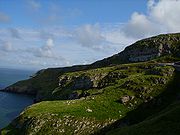
The Great Orme is a prominent limestone
headland
on the north
coast of Wales
situated in Llandudno
. It is referred to as Cyngreawdr Fynydd in a poem by the 12th century poet Gwalchmai ap Meilyr
. It is echoed by the Little Orme
, a smaller but very similar limestone headland, which is on the eastern side of Llandudno Bay in the parish of Llanrhos
.
, Heritage Coast
, Country Park, and Site of Special Scientific Interest
), being an area 2 miles (3.2 km) long by 1 miles (1.6 km) wide. It is home to a long-established herd of about two hundred feral
Kashmir goats (acquired from Queen Victoria
). There are numerous paths for walking on the summit, including a section of the North Wales Path
, a long distance route. About half the Great Orme is in use as farmland, mostly for sheep grazing.
 The geology
of the Great Orme is limestone
and the surface is particularly noted for the limestone pavements covering several headland areas. There are also rich seams of Dolomite
-hosted copper ore.
The Great Orme has a very rich flora, including most notably the only known site of the critically endangered Wild Cotoneaster Cotoneaster cambricus
, of which only six wild plants are known.
Many of the flowers growing in shallow lime-rich earth on the headland have developed from the alpine
sub-Arctic species that developed following the last ice-age.
Spring and early summer flowers include Bloody Cranesbill
, Thrift
and Sea Campion, clinging to the sheer rock face, while Pyramidal Orchid
, Common Rockrose and Wild Thyme
carpet the grassland. The old mines and quarries also provide suitable habitat for species of plants including Spring Squill growing on the old copper workings.
The White Horehound (Marrubium vulgare), which is found growing on the western-most slopes of the Orme is said to have been used, and perhaps cultivated, by fourteenth century monks, no doubt to make herbal remedies including cough mixtures. The rare Horehound Plume Moth
(Pterophorus spilodactylus) lays her eggs amongst the silky leaves and its caterpillars rely for food solely upon this one plant.
The headland is the habitat of several endangered species of butterflies and moth
s, including the Silky Wave, the Silver-studded Blue
(Plebejus argus subsp. caernesis) and the Grayling
(Hipparchia semele thyone) These last two have adapted to the Great Orme by appearing earlier in the year to take advantage of the limestone flowers and grasses. Also they are smaller than in other parts of the country and are recognised as a definite subspecies.
The Great Orme is reported as the northernmost known habitat within Britain for several ‘southern’ species of spider
notably: Segestria bavarica, Episinus truncatus
, Micrargus laudatus, Drassyllus praeficus, Liocranum rupicola and Ozyptila
scabricula.
The caves and abandoned mine workings are home to large colonies of the rare Horseshoe bat
. This small flying mammal navigates the caves and tunnels by using echo location to obtain a mental picture of its surroundings. During the daytime, Horseshoe bats are found suspended from the roof of tunnels and caves, with their wings tightly wrapped around their bodies. Only at dusk do the bats leave the caves and mine shafts, to feed on beetles and moths.
The cliffs are host to colonies of seabirds (such as guillemot
s, kittiwake
s, razorbill
s and even fulmar
s as well as gull
s). The Great Orme is also home to many resident and migrant land birds including raven
s, little Owl
s and peregrine falcon
s.
Below the cliffs, the rock-pools around the headland are a rich and varied habitat for aquatic plants and animals including barnacle
s, red beadlet anemone
s and hermit crab
s.
. The Manor of Gogarth (which included all three townships) had been bestowed on Anian, Bishop of Bangor by King Edward I
in 1284 in recognition of services rendered to the crown, notably the baptism
of the first English Prince of Wales
, newly born at Caernarfon
. The palace was burnt down by Owain Glyndŵr
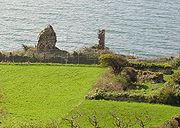
in 1400 and the ruins have mostly been washed away together with much of the township by coastal erosion in the Conwy Estuary.
The significant agricultural yet north facing township of Cyngreawdr includes the original parish church
and rectory
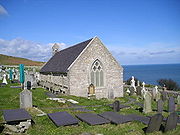
of St Tudno, a sixth or seventh century foundation. Following the Glyndŵr uprising, the villagers of the Creuddyn peninsula were harshly taxed and by 1507 they had nearly all fled their homes. Henceforth the cultivated land lay fallow and is now grazed by sheep and goats. Llandudno's Victorian cemetery, which is still in regular use, was laid out in 1859 adjacent to the 12th century church of Saint Tudno where open-air services are held every Sunday Morning in summer. Nearby are several large ancient stones that have become shrouded in folklore
and also an unexplained stone lined avenue called Hwylfa'r Ceirw leading towards Cilfin Ceirw (Precipice of Deer).
The third township was Yn Wyddfid clustered below the Iron Age
hill fort
of Pen y Dinas at the north eastern "corner" of the Great Orme. With the reopening of the copper mines from the 18th century onwards, this township grew considerably in size with the streets and cottages of the mining village laid out on the largely abandoned agricultural holdings.
Ffynnon Llygaid
Possibly one of the wells supplying the needs of the once populous Gogarth community before much of it was lost to coastal erosion.
Ffynnon Gogarth
The main water source for Gogarth and in the later eighteenth and early nineteenth centuries the power source to operate the famous Tom and Gerry engine that though a long series of Brammock rods powered the mine water pumps at the Higher shaft near the summit above Pyllau.
Ffynnon Powel
One of the water supplies together with ffynnon Tudno and ffynnon Rufeinig serving the medieval farming community of Cyngreawdr.
Ffynnon Galchog
This well, near Mynydd Isaf, to the north of Pen Dinas, is a source of lime-rich water known for its petrifying
qualities, it is one of two wells known to have been used in the washing of copper ores.
Ffynnon Tudno
Situated beyond the road, near the north-east corner of St Tudno's Church, ffynnon Tudno was, together with ffynnon Rufeinig, a principal source of water for the community settled round the church.
Ffynnon Rufeinig
Translated Roman Well it takes its name from the tradition that Roman copper miners used its waters to wash the copper ores mined nearby.
Ffynnon Llech
A spring of water located in Ogof Llech, a cave on the headland very difficult of access, and claimed to have been used as a hermitage by Saint Tudno a sixth century monk of Bangor-is-y-Coed who established the first church here.
Ffynnon Gaseg
Literally "Mare's well" this spring was revealed, at the side of the road, about half way round and near the highest point (and where it can still be seen), during the construction of the Marine Drive in the nineteenth century. It was thus ideally situated to refresh the horses on that five mile carriage drive round the base of the Great Orme.
 The Great Orme Mines are possibly the most important copper mines of the Bronze Age
yet discovered and excavated. Apparently abandoned around 600 BC, but with some evidence of Roman patronage, the mines were reopened in 1692 and continued to be worked until the end of the 19th century. It is possible that some of the copper
from the mine was exported to Continental Europe
, even in the Bronze Age. In addition to the three main mining areas, there are many open-cast
bell pit
mines along the lines of the main geological faults.
In the 20th century the mines were once again reopened, and the Bronze Age mine workings are now a fee-paying attraction for the public to experience.
and the Lake District
are visible on the horizon.
 A cabin-lift
(built 1969) and the Great Orme Tramway
, a vintage tram
system (built 1902), convey visitors to the summit of the Great Orme, past one of only two artificial ski
slopes in North Wales, complete with one of the longest toboggan
runs in the UK
.
Around the lower slopes of the Orme are landscaped gardens in the Happy Valley and terraces in the Haulfre Garden on the landward facing steeply sloping southern side. Walkways link the Haulfre Gardens with the western end of the Marine Drive.
The 'Marine Drive' toll road runs around the coastal perimeter of the Orme and leads to St. Tudno's Church, the award-winning Bronze Age
Copper Mine and to the Great Orme Summit complex with car park. The toll road ticket also pays for the parking at the Summit Complex.
Among the summit complex attractions are a tourist shop, cafeteria, visitors' centre, a play area, a licensed hotel, cable car
terminal and funicular railway/tram terminal.
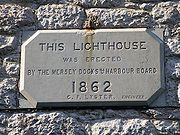
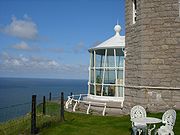
On the northernmost point of the Orme there is the decommissioned Llandudno lighthouse
which has been converted to a small bed & breakfast guest house with accommodation for eight guests. Nearby, on the Marine Drive, is the old established "Rest and be thankful" café with a large car park.
coastal gunnery school was transferred from Shoeburyness
to the Great Orme in 1940 (and additionally to the Little Orme in 1941) during the Second World War. Target practice was undertaken from the headland to anchored boats. The foundations of some of the buildings and installations remain and can be seen from the western end of the Marine Drive. There was also a Chain Home Low
radar
station operated by the Royal Air Force
at the hotel during World War II
.
 Both the Great and Little Ormes have been etymologised
to the Old Norse
word for sea serpent
(transliterated to urm or orm - the English word worm
having the same origin). Marauding Vikings are thus said to have believed that the Ormes (and the wider Creuddyn peninsula
) resembled a sea serpent
- with the Great Orme being the serpent's head - as their boats came in. But it is very difficult to substantiate this belief because the Vikings left us no written texts, and although they certainly raided the area they do not appear to have colonised it. There are other Norse names in the kingdom of Gwynedd (such as Point of Ayr), but etymology
is an imprecise tool.
Until the coming of tourism in the 19th century (and the first tourists and developers came by sea), the name used for the wider peninsula as a whole was usually Creuddyn
(the name of the medieval cwmwd in the area) but Y Gogarth or Pen y Gogarth for the Orme itself, and the name Orme appears to have been used for the headland as seen from the sea. This is the case in the "Plan of the Bay & Harbour of Conway in Caernarvon Shire" by Lewis Morris and published in 1748, which map boldly shows the name "CREUDDYN" in the body of the peninsula and applies the name "Orme's Head" beyond the Great Orme headland at its north-westerly seaward point.
Limestone
Limestone is a sedimentary rock composed largely of the minerals calcite and aragonite, which are different crystal forms of calcium carbonate . Many limestones are composed from skeletal fragments of marine organisms such as coral or foraminifera....
headland
Headlands and bays
Headlands and bays are two related features of the coastal environment.- Geology and geography :Headlands and bays are often found on the same coastline. A bay is surrounded by land on three sides, whereas a headland is surrounded by water on three sides. Headlands are characterized by high,...
on the north
North Wales
North Wales is the northernmost unofficial region of Wales. It is bordered to the south by the counties of Ceredigion and Powys in Mid Wales and to the east by the counties of Shropshire in the West Midlands and Cheshire in North West England...
coast of Wales
Wales
Wales is a country that is part of the United Kingdom and the island of Great Britain, bordered by England to its east and the Atlantic Ocean and Irish Sea to its west. It has a population of three million, and a total area of 20,779 km²...
situated in Llandudno
Llandudno
Llandudno is a seaside resort and town in Conwy County Borough, Wales. In the 2001 UK census it had a population of 20,090 including that of Penrhyn Bay and Penrhynside, which are within the Llandudno Community...
. It is referred to as Cyngreawdr Fynydd in a poem by the 12th century poet Gwalchmai ap Meilyr
Gwalchmai ap Meilyr
Gwalchmai ap Meilyr was a Welsh language court poet from Ynys Môn who composed poems in praise of Owain Gwynedd, king of Gwynedd, and his brothers. He was the son of another poet, Meilyr Brydydd, and father of the poets Meilyr ap Gwalchmai and Einion ap Gwalchmai...
. It is echoed by the Little Orme
Little Orme
The Little Orme is in height. It is one of two headlands that are situated at either end of Llandudno Bay, in Conwy County Borough, Wales. The other, larger, headland is the Great Orme.-Uses:...
, a smaller but very similar limestone headland, which is on the eastern side of Llandudno Bay in the parish of Llanrhos
Llanrhos
Llanrhos is a village to the east and south of Llandudno in the Conwy County Borough, Wales. The Llanrhos parish traditionally includes Deganwy, the Craig-y-Don district of Llandudno, the Little Orme and Penrhyn Bay....
.
Geology and natural history
The Great Orme is run as a nature reserve by the Conwy County Borough Countryside Service, with a number of protective designations (including Special Area of ConservationSpecial Area of Conservation
A Special Area of Conservation is defined in the European Union's Habitats Directive , also known as the Directive on the Conservation of Natural Habitats and of Wild Fauna and Flora...
, Heritage Coast
Heritage Coast
A Heritage Coast is a strip of UK coastline designated by the Countryside Agency in England and the Countryside Council for Wales as having notable natural beauty or scientific significance.- Designated coastline :...
, Country Park, and Site of Special Scientific Interest
Site of Special Scientific Interest
A Site of Special Scientific Interest is a conservation designation denoting a protected area in the United Kingdom. SSSIs are the basic building block of site-based nature conservation legislation and most other legal nature/geological conservation designations in Great Britain are based upon...
), being an area 2 miles (3.2 km) long by 1 miles (1.6 km) wide. It is home to a long-established herd of about two hundred feral
Feral
A feral organism is one that has changed from being domesticated to being wild or untamed. In the case of plants it is a movement from cultivated to uncultivated or controlled to volunteer. The introduction of feral animals or plants to their non-native regions, like any introduced species, may...
Kashmir goats (acquired from Queen Victoria
Victoria of the United Kingdom
Victoria was the monarch of the United Kingdom of Great Britain and Ireland from 20 June 1837 until her death. From 1 May 1876, she used the additional title of Empress of India....
). There are numerous paths for walking on the summit, including a section of the North Wales Path
North Wales Path
The North Wales Path is a long distance walk of some 60 miles which runs close to the North Wales coast between Prestatyn in the east and Bangor in the west....
, a long distance route. About half the Great Orme is in use as farmland, mostly for sheep grazing.
Geology
Geology is the science comprising the study of solid Earth, the rocks of which it is composed, and the processes by which it evolves. Geology gives insight into the history of the Earth, as it provides the primary evidence for plate tectonics, the evolutionary history of life, and past climates...
of the Great Orme is limestone
Limestone
Limestone is a sedimentary rock composed largely of the minerals calcite and aragonite, which are different crystal forms of calcium carbonate . Many limestones are composed from skeletal fragments of marine organisms such as coral or foraminifera....
and the surface is particularly noted for the limestone pavements covering several headland areas. There are also rich seams of Dolomite
Dolomite
Dolomite is a carbonate mineral composed of calcium magnesium carbonate CaMg2. The term is also used to describe the sedimentary carbonate rock dolostone....
-hosted copper ore.
The Great Orme has a very rich flora, including most notably the only known site of the critically endangered Wild Cotoneaster Cotoneaster cambricus
Cotoneaster cambricus
Cotoneaster cambricus is a species of Cotoneaster endemic to the Great Orme peninsula in north Wales. It is the only species of Cotoneaster native to the British Isles. It has never been found naturally at any other location...
, of which only six wild plants are known.
Many of the flowers growing in shallow lime-rich earth on the headland have developed from the alpine
Alpine plant
Alpine plants are plants that grow in the alpine climate, which occurs at high elevation and above the tree line. Alpine plants grow together as a plant community in alpine tundra.-Alpine plant diversity:...
sub-Arctic species that developed following the last ice-age.
Spring and early summer flowers include Bloody Cranesbill
Cranesbill
Geranium is a genus of 422 species of flowering annual, biennial, and perennial plants that are commonly known as the cranesbills. It is found throughout the temperate regions of the world and the mountains of the tropics, but mostly in the eastern part of the Mediterranean region. The long,...
, Thrift
Armeria maritima
Armeria maritima is the botanical name for a species of flowering plant.It is a popular garden flower, known by several common names, including thrift, sea thrift, and sea pink. The plant has been distributed worldwide as a garden and cut flower...
and Sea Campion, clinging to the sheer rock face, while Pyramidal Orchid
Pyramidal orchid
The Pyramidal Orchid, Anacamptis pyramidalis, is an herbaceous perennial plant belonging to the Genus Anacamptis of the family Orchidaceae...
, Common Rockrose and Wild Thyme
Wild thyme
Thymus serpyllum, known by the common names of Breckland Thyme, Wild Thyme or Creeping Thyme is a species of thyme native to most of Europe and North Africa. It is a low, usually prostrate subshrub growing to 2 cm tall with creeping stems up to 10 cm long, with oval evergreen leaves...
carpet the grassland. The old mines and quarries also provide suitable habitat for species of plants including Spring Squill growing on the old copper workings.
The White Horehound (Marrubium vulgare), which is found growing on the western-most slopes of the Orme is said to have been used, and perhaps cultivated, by fourteenth century monks, no doubt to make herbal remedies including cough mixtures. The rare Horehound Plume Moth
Plume moth
The Pterophoridae or plume moths are a family of Lepidoptera with unusually modified wings. Though they belong to the Apoditrysia like the larger moths and the butterflies, unlike these they are tiny and were formerly included among the assemblage called "Microlepidoptera".-Description and...
(Pterophorus spilodactylus) lays her eggs amongst the silky leaves and its caterpillars rely for food solely upon this one plant.
The headland is the habitat of several endangered species of butterflies and moth
Moth
A moth is an insect closely related to the butterfly, both being of the order Lepidoptera. Moths form the majority of this order; there are thought to be 150,000 to 250,000 different species of moth , with thousands of species yet to be described...
s, including the Silky Wave, the Silver-studded Blue
Silver-studded Blue
The Silver-studded Blue is a butterfly in the family Lycaenidae.-Appearance, behavior and distribution:So named due to the silvery blue metallic spots on the underside hind wings. The upperside are a rich, deep iridescent blue in the males with a black border and the characteristic Lycid white...
(Plebejus argus subsp. caernesis) and the Grayling
Grayling (butterfly)
The Grayling is a species in the brush-footed butterfly family Nymphalidae. It sometimes occurs in coastal areas of northeast Scotland such as the Fowlsheugh Nature Reserve. It can also be found near the coast around England, such as Fire Beacon Hill...
(Hipparchia semele thyone) These last two have adapted to the Great Orme by appearing earlier in the year to take advantage of the limestone flowers and grasses. Also they are smaller than in other parts of the country and are recognised as a definite subspecies.
The Great Orme is reported as the northernmost known habitat within Britain for several ‘southern’ species of spider
Spider
Spiders are air-breathing arthropods that have eight legs, and chelicerae with fangs that inject venom. They are the largest order of arachnids and rank seventh in total species diversity among all other groups of organisms...
notably: Segestria bavarica, Episinus truncatus
Episinus truncatus
Episinus truncatus is a small dark tangle-web spider. In England, it is mostly found on heather and sometimes on coastal grassland. It spins a simple web near the ground. It can grow up to 4 mm and is very similar to Episinus angulatus....
, Micrargus laudatus, Drassyllus praeficus, Liocranum rupicola and Ozyptila
Ozyptila
Ozyptila is a genus of rather small crab spiders.-Species:* Ozyptila aculeipes Strand, 1906 * Ozyptila aculipalpa Wunderlich, 1995 * Ozyptila americana Banks, 1895...
scabricula.
The caves and abandoned mine workings are home to large colonies of the rare Horseshoe bat
Horseshoe bat
Horseshoe bats are a family of bats. In addition to the single living genus, Rhinolophus, there is one extinct genus, Palaeonycteris. The closely related Hipposideridae are sometimes included within the horseshoe bats as a subfamily, Hipposiderinae...
. This small flying mammal navigates the caves and tunnels by using echo location to obtain a mental picture of its surroundings. During the daytime, Horseshoe bats are found suspended from the roof of tunnels and caves, with their wings tightly wrapped around their bodies. Only at dusk do the bats leave the caves and mine shafts, to feed on beetles and moths.
The cliffs are host to colonies of seabirds (such as guillemot
Guillemot
Guillemots is the common name for several species of seabird in the auk family . In British use, the term comprises two genera: Uria and Cepphus. In North America the Uria species are called "murres" and only the Cepphus species are called "guillemots"...
s, kittiwake
Kittiwake
The kittiwakes are two closely related seabird species in the gull family Laridae, the Black-legged Kittiwake and the Red-legged Kittiwake . The epithets "Black-legged" and "Red-legged" are used to distinguish the two species in North America, but in Europe, where R...
s, razorbill
Razorbill
The Razorbill is colonial seabird that will only come to land in order to breed. It is the largest living member of the Auk family. This agile bird will choose only one partner for life and females will lay one egg per year. Razorbills will nest along coastal cliffs in enclosed or slightly exposed...
s and even fulmar
Fulmar
Fulmars are seabirds of the family Procellariidae. The family consists of two extant species and two that are extinct.-Taxonomy:As members of Procellaridae and then the order Procellariiformes, they share certain traits. First, they have nasal passages that attach to the upper bill called...
s as well as gull
Gull
Gulls are birds in the family Laridae. They are most closely related to the terns and only distantly related to auks, skimmers, and more distantly to the waders...
s). The Great Orme is also home to many resident and migrant land birds including raven
Raven
Raven is the common name given to several larger-bodied members of the genus Corvus—but in Europe and North America the Common Raven is normally implied...
s, little Owl
Little Owl
The Little Owl is a bird which is resident in much of the temperate and warmer parts of Europe, Asia east to Korea, and north Africa. It is not native to Great Britain, but was first introduced in 1842, and is now naturalised there...
s and peregrine falcon
Peregrine Falcon
The Peregrine Falcon , also known as the Peregrine, and historically as the Duck Hawk in North America, is a widespread bird of prey in the family Falconidae. A large, crow-sized falcon, it has a blue-gray back, barred white underparts, and a black head and "moustache"...
s.
Below the cliffs, the rock-pools around the headland are a rich and varied habitat for aquatic plants and animals including barnacle
Barnacle
A barnacle is a type of arthropod belonging to infraclass Cirripedia in the subphylum Crustacea, and is hence related to crabs and lobsters. Barnacles are exclusively marine, and tend to live in shallow and tidal waters, typically in erosive settings. They are sessile suspension feeders, and have...
s, red beadlet anemone
Anemone
Anemone , is a genus of about 120 species of flowering plants in the buttercup family Ranunculaceae in the north and south temperate zones...
s and hermit crab
Hermit crab
Hermit crabs are decapod crustaceans of the superfamily Paguroidea. Most of the 1100 species possess an asymmetrical abdomen which is concealed in an empty gastropod shell that is carried around by the hermit crab.-Description:...
s.
Gogarth Manor
The medieval parish of Llandudno comprised three townships, each established on the lower slopes of the Great Orme. The township of Y Gogarth at the south-western 'corner' of the Great Orme was latterly the smallest but it contained the palace of the Bishop of BangorBishop of Bangor
The Bishop of Bangor is the Ordinary of the Church in Wales Diocese of Bangor.The diocese covers the counties of Anglesey, most of Caernarfonshire and Merionethshire and a small part of Montgomeryshire...
. The Manor of Gogarth (which included all three townships) had been bestowed on Anian, Bishop of Bangor by King Edward I
Edward I of England
Edward I , also known as Edward Longshanks and the Hammer of the Scots, was King of England from 1272 to 1307. The first son of Henry III, Edward was involved early in the political intrigues of his father's reign, which included an outright rebellion by the English barons...
in 1284 in recognition of services rendered to the crown, notably the baptism
Baptism
In Christianity, baptism is for the majority the rite of admission , almost invariably with the use of water, into the Christian Church generally and also membership of a particular church tradition...
of the first English Prince of Wales
Prince of Wales
Prince of Wales is a title traditionally granted to the heir apparent to the reigning monarch of the United Kingdom of Great Britain and Northern Ireland and the 15 other independent Commonwealth realms...
, newly born at Caernarfon
Caernarfon
Caernarfon is a Royal town, community and port in Gwynedd, Wales, with a population of 9,611. It lies along the A487 road, on the east banks of the Menai Straits, opposite the Isle of Anglesey. The city of Bangor is to the northeast, while Snowdonia fringes Caernarfon to the east and southeast...
. The palace was burnt down by Owain Glyndŵr
Owain Glyndwr
Owain Glyndŵr , or Owain Glyn Dŵr, anglicised by William Shakespeare as Owen Glendower , was a Welsh ruler and the last native Welshman to hold the title Prince of Wales...
in 1400 and the ruins have mostly been washed away together with much of the township by coastal erosion in the Conwy Estuary.
The significant agricultural yet north facing township of Cyngreawdr includes the original parish church
Parish church
A parish church , in Christianity, is the church which acts as the religious centre of a parish, the basic administrative unit of episcopal churches....
and rectory
Rectory
A rectory is the residence, or former residence, of a rector, most often a Christian cleric, but in some cases an academic rector or other person with that title...
of St Tudno, a sixth or seventh century foundation. Following the Glyndŵr uprising, the villagers of the Creuddyn peninsula were harshly taxed and by 1507 they had nearly all fled their homes. Henceforth the cultivated land lay fallow and is now grazed by sheep and goats. Llandudno's Victorian cemetery, which is still in regular use, was laid out in 1859 adjacent to the 12th century church of Saint Tudno where open-air services are held every Sunday Morning in summer. Nearby are several large ancient stones that have become shrouded in folklore
Folklore
Folklore consists of legends, music, oral history, proverbs, jokes, popular beliefs, fairy tales and customs that are the traditions of a culture, subculture, or group. It is also the set of practices through which those expressive genres are shared. The study of folklore is sometimes called...
and also an unexplained stone lined avenue called Hwylfa'r Ceirw leading towards Cilfin Ceirw (Precipice of Deer).
The third township was Yn Wyddfid clustered below the Iron Age
Iron Age
The Iron Age is the archaeological period generally occurring after the Bronze Age, marked by the prevalent use of iron. The early period of the age is characterized by the widespread use of iron or steel. The adoption of such material coincided with other changes in society, including differing...
hill fort
Hill fort
A hill fort is a type of earthworks used as a fortified refuge or defended settlement, located to exploit a rise in elevation for defensive advantage. They are typically European and of the Bronze and Iron Ages. Some were used in the post-Roman period...
of Pen y Dinas at the north eastern "corner" of the Great Orme. With the reopening of the copper mines from the 18th century onwards, this township grew considerably in size with the streets and cottages of the mining village laid out on the largely abandoned agricultural holdings.
The Great Orme Wells
Natural wells were greatly prized in limestone districts and the Great Orme was no exception. Water was required for copper mining purposes as well as for domestic and agricultural use. The following Great Orme wells are known and most still supply running water:Ffynnon Llygaid
Possibly one of the wells supplying the needs of the once populous Gogarth community before much of it was lost to coastal erosion.
Ffynnon Gogarth
The main water source for Gogarth and in the later eighteenth and early nineteenth centuries the power source to operate the famous Tom and Gerry engine that though a long series of Brammock rods powered the mine water pumps at the Higher shaft near the summit above Pyllau.
Ffynnon Powel
One of the water supplies together with ffynnon Tudno and ffynnon Rufeinig serving the medieval farming community of Cyngreawdr.
Ffynnon Galchog
This well, near Mynydd Isaf, to the north of Pen Dinas, is a source of lime-rich water known for its petrifying
Petrifying well
-Nature:If an object is placed into such a well and left there for a period of months or years the object acquires a stony exterior. At one time this property was believed to be a result of magic or witchcraft, but it is an entirely natural phenomenon and due to a process of evaporation and...
qualities, it is one of two wells known to have been used in the washing of copper ores.
Ffynnon Tudno
Situated beyond the road, near the north-east corner of St Tudno's Church, ffynnon Tudno was, together with ffynnon Rufeinig, a principal source of water for the community settled round the church.
Ffynnon Rufeinig
Translated Roman Well it takes its name from the tradition that Roman copper miners used its waters to wash the copper ores mined nearby.
Ffynnon Llech
A spring of water located in Ogof Llech, a cave on the headland very difficult of access, and claimed to have been used as a hermitage by Saint Tudno a sixth century monk of Bangor-is-y-Coed who established the first church here.
Ffynnon Gaseg
Literally "Mare's well" this spring was revealed, at the side of the road, about half way round and near the highest point (and where it can still be seen), during the construction of the Marine Drive in the nineteenth century. It was thus ideally situated to refresh the horses on that five mile carriage drive round the base of the Great Orme.
The Copper Mines
Bronze Age
The Bronze Age is a period characterized by the use of copper and its alloy bronze as the chief hard materials in the manufacture of some implements and weapons. Chronologically, it stands between the Stone Age and Iron Age...
yet discovered and excavated. Apparently abandoned around 600 BC, but with some evidence of Roman patronage, the mines were reopened in 1692 and continued to be worked until the end of the 19th century. It is possible that some of the copper
Copper
Copper is a chemical element with the symbol Cu and atomic number 29. It is a ductile metal with very high thermal and electrical conductivity. Pure copper is soft and malleable; an exposed surface has a reddish-orange tarnish...
from the mine was exported to Continental Europe
Continental Europe
Continental Europe, also referred to as mainland Europe or simply the Continent, is the continent of Europe, explicitly excluding European islands....
, even in the Bronze Age. In addition to the three main mining areas, there are many open-cast
Open-pit mining
Open-pit mining or opencast mining refers to a method of extracting rock or minerals from the earth by their removal from an open pit or borrow....
bell pit
Bell pit
A bell pit is a primitive method of mining coal, iron ore or other minerals where the coal or ore lies near the surface.. A shaft is sunk to reach the mineral which is excavated by miners transported to the surface by a winch and removed by means of a bucket, much like a well. It gets its name...
mines along the lines of the main geological faults.
In the 20th century the mines were once again reopened, and the Bronze Age mine workings are now a fee-paying attraction for the public to experience.
Views from the Summit
Due to its location the Great Orme commands extensive views particularly towards the East and North. On particularly clear days, the Isle of ManIsle of Man
The Isle of Man , otherwise known simply as Mann , is a self-governing British Crown Dependency, located in the Irish Sea between the islands of Great Britain and Ireland, within the British Isles. The head of state is Queen Elizabeth II, who holds the title of Lord of Mann. The Lord of Mann is...
and the Lake District
Lake District
The Lake District, also commonly known as The Lakes or Lakeland, is a mountainous region in North West England. A popular holiday destination, it is famous not only for its lakes and its mountains but also for its associations with the early 19th century poetry and writings of William Wordsworth...
are visible on the horizon.
Tourism
Gondola lift
A gondola lift is a type of aerial lift, normally called a cable car, which is supported and propelled by cables from above. It consists of a loop of steel cable that is strung between two stations, sometimes over intermediate supporting towers. The cable is driven by a bullwheel in a terminal,...
(built 1969) and the Great Orme Tramway
Great Orme Tramway
The Great Orme Tramway is a cable-hauled gauge tramway in Llandudno in north Wales.This is Great Britain's only remaining cable operated street tramway and one of only three surviving in the world . It takes passengers from Llandudno Victoria Station to just below the summit of the Great Orme...
, a vintage tram
Tram
A tram is a passenger rail vehicle which runs on tracks along public urban streets and also sometimes on separate rights of way. It may also run between cities and/or towns , and/or partially grade separated even in the cities...
system (built 1902), convey visitors to the summit of the Great Orme, past one of only two artificial ski
Ski
A ski is a long, flat device worn on the foot, usually attached through a boot, designed to help the wearer slide smoothly over snow. Originally intended as an aid to travel in snowy regions, they are now mainly used for recreational and sporting purposes...
slopes in North Wales, complete with one of the longest toboggan
Toboggan
A toboggan is a simple sled which is a traditional form of transport used by the Innu and Cree of northern Canada. In modern times, it is used on snow to carry one or more people down a hill or other slope for recreation. Designs vary from simple, traditional models to modern engineered composites...
runs in the UK
United Kingdom
The United Kingdom of Great Britain and Northern IrelandIn the United Kingdom and Dependencies, other languages have been officially recognised as legitimate autochthonous languages under the European Charter for Regional or Minority Languages...
.
Around the lower slopes of the Orme are landscaped gardens in the Happy Valley and terraces in the Haulfre Garden on the landward facing steeply sloping southern side. Walkways link the Haulfre Gardens with the western end of the Marine Drive.
The 'Marine Drive' toll road runs around the coastal perimeter of the Orme and leads to St. Tudno's Church, the award-winning Bronze Age
Bronze Age
The Bronze Age is a period characterized by the use of copper and its alloy bronze as the chief hard materials in the manufacture of some implements and weapons. Chronologically, it stands between the Stone Age and Iron Age...
Copper Mine and to the Great Orme Summit complex with car park. The toll road ticket also pays for the parking at the Summit Complex.
Among the summit complex attractions are a tourist shop, cafeteria, visitors' centre, a play area, a licensed hotel, cable car
Aerial tramway
An aerial tramway , cable car , ropeway or aerial tram is a type of aerial lift which uses one or two stationary ropes for support while a third moving rope provides propulsion...
terminal and funicular railway/tram terminal.
On the northernmost point of the Orme there is the decommissioned Llandudno lighthouse
Lighthouse
A lighthouse is a tower, building, or other type of structure designed to emit light from a system of lamps and lenses or, in older times, from a fire, and used as an aid to navigation for maritime pilots at sea or on inland waterways....
which has been converted to a small bed & breakfast guest house with accommodation for eight guests. Nearby, on the Marine Drive, is the old established "Rest and be thankful" café with a large car park.
Military occupation
The Royal ArtilleryRoyal Artillery
The Royal Regiment of Artillery, commonly referred to as the Royal Artillery , is the artillery arm of the British Army. Despite its name, it comprises a number of regiments.-History:...
coastal gunnery school was transferred from Shoeburyness
Shoeburyness
Shoeburyness is a town in southeast Essex, England, situated at the mouth of the river Thames Estuary. It is within the borough of Southend-on-Sea, and is situated at the far east of the borough, around east of Southend town centre...
to the Great Orme in 1940 (and additionally to the Little Orme in 1941) during the Second World War. Target practice was undertaken from the headland to anchored boats. The foundations of some of the buildings and installations remain and can be seen from the western end of the Marine Drive. There was also a Chain Home Low
Chain Home Low
Chain Home Low was the name of a British radar early warning system, detecting enemy aircraft movement at lower altitudes than and summarily used with the fixed Chain Home system which was operated by the RAF during World War II...
radar
Radar
Radar is an object-detection system which uses radio waves to determine the range, altitude, direction, or speed of objects. It can be used to detect aircraft, ships, spacecraft, guided missiles, motor vehicles, weather formations, and terrain. The radar dish or antenna transmits pulses of radio...
station operated by the Royal Air Force
Royal Air Force
The Royal Air Force is the aerial warfare service branch of the British Armed Forces. Formed on 1 April 1918, it is the oldest independent air force in the world...
at the hotel during World War II
World War II
World War II, or the Second World War , was a global conflict lasting from 1939 to 1945, involving most of the world's nations—including all of the great powers—eventually forming two opposing military alliances: the Allies and the Axis...
.
Origin of the word 'Orme'
Etymology
Etymology is the study of the history of words, their origins, and how their form and meaning have changed over time.For languages with a long written history, etymologists make use of texts in these languages and texts about the languages to gather knowledge about how words were used during...
to the Old Norse
Old Norse
Old Norse is a North Germanic language that was spoken by inhabitants of Scandinavia and inhabitants of their overseas settlements during the Viking Age, until about 1300....
word for sea serpent
Sea serpent
A sea serpent or sea dragon is a type of sea monster either wholly or partly serpentine.Sightings of sea serpents have been reported for hundreds of years, and continue to be claimed today. Cryptozoologist Bruce Champagne identified more than 1,200 purported sea serpent sightings...
(transliterated to urm or orm - the English word worm
Worm
The term worm refers to an obsolete taxon used by Carolus Linnaeus and Jean-Baptiste Lamarck for all non-arthropod invertebrate animals, and stems from the Old English word wyrm. Currently it is used to describe many different distantly-related animals that typically have a long cylindrical...
having the same origin). Marauding Vikings are thus said to have believed that the Ormes (and the wider Creuddyn peninsula
Creuddyn peninsula
Creuddyn peninsula is the geographical term for a peninsula in the county borough of Conwy in North Wales. It includes the town of Llandudno, plus Rhos-on-Sea, Deganwy and Llandudno Junction...
) resembled a sea serpent
Sea serpent
A sea serpent or sea dragon is a type of sea monster either wholly or partly serpentine.Sightings of sea serpents have been reported for hundreds of years, and continue to be claimed today. Cryptozoologist Bruce Champagne identified more than 1,200 purported sea serpent sightings...
- with the Great Orme being the serpent's head - as their boats came in. But it is very difficult to substantiate this belief because the Vikings left us no written texts, and although they certainly raided the area they do not appear to have colonised it. There are other Norse names in the kingdom of Gwynedd (such as Point of Ayr), but etymology
Etymology
Etymology is the study of the history of words, their origins, and how their form and meaning have changed over time.For languages with a long written history, etymologists make use of texts in these languages and texts about the languages to gather knowledge about how words were used during...
is an imprecise tool.
Until the coming of tourism in the 19th century (and the first tourists and developers came by sea), the name used for the wider peninsula as a whole was usually Creuddyn
Creuddyn
Creuddyn may refer to:* The Creuddyn Peninsula, in Conwy county borough* Creuddyn, Ceredigion, a historic commote of Ceredigion* Creuddyn, Rhos, a historic commote of Cantref Rhos in the kingdom of Gwynedd, and later of Caernarfonshire...
(the name of the medieval cwmwd in the area) but Y Gogarth or Pen y Gogarth for the Orme itself, and the name Orme appears to have been used for the headland as seen from the sea. This is the case in the "Plan of the Bay & Harbour of Conway in Caernarvon Shire" by Lewis Morris and published in 1748, which map boldly shows the name "CREUDDYN" in the body of the peninsula and applies the name "Orme's Head" beyond the Great Orme headland at its north-westerly seaward point.