

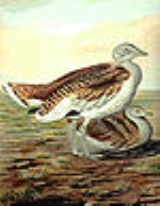
Great Bustard

Encyclopedia
The Great Bustard is in the bustard
family, the only member of the genus
Otis. It breeds in southern and central Europe
, where it is the largest species of bird, and across temperate Asia
. European populations are mainly resident, but Asian birds move
further south in winter.
. A male is typically 90 – tall, about 115 cm (45.3 in) long, has a 2.1–2.7 m (6.9–8.9 ft) wingspan and can weigh from 5.8 to 18 kg (12.8 to 39.7 lb), with an average of 13.5 kg (29.8 lb). The heaviest verified specimen was about 21 kg (46.3 lb); larger specimens have been reported but remain unverified. An adult male is brown above and white below, with a long grey neck and head. The breast and lower neck sides are chestnut. In the breeding season, the male has long white neck bristles. In flight, the long wings show large areas of white.
The female is about a third smaller in linear dimensions, typically measuring 75 to 85 cm (29.5 to 33.5 in) in height, about 90 cm (35.4 in) in length and 180 cm (5.9 ft) across the wings. At an average of 4.4 kg (9.7 lb), the females are one-third the weight of the male. Overall, the female's weight can range from 3.3 to 8 kg (7.3 to 17.6 lb). Perhaps because of this physical sexual dimorphism, there is a skewed sex ratio of about 1.5:1 female to male. The breast and neck of the female are buff. Both sexes are usually silent. Immature birds resemble the female.
Two or three olive or tan coloured, glossy eggs are laid in a small ground scrape. Eggs weigh about 150 g (5.3 oz) and are on average 79.4 mm (3.1 in) tall by 56.8 mm (2.2 in) wide. The female incubates the eggs alone for around 4 weeks. The chicks almost immediately leave the nest after they hatch, although they do not move very far from their mother until they are at least 1 year old. Young Great Bustards begin developing their adult plumage at about 2 months, and begin to develop flying skills at the same time. They practice by stretching, running, flapping, and making small hops and jumps to get airborne. By three months they are able to fly reasonable distances. Juveniles are independent by their first winter, but normally stay with their mother until the next breeding season. Males usually start to mate from about 5 years old. Great Bustards typically live for around 10 years, but some have been known to live up to 15 years or more. Adult males seem to have a higher mortality rate than females due mainly to fierce intraspecies fighting with other males during the breeding season.
This bird's habitat is open grassland, although it can be found on undisturbed cultivation. It has a stately slow walk, and tends to run when disturbed rather than fly. It is gregarious, especially in winter. This species is omnivorous
, taking seeds, insects and other small creatures, including frog
s and beetle
s.
Over 80% of Great Bustards die in the first year of life. Chicks are endangered to predation by the fact that they are ground-dwelling birds who are reluctant to fly. Common predators of eggs and hatchlings include raptor
s, corvids, fox
es, badger
s and hedgehog
s. Chicks grow very quickly, by 6 months nearly a two-thirds of their adult size, and are predated by fox
es, lynx
, wolves
and eagle
s. The bold, conspicuous behavior of the breeding adult male bustard may attract large mammalian predators such as wolves and lynx, while the more inconspicuous female may sometimes be attacked by large eagles. However, predation is rare for adults due to their size, nimbleness and safety in numbers due to their social behavior.
Two very rare albino
Great Bustards from the same nest were killed by electricity cables in Hungary in 2000 and 2003. The bustards, despite their large size, are able to fly at a high velocity (60 kilometre/hour) and are often mutilated or killed by the cables which are placed in Hungary just at their flying heights. The electricity companies affected will bury only part of the dangerous cables, therefore the authorities are experimenting with fixing fluorescent "Firefly" devices on the most dangerous cables to provide the birds with warning lights.
The Great Bustard, túzok in Hungarian
, is a national bird of Hungary and a subject of several proverb
s.
and Mongolia
.
Sizeable populations exist in Spain
(23,055 birds), Russia
(8,000 birds), Turkey
(800–3,000 birds), Portugal
(1,435 birds) and Mongolia
(1,000 birds). Elsewhere, the populations are declining due to habitat loss throughout its range. A sizeable population also exists in Hungary
(1,100–1,300 birds) where the Eastern European steppe zone ends, near Dévaványa
town and also in the Hortobágy
, Nagykunság and Nagy-Sárrét regions. The population is down from a population of 10,000–12,000 before the Second World War. The Hungarian authorities are seeking to preserve the long-term future of the population by active protection measures: the area affected by the special ecological treatment had grown to 15 square kilometres by the summer of 2006.
The Great Bustard was formerly native in Great Britain
and a bustard forms part of the design of the Wiltshire
Coat of Arms
. It was hunted out of existence by the 1840s. In 2004 a project overseeing the reintroduction to Salisbury Plain
in Wiltshire using eggs taken from Saratov in Russia was undertaken by The Great Bustard Group, a UK Registered Charity that aims to establish a self-sustaining population of Great Bustards in the UK. They have laid eggs and raised chicks in Britain in 2009 and 2010. Although the Great Bustard was once native to Britain, Great Bustards are considered an alien species under English law. The reintroduction of the Great Bustard to the UK by the Great Bustard Group is being carried out in parallel with researchers from the University of Bath that are providing insight into the habitat of native Great Bustard populations in Russia and Hungary. On January 19, 2011 it was announced that the Great Bustard Project had been awarded EU LIFE+ funding, reportedly to the tune of £1.8 million.
Bustard
Bustards, including floricans and korhaans, are large terrestrial birds mainly associated with dry open country and steppes in the Old World...
family, the only member of the genus
Genus
In biology, a genus is a low-level taxonomic rank used in the biological classification of living and fossil organisms, which is an example of definition by genus and differentia...
Otis. It breeds in southern and central Europe
Europe
Europe is, by convention, one of the world's seven continents. Comprising the westernmost peninsula of Eurasia, Europe is generally 'divided' from Asia to its east by the watershed divides of the Ural and Caucasus Mountains, the Ural River, the Caspian and Black Seas, and the waterways connecting...
, where it is the largest species of bird, and across temperate Asia
Asia
Asia is the world's largest and most populous continent, located primarily in the eastern and northern hemispheres. It covers 8.7% of the Earth's total surface area and with approximately 3.879 billion people, it hosts 60% of the world's current human population...
. European populations are mainly resident, but Asian birds move
Bird migration
Bird migration is the regular seasonal journey undertaken by many species of birds. Bird movements include those made in response to changes in food availability, habitat or weather. Sometimes, journeys are not termed "true migration" because they are irregular or in only one direction...
further south in winter.
Description
The male of this huge bird is possibly the heaviest living flying animal, alongside the similarly sized Kori BustardKori Bustard
The Kori Bustard is a large bird native to Africa. It is a member of the bustard family. It may be the heaviest bird capable of flight....
. A male is typically 90 – tall, about 115 cm (45.3 in) long, has a 2.1–2.7 m (6.9–8.9 ft) wingspan and can weigh from 5.8 to 18 kg (12.8 to 39.7 lb), with an average of 13.5 kg (29.8 lb). The heaviest verified specimen was about 21 kg (46.3 lb); larger specimens have been reported but remain unverified. An adult male is brown above and white below, with a long grey neck and head. The breast and lower neck sides are chestnut. In the breeding season, the male has long white neck bristles. In flight, the long wings show large areas of white.
The female is about a third smaller in linear dimensions, typically measuring 75 to 85 cm (29.5 to 33.5 in) in height, about 90 cm (35.4 in) in length and 180 cm (5.9 ft) across the wings. At an average of 4.4 kg (9.7 lb), the females are one-third the weight of the male. Overall, the female's weight can range from 3.3 to 8 kg (7.3 to 17.6 lb). Perhaps because of this physical sexual dimorphism, there is a skewed sex ratio of about 1.5:1 female to male. The breast and neck of the female are buff. Both sexes are usually silent. Immature birds resemble the female.
Life history
Before mating, the males moult into their breeding plumage around January. Like other bustards, the male Great Bustard has a flamboyant display showing much white, mainly from the undertail, and withdrawing the head. The Great Bustard breeds in March, and a single male may mate with up to 5 females. All breeding Great Bustards also moult again from June to September.Two or three olive or tan coloured, glossy eggs are laid in a small ground scrape. Eggs weigh about 150 g (5.3 oz) and are on average 79.4 mm (3.1 in) tall by 56.8 mm (2.2 in) wide. The female incubates the eggs alone for around 4 weeks. The chicks almost immediately leave the nest after they hatch, although they do not move very far from their mother until they are at least 1 year old. Young Great Bustards begin developing their adult plumage at about 2 months, and begin to develop flying skills at the same time. They practice by stretching, running, flapping, and making small hops and jumps to get airborne. By three months they are able to fly reasonable distances. Juveniles are independent by their first winter, but normally stay with their mother until the next breeding season. Males usually start to mate from about 5 years old. Great Bustards typically live for around 10 years, but some have been known to live up to 15 years or more. Adult males seem to have a higher mortality rate than females due mainly to fierce intraspecies fighting with other males during the breeding season.
This bird's habitat is open grassland, although it can be found on undisturbed cultivation. It has a stately slow walk, and tends to run when disturbed rather than fly. It is gregarious, especially in winter. This species is omnivorous
Omnivore
Omnivores are species that eat both plants and animals as their primary food source...
, taking seeds, insects and other small creatures, including frog
Frog
Frogs are amphibians in the order Anura , formerly referred to as Salientia . Most frogs are characterized by a short body, webbed digits , protruding eyes and the absence of a tail...
s and beetle
Beetle
Coleoptera is an order of insects commonly called beetles. The word "coleoptera" is from the Greek , koleos, "sheath"; and , pteron, "wing", thus "sheathed wing". Coleoptera contains more species than any other order, constituting almost 25% of all known life-forms...
s.
Over 80% of Great Bustards die in the first year of life. Chicks are endangered to predation by the fact that they are ground-dwelling birds who are reluctant to fly. Common predators of eggs and hatchlings include raptor
Bird of prey
Birds of prey are birds that hunt for food primarily on the wing, using their keen senses, especially vision. They are defined as birds that primarily hunt vertebrates, including other birds. Their talons and beaks tend to be relatively large, powerful and adapted for tearing and/or piercing flesh....
s, corvids, fox
Fox
Fox is a common name for many species of omnivorous mammals belonging to the Canidae family. Foxes are small to medium-sized canids , characterized by possessing a long narrow snout, and a bushy tail .Members of about 37 species are referred to as foxes, of which only 12 species actually belong to...
es, badger
Badger
Badgers are short-legged omnivores in the weasel family, Mustelidae. There are nine species of badger, in three subfamilies : Melinae , Mellivorinae , and Taxideinae...
s and hedgehog
Hedgehog
A hedgehog is any of the spiny mammals of the subfamily Erinaceinae and the order Erinaceomorpha. There are 17 species of hedgehog in five genera, found through parts of Europe, Asia, Africa, and New Zealand . There are no hedgehogs native to Australia, and no living species native to the Americas...
s. Chicks grow very quickly, by 6 months nearly a two-thirds of their adult size, and are predated by fox
Fox
Fox is a common name for many species of omnivorous mammals belonging to the Canidae family. Foxes are small to medium-sized canids , characterized by possessing a long narrow snout, and a bushy tail .Members of about 37 species are referred to as foxes, of which only 12 species actually belong to...
es, lynx
Eurasian Lynx
The Eurasian lynx is a medium-sized cat native to European and Siberian forests, South Asia and East Asia. It is also known as the European lynx, common lynx, the northern lynx, and the Siberian or Russian lynx...
, wolves
Gray Wolf
The gray wolf , also known as the wolf, is the largest extant wild member of the Canidae family...
and eagle
Eagle
Eagles are members of the bird family Accipitridae, and belong to several genera which are not necessarily closely related to each other. Most of the more than 60 species occur in Eurasia and Africa. Outside this area, just two species can be found in the United States and Canada, nine more in...
s. The bold, conspicuous behavior of the breeding adult male bustard may attract large mammalian predators such as wolves and lynx, while the more inconspicuous female may sometimes be attacked by large eagles. However, predation is rare for adults due to their size, nimbleness and safety in numbers due to their social behavior.
Two very rare albino
Albinism
Albinism is a congenital disorder characterized by the complete or partial absence of pigment in the skin, hair and eyes due to absence or defect of an enzyme involved in the production of melanin...
Great Bustards from the same nest were killed by electricity cables in Hungary in 2000 and 2003. The bustards, despite their large size, are able to fly at a high velocity (60 kilometre/hour) and are often mutilated or killed by the cables which are placed in Hungary just at their flying heights. The electricity companies affected will bury only part of the dangerous cables, therefore the authorities are experimenting with fixing fluorescent "Firefly" devices on the most dangerous cables to provide the birds with warning lights.
The Great Bustard, túzok in Hungarian
Hungarian language
Hungarian is a Uralic language, part of the Ugric group. With some 14 million speakers, it is one of the most widely spoken non-Indo-European languages in Europe....
, is a national bird of Hungary and a subject of several proverb
Proverb
A proverb is a simple and concrete saying popularly known and repeated, which expresses a truth, based on common sense or the practical experience of humanity. They are often metaphorical. A proverb that describes a basic rule of conduct may also be known as a maxim...
s.
Populations
The population numbers between 31,000 to 37,000 birds. Between 4,200 and 4,500 are found in east Asia. In recent times, there have been steep declines in population throughout eastern and central Europe and in Asia, particularly in KazakhstanKazakhstan
Kazakhstan , officially the Republic of Kazakhstan, is a transcontinental country in Central Asia and Eastern Europe. Ranked as the ninth largest country in the world, it is also the world's largest landlocked country; its territory of is greater than Western Europe...
and Mongolia
Mongolia
Mongolia is a landlocked country in East and Central Asia. It is bordered by Russia to the north and China to the south, east and west. Although Mongolia does not share a border with Kazakhstan, its western-most point is only from Kazakhstan's eastern tip. Ulan Bator, the capital and largest...
.
| Presence | Countries |
|---|---|
| Native | Afghanistan Afghanistan Afghanistan , officially the Islamic Republic of Afghanistan, is a landlocked country located in the centre of Asia, forming South Asia, Central Asia and the Middle East. With a population of about 29 million, it has an area of , making it the 42nd most populous and 41st largest nation in the world... , Armenia Armenia Armenia , officially the Republic of Armenia , is a landlocked mountainous country in the Caucasus region of Eurasia... , Austria Austria Austria , officially the Republic of Austria , is a landlocked country of roughly 8.4 million people in Central Europe. It is bordered by the Czech Republic and Germany to the north, Slovakia and Hungary to the east, Slovenia and Italy to the south, and Switzerland and Liechtenstein to the... , Azerbaijan Azerbaijan Azerbaijan , officially the Republic of Azerbaijan is the largest country in the Caucasus region of Eurasia. Located at the crossroads of Western Asia and Eastern Europe, it is bounded by the Caspian Sea to the east, Russia to the north, Georgia to the northwest, Armenia to the west, and Iran to... , Bulgaria Bulgaria Bulgaria , officially the Republic of Bulgaria , is a parliamentary democracy within a unitary constitutional republic in Southeast Europe. The country borders Romania to the north, Serbia and Macedonia to the west, Greece and Turkey to the south, as well as the Black Sea to the east... , China China Chinese civilization may refer to:* China for more general discussion of the country.* Chinese culture* Greater China, the transnational community of ethnic Chinese.* History of China* Sinosphere, the area historically affected by Chinese culture... , Croatia Croatia Croatia , officially the Republic of Croatia , is a unitary democratic parliamentary republic in Europe at the crossroads of the Mitteleuropa, the Balkans, and the Mediterranean. Its capital and largest city is Zagreb. The country is divided into 20 counties and the city of Zagreb. Croatia covers ... , Czech Republic Czech Republic The Czech Republic is a landlocked country in Central Europe. The country is bordered by Poland to the northeast, Slovakia to the east, Austria to the south, and Germany to the west and northwest.... , France France The French Republic , The French Republic , The French Republic , (commonly known as France , is a unitary semi-presidential republic in Western Europe with several overseas territories and islands located on other continents and in the Indian, Pacific, and Atlantic oceans. Metropolitan France... , Georgia Georgia (country) Georgia is a sovereign state in the Caucasus region of Eurasia. Located at the crossroads of Western Asia and Eastern Europe, it is bounded to the west by the Black Sea, to the north by Russia, to the southwest by Turkey, to the south by Armenia, and to the southeast by Azerbaijan. The capital of... , Germany Germany Germany , officially the Federal Republic of Germany , is a federal parliamentary republic in Europe. The country consists of 16 states while the capital and largest city is Berlin. Germany covers an area of 357,021 km2 and has a largely temperate seasonal climate... , Greece Greece Greece , officially the Hellenic Republic , and historically Hellas or the Republic of Greece in English, is a country in southeastern Europe.... , Hungary Hungary Hungary , officially the Republic of Hungary , is a landlocked country in Central Europe. It is situated in the Carpathian Basin and is bordered by Slovakia to the north, Ukraine and Romania to the east, Serbia and Croatia to the south, Slovenia to the southwest and Austria to the west. The... , Iran Iran Iran , officially the Islamic Republic of Iran , is a country in Southern and Western Asia. The name "Iran" has been in use natively since the Sassanian era and came into use internationally in 1935, before which the country was known to the Western world as Persia... , Iraq Iraq Iraq ; officially the Republic of Iraq is a country in Western Asia spanning most of the northwestern end of the Zagros mountain range, the eastern part of the Syrian Desert and the northern part of the Arabian Desert.... , Italy Italy Italy , officially the Italian Republic languages]] under the European Charter for Regional or Minority Languages. In each of these, Italy's official name is as follows:;;;;;;;;), is a unitary parliamentary republic in South-Central Europe. To the north it borders France, Switzerland, Austria and... , Kazakhstan Kazakhstan Kazakhstan , officially the Republic of Kazakhstan, is a transcontinental country in Central Asia and Eastern Europe. Ranked as the ninth largest country in the world, it is also the world's largest landlocked country; its territory of is greater than Western Europe... , Kyrgyzstan Kyrgyzstan Kyrgyzstan , officially the Kyrgyz Republic is one of the world's six independent Turkic states . Located in Central Asia, landlocked and mountainous, Kyrgyzstan is bordered by Kazakhstan to the north, Uzbekistan to the west, Tajikistan to the southwest and China to the east... , Macedonia Republic of Macedonia Macedonia , officially the Republic of Macedonia , is a country located in the central Balkan peninsula in Southeast Europe. It is one of the successor states of the former Yugoslavia, from which it declared independence in 1991... , Moldova Moldova Moldova , officially the Republic of Moldova is a landlocked state in Eastern Europe, located between Romania to the West and Ukraine to the North, East and South. It declared itself an independent state with the same boundaries as the preceding Moldavian Soviet Socialist Republic in 1991, as part... , Mongolia Mongolia Mongolia is a landlocked country in East and Central Asia. It is bordered by Russia to the north and China to the south, east and west. Although Mongolia does not share a border with Kazakhstan, its western-most point is only from Kazakhstan's eastern tip. Ulan Bator, the capital and largest... , Montenegro Montenegro Montenegro Montenegrin: Crna Gora Црна Гора , meaning "Black Mountain") is a country located in Southeastern Europe. It has a coast on the Adriatic Sea to the south-west and is bordered by Croatia to the west, Bosnia and Herzegovina to the northwest, Serbia to the northeast and Albania to the... , Morocco Morocco Morocco , officially the Kingdom of Morocco , is a country located in North Africa. It has a population of more than 32 million and an area of 710,850 km², and also primarily administers the disputed region of the Western Sahara... , Portugal Portugal Portugal , officially the Portuguese Republic is a country situated in southwestern Europe on the Iberian Peninsula. Portugal is the westernmost country of Europe, and is bordered by the Atlantic Ocean to the West and South and by Spain to the North and East. The Atlantic archipelagos of the... , Romania Romania Romania is a country located at the crossroads of Central and Southeastern Europe, on the Lower Danube, within and outside the Carpathian arch, bordering on the Black Sea... , Russia Russia Russia or , officially known as both Russia and the Russian Federation , is a country in northern Eurasia. It is a federal semi-presidential republic, comprising 83 federal subjects... , Serbia Serbia Serbia , officially the Republic of Serbia , is a landlocked country located at the crossroads of Central and Southeast Europe, covering the southern part of the Carpathian basin and the central part of the Balkans... , Slovakia Slovakia The Slovak Republic is a landlocked state in Central Europe. It has a population of over five million and an area of about . Slovakia is bordered by the Czech Republic and Austria to the west, Poland to the north, Ukraine to the east and Hungary to the south... , Spain Spain Spain , officially the Kingdom of Spain languages]] under the European Charter for Regional or Minority Languages. In each of these, Spain's official name is as follows:;;;;;;), is a country and member state of the European Union located in southwestern Europe on the Iberian Peninsula... , Syria Syria Syria , officially the Syrian Arab Republic , is a country in Western Asia, bordering Lebanon and the Mediterranean Sea to the West, Turkey to the north, Iraq to the east, Jordan to the south, and Israel to the southwest.... , Tajikistan Tajikistan Tajikistan , officially the Republic of Tajikistan , is a mountainous landlocked country in Central Asia. Afghanistan borders it to the south, Uzbekistan to the west, Kyrgyzstan to the north, and China to the east.... , Turkey Turkey Turkey , known officially as the Republic of Turkey , is a Eurasian country located in Western Asia and in East Thrace in Southeastern Europe... , Turkmenistan Turkmenistan Turkmenistan , formerly also known as Turkmenia is one of the Turkic states in Central Asia. Until 1991, it was a constituent republic of the Soviet Union, the Turkmen Soviet Socialist Republic . Turkmenistan is one of the six independent Turkic states... , Ukraine Ukraine Ukraine is a country in Eastern Europe. It has an area of 603,628 km², making it the second largest contiguous country on the European continent, after Russia... , Uzbekistan Uzbekistan Uzbekistan , officially the Republic of Uzbekistan is a doubly landlocked country in Central Asia and one of the six independent Turkic states. It shares borders with Kazakhstan to the west and to the north, Kyrgyzstan and Tajikistan to the east, and Afghanistan and Turkmenistan to the south.... |
| Regionally extinct | Algeria Algeria Algeria , officially the People's Democratic Republic of Algeria , also formally referred to as the Democratic and Popular Republic of Algeria, is a country in the Maghreb region of Northwest Africa with Algiers as its capital.In terms of land area, it is the largest country in Africa and the Arab... , Myanmar Myanmar Burma , officially the Republic of the Union of Myanmar , is a country in Southeast Asia. Burma is bordered by China on the northeast, Laos on the east, Thailand on the southeast, Bangladesh on the west, India on the northwest, the Bay of Bengal to the southwest, and the Andaman Sea on the south.... , Poland Poland Poland , officially the Republic of Poland , is a country in Central Europe bordered by Germany to the west; the Czech Republic and Slovakia to the south; Ukraine, Belarus and Lithuania to the east; and the Baltic Sea and Kaliningrad Oblast, a Russian exclave, to the north... , Sweden Sweden Sweden , officially the Kingdom of Sweden , is a Nordic country on the Scandinavian Peninsula in Northern Europe. Sweden borders with Norway and Finland and is connected to Denmark by a bridge-tunnel across the Öresund.... , Switzerland Switzerland Switzerland name of one of the Swiss cantons. ; ; ; or ), in its full name the Swiss Confederation , is a federal republic consisting of 26 cantons, with Bern as the seat of the federal authorities. The country is situated in Western Europe,Or Central Europe depending on the definition.... , United Kingdom United Kingdom The United Kingdom of Great Britain and Northern IrelandIn the United Kingdom and Dependencies, other languages have been officially recognised as legitimate autochthonous languages under the European Charter for Regional or Minority Languages... |
| Vagrant | Albania Albania Albania , officially known as the Republic of Albania , is a country in Southeastern Europe, in the Balkans region. It is bordered by Montenegro to the northwest, Kosovo to the northeast, the Republic of Macedonia to the east and Greece to the south and southeast. It has a coast on the Adriatic Sea... , Belgium Belgium Belgium , officially the Kingdom of Belgium, is a federal state in Western Europe. It is a founding member of the European Union and hosts the EU's headquarters, and those of several other major international organisations such as NATO.Belgium is also a member of, or affiliated to, many... , Cyprus Cyprus Cyprus , officially the Republic of Cyprus , is a Eurasian island country, member of the European Union, in the Eastern Mediterranean, east of Greece, south of Turkey, west of Syria and north of Egypt. It is the third largest island in the Mediterranean Sea.The earliest known human activity on the... , Denmark Denmark Denmark is a Scandinavian country in Northern Europe. The countries of Denmark and Greenland, as well as the Faroe Islands, constitute the Kingdom of Denmark . It is the southernmost of the Nordic countries, southwest of Sweden and south of Norway, and bordered to the south by Germany. Denmark... , Egypt Egypt Egypt , officially the Arab Republic of Egypt, Arabic: , is a country mainly in North Africa, with the Sinai Peninsula forming a land bridge in Southwest Asia. Egypt is thus a transcontinental country, and a major power in Africa, the Mediterranean Basin, the Middle East and the Muslim world... , Finland Finland Finland , officially the Republic of Finland, is a Nordic country situated in the Fennoscandian region of Northern Europe. It is bordered by Sweden in the west, Norway in the north and Russia in the east, while Estonia lies to its south across the Gulf of Finland.Around 5.4 million people reside... , Gibraltar Gibraltar Gibraltar is a British overseas territory located on the southern end of the Iberian Peninsula at the entrance of the Mediterranean. A peninsula with an area of , it has a northern border with Andalusia, Spain. The Rock of Gibraltar is the major landmark of the region... , Ireland Ireland Ireland is an island to the northwest of continental Europe. It is the third-largest island in Europe and the twentieth-largest island on Earth... , Israel Israel The State of Israel is a parliamentary republic located in the Middle East, along the eastern shore of the Mediterranean Sea... , Japan Japan Japan is an island nation in East Asia. Located in the Pacific Ocean, it lies to the east of the Sea of Japan, China, North Korea, South Korea and Russia, stretching from the Sea of Okhotsk in the north to the East China Sea and Taiwan in the south... , Korea Korea Korea ) is an East Asian geographic region that is currently divided into two separate sovereign states — North Korea and South Korea. Located on the Korean Peninsula, Korea is bordered by the People's Republic of China to the northwest, Russia to the northeast, and is separated from Japan to the... , Latvia Latvia Latvia , officially the Republic of Latvia , is a country in the Baltic region of Northern Europe. It is bordered to the north by Estonia , to the south by Lithuania , to the east by the Russian Federation , to the southeast by Belarus and shares maritime borders to the west with Sweden... , Luxembourg Luxembourg Luxembourg , officially the Grand Duchy of Luxembourg , is a landlocked country in western Europe, bordered by Belgium, France, and Germany. It has two principal regions: the Oesling in the North as part of the Ardennes massif, and the Gutland in the south... , Malta Malta Malta , officially known as the Republic of Malta , is a Southern European country consisting of an archipelago situated in the centre of the Mediterranean, south of Sicily, east of Tunisia and north of Libya, with Gibraltar to the west and Alexandria to the east.Malta covers just over in... , Netherlands Netherlands The Netherlands is a constituent country of the Kingdom of the Netherlands, located mainly in North-West Europe and with several islands in the Caribbean. Mainland Netherlands borders the North Sea to the north and west, Belgium to the south, and Germany to the east, and shares maritime borders... , Saudi Arabia Saudi Arabia The Kingdom of Saudi Arabia , commonly known in British English as Saudi Arabia and in Arabic as as-Sa‘ūdiyyah , is the largest state in Western Asia by land area, constituting the bulk of the Arabian Peninsula, and the second-largest in the Arab World... , Tunisia Tunisia Tunisia , officially the Tunisian RepublicThe long name of Tunisia in other languages used in the country is: , is the northernmost country in Africa. It is a Maghreb country and is bordered by Algeria to the west, Libya to the southeast, and the Mediterranean Sea to the north and east. Its area... |
| Presence uncertain | Lebanon Lebanon Lebanon , officially the Republic of LebanonRepublic of Lebanon is the most common term used by Lebanese government agencies. The term Lebanese Republic, a literal translation of the official Arabic and French names that is not used in today's world. Arabic is the most common language spoken among... , Pakistan Pakistan Pakistan , officially the Islamic Republic of Pakistan is a sovereign state in South Asia. It has a coastline along the Arabian Sea and the Gulf of Oman in the south and is bordered by Afghanistan and Iran in the west, India in the east and China in the far northeast. In the north, Tajikistan... |
Sizeable populations exist in Spain
Spain
Spain , officially the Kingdom of Spain languages]] under the European Charter for Regional or Minority Languages. In each of these, Spain's official name is as follows:;;;;;;), is a country and member state of the European Union located in southwestern Europe on the Iberian Peninsula...
(23,055 birds), Russia
Russia
Russia or , officially known as both Russia and the Russian Federation , is a country in northern Eurasia. It is a federal semi-presidential republic, comprising 83 federal subjects...
(8,000 birds), Turkey
Turkey
Turkey , known officially as the Republic of Turkey , is a Eurasian country located in Western Asia and in East Thrace in Southeastern Europe...
(800–3,000 birds), Portugal
Portugal
Portugal , officially the Portuguese Republic is a country situated in southwestern Europe on the Iberian Peninsula. Portugal is the westernmost country of Europe, and is bordered by the Atlantic Ocean to the West and South and by Spain to the North and East. The Atlantic archipelagos of the...
(1,435 birds) and Mongolia
Mongolia
Mongolia is a landlocked country in East and Central Asia. It is bordered by Russia to the north and China to the south, east and west. Although Mongolia does not share a border with Kazakhstan, its western-most point is only from Kazakhstan's eastern tip. Ulan Bator, the capital and largest...
(1,000 birds). Elsewhere, the populations are declining due to habitat loss throughout its range. A sizeable population also exists in Hungary
Hungary
Hungary , officially the Republic of Hungary , is a landlocked country in Central Europe. It is situated in the Carpathian Basin and is bordered by Slovakia to the north, Ukraine and Romania to the east, Serbia and Croatia to the south, Slovenia to the southwest and Austria to the west. The...
(1,100–1,300 birds) where the Eastern European steppe zone ends, near Dévaványa
Dévaványa
Dévaványa is a town in northern Békés county, in the Southern Great Plain region of south-east Hungary.-Geography:It covers an area of 216.73 km² and has a population of 8273 people ....
town and also in the Hortobágy
Hortobágy
Hortobágy is both the name of a village in Hajdú-Bihar county and an 800 km² national park in Eastern Hungary, rich with folklore and cultural history. The park, a part of the Alföld , was designated as a national park in 1973 , and elected among the World Heritage sites in 1999...
, Nagykunság and Nagy-Sárrét regions. The population is down from a population of 10,000–12,000 before the Second World War. The Hungarian authorities are seeking to preserve the long-term future of the population by active protection measures: the area affected by the special ecological treatment had grown to 15 square kilometres by the summer of 2006.
The Great Bustard was formerly native in Great Britain
Great Britain
Great Britain or Britain is an island situated to the northwest of Continental Europe. It is the ninth largest island in the world, and the largest European island, as well as the largest of the British Isles...
and a bustard forms part of the design of the Wiltshire
Wiltshire
Wiltshire is a ceremonial county in South West England. It is landlocked and borders the counties of Dorset, Somerset, Hampshire, Gloucestershire, Oxfordshire and Berkshire. It contains the unitary authority of Swindon and covers...
Coat of Arms
Coat of arms
A coat of arms is a unique heraldic design on a shield or escutcheon or on a surcoat or tabard used to cover and protect armour and to identify the wearer. Thus the term is often stated as "coat-armour", because it was anciently displayed on the front of a coat of cloth...
. It was hunted out of existence by the 1840s. In 2004 a project overseeing the reintroduction to Salisbury Plain
Salisbury Plain
Salisbury Plain is a chalk plateau in central southern England covering . It is part of the Southern England Chalk Formation and largely lies within the county of Wiltshire, with a little in Hampshire. The plain is famous for its rich archaeology, including Stonehenge, one of England's best known...
in Wiltshire using eggs taken from Saratov in Russia was undertaken by The Great Bustard Group, a UK Registered Charity that aims to establish a self-sustaining population of Great Bustards in the UK. They have laid eggs and raised chicks in Britain in 2009 and 2010. Although the Great Bustard was once native to Britain, Great Bustards are considered an alien species under English law. The reintroduction of the Great Bustard to the UK by the Great Bustard Group is being carried out in parallel with researchers from the University of Bath that are providing insight into the habitat of native Great Bustard populations in Russia and Hungary. On January 19, 2011 it was announced that the Great Bustard Project had been awarded EU LIFE+ funding, reportedly to the tune of £1.8 million.