

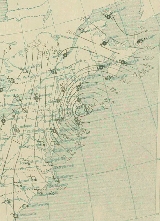
Great Blizzard of 1888

Overview
Blizzard
A blizzard is a severe snowstorm characterized by strong winds. By definition, the difference between blizzard and a snowstorm is the strength of the wind. To be a blizzard, a snow storm must have winds in excess of with blowing or drifting snow which reduces visibility to 400 meters or ¼ mile or...
s in United States
United States
The United States of America is a federal constitutional republic comprising fifty states and a federal district...
' recorded history. Snowfalls of 40-50 inches (102–127 cm) fell in parts of New Jersey
New Jersey
New Jersey is a state in the Northeastern and Middle Atlantic regions of the United States. , its population was 8,791,894. It is bordered on the north and east by the state of New York, on the southeast and south by the Atlantic Ocean, on the west by Pennsylvania and on the southwest by Delaware...
, New York
New York
New York is a state in the Northeastern region of the United States. It is the nation's third most populous state. New York is bordered by New Jersey and Pennsylvania to the south, and by Connecticut, Massachusetts and Vermont to the east...
, Massachusetts
Massachusetts
The Commonwealth of Massachusetts is a state in the New England region of the northeastern United States of America. It is bordered by Rhode Island and Connecticut to the south, New York to the west, and Vermont and New Hampshire to the north; at its east lies the Atlantic Ocean. As of the 2010...
and Connecticut
Connecticut
Connecticut is a state in the New England region of the northeastern United States. It is bordered by Rhode Island to the east, Massachusetts to the north, and the state of New York to the west and the south .Connecticut is named for the Connecticut River, the major U.S. river that approximately...
, and sustained winds of over 45 miles per hour (72 km/h) produced snowdrift
Snowdrift
A snowdrift is a deposit of snow sculpted by wind into a mound during a snowstorm. Snowdrifts resemble sand dunes and are formed in a similar manner, namely, by wind moving light snow and depositing it when the wind is slowed, usually against a stationary object. Snow normally crests and slopes...
s in excess of 50 feet (15.2 m). Railroads were shut down and people were confined to their houses for up to a week.
The weather preceding the blizzard was unseasonably mild with heavy rains that turned to snow as temperatures dropped rapidly.
The storm began in earnest shortly after midnight on March 12, and continued unabated for a full day and a half.
Discussions
