

Great Barrier Reef

Encyclopedia
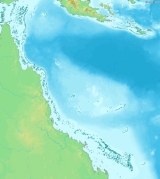
The Great Barrier Reef is the world's
largest reef
system composed of over 2,900 individual reefs and 900 islands stretching for over 2,600 kilometres (1,600 mi) over an area of approximately 344400 square kilometres (132,973.6 sq mi). The reef is located in the Coral Sea
, off the coast of Queensland
in north-east Australia
.
The Great Barrier Reef can be seen from outer space
and is the world's biggest single structure made by living organisms. This reef structure is composed of and built by billions of tiny organisms, known as coral
polyp
s. It supports a wide diversity of life and was selected as a World Heritage Site
in 1981. CNN
labeled it one of the seven natural wonders of the world. The Queensland National Trust named it a state icon of Queensland.
A large part of the reef is protected by the Great Barrier Reef Marine Park
, which helps to limit the impact of human use, such as fishing and tourism. Other environmental pressures on the reef and its ecosystem
include runoff
, climate change accompanied by mass coral bleaching
, and cyclic population outbreaks of the crown-of-thorns starfish
.
The Great Barrier Reef has long been known to and used by the Aboriginal Australian
and Torres Strait Islander peoples, and is an important part of local groups' cultures and spirituality. The reef is a very popular destination for tourists, especially in the Whitsunday Islands
and Cairns regions. Tourism is an important economic activity for the region, generating $1 billion per year.
 The Great Barrier Reef is a distinct feature of the East Australian Cordillera division. It includes the smaller Murray Islands
. It reaches from Torres Strait
(between Bramble Cay
, its northernmost island, and the south coast of Papua New Guinea
) in the north to the unnamed passage between Lady Elliot Island
(its southernmost island) and Fraser Island in the south. Lady Elliot Island is located 1915 km (1,189.9 mi) southeast of Bramble Cay as the crow flies
.
Australia has moved northwards
at a rate of 7 cm (2.8 in) per year, starting during the Cainozoic. Eastern Australia experienced a period of tectonic uplift
, which moved the drainage divide in Queensland 400 km (248.5 mi) inland. Also during this time, Queensland experienced volcanic eruptions leading to central and shield volcano
es and basalt
flows. Some of these granitic outcrops have become high island
s. After the Coral Sea
Basin
formed, coral reefs began to grow in the Basin, but until about 25 million years ago, northern Queensland was still in temperate waters south of the tropics—too cool to support coral growth. The Great Barrier Reef's development history is complex; after Queensland drifted into tropical waters, it was largely influenced by reef growth and decline as sea level changed. They can increase in diameter by 1 to 3 cm (0.393700787401575 to 1.2 in) per year, and grow vertically anywhere from 1 to 25 cm (0.393700787401575 to 9.8 in) per year; however, they grow only above a depth of 150 metres (492.1 ft) due to their need for sunlight, and cannot grow above sea level. When Queensland edged into tropical waters 24 million years ago, some coral grew, but a sedimentation
regime
quickly developed with erosion of the Great Dividing Range
; creating river delta
s, oozes
and turbidite
s, unsuitable conditions for coral growth. 10 million years ago, the sea level significantly lowered, which further enabled sedimentation. The reef's substrate may have needed to build up from the sediment until its edge was too far away for suspended sediments to inhibit coral growth. In addition, approximately 400,000 years ago there was a particularly warm interglacial period
with higher sea levels and a 4 C-change water temperature change.
 The land that formed the substrate of the current Great Barrier Reef was a coastal plain
formed from the eroded sediments of the Great Dividing Range
with some larger hills (some of which were themselves remnants of older reefs or volcanoes).
The Reef Research Centre, a Cooperative Research Centre
, has found coral 'skeleton' deposits that date back half a million years. The Great Barrier Reef Marine Park Authority (GBRMPA) considers the earliest evidence of complete reef structures to have been 600,000 years ago. According to the GBRMPA, the current, living reef structure is believed to have begun growing on the older platform about 20,000 years ago. The Australian Institute of Marine Science
agrees, placing the beginning of the growth of the current reef at the time of the Last Glacial Maximum
. At around that time, sea level was 120 metres (393.7 ft) lower than it is today.
From 20,000 years ago until 6,000 years ago, sea level rose steadily. As it rose, the corals could then grow higher on the hills of the coastal plain. By around 13,000 years ago the sea level was only 60 metres (196.9 ft) lower than the present day, and corals began to grow around the hills of the coastal plain, which were, by then, continental islands. As the sea level rose further still, most of the continental islands were submerged. The corals could then overgrow the hills, to form the present cay
s and reefs. Sea level here has not risen significantly in the last 6,000 years. The CRC Reef Research Centre estimates the age of the present, living reef structure at 6–8,000 years old.
The remains of an ancient barrier reef similar to the Great Barrier Reef can be found in The Kimberley, a northern region of Western Australia.
The Great Barrier Reef World Heritage Area has been divided into 70 bioregions, of which 30 are reef bioregions. In the northern part of the Great Barrier Reef, ribbon reefs and deltaic reefs have formed; these structures are not found in the rest of the reef system. There are no atoll
s in the system, and reefs attached to the mainland are rare.
Fringing reef
s are distributed widely, but are most common towards the southern part of the Great Barrier Reef, attached to high islands, for example, the Whitsunday Islands
. Lagoonal reefs are found in the southern Great Barrier Reef, and further north, off the coast of Princess Charlotte Bay
. Cresentic reefs are the most common shape of reef in the middle of the system, for example the reefs surrounding Lizard Island. Cresentic reefs are also found in the far north of the Great Barrier Reef Marine Park, and in the Swain Reefs (20
–22 degrees south
). Planar reefs are found in the northern and southern parts, near Cape York Peninsula
, Princess Charlotte Bay, and Cairns. Most of the islands on the reef are found on planar reefs.
or endangered
species
, some of which may be endemic to the reef system.
 Thirty species of whales, dolphins, and porpoises have been recorded in the Great Barrier Reef, including the dwarf minke whale
, Indo-Pacific humpback dolphin
, and the humpback whale
. Large populations of dugong
s live there.
Six species of sea turtle
s come to the reef to breed – the green sea turtle
, leatherback sea turtle
, hawksbill turtle
, loggerhead sea turtle
, flatback turtle
, and the olive ridley
. The green sea turtles on the Great Barrier Reef have two genetically distinct populations
, one in the northern part of the reef and the other in the southern part. Fifteen species of seagrass
in beds attract the dugongs and turtles, and provide fish habitat. The most common genera
of seagrasses are Halophila
and Halodule
.
Saltwater crocodile
s live in mangrove
and salt marsh
es on the coast near the reef. Nesting has not been reported, and the salt water crocodile population in the GBRWHA is wide-ranging but low density
. Around 125 species of shark
, stingray
, skate
s or chimaera
live on the reef. Close to 5,000 species of mollusc have been recorded on the reef, including the giant clam
and various nudibranch
s and cone snail
s. Forty-nine species of pipefish
and nine species of seahorse
have been recorded. At least seven species of frog inhabit the islands.
215 species of birds (including 22 species of seabirds and 32 species of shorebirds) visit the reef or nest or roost on the islands, including the white-bellied sea eagle
and roseate tern
. Most nesting sites are on islands in the northern and southern regions of the Great Barrier Reef, with 1.4–1.7 million birds using the sites to breed. The islands of the Great Barrier Reef also support 2,195 known plant species; three of these are endemic. The northern islands have 300–350 plant species which tend to be woody, whereas the southern islands have 200 which tend to be herbaceous; the Whitsunday region is the most diverse, supporting 1,141 species. The plants are propagated by birds.
Seventeen species of sea snake live on the Great Barrier Reef in warm waters up to 50 metres (164 ft) deep and are more common in the southern than in the northern section. None found in the Great Barrier Reef World Heritage Area are endemic, nor are any endangered.
More than 1,500 fish species live on the reef, including the clownfish
, red bass, red-throat emperor, and several species of snapper
and coral trout
. Forty-nine species mass spawn
, while eighty-four other species spawn elsewhere in their range.
There are at least 330 species of ascidians on the reef system with the diameter of 1–10 cm (0.393700787401575–3.9 in). Between 300–500 species of bryozoans live on the reef.
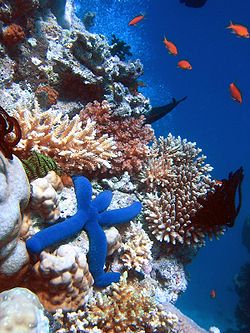
Four hundred coral species, both hard corals and soft corals inhabit the reef. The majority of these spawn gamete
s, breeding in mass spawning events that are triggered by the rising sea temperatures of spring and summer, the lunar cycle, and the diurnal cycle. Reefs in the inner Great Barrier Reef spawn during the week after the full moon in October, while the outer reefs spawn in November and December. Its common soft corals belong to 36 genera. Five hundred species of marine algae or seaweed
live on the reef, including thirteen species of genus Halimeda
, which deposit calcareous
mounds up to 100 metres (109.4 yd) wide, creating mini-ecosystems on their surface which have been compared to rainforest
cover.
 Climate change
, pollution, crown-of-thorns starfish
and fishing are the primary threats to the health of this reef system. Other threats include shipping accidents, oil spill
s, and tropical cyclones. Skeletal Eroding Band
, a disease of bony corals caused by the protozoan Halofolliculina corallasia
, affects 31 coral species.
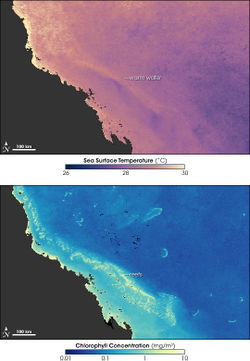
. Mass coral bleaching events due to elevated ocean temperatures occurred in the summers of 1998, 2002 and 2006, and coral bleaching is expected to become an annual occurrence. Climate change has implications for other forms of reef life—some fish's preferred temperature range leads them to seek new habitat, thus increasing chick mortality in predatory seabirds. Climate change will also affect the population and sea turtle's available habitat.
. The rivers of north eastern Australia pollute the Reef during tropical flood events. Over 90% of this pollution comes from farm runoff
. Farm run-off is caused by overgrazing
, excessive fertiliser use, and pesticide use.
The runoff problem is exacerbated by the loss of coastal wetland
s which act as a natural filter for toxins and help deposit sediment. It is thought that the poor water quality is due to increased light and oxygen competition
from algae
.
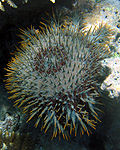 The crown-of-thorns starfish
preys on coral polyps. Large outbreaks of these starfish can devastate reefs. In 2000, an outbreak contributed to a loss of 66% of live coral cover on sampled reefs in a study by the RRC (Reefs Research Centre.) Outbreaks are believed to occur in natural cycles, worsened by poor water quality and overfishing of the starfish's predators.
of keystone species
, such as the Giant Triton
, can disrupt food chain
s vital to reef life. Fishing also impacts the reef through increased water pollution from boats, by-catch
of unwanted species (such as dolphins and turtles) and habitat destruction
from trawling
, anchors and nets. As of the middle of 2004, approximately one-third of the Great Barrier Reef Marine Park
is protected from species removal of any kind, including fishing, without written permission.
Although the route through the Great Barrier Reef is not easy, reef pilots consider it safer than outside the reef in the event of mechanical failure, since a ship can sit safely while being repaired. There have been over 1,600 known shipwrecks in the Great Barrier Reef region.
On 3 April 2010, bulk coal carrier Shen Neng 1 ran aground on Douglas Shoals, spilling up to four tonnes of oil
into the water and causing extensive damage to the reef.
In 1768, Louis de Bougainville found the reef during an exploratory mission, but did not claim the area for the French. On 11 June 1770, the HM Bark Endeavour
, captained by explorer James Cook
, ran aground on the Great Barrier Reef, sustaining considerable damage. Lightening the ship and re-floating it during an incoming tide eventually saved it. One of the most famous wrecks was the HMS Pandora
, which sank on 29 August 1791, killing 35. The Queensland Museum
has led archaeological digs to the Pandora since 1983. Because the reef had no atolls, it was largely unstudied in the 19th century. During this time, some of the reef's islands were mined for deposits of guano
, and lighthouses were built as beacons throughout the system. as in Raine Island
, the earliest example. In 1922, the Great Barrier Reef Committee began carrying out much of the early research on the reef.
created the Great Barrier Reef Marine Park and prohibited various activities. The Great Barrier Reef Marine Park does not include the entire Great Barrier Reef Province. The park is managed, in partnership with the Government of Queensland
, through the Great Barrier Reef Marine Park Authority to ensure that it is used in a sustainable manner. A combination of zoning
, management plans, permits, education and incentives (such as eco-tourism certification) are employed in the effort to conserve the reef.
In 1999, the Australian Parliament passed the Environment Protect and Biodiversity Conservation Act which improved the operation of national environmental law by providing guidance about regional biodiversity conservation priorities. The marine bioregional planning process came from the implementation of this law. This process conserves marine biodiversity by considering the whole ecosystem a species is in and how different species interact in the marine environment.
There are two steps to this process. The first step is to identify regional conservation priorities in the five (currently) different marine regions. The second step is to identify marine reserves (protected areas or marine parks) to be added to Australia’s National Representative System of Marine Protected Areas. Like protected areas on land, marine reserves are created to protect biodiversity for generations to come. Marine reserves are identified based on criteria written in a document created by Australian and New Zealand Environment and Conservation Council entitled ‘Guidelines for establishing the national representative system of marine protected areas,’ also known as just “the Guidelines.” These guidelines are nationally recognised and implemented at the local level based on the Australian policy for implementation outlined in the “Goals and Principles for the Establishment of the National Representative System of Marine Protected Areas in Commonwealth Waters.” These policies are in place to make sure that a marine reserve is only added to the NRSMPA after careful evaluation of different data.
The priorities for each region are created based on human and environmental threats and the Marine Bioregional Plans are drafted to address these priorities. To assess different region’s priorities, three steps are taken, first, a bioregional profile is created, second, a bioregional plan is drafted and third, the plan is finalised. After the plan is finalized, activity in different bioregions may become limited based on particular threats an activity may pose.
In 2001, the GBRMPA released a report about the declining water quality in the Great Barrier Reef and detailed the importance of this issue. In repose to this report a joint initiative between the governments of Australia and Queensland to improve the water quality of the Great Barrier Reef. In 2003, the Australian and Queensland governments launched a joint initiative to improve the quality of water entering the Great Barrier Reef. The decline in the quality of water over the past 150 years (due to development) has contributed to coral bleaching, algal blooms and pesticide pollution. These forms of pollution have made the reef less resilient to climate change. When the plan was introduced in October in 2003, it originally contained 65 actions built on previous legislation. Their immediate goal was to halt and reverse the decline in water quality entering the reef by 2013. By 2020, they hope that the quality of the water entering in the reef improves enough so that it doesn't have a detrimental impact on the health of the Great Barrier Reef. To achieve these goals they decided to reduce pollutants in the water entering the reef and to rehabilitate and conserve areas of the reef that naturally help reduce water pollutants. In order to achieve the objectives described above, this plan focuses on non-point sources of pollution, which cannot be traced to a single source such as a waste outlet.
The plan specifically targets nutrients, pesticides and sediment that make their way into the reef as a result of agricultural activities. Other non-point sources of pollution that are attributed to urban areas are covered under different legislation. In 2009 the plan was updated. The updated version states that to date, none of the efforts undertaken to improve the quality of water entering the reef has been unsuccessful. The new plan attempts to address this issue by “targeting priority outcomes, integrating industry and community initiatives and incorporating new policy and regulatory frameworks (Reef Plan 5).” This updated version has improved the clarity of the previous plan and targets set by that plan, have improved accountability and further improved monitoring and assessment. The 2009 report found that 41 out of the 65 actions met their original goals, however, 18 were not progressing well according to evaluation criteria as well as 6 were rated as having unsatisfactory levels of progress. Some key achievements made since the plan’s initial passing in 2003 were the establishment of the Reef Quality Partnership to set targets, report findings and monitor progress towards targets, improved land condition by landowners was rewarded with extended leases, Water Quality Improvement Plans were created to identify regional targets and identified management changes that needed to be made to reach those targets, Nutrient Management Zones have been created to combat sediment loss in particular areas, education programs have been started to help gather support for sustainable agriculture, changes to land management practices have taken place through the implementation of the Farm Management Systems and codes of practice, the creation of the Queensland Wetland program and other achievements were made to help improve the water quality flowing into the coral reefs.
A taskforce of scientists was also created to assess the impact of different parts of the plan on the quality of water flowing into the coral reefs. They found that many of the goals have yet to be reached but found more evidence that states that improving the water quality of the Great Barrier Reef will improve its resilience to climate change. The Reefocus summit in 2008, which is also detailed in the report, came to similar conclusions. After this, a stakeholder working group was formed that worked between several groups as well as the Australian and Queensland governments to update reef goals and objectives. The updated version of the plan focuses on strategic priority areas and actions to achieve 2013 goals. Also quantitative targets have been made in order to critically assess whether targets are being met. Some examples of the water quality goals outlined by this plan are that by 2013, there will be a 50 percent reduction in nitrogen and phosphorus loads at the end of catchments and that by 2020, there will be a reduction in sediment load by 20 percent. The plan also outlines a number of steps that must be taken by landholders to help improve grazing, soil, nutrient and chemical management practices. There are also a number of supporting initiatives to take place outlined in the plan to help create a framework to improve land use practices which will in turn improve water quality.
Through these means the governments of Australia and Queensland hope to improve water quality by 2013. The 2013 outlook report and revised water quality plan will assess what needs to be done in the future to improve water quality and the livelihoods of the wildlife that resides there.
In July 2004, a new zoning plan took effect for the entire Marine Park, and has been widely acclaimed as a new global benchmark for marine ecosystem
conservation. The rezoning was based on the application of systematic conservation planning techniques, using MARXAN
software. While protection across the Marine Park was improved, the highly protected zones increased from 4.5% to over 33.3%. At the time, it was the largest marine protected area
in the world, although in 2006, the new Northwestern Hawaiian Islands National Monument
became the largest.
In 2006, a review of the Great Barrier Reef Marine Park Act 1975 recommended are that there should be no further zoning plan changes until 2013, and that every five years, a peer-reviewed
Outlook Report should be published, examining the reef's health, management, and environmental pressures.
In each outlook report, several assessments are required. Each assessment has a set of assessment criteria that allows for better presentation of available evidence. Each assessment is judged by these criteria and given a grade. Every outlook report follows the same judging and grading process so that information can be tracked over time. No new research is done to produce the report. Only readily available information goes into the report so little of what is known about the Reef is actually featured in each outlook report.
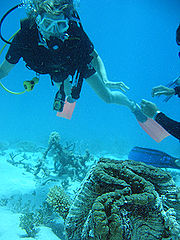
, warm clear waters and accessibility from the tourist boats called 'live aboard
s', the reef is a very popular destination, especially for scuba divers
. Tourism on the Great Barrier Reef is concentrated in the Whitsundays and Cairns due to their accessibility. These areas make up 7% of the Park's area. The Whitsundays and Cairns have their own Plans of Management. Many cities along the Queensland coast offer daily boat trips. Several continental and coral cay islands are now resort
s, including the pristine Lady Elliot Island
. As of 1996, 27 islands on the Great Barrier Reef supported resorts.
 Domestic tourism made up most of the tourism in the region as of 1996, and the most popular visiting times were in the Australian winter. It was estimated that tourists to the Great Barrier Reef contributed A$776 million per annum at this time.
As the largest commercial activity in the region, it was estimated in 2003 that tourism in the Great Barrier Reef generates over A$
4 billion annually. (A 2005 estimate puts the figure at A$
5.1 billion.) Approximately two million people visit the Great Barrier Reef each year. Although most of these visits are managed in partnership with the marine tourism industry
, there is a concern amongst the general public that tourism is harmful to the Great Barrier Reef.
A variety of boat tours and cruises are offered, from single day trips, to longer voyages. Boat sizes range from dinghies to superyachts. Glass-bottomed boats
and underwater observatories
are also popular, as are helicopter
flights. By far, the most popular tourist activities on the Great Barrier Reef are snorkelling and diving, for which pontoons are often used, and the area is often enclosed by nets. The outer part of the Great Barrier Reef is favoured for such activities, due to water quality.
Management of tourism in the Great Barrier Reef is geared towards making tourism ecologically sustainable. A daily fee is levied that goes towards research of the Great Barrier Reef. This fee ends up being 20% of the GBRMPA's income.
Policies on cruise ship
s, bareboat charter
s, and anchorages limit the traffic on the Great Barrier Reef.
in the Great Barrier Reef, controlled by the Queensland Government, is worth A$
1 billion annually. It employs approximately 2000 people, and fishing in the Great Barrier Reef is pursued commercially, for recreation, and as a traditional means for feeding one's family.
largest reef
Reef
In nautical terminology, a reef is a rock, sandbar, or other feature lying beneath the surface of the water ....
system composed of over 2,900 individual reefs and 900 islands stretching for over 2,600 kilometres (1,600 mi) over an area of approximately 344400 square kilometres (132,973.6 sq mi). The reef is located in the Coral Sea
Coral Sea
The Coral Sea is a marginal sea off the northeast coast of Australia. It is bounded in the west by the east coast of Queensland, thereby including the Great Barrier Reef, in the east by Vanuatu and by New Caledonia, and in the north approximately by the southern extremity of the Solomon Islands...
, off the coast of Queensland
Queensland
Queensland is a state of Australia, occupying the north-eastern section of the mainland continent. It is bordered by the Northern Territory, South Australia and New South Wales to the west, south-west and south respectively. To the east, Queensland is bordered by the Coral Sea and Pacific Ocean...
in north-east Australia
Australia
Australia , officially the Commonwealth of Australia, is a country in the Southern Hemisphere comprising the mainland of the Australian continent, the island of Tasmania, and numerous smaller islands in the Indian and Pacific Oceans. It is the world's sixth-largest country by total area...
.
The Great Barrier Reef can be seen from outer space
Outer space
Outer space is the void that exists between celestial bodies, including the Earth. It is not completely empty, but consists of a hard vacuum containing a low density of particles: predominantly a plasma of hydrogen and helium, as well as electromagnetic radiation, magnetic fields, and neutrinos....
and is the world's biggest single structure made by living organisms. This reef structure is composed of and built by billions of tiny organisms, known as coral
Coral
Corals are marine animals in class Anthozoa of phylum Cnidaria typically living in compact colonies of many identical individual "polyps". The group includes the important reef builders that inhabit tropical oceans and secrete calcium carbonate to form a hard skeleton.A coral "head" is a colony of...
polyp
Polyp
A polyp in zoology is one of two forms found in the phylum Cnidaria, the other being the medusa. Polyps are approximately cylindrical in shape and elongated at the axis of the body...
s. It supports a wide diversity of life and was selected as a World Heritage Site
World Heritage Site
A UNESCO World Heritage Site is a place that is listed by the UNESCO as of special cultural or physical significance...
in 1981. CNN
CNN
Cable News Network is a U.S. cable news channel founded in 1980 by Ted Turner. Upon its launch, CNN was the first channel to provide 24-hour television news coverage, and the first all-news television channel in the United States...
labeled it one of the seven natural wonders of the world. The Queensland National Trust named it a state icon of Queensland.
A large part of the reef is protected by the Great Barrier Reef Marine Park
Great Barrier Reef Marine Park
The Great Barrier Reef Marine Park protects a large part of Australia's Great Barrier Reef from damaging activities. Fishing and the removal of artefacts or...
, which helps to limit the impact of human use, such as fishing and tourism. Other environmental pressures on the reef and its ecosystem
Ecosystem
An ecosystem is a biological environment consisting of all the organisms living in a particular area, as well as all the nonliving , physical components of the environment with which the organisms interact, such as air, soil, water and sunlight....
include runoff
Surface runoff
Surface runoff is the water flow that occurs when soil is infiltrated to full capacity and excess water from rain, meltwater, or other sources flows over the land. This is a major component of the water cycle. Runoff that occurs on surfaces before reaching a channel is also called a nonpoint source...
, climate change accompanied by mass coral bleaching
Coral bleaching
Coral bleaching is the loss of intracellular endosymbionts through either expulsion or loss of algal pigmentation.The corals that form the structure of the great reef ecosystems of tropical seas depend upon a symbiotic relationship with unicellular flagellate protozoa, called zooxanthellae, that...
, and cyclic population outbreaks of the crown-of-thorns starfish
Crown-of-thorns starfish
The crown-of-thorns starfish is a large nocturnal sea star that preys upon coral polyps. The crown-of-thorns receives its name from venomous thorn-like spines that cover its body. It is endemic to tropical coral reefs in the Red Sea, the Indian Ocean, and the Pacific Ocean...
.
The Great Barrier Reef has long been known to and used by the Aboriginal Australian
Australian Aborigines
Australian Aborigines , also called Aboriginal Australians, from the latin ab originem , are people who are indigenous to most of the Australian continentthat is, to mainland Australia and the island of Tasmania...
and Torres Strait Islander peoples, and is an important part of local groups' cultures and spirituality. The reef is a very popular destination for tourists, especially in the Whitsunday Islands
Whitsunday Islands
The Whitsunday Islands are a collection of continental islands of various sizes off the central coast of Queensland, Australia, situated between just south of Bowen and to the north of Mackay, some north of Brisbane. The island group is centred on Whitsunday Island, while the group's commercial...
and Cairns regions. Tourism is an important economic activity for the region, generating $1 billion per year.
Geology and geography
Murray Islands
Murray Islands is a group of small islands 1.2 nautical miles southeast of Cape Whitson, off the south coast of Laurie Island in the South Orkney Islands. Discovered in 1823 by Matthew Brisbane, who explored the south coast of Laurie Island under the direction of James Weddell...
. It reaches from Torres Strait
Torres Strait
The Torres Strait is a body of water which lies between Australia and the Melanesian island of New Guinea. It is approximately wide at its narrowest extent. To the south is Cape York Peninsula, the northernmost continental extremity of the Australian state of Queensland...
(between Bramble Cay
Bramble Cay
Bramble Cay, also called Naizab Kaur, Massaramcoer or Baramaki, and located at the northeastern edge of the Torres Strait Islands of Queensland and at the same time at the northern end of the Great Barrier Reef, is the northernmost point of land of Australia...
, its northernmost island, and the south coast of Papua New Guinea
Papua New Guinea
Papua New Guinea , officially the Independent State of Papua New Guinea, is a country in Oceania, occupying the eastern half of the island of New Guinea and numerous offshore islands...
) in the north to the unnamed passage between Lady Elliot Island
Lady Elliot Island
Lady Elliot Island is the southern-most coral cay of the Great Barrier Reef, Australia. The island lies north-east of Bundaberg and covers an area of approximately . The island is home to a small eco resort and an airstrip, which is serviced daily by flights from Bundaberg, Hervey Bay,...
(its southernmost island) and Fraser Island in the south. Lady Elliot Island is located 1915 km (1,189.9 mi) southeast of Bramble Cay as the crow flies
As the crow flies
"As the crow flies" or beelining is an idiom for the shortest route between two points; the geodesic distance.An example is the great-circle distance between Key West and Pensacola, at either end of the U.S...
.
Australia has moved northwards
Continental drift
Continental drift is the movement of the Earth's continents relative to each other. The hypothesis that continents 'drift' was first put forward by Abraham Ortelius in 1596 and was fully developed by Alfred Wegener in 1912...
at a rate of 7 cm (2.8 in) per year, starting during the Cainozoic. Eastern Australia experienced a period of tectonic uplift
Tectonic uplift
Tectonic uplift is a geological process most often caused by plate tectonics which increases elevation. The opposite of uplift is subsidence, which results in a decrease in elevation. Uplift may be orogenic or isostatic.-Orogenic uplift:...
, which moved the drainage divide in Queensland 400 km (248.5 mi) inland. Also during this time, Queensland experienced volcanic eruptions leading to central and shield volcano
Volcano
2. Bedrock3. Conduit 4. Base5. Sill6. Dike7. Layers of ash emitted by the volcano8. Flank| 9. Layers of lava emitted by the volcano10. Throat11. Parasitic cone12. Lava flow13. Vent14. Crater15...
es and basalt
Basalt
Basalt is a common extrusive volcanic rock. It is usually grey to black and fine-grained due to rapid cooling of lava at the surface of a planet. It may be porphyritic containing larger crystals in a fine matrix, or vesicular, or frothy scoria. Unweathered basalt is black or grey...
flows. Some of these granitic outcrops have become high island
High island
In geology , a high island is an island of volcanic origin. The term can be used to distinguish such islands from low islands, whose origin is due to sedimentation or uplifting of coral reefs.-Definition and origin:...
s. After the Coral Sea
Coral Sea
The Coral Sea is a marginal sea off the northeast coast of Australia. It is bounded in the west by the east coast of Queensland, thereby including the Great Barrier Reef, in the east by Vanuatu and by New Caledonia, and in the north approximately by the southern extremity of the Solomon Islands...
Basin
Basin (geology)
A structural basin is a large-scale structural formation of rock strata formed by tectonic warping of previously flat lying strata. Structural basins are geological depressions, and are the inverse of domes. Some elongated structural basins are also known as synclines...
formed, coral reefs began to grow in the Basin, but until about 25 million years ago, northern Queensland was still in temperate waters south of the tropics—too cool to support coral growth. The Great Barrier Reef's development history is complex; after Queensland drifted into tropical waters, it was largely influenced by reef growth and decline as sea level changed. They can increase in diameter by 1 to 3 cm (0.393700787401575 to 1.2 in) per year, and grow vertically anywhere from 1 to 25 cm (0.393700787401575 to 9.8 in) per year; however, they grow only above a depth of 150 metres (492.1 ft) due to their need for sunlight, and cannot grow above sea level. When Queensland edged into tropical waters 24 million years ago, some coral grew, but a sedimentation
Sedimentation
Sedimentation is the tendency for particles in suspension to settle out of the fluid in which they are entrained, and come to rest against a barrier. This is due to their motion through the fluid in response to the forces acting on them: these forces can be due to gravity, centrifugal acceleration...
regime
Regime
The word regime refers to a set of conditions, most often of a political nature.-Politics:...
quickly developed with erosion of the Great Dividing Range
Great Dividing Range
The Great Dividing Range, or the Eastern Highlands, is Australia's most substantial mountain range and the third longest in the world. The range stretches more than 3,500 km from Dauan Island off the northeastern tip of Queensland, running the entire length of the eastern coastline through...
; creating river delta
River delta
A delta is a landform that is formed at the mouth of a river where that river flows into an ocean, sea, estuary, lake, reservoir, flat arid area, or another river. Deltas are formed from the deposition of the sediment carried by the river as the flow leaves the mouth of the river...
s, oozes
Pelagic sediments
Pelagic sediment or pelagite is a fine-grained sediment that has accumulated by the settling of particles through the water column to the ocean floor beneath the open ocean far from land. These particles consist primarily of either the microscopic, calcareous or siliceous shells of phytoplankton or...
and turbidite
Turbidite
Turbidite geological formations have their origins in turbidity current deposits, which are deposits from a form of underwater avalanche that are responsible for distributing vast amounts of clastic sediment into the deep ocean.-The ideal turbidite sequence:...
s, unsuitable conditions for coral growth. 10 million years ago, the sea level significantly lowered, which further enabled sedimentation. The reef's substrate may have needed to build up from the sediment until its edge was too far away for suspended sediments to inhibit coral growth. In addition, approximately 400,000 years ago there was a particularly warm interglacial period
Interglacial
An Interglacial period is a geological interval of warmer global average temperature lasting thousands of years that separates consecutive glacial periods within an ice age...
with higher sea levels and a 4 C-change water temperature change.
Coastal plain
A coastal plain is an area of flat, low-lying land adjacent to a seacoast and separated from the interior by other features. One of the world's longest coastal plains is located in eastern South America. The southwestern coastal plain of North America is notable for its species diversity...
formed from the eroded sediments of the Great Dividing Range
Great Dividing Range
The Great Dividing Range, or the Eastern Highlands, is Australia's most substantial mountain range and the third longest in the world. The range stretches more than 3,500 km from Dauan Island off the northeastern tip of Queensland, running the entire length of the eastern coastline through...
with some larger hills (some of which were themselves remnants of older reefs or volcanoes).
The Reef Research Centre, a Cooperative Research Centre
Cooperative Research Centre
Cooperative Research Centres are key bodies for Australian scientific research. The Cooperative Research Centres Program was established in 1990 to enhance Australia's industrial, commercial and economic growth through the development of sustained, user-driven, cooperative public-private research...
, has found coral 'skeleton' deposits that date back half a million years. The Great Barrier Reef Marine Park Authority (GBRMPA) considers the earliest evidence of complete reef structures to have been 600,000 years ago. According to the GBRMPA, the current, living reef structure is believed to have begun growing on the older platform about 20,000 years ago. The Australian Institute of Marine Science
Australian Institute of Marine Science
The Australian Institute of Marine Science is a state-of-the-art tropical marine research centre located primarily at Cape Ferguson, 50km by road east of Townsville in North Queensland, Australia. It was established in 1972, by the Commonwealth of Australia...
agrees, placing the beginning of the growth of the current reef at the time of the Last Glacial Maximum
Last Glacial Maximum
The Last Glacial Maximum refers to a period in the Earth's climate history when ice sheets were at their maximum extension, between 26,500 and 19,000–20,000 years ago, marking the peak of the last glacial period. During this time, vast ice sheets covered much of North America, northern Europe and...
. At around that time, sea level was 120 metres (393.7 ft) lower than it is today.
From 20,000 years ago until 6,000 years ago, sea level rose steadily. As it rose, the corals could then grow higher on the hills of the coastal plain. By around 13,000 years ago the sea level was only 60 metres (196.9 ft) lower than the present day, and corals began to grow around the hills of the coastal plain, which were, by then, continental islands. As the sea level rose further still, most of the continental islands were submerged. The corals could then overgrow the hills, to form the present cay
Cay
A cay , also spelled caye or key, is a small, low-elevation, sandy island formed on the surface of coral reefs. Cays occur in tropical environments throughout the Pacific, Atlantic and Indian Oceans , where they provide habitable and agricultural land for hundreds of thousands of people...
s and reefs. Sea level here has not risen significantly in the last 6,000 years. The CRC Reef Research Centre estimates the age of the present, living reef structure at 6–8,000 years old.
The remains of an ancient barrier reef similar to the Great Barrier Reef can be found in The Kimberley, a northern region of Western Australia.
The Great Barrier Reef World Heritage Area has been divided into 70 bioregions, of which 30 are reef bioregions. In the northern part of the Great Barrier Reef, ribbon reefs and deltaic reefs have formed; these structures are not found in the rest of the reef system. There are no atoll
Atoll
An atoll is a coral island that encircles a lagoon partially or completely.- Usage :The word atoll comes from the Dhivehi word atholhu OED...
s in the system, and reefs attached to the mainland are rare.
Fringing reef
Fringing reef
A fringing reef is one of the three main types of coral reefs recognized by most coral reef scientists. It is distinguished from the other two main types in that it has either an entirely shallow backreef zone or none at all...
s are distributed widely, but are most common towards the southern part of the Great Barrier Reef, attached to high islands, for example, the Whitsunday Islands
Whitsunday Islands
The Whitsunday Islands are a collection of continental islands of various sizes off the central coast of Queensland, Australia, situated between just south of Bowen and to the north of Mackay, some north of Brisbane. The island group is centred on Whitsunday Island, while the group's commercial...
. Lagoonal reefs are found in the southern Great Barrier Reef, and further north, off the coast of Princess Charlotte Bay
Princess Charlotte Bay
Princess Charlotte Bay is a large bay on the east coast of Far North Queensland at the base of Cape York Peninsula, 350 km north northwest of Cairns. Princess Charlotte Bay is a part of the Great Barrier Reef Marine Park and it is a habitat for the dugong....
. Cresentic reefs are the most common shape of reef in the middle of the system, for example the reefs surrounding Lizard Island. Cresentic reefs are also found in the far north of the Great Barrier Reef Marine Park, and in the Swain Reefs (20
20th parallel south
The 20th parallel south is a circle of latitude that is 20 degrees south of the Earth's equatorial plane. It crosses the Atlantic Ocean, Africa, the Indian Ocean, Australasia, the Pacific Ocean and South America....
–22 degrees south
22nd parallel south
The 22nd parallel south is a circle of latitude that is 22 degrees south of the Earth's equatorial plane. It crosses the Atlantic Ocean, Africa, the Indian Ocean, Australasia, the Pacific Ocean and South America....
). Planar reefs are found in the northern and southern parts, near Cape York Peninsula
Cape York Peninsula
Cape York Peninsula is a large remote peninsula located in Far North Queensland at the tip of the state of Queensland, Australia, the largest unspoilt wilderness in northern Australia and one of the last remaining wilderness areas on Earth...
, Princess Charlotte Bay, and Cairns. Most of the islands on the reef are found on planar reefs.
Ecology
The Great Barrier Reef supports a diversity of life, including many vulnerableVulnerable species
On 30 January 2010, the IUCN Red List of Threatened Species identified 9694 Vulnerable species, subspecies and varieties, stocks and sub-populations.-References:...
or endangered
Endangered species
An endangered species is a population of organisms which is at risk of becoming extinct because it is either few in numbers, or threatened by changing environmental or predation parameters...
species
Species
In biology, a species is one of the basic units of biological classification and a taxonomic rank. A species is often defined as a group of organisms capable of interbreeding and producing fertile offspring. While in many cases this definition is adequate, more precise or differing measures are...
, some of which may be endemic to the reef system.
Minke Whale
Minke whale , or lesser rorqual, is a name given to two species of marine mammal belonging to a clade within the suborder of baleen whales. The minke whale was given its official designation by Lacepède in 1804, who described a dwarf form of Balænoptera acuto-rostrata...
, Indo-Pacific humpback dolphin
Humpback dolphin
Humpback dolphins are members of the genus Sousa. These dolphins are characterized by the conspicuous humps and elongated dorsal fins found on the back of adult members of the species...
, and the humpback whale
Humpback Whale
The humpback whale is a species of baleen whale. One of the larger rorqual species, adults range in length from and weigh approximately . The humpback has a distinctive body shape, with unusually long pectoral fins and a knobbly head. It is an acrobatic animal, often breaching and slapping the...
. Large populations of dugong
Dugong
The dugong is a large marine mammal which, together with the manatees, is one of four living species of the order Sirenia. It is the only living representative of the once-diverse family Dugongidae; its closest modern relative, Steller's sea cow , was hunted to extinction in the 18th century...
s live there.
Six species of sea turtle
Sea turtle
Sea turtles are marine reptiles that inhabit all of the world's oceans except the Arctic.-Distribution:...
s come to the reef to breed – the green sea turtle
Green Sea Turtle
The Green sea turtle or green turtle is a large sea turtle of the family Cheloniidae. It is the only species in the genus Chelonia. Its range extends throughout tropical and subtropical seas around the world, with two distinct populations in the Atlantic and Pacific Oceans...
, leatherback sea turtle
Leatherback Sea Turtle
The leatherback sea turtle is the largest of all living sea turtles and the fourth largest modern reptile behind three crocodilians. It is the only living species in the genus Dermochelys. It can easily be differentiated from other modern sea turtles by its lack of a bony shell. Instead, its...
, hawksbill turtle
Hawksbill turtle
The hawksbill sea turtle is a critically endangered sea turtle belonging to the family Cheloniidae. It is the only extant species in its genus. The species has a worldwide distribution, with Atlantic and Pacific subspecies. E. imbricata imbricata is the Atlantic subspecies, while E...
, loggerhead sea turtle
Loggerhead sea turtle
The loggerhead sea turtle , or loggerhead, is an oceanic turtle distributed throughout the world. It is a marine reptile, belonging to the family Cheloniidae. The average loggerhead measures around long when fully grown, although larger specimens of up to have been discovered...
, flatback turtle
Flatback Turtle
The flatback sea turtle is a sea turtle that is endemic to the continental shelf of Australia. Flatback turtles belong to the Cheloniidae, or sea turtle, superfamily and are the only species found in the genus Natator....
, and the olive ridley
Olive Ridley
The olive ridley sea turtle , also known as the Pacific ridley, is a species of sea turtle.- Description :The olive ridley is a small extant sea turtle, with an adult carapace length averaging 60 to 70 cm 1...
. The green sea turtles on the Great Barrier Reef have two genetically distinct populations
Population genetics
Population genetics is the study of allele frequency distribution and change under the influence of the four main evolutionary processes: natural selection, genetic drift, mutation and gene flow. It also takes into account the factors of recombination, population subdivision and population...
, one in the northern part of the reef and the other in the southern part. Fifteen species of seagrass
Seagrass
Seagrasses are flowering plants from one of four plant families , all in the order Alismatales , which grow in marine, fully saline environments.-Ecology:...
in beds attract the dugongs and turtles, and provide fish habitat. The most common genera
Genus
In biology, a genus is a low-level taxonomic rank used in the biological classification of living and fossil organisms, which is an example of definition by genus and differentia...
of seagrasses are Halophila
Halophila
Halophila is a genus of seagrasses in the family Hydrocharitaceae, the tape-grasses. The number of its contained species, and its own placement in the order Alismatales, has been subject to revision by botanical authors....
and Halodule
Halodule
Halodule is a genus of plants in the family Cymodoceaceae. It includes six to ten species of sea grass distributed in warm oceans.-External links:***...
.
Saltwater crocodile
Saltwater Crocodile
The saltwater crocodile, also known as estuarine or Indo-Pacific crocodile, is the largest of all living reptiles...
s live in mangrove
Mangrove
Mangroves are various kinds of trees up to medium height and shrubs that grow in saline coastal sediment habitats in the tropics and subtropics – mainly between latitudes N and S...
and salt marsh
Salt marsh
A salt marsh is an environment in the upper coastal intertidal zone between land and salt water or brackish water, it is dominated by dense stands of halophytic plants such as herbs, grasses, or low shrubs. These plants are terrestrial in origin and are essential to the stability of the salt marsh...
es on the coast near the reef. Nesting has not been reported, and the salt water crocodile population in the GBRWHA is wide-ranging but low density
Population density
Population density is a measurement of population per unit area or unit volume. It is frequently applied to living organisms, and particularly to humans...
. Around 125 species of shark
Shark
Sharks are a type of fish with a full cartilaginous skeleton and a highly streamlined body. The earliest known sharks date from more than 420 million years ago....
, stingray
Stingray
The stingrays are a group of rays, which are cartilaginous fishes related to sharks. They are classified in the suborder Myliobatoidei of the order Myliobatiformes, and consist of eight families: Hexatrygonidae , Plesiobatidae , Urolophidae , Urotrygonidae , Dasyatidae , Potamotrygonidae The...
, skate
Skate
Skates are cartilaginous fish belonging to the family Rajidae in the superorder Batoidea of rays. There are more than 200 described species in 27 genera. There are two subfamilies, Rajinae and Arhynchobatinae ....
s or chimaera
Chimaera
Chimaeras are cartilaginous fish in the order Chimaeriformes, known informally as ghost sharks, ratfish , spookfish , or rabbitfishes...
live on the reef. Close to 5,000 species of mollusc have been recorded on the reef, including the giant clam
Giant clam
The giant clam, Tridacna gigas , is the largest living bivalve mollusc. T. gigas is one of the most endangered clam species. It was mentioned as early as 1825 in scientific reports...
and various nudibranch
Nudibranch
A nudibranch is a member of what is now a taxonomic clade, and what was previously a suborder, of soft-bodied, marine gastropod mollusks which shed their shell after their larval stage. They are noted for their often extraordinary colors and striking forms...
s and cone snail
Cone snail
Conidae is a taxonomic family of minute to quite large sea snails, marine gastropod molluscs in the superfamily Conoidea.The snails within this family are sophisticated predatory animals...
s. Forty-nine species of pipefish
Pipefish
Pipefishes or pipe-fishes are a subfamily of small fishes, which, together with the seahorses, form the family Syngnathidae.-Anatomy:...
and nine species of seahorse
Seahorse
Seahorses compose the fish genus Hippocampus within the family Syngnathidae, in order Syngnathiformes. Syngnathidae also includes the pipefishes. "Hippocampus" comes from the Ancient Greek hippos meaning "horse" and kampos meaning “sea monster”.There are nearly 50 species of seahorse...
have been recorded. At least seven species of frog inhabit the islands.
215 species of birds (including 22 species of seabirds and 32 species of shorebirds) visit the reef or nest or roost on the islands, including the white-bellied sea eagle
White-bellied Sea Eagle
The White-bellied Sea Eagle , also known as the White-breasted Sea Eagle, is a large diurnal bird of prey in the family Accipitridae. Originally described by Johann Friedrich Gmelin in 1788, it is closely related to Sanford's Sea Eagle of the Solomon Islands, and the two are considered a superspecies...
and roseate tern
Roseate Tern
The Roseate Tern is a seabird of the tern family Sternidae. This bird has a number of geographical races, differing mainly in bill colour and minor plumage details....
. Most nesting sites are on islands in the northern and southern regions of the Great Barrier Reef, with 1.4–1.7 million birds using the sites to breed. The islands of the Great Barrier Reef also support 2,195 known plant species; three of these are endemic. The northern islands have 300–350 plant species which tend to be woody, whereas the southern islands have 200 which tend to be herbaceous; the Whitsunday region is the most diverse, supporting 1,141 species. The plants are propagated by birds.
Seventeen species of sea snake live on the Great Barrier Reef in warm waters up to 50 metres (164 ft) deep and are more common in the southern than in the northern section. None found in the Great Barrier Reef World Heritage Area are endemic, nor are any endangered.
More than 1,500 fish species live on the reef, including the clownfish
Clownfish
Clownfish or anemonefish are fishes from the subfamily Amphiprioninae in the family Pomacentridae. Twenty-eight species are recognized, one in the genus Premnas, while the remaining are in the genus Amphiprion. In the wild they all form symbiotic mutualisms with sea anemones...
, red bass, red-throat emperor, and several species of snapper
Lutjanidae
Snappers are a family of perciform fish, mainly marine but with some members inhabiting estuaries, feeding in freshwater. Some are important food fish. One of the best known is the red snapper....
and coral trout
Coral trout
The coral trout, leopard coral grouper, or leopard coral trout is a species of fish in the Serranidae family. Native to the western Pacific Ocean, its natural habitat includes open seas and coral reefs...
. Forty-nine species mass spawn
Reproductive synchrony
Reproductive synchrony is a term used in evolutionary biology and behavioural ecology. Reproductive synchrony — sometimes termed 'ovulatory synchrony' — may manifest itself as 'breeding seasonality'...
, while eighty-four other species spawn elsewhere in their range.
There are at least 330 species of ascidians on the reef system with the diameter of 1–10 cm (0.393700787401575–3.9 in). Between 300–500 species of bryozoans live on the reef.
Four hundred coral species, both hard corals and soft corals inhabit the reef. The majority of these spawn gamete
Gamete
A gamete is a cell that fuses with another cell during fertilization in organisms that reproduce sexually...
s, breeding in mass spawning events that are triggered by the rising sea temperatures of spring and summer, the lunar cycle, and the diurnal cycle. Reefs in the inner Great Barrier Reef spawn during the week after the full moon in October, while the outer reefs spawn in November and December. Its common soft corals belong to 36 genera. Five hundred species of marine algae or seaweed
Seaweed
Seaweed is a loose, colloquial term encompassing macroscopic, multicellular, benthic marine algae. The term includes some members of the red, brown and green algae...
live on the reef, including thirteen species of genus Halimeda
Halimeda
Halimeda is a genus of green macroalgae. The algal body is composed of calcified green segments. Calcium carbonate is deposited in its tissues, making it inedible to most herbivores....
, which deposit calcareous
Calcareous
Calcareous is an adjective meaning mostly or partly composed of calcium carbonate, in other words, containing lime or being chalky. The term is used in a wide variety of scientific disciplines.-In zoology:...
mounds up to 100 metres (109.4 yd) wide, creating mini-ecosystems on their surface which have been compared to rainforest
Rainforest
Rainforests are forests characterized by high rainfall, with definitions based on a minimum normal annual rainfall of 1750-2000 mm...
cover.
Environmental threats
Climate change
Climate change is a significant and lasting change in the statistical distribution of weather patterns over periods ranging from decades to millions of years. It may be a change in average weather conditions or the distribution of events around that average...
, pollution, crown-of-thorns starfish
Crown-of-thorns starfish
The crown-of-thorns starfish is a large nocturnal sea star that preys upon coral polyps. The crown-of-thorns receives its name from venomous thorn-like spines that cover its body. It is endemic to tropical coral reefs in the Red Sea, the Indian Ocean, and the Pacific Ocean...
and fishing are the primary threats to the health of this reef system. Other threats include shipping accidents, oil spill
Oil spill
An oil spill is the release of a liquid petroleum hydrocarbon into the environment, especially marine areas, due to human activity, and is a form of pollution. The term is mostly used to describe marine oil spills, where oil is released into the ocean or coastal waters...
s, and tropical cyclones. Skeletal Eroding Band
Skeletal Eroding Band
Skeletal eroding band is a disease of corals that appears a black or dark gray band that slowly advances over corals, leaving a spotted region of dead coral in its wake...
, a disease of bony corals caused by the protozoan Halofolliculina corallasia
Halofolliculina corallasia
Halofolliculina corallasia is a heterotrich ciliate identified as a cause of the syndrome called Skeletal Eroding Band . It is the first coral disease pathogen that is a protozoan as well as the first known to be an eucaryote; all others identified are bacteria...
, affects 31 coral species.
Climate change
The Great Barrier Reef Marine Park Authority considers the greatest threat to the Great Barrier Reef to be climate change, causing ocean warming which increases coral bleachingCoral bleaching
Coral bleaching is the loss of intracellular endosymbionts through either expulsion or loss of algal pigmentation.The corals that form the structure of the great reef ecosystems of tropical seas depend upon a symbiotic relationship with unicellular flagellate protozoa, called zooxanthellae, that...
. Mass coral bleaching events due to elevated ocean temperatures occurred in the summers of 1998, 2002 and 2006, and coral bleaching is expected to become an annual occurrence. Climate change has implications for other forms of reef life—some fish's preferred temperature range leads them to seek new habitat, thus increasing chick mortality in predatory seabirds. Climate change will also affect the population and sea turtle's available habitat.
Pollution
Another key threat faced by the Great Barrier Reef is pollution and declining water qualityWater pollution
Water pollution is the contamination of water bodies . Water pollution occurs when pollutants are discharged directly or indirectly into water bodies without adequate treatment to remove harmful compounds....
. The rivers of north eastern Australia pollute the Reef during tropical flood events. Over 90% of this pollution comes from farm runoff
Surface runoff
Surface runoff is the water flow that occurs when soil is infiltrated to full capacity and excess water from rain, meltwater, or other sources flows over the land. This is a major component of the water cycle. Runoff that occurs on surfaces before reaching a channel is also called a nonpoint source...
. Farm run-off is caused by overgrazing
Overgrazing
Overgrazing occurs when plants are exposed to intensive grazing for extended periods of time, or without sufficient recovery periods. It can be caused by either livestock in poorly managed agricultural applications, or by overpopulations of native or non-native wild animals.Overgrazing reduces the...
, excessive fertiliser use, and pesticide use.
The runoff problem is exacerbated by the loss of coastal wetland
Wetland
A wetland is an area of land whose soil is saturated with water either permanently or seasonally. Wetlands are categorised by their characteristic vegetation, which is adapted to these unique soil conditions....
s which act as a natural filter for toxins and help deposit sediment. It is thought that the poor water quality is due to increased light and oxygen competition
Competition (biology)
Competition is an interaction between organisms or species, in which the fitness of one is lowered by the presence of another. Limited supply of at least one resource used by both is required. Competition both within and between species is an important topic in ecology, especially community ecology...
from algae
Algae
Algae are a large and diverse group of simple, typically autotrophic organisms, ranging from unicellular to multicellular forms, such as the giant kelps that grow to 65 meters in length. They are photosynthetic like plants, and "simple" because their tissues are not organized into the many...
.
Crown of thorns
Crown-of-thorns starfish
The crown-of-thorns starfish is a large nocturnal sea star that preys upon coral polyps. The crown-of-thorns receives its name from venomous thorn-like spines that cover its body. It is endemic to tropical coral reefs in the Red Sea, the Indian Ocean, and the Pacific Ocean...
preys on coral polyps. Large outbreaks of these starfish can devastate reefs. In 2000, an outbreak contributed to a loss of 66% of live coral cover on sampled reefs in a study by the RRC (Reefs Research Centre.) Outbreaks are believed to occur in natural cycles, worsened by poor water quality and overfishing of the starfish's predators.
Fishing
The unsustainable overfishingOverfishing
Overfishing occurs when fishing activities reduce fish stocks below an acceptable level. This can occur in any body of water from a pond to the oceans....
of keystone species
Keystone species
A keystone species is a species that has a disproportionately large effect on its environment relative to its abundance. Such species play a critical role in maintaining the structure of an ecological community, affecting many other organisms in an ecosystem and helping to determine the types and...
, such as the Giant Triton
Triton (mollusk)
Triton is the common name given to a number of very large sea snails, predatory marine gastropods in the genus Charonia. The name "triton" is also often applied as part of the common name, to other, much smaller sea snails of other genera within the same family, Ranellidae.Tritons are named after...
, can disrupt food chain
Food chain
A food web depicts feeding connections in an ecological community. Ecologists can broadly lump all life forms into one of two categories called trophic levels: 1) the autotrophs, and 2) the heterotrophs...
s vital to reef life. Fishing also impacts the reef through increased water pollution from boats, by-catch
By-catch
The term “bycatch” is usually used for fish caught unintentionally in a fishery while intending to catch other fish. It may however also indicate untargeted catch in other forms of animal harvesting or collecting...
of unwanted species (such as dolphins and turtles) and habitat destruction
Habitat destruction
Habitat destruction is the process in which natural habitat is rendered functionally unable to support the species present. In this process, the organisms that previously used the site are displaced or destroyed, reducing biodiversity. Habitat destruction by human activity mainly for the purpose of...
from trawling
Trawling
Trawling is a method of fishing that involves pulling a fishing net through the water behind one or more boats. The net that is used for trawling is called a trawl....
, anchors and nets. As of the middle of 2004, approximately one-third of the Great Barrier Reef Marine Park
Great Barrier Reef Marine Park
The Great Barrier Reef Marine Park protects a large part of Australia's Great Barrier Reef from damaging activities. Fishing and the removal of artefacts or...
is protected from species removal of any kind, including fishing, without written permission.
Shipping
Shipping accidents are a pressing concern, as several commercial shipping routes pass through the Great Barrier Reef.Although the route through the Great Barrier Reef is not easy, reef pilots consider it safer than outside the reef in the event of mechanical failure, since a ship can sit safely while being repaired. There have been over 1,600 known shipwrecks in the Great Barrier Reef region.
On 3 April 2010, bulk coal carrier Shen Neng 1 ran aground on Douglas Shoals, spilling up to four tonnes of oil
2010 Great Barrier Reef oil spill
The 2010 Great Barrier Reef oil spill occurred on 3 April 2010, when the Chinese bulk coal carrier, ran aground east of Rockhampton in Central Queensland, Australia. The vessel is owned by Shenzhen Energy Transport Co. Ltd....
into the water and causing extensive damage to the reef.
Human use
The Great Barrier Reef has long been known to and used by the Aboriginal Australian and Torres Strait Islander peoples. Aboriginal Australians have been living in the area for at least 40,000 years, and Torres Strait Islanders since about 10,000 years ago. For these 70 or so clan groups, the reef is also an important cultural feature.In 1768, Louis de Bougainville found the reef during an exploratory mission, but did not claim the area for the French. On 11 June 1770, the HM Bark Endeavour
HM Bark Endeavour
HMS Endeavour, also known as HM Bark Endeavour, was a British Royal Navy research vessel commanded by Lieutenant James Cook on his first voyage of discovery, to Australia and New Zealand from 1769 to 1771....
, captained by explorer James Cook
James Cook
Captain James Cook, FRS, RN was a British explorer, navigator and cartographer who ultimately rose to the rank of captain in the Royal Navy...
, ran aground on the Great Barrier Reef, sustaining considerable damage. Lightening the ship and re-floating it during an incoming tide eventually saved it. One of the most famous wrecks was the HMS Pandora
HMS Pandora (1779)
HMS Pandora was a 24-gun Porcupine-class sixth-rate post ship of the Royal Navy launched in May 1779. She is best known as the ship sent in 1790 to search for the Bounty and the mutineers who had taken her...
, which sank on 29 August 1791, killing 35. The Queensland Museum
Queensland Museum
The Queensland Museum is the state museum of Queensland. The museum currently operates four separate campuses; at South Brisbane, Ipswich, Toowoomba and Townsville.The museum is funded by the State Government of Queensland.-History:...
has led archaeological digs to the Pandora since 1983. Because the reef had no atolls, it was largely unstudied in the 19th century. During this time, some of the reef's islands were mined for deposits of guano
Guano
Guano is the excrement of seabirds, cave dwelling bats, and seals. Guano manure is an effective fertilizer due to its high levels of phosphorus and nitrogen and also its lack of odor. It was an important source of nitrates for gunpowder...
, and lighthouses were built as beacons throughout the system. as in Raine Island
Raine Island
Raine Island is a vegetated coral cay that is 32 hectares in total area and is situated on the outer edges of the Great Barrier Reef, approximately north north west of Cairns, Queensland, Australia, and about 120 km east-north-east of Cape Grenville, Cape York Peninsula...
, the earliest example. In 1922, the Great Barrier Reef Committee began carrying out much of the early research on the reef.
Management
Royal Commissions disallowed oil drilling in the Great Barrier Reef, in 1975 the Government of AustraliaGovernment of Australia
The Commonwealth of Australia is a federal constitutional monarchy under a parliamentary democracy. The Commonwealth of Australia was formed in 1901 as a result of an agreement among six self-governing British colonies, which became the six states...
created the Great Barrier Reef Marine Park and prohibited various activities. The Great Barrier Reef Marine Park does not include the entire Great Barrier Reef Province. The park is managed, in partnership with the Government of Queensland
Government of Queensland
The Government of Queensland is commonly known as the "Queensland Government".The form of the Government of Queensland is prescribed in its Constitution, which dates from 1859, although it has been amended many times since then...
, through the Great Barrier Reef Marine Park Authority to ensure that it is used in a sustainable manner. A combination of zoning
Zoning
Zoning is a device of land use planning used by local governments in most developed countries. The word is derived from the practice of designating permitted uses of land based on mapped zones which separate one set of land uses from another...
, management plans, permits, education and incentives (such as eco-tourism certification) are employed in the effort to conserve the reef.
In 1999, the Australian Parliament passed the Environment Protect and Biodiversity Conservation Act which improved the operation of national environmental law by providing guidance about regional biodiversity conservation priorities. The marine bioregional planning process came from the implementation of this law. This process conserves marine biodiversity by considering the whole ecosystem a species is in and how different species interact in the marine environment.
There are two steps to this process. The first step is to identify regional conservation priorities in the five (currently) different marine regions. The second step is to identify marine reserves (protected areas or marine parks) to be added to Australia’s National Representative System of Marine Protected Areas. Like protected areas on land, marine reserves are created to protect biodiversity for generations to come. Marine reserves are identified based on criteria written in a document created by Australian and New Zealand Environment and Conservation Council entitled ‘Guidelines for establishing the national representative system of marine protected areas,’ also known as just “the Guidelines.” These guidelines are nationally recognised and implemented at the local level based on the Australian policy for implementation outlined in the “Goals and Principles for the Establishment of the National Representative System of Marine Protected Areas in Commonwealth Waters.” These policies are in place to make sure that a marine reserve is only added to the NRSMPA after careful evaluation of different data.
The priorities for each region are created based on human and environmental threats and the Marine Bioregional Plans are drafted to address these priorities. To assess different region’s priorities, three steps are taken, first, a bioregional profile is created, second, a bioregional plan is drafted and third, the plan is finalised. After the plan is finalized, activity in different bioregions may become limited based on particular threats an activity may pose.
In 2001, the GBRMPA released a report about the declining water quality in the Great Barrier Reef and detailed the importance of this issue. In repose to this report a joint initiative between the governments of Australia and Queensland to improve the water quality of the Great Barrier Reef. In 2003, the Australian and Queensland governments launched a joint initiative to improve the quality of water entering the Great Barrier Reef. The decline in the quality of water over the past 150 years (due to development) has contributed to coral bleaching, algal blooms and pesticide pollution. These forms of pollution have made the reef less resilient to climate change. When the plan was introduced in October in 2003, it originally contained 65 actions built on previous legislation. Their immediate goal was to halt and reverse the decline in water quality entering the reef by 2013. By 2020, they hope that the quality of the water entering in the reef improves enough so that it doesn't have a detrimental impact on the health of the Great Barrier Reef. To achieve these goals they decided to reduce pollutants in the water entering the reef and to rehabilitate and conserve areas of the reef that naturally help reduce water pollutants. In order to achieve the objectives described above, this plan focuses on non-point sources of pollution, which cannot be traced to a single source such as a waste outlet.
The plan specifically targets nutrients, pesticides and sediment that make their way into the reef as a result of agricultural activities. Other non-point sources of pollution that are attributed to urban areas are covered under different legislation. In 2009 the plan was updated. The updated version states that to date, none of the efforts undertaken to improve the quality of water entering the reef has been unsuccessful. The new plan attempts to address this issue by “targeting priority outcomes, integrating industry and community initiatives and incorporating new policy and regulatory frameworks (Reef Plan 5).” This updated version has improved the clarity of the previous plan and targets set by that plan, have improved accountability and further improved monitoring and assessment. The 2009 report found that 41 out of the 65 actions met their original goals, however, 18 were not progressing well according to evaluation criteria as well as 6 were rated as having unsatisfactory levels of progress. Some key achievements made since the plan’s initial passing in 2003 were the establishment of the Reef Quality Partnership to set targets, report findings and monitor progress towards targets, improved land condition by landowners was rewarded with extended leases, Water Quality Improvement Plans were created to identify regional targets and identified management changes that needed to be made to reach those targets, Nutrient Management Zones have been created to combat sediment loss in particular areas, education programs have been started to help gather support for sustainable agriculture, changes to land management practices have taken place through the implementation of the Farm Management Systems and codes of practice, the creation of the Queensland Wetland program and other achievements were made to help improve the water quality flowing into the coral reefs.
A taskforce of scientists was also created to assess the impact of different parts of the plan on the quality of water flowing into the coral reefs. They found that many of the goals have yet to be reached but found more evidence that states that improving the water quality of the Great Barrier Reef will improve its resilience to climate change. The Reefocus summit in 2008, which is also detailed in the report, came to similar conclusions. After this, a stakeholder working group was formed that worked between several groups as well as the Australian and Queensland governments to update reef goals and objectives. The updated version of the plan focuses on strategic priority areas and actions to achieve 2013 goals. Also quantitative targets have been made in order to critically assess whether targets are being met. Some examples of the water quality goals outlined by this plan are that by 2013, there will be a 50 percent reduction in nitrogen and phosphorus loads at the end of catchments and that by 2020, there will be a reduction in sediment load by 20 percent. The plan also outlines a number of steps that must be taken by landholders to help improve grazing, soil, nutrient and chemical management practices. There are also a number of supporting initiatives to take place outlined in the plan to help create a framework to improve land use practices which will in turn improve water quality.
Through these means the governments of Australia and Queensland hope to improve water quality by 2013. The 2013 outlook report and revised water quality plan will assess what needs to be done in the future to improve water quality and the livelihoods of the wildlife that resides there.
In July 2004, a new zoning plan took effect for the entire Marine Park, and has been widely acclaimed as a new global benchmark for marine ecosystem
Marine ecosystem
Marine ecosystems are among the largest of Earth's aquatic ecosystems. They include oceans, salt marsh and intertidal ecology, estuaries and lagoons, mangroves and coral reefs, the deep sea and the sea floor. They can be contrasted with freshwater ecosystems, which have a lower salt content. Marine...
conservation. The rezoning was based on the application of systematic conservation planning techniques, using MARXAN
Marxan
MARXAN is software designed to aid systematic reserve design on conservation planning. With the use of stochastic optimisation routines it generates spatial reserve systems that achieve particular biodiversity representation goals with reasonable optimality.Computationally, MARXAN provides...
software. While protection across the Marine Park was improved, the highly protected zones increased from 4.5% to over 33.3%. At the time, it was the largest marine protected area
Marine Protected Area
Marine Protected Areas, like any protected area, are regions in which human activity has been placed under some restrictions in the interest of conserving the natural environment, it's surrounding waters and the occupant ecosystems, and any cultural or historical resources that may require...
in the world, although in 2006, the new Northwestern Hawaiian Islands National Monument
Northwestern Hawaiian Islands National Monument
The Papahānaumokuākea Marine National Monument is a World Heritage listed, U.S. National Monument encompassing of ocean waters, including ten islands and atolls of the Northwestern Hawaiian Islands, internationally recognized for both its cultural and natural values as follows:"The area has deep...
became the largest.
In 2006, a review of the Great Barrier Reef Marine Park Act 1975 recommended are that there should be no further zoning plan changes until 2013, and that every five years, a peer-reviewed
Peer review
Peer review is a process of self-regulation by a profession or a process of evaluation involving qualified individuals within the relevant field. Peer review methods are employed to maintain standards, improve performance and provide credibility...
Outlook Report should be published, examining the reef's health, management, and environmental pressures.
In each outlook report, several assessments are required. Each assessment has a set of assessment criteria that allows for better presentation of available evidence. Each assessment is judged by these criteria and given a grade. Every outlook report follows the same judging and grading process so that information can be tracked over time. No new research is done to produce the report. Only readily available information goes into the report so little of what is known about the Reef is actually featured in each outlook report.
Tourism
Due to its vast biodiversityBiodiversity
Biodiversity is the degree of variation of life forms within a given ecosystem, biome, or an entire planet. Biodiversity is a measure of the health of ecosystems. Biodiversity is in part a function of climate. In terrestrial habitats, tropical regions are typically rich whereas polar regions...
, warm clear waters and accessibility from the tourist boats called 'live aboard
Live aboard
Liveaboard can mean:*Someone who makes a boat, typically a small yacht in a marina, his primary residence. Powerboats and cruising sailboats are commonly used for living aboard, as well as houseboats which are designed primarily as a residence....
s', the reef is a very popular destination, especially for scuba divers
Scuba diving
Scuba diving is a form of underwater diving in which a diver uses a scuba set to breathe underwater....
. Tourism on the Great Barrier Reef is concentrated in the Whitsundays and Cairns due to their accessibility. These areas make up 7% of the Park's area. The Whitsundays and Cairns have their own Plans of Management. Many cities along the Queensland coast offer daily boat trips. Several continental and coral cay islands are now resort
Resort
A resort is a place used for relaxation or recreation, attracting visitors for holidays or vacations. Resorts are places, towns or sometimes commercial establishment operated by a single company....
s, including the pristine Lady Elliot Island
Lady Elliot Island
Lady Elliot Island is the southern-most coral cay of the Great Barrier Reef, Australia. The island lies north-east of Bundaberg and covers an area of approximately . The island is home to a small eco resort and an airstrip, which is serviced daily by flights from Bundaberg, Hervey Bay,...
. As of 1996, 27 islands on the Great Barrier Reef supported resorts.
As the largest commercial activity in the region, it was estimated in 2003 that tourism in the Great Barrier Reef generates over A$
Australian dollar
The Australian dollar is the currency of the Commonwealth of Australia, including Christmas Island, Cocos Islands, and Norfolk Island, as well as the independent Pacific Island states of Kiribati, Nauru and Tuvalu...
4 billion annually. (A 2005 estimate puts the figure at A$
Australian dollar
The Australian dollar is the currency of the Commonwealth of Australia, including Christmas Island, Cocos Islands, and Norfolk Island, as well as the independent Pacific Island states of Kiribati, Nauru and Tuvalu...
5.1 billion.) Approximately two million people visit the Great Barrier Reef each year. Although most of these visits are managed in partnership with the marine tourism industry
Tourism
Tourism is travel for recreational, leisure or business purposes. The World Tourism Organization defines tourists as people "traveling to and staying in places outside their usual environment for not more than one consecutive year for leisure, business and other purposes".Tourism has become a...
, there is a concern amongst the general public that tourism is harmful to the Great Barrier Reef.
A variety of boat tours and cruises are offered, from single day trips, to longer voyages. Boat sizes range from dinghies to superyachts. Glass-bottomed boats
Glass bottom boat
A glass bottom boat is a boat with sections of glass, or other suitable transparent material, below the waterline allowing passengers to observe the underwater environment from within the boat. The view through the glass bottom is better than simply looking into the water from above, because one...
and underwater observatories
Observatory
An observatory is a location used for observing terrestrial or celestial events. Astronomy, climatology/meteorology, geology, oceanography and volcanology are examples of disciplines for which observatories have been constructed...
are also popular, as are helicopter
Helicopter
A helicopter is a type of rotorcraft in which lift and thrust are supplied by one or more engine-driven rotors. This allows the helicopter to take off and land vertically, to hover, and to fly forwards, backwards, and laterally...
flights. By far, the most popular tourist activities on the Great Barrier Reef are snorkelling and diving, for which pontoons are often used, and the area is often enclosed by nets. The outer part of the Great Barrier Reef is favoured for such activities, due to water quality.
Management of tourism in the Great Barrier Reef is geared towards making tourism ecologically sustainable. A daily fee is levied that goes towards research of the Great Barrier Reef. This fee ends up being 20% of the GBRMPA's income.
Policies on cruise ship
Cruise ship
A cruise ship or cruise liner is a passenger ship used for pleasure voyages, where the voyage itself and the ship's amenities are part of the experience, as well as the different destinations along the way...
s, bareboat charter
Bareboat charter
A bareboat charter is an arrangement for the chartering or hiring of a ship or boat, whereby no crew or provisions are included as part of the agreement; instead, the people who rent the vessel from the owner are responsible for taking care of such things....
s, and anchorages limit the traffic on the Great Barrier Reef.
Fishing
The fishing industryFishing industry
The fishing industry includes any industry or activity concerned with taking, culturing, processing, preserving, storing, transporting, marketing or selling fish or fish products....
in the Great Barrier Reef, controlled by the Queensland Government, is worth A$
Australian dollar
The Australian dollar is the currency of the Commonwealth of Australia, including Christmas Island, Cocos Islands, and Norfolk Island, as well as the independent Pacific Island states of Kiribati, Nauru and Tuvalu...
1 billion annually. It employs approximately 2000 people, and fishing in the Great Barrier Reef is pursued commercially, for recreation, and as a traditional means for feeding one's family.
Further reading
- Great Barrier Reef Marine Park Authority Research Publications