

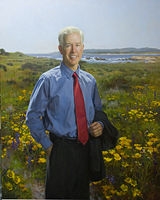
Gray Davis

Encyclopedia
Joseph Graham "Gray" Davis, Jr. (born December 26, 1942) is an American
Democratic
politician who served as California
's 37th Governor
from 1999 until being recalled
in 2003. Prior to serving as Governor, Davis served as Chief of Staff to Governor Jerry Brown
(1975–1981), California State Assembly
man (1983–1987), California State Controller
(1987–1995), and the 44th Lieutenant Governor of California
(1995–1999). Davis holds a B.A.
in history
from Stanford University
and a J.D.
from Columbia Law School
. He was awarded a Bronze Star
for his service as a Captain
in the Vietnam War
.
During his time as Governor, Davis made education his top priority and California spent eight billion dollars more than was required under Proposition 98
during his first term. Under Davis, California standardized test scores increased for five straight years. Davis signed the nation's first state law requiring automakers to limit auto emissions. Davis supported laws to ban assault weapons
. He is also credited with improving relations between California and Mexico
. Davis began his tenure as Governor with strong approval ratings, but those ratings declined as voters blamed Davis for the California electricity crisis
and the California budget crisis that followed the dot-com bubble burst. Voters were also alienated by Davis’s record breaking fundraising efforts and negative campaigning
.
On October 7, 2003, he became the second governor to be recalled
in American history. Davis was succeeded by Republican
Arnold Schwarzenegger
on November 17 after the recall election. Davis spent 1,778 days as Governor, and signed 5,132 bills out of 6,244, vetoing 1,112 bills. Since being recalled, Davis has worked as a guest lecturer at the UCLA School of Public Affairs
and as an attorney at Loeb & Loeb, and sat on the Board of Directors of the animation company DiC Entertainment
.
, New York City
, Davis moved to California
with his family as a child in 1954. He was the first of the family's five children: three boys and two girls. He was raised a Roman Catholic. Davis and his family were one of the millions of Americans to migrate to the southwest and California as part of the post-World War II
sun belt
migration.
His diverse educational experiences at public, private and Catholic schools allowed him an opportunity to compare all three systems as a lawmaker. Davis graduated from a North Hollywood
military academy
, the Harvard School for Boys (now part of Harvard-Westlake School
). Davis's family was upper middle class and was led by his demanding mother. Davis was nicknamed Gray by his mother. His father, Joseph Graham Davis, Sr., an advertising manager at Time, Inc. and an alcoholic, was the son of William Rhodes Davis
.
His strong academic accomplishments earned him acceptance to Stanford University
. He played on the Stanford golf team with a two handicap. After Davis entered Stanford University
, his father left the family, forcing Davis to join the ROTC
to stay in school. The deal included a promise to enter the regular Army after completing his education. He earned a Bachelor of Arts
in history
at Stanford, where he was admitted to the Zeta Psi
fraternity, graduating in 1964 with distinction. He then returned to New York
to attend Columbia Law School
where he won the Moot Court award. During law school Davis had a romantic encounter with actress Cybill Shepherd
. He graduated from Columbia in 1967 and then clerked at the law firm of Beekman & Bogue in New York City.
After completing the program in 1967 he entered active duty in the United States Army
, serving in the Vietnam War
during its height until 1969. Davis saw time on the battlefield during his time in Vietnam. Davis returned home as a captain with a Bronze Star for meritorious service. Friends who knew him at the time said Davis— like many war veterans— came back a changed man, interested in politics and more intense, according to the Sacramento Bee. He returned from Vietnam more "serious and directed." Davis was surprised to discover that the majority of those serving in Vietnam were Latino
s, African American
s, and southern whites with very few from schools like Stanford and Columbia; Davis believed that the burden of the war should be felt equally and he resolved early on to go about changing America so that would change. Davis is a life member of the American Legion
and the Veterans of Foreign Wars
.
Davis volunteered for the campaign of John V. Tunney
for the United States Senate
in 1970. He started a statewide neighborhood crime watch program while serving as chairman of the California Council on Criminal Justice. His initial political experience included working to help Tom Bradley
win election as Los Angeles' first black mayor in 1973. The historical significance of Bradley's victory further inspired Davis to pursue a career in politics. Davis ran for State Treasurer
in 1974 but lost when the more popular Jesse Unruh filed to run on the deadline.
Davis returned to California and entered politics, serving as Executive Secretary and Chief of Staff to Governor Edmund G. "Jerry" Brown Jr.
from 1975 to 1981. In 1976, while Chief of Staff, Davis was suspended from the State Bar of California
on the first of two occasions for failure to pay his yearly State Bar dues on time. Each time Davis then paid his dues and was automatically reinstated. Davis was not as liberal as Brown, and some said he offset Brown's style by projecting a more intense, controlled personality. While Brown was campaigning for President
in 1980, Davis ran California in Brown's absence though Davis would later claim that "we always did what he thought Brown would have done."
He met his present wife, Sharon Ryer, while on an airplane tending to official business in 1978. Ryer, a flight attendant for Pacific Southwest Airlines
, was annoyed when Davis held up the departure of the flight from Sacramento to Los Angeles. Davis apologized and asked her out, and they later married in 1983, with California Supreme Court justice Rose Bird
officiating.
He was elected to the office of Assemblyman
from the 43rd district, representing parts of Los Angeles County
including West Los Angeles and Beverly Hills from 1983-7. Davis championed a popular campaign to help find missing children by placing their pictures on milk cartons and grocery bags.
; several of those candidates, including Democrat John Garamendi
and Republican Bill Campbell, were arguably better known at the time. Davis served as State Controller for eight years until 1995. As California's chief fiscal officer, he saved taxpayers more than half a billion dollars by cracking down on Medi-Cal fraud, rooting out government waste and inefficiency, and exposing the misuse of public funds. He was the first Controller to withhold paychecks from all state elected officials, including himself, until the Governor and the Legislature passed an overdue budget. He also found and returned more than $1.8 billion in unclaimed property to California citizens, including forgotten bank accounts, insurance settlements, and stocks.
for the Democratic nomination for the United States Senate
in the 1992 special election to fill the Senate seat vacated by Pete Wilson
who was elected Governor of California
in 1990. The race is often cited as an example of Davis's history of negative campaign tactics. The Davis campaign featured an ad that compared Feinstein to the incarcerated hotelier Leona Helmsley
. Some experts consider that ad to be the most negative in state history. The ad backfired with Davis losing to Feinstein by a significant margin for the nomination although this loss did not stop Davis from using negative campaign ads in the future, including in his race for Lieutenant Governor. Davis blamed his campaign managers for the defeat and vowed not to let major decisions in future campaigns be decided by his campaign staff. In 2003, when Feinstein urged voters to vote no during the recall election, she was constantly reminded through questions, video, and the media about the 1992 primary.
in 1994, receiving more votes than any other Democratic candidate in America. Davis ran as a moderate candidate against Republican Cathie Wright. Davis used ads to depict Wright as a Republican that was too conservative for California. Davis had a large advantage in campaign funds.
As Lieutenant Governor until 1999, Gray Davis focused on efforts on the California economy and worked to encourage new industries to locate and expand in the state. He also worked to keep college education affordable for California's middle-class families and oversaw the largest student-fee reduction in California history. As the state's second-highest officeholder, he served as President of the State Senate, Chair of the Commission for Economic Development, Chair of the State Lands Commission, Regent of the University of California
and Trustee of the California State University
.
and Jane Harman
, whose husband is a multimillionaire. Davis's campaign slogan during the primary was "Experience Money Can't Buy." Early primary polls showed Davis in third for the Democratic nomination. Davis surprised many political insiders with his landslide come-from-behind victory. Davis even finished ahead of the unopposed Republican nominee in California's first blanket
gubernatorial primary.
Davis won the 1998 general election for Governor with 57.9% of the vote, defeating Republican Dan Lungren
who had 38.4%. Davis aimed to portray himself as a moderate centrist democrat and to label Lungren a Republican too conservative for California and out of touch with its views on issues like guns and abortion. After his victory, Davis declared that he would work to end the "divisive politics" of his predecessor Pete Wilson
. In his campaign, Davis emphasized the need to improve California's public schools, which voters had cited as their top concern in this election.
in 2004. In March 1999, Davis enjoyed a 58% approval rating and just 12% disapproval. His numbers peaked in February 2000 with 62% approval and 20% disapproval, coinciding with the peak of the dot-com boom
in California. Davis held his strong poll numbers into January 2001.
Davis's first official act as governor was to call a special session of the state legislature to address his plan for all California children to be able to read by age 9.
Nine months into his first term as Governor, Davis was suspended from the State Bar of California
for non-payment of membership fees for the second time (the first time was while serving as Governor Jerry Brown
's Chief of Staff
).
Davis used California's growing budget surplus to increase education spending. He signed legislation that provided for a new statewide accountability program and for the Academic Performance Index and supported the high school exit exam. He signed legislation that authorized the largest expansion of the Cal Grant program. Under the Davis administration, California began recognizing students for outstanding academic achievement in math and sciences on the new Golden State Exam. Davis's Governors Scholarship program provided $1,000 scholarships to those students who scored in the top 1% in two subject areas on the state's annual statewide standardized test.
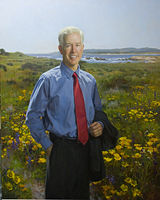 Davis signed into law legislation that began the Eligibility in the Local Context (ELC) program that guaranteed admission to a University of California
institution to students that finished in the top 4% of their high school class. Public schools received $8 billion over the minimum required by Proposition 98
during Davis's first term. Davis increased spending on recruiting more and better-qualified teachers. He campaigned to lower the approval threshold for local school bonds from two-thirds to 55 percent in a statewide proposition that passed. Davis earmarked $3 billion over four years for new textbooks and, between 1999 and 2004, increased state per-pupil spending from $5,756 to $6,922.
In 2001, Gov. Gray Davis signed Senate Bill 19, which establishes nutritional standards for food at elementary schools and bans the sale of carbonated beverages in elementary and middle schools.
Another early act of Davis's was the reversal of his predecessor Republican Governor Pete Wilson's alteration of California's eight-hour overtime pay rule for wage earners.
s with all sales of new firearms and reducing the sale of cheap handguns. Davis's ban included a ban on .50 caliber firearms and so-called "Saturday Night Specials." In 2001, Davis signed a bill requiring gun buyers to pass a safety test. A supporter of the death penalty and tougher sentencing laws, Davis blocked nearly all parole recommendations by the parole board.
. Davis believed that California under Pete Wilson
had left millions of dollars of potential trade revenues "on the table." Interestingly, given Davis's later criticisms of Bush during the energy crisis, Davis wanted California to have relations with Mexico that were more like Texas
under then-Governor George W. Bush
. Controversy over the California Mexico border and California Proposition 187 had strained the relationship between the two parties. Davis met with Mexican President Ernesto Zedillo
to improve relations with California's southern neighbor and major trading partner within Davis's first 30 days in office. Davis later met with President Vicente Fox
and participated in his inauguration. The Governor met with Mexican Presidents eight times. Under the Davis administration, California and Baja California
signed a "Memorandum of Understanding" expanding cooperation in several policy areas. Under Davis, Mexico became California's leading export market for the first time in history and California's trade with Mexico surpasses all of Mexico's trade with Latin America, Europe and Asia combined. Because of the growth in the California economy, Davis opened and expanded trade offices around the world, including in Mexico. But most of these offices were eliminated in the 2003 California budget due to difficult fiscal times.
if their HMO denies treatment and, in limited cases, the right to sue. Davis signed legislation that provided HMO patients a bill of rights, including help-line to resolve disputes and independent medical review of claims. Under Davis, staff-to-patient ratios in nursing homes improved. However, Davis didn't expand low-cost health care to parents of needy children due to budget constraints or prevent millions of health care dollars being returned to federal government unused.
Davis allowed non-disabled low-income people with HIV
to be treated under Medi-Cal
. He signed a law allowing people participating in needle exchange programs to be immune from criminal prosecution. He also increased state spending on AIDS prevention.
Under Governor Davis, California's anti-tobacco
campaign became one of the largest and most effective in the nation. R. J. Reynolds and Lorillard Tobacco sued over California's antismoking campaign but their lawsuit was dismissed in July 2003. Davis also authorized a new hard-hitting anti-smoking ad that graphically depicts the damage caused by secondhand smoke.
In September 2002, Governor Davis signed bills to ensure age verification was obtained for cigarettes and other tobacco products sold over the Internet
or through the mail, ensured that all state taxes are being fully paid on tobacco purchases, and increased the penalty for possessing or purchasing untaxed cigarettes. He also signed legislation to expand smoke-free zones around public buildings.
Davis approved legislation creating a telemarketing do-not-call list in 2003. Under Davis, benefits for injured and unemployed workers increased. The minimum wage increased by $1 to $6.75. Davis backed higher research and development tax credits. He pushed for elimination of the minimum franchise tax paid by new businesses during the first two years of operation.
While Davis's record was pro environmental by increasing spending on land acquisition and maintenance of the state's park system, signing legislation that attempts to cut greenhouse gas emissions by having automakers produce more efficient vehicles, cutting fees to state parks, and opposing offshore drilling
, he did not back tougher restrictions on timber companies as some environmentalists desired. Under the Davis administration, California purchased 10000 acres (40 km²) for urban parks.
Davis signed the first state law in the US in July 2002 to require automakers to limit auto emissions. The law required the California Air Resources Board to obtain the "maximum feasible" cuts in greenhouse gases emitted by all non-commercial vehicles in 2009 and beyond. Automakers claimed the law would lead smaller and more expensive cars sold in California.
On March 25, 1999, Davis issued an executive order calling for the removal of MTBE (a toxic gasoline additive) from gasoline sold in the state. In 2001, in order for gas prices to remain reasonable in California while removing MTBE, Davis asked President George W. Bush
to order the EPA to grant California a waiver on the federal minimum oxygen requirement. Without a waiver, California would have to import a much larger amount of ethanol
per year and gas prices were projected to increase drastically. Bush did not grant the waiver, and in 2002, Davis issued an executive order reversing his earlier executive order.
Davis's actions when it came to regulating business suggested that Davis was a more moderate Governor. He worked to kill a comprehensive bill opposed by banks and insurance companies to protect consumers' personal financial information. "What you saw in the campaign was what you got," said professor Bruce Cain. "He's tried to negotiate a course between the different interest groups and keep Democrats on a more centrist, business-oriented track".
Davis approved $5.3 billion over five years for more than 150 transit and highway projects. One of those projects was construction on the new eastern section of the Bay Bridge. During 1999 and 2000, California spent millions on onetime projects like buying new rail cars and track improvements.
, his numbers declined to 42% approval and 49% disapproval. By December 2001, Davis' approval ratings spiked up to 51%. His numbers declined back to the May 2001 level and remained about the same over the next year. In April 2003, Davis had a 24% approval rating and 65% disapproval rating. Voters cited disapproval of the state's record $34.6 billion budget shortfall, growing unemployment, and dubious campaign contributor connections.
Davis had tried to maintain a middle-of-the-road approach, but ultimately alienated many of the state's liberals who viewed him as too conservative, and many conservatives who viewed him as too liberal. Many were upset that in trying to balance the budget, Davis cut spending for schools while increasing spending for prisons in lieu that in the coming years, a federal court ruling would declare the conditions in California prisons so poor and overcrowded that they were unconstitutional. Some critics attributed the proposal to the California Correctional Peace Officers Association
s donations to Davis's re-election campaign.
Negative sentiment was expressed on talk radio
. The John and Ken
Show in Los Angeles called Davis Gumby
in response to his changing positions on issues, while Mr. KABC
and Al Rantel
(also in Los Angeles) coined the term Governor Lowbeam as a reference to his alleged mishandling of the electricity crisis and his term as Chief of Staff for Jerry Brown, who was often mocked as Governor Moonbeam. Many talk radio programs played a role in collecting signatures to force a recall election.
According to the subsequent Federal Energy Regulatory commission's investigation and report, numerous energy trading companies, many based in Texas, such as Enron Corporation, illegally restricted their supply to the point where the spikes in power usage would cause blackouts. Rolling blackouts affecting 97,000 customers hit the San Francisco Bay area on June 14, 2000, and San Diego Gas & Electric Company filed a complaint alleging market manipulation
by some energy producers in August 2000. On December 7, 2000, suffering from low supply and idled power plants, the California Independent System Operator (ISO), which manages the California power grid, declared the first statewide Stage 3 power alert, meaning power reserves were below 3 percent. Rolling blackouts were avoided when the state halted two large state and federal water pumps to conserve electricity.
On January 17, 2001, Davis declared a state of emergency in response to the electricity crisis. Speculators, led by Enron Corporation, were collectively making large profits while the state teetered on the edge for weeks, and finally suffered rolling blackouts on January 17 and 18. Davis stepped in to buy power at highly unfavorable terms on the open market, since the California power companies were technically bankrupt
and had no buying power. California agreed to pay $43 billion for power over the next 20 years. Newspaper publishers sued Davis to force him to make public the details of the energy deal.
During the electricity crisis, the Davis administration implemented a power conservation program that included television ads and financial incentives to reduce energy consumption. These efforts, the fear of rolling blackouts, and the increased cost of electricity resulted in a 14.1% reduction in electricity usage from June 2000 to June 2001.
Gray Davis critics often charge that he did not respond properly to the crisis, while his defenders attribute the crisis solely to the corporate accounting scandal
s and say that Davis did all he could. Some critics on the left, such as Arianna Huffington
, alleged that Davis was lulled to inaction by campaign contributions from energy producers. Some of Davis's energy advisers were formerly employed by the same energy speculators who made millions from the crisis. In addition, the Democrat-controlled legislature would sometimes push Davis to act decisively by taking over power plants which were known to have been gamed and place them back under control of the utilities. Some conservatives argued that Davis signed overpriced energy contracts, employed incompetent negotiators, and refused to allow prices to rise for residences statewide much like they did in San Diego, which they argue could have given Davis more leverage against the energy traders and encouraged more conservation. The electricity crisis is considered one of the major factors that lead to Davis's recall.
In a speech at UCLA on August 19, 2003, Davis apologized for being slow to act during the energy crisis, but then forcefully attacked the Houston-based energy suppliers: "I inherited the energy deregulation scheme which put us all at the mercy of the big energy producers. We got no help from the Federal government. In fact, when I was fighting Enron
and the other energy companies, these same companies were sitting down with Vice President
Cheney to draft a national energy strategy."
When the Enron verdicts were rendered years later, convicting Enron and other companies of market manipulation, Davis responded with the following quote:
On November 13, 2003, shortly before leaving office, Davis officially brought the energy crisis to an end by issuing a proclamation ending the state of emergency he declared on January 17, 2001. The state of emergency allowed the state to buy electricity for the financially strapped utility companies. The emergency authority allowed Davis to order the California Energy Commission
to streamline the application process for new power plants. During that time, California issued licenses to 38 new power plants, amounting to 14,365 megawatts of electricity production when completed.
In 2006, the Los Angeles Times
published an article that credited Davis's signing of the long term projects for preventing future blackouts and providing California a cheap supply of energy with the increasing costs of energy.
In March 2003, the Federal Energy Regulatory Commission's long awaited report on the so-called "energy crisis" was released. That report mostly vindicated Davis, laying the blame for the energy disruption and raiding of California's treasury on some 25 energy trading companies, most of which were based in Texas.
While California's economy was expanding, California was producing record budget surpluses under Davis even after his tax cuts and new spending. According to the California Department of Finance, California had a 10% surplus at the end of 1999 and California was projected to have a 4% surplus at the end fiscal year 2000. These surplus monies were left in the treasury. Davis claimed to be cautious with state finances.
Then, the dot-com boom that had been fueling California's record tax revenues burst unexpectedly because of the large number of high tech firms in California and California's dependence on state income taxes. When the dot-com boom turned to bust, state revenues fell while ongoing spending commitments created deficits. Restoring the licensing fees to pre tax cut levels to close the budget gap and stabilize the state's credit rating became unpopular. The beginning shortfall for the 2002-2003 state budget was $23.6 billion. Davis announced that the 2003-2004 budget shortfall would be $34.6 billion while the Legislative Analyst projected a $21.1.
Davis's fundraising efforts attracted much attention. University of California Berkeley's Institute of Government Studies claimed that Davis's fundraising skills were "second to none in the political arena" while Senator John McCain
called Davis's 2001 goal of $26 million "disgraceful." One article in the San Francisco Chronicle claimed that Davis was raising $34,000 a day. Although Davis's fundraising pace was criticized by his many detractors, Arnold Schwarzenegger
would later collect contributions at a quicker rate during the early years of his governorship. Now Arnoldwatch.org, a project of the Foundation for Taxpayer and Consumer Rights which is a nonpartisan organization that is critical of both Democrats and Republicans, called Davis a "pay to play" politician and a "sellout".
During the 2002 election campaign, Davis took the unusual step of taking out campaign ads during the Republican primaries
against Los Angeles mayor Richard Riordan
. Davis claimed that Riordan had attacked his record and that his campaign was defending his record. Polls showed that, as a moderate, Riordan would be a more formidable challenger in the general election than a conservative candidate. Polls even showed that Riordan would defeat Davis. Davis attacked Riordian with negative ads in the primary. The ads questioned Riordan's pro-choice stance by questioning Riordan's support of pro-life politicians and judges. The ads pointed out Riordan's position of wanting a moratorium on the death penalty as being to the left of Gray Davis, who strongly supported it.
Davis's negative ads against Riordan and a variety of other equally important factors explained on the 2002 election page, led to Riordan's defeat in the Republican primary by the more staunchly conservative candidate Bill Simon. In the first 10 weeks of 2002, Davis spent $10 million on ad: $3 million on positive ads boasting of his record, $7 million on negative ads against Riordan.
Davis was re-elected in the November 2002 general election following a long and bitter campaign against Simon, marked by accusations of ethical lapses on both sides and widespread voter apathy. Simon was also hurt by a financial fraud scandal that tarnished Simon's reputation. Davis's campaign touted California's improving test scores, environmental protection, health insurance coverage for children, and lower prescription drug costs for seniors. Davis's campaign featured several negative ads that highlighted Simon's financial fraud scandal. The 2002 gubernatorial race was the most expensive in California state history with over $100 million spent. Davis's campaign was better financed; Davis had over $26 million in campaign reserves more than Simon in August 2002. Davis gained re-election with 47.4% of the vote to Simon's 42.4%. However, the Simon-Davis race led in the lowest turnout percentage in modern gubernatorial history, allowing a lower than normal amount of signatures required for a recall. Davis won the election but majority of the voters disliked Davis and did not approve of his job performance.
, the leader of the California State Senate
, was Davis's chief antagonist. In 2003, Republican leader Jim Brulte
told The Los Angeles Times that Davis lacked the basics of political collegiality to pull him through hard times. "I never felt I got to know him ... I always felt a little sorry for him".
Davis's moderate record made it difficult for him to appeal to the core constituency of the Democratic Party. During the recall, Davis failed to gain the full support he needed from his more liberal Democratic base. He had the reputation of being beholden to supporters yet unable to satisfy them.
Davis's leadership and compromise-building skills have also been questioned. Many of the challenges that California faced during his years required a strong force of personality to forge compromise but Davis lacked such skill. He was also hurt by redistricting in 2000 that made most districts safe for the incumbent party, limiting some legislators' need and willingness to compromise.
When Davis was inaugurated, he said, regarding Proposition 187
, "I'm a governor, not a judge", and vowed to uphold all of the laws of the state, even the ones with which he personally disagreed. Davis defended the law initially, but when it was declared unconstitutional Ninth Circuit Court of Appeals he did not appeal the decision.
Davis's personality was often described as aloof and his political style cautious and calculated instead of charismatic. His personality forced him to depend more on political skills, such as fundraising, to win elections. Davis's tendency to micromanage his administration made it difficult for people to present opposing views and even drove some out of service.
As Davis left office in 2003, the San Francisco Chronicle published an editorial discussing his legacy. The newspaper claimed that he lacked vision, allowed the legislature and its policies to define his tenure, and had a "robotic governing style" that focused on fundraising instead of personal relationships. The Chronicle commented that Davis was often on the right side of the issues but that being on the right side of the issues alienated the electorate. Davis lacked charisma and seemed to be more passionate about winning campaigns than governing. Davis never showed emotion to the voters. He spent much of his campaign time talking about his accomplishments instead of providing voters with a vision.
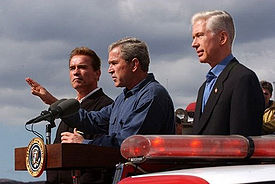 Davis was Governor during the southern California fires of 2003, more commonly known as the Cedar Fire
. Davis declared a state of emergency in Los Angeles County, San Bernardino County, San Diego County, and Ventura County in October 2003 and deployed the National Guard to help with disaster relief. By mid-November, the greater South Los Angeles area had been declared a disaster area. This enabled federal funding to help repair flooding and weather-related damage, including the destruction of thousands of acres of vegetation. The Cedar Fire was the last major event during Davis's tenure as Governor. Both Davis and governor-elect Schwarzenegger worked to help with disaster relief. Schwarzenegger went to Washington, D.C.
and met Vice President Dick Cheney
to lobby the federal government for more disaster relief funds.
. The initial drive for the recall was fueled by funds from the personal fortune of U.S. Rep.
Darrell Issa
, a Republican who originally hoped to replace Davis himself. The 2003 California recall special election was the goal of the "Dump Davis" campaign, and constituted the first gubernatorial recall in Californian history, and only the second in U.S. history.
Early in the recall election, Davis called the recall election an “insult” to the eight million voters who had voted in the 2002 gubernatorial election.
The Davis campaign tried to run against the recall Yes/No vote instead of against the candidates that were trying to replace him. Davis tried to depict the recall as a $66 million waste of money that could allow a candidate with a very small percentage of the vote to become Governor—potentially someone who was very liberal or conservative. There are no primaries in a recall election. Davis tried to run “outside the recall circus” and to make himself appear gubernatorial and hard at work for California, who had made improvements to education and healthcare. Early August polls showed that over 50% supported the recall.
In September 2003, Davis conceded that he had lost touch with the voters and he was trying to correct that with numerous townhall meetings. Poll numbers in September showed a 3% drop in the number of California voters who were planning to vote yes on the recall.
According to some analysts and campaign aides, Davis's town hall meetings and conversations with voters were softening his image. Many political insiders remarked that Davis had made several comebacks and that he should not be counted out of the race despite poll numbers that showed over 50% planning to vote yes on the recall.
During the recall, Davis blamed some of the state's problems on his predecessor Pete Wilson. Davis claimed that he would have rather raised taxes on the upper tax brackets instead of restoring vehicle registration fees and college student tuition.
Davis called the recall a right-wing effort to rewrite history after losing the fall election last year. In a major 19 minute campaign address that was broadcast statewide, Davis said the recall was a "right-wing power grab" by Republicans and he blamed Republicans in the legislature and in Washington for many of the state's problems while at the same time he tried to take some of the responsibility for the state's problems.
On October 7, 2003, Davis was recalled with 55.4% of the votes in favor of the recall, and Republican Arnold Schwarzenegger
was elected to replace him as governor. The Bay Area
and Los Angeles County were the only regions in California to vote no on the recall. San Francisco rejected the recall by a 4 to 1 ratio. Davis joined Lynn Frazier
of North Dakota
, who was ousted in 1921, as the only governors in American history to be recalled.
On the night of the recall, Davis conceded defeat and thanked California for having elected him in 5 statewide elections. Davis mentioned what he defined as the accomplishments of his administration such as improvements in education, environmental protection, and health insurance for children. Davis said he would help Schwarzenegger in the transition and he later urged his staff to do the same.
on the CBS
sitcom Yes, Dear
. In December 2004, he announced that he was joining the law firm of Loeb & Loeb.
Davis spends 80% of his workdays practicing corporate law as "of counsel
" to Loeb & Loeb in Century City, a firm where all attorneys wear casual attire, even Davis. American Lawyer magazine called the firm one of "best places" in the country for legal staff to work.
Davis has done several media interviews about his legacy. He appeared prominently in the documentary Enron: The Smartest Guys in the Room
.
The debate about his legacy and role in the energy woes that proved to be his downfall remains. In a CNN interview on August 5, 2005, Davis expressed that he feels complete vindication because of the revelation that Enron manipulated the California energy market and because of Schwarzenegger's then-low approval ratings. He also indicated that he had no interest in running for Governor again, although he had been urged to run by some Democrats.
He was a guest lecturer at UCLA's School of Public Policy in 2006 alongside former Republican State Senator Jim Brulte
. He wrote an introduction for a journalist's book on the Amber Alert
system for missing children, a cause he championed.
On April 23, 2007, Davis was appointed to the Board of Directors of animation company DiC Entertainment
, as a non-executive.
On May 21, 2009, Davis was the keynote speaker at the Columbia Law School graduation ceremony.
United States
The United States of America is a federal constitutional republic comprising fifty states and a federal district...
Democratic
Democratic Party (United States)
The Democratic Party is one of two major contemporary political parties in the United States, along with the Republican Party. The party's socially liberal and progressive platform is largely considered center-left in the U.S. political spectrum. The party has the lengthiest record of continuous...
politician who served as California
California
California is a state located on the West Coast of the United States. It is by far the most populous U.S. state, and the third-largest by land area...
's 37th Governor
Governor of California
The Governor of California is the chief executive of the California state government, whose responsibilities include making annual State of the State addresses to the California State Legislature, submitting the budget, and ensuring that state laws are enforced...
from 1999 until being recalled
Recall election
A recall election is a procedure by which voters can remove an elected official from office through a direct vote before his or her term has ended...
in 2003. Prior to serving as Governor, Davis served as Chief of Staff to Governor Jerry Brown
Jerry Brown
Edmund Gerald "Jerry" Brown, Jr. is an American politician. Brown served as the 34th Governor of California , and is currently serving as the 39th California Governor...
(1975–1981), California State Assembly
California State Assembly
The California State Assembly is the lower house of the California State Legislature. There are 80 members in the Assembly, representing an approximately equal number of constituents, with each district having a population of at least 420,000...
man (1983–1987), California State Controller
California State Controller
The State Controller is the Chief Financial Officer of the State of California in the United States. The post has broader responsibilities and authority than the California State Treasurer...
(1987–1995), and the 44th Lieutenant Governor of California
Lieutenant Governor of California
The Lieutenant Governor of California is a statewide constitutional officer elected separately from the Governor who serves as the "vice-executive" of California. The Lieutenant Governor of California is elected to serve a four year term and can serve a maximum of two terms...
(1995–1999). Davis holds a B.A.
Bachelor of Arts
A Bachelor of Arts , from the Latin artium baccalaureus, is a bachelor's degree awarded for an undergraduate course or program in either the liberal arts, the sciences, or both...
in history
History
History is the discovery, collection, organization, and presentation of information about past events. History can also mean the period of time after writing was invented. Scholars who write about history are called historians...
from Stanford University
Stanford University
The Leland Stanford Junior University, commonly referred to as Stanford University or Stanford, is a private research university on an campus located near Palo Alto, California. It is situated in the northwestern Santa Clara Valley on the San Francisco Peninsula, approximately northwest of San...
and a J.D.
Juris Doctor
Juris Doctor is a professional doctorate and first professional graduate degree in law.The degree was first awarded by Harvard University in the United States in the late 19th century and was created as a modern version of the old European doctor of law degree Juris Doctor (see etymology and...
from Columbia Law School
Columbia Law School
Columbia Law School, founded in 1858, is one of the oldest and most prestigious law schools in the United States. A member of the Ivy League, Columbia Law School is one of the professional graduate schools of Columbia University in New York City. It offers the J.D., LL.M., and J.S.D. degrees in...
. He was awarded a Bronze Star
Bronze Star Medal
The Bronze Star Medal is a United States Armed Forces individual military decoration that may be awarded for bravery, acts of merit, or meritorious service. As a medal it is awarded for merit, and with the "V" for valor device it is awarded for heroism. It is the fourth-highest combat award of the...
for his service as a Captain
Captain (OF-2)
The army rank of captain is a commissioned officer rank historically corresponding to command of a company of soldiers. The rank is also used by some air forces and marine forces. Today a captain is typically either the commander or second-in-command of a company or artillery battery...
in the Vietnam War
Vietnam War
The Vietnam War was a Cold War-era military conflict that occurred in Vietnam, Laos, and Cambodia from 1 November 1955 to the fall of Saigon on 30 April 1975. This war followed the First Indochina War and was fought between North Vietnam, supported by its communist allies, and the government of...
.
During his time as Governor, Davis made education his top priority and California spent eight billion dollars more than was required under Proposition 98
California Proposition 98 (1988)
California Proposition 98 requires a minimum percentage of the state budget to be spent on K-14 education. Prop 98 guarantees an annual increase in education in the California budget. Prop 98, also called the "Classroom Instructional Improvement and Accountability Act," amended the California...
during his first term. Under Davis, California standardized test scores increased for five straight years. Davis signed the nation's first state law requiring automakers to limit auto emissions. Davis supported laws to ban assault weapons
Assault weapon
Assault weapon is a non-technical term referring to any of a broad category of firearms with certain features, including some semiautomatic rifles, some pistols, and some shotguns. There are a variety of different statutory definitions of assault weapons in local, state, and federal laws in the...
. He is also credited with improving relations between California and Mexico
Mexico
The United Mexican States , commonly known as Mexico , is a federal constitutional republic in North America. It is bordered on the north by the United States; on the south and west by the Pacific Ocean; on the southeast by Guatemala, Belize, and the Caribbean Sea; and on the east by the Gulf of...
. Davis began his tenure as Governor with strong approval ratings, but those ratings declined as voters blamed Davis for the California electricity crisis
California electricity crisis
The California electricity crisis, also known as the Western U.S. Energy Crisis of 2000 and 2001 was a situation in which California had a shortage of electricity caused by market manipulations and illegal shutdowns of pipelines by Texas energy consortiums...
and the California budget crisis that followed the dot-com bubble burst. Voters were also alienated by Davis’s record breaking fundraising efforts and negative campaigning
Negative campaigning
Negative campaigning, also known more colloquially as "mudslinging", is trying to win an advantage by referring to negative aspects of an opponent or of a policy rather than emphasizing one's own positive attributes or preferred policies...
.
On October 7, 2003, he became the second governor to be recalled
Recall election
A recall election is a procedure by which voters can remove an elected official from office through a direct vote before his or her term has ended...
in American history. Davis was succeeded by Republican
Republican Party (United States)
The Republican Party is one of the two major contemporary political parties in the United States, along with the Democratic Party. Founded by anti-slavery expansion activists in 1854, it is often called the GOP . The party's platform generally reflects American conservatism in the U.S...
Arnold Schwarzenegger
Arnold Schwarzenegger
Arnold Alois Schwarzenegger is an Austrian-American former professional bodybuilder, actor, businessman, investor, and politician. Schwarzenegger served as the 38th Governor of California from 2003 until 2011....
on November 17 after the recall election. Davis spent 1,778 days as Governor, and signed 5,132 bills out of 6,244, vetoing 1,112 bills. Since being recalled, Davis has worked as a guest lecturer at the UCLA School of Public Affairs
UCLA School of Public Affairs
The UCLA Luskin School of Public Affairs is the public affairs/public service graduate school at UCLA. The school consists of three departments -- Public Policy, Social Welfare, and Urban Planning -- offering two undergraduate minors, three master's degrees, and two doctoral degrees...
and as an attorney at Loeb & Loeb, and sat on the Board of Directors of the animation company DiC Entertainment
DiC Entertainment
DIC Entertainment was an international film and television production company. In addition to animated television shows such as Ulysses 31 , Inspector Gadget , The Littles , The Real Ghostbusters , Captain Planet and the Planeteers , and the first two seasons of the English adaptation of...
.
Early life and political career
Born in The BronxThe Bronx
The Bronx is the northernmost of the five boroughs of New York City. It is also known as Bronx County, the last of the 62 counties of New York State to be incorporated...
, New York City
New York City
New York is the most populous city in the United States and the center of the New York Metropolitan Area, one of the most populous metropolitan areas in the world. New York exerts a significant impact upon global commerce, finance, media, art, fashion, research, technology, education, and...
, Davis moved to California
California
California is a state located on the West Coast of the United States. It is by far the most populous U.S. state, and the third-largest by land area...
with his family as a child in 1954. He was the first of the family's five children: three boys and two girls. He was raised a Roman Catholic. Davis and his family were one of the millions of Americans to migrate to the southwest and California as part of the post-World War II
World War II
World War II, or the Second World War , was a global conflict lasting from 1939 to 1945, involving most of the world's nations—including all of the great powers—eventually forming two opposing military alliances: the Allies and the Axis...
sun belt
Sun Belt
The Sun Belt or Spanish Belt is a region of the United States generally considered to stretch across the South and Southwest . Another rough boundary of the region is the area south of the 36th parallel, north latitude. It is the largest region which the U.S government does not recognize officially...
migration.
His diverse educational experiences at public, private and Catholic schools allowed him an opportunity to compare all three systems as a lawmaker. Davis graduated from a North Hollywood
North Hollywood, Los Angeles, California
North Hollywood is a district in the San Fernando Valley region of the city of Los Angeles, California, along the Tujunga Wash. It is bounded on the south by Moorpark Street and the Ventura Freeway, on the southwest by Burbank Blvd...
military academy
Military academy
A military academy or service academy is an educational institution which prepares candidates for service in the officer corps of the army, the navy, air force or coast guard, which normally provides education in a service environment, the exact definition depending on the country concerned.Three...
, the Harvard School for Boys (now part of Harvard-Westlake School
Harvard-Westlake School
Harvard-Westlake School is an independent, co-educational university preparatory day school consisting of two campuses located in Los Angeles, California with approximately 1,600 students enrolled in grades 7 through 12....
). Davis's family was upper middle class and was led by his demanding mother. Davis was nicknamed Gray by his mother. His father, Joseph Graham Davis, Sr., an advertising manager at Time, Inc. and an alcoholic, was the son of William Rhodes Davis
William Rhodes Davis
William Rhodes Davis was an American businessman, named in assistant U.S. Attorney General O. John Rogge's Nazi Report, published in 1961, as Abwehr agent C-80, financed with the personal approval of Hitler, engaged in supplying petroleum to Germany.-Biography:William Rhodes Davis first married...
.
His strong academic accomplishments earned him acceptance to Stanford University
Stanford University
The Leland Stanford Junior University, commonly referred to as Stanford University or Stanford, is a private research university on an campus located near Palo Alto, California. It is situated in the northwestern Santa Clara Valley on the San Francisco Peninsula, approximately northwest of San...
. He played on the Stanford golf team with a two handicap. After Davis entered Stanford University
Stanford University
The Leland Stanford Junior University, commonly referred to as Stanford University or Stanford, is a private research university on an campus located near Palo Alto, California. It is situated in the northwestern Santa Clara Valley on the San Francisco Peninsula, approximately northwest of San...
, his father left the family, forcing Davis to join the ROTC
Reserve Officers' Training Corps
The Reserve Officers' Training Corps is a college-based, officer commissioning program, predominantly in the United States. It is designed as a college elective that focuses on leadership development, problem solving, strategic planning, and professional ethics.The U.S...
to stay in school. The deal included a promise to enter the regular Army after completing his education. He earned a Bachelor of Arts
Bachelor of Arts
A Bachelor of Arts , from the Latin artium baccalaureus, is a bachelor's degree awarded for an undergraduate course or program in either the liberal arts, the sciences, or both...
in history
History
History is the discovery, collection, organization, and presentation of information about past events. History can also mean the period of time after writing was invented. Scholars who write about history are called historians...
at Stanford, where he was admitted to the Zeta Psi
Zeta Psi
The Zeta Psi Fraternity of North America was founded June 1, 1847 as a social college fraternity. The organization now comprises about fifty active chapters and twenty-five inactive chapters, encompassing roughly fifty thousand brothers, and is a founding member of the North-American...
fraternity, graduating in 1964 with distinction. He then returned to New York
New York
New York is a state in the Northeastern region of the United States. It is the nation's third most populous state. New York is bordered by New Jersey and Pennsylvania to the south, and by Connecticut, Massachusetts and Vermont to the east...
to attend Columbia Law School
Columbia Law School
Columbia Law School, founded in 1858, is one of the oldest and most prestigious law schools in the United States. A member of the Ivy League, Columbia Law School is one of the professional graduate schools of Columbia University in New York City. It offers the J.D., LL.M., and J.S.D. degrees in...
where he won the Moot Court award. During law school Davis had a romantic encounter with actress Cybill Shepherd
Cybill Shepherd
Cybill Lynne Shepherd is an American actress, singer and former model. Her best known roles include starring as Jacy in The Last Picture Show, as Betsy in Taxi Driver, as Madeleine Spencer in Psych, as Maddie Hayes on Moonlighting, as Cybill Sheridan on Cybill, and as Phyllis Kroll on The L...
. He graduated from Columbia in 1967 and then clerked at the law firm of Beekman & Bogue in New York City.
After completing the program in 1967 he entered active duty in the United States Army
United States Army
The United States Army is the main branch of the United States Armed Forces responsible for land-based military operations. It is the largest and oldest established branch of the U.S. military, and is one of seven U.S. uniformed services...
, serving in the Vietnam War
Vietnam War
The Vietnam War was a Cold War-era military conflict that occurred in Vietnam, Laos, and Cambodia from 1 November 1955 to the fall of Saigon on 30 April 1975. This war followed the First Indochina War and was fought between North Vietnam, supported by its communist allies, and the government of...
during its height until 1969. Davis saw time on the battlefield during his time in Vietnam. Davis returned home as a captain with a Bronze Star for meritorious service. Friends who knew him at the time said Davis— like many war veterans— came back a changed man, interested in politics and more intense, according to the Sacramento Bee. He returned from Vietnam more "serious and directed." Davis was surprised to discover that the majority of those serving in Vietnam were Latino
Latino
The demonyms Latino and Latina , are defined in English language dictionaries as:* "a person of Latin-American descent."* "A Latin American."* "A person of Hispanic, especially Latin-American, descent, often one living in the United States."...
s, African American
African American
African Americans are citizens or residents of the United States who have at least partial ancestry from any of the native populations of Sub-Saharan Africa and are the direct descendants of enslaved Africans within the boundaries of the present United States...
s, and southern whites with very few from schools like Stanford and Columbia; Davis believed that the burden of the war should be felt equally and he resolved early on to go about changing America so that would change. Davis is a life member of the American Legion
American Legion
The American Legion is a mutual-aid organization of veterans of the United States armed forces chartered by the United States Congress. It was founded to benefit those veterans who served during a wartime period as defined by Congress...
and the Veterans of Foreign Wars
Veterans of Foreign Wars
The Veterans of Foreign Wars of the United States is a congressionally chartered war veterans organization in the United States. Headquartered in Kansas City, Missouri, VFW currently has 1.5 million members belonging to 7,644 posts, and is the largest American organization of combat...
.
Davis volunteered for the campaign of John V. Tunney
John V. Tunney
John Varick Tunney , is a former Democratic Party United States Senator and Representative.-Biography:He is the son of the famous heavyweight boxing champion Gene Tunney and Connecticut socialite Polly Lauder Tunney....
for the United States Senate
United States Senate
The United States Senate is the upper house of the bicameral legislature of the United States, and together with the United States House of Representatives comprises the United States Congress. The composition and powers of the Senate are established in Article One of the U.S. Constitution. Each...
in 1970. He started a statewide neighborhood crime watch program while serving as chairman of the California Council on Criminal Justice. His initial political experience included working to help Tom Bradley
Tom Bradley (politician)
Thomas J. "Tom" Bradley was the 38th Mayor of Los Angeles, California, serving in that office from 1973 to 1993. He was the first and to date only African American mayor of Los Angeles...
win election as Los Angeles' first black mayor in 1973. The historical significance of Bradley's victory further inspired Davis to pursue a career in politics. Davis ran for State Treasurer
California State Treasurer
The California State Treasurer is responsible for the state's investment and finance. The post has more narrow responsibilities and authority than the California State Controller...
in 1974 but lost when the more popular Jesse Unruh filed to run on the deadline.
Davis returned to California and entered politics, serving as Executive Secretary and Chief of Staff to Governor Edmund G. "Jerry" Brown Jr.
Jerry Brown
Edmund Gerald "Jerry" Brown, Jr. is an American politician. Brown served as the 34th Governor of California , and is currently serving as the 39th California Governor...
from 1975 to 1981. In 1976, while Chief of Staff, Davis was suspended from the State Bar of California
State Bar of California
The State Bar of California is California's official bar association. It is responsible for managing the admission of lawyers to the practice of law, investigating complaints of professional misconduct, and prescribing appropriate discipline...
on the first of two occasions for failure to pay his yearly State Bar dues on time. Each time Davis then paid his dues and was automatically reinstated. Davis was not as liberal as Brown, and some said he offset Brown's style by projecting a more intense, controlled personality. While Brown was campaigning for President
President of the United States
The President of the United States of America is the head of state and head of government of the United States. The president leads the executive branch of the federal government and is the commander-in-chief of the United States Armed Forces....
in 1980, Davis ran California in Brown's absence though Davis would later claim that "we always did what he thought Brown would have done."
He met his present wife, Sharon Ryer, while on an airplane tending to official business in 1978. Ryer, a flight attendant for Pacific Southwest Airlines
Pacific Southwest Airlines
Pacific Southwest Airlines was a United States airline headquartered in San Diego, California, that operated from 1949 to 1988. It was one of the first large discount airlines in the United States and is considered a precursor to Southwest Airlines...
, was annoyed when Davis held up the departure of the flight from Sacramento to Los Angeles. Davis apologized and asked her out, and they later married in 1983, with California Supreme Court justice Rose Bird
Rose Bird
Rose Elizabeth Bird served for 10 years as the 25th Chief Justice of California. She was the first female Justice, and first female Chief Justice, on that court, appointed by then Governor Jerry Brown...
officiating.
He was elected to the office of Assemblyman
California State Assembly
The California State Assembly is the lower house of the California State Legislature. There are 80 members in the Assembly, representing an approximately equal number of constituents, with each district having a population of at least 420,000...
from the 43rd district, representing parts of Los Angeles County
Los Angeles County, California
Los Angeles County is a county in the U.S. state of California. As of 2010 U.S. Census, the county had a population of 9,818,605, making it the most populous county in the United States. Los Angeles County alone is more populous than 42 individual U.S. states...
including West Los Angeles and Beverly Hills from 1983-7. Davis championed a popular campaign to help find missing children by placing their pictures on milk cartons and grocery bags.
State Controller
In 1986, Davis ran against six other contenders in his race for State ControllerCalifornia State Controller
The State Controller is the Chief Financial Officer of the State of California in the United States. The post has broader responsibilities and authority than the California State Treasurer...
; several of those candidates, including Democrat John Garamendi
John Garamendi
John Raymond Garamendi is the U.S. Representative for , serving since November 2009. He is a member of the Democratic Party. Garamendi was the California State Insurance Commissioner from 1991 to 1995, the U.S. Deputy Secretary of the Interior from 1995 to 1998, and the California State Insurance...
and Republican Bill Campbell, were arguably better known at the time. Davis served as State Controller for eight years until 1995. As California's chief fiscal officer, he saved taxpayers more than half a billion dollars by cracking down on Medi-Cal fraud, rooting out government waste and inefficiency, and exposing the misuse of public funds. He was the first Controller to withhold paychecks from all state elected officials, including himself, until the Governor and the Legislature passed an overdue budget. He also found and returned more than $1.8 billion in unclaimed property to California citizens, including forgotten bank accounts, insurance settlements, and stocks.
1992 campaign for Senate
Davis ran against San Francisco mayor Dianne FeinsteinDianne Feinstein
Dianne Goldman Berman Feinstein is the senior U.S. Senator from California. A member of the Democratic Party, she has served in the Senate since 1992. She also served as 38th Mayor of San Francisco from 1978 to 1988....
for the Democratic nomination for the United States Senate
United States Senate
The United States Senate is the upper house of the bicameral legislature of the United States, and together with the United States House of Representatives comprises the United States Congress. The composition and powers of the Senate are established in Article One of the U.S. Constitution. Each...
in the 1992 special election to fill the Senate seat vacated by Pete Wilson
Pete Wilson
Peter Barton "Pete" Wilson is an American politician from California. Wilson, a Republican, served as the 36th Governor of California , the culmination of more than three decades in the public arena that included eight years as a United States Senator , eleven years as Mayor of San Diego and...
who was elected Governor of California
Governor of California
The Governor of California is the chief executive of the California state government, whose responsibilities include making annual State of the State addresses to the California State Legislature, submitting the budget, and ensuring that state laws are enforced...
in 1990. The race is often cited as an example of Davis's history of negative campaign tactics. The Davis campaign featured an ad that compared Feinstein to the incarcerated hotelier Leona Helmsley
Leona Helmsley
Leona Mindy Roberts Helmsley was an American businesswoman and real estate entrepreneur. She was a flamboyant personality and had a reputation for tyrannical behavior that earned her the nickname Queen of Mean...
. Some experts consider that ad to be the most negative in state history. The ad backfired with Davis losing to Feinstein by a significant margin for the nomination although this loss did not stop Davis from using negative campaign ads in the future, including in his race for Lieutenant Governor. Davis blamed his campaign managers for the defeat and vowed not to let major decisions in future campaigns be decided by his campaign staff. In 2003, when Feinstein urged voters to vote no during the recall election, she was constantly reminded through questions, video, and the media about the 1992 primary.
Lieutenant Governor
Many Democrats came to believe that Davis's political career was over after his defeat in his run for the Senate but Davis created a new campaign team. He won a landslide victory in his race for Lieutenant GovernorLieutenant Governor of California
The Lieutenant Governor of California is a statewide constitutional officer elected separately from the Governor who serves as the "vice-executive" of California. The Lieutenant Governor of California is elected to serve a four year term and can serve a maximum of two terms...
in 1994, receiving more votes than any other Democratic candidate in America. Davis ran as a moderate candidate against Republican Cathie Wright. Davis used ads to depict Wright as a Republican that was too conservative for California. Davis had a large advantage in campaign funds.
As Lieutenant Governor until 1999, Gray Davis focused on efforts on the California economy and worked to encourage new industries to locate and expand in the state. He also worked to keep college education affordable for California's middle-class families and oversaw the largest student-fee reduction in California history. As the state's second-highest officeholder, he served as President of the State Senate, Chair of the Commission for Economic Development, Chair of the State Lands Commission, Regent of the University of California
University of California
The University of California is a public university system in the U.S. state of California. Under the California Master Plan for Higher Education, the University of California is a part of the state's three-tier public higher education system, which also includes the California State University...
and Trustee of the California State University
California State University
The California State University is a public university system in the state of California. It is one of three public higher education systems in the state, the other two being the University of California system and the California Community College system. It is incorporated as The Trustees of the...
.
1998 campaign for Governor
In the June primary election, Davis surprised political observers by handily defeating two better funded Democratic opponents: multimillionaire airline executive Al ChecchiAl Checchi
Alfred Attilio Checchi is an American politician who was a candidate for Governor of California in the 1998 gubernatorial election, losing to fellow Democrat Gray Davis in the June 1998 primary. Checchi finished in second place in the Democratic primary, capturing 12.49% of the vote. He ran as a...
and Jane Harman
Jane Harman
Jane Margaret Lakes Harman is the former U.S. Representative for , serving from 1993 to 1999, and from 2001 to 2011. She is a member of the Democratic Party....
, whose husband is a multimillionaire. Davis's campaign slogan during the primary was "Experience Money Can't Buy." Early primary polls showed Davis in third for the Democratic nomination. Davis surprised many political insiders with his landslide come-from-behind victory. Davis even finished ahead of the unopposed Republican nominee in California's first blanket
Blanket primary
The blanket primary is a system used for selecting political party candidates in a primary election in the USA. In a blanket primary, voters may pick one candidate for each office without regard to party lines; for instance, a voter might select a Democratic candidate for governor and a Republican...
gubernatorial primary.
Davis won the 1998 general election for Governor with 57.9% of the vote, defeating Republican Dan Lungren
Dan Lungren
Daniel Edward "Dan" Lungren is the U.S. Representative for , serving since 2005. The district covers most of Sacramento County and part of Solano County, as well as all of Alpine, Amador and Calaveras counties...
who had 38.4%. Davis aimed to portray himself as a moderate centrist democrat and to label Lungren a Republican too conservative for California and out of touch with its views on issues like guns and abortion. After his victory, Davis declared that he would work to end the "divisive politics" of his predecessor Pete Wilson
Pete Wilson
Peter Barton "Pete" Wilson is an American politician from California. Wilson, a Republican, served as the 36th Governor of California , the culmination of more than three decades in the public arena that included eight years as a United States Senator , eleven years as Mayor of San Diego and...
. In his campaign, Davis emphasized the need to improve California's public schools, which voters had cited as their top concern in this election.
Popular start and education
In 1998, Davis was elected the Golden State's first Democratic governor in 16 years. The San Jose Mercury News called him "perhaps the best-trained governor-in-waiting California has ever produced." Davis was strongly viewed as a possible Democratic candidate for PresidentPresident of the United States
The President of the United States of America is the head of state and head of government of the United States. The president leads the executive branch of the federal government and is the commander-in-chief of the United States Armed Forces....
in 2004. In March 1999, Davis enjoyed a 58% approval rating and just 12% disapproval. His numbers peaked in February 2000 with 62% approval and 20% disapproval, coinciding with the peak of the dot-com boom
Dot-com bubble
The dot-com bubble was a speculative bubble covering roughly 1995–2000 during which stock markets in industrialized nations saw their equity value rise rapidly from growth in the more...
in California. Davis held his strong poll numbers into January 2001.
Davis's first official act as governor was to call a special session of the state legislature to address his plan for all California children to be able to read by age 9.
Nine months into his first term as Governor, Davis was suspended from the State Bar of California
State Bar of California
The State Bar of California is California's official bar association. It is responsible for managing the admission of lawyers to the practice of law, investigating complaints of professional misconduct, and prescribing appropriate discipline...
for non-payment of membership fees for the second time (the first time was while serving as Governor Jerry Brown
Jerry Brown
Edmund Gerald "Jerry" Brown, Jr. is an American politician. Brown served as the 34th Governor of California , and is currently serving as the 39th California Governor...
's Chief of Staff
Chief of Staff
The title, chief of staff, identifies the leader of a complex organization, institution, or body of persons and it also may identify a Principal Staff Officer , who is the coordinator of the supporting staff or a primary aide to an important individual, such as a president.In general, a chief of...
).
Davis used California's growing budget surplus to increase education spending. He signed legislation that provided for a new statewide accountability program and for the Academic Performance Index and supported the high school exit exam. He signed legislation that authorized the largest expansion of the Cal Grant program. Under the Davis administration, California began recognizing students for outstanding academic achievement in math and sciences on the new Golden State Exam. Davis's Governors Scholarship program provided $1,000 scholarships to those students who scored in the top 1% in two subject areas on the state's annual statewide standardized test.
University of California
The University of California is a public university system in the U.S. state of California. Under the California Master Plan for Higher Education, the University of California is a part of the state's three-tier public higher education system, which also includes the California State University...
institution to students that finished in the top 4% of their high school class. Public schools received $8 billion over the minimum required by Proposition 98
California Proposition 98 (1988)
California Proposition 98 requires a minimum percentage of the state budget to be spent on K-14 education. Prop 98 guarantees an annual increase in education in the California budget. Prop 98, also called the "Classroom Instructional Improvement and Accountability Act," amended the California...
during Davis's first term. Davis increased spending on recruiting more and better-qualified teachers. He campaigned to lower the approval threshold for local school bonds from two-thirds to 55 percent in a statewide proposition that passed. Davis earmarked $3 billion over four years for new textbooks and, between 1999 and 2004, increased state per-pupil spending from $5,756 to $6,922.
In 2001, Gov. Gray Davis signed Senate Bill 19, which establishes nutritional standards for food at elementary schools and bans the sale of carbonated beverages in elementary and middle schools.
Another early act of Davis's was the reversal of his predecessor Republican Governor Pete Wilson's alteration of California's eight-hour overtime pay rule for wage earners.
Domestic partnerships
Davis recognized the domestic partnerships registry in 1999 and, in 2001, gave only samesex partners a few of the rights enjoyed by spouses such as making health care decisions for an incapacitated partner, acting as a conservator and inheriting property. He also signed a bill to prevent disqualification from a jury based on sexual orientation. He signed a bill allowing employees to use family leave to care for a domestic partner though he didn't make good on his promise to convene a task force on civil unions.Guns and public safety
He signed laws in 1999 banning assault weapons by characteristic rather than brand name, as well as limiting handgun purchases to one a month, requiring trigger lockTrigger lock
A trigger lock is a device designed to prevent a firearm from being discharged while the device is in place. Generally, two pieces come together from either side behind the trigger and are locked in place, which can be unlocked with a key or combination. This physically prevents the trigger from...
s with all sales of new firearms and reducing the sale of cheap handguns. Davis's ban included a ban on .50 caliber firearms and so-called "Saturday Night Specials." In 2001, Davis signed a bill requiring gun buyers to pass a safety test. A supporter of the death penalty and tougher sentencing laws, Davis blocked nearly all parole recommendations by the parole board.
Relations with Mexico
Early in 1999, Davis sought to improve relations with MexicoMexico
The United Mexican States , commonly known as Mexico , is a federal constitutional republic in North America. It is bordered on the north by the United States; on the south and west by the Pacific Ocean; on the southeast by Guatemala, Belize, and the Caribbean Sea; and on the east by the Gulf of...
. Davis believed that California under Pete Wilson
Pete Wilson
Peter Barton "Pete" Wilson is an American politician from California. Wilson, a Republican, served as the 36th Governor of California , the culmination of more than three decades in the public arena that included eight years as a United States Senator , eleven years as Mayor of San Diego and...
had left millions of dollars of potential trade revenues "on the table." Interestingly, given Davis's later criticisms of Bush during the energy crisis, Davis wanted California to have relations with Mexico that were more like Texas
Texas
Texas is the second largest U.S. state by both area and population, and the largest state by area in the contiguous United States.The name, based on the Caddo word "Tejas" meaning "friends" or "allies", was applied by the Spanish to the Caddo themselves and to the region of their settlement in...
under then-Governor George W. Bush
George W. Bush
George Walker Bush is an American politician who served as the 43rd President of the United States, from 2001 to 2009. Before that, he was the 46th Governor of Texas, having served from 1995 to 2000....
. Controversy over the California Mexico border and California Proposition 187 had strained the relationship between the two parties. Davis met with Mexican President Ernesto Zedillo
Ernesto Zedillo
Ernesto Zedillo Ponce de León is a Mexican economist and politician. He served as President of Mexico from December 1, 1994 to November 30, 2000, as the last of the uninterrupted seventy year line of Mexican presidents from the Institutional Revolutionary Party...
to improve relations with California's southern neighbor and major trading partner within Davis's first 30 days in office. Davis later met with President Vicente Fox
Vicente Fox
Vicente Fox Quesada is a Mexican former politician who served as President of Mexico from 1 December 2000 to 30 November 2006 and currently serves as co-President of the Centrist Democrat International, an international organization of Christian democratic political parties.Fox was elected...
and participated in his inauguration. The Governor met with Mexican Presidents eight times. Under the Davis administration, California and Baja California
Baja California
Baja California officially Estado Libre y Soberano de Baja California is one of the 31 states which, with the Federal District, comprise the 32 Federal Entities of Mexico. It is both the northernmost and westernmost state of Mexico. Before becoming a state in 1953, the area was known as the North...
signed a "Memorandum of Understanding" expanding cooperation in several policy areas. Under Davis, Mexico became California's leading export market for the first time in history and California's trade with Mexico surpasses all of Mexico's trade with Latin America, Europe and Asia combined. Because of the growth in the California economy, Davis opened and expanded trade offices around the world, including in Mexico. But most of these offices were eliminated in the 2003 California budget due to difficult fiscal times.
Health, environment, business, and transportation
Davis significantly expanded the number of low-income children with state-subsidized health coverage. He signed laws to allow patients to get a second opinionSecond opinion (medicine)
A second opinion is a visit to a physician other than the one a patient has previously been seeing in order to get a differing point-of-view. Second opinions may be sought by a patient under the following circumstances:*Physician recommends surgery....
if their HMO denies treatment and, in limited cases, the right to sue. Davis signed legislation that provided HMO patients a bill of rights, including help-line to resolve disputes and independent medical review of claims. Under Davis, staff-to-patient ratios in nursing homes improved. However, Davis didn't expand low-cost health care to parents of needy children due to budget constraints or prevent millions of health care dollars being returned to federal government unused.
Davis allowed non-disabled low-income people with HIV
HIV
Human immunodeficiency virus is a lentivirus that causes acquired immunodeficiency syndrome , a condition in humans in which progressive failure of the immune system allows life-threatening opportunistic infections and cancers to thrive...
to be treated under Medi-Cal
Medi-Cal
The California Medical Assistance Program is the name of the California Medicaid program serving low-income families, seniors, persons with disabilities, children in foster care, pregnant women, and certain low-income adults...
. He signed a law allowing people participating in needle exchange programs to be immune from criminal prosecution. He also increased state spending on AIDS prevention.
Under Governor Davis, California's anti-tobacco
Tobacco
Tobacco is an agricultural product processed from the leaves of plants in the genus Nicotiana. It can be consumed, used as a pesticide and, in the form of nicotine tartrate, used in some medicines...
campaign became one of the largest and most effective in the nation. R. J. Reynolds and Lorillard Tobacco sued over California's antismoking campaign but their lawsuit was dismissed in July 2003. Davis also authorized a new hard-hitting anti-smoking ad that graphically depicts the damage caused by secondhand smoke.
In September 2002, Governor Davis signed bills to ensure age verification was obtained for cigarettes and other tobacco products sold over the Internet
Internet
The Internet is a global system of interconnected computer networks that use the standard Internet protocol suite to serve billions of users worldwide...
or through the mail, ensured that all state taxes are being fully paid on tobacco purchases, and increased the penalty for possessing or purchasing untaxed cigarettes. He also signed legislation to expand smoke-free zones around public buildings.
Davis approved legislation creating a telemarketing do-not-call list in 2003. Under Davis, benefits for injured and unemployed workers increased. The minimum wage increased by $1 to $6.75. Davis backed higher research and development tax credits. He pushed for elimination of the minimum franchise tax paid by new businesses during the first two years of operation.
While Davis's record was pro environmental by increasing spending on land acquisition and maintenance of the state's park system, signing legislation that attempts to cut greenhouse gas emissions by having automakers produce more efficient vehicles, cutting fees to state parks, and opposing offshore drilling
Offshore drilling
Offshore drilling refers to a mechanical process where a wellbore is drilled through the seabed. It is typically carried out in order to explore for and subsequently produce hydrocarbons which lie in rock formations beneath the seabed...
, he did not back tougher restrictions on timber companies as some environmentalists desired. Under the Davis administration, California purchased 10000 acres (40 km²) for urban parks.
Davis signed the first state law in the US in July 2002 to require automakers to limit auto emissions. The law required the California Air Resources Board to obtain the "maximum feasible" cuts in greenhouse gases emitted by all non-commercial vehicles in 2009 and beyond. Automakers claimed the law would lead smaller and more expensive cars sold in California.
On March 25, 1999, Davis issued an executive order calling for the removal of MTBE (a toxic gasoline additive) from gasoline sold in the state. In 2001, in order for gas prices to remain reasonable in California while removing MTBE, Davis asked President George W. Bush
George W. Bush
George Walker Bush is an American politician who served as the 43rd President of the United States, from 2001 to 2009. Before that, he was the 46th Governor of Texas, having served from 1995 to 2000....
to order the EPA to grant California a waiver on the federal minimum oxygen requirement. Without a waiver, California would have to import a much larger amount of ethanol
Ethanol
Ethanol, also called ethyl alcohol, pure alcohol, grain alcohol, or drinking alcohol, is a volatile, flammable, colorless liquid. It is a psychoactive drug and one of the oldest recreational drugs. Best known as the type of alcohol found in alcoholic beverages, it is also used in thermometers, as a...
per year and gas prices were projected to increase drastically. Bush did not grant the waiver, and in 2002, Davis issued an executive order reversing his earlier executive order.
Davis's actions when it came to regulating business suggested that Davis was a more moderate Governor. He worked to kill a comprehensive bill opposed by banks and insurance companies to protect consumers' personal financial information. "What you saw in the campaign was what you got," said professor Bruce Cain. "He's tried to negotiate a course between the different interest groups and keep Democrats on a more centrist, business-oriented track".
Davis approved $5.3 billion over five years for more than 150 transit and highway projects. One of those projects was construction on the new eastern section of the Bay Bridge. During 1999 and 2000, California spent millions on onetime projects like buying new rail cars and track improvements.
Declining popularity
In May 2001, in the middle of the California electricity crisisCalifornia electricity crisis
The California electricity crisis, also known as the Western U.S. Energy Crisis of 2000 and 2001 was a situation in which California had a shortage of electricity caused by market manipulations and illegal shutdowns of pipelines by Texas energy consortiums...
, his numbers declined to 42% approval and 49% disapproval. By December 2001, Davis' approval ratings spiked up to 51%. His numbers declined back to the May 2001 level and remained about the same over the next year. In April 2003, Davis had a 24% approval rating and 65% disapproval rating. Voters cited disapproval of the state's record $34.6 billion budget shortfall, growing unemployment, and dubious campaign contributor connections.
Davis had tried to maintain a middle-of-the-road approach, but ultimately alienated many of the state's liberals who viewed him as too conservative, and many conservatives who viewed him as too liberal. Many were upset that in trying to balance the budget, Davis cut spending for schools while increasing spending for prisons in lieu that in the coming years, a federal court ruling would declare the conditions in California prisons so poor and overcrowded that they were unconstitutional. Some critics attributed the proposal to the California Correctional Peace Officers Association
California Correctional Peace Officers Association
The California Correctional Peace Officers Association , founded in 1957 as the California Correctional Officers Association , is the corrections officers' labor union in California. The CCPOA is widely considered one of the most powerful political forces in California politics...
s donations to Davis's re-election campaign.
Negative sentiment was expressed on talk radio
Talk radio
Talk radio is a radio format containing discussion about topical issues. Most shows are regularly hosted by a single individual, and often feature interviews with a number of different guests. Talk radio typically includes an element of listener participation, usually by broadcasting live...
. The John and Ken
John and Ken
John Chester Kobylt and Kenneth Robertson Chiampou, known professionally as John and Ken are American talk radio hosts of a four-hour weekday radio show, The John and Ken Show, on KFI AM 640 in Southern California. The John and Ken Show airs from 3 p.m. to 7 p.m....
Show in Los Angeles called Davis Gumby
Gumby
Gumby is a green clay humanoid character created and modeled by Art Clokey, who also created Davey and Goliath. Gumby has been the subject of a 233-episode series of American television as well as a feature-length film and other media...
in response to his changing positions on issues, while Mr. KABC
Mr. KABC
Marc Germain , previously known as Mr. KFI, Mr. KABC or simply Mr. K, is an American radio talk show host, formerly broadcasting from Los Angeles, California. Now a resident of Las Vegas, Nevada, he can be heard nationwide on Doug McIntyre's Red Eye Radio on Saturday night/Sunday morning, in...
and Al Rantel
Al Rantel
Al Rantel is a conservative talk show host. Rantel's most recent contract was with KABC radio, Los Angeles, California . Rantel is unusual in being an outspoken conservative who is openly gay...
(also in Los Angeles) coined the term Governor Lowbeam as a reference to his alleged mishandling of the electricity crisis and his term as Chief of Staff for Jerry Brown, who was often mocked as Governor Moonbeam. Many talk radio programs played a role in collecting signatures to force a recall election.
California electricity deregulation crisis
Soon after taking office, Davis was able to fast-track the first power plant construction in twelve years in April 1999, although the plant did not come on line before the electricity crisis.According to the subsequent Federal Energy Regulatory commission's investigation and report, numerous energy trading companies, many based in Texas, such as Enron Corporation, illegally restricted their supply to the point where the spikes in power usage would cause blackouts. Rolling blackouts affecting 97,000 customers hit the San Francisco Bay area on June 14, 2000, and San Diego Gas & Electric Company filed a complaint alleging market manipulation
Market manipulation
Market manipulation describes a deliberate attempt to interfere with the free and fair operation of the market and create artificial, false or misleading appearances with respect to the price of, or market for, a security, commodity or currency...
by some energy producers in August 2000. On December 7, 2000, suffering from low supply and idled power plants, the California Independent System Operator (ISO), which manages the California power grid, declared the first statewide Stage 3 power alert, meaning power reserves were below 3 percent. Rolling blackouts were avoided when the state halted two large state and federal water pumps to conserve electricity.
On January 17, 2001, Davis declared a state of emergency in response to the electricity crisis. Speculators, led by Enron Corporation, were collectively making large profits while the state teetered on the edge for weeks, and finally suffered rolling blackouts on January 17 and 18. Davis stepped in to buy power at highly unfavorable terms on the open market, since the California power companies were technically bankrupt
Bankruptcy
Bankruptcy is a legal status of an insolvent person or an organisation, that is, one that cannot repay the debts owed to creditors. In most jurisdictions bankruptcy is imposed by a court order, often initiated by the debtor....
and had no buying power. California agreed to pay $43 billion for power over the next 20 years. Newspaper publishers sued Davis to force him to make public the details of the energy deal.
During the electricity crisis, the Davis administration implemented a power conservation program that included television ads and financial incentives to reduce energy consumption. These efforts, the fear of rolling blackouts, and the increased cost of electricity resulted in a 14.1% reduction in electricity usage from June 2000 to June 2001.
Gray Davis critics often charge that he did not respond properly to the crisis, while his defenders attribute the crisis solely to the corporate accounting scandal
Accounting scandals
Accounting scandals, or corporate accounting scandals, are political and business scandals which arise with the disclosure of misdeeds by trusted executives of large public corporations...
s and say that Davis did all he could. Some critics on the left, such as Arianna Huffington
Arianna Huffington
Arianna Huffington is a Greek American author and syndicated columnist. She is best known as co-founder of the news website The Huffington Post. A popular conservative commentator in the mid-1990s, she adopted more liberal political beliefs in the late 1990s...
, alleged that Davis was lulled to inaction by campaign contributions from energy producers. Some of Davis's energy advisers were formerly employed by the same energy speculators who made millions from the crisis. In addition, the Democrat-controlled legislature would sometimes push Davis to act decisively by taking over power plants which were known to have been gamed and place them back under control of the utilities. Some conservatives argued that Davis signed overpriced energy contracts, employed incompetent negotiators, and refused to allow prices to rise for residences statewide much like they did in San Diego, which they argue could have given Davis more leverage against the energy traders and encouraged more conservation. The electricity crisis is considered one of the major factors that lead to Davis's recall.
In a speech at UCLA on August 19, 2003, Davis apologized for being slow to act during the energy crisis, but then forcefully attacked the Houston-based energy suppliers: "I inherited the energy deregulation scheme which put us all at the mercy of the big energy producers. We got no help from the Federal government. In fact, when I was fighting Enron
Enron
Enron Corporation was an American energy, commodities, and services company based in Houston, Texas. Before its bankruptcy on December 2, 2001, Enron employed approximately 22,000 staff and was one of the world's leading electricity, natural gas, communications, and pulp and paper companies, with...
and the other energy companies, these same companies were sitting down with Vice President
Vice President of the United States
The Vice President of the United States is the holder of a public office created by the United States Constitution. The Vice President, together with the President of the United States, is indirectly elected by the people, through the Electoral College, to a four-year term...
Cheney to draft a national energy strategy."
When the Enron verdicts were rendered years later, convicting Enron and other companies of market manipulation, Davis responded with the following quote:
On November 13, 2003, shortly before leaving office, Davis officially brought the energy crisis to an end by issuing a proclamation ending the state of emergency he declared on January 17, 2001. The state of emergency allowed the state to buy electricity for the financially strapped utility companies. The emergency authority allowed Davis to order the California Energy Commission
California Energy Commission
The California Energy Commission is California’s primary energy policy and planning agency. Created in 1974 and headquartered in Sacramento, the Commission has responsibility for activities that include forecasting future energy needs, promoting energy efficiency through appliance and building...
to streamline the application process for new power plants. During that time, California issued licenses to 38 new power plants, amounting to 14,365 megawatts of electricity production when completed.
In 2006, the Los Angeles Times
Los Angeles Times
The Los Angeles Times is a daily newspaper published in Los Angeles, California, since 1881. It was the second-largest metropolitan newspaper in circulation in the United States in 2008 and the fourth most widely distributed newspaper in the country....
published an article that credited Davis's signing of the long term projects for preventing future blackouts and providing California a cheap supply of energy with the increasing costs of energy.
In March 2003, the Federal Energy Regulatory Commission's long awaited report on the so-called "energy crisis" was released. That report mostly vindicated Davis, laying the blame for the energy disruption and raiding of California's treasury on some 25 energy trading companies, most of which were based in Texas.
Budget crisis
During the economic boom years of the Davis administration, the California budget expanded to cover Davis's new programs. California's low national K-12 education rankings and Davis's campaign pledge to help education, along with the large majority that elected Davis to his first term and his early popularity, suggest that a majority of Californians supported increases in education spending during the early part of his first term when California was in budget surplus. Polls also showed that increased spending in education was supported by the California voters. Under the Davis administration, taxes were cut by over $5.1 billion that included a $3.5 billion cut in sales tax and a reduction in the vehicle licensing fees. The cut in sales taxes was mandated due to a 1991 law that required sales taxes to be reduced a quarter percent when budget reserves exceed 4 percent of the state general fund for two straight fiscal years which they did in 1999 and 2000. Davis also vetoed $5.1 billion in appropriations during that span.While California's economy was expanding, California was producing record budget surpluses under Davis even after his tax cuts and new spending. According to the California Department of Finance, California had a 10% surplus at the end of 1999 and California was projected to have a 4% surplus at the end fiscal year 2000. These surplus monies were left in the treasury. Davis claimed to be cautious with state finances.
Then, the dot-com boom that had been fueling California's record tax revenues burst unexpectedly because of the large number of high tech firms in California and California's dependence on state income taxes. When the dot-com boom turned to bust, state revenues fell while ongoing spending commitments created deficits. Restoring the licensing fees to pre tax cut levels to close the budget gap and stabilize the state's credit rating became unpopular. The beginning shortfall for the 2002-2003 state budget was $23.6 billion. Davis announced that the 2003-2004 budget shortfall would be $34.6 billion while the Legislative Analyst projected a $21.1.
2002 reelection
Davis began fundraising for his 2002 reelection campaign early in his governorship. Davis raised $13.2 million in 1999 and $14.2 million in 2000, both unprecedented sums at the time so early in an elected term. Davis's 1999 and 2000 contributions included contributions from Pacific Gas & Electric and Edison International. Davis also received large contributions from labor groups, environmental groups, and individuals.Davis's fundraising efforts attracted much attention. University of California Berkeley's Institute of Government Studies claimed that Davis's fundraising skills were "second to none in the political arena" while Senator John McCain
John McCain
John Sidney McCain III is the senior United States Senator from Arizona. He was the Republican nominee for president in the 2008 United States election....
called Davis's 2001 goal of $26 million "disgraceful." One article in the San Francisco Chronicle claimed that Davis was raising $34,000 a day. Although Davis's fundraising pace was criticized by his many detractors, Arnold Schwarzenegger
Arnold Schwarzenegger
Arnold Alois Schwarzenegger is an Austrian-American former professional bodybuilder, actor, businessman, investor, and politician. Schwarzenegger served as the 38th Governor of California from 2003 until 2011....
would later collect contributions at a quicker rate during the early years of his governorship. Now Arnoldwatch.org, a project of the Foundation for Taxpayer and Consumer Rights which is a nonpartisan organization that is critical of both Democrats and Republicans, called Davis a "pay to play" politician and a "sellout".
During the 2002 election campaign, Davis took the unusual step of taking out campaign ads during the Republican primaries
Primary election
A primary election is an election in which party members or voters select candidates for a subsequent election. Primary elections are one means by which a political party nominates candidates for the next general election....
against Los Angeles mayor Richard Riordan
Richard Riordan
Richard J. Riordan is a Republican politician from California, U.S.A. who served as the California Secretary for Education from 2003–2005 and as the 39th Mayor of Los Angeles, California from 1993–2001...
. Davis claimed that Riordan had attacked his record and that his campaign was defending his record. Polls showed that, as a moderate, Riordan would be a more formidable challenger in the general election than a conservative candidate. Polls even showed that Riordan would defeat Davis. Davis attacked Riordian with negative ads in the primary. The ads questioned Riordan's pro-choice stance by questioning Riordan's support of pro-life politicians and judges. The ads pointed out Riordan's position of wanting a moratorium on the death penalty as being to the left of Gray Davis, who strongly supported it.
Davis's negative ads against Riordan and a variety of other equally important factors explained on the 2002 election page, led to Riordan's defeat in the Republican primary by the more staunchly conservative candidate Bill Simon. In the first 10 weeks of 2002, Davis spent $10 million on ad: $3 million on positive ads boasting of his record, $7 million on negative ads against Riordan.
Davis was re-elected in the November 2002 general election following a long and bitter campaign against Simon, marked by accusations of ethical lapses on both sides and widespread voter apathy. Simon was also hurt by a financial fraud scandal that tarnished Simon's reputation. Davis's campaign touted California's improving test scores, environmental protection, health insurance coverage for children, and lower prescription drug costs for seniors. Davis's campaign featured several negative ads that highlighted Simon's financial fraud scandal. The 2002 gubernatorial race was the most expensive in California state history with over $100 million spent. Davis's campaign was better financed; Davis had over $26 million in campaign reserves more than Simon in August 2002. Davis gained re-election with 47.4% of the vote to Simon's 42.4%. However, the Simon-Davis race led in the lowest turnout percentage in modern gubernatorial history, allowing a lower than normal amount of signatures required for a recall. Davis won the election but majority of the voters disliked Davis and did not approve of his job performance.
Other challenges
While polls attributed Davis's declining popularity to the energy and budget problems, some newspaper articles and commentators have identified other issues that limited his effectiveness and political appeal. Davis, a moderate, had some disagreements with the more liberal Democrat-controlled Legislature. Democrat John L. BurtonJohn L. Burton
John Lowell Burton is the current Chairman of the California Democratic Party. He is an American politician who served as a Democratic California State Senator from 1996 until 2004, representing the 3rd district. From 1998 until he was forced out of office by term limits in 2004, he served as the...
, the leader of the California State Senate
California State Senate
The California State Senate is the upper house of the California State Legislature. There are 40 state senators. The state legislature meets in the California State Capitol in Sacramento. The Lieutenant Governor is the ex officio President of the Senate and may break a tied vote...
, was Davis's chief antagonist. In 2003, Republican leader Jim Brulte
Jim Brulte
James L. Brulte is a Republican U.S. politician who served as a California State Senator, representing the 31st district, from 1996 to 2004. He also served as the Senate Republican leader from 2000 to 2004. Brulte also served as Vice-Chair of the Senate Budget and Fiscal Review Committee...
told The Los Angeles Times that Davis lacked the basics of political collegiality to pull him through hard times. "I never felt I got to know him ... I always felt a little sorry for him".
Davis's moderate record made it difficult for him to appeal to the core constituency of the Democratic Party. During the recall, Davis failed to gain the full support he needed from his more liberal Democratic base. He had the reputation of being beholden to supporters yet unable to satisfy them.
Davis's leadership and compromise-building skills have also been questioned. Many of the challenges that California faced during his years required a strong force of personality to forge compromise but Davis lacked such skill. He was also hurt by redistricting in 2000 that made most districts safe for the incumbent party, limiting some legislators' need and willingness to compromise.
When Davis was inaugurated, he said, regarding Proposition 187
California Proposition 187 (1994)
California Proposition 187 was a 1994 ballot initiative to establish a state-run citizenship screening system and prohibit illegal aliens from using health care, public education, and other social services in the U.S. State of California...
, "I'm a governor, not a judge", and vowed to uphold all of the laws of the state, even the ones with which he personally disagreed. Davis defended the law initially, but when it was declared unconstitutional Ninth Circuit Court of Appeals he did not appeal the decision.
Davis's personality was often described as aloof and his political style cautious and calculated instead of charismatic. His personality forced him to depend more on political skills, such as fundraising, to win elections. Davis's tendency to micromanage his administration made it difficult for people to present opposing views and even drove some out of service.
As Davis left office in 2003, the San Francisco Chronicle published an editorial discussing his legacy. The newspaper claimed that he lacked vision, allowed the legislature and its policies to define his tenure, and had a "robotic governing style" that focused on fundraising instead of personal relationships. The Chronicle commented that Davis was often on the right side of the issues but that being on the right side of the issues alienated the electorate. Davis lacked charisma and seemed to be more passionate about winning campaigns than governing. Davis never showed emotion to the voters. He spent much of his campaign time talking about his accomplishments instead of providing voters with a vision.
Second term
Davis's second term, which lasted only ten months, was dominated by the recall election. Davis signed into law several controversial measures during the closing weeks of the recall campaign, including one granting drivers' licenses to illegal immigrants. Davis also signed legislation requiring employers to pay for medical insurance for workers and legislation granting domestic partners many of the same rights as married people. He vetoed legislation that would have given illegal immigrants free tuition for community college. Many of Davis's opponents were furious over the signings of these measures so late in his administration. Some political observers see these efforts as an attempt to reinforce support from Hispanics, labor union members, and liberal Democrats. Ultimately, Davis did not have as much support from Hispanics and union members in the recall election as he did in his 2002 re-election.Cedar Fire
The Cedar Fire was a human-caused wildfire that burned out of control through a large area of San Diego County, in Southern California, in October 2003...
. Davis declared a state of emergency in Los Angeles County, San Bernardino County, San Diego County, and Ventura County in October 2003 and deployed the National Guard to help with disaster relief. By mid-November, the greater South Los Angeles area had been declared a disaster area. This enabled federal funding to help repair flooding and weather-related damage, including the destruction of thousands of acres of vegetation. The Cedar Fire was the last major event during Davis's tenure as Governor. Both Davis and governor-elect Schwarzenegger worked to help with disaster relief. Schwarzenegger went to Washington, D.C.
Washington, D.C.
Washington, D.C., formally the District of Columbia and commonly referred to as Washington, "the District", or simply D.C., is the capital of the United States. On July 16, 1790, the United States Congress approved the creation of a permanent national capital as permitted by the U.S. Constitution....
and met Vice President Dick Cheney
Dick Cheney
Richard Bruce "Dick" Cheney served as the 46th Vice President of the United States , under George W. Bush....
to lobby the federal government for more disaster relief funds.
Recall
In July 2003, a sufficient number of citizen signatures were collected for a recall electionRecall election
A recall election is a procedure by which voters can remove an elected official from office through a direct vote before his or her term has ended...
. The initial drive for the recall was fueled by funds from the personal fortune of U.S. Rep.
United States House of Representatives
The United States House of Representatives is one of the two Houses of the United States Congress, the bicameral legislature which also includes the Senate.The composition and powers of the House are established in Article One of the Constitution...
Darrell Issa
Darrell Issa
Darrell Edward Issa is the U.S. Representative for , and previously the 48th, serving since 2001. He is a member of the Republican Party. He was formerly a CEO of Directed Electronics, the Vista, California-based manufacturer of automobile security and convenience products...
, a Republican who originally hoped to replace Davis himself. The 2003 California recall special election was the goal of the "Dump Davis" campaign, and constituted the first gubernatorial recall in Californian history, and only the second in U.S. history.
Early in the recall election, Davis called the recall election an “insult” to the eight million voters who had voted in the 2002 gubernatorial election.
The Davis campaign tried to run against the recall Yes/No vote instead of against the candidates that were trying to replace him. Davis tried to depict the recall as a $66 million waste of money that could allow a candidate with a very small percentage of the vote to become Governor—potentially someone who was very liberal or conservative. There are no primaries in a recall election. Davis tried to run “outside the recall circus” and to make himself appear gubernatorial and hard at work for California, who had made improvements to education and healthcare. Early August polls showed that over 50% supported the recall.
In September 2003, Davis conceded that he had lost touch with the voters and he was trying to correct that with numerous townhall meetings. Poll numbers in September showed a 3% drop in the number of California voters who were planning to vote yes on the recall.
According to some analysts and campaign aides, Davis's town hall meetings and conversations with voters were softening his image. Many political insiders remarked that Davis had made several comebacks and that he should not be counted out of the race despite poll numbers that showed over 50% planning to vote yes on the recall.
During the recall, Davis blamed some of the state's problems on his predecessor Pete Wilson. Davis claimed that he would have rather raised taxes on the upper tax brackets instead of restoring vehicle registration fees and college student tuition.
Davis called the recall a right-wing effort to rewrite history after losing the fall election last year. In a major 19 minute campaign address that was broadcast statewide, Davis said the recall was a "right-wing power grab" by Republicans and he blamed Republicans in the legislature and in Washington for many of the state's problems while at the same time he tried to take some of the responsibility for the state's problems.
On October 7, 2003, Davis was recalled with 55.4% of the votes in favor of the recall, and Republican Arnold Schwarzenegger
Arnold Schwarzenegger
Arnold Alois Schwarzenegger is an Austrian-American former professional bodybuilder, actor, businessman, investor, and politician. Schwarzenegger served as the 38th Governor of California from 2003 until 2011....
was elected to replace him as governor. The Bay Area
San Francisco Bay Area
The San Francisco Bay Area, commonly known as the Bay Area, is a populated region that surrounds the San Francisco and San Pablo estuaries in Northern California. The region encompasses metropolitan areas of San Francisco, Oakland, and San Jose, along with smaller urban and rural areas...
and Los Angeles County were the only regions in California to vote no on the recall. San Francisco rejected the recall by a 4 to 1 ratio. Davis joined Lynn Frazier
Lynn Frazier
Lynn Joseph Frazier was a politician from North Dakota, serving as a U.S. Senator from 1923 to 1941 and the 12th Governor of North Dakota of that state from 1917 until being recalled in 1921. He was the first American governor ever successfully recalled from office...
of North Dakota
North Dakota
North Dakota is a state located in the Midwestern region of the United States of America, along the Canadian border. The state is bordered by Canada to the north, Minnesota to the east, South Dakota to the south and Montana to the west. North Dakota is the 19th-largest state by area in the U.S....
, who was ousted in 1921, as the only governors in American history to be recalled.
On the night of the recall, Davis conceded defeat and thanked California for having elected him in 5 statewide elections. Davis mentioned what he defined as the accomplishments of his administration such as improvements in education, environmental protection, and health insurance for children. Davis said he would help Schwarzenegger in the transition and he later urged his staff to do the same.
Life after politics
After leaving public office, Davis appeared on several shows, such as The Tonight Show with Jay Leno and The Late Show with David Letterman, as well as a cameoCameo appearance
A cameo role or cameo appearance is a brief appearance of a known person in a work of the performing arts, such as plays, films, video games and television...
on the CBS
CBS
CBS Broadcasting Inc. is a major US commercial broadcasting television network, which started as a radio network. The name is derived from the initials of the network's former name, Columbia Broadcasting System. The network is sometimes referred to as the "Eye Network" in reference to the shape of...
sitcom Yes, Dear
Yes, Dear
Yes, Dear is a television sitcom that aired from October 2, 2000, to February 15, 2006, on CBS. It starred Anthony Clark, Jean Louisa Kelly, Mike O'Malley and Liza Snyder....
. In December 2004, he announced that he was joining the law firm of Loeb & Loeb.
Davis spends 80% of his workdays practicing corporate law as "of counsel
Of counsel
Of counsel is often the title of an attorney who is employed by a law firm or an organization, but is not an associate or a partner. Some firms use titles like "counsel," "special counsel," and "senior counsel" for the same concept...
" to Loeb & Loeb in Century City, a firm where all attorneys wear casual attire, even Davis. American Lawyer magazine called the firm one of "best places" in the country for legal staff to work.
Davis has done several media interviews about his legacy. He appeared prominently in the documentary Enron: The Smartest Guys in the Room
Enron: The Smartest Guys in the Room
Enron: The Smartest Guys in the Room is a 2005 documentary film based on the best-selling 2003 book of the same name by Fortune reporters Bethany McLean and Peter Elkind, a study of one of the largest business scandals in American history...
.
The debate about his legacy and role in the energy woes that proved to be his downfall remains. In a CNN interview on August 5, 2005, Davis expressed that he feels complete vindication because of the revelation that Enron manipulated the California energy market and because of Schwarzenegger's then-low approval ratings. He also indicated that he had no interest in running for Governor again, although he had been urged to run by some Democrats.
He was a guest lecturer at UCLA's School of Public Policy in 2006 alongside former Republican State Senator Jim Brulte
Jim Brulte
James L. Brulte is a Republican U.S. politician who served as a California State Senator, representing the 31st district, from 1996 to 2004. He also served as the Senate Republican leader from 2000 to 2004. Brulte also served as Vice-Chair of the Senate Budget and Fiscal Review Committee...
. He wrote an introduction for a journalist's book on the Amber Alert
AMBER Alert
An AMBER Alert or a Child Abduction Emergency is a child abduction alert bulletin in several countries throughout the world, issued upon the suspected abduction of a child, since 1996...
system for missing children, a cause he championed.
On April 23, 2007, Davis was appointed to the Board of Directors of animation company DiC Entertainment
DiC Entertainment
DIC Entertainment was an international film and television production company. In addition to animated television shows such as Ulysses 31 , Inspector Gadget , The Littles , The Real Ghostbusters , Captain Planet and the Planeteers , and the first two seasons of the English adaptation of...
, as a non-executive.
On May 21, 2009, Davis was the keynote speaker at the Columbia Law School graduation ceremony.
External links
- Gray Davis Digital Library (active web site, launched 2006)
- Gray Davis's Web site as Governor (from the Internet ArchiveInternet ArchiveThe Internet Archive is a non-profit digital library with the stated mission of "universal access to all knowledge". It offers permanent storage and access to collections of digitized materials, including websites, music, moving images, and nearly 3 million public domain books. The Internet Archive...
) - lnterview With California Governor Gray Davis, Wife Sharon Davis
- Department of Energy article on Davis's energy conservation efforts