

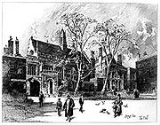
Gray's Inn

Encyclopedia
Inns of Court
The Inns of Court in London are the professional associations for barristers in England and Wales. All such barristers must belong to one such association. They have supervisory and disciplinary functions over their members. The Inns also provide libraries, dining facilities and professional...
(professional associations for barrister
Barrister
A barrister is a member of one of the two classes of lawyer found in many common law jurisdictions with split legal professions. Barristers specialise in courtroom advocacy, drafting legal pleadings and giving expert legal opinions...
s and judge
Judge
A judge is a person who presides over court proceedings, either alone or as part of a panel of judges. The powers, functions, method of appointment, discipline, and training of judges vary widely across different jurisdictions. The judge is supposed to conduct the trial impartially and in an open...
s) in London
London
London is the capital city of :England and the :United Kingdom, the largest metropolitan area in the United Kingdom, and the largest urban zone in the European Union by most measures. Located on the River Thames, London has been a major settlement for two millennia, its history going back to its...
. To be called to the Bar and practise as a barrister in England and Wales
England and Wales
England and Wales is a jurisdiction within the United Kingdom. It consists of England and Wales, two of the four countries of the United Kingdom...
, an individual must belong to one of these Inns. Located at the intersection of High Holborn
High Holborn
High Holborn is a road in Holborn in central London, England. It starts in the west near St Giles Circus, then goes east, past the Kingsway and Southampton Row, and continues east. The road becomes Holborn at the junction with Gray's Inn Road....
and Gray's Inn Road
Gray's Inn Road
Gray's Inn Road, formerly Gray's Inn Lane, is a major road in central London, in the London Borough of Camden. It is named after Gray's Inn, one of the main Inns of Court. The road starts in Holborn, near Chancery Lane tube station and the boundaries of the City of London and the London Borough...
, the Inn is both a professional body
Professional body
A professional association is usually a nonprofit organization seeking to further a particular profession, the interests of individuals engaged in that profession, and the public interest.The roles of these professional associations have been variously defined: "A group of people in a...
and a provider of office accommodation (chambers
Chambers (law)
A judge's chambers, often just called his or her chambers, is the office of a judge.Chambers may also refer to the type of courtroom where motions related to matter of procedure are heard.- United Kingdom and Commonwealth :...
) for many barristers. It is ruled by a governing council called "Pension", made up of the Masters of the Bench (or "Bencher
Bencher
A bencher or Master of the Bench is a senior member of an Inn of Court in England and Wales. Benchers hold office for life once elected. A bencher can be elected while still a barrister , in recognition of the contribution that the barrister has made to the life of the Inn or to the law...
s"), and led by the Treasurer, who is elected to serve a one-year term. The Inn is known for its gardens, or Walks, which have existed since at least 1597.
Gray's Inn does not claim a specific foundation date; there is a tradition that none of the Inns of Court claims to be any older than the others. Law clerk
Law clerk
A law clerk or a judicial clerk is a person who provides assistance to a judge in researching issues before the court and in writing opinions. Law clerks are not court clerks or courtroom deputies, who are administrative staff for the court. Most law clerks are recent law school graduates who...
s and their apprentices have been established on the present site since at least 1370, with records dating from 1391. During the 15th and 16th centuries, the Inn grew steadily, reaching its pinnacle during the reign of Elizabeth I
Elizabeth I of England
Elizabeth I was queen regnant of England and Ireland from 17 November 1558 until her death. Sometimes called The Virgin Queen, Gloriana, or Good Queen Bess, Elizabeth was the fifth and last monarch of the Tudor dynasty...
. The Inn was home to many important barristers and politicians, most notably Francis Bacon
Francis Bacon
Francis Bacon, 1st Viscount St Albans, KC was an English philosopher, statesman, scientist, lawyer, jurist, author and pioneer of the scientific method. He served both as Attorney General and Lord Chancellor of England...
, and counted Elizabeth herself as a patron. Thanks to the efforts of prominent members such as William Cecil
William Cecil, 1st Baron Burghley
William Cecil, 1st Baron Burghley , KG was an English statesman, the chief advisor of Queen Elizabeth I for most of her reign, twice Secretary of State and Lord High Treasurer from 1572...
and Gilbert Gerard, Gray's Inn became the largest of the four by number, with over 200 barristers recorded as members. During this period, the Inn became noted for the masques and revels that it threw, and William Shakespeare
William Shakespeare
William Shakespeare was an English poet and playwright, widely regarded as the greatest writer in the English language and the world's pre-eminent dramatist. He is often called England's national poet and the "Bard of Avon"...
is believed to have performed there at least once.
The Inn continued to prosper during the reign of James I
James I of England
James VI and I was King of Scots as James VI from 24 July 1567 and King of England and Ireland as James I from the union of the English and Scottish crowns on 24 March 1603...
(1603–1625) and the beginning of that of Charles I
Charles I of England
Charles I was King of England, King of Scotland, and King of Ireland from 27 March 1625 until his execution in 1649. Charles engaged in a struggle for power with the Parliament of England, attempting to obtain royal revenue whilst Parliament sought to curb his Royal prerogative which Charles...
, when over 100 students per year were recorded as joining. The outbreak of the First English Civil War
First English Civil War
The First English Civil War began the series of three wars known as the English Civil War . "The English Civil War" was a series of armed conflicts and political machinations that took place between Parliamentarians and Royalists from 1642 until 1651, and includes the Second English Civil War and...
in 1642 during the reign of Charles I disrupted the systems of legal education and governance at the Inns of Court, shutting down all calls to the Bar and new admissions, and Gray's Inn never fully recovered. Fortunes continued to decline after the English Restoration
English Restoration
The Restoration of the English monarchy began in 1660 when the English, Scottish and Irish monarchies were all restored under Charles II after the Interregnum that followed the Wars of the Three Kingdoms...
, which saw the end of the traditional method of legal education. Although now more prosperous, Gray's Inn is today the smallest of the Inns of Court.
Role
Gray's Inn and the other three Inns of Court remain the only bodies legally allowed to callCall to the bar
The Call to the Bar is a legal term of art in most common law jurisdictions where persons must be qualified to be allowed to argue in court on behalf of another party, and are then said to have been "called to the bar" or to have received a "call to the bar"...
a barrister
Barrister
A barrister is a member of one of the two classes of lawyer found in many common law jurisdictions with split legal professions. Barristers specialise in courtroom advocacy, drafting legal pleadings and giving expert legal opinions...
to the Bar, allowing him or her to practise in England and Wales. Although the Inn was previously a disciplinary and teaching body, these functions are now shared between the four Inns, with the Bar Standards Board
Bar Standards Board
The Bar Standards Board regulates admission to the Bar for barristers in England and Wales. In addition, it responds to complaints from the public regarding behavior and adequacy of representation by members of the Bar and conducts disciplinary proceedings. The most serious of these are conducted...
(a division of the General Council of the Bar
General Council of the Bar
The General Council of the Bar, commonly known as the Bar Council, is the professional association for Barristers in England and Wales. Established in 1894, it acts as a disciplinary body and a regulatory body through the Bar Standards Board...
) acting as a disciplinary body and the Inns of Court and Bar Educational Trust providing education. The Inn remains a collegiate self-governing, unincorporated association of its members, providing within its precincts library, dining, residential and office accommodation (chambers
Chambers (law)
A judge's chambers, often just called his or her chambers, is the office of a judge.Chambers may also refer to the type of courtroom where motions related to matter of procedure are heard.- United Kingdom and Commonwealth :...
), along with a chapel. Members of the Bar from other Inns may use these facilities to some extent.
History
During the 12th and 13th centuries, law was taught in the City of LondonCity of London
The City of London is a small area within Greater London, England. It is the historic core of London around which the modern conurbation grew and has held city status since time immemorial. The City’s boundaries have remained almost unchanged since the Middle Ages, and it is now only a tiny part of...
, primarily by the clergy. During the 13th century, two events happened that destroyed this form of legal education; firstly, a decree by Henry III of England
Henry III of England
Henry III was the son and successor of John as King of England, reigning for 56 years from 1216 until his death. His contemporaries knew him as Henry of Winchester. He was the first child king in England since the reign of Æthelred the Unready...
on 2 December 1234 that no institutes of legal education could exist in the City of London, and secondly a papal bull
Papal bull
A Papal bull is a particular type of letters patent or charter issued by a Pope of the Catholic Church. It is named after the bulla that was appended to the end in order to authenticate it....
that prohibited the clergy from teaching the common law
Common law
Common law is law developed by judges through decisions of courts and similar tribunals rather than through legislative statutes or executive branch action...
, rather than canon law
Canon law
Canon law is the body of laws & regulations made or adopted by ecclesiastical authority, for the government of the Christian organization and its members. It is the internal ecclesiastical law governing the Catholic Church , the Eastern and Oriental Orthodox churches, and the Anglican Communion of...
. As a result the existing system of legal education fell apart. The common lawyers migrated to the hamlet of Holborn
Holborn
Holborn is an area of Central London. Holborn is also the name of the area's principal east-west street, running as High Holborn from St Giles's High Street to Gray's Inn Road and then on to Holborn Viaduct...
, the nearest place to the law courts at Westminster Hall that was outside the City.
Founding and early years
Inns of Court
The Inns of Court in London are the professional associations for barristers in England and Wales. All such barristers must belong to one such association. They have supervisory and disciplinary functions over their members. The Inns also provide libraries, dining facilities and professional...
have been lost, and it is not known precisely when each was founded. The records of Gray's Inn itself are lost up until 1569, and the precise date of founding cannot therefore be verified. Lincoln's Inn
Lincoln's Inn
The Honourable Society of Lincoln's Inn is one of four Inns of Court in London to which barristers of England and Wales belong and where they are called to the Bar. The other three are Middle Temple, Inner Temple and Gray's Inn. Although Lincoln's Inn is able to trace its official records beyond...
has the earliest surviving records. Gray's Inn dates from at least 1370, and takes its name from Baron Grey of Wilton
Reginald de Grey, 1st Baron Grey de Wilton
Reginald de Grey, 1st Baron Grey de Wilton was an English nobleman for whom one of the four Inns of Court is named. He was son of Sir John de Grey and grandson of Henry de Grey...
, as the Inn was originally Wilton's family home (or inn), the Manor of Portpoole. A lease was taken for various parts of the inn by practising lawyers as both residential and working accommodation, and their apprentices were housed with them. From this the tradition of dining in "commons", probably by using the inn's main hall, followed as the most convenient arrangement for the members. Outside records from 1437 show that Gray's Inn was occupied by socii, or members of a society at that date.
In 1456 Reginald de Gray, the owner of the Manor itself, sold the land to a group including Thomas Bryan
Thomas Bryan (Chief Justice)
Sir Thomas Bryan KS KB was a British justiceHe was born to common blood, most likely to the son of John Bryan, who was a fishmonger, although Thomas assumed the arms of Guy Bryan when he became a person of some importance...
. A few months later, the other members signed deeds of release, granting the property solely to Thomas Bryan. Bryan acted as either a feoffee
Feoffee
A Feoffee is a trustee who holds a fief , that is to say an estate in land, for the use of a beneficial owner. The term is more fully stated as a feoffee to uses of the beneficial owner. The use of such trustees developed towards the end of the era of feudalism in the middle ages and became...
or an owner representing the governing body of the Inn (there are some records suggesting he may have been a Bencher
Bencher
A bencher or Master of the Bench is a senior member of an Inn of Court in England and Wales. Benchers hold office for life once elected. A bencher can be elected while still a barrister , in recognition of the contribution that the barrister has made to the life of the Inn or to the law...
at this point) but in 1493 he transferred the ownership by charter to a group including Sir Robert Brudenell
Robert Brudenell (Chief Justice)
Sir Robert Brudenell KS was a British justice. He entered Inner Temple in 1480 and gave his first reading in 1490 on the subject of De donis conditionalibus, followed by a second reading in 1500. He became governor of the inn in 1496, and before 1503 served as treasurer...
and Thomas Wodeward, reverting the ownership of the Inn partially back to the Gray family.
In 1506 the Inn was sold by the Gray family to Hugh Denys and a group of his feoffees including Roger Lupton
Roger Lupton
Roger Lupton was born in the Parish of Sedbergh in the year 1456. In 1483, he was awarded a Bachelor of Canon Law degree from King's College, Cambridge, and Doctor of Canon law in 1504....
. This was not a purchase on behalf of the society and after a five year delay, it was transferred under the will of Denys in 1516 to the Carthusian
Carthusian
The Carthusian Order, also called the Order of St. Bruno, is a Roman Catholic religious order of enclosed monastics. The order was founded by Saint Bruno of Cologne in 1084 and includes both monks and nuns...
House of Jesus of Bethlehem (Sheen Priory
Sheen Priory
Sheen Priory in Sheen, now Richmond, London was a former Carthusian monastery founded in 1414 within the royal manor of Sheen, on the south bank of the Thames, upstream and approximately 9 miles southwest of the Palace of Westminster...
), which remained the Society's landlord until 1539, when the Second Act of Dissolution
Second Act of Dissolution
The Second Act of Dissolution , also known as the Act for the Dissolution of the Greater Monasteries, was an Act of the Parliament of England passed in 1539 in the reign of Henry VIII which provided for the dissolution of 552 Catholic monasteries and houses remaining after the Dissolution of the...
led to the Dissolution of the Monasteries
Dissolution of the Monasteries
The Dissolution of the Monasteries, sometimes referred to as the Suppression of the Monasteries, was the set of administrative and legal processes between 1536 and 1541 by which Henry VIII disbanded monasteries, priories, convents and friaries in England, Wales and Ireland; appropriated their...
and passed ownership of the Inn to the Crown.
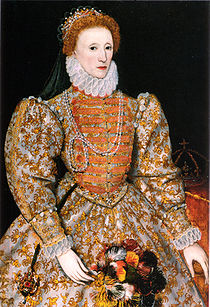
Elizabethan golden age
During the reign of Elizabeth IElizabeth I of England
Elizabeth I was queen regnant of England and Ireland from 17 November 1558 until her death. Sometimes called The Virgin Queen, Gloriana, or Good Queen Bess, Elizabeth was the fifth and last monarch of the Tudor dynasty...
, Gray's Inn rose in prominence, and that period is considered the "golden age" of the Inn, with Elizabeth serving as the Patron Lady. This can be traced to the actions of Nicholas Bacon, William Cecil
William Cecil, 1st Baron Burghley
William Cecil, 1st Baron Burghley , KG was an English statesman, the chief advisor of Queen Elizabeth I for most of her reign, twice Secretary of State and Lord High Treasurer from 1572...
and Gilbert Gerard, all prominent members of the Inn and confidantes of Elizabeth. Cecil and Bacon in particular took pains to find the most promising young men and get them to join the Inn. In 1574 it was the largest of all the Inns of Court by number, with 120 barrister
Barrister
A barrister is a member of one of the two classes of lawyer found in many common law jurisdictions with split legal professions. Barristers specialise in courtroom advocacy, drafting legal pleadings and giving expert legal opinions...
s, and by 1619 it had a membership of more than 200 barristers. Gray's Inn, as well as the other Inns of Court, became noted for the parties and festivals it hosted. Students performed masque
Masque
The masque was a form of festive courtly entertainment which flourished in 16th and early 17th century Europe, though it was developed earlier in Italy, in forms including the intermedio...
s and plays in court weddings, in front of Queen Elizabeth herself, and hosted regular festivals and banquets at Candlemas, All Hallows Eve
Halloween
Hallowe'en , also known as Halloween or All Hallows' Eve, is a yearly holiday observed around the world on October 31, the night before All Saints' Day...
and Easter. At Christmas the students ruled the Inn for the day, appointing a Lord of Misrule
Lord of Misrule
In England, the Lord of Misrule — known in Scotland as the Abbot of Unreason and in France as the Prince des Sots — was an officer appointed by lot at Christmas to preside over the Feast of Fools...
called the Prince of Purpoole, and organising a masque entirely on their own, with the Benchers and other senior members away for the holiday. The Gray's Inn masque in 1588 with its centrepiece, The Misfortunes of Arthur
The Misfortunes of Arthur
The Misfortunes of Arthur, Uther Pendragon's son reduced into tragical notes is a play by the 16th-century English dramatist Thomas Hughes. Written in 1587, it was performed at Greenwich before Queen Elizabeth I on February 28, 1588...
by Thomas Hughes
Thomas Hughes (dramatist)
Thomas Hughes was an English dramatist, a native of Cheshire, entered Queens' College, Cambridge, in 1571. He graduated and became a fellow of his college in 1576, and was afterwards a member of Gray's Inn. He wrote The Misfortunes of Arthur, Uther Pendragon's son reduced into tragical notes, which...
, is considered by A.W. Ward
Adolphus William Ward
Sir Adolphus William Ward was an English historian and man of letters.He was born at Hampstead, London, and was educated in Germany and at Peterhouse, Cambridge....
be the most impressive masque thrown at any of the Inns. William Shakespeare
William Shakespeare
William Shakespeare was an English poet and playwright, widely regarded as the greatest writer in the English language and the world's pre-eminent dramatist. He is often called England's national poet and the "Bard of Avon"...
performed at the Inn at least once, as his patron, Lord Southampton
Henry Wriothesley, 3rd Earl of Southampton
Henry Wriothesley , 3rd Earl of Southampton , was the second son of Henry Wriothesley, 2nd Earl of Southampton, and his wife Mary Browne, Countess of Southampton, daughter of the 1st Viscount Montagu...
, was a member. For the Christmas of 1594, his play The Comedy of Errors
The Comedy of Errors
The Comedy of Errors is one of William Shakespeare's earliest plays. It is his shortest and one of his most farcical comedies, with a major part of the humour coming from slapstick and mistaken identity, in addition to puns and word play. The Comedy of Errors is one of only two of Shakespeare's...
was performed by the Lord Chamberlain's Men
Lord Chamberlain's Men
The Lord Chamberlain's Men was a playing company for whom Shakespeare worked for most of his career. Formed at the end of a period of flux in the theatrical world of London, it had become, by 1603, one of the two leading companies of the city and was subsequently patronised by James I.It was...
before a riotous assembly of notables in such disorder that the affair became known as the Night of Errors and a mock trial was held to arraign the culprit.
Call to the bar
The Call to the Bar is a legal term of art in most common law jurisdictions where persons must be qualified to be allowed to argue in court on behalf of another party, and are then said to have been "called to the bar" or to have received a "call to the bar"...
, which lasted approximately 12 to 14 years. A student would first study at either Oxford or Cambridge University, or at one of the Inns of Chancery
Inns of Chancery
The Inns of Chancery or Hospida Cancellarie were a group of buildings and legal institutions in London initially attached to the Inns of Court and used as offices for the clerks of chancery, from which they drew their name...
, which were dedicated legal training institutions. If he studied at Oxford or Cambridge he would spend three years working towards a degree, and be admitted to one of the Inns of Court after graduation. If he studied at one of the Inns of Chancery he would do so for one year before seeking admission to the Inn of Court to which his Inn of Chancery was tied—in the case of Gray's Inn, the attached Inns of Chancery were Staple Inn
Staple Inn
Staple Inn is a building on the south side of High Holborn in London, England. Located near Chancery Lane tube station, it is used as the London office of the Institute of Actuaries and is the last surviving Inn of Chancery and is a listed building....
and Barnard's Inn
Barnard's Inn
Barnard's Inn is the current home of Gresham College in Holborn, London.-History:Barnard's Inn dates back at least to the mid 13th century — it was recorded as part of the estate of Sir Adam de Basyng, one time Mayor of London. It passed on to John Mackworth, the Dean of Lincoln who in turn passed...
. The student was then considered an "inner barrister", and would study in private, take part in the moots
Moot court
A moot court is an extracurricular activity at many law schools in which participants take part in simulated court proceedings, usually to include drafting briefs and participating in oral argument. The term derives from Anglo Saxon times, when a moot was a gathering of prominent men in a...
and listen to the readings and other lectures. After serving from six to nine years as an "inner barrister," the student was called to the Bar, assuming he had fulfilled the requirements of having argued twice at moots in one of the Inns of Chancery, twice in the Hall of his Inn of Court and twice in the Inn Library. The new "utter barrister" was then expected to supervise bolts ("arguments" over a single point of law between students and barristers) and moots at his Inn of Court, attend lectures at the Inns of Court and Chancery and teach students. After five years as an "utter" barrister he was allowed to practice in court—after 10 years he was made an Ancient.
The period saw the establishment of a regular system of legal education. In the early days of the Inn, the quality of legal education had been poor—readings were given infrequently, and the standards for call to the Bar were weak and varied. During the Elizabethan age readings were given regularly, moots took place daily and barristers who were called to the Bar were expected to play a part in teaching students, resulting in skilled and knowledgeable graduates from the Inn.
Many noted barristers, judges and politicians were members of the Inn during this period, including Gilbert Gerard, Master of the Rolls
Master of the Rolls
The Keeper or Master of the Rolls and Records of the Chancery of England, known as the Master of the Rolls, is the second most senior judge in England and Wales, after the Lord Chief Justice. The Master of the Rolls is the presiding officer of the Civil Division of the Court of Appeal...
, Edmund Pelham
Edmund Pelham
Sir Edmund Pelham , a member of the distinguished Pelham family of Laughton, was an Irish judge who held the office of Chief Baron of the Irish Exchequer, and was noteworthy as the first judge to hold assizes in Ulster....
, Lord Chief Justice of Ireland
Lord Chief Justice of Ireland
thumb|200px|The Four CourtsThe headquarters of the Irish judicial system since 1804. The Court of King's Bench was one of the original four courts that sat there....
, and Francis Bacon
Francis Bacon
Francis Bacon, 1st Viscount St Albans, KC was an English philosopher, statesman, scientist, lawyer, jurist, author and pioneer of the scientific method. He served both as Attorney General and Lord Chancellor of England...
, who served as Treasurer for eight years, supervising significant changes to the facilities of the Inn and the first proper construction of the gardens and walks for which the Inn is noted. The Inn's prosperity continued relatively uninterrupted through the reign of James I
James I of England
James VI and I was King of Scots as James VI from 24 July 1567 and King of England and Ireland as James I from the union of the English and Scottish crowns on 24 March 1603...
.
Caroline period and the English Civil War
At the start of the Caroline eraCaroline era
The Caroline era refers to the era in English and Scottish history during the Stuart period that coincided with the reign of Charles I , Carolus being Latin for Charles...
, when Charles I came to the throne, the Inn continued to prosper. Over 100 students were admitted to the Inn each year, and except during the plague of 1636 the legal education of students continued. Masques continued to be held, including one in 1634 organised by all four Inns that cost £21,000—approximately £ in terms. Before 1685 the Inn counted as members five duke
Duke
A duke or duchess is a member of the nobility, historically of highest rank below the monarch, and historically controlling a duchy...
s, three marquises
Marquess
A marquess or marquis is a nobleman of hereditary rank in various European peerages and in those of some of their former colonies. The term is also used to translate equivalent oriental styles, as in imperial China, Japan, and Vietnam...
, twenty-nine earl
Earl
An earl is a member of the nobility. The title is Anglo-Saxon, akin to the Scandinavian form jarl, and meant "chieftain", particularly a chieftain set to rule a territory in a king's stead. In Scandinavia, it became obsolete in the Middle Ages and was replaced with duke...
s, five viscounts and thirty-nine baron
Baron
Baron is a title of nobility. The word baron comes from Old French baron, itself from Old High German and Latin baro meaning " man, warrior"; it merged with cognate Old English beorn meaning "nobleman"...
s, and during that period "none can exhibit a more illustrious list of great men".
Many academics, including William Holdsworth, a man considered to be one of the best legal academics in history, maintain that this period saw a decline in the standard of teaching at all the Inns. From 1640 onwards no readings were held, and barristers such as Sir Edward Coke
Edward Coke
Sir Edward Coke SL PC was an English barrister, judge and politician considered to be the greatest jurist of the Elizabethan and Jacobean eras. Born into a middle class family, Coke was educated at Trinity College, Cambridge before leaving to study at the Inner Temple, where he was called to the...
remarked at the time that the quality of education at the Inns of Court had decreased. Holdsworth put this down to three things—the introduction of printed books, the disinclination of students to attend moots and readings and the disinclination of the Benchers and Readers to enforce attendance. With the introduction of printing, written legal texts became more available, reducing the need for students to attend readings and lectures. However, this meant that the students denied themselves the opportunity to query what they had learnt or discuss it in greater detail. Eventually, students now had a way to learn without attending lectures, they began to excuse themselves from lectures, meetings and moots altogether; in the early 17th century they developed a way of deputising other students to do their moots for them. The Benchers and Readers did little to arrest the decline of the practice of lecturers and readings, first because many probably believed (as the students did) that books were an adequate substitute, and secondly because many were keen to avoid the work of preparing a reading, which cut into their time as practising barristers. These problems were endemic to all the Inns, not just Gray's Inn.
The outbreak of the First English Civil War
First English Civil War
The First English Civil War began the series of three wars known as the English Civil War . "The English Civil War" was a series of armed conflicts and political machinations that took place between Parliamentarians and Royalists from 1642 until 1651, and includes the Second English Civil War and...
led to a complete suspension of legal education, and from November 1642 until July 1644 no Pension meetings were held. Only 43 students were admitted during the four years of the war, and none were called to the Bar. Meetings of Pension resumed after the Battle of Marston Moor
Battle of Marston Moor
The Battle of Marston Moor was fought on 2 July 1644, during the First English Civil War of 1642–1646. The combined forces of the Scottish Covenanters under the Earl of Leven and the English Parliamentarians under Lord Fairfax and the Earl of Manchester defeated the Royalists commanded by Prince...
but the education system remained dormant. Although Readers were appointed, none read, and no moots were held. In 1646, after the end of the war, there was an attempt to restore the old system of readings and moots, and in 1647 an order was made that students were required to moot at least once a day. This failed to work, with Readers refusing to read, and the old system of legal education completely died out.
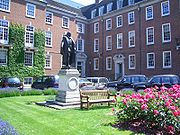
Dudley Digges
Sir Dudley Digges , of Chilham Castle, Kent , was a Member of Parliament, elected to the Parliament of 1614 and that of 1621, and also a "Virginia adventurer," an investor who ventured his capital in the Virginia Company of London...
, Thomas Bedingfield and Francis Bacon
Francis Bacon (judge)
-Life:He was the son of John Bacon, of King's Lynn, Norfolk, born about 1587. He began his legal studies at Barnard's Inn, and was admitted a member of Gray's Inn in February 1607. He was not called to the bar until eight years later in 1615...
, for example) and non-legal (including William Juxon
William Juxon
William Juxon was an English churchman, Bishop of London from 1633 to 1649 and Archbishop of Canterbury from 1660 until his death.-Life:...
, the Archbishop of Canterbury
Archbishop of Canterbury
The Archbishop of Canterbury is the senior bishop and principal leader of the Church of England, the symbolic head of the worldwide Anglican Communion, and the diocesan bishop of the Diocese of Canterbury. In his role as head of the Anglican Communion, the archbishop leads the third largest group...
), the list could not compare to that of the Elizabethan period. Following the English Restoration
English Restoration
The Restoration of the English monarchy began in 1660 when the English, Scottish and Irish monarchies were all restored under Charles II after the Interregnum that followed the Wars of the Three Kingdoms...
, admissions fell to an average of 57 a year.
English Restoration to Present
The fortunes of Gray's Inn continued to decline after the English RestorationEnglish Restoration
The Restoration of the English monarchy began in 1660 when the English, Scottish and Irish monarchies were all restored under Charles II after the Interregnum that followed the Wars of the Three Kingdoms...
, and by 1719 only 22 students were joining the Inn a year. This fall in numbers was partly because the landed gentry were no longer sending sons who had no intention of becoming barristers to study at the Inn. In 1615, 13 students joined the Inn for every student called to the Bar, but by 1713 the ratio had become 2.3 new members to every 1 call. Over a 50-year period the Civil War and high taxation under William III
William III of England
William III & II was a sovereign Prince of Orange of the House of Orange-Nassau by birth. From 1672 he governed as Stadtholder William III of Orange over Holland, Zeeland, Utrecht, Guelders, and Overijssel of the Dutch Republic. From 1689 he reigned as William III over England and Ireland...
economically crippled many members of the gentry, meaning that they could not afford to allow their sons to study at the Inns. David Lemmings considers it to have been more serious than that, for two reasons; firstly, Inner Temple
Inner Temple
The Honourable Society of the Inner Temple, commonly known as Inner Temple, is one of the four Inns of Court in London. To be called to the Bar and practise as a barrister in England and Wales, an individual must belong to one of these Inns...
and Middle Temple
Middle Temple
The Honourable Society of the Middle Temple, commonly known as Middle Temple, is one of the four Inns of Court exclusively entitled to call their members to the English Bar as barristers; the others being the Inner Temple, Gray's Inn and Lincoln's Inn...
had actually shown an increase in membership following the Restoration, and secondly because Gray's Inn had previously had far more "common" members than the other Inns. The decrease in the number of gentry at the Inn could therefore not completely explain the large drop in members.
In 1733 the requirements for a call to the Bar were significantly revised in a joint meeting between the Benchers of Inner Temple and Gray's Inn, revisions accepted by Lincoln's Inn and Middle Temple, although they were not represented. It is not recorded what these changes were, but after a further discussion in 1762 the Inns adopted a rule that any student with a Master of Arts
Master of Arts (postgraduate)
A Master of Arts from the Latin Magister Artium, is a type of Master's degree awarded by universities in many countries. The M.A. is usually contrasted with the M.S. or M.Sc. degrees...
or Bachelor of Laws
Bachelor of Laws
The Bachelor of Laws is an undergraduate, or bachelor, degree in law originating in England and offered in most common law countries as the primary law degree...
degree from the universities of Oxford or Cambridge could be called to the Bar after three years as a student, and any other student could be called after five years. An attempt was made to increase the quality of legal education at Gray's Inn; in 1753 a barrister, Danby Pickering, was employed to lecture there, although this agreement ended in 1761 when he was called to the Bar.
The 18th century was not a particularly prosperous time for the Inn or its members, and few notable barristers were members during this period. Some noted members include Sir Thomas Clarke, the Master of the Rolls
Master of the Rolls
The Keeper or Master of the Rolls and Records of the Chancery of England, known as the Master of the Rolls, is the second most senior judge in England and Wales, after the Lord Chief Justice. The Master of the Rolls is the presiding officer of the Civil Division of the Court of Appeal...
, Sir James Eyre
James Eyre
Sir James Eyre was an English judge, the son of the Rev. Thomas Eyre, of Wells, Somerset.-Biography:He was educated at Winchester College and at St John's College, Oxford, which he left without taking a degree. He was called to the bar at Gray's Inn in 1755, Thomas Parker, chief baron of the...
, Chief Justice of the Common Pleas
Chief Justice of the Common Pleas
The Court of Common Pleas, also known as the Common Bench or Common Place, was the second highest common law court in the English legal system until 1880, when it was dissolved. As such, the Chief Justice of the Common Pleas was one of the highest judicial officials in England, behind only the Lord...
and Samuel Romilly
Samuel Romilly
Sir Samuel Romilly , was a British legal reformer.-Background and education:Romilly was born in Frith Street, Soho, London, the second son of Peter Romilly, a watchmaker and jeweller...
, a noted law reformer. In 1780 the Inn was involved in the case of R v the Benchers of Gray's Inn, a test of the role of the Inns of Court as the sole authority to call students to the Bar. The case was brought to the Court of King's Bench
Court of King's Bench (England)
The Court of King's Bench , formally known as The Court of the King Before the King Himself, was an English court of common law in the English legal system...
by William Hart, a student at the Inn, who asked the court (under Lord Mansfield) to order the Inn to call him to the Bar. Mansfield ruled that the Inns of Court were indeed the only organisations able to call students to the Bar, and refused to order the Inns to call Hart.
During the 19th century, the Inns began to stagnate; little had been changed since the 17th century in terms of legal education or practice, except that students were no longer bound to take the Anglican
Church of England
The Church of England is the officially established Christian church in England and the Mother Church of the worldwide Anglican Communion. The church considers itself within the tradition of Western Christianity and dates its formal establishment principally to the mission to England by St...
sacrament
Sacrament
A sacrament is a sacred rite recognized as of particular importance and significance. There are various views on the existence and meaning of such rites.-General definitions and terms:...
before their call to the Bar
Call to the bar
The Call to the Bar is a legal term of art in most common law jurisdictions where persons must be qualified to be allowed to argue in court on behalf of another party, and are then said to have been "called to the bar" or to have received a "call to the bar"...
. In 1852 the Council of Legal Education
Council of Legal Education
The Council of Legal Education was an English supervisory body established by the four Inns of Court to regulate and improve the legal education of barristers within England and Wales.-History:...
was established by the Inns, and in 1872 a formal examination for the call to the Bar
Call to the bar
The Call to the Bar is a legal term of art in most common law jurisdictions where persons must be qualified to be allowed to argue in court on behalf of another party, and are then said to have been "called to the bar" or to have received a "call to the bar"...
was introduced. Gray's Inn itself suffered more than most; as in the 18th century, the fortunes of its members declined, and many barristers who had been called to the Bar at the Inn transferred to others.
Gray's Inn was the smallest of the Inns during the early 20th century, and was noted for its connection to the Northern Circuit
Northern Circuit
The Northern Circuit dates from 1176 when Henry II sent his judges on circuit to do justice in his name. The Circuit encompassed the whole of the North of England but in 1876 it was divided. That part to the west of the Pennines retained the old name. The land to the east became the territory of...
. During the Second World War, the Inn was badly damaged during the Blitz
The Blitz
The Blitz was the sustained strategic bombing of Britain by Nazi Germany between 7 September 1940 and 10 May 1941, during the Second World War. The city of London was bombed by the Luftwaffe for 76 consecutive nights and many towns and cities across the country followed...
in 1941, with the Hall, the Chapel, the Library and many other buildings hit and almost destroyed. The rebuilding of much of the Inn took until 1960 by the architect Sir Edward Maufe
Edward Maufe
Sir Edward Brantwood Maufe KBE, R.A, F.R.I.B.A. was an English architect and designer, noted chiefly for his work on places of worship and remembrance memorials. He was a skilled interior designer and designed many pieces of furniture...
. In 2008 Gray's Inn became the first Inn to appoint "fellows"—elected businesspeople, legal academics and others—with the intent of giving them a wider perspective and education than the other Inns would offer.
Structure and governance
Gray's Inn's internal records date from 1569, at which point there were four types of member; those who had not yet been called to the Bar, Utter Barristers, Ancients and Readers. Utter Barristers were those who had been called to the Bar but were still studying, Ancients were those who were called to the Bar and were allowed to practise and Readers were those who had been called to the Bar, were allowed to practise and now played a part in educating law students at the Inns of ChanceryInns of Chancery
The Inns of Chancery or Hospida Cancellarie were a group of buildings and legal institutions in London initially attached to the Inns of Court and used as offices for the clerks of chancery, from which they drew their name...
and at Gray's Inn itself. At the time Gray's Inn was the odd one out amongst the Inns; the others did not recognise Ancients as a degree of barrister and had Benchers roughly corresponding to the Readers used at Gray's Inn (although the positions were not identical).
The Inn is run by Pension, its ultimate governing body. The name is peculiar to Gray's Inn—at Lincoln's Inn
Lincoln's Inn
The Honourable Society of Lincoln's Inn is one of four Inns of Court in London to which barristers of England and Wales belong and where they are called to the Bar. The other three are Middle Temple, Inner Temple and Gray's Inn. Although Lincoln's Inn is able to trace its official records beyond...
the governing body is called the Council, and at the Inner
Inner Temple
The Honourable Society of the Inner Temple, commonly known as Inner Temple, is one of the four Inns of Court in London. To be called to the Bar and practise as a barrister in England and Wales, an individual must belong to one of these Inns...
and Middle Temple
Middle Temple
The Honourable Society of the Middle Temple, commonly known as Middle Temple, is one of the four Inns of Court exclusively entitled to call their members to the English Bar as barristers; the others being the Inner Temple, Gray's Inn and Lincoln's Inn...
s it is called the Parliament. The name was used for the governing bodies of three of the Inns of Chancery—Barnard's Inn
Barnard's Inn
Barnard's Inn is the current home of Gresham College in Holborn, London.-History:Barnard's Inn dates back at least to the mid 13th century — it was recorded as part of the estate of Sir Adam de Basyng, one time Mayor of London. It passed on to John Mackworth, the Dean of Lincoln who in turn passed...
, Clement's Inn and New Inn. In Gray's Inn the Readers, when they existed, were required to attend Pension meetings, and other barristers were at one point welcome to, although only the Readers would be allowed to talk. Pension at Gray's Inn is made up of the Masters of the Bench, and the Inn as a whole is headed by the Treasurer, a senior Bencher. The Treasurer has always been elected, and since 1744 the office has rotated between individuals, with a term of one year.
Readers
A ReaderReader (Inns of Court)
A Reader in one of the Inns of Court in London was originally a senior barrister of the Inn who was elected to deliver a lecture or series of lectures on a particular legal topic...
was a person literally elected to read—he would be elected to the Pension (council) of Gray's Inn, and would take his place by giving a "reading", or lecture, on a particular legal topic. Two readers would be elected annually by Pension to serve a one-year term. Initially (before the rise of the Benchers) the Readers were the governing body of Gray's Inn, and formed Pension. The earliest certain records of Readers are from the 16th century—although the Inn's records only start at 1569 William Dugdale
William Dugdale
Sir William Dugdale was an English antiquary and herald. As a scholar he was influential in the development of medieval history as an academic subject.-Life:...
(himself a member) published a list in his Origines Juridiciales dating from 1514. S.E. Thorne published a list dating from 1430, but this is entirely conjectural and not based on any official records, only reports of "readings" that took place at Gray's Inn. By 1569 there had certainly been Readers for more than a century.
The English Civil War
English Civil War
The English Civil War was a series of armed conflicts and political machinations between Parliamentarians and Royalists...
marked the end of legal education at the Inns, and the class of Readers went into decline. The last Readers were appointed in 1677, and the position of the Readers as heads of the Inn and members of Pension was taken by the Benchers.
Benchers
A Bencher, Benchsitter or (formally) Master of the Bench, is a member of Pension, the governing body of the Honourable Society of Gray's Inn. The term originally referred to one who sat on the benches in the main hall of the Inn which were used for dining and during moots, and the term originally had no significance. The position of Bencher developed during the 16th century when the Readers, for unknown reasons, decided that some barristers who were not Readers should be afforded the same rights and privileges as those who were, although without a voice in Pension. This was a rare practice and occurred a total of seven times within the 16th century, the first being Robert Flynt in 1549. The next was Nicholas Bacon in 1550, then Edward Stanhope in 1580, who was afforded the privilege because, although a skilled attorney, an illness meant he could never fulfil the duties of a Reader.The practice became more common during the 17th century—11 people were made Benchers between 1600 and 1630—and in 1614 one of the Benchers appointed was explicitly allowed to be a member of Pension. This became more common, creating a two-rank system in which both Readers and Benchers were members of Pension. However far more Readers were appointed than Benchers—50 between 1600 and 1630—and it appeared that Readers would remain the higher rank despite this change. The English Civil War
English Civil War
The English Civil War was a series of armed conflicts and political machinations between Parliamentarians and Royalists...
marked the end of legal education at the Inns, although the government
Commonwealth of England
The Commonwealth of England was the republic which ruled first England, and then Ireland and Scotland from 1649 to 1660. Between 1653–1659 it was known as the Commonwealth of England, Scotland and Ireland...
attempted to persuade Readers to continue by threatening them with fines. The class of Readers went into decline and Benchers were called as members of Pension instead. In 1679 there was the first mass-call of Benchers (22 on one occasion, and 15 on another), with the Benchers paying a fine of 100 marks because they refused to read, and modern Benchers pay a "fine" in a continuation of this tradition.
Noted Benchers of Gray's Inn include Lord Birkenhead
F. E. Smith, 1st Earl of Birkenhead
Frederick Edwin Smith, 1st Earl of Birkenhead GCSI, PC, KC , best known to history as F. E. Smith , was a British Conservative statesman and lawyer of the early 20th century. He was a skilled orator, noted for his staunch opposition to Irish nationalism, his wit, pugnacious views, and hard living...
and Francis Bacon
Francis Bacon
Francis Bacon, 1st Viscount St Albans, KC was an English philosopher, statesman, scientist, lawyer, jurist, author and pioneer of the scientific method. He served both as Attorney General and Lord Chancellor of England...
. Honorary Benchers can also be appointed, although they have no role in Pension, such as Lord Denning, who was appointed in 1979, and Winston Churchill
Winston Churchill
Sir Winston Leonard Spencer-Churchill, was a predominantly Conservative British politician and statesman known for his leadership of the United Kingdom during the Second World War. He is widely regarded as one of the greatest wartime leaders of the century and served as Prime Minister twice...
. Today there are over 300 Benchers in Gray's Inn, mostly senior barristers and members of the judiciary.
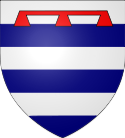
Badge
Gray's Inn does not possess a coat of armsCoat of arms
A coat of arms is a unique heraldic design on a shield or escutcheon or on a surcoat or tabard used to cover and protect armour and to identify the wearer. Thus the term is often stated as "coat-armour", because it was anciently displayed on the front of a coat of cloth...
as such, but instead uses a badge, often displayed on a shield, blazon
Blazon
In heraldry and heraldic vexillology, a blazon is a formal description of a coat of arms, flag or similar emblem, from which the reader can reconstruct the appropriate image...
ed either "Azure
Azure
In heraldry, azure is the tincture with the colour blue, and belongs to the class of tinctures called "colours". In engraving, it is sometimes depicted as a region of horizontal lines or else marked with either az. or b. as an abbreviation....
an Indian Griffin proper segreant" or, more currently, "Sable
Sable (heraldry)
In heraldry, sable is the tincture black, and belongs to the class of dark tinctures, called "colours". In engravings and line drawings, it is sometimes depicted as a region of crossed horizontal and vertical lines or else marked with sa. as an abbreviation.The name derives from the black fur of...
a griffin segreant or
Or (heraldry)
In heraldry, Or is the tincture of gold and, together with argent , belongs to the class of light tinctures called "metals". In engravings and line drawings, it may be represented using a field of evenly spaced dots...
", i.e., a gold griffin on a black background. The Inn originally used a form of the coat of arms of the de Grey family, but this was changed at some time around 1600 to the griffin. There is no direct record of why this was done, but it seems likely that the new device was adapted from the arms of the Treasurer Richard Aungier (d. 1597), for two probable reasons: firstly, because he was a particularly important and prestigious member of the Inn, and secondly, because the griffin would have looked more impressive on occasions such as masques and revels than the plain geometric arms of the de Greys. The motto around the badge, the date of adoption of which is unknown, is Integra Lex Aequi Custos Rectique Magistra Non Habet Affectus Sed Causas Gubernat, or "Impartial justice, guardian of equity, mistress of the law, without fear or favour rules men's causes aright".
Buildings and gardens
The Inn is located at the intersection of High HolbornHigh Holborn
High Holborn is a road in Holborn in central London, England. It starts in the west near St Giles Circus, then goes east, past the Kingsway and Southampton Row, and continues east. The road becomes Holborn at the junction with Gray's Inn Road....
and Gray's Inn Road
Gray's Inn Road
Gray's Inn Road, formerly Gray's Inn Lane, is a major road in central London, in the London Borough of Camden. It is named after Gray's Inn, one of the main Inns of Court. The road starts in Holborn, near Chancery Lane tube station and the boundaries of the City of London and the London Borough...
. It started as a single manor house
Manor house
A manor house is a country house that historically formed the administrative centre of a manor, the lowest unit of territorial organisation in the feudal system in Europe. The term is applied to country houses that belonged to the gentry and other grand stately homes...
with a hall and chapel, although an additional wing had been added by 1591, when the first point of reference (a map drawn by Ralph Agas
Ralph Agas
Ralph Agas , English land surveyor, was born at Stoke-by-Nayland, Suffolk, about 1540, and entered upon the practice of his profession in 1566....
) was created. Expansion continued over the next few decades, and by 1586 the Pension had added another two wings around the central court
Courtyard
A court or courtyard is an enclosed area, often a space enclosed by a building that is open to the sky. These areas in inns and public buildings were often the primary meeting places for some purposes, leading to the other meanings of court....
. Around these were several sets of chambers
Chambers (law)
A judge's chambers, often just called his or her chambers, is the office of a judge.Chambers may also refer to the type of courtroom where motions related to matter of procedure are heard.- United Kingdom and Commonwealth :...
erected by members of the Inn under a leasehold agreement whereby ownership of the buildings would revert to the Inn at the end of the lease. As the Inn grew it became necessary (for safety purposes) to wall off the land owned by the Inn, which had previously been open to everyone. In 1591 the "back field" was walled off, but little more was done until 1608, when under the supervision of Francis Bacon
Francis Bacon
Francis Bacon, 1st Viscount St Albans, KC was an English philosopher, statesman, scientist, lawyer, jurist, author and pioneer of the scientific method. He served both as Attorney General and Lord Chancellor of England...
, the Treasurer, more construction work was undertaken, particularly in walling off and improving the gardens and walks. In 1629 it was ordered that an architect supervise any construction and ensure that the new buildings were architecturally similar to the old ones, and the strict enforcement of this rule during the 18th century is given as a reason for the uniformity of the buildings at Gray's Inn.
During the late 17th century many buildings were demolished, either because of poor repair or to standardise and modernise the buildings at the Inn. Many more were built over the open land surrounding the Inn, although this was controversial at the time; in November 1672 the Privy Council and Charles II
Charles II of England
Charles II was monarch of the three kingdoms of England, Scotland, and Ireland.Charles II's father, King Charles I, was executed at Whitehall on 30 January 1649, at the climax of the English Civil War...
himself were petitioned to order that nothing should be built on the open land, and a similar request was sent to the Lord Chancellor
Lord Chancellor
The Lord High Chancellor of Great Britain, or Lord Chancellor, is a senior and important functionary in the government of the United Kingdom. He is the second highest ranking of the Great Officers of State, ranking only after the Lord High Steward. The Lord Chancellor is appointed by the Sovereign...
in May 1673. From 1672 to 1674 additional buildings were constructed in the Red Lyon Fields by Nicholas Barebone
Nicholas Barbon
Nicholas If-Jesus-Christ-Had-Not-Died-For-Thee-Thou-Hadst-Been-Damned Barebon who traded as Nicholas Barbon was an English economist, physician and financial speculator. He is counted among the critics of mercantilism and was one of the first proponents of the free market...
, and members of the Inn attempted to sue him to prevent this. After the lawsuits failed members of the Inn were seen to fight with Barebones' workmen, "wherein several were shrewdly hurt".
In February 1679 a fire broke out on the west side of Coney Court, necessitating the rebuilding of the entire row. Another fire broke out in January 1684 in Coney Court, destroying several buildings including the Library. A third fire in 1687 destroyed a large part of Holborn Court, and when the buildings were rebuilt after these fires they were constructed of brick to be more resistant to fire than the wood and plaster previously used in construction. As a result the domestic Tudor style architecture
Tudor style architecture
The Tudor architectural style is the final development of medieval architecture during the Tudor period and even beyond, for conservative college patrons...
which had dominated much of the Inn was replaced with more modern styles. Records show that prior to the rebuilding in 1687, the Inn had been "so incommodious" that the "ancients" were forced to work two to a chamber. More of the Inn was rebuilt during that period, and between 1669 and 1774 all of the Inn apart from parts of the Hall and Chapel had been rebuilt.
More buildings were constructed during the 18th and 19th centuries. In 1941 the Inn suffered under The Blitz
The Blitz
The Blitz was the sustained strategic bombing of Britain by Nazi Germany between 7 September 1940 and 10 May 1941, during the Second World War. The city of London was bombed by the Luftwaffe for 76 consecutive nights and many towns and cities across the country followed...
, which damaged or destroyed much of the Inn, necessitating the repair of many buildings and the construction of more. Today many buildings are let as professional offices for barristers and solicitor
Solicitor
Solicitors are lawyers who traditionally deal with any legal matter including conducting proceedings in courts. In the United Kingdom, a few Australian states and the Republic of Ireland, the legal profession is split between solicitors and barristers , and a lawyer will usually only hold one title...
s with between 265000 square feet (24,619.3 m²) and 275000 square feet (25,548.3 m²) of office space available. There are also approximately 60 residential apartments, rented out to barristers who are members of the Inn. The Inn also contains the Inns of Court School of Law
Inns of Court School of Law
The Inns of Court School of Law, often abbreviated to ICSL is a professional legal training institution based in London in Gray's Inn...
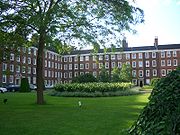
, a joint educational venture between all four Inns of Court where the vocational training for barristers and solicitors is undertaken. The current Inn layout consists of two squares—South Square and Gray's Inn Square—with the remaining buildings arranged around the Walks.
Hall
The Hall was part of the original Manor of Portpoole, although it was significantly rebuilt during the reign of Mary IMary I of England
Mary I was queen regnant of England and Ireland from July 1553 until her death.She was the only surviving child born of the ill-fated marriage of Henry VIII and his first wife Catherine of Aragon. Her younger half-brother, Edward VI, succeeded Henry in 1547...
, and again during the reign of Elizabeth, with the rebuilding being finished on 10 November 1559. The rebuilt Hall measured 70 feet (21.3 m) in length, 35 feet (10.7 m) in width and 47 feet (14.3 m) in height, and remains about the same size today. It has a hammerbeam roof
Hammerbeam roof
Hammerbeam roof, in architecture, is the name given to an open timber roof, typical of English Gothic architecture, using short beams projecting from the wall.- Design :...
and a raised dais at one end with a grand table on it, where the Benchers and other notables would originally have sat. It also contains a large carved screen at one end covering the entrance to the Vestibule
Vestibule (architecture)
A vestibule is a lobby, entrance hall, or passage between the entrance and the interior of a building.The same term can apply to structures in modern or ancient roman architecture. In modern architecture vestibule typically refers to a small room or hall between an entrance and the interior of...
; legend says that the screen was given to the Inn by Elizabeth I
Elizabeth I of England
Elizabeth I was queen regnant of England and Ireland from 17 November 1558 until her death. Sometimes called The Virgin Queen, Gloriana, or Good Queen Bess, Elizabeth was the fifth and last monarch of the Tudor dynasty...
while she was the Inn's patron, and is carved out of the wood of a Spanish galleon captured from the Spanish Armada
Spanish Armada
This article refers to the Battle of Gravelines, for the modern navy of Spain, see Spanish NavyThe Spanish Armada was the Spanish fleet that sailed against England under the command of the Duke of Medina Sidonia in 1588, with the intention of overthrowing Elizabeth I of England to stop English...
. The Hall was lit with the aid of massive windows filled with the Coats of Arms
Coat of arms
A coat of arms is a unique heraldic design on a shield or escutcheon or on a surcoat or tabard used to cover and protect armour and to identify the wearer. Thus the term is often stated as "coat-armour", because it was anciently displayed on the front of a coat of cloth...
of those members who became Treasurers. The Benchers' table is also said to have been a gift from Elizabeth, and as a result the only public toast in the Inn up until the late 19th century was "to the glorious, pious and immortal memory of Queen Elizabeth".
The walls of the Hall are decorated with paintings of noted patrons or members of the Inn, including Nicholas Bacon and Elizabeth I. During the Second World War the Hall was one of those buildings badly damaged during the Blitz
The Blitz
The Blitz was the sustained strategic bombing of Britain by Nazi Germany between 7 September 1940 and 10 May 1941, during the Second World War. The city of London was bombed by the Luftwaffe for 76 consecutive nights and many towns and cities across the country followed...
. The Treasurers' Arms and paintings had been moved to a place of safety and were not damaged; during the rebuilding after the War they were put back in the Hall, where they remain. The rebuilt hall was designed by Edward Maufe, and was formally opened in 1951 by the Duke of Gloucester
Prince Henry, Duke of Gloucester
The Prince Henry, Duke of Gloucester was a soldier and member of the British Royal Family, the third son of George V of the United Kingdom and Queen Mary....
.
Chapel
The Chapel existed in the original manor house used by the Inn, and dates from 1315. In 1625 it was enlarged under the supervision of Eubule ThelwallEubule Thelwall
Sir Eubule Thelwall a Welsh lawyer, academic and politician who sat in the House of Commons between 1624 and 1629. He was principal of Jesus College, Oxford from 1621 to 1630.-Life:...
, but by 1698 it was "very ruinous", and had to be rebuilt. Little is known of the changes, except that the barrister's chambers
Chambers (law)
A judge's chambers, often just called his or her chambers, is the office of a judge.Chambers may also refer to the type of courtroom where motions related to matter of procedure are heard.- United Kingdom and Commonwealth :...
above the Chapel were removed. The building was again rebuilt in 1893, and remained that way until its destruction during The Blitz
The Blitz
The Blitz was the sustained strategic bombing of Britain by Nazi Germany between 7 September 1940 and 10 May 1941, during the Second World War. The city of London was bombed by the Luftwaffe for 76 consecutive nights and many towns and cities across the country followed...
in 1941. The Chapel was finally rebuilt in 1960, and the original stained glass windows (which had been removed and taken to a safe location) were restored. The rebuilt Chapel contains "simple furnishings" made of Canadian maple
Maple
Acer is a genus of trees or shrubs commonly known as maple.Maples are variously classified in a family of their own, the Aceraceae, or together with the Hippocastanaceae included in the family Sapindaceae. Modern classifications, including the Angiosperm Phylogeny Group system, favour inclusion in...
donated by the Canadian Bar Association
Canadian Bar Association
The Canadian Bar Association represents over 37,000 lawyers, judges, notaries, law teachers, and law students from across Canada.-History:The Association's first Annual Meeting was held in Montreal in 1896. However, the CBA has been in continuous existence in its present form since 1914...
.
The Inn has had a Chaplain since at least 1400, where a court case is recorded as being brought by the "Chaplain of Greyes Inn". During the 16th century the Inn began hiring full-time preachers to staff the Chapel—the first, John Cherke, was appointed in 1576. A radical Puritan
Puritan
The Puritans were a significant grouping of English Protestants in the 16th and 17th centuries. Puritanism in this sense was founded by some Marian exiles from the clergy shortly after the accession of Elizabeth I of England in 1558, as an activist movement within the Church of England...
in a time of religious conflict, Cherke held his post for only a short time before being replaced by a Thomas Crooke in 1580. After Crooke's death in 1598 Roger Fenton served as preacher, until his replacement by Richard Sibbes
Richard Sibbes
Richard Sibbes was an English theologian. He is known as a Biblical exegete, and as a representative, with William Perkins and John Preston, of what has been called "main-line" Puritanism.-Life:...
, later Master of Catherine Hall, Cambridge, in 1616. Gray's Inn still employs a Preacher; Michael Doe
Michael Doe
The Rt Rev.Michael David Doe is the former Bishop of Swindon. He was born on Christmas Eve 1947 and educated at Durham University. After a period of study at Ripon College Cuddesdon he was ordained in 1973. His career began with a curacy in St Helier after which he was Youth Secretary of Churches...
, former Bishop of Swindon
Bishop of Swindon
The Bishop of Swindon is an episcopal title used by a suffragan bishop of the Church of England Diocese of Bristol, in the Province of Canterbury, England. The title takes its name after the town of Swindon in Wiltshire.-List of the Bishops of Swindon:...
and more recently General Secretary of the United Society for the Propagation of the Gospel
USPG
The USPG or United Society for the Propagation of the Gospel is a 300-year-old Anglican missionary organization, formed originally as the Society for the Propagation of the Gospel in Foreign Parts in 1701...
, was appointed in 2011.
Walks
The Walks are the gardens within Gray's Inn, and have existed since at least 1597, when records show that Francis BaconFrancis Bacon
Francis Bacon, 1st Viscount St Albans, KC was an English philosopher, statesman, scientist, lawyer, jurist, author and pioneer of the scientific method. He served both as Attorney General and Lord Chancellor of England...
was to be paid £7 for "planting of trees in the walkes". Prior to this the area (known as Green Court) was used as a place to dump waste and rubble, since at the time the Inn was open to any Londoner. In 1587 four Benchers were ordered by the Pension to "consider what charge a brick wall in the fields will draw unto And where the said wall shalbe fittest to be builded", and work on such a wall was completed in 1598, which helped keep out the citizens of London. In 1599 additional trees were planted in the Walks, and stairs up to the Walks were also added. When Francis Bacon became treasurer in 1608 more improvements were made, since he no longer had to seek the approval of the Pension to make changes. In September 1608 a gate was installed on the southern wall, and various gardeners were employed to maintain the Walks. The gardens became commonly used as a place of relaxation, and James Howell
James Howell
James Howell was a 17th-century Anglo-Welsh historian and writer who is in many ways a representative figure of his age. The son of a Welsh clergyman, he was for much of his life in the shadow of his elder brother Thomas Howell, who became Lord Bishop of Bristol.-Education:In 1613 he gained his B.A...
wrote in 1621 that "I hold [Gray's Inn Walks] to be the pleasantest place about London, and that there you have the choicest society".
The Walks were well-maintained during the reign of William III
William III of England
William III & II was a sovereign Prince of Orange of the House of Orange-Nassau by birth. From 1672 he governed as Stadtholder William III of Orange over Holland, Zeeland, Utrecht, Guelders, and Overijssel of the Dutch Republic. From 1689 he reigned as William III over England and Ireland...
, although the Inn's lack of prosperity made more improvements impossible. In 1711 the gardener was ordered not to admit "any women or children into the Walkes", and in 1718 was given permission to physically remove those he found. At the end of the 18th century Charles Lamb said that the Walks were "the best gardens of any of the Inns of Court, their aspect being altogether reverend and law-abiding". In 1720 the old gate was replaced by "a pair of handsome iron gates with peers and other proper imbellishments". The 19th and 20th centuries saw few major changes, apart from the introduction of plane trees
Platanus
Platanus is a small genus of trees native to the Northern Hemisphere. They are the sole living members of the family Platanaceae....
into the Walks.
Library
The Library of Gray's Inn has existed since at least 1555, when the first mention of it was made in the will of Robert Chaloner, who left some money to buy law books for the Library. The Library was neither a big collection nor a dedicated one; in 1568 it was being housed in a single room in the chambers of Nicholas Bacon, a room that was also used for mooting and to store the deedDeed
A deed is any legal instrument in writing which passes, or affirms or confirms something which passes, an interest, right, or property and that is signed, attested, delivered, and in some jurisdictions sealed...
chest. The collection grew larger over the years as individual Benchers such as Sir John Finch
John Finch
John Finch, 1st Baron Finch was an English judge, and politician who sat in the House of Commons at various times between 1614 and 1629. He was Speaker of the House of Commons.-Early life:...
and Sir John Bankes
John Bankes
Sir John Bankes was Attorney General and Chief Justice to King Charles I of England during the English Civil War. He was one of the most prominent members of the Bankes family of Dorset...
left books or money to buy books in their wills, and the first Librarian was appointed in 1646 after members of the Inn had been found stealing books. In 1669 books were bought by the Inn as an organisation for the first time, and a proper catalogue was drawn up to prevent theft. In 1684 a fire that broke out in Coney Court, where the Library was situated, and destroyed much of the collection. While some books were saved, most of the records prior to 1684 were lost. A "handsome room" was then built to house the Library.
The Library became more important during the 18th century; prior to that it had been a small, little-used collection of books. In 1725 it was proposed by the Pension that "a publick Library be sett up and kept open for ye use of ye society", and that more books be purchased. The first order of new books was on 27 June 1729 and consisted of "a collection of Lord Bacon
Francis Bacon
Francis Bacon, 1st Viscount St Albans, KC was an English philosopher, statesman, scientist, lawyer, jurist, author and pioneer of the scientific method. He served both as Attorney General and Lord Chancellor of England...
's works". In 1750 the Under-Steward of the Inn made a new catalogue of the books, and in 1789 the Library was moved to a new room between the Hall and the Chapel. In 1840 another two rooms were erected in which to store books, and in 1883 a new Library was constructed with space to store approximately 11,000 books. This was rapidly found to be inadequate, and in 1929 a new Library, known as the Holker Library after the benefactor, Sir John Holker
John Holker
Sir John Holker QC was a British lawyer and politician. He sat as a Member of Parliament for Preston from 1872 until his death ten years later. He was first Solicitor General and later Attorney General in the second government of Benjamin Disraeli.- External links :...
, was opened. The library, although impressive looking, was not particularly useful; Francis Cowper wrote that:
Though impressive to look at, the new building was something less than a success as a library. The air of spaciousness was produced at the expense of shelf room, and though in the octagon [at the north end] the decorative effect of row upon row of books soaring upwards towards the cornice was considerable, the loftiest were totally inaccessible save to those who could scale the longest and dizziest ladders. Further, the appointments were of such surpassing mag-nificence that no ink-pots were allowed in the room for fear of accidents.
The building did not last very long—damage to the Inn during the Blitz
The Blitz
The Blitz was the sustained strategic bombing of Britain by Nazi Germany between 7 September 1940 and 10 May 1941, during the Second World War. The city of London was bombed by the Luftwaffe for 76 consecutive nights and many towns and cities across the country followed...
completely destroyed the Library and a large part of its collection, although the rare manuscripts, which had been moved elsewhere, survived. After the destruction of much of the Inn's collection, George VI
George VI of the United Kingdom
George VI was King of the United Kingdom and the Dominions of the British Commonwealth from 11 December 1936 until his death...
donated replacements for many lost texts. A prefabricated building in the Walks was used to hold the surviving books while a new Library was constructed, and the new building (designed by Sir Edward Maufe
Edward Maufe
Sir Edward Brantwood Maufe KBE, R.A, F.R.I.B.A. was an English architect and designer, noted chiefly for his work on places of worship and remembrance memorials. He was a skilled interior designer and designed many pieces of furniture...
) was opened in 1958. It is similar in size to the old Holker Library, but is more workmanlike and designed to allow for easy access to the books.
Notable members
Having existed for over 600 years, Gray's Inn has a long list of notable members and honorary members. Even as the smallest of the Inns of CourtInns of Court
The Inns of Court in London are the professional associations for barristers in England and Wales. All such barristers must belong to one such association. They have supervisory and disciplinary functions over their members. The Inns also provide libraries, dining facilities and professional...
it has had members who have been particularly noted lawyers and judges, such as Francis Bacon
Francis Bacon
Francis Bacon, 1st Viscount St Albans, KC was an English philosopher, statesman, scientist, lawyer, jurist, author and pioneer of the scientific method. He served both as Attorney General and Lord Chancellor of England...
, Baron Slynn
Gordon Slynn, Baron Slynn of Hadley
Gordon Slynn, Baron Slynn of Hadley, GBE, PC, QC was a British jurist specialising in European and International Law, and a former judge of the European Court of Justice and Lord of Appeal in Ordinary.-Early life:...
, Lord Bingham of Cornhill, Lord Hoffmann and others. Outside the Bar and judiciary of England and Wales, members have included the clergy (including five Archbishops of Canterbury
Archbishop of Canterbury
The Archbishop of Canterbury is the senior bishop and principal leader of the Church of England, the symbolic head of the worldwide Anglican Communion, and the diocesan bishop of the Diocese of Canterbury. In his role as head of the Anglican Communion, the archbishop leads the third largest group...
), industrialists like John Wynne
John Wynne (industrialist)
John Wynne was a Welsh industrialist, who tried but failed to turn the place where he was born into a centre of the lead industry.-Life:Wynne was born in Trelawnyd in Flintshire, north Wales...
, astronomers such as John Lee
John Lee (astronomer)
John Lee LL.D , born John Fiott, was an English philanthropist, astronomer, mathematician, antiquarian and barrister.-Family:...
, media figures, like Huw Thomas
Huw Thomas
Hywel Gruffydd "Huw" Thomas was a Welsh broadcaster, barrister and Liberal Party politician.-Family and education:Huw Thomas was born in Pen-bre, near Llanelli, and was a fluent Welsh speaker...
, and members of the Bar and judiciary of other nations, such as Yang Ti-liang
Yang Ti-liang
Dato Seri Paduka Sir Ti-liang Yang, GBM, SPMB, JP , also known as Sir TL, is a retired senior judge in Hong Kong...
(former Chief Justice of the Supreme Court of Hong Kong
Chief Justice of the Supreme Court of Hong Kong
Chief Justice of Hong Kong or erroneously Chief Justice of the Supreme Court of Hong Kong was the most senior judge in the court system in Hong Kong until 1997....
) and Aitzaz Ahsan
Aitzaz Ahsan
Chaudhry Aitzaz Ahsan is a Pakistani lawmaker, barrister, and politician from Pakistan's People's Party who served as President of the Supreme Court Bar Association of Pakistan.-Early life and education:...
(former president of the Supreme Court Bar Association of Pakistan
Supreme Court Bar Association of Pakistan
The Supreme Court Bar Association is a legal body comprising the supreme court lawyers in Pakistan. It is currently headed by Asma Jahangir. Ms. Jahangir has been a leading human rights activist and lawyer in South Asia...
).