


Government reform of Alexander I

Encyclopedia
Russia
Russia or , officially known as both Russia and the Russian Federation , is a country in northern Eurasia. It is a federal semi-presidential republic, comprising 83 federal subjects...
n system of government instituted by Peter the Great
Peter I of Russia
Peter the Great, Peter I or Pyotr Alexeyevich Romanov Dates indicated by the letters "O.S." are Old Style. All other dates in this article are New Style. ruled the Tsardom of Russia and later the Russian Empire from until his death, jointly ruling before 1696 with his half-brother, Ivan V...
, which consisted of various state committees, each named Collegium
Collegium (ministry)
The collegia were government departments in Imperial Russia, established in 1717 by Peter the Great...
with subordinate departments named Prikaz
Prikaz
Prikaz was an administrative or judicial office in Muscovy and Russia of 15th-18th centuries. The term is usually translated as "ministry", "office" or "department". In modern Russian "prikaz" means administrative or military order...
, was largely outdated by the 19th century. The responsibilities of the Collegia were chosen very randomly and often overlapped.
Soon after Alexander I
Alexander I of Russia
Alexander I of Russia , served as Emperor of Russia from 23 March 1801 to 1 December 1825 and the first Russian King of Poland from 1815 to 1825. He was also the first Russian Grand Duke of Finland and Lithuania....
inherited the throne in 1801, he formed a Privy Committee (Негласный комитет) which consisted of Viktor Kochubey
Viktor Kochubey
Count Viktor Pavlovich Kochubey was a Russian statesman and a close aide of Alexander I of Russia. Of Ukrainian birth, he was a great-grandson of the celebrated Vasily Kochubey. He took part in the Privy Committee that outlined Government reform of Alexander I. He served in London and Paris...
, Nikolay Novosiltsev, Pavel Stroganov and Adam Jerzy Czartoryski
Adam Jerzy Czartoryski
Prince Adam Jerzy Czartoryski was a Polish-Lithuanian noble, statesman and author. He was the son of Prince Adam Kazimierz Czartoryski and Izabela Fleming....
. Mikhail Speransky
Mikhail Speransky
Count Mikhail Mikhailovich Speransky was probably the greatest of Russian reformers during the reign of Alexander I of Russia. He was a close advisor to Tsar Alexander I of Russia and later to Tsar Nicholas I of Russia, he is sometimes called the father of Russian liberalism.-Early life and...
took an active part in the Committee, although he wasn't a formal member.
The reforms proposed by Speransky were to introduce a parliament and a State Council
State Council of Imperial Russia
The State Council was the supreme state advisory body to the Tsar in Imperial Russia.-18th century:Early Tsars' Councils were small and dealt primarily with the external politics....
as legislative and executive bodies of the Tsar and to relieve the Governing Senate
Governing Senate
The Governing Senate was a legislative, judicial, and executive body of Russian Monarchs, instituted by Peter the Great to replace the Boyar Duma and lasted until the very end of the Russian Empire. It was chaired by the Ober-Procurator...
of these functions, transforming it to a kind of Supreme Court
Supreme court
A supreme court is the highest court within the hierarchy of many legal jurisdictions. Other descriptions for such courts include court of last resort, instance court, judgment court, high court, or apex court...
. Speransky even prepared the Constitution project. The reform was stopped by 1810 because of the Napoleonic wars
Napoleonic Wars
The Napoleonic Wars were a series of wars declared against Napoleon's French Empire by opposing coalitions that ran from 1803 to 1815. As a continuation of the wars sparked by the French Revolution of 1789, they revolutionised European armies and played out on an unprecedented scale, mainly due to...
and growing resistance from conservative nobility, as voiced by Nikolai Karamzin.
On September 8, 1802 Alexander I
Alexander I of Russia
Alexander I of Russia , served as Emperor of Russia from 23 March 1801 to 1 December 1825 and the first Russian King of Poland from 1815 to 1825. He was also the first Russian Grand Duke of Finland and Lithuania....
, the Emperor of the Russian Empire
Russian Empire
The Russian Empire was a state that existed from 1721 until the Russian Revolution of 1917. It was the successor to the Tsardom of Russia and the predecessor of the Soviet Union...
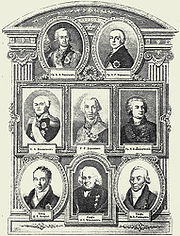
, issued the Manifesto according to which following ministries had been founded on the basis of the Administration of State Affairs: Military Land Forces, Naval Forces, Foreign Affairs, Justice, Internal Affairs, Finances, Commerce, Education. The Manifesto facilitated the formation of the Russian State and unified the system of the executive power bodies. The Ministry of Defense, the Ministry of Foreign Affairs, the Ministry of Justice, the Ministry of Internal Affairs, the Ministry of Finances, the Ministry of Economic Development and Trade, the Ministry of Education of the Russian Federation are indirect successors of the Ministries founded according to the Manifesto of Alexander I
Alexander I of Russia
Alexander I of Russia , served as Emperor of Russia from 23 March 1801 to 1 December 1825 and the first Russian King of Poland from 1815 to 1825. He was also the first Russian Grand Duke of Finland and Lithuania....
.