


Gouache

Encyclopedia
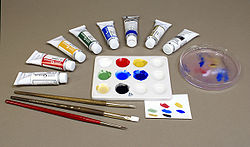
Pigment
A pigment is a material that changes the color of reflected or transmitted light as the result of wavelength-selective absorption. This physical process differs from fluorescence, phosphorescence, and other forms of luminescence, in which a material emits light.Many materials selectively absorb...
suspended in water. A binding agent, usually gum arabic
Gum arabic
220px|thumb|right|Acacia gumGum arabic, also known as acacia gum, chaar gund, char goond, or meska, is a natural gum made of hardened sap taken from two species of the acacia tree; Acacia senegal and Acacia seyal...
, is also present, just as in watercolor. Gouache differs from watercolor
Watercolor painting
Watercolor or watercolour , also aquarelle from French, is a painting method. A watercolor is the medium or the resulting artwork in which the paints are made of pigments suspended in a water-soluble vehicle...
in that the particles are larger, the ratio of pigment to water is much higher, and an additional, inert, white pigment such as chalk is also present. This makes gouache heavier and more opaque, with greater reflective qualities.
History
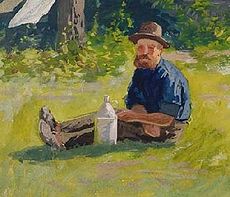
Oil paint
Oil paint is a type of slow-drying paint that consists of particles of pigment suspended in a drying oil, commonly linseed oil. The viscosity of the paint may be modified by the addition of a solvent such as turpentine or white spirit, and varnish may be added to increase the glossiness of the...
over a tempera
Tempera
Tempera, also known as egg tempera, is a permanent fast-drying painting medium consisting of colored pigment mixed with a water-soluble binder medium . Tempera also refers to the paintings done in this medium. Tempera paintings are very long lasting, and examples from the 1st centuries AD still exist...
base. The term was applied to the watermedia in the 18th century in France
France
The French Republic , The French Republic , The French Republic , (commonly known as France , is a unitary semi-presidential republic in Western Europe with several overseas territories and islands located on other continents and in the Indian, Pacific, and Atlantic oceans. Metropolitan France...
, although the technique is considerably older. It was used as early as the 14th century in Europe.
Application
Gouache generally dries to a different value than it appears when wet (lighter tones generally dry darker, while darker tones tend to dry lighter), which can make it difficult to match colors over multiple painting sessions. This, combined with its quick coverage and total hiding power, mean that gouache lends itself to more immediate techniques than watercolor. "En plein airEn plein air
En plein air is a French expression which means "in the open air", and is particularly used to describe the act of painting outdoors.Artists have long painted outdoors, but in the mid-19th century working in natural light became particularly important to the Barbizon school and Impressionism...
" paintings take advantage of this, as do works of J.M.W. Turner and Victor Lensner.
It is used most consistently by commercial artists for works such as posters, illustrations, comics, and for other design work. For example, comics illustrators like Alex Ross
Alex Ross
Nelson Alexander "Alex" Ross is an American comic book painter, illustrator, and plotter. He is praised for his realistic, human depictions of classic comic book characters. Since the 1990s he has done work for Marvel Comics and DC Comics Nelson Alexander "Alex" Ross (born January 22, 1970) is an...
use mostly gouache for their work. Industrial Designer and Visual Futurist Syd Mead
Syd Mead
Sydney Jay Mead, commonly Syd Mead, is a "visual futurist" and concept artist. He is best known for his designs for science-fiction films such as Blade Runner, Aliens and Tron...
also works primarily in gouache. Most 20th-century animation
Animation
Animation is the rapid display of a sequence of images of 2-D or 3-D artwork or model positions in order to create an illusion of movement. The effect is an optical illusion of motion due to the phenomenon of persistence of vision, and can be created and demonstrated in several ways...
s used it to create an opaque color on a cel
Cel
A cel, short for celluloid, is a transparent sheet on which objects are drawn or painted for traditional, hand-drawn animation. Actual celluloid was used during the first half of the 20th century, but since it was flammable and dimensionally unstable it was largely replaced by cellulose acetate...
with watercolor paint used for backgrounds, and gouache as "poster paint" is desirable for its speed and durability.
As with all types of paint, gouache has been used on some unusual papers or surfaces.
One variation of the medium is gouaches découpées
Decoupage
Decoupage is the art of decorating an object by gluing colored paper cutouts onto it in combination with special paint effects, gold leaf and so on. Commonly an object like a small box or an item of furniture is covered by cutouts from magazines or from purpose-manufactured papers...
created by Henri Matisse
Henri Matisse
Henri Matisse was a French artist, known for his use of colour and his fluid and original draughtsmanship. He was a draughtsman, printmaker, and sculptor, but is known primarily as a painter...
, cut paper collages. His Blue Nudes series is a good example of the technique.