


Gordium

Encyclopedia
Capital City
Capital City was a television show produced by Euston Films which focused on the lives of investment bankers in London living and working on the corporate trading floor for the fictional international bank Shane-Longman....
of ancient Phrygia
Phrygia
In antiquity, Phrygia was a kingdom in the west central part of Anatolia, in what is now modern-day Turkey. The Phrygians initially lived in the southern Balkans; according to Herodotus, under the name of Bryges , changing it to Phruges after their final migration to Anatolia, via the...
. It was located at the site of modern Yassıhüyük, about 70–80 km southwest of Ankara
Ankara
Ankara is the capital of Turkey and the country's second largest city after Istanbul. The city has a mean elevation of , and as of 2010 the metropolitan area in the entire Ankara Province had a population of 4.4 million....
(capital of Turkey
Turkey
Turkey , known officially as the Republic of Turkey , is a Eurasian country located in Western Asia and in East Thrace in Southeastern Europe...
), in the immediate vicinity of Polatlı
Polatli
Polatlı is a city and a district in Ankara Province in the Central Anatolia region of Turkey, 80 km west of the Turkish capital Ankara, on the road to Eskişehir. According to 2010 census, population of the district is 117,473 of which 98,605 live in the city of Polatlı...
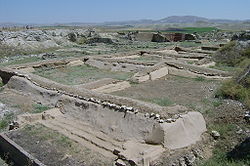
district. The site was excavated by Gustav and Alfred Körte in 1900 and then by the University of Pennsylvania Museum, under the direction of Rodney S. Young, between 1950 and 1973. Excavations have continued at the site under the auspices of the University of Pennsylvania Museum with an international team.
Gordium lies where the ancient road between Lydia
Lydia
Lydia was an Iron Age kingdom of western Asia Minor located generally east of ancient Ionia in the modern Turkish provinces of Manisa and inland İzmir. Its population spoke an Anatolian language known as Lydian....
and Assyria
Assyria
Assyria was a Semitic Akkadian kingdom, extant as a nation state from the mid–23rd century BC to 608 BC centred on the Upper Tigris river, in northern Mesopotamia , that came to rule regional empires a number of times through history. It was named for its original capital, the ancient city of Assur...
/Babylonia
Babylonia
Babylonia was an ancient cultural region in central-southern Mesopotamia , with Babylon as its capital. Babylonia emerged as a major power when Hammurabi Babylonia was an ancient cultural region in central-southern Mesopotamia (present-day Iraq), with Babylon as its capital. Babylonia emerged as...
crossed the Sangarius river.
History
In the twelfth century BCE12th century BC
-Overview:The 12th century BC is the period from 1200 to 1101 BC. Although many human societies were literate in this period, most individual persons mentioned in this article ought to be considered legendary rather than historical...
, Gordium was settled by Thracians
Thrace
Thrace is a historical and geographic area in southeast Europe. As a geographical concept, Thrace designates a region bounded by the Balkan Mountains on the north, Rhodope Mountains and the Aegean Sea on the south, and by the Black Sea and the Sea of Marmara on the east...
who had migrated from southeastern Europe. During the ninth and eighth centuries (BC), the city grew into the capital of a kingdom
Monarchy
A monarchy is a form of government in which the office of head of state is usually held until death or abdication and is often hereditary and includes a royal house. In some cases, the monarch is elected...
that controlled much of Asia Minor
Anatolia
Anatolia is a geographic and historical term denoting the westernmost protrusion of Asia, comprising the majority of the Republic of Turkey...
west of the river Halys
Halys River
The Kızılırmak , also known as the Halys River , is the longest river in Turkey. It is a source of hydroelectric power and is not used for navigation.- Geography :...
. The kings of Phrygia
Phrygia
In antiquity, Phrygia was a kingdom in the west central part of Anatolia, in what is now modern-day Turkey. The Phrygians initially lived in the southern Balkans; according to Herodotus, under the name of Bryges , changing it to Phruges after their final migration to Anatolia, via the...
built large tomb
Tomb
A tomb is a repository for the remains of the dead. It is generally any structurally enclosed interment space or burial chamber, of varying sizes...
s near Gordium called tumuli, which consist of artificial mounds constructed over burial chambers
Chamber tomb
A chamber tomb is a tomb for burial used in many different cultures. In the case of individual burials, the chamber is thought to signify a higher status for the interree than a simple grave. Built from rock or sometimes wood, the chambers could also serve as places for storage of the dead from one...
. There are about one hundred of them, covering both cremations and inhumations. In the 8th century, the lower city and the area to the north of the citadel
Citadel
A citadel is a fortress for protecting a town, sometimes incorporating a castle. The term derives from the same Latin root as the word "city", civis, meaning citizen....
was surrounded by a circuit wall with regularly spaced tower
Tower
A tower is a tall structure, usually taller than it is wide, often by a significant margin. Towers are distinguished from masts by their lack of guy-wires....
s.
The most famous king of Phrygia was the quasi-legend
Legend
A legend is a narrative of human actions that are perceived both by teller and listeners to take place within human history and to possess certain qualities that give the tale verisimilitude...
ary Midas
Midas
For the legend of Gordias, a person who was taken by the people and made King, in obedience to the command of the oracle, see Gordias.Midas or King Midas is popularly remembered in Greek mythology for his ability to turn everything he touched into gold. This was called the Golden touch, or the...
. Contemporary Assyria
Assyria
Assyria was a Semitic Akkadian kingdom, extant as a nation state from the mid–23rd century BC to 608 BC centred on the Upper Tigris river, in northern Mesopotamia , that came to rule regional empires a number of times through history. It was named for its original capital, the ancient city of Assur...
n sources dating between ca. 718 and 709 BCE call him Mit-ta-a. According to the Greek historian Herodotus
Herodotus
Herodotus was an ancient Greek historian who was born in Halicarnassus, Caria and lived in the 5th century BC . He has been called the "Father of History", and was the first historian known to collect his materials systematically, test their accuracy to a certain extent and arrange them in a...
, King Midas was the first foreigner to make an offering at the sanctuary of Apollo at Delphi, dedicating the throne from which he gave judgment. During his reign, according to Strabo
Strabo
Strabo, also written Strabon was a Greek historian, geographer and philosopher.-Life:Strabo was born to an affluent family from Amaseia in Pontus , a city which he said was situated the approximate equivalent of 75 km from the Black Sea...
, the nomadic Cimmerians
Cimmerians
The Cimmerians or Kimmerians were ancient equestrian nomads of Indo-European origin.According to the Greek historian Herodotus, of the 5th century BC, the Cimmerians inhabited the region north of the Caucasus and the Black Sea during the 8th and 7th centuries BC, in what is now Ukraine and Russia...
invaded Asia Minor, and in 710/709, Midas was forced to ask for help from the Assyrian king Sargon II
Sargon II
Sargon II was an Assyrian king. Sargon II became co-regent with Shalmaneser V in 722 BC, and became the sole ruler of the kingdom of Assyria in 722 BC after the death of Shalmaneser V. It is not clear whether he was the son of Tiglath-Pileser III or a usurper unrelated to the royal family...
. In Strabo's account, King Midas committed suicide by drinking bull's blood when the Cimmerians overran the city.
There is ample evidence of widespread burning of the city mound of Gordium, in a level referred to by Young as the destruction level. Archaeologists
Archaeology
Archaeology, or archeology , is the study of human society, primarily through the recovery and analysis of the material culture and environmental data that they have left behind, which includes artifacts, architecture, biofacts and cultural landscapes...
at first interpreted the destruction level as the remains of a Cimmerian attack, circa 700 BCE. The traces were later reinterpreted as dating to circa 800 BCE, largely on the basis of dendrochronology
Dendrochronology
Dendrochronology or tree-ring dating is the scientific method of dating based on the analysis of patterns of tree-rings. Dendrochronology can date the time at which tree rings were formed, in many types of wood, to the exact calendar year...
and radiocarbon analysis, although with reference to the types of objects found in the burned level. If this reinterpretation is correct, then the otherwise-unrecorded destruction would seem to have been caused by a conflagration
Conflagration
A conflagration or a blaze is an uncontrolled burning that threatens human life, health, or property. A conflagration can be accidentally begun, naturally caused , or intentionally created . Arson can be accomplished for the purpose of sabotage or diversion, and also can be the consequence of...
unrelated to a Cimmerian attack. The earlier date, though, is contested, primarily on the basis of the types and styles of objects excavated in the destruction level, the latest of which are dated to ca. 700 BCE by some scholars. The newly proposed radiocarbon date seems to have a range wide enough to accommodate both proposed archaeological dates, and the matter continues to be debated.
Tumulus MM (for "Midas Mound"), the Great Tumulus, is the largest burial mound at Gordium, standing over 50 meters high today, with a diameter of ca. 300 meters. The tumulus was excavated in 1957 by Young's team, revealing the remains of the royal occupant, resting on purple and golden textiles in an open log coffin, surrounded by a vast array of magnificent objects. The burial goods included pottery and bronze vessels containing organic residues, bronze fibulae (ancient safety pins), leather belts with bronze attachments, and an extraordinary collection of carved and inlaid wooden furniture
Gordion Furniture and Wooden Artifacts
A spectacular collection of furniture and wooden artifacts was excavated by the University of Pennsylvania at the site of Gordion , the capital of the ancient kingdom of Phrygia in the early first millennium BC...
, exceptional for its state of preservation. The Tumulus MM funeral ceremony has been reconstructed, and scientists have determined that the guests at the banquet ate lamb or goat stew and drank a mixed fermented beverage. The burial is now dated to the second half of the eighth century BCE, and while it is possible that this is the tomb of King Midas himself, it is now generally assumed to be that of his father Gordias.
According to ancient tradition, in 333 BCE Alexander the Great cut (or otherwise unfastened) the Gordian Knot
Gordian Knot
The Gordian Knot is a legend of Phrygian Gordium associated with Alexander the Great. It is often used as a metaphor for an intractable problem solved by a bold stroke :"Turn him to any cause of policy,...
: this intricate knot joined the yoke to the pole of a Phrygian wagon that stood on the acropolis of the city. The wagon was associated with Midas or Gordias (or both), and was connected with the dynasty's rise to power. A local prophecy had decreed that whoever could loose the knot was destined to become the ruler of Asia.
External links
- The Gordion Archaeological Project official site
- Conservation at Gordion by the University of Pennsylvania's Architectural Conservation Laboratory
- Excavation, Study of Material Excavated 1988–1996, Regional Surface Survey, and Ethnographic Survey by Mary Voigt.
- Erosion, Biodiversity, and Archaeology: Preserving the Midas Tumulus at Gordion by Naomi F. Miller
- Livius.org: Gordium
- University of Pennsylvania Museum excavations at Gordion
Further reading
- Keith DeVriesKeith DeVriesKeith Robert DeVries was a prominent archaeologist and expert on the Phrygian city of Gordium, in what is now Turkey. He was born in Grand Rapids, Michigan....
(editor). From Athens to Gordion (Philadelphia: University Museum, 1980). - Ann C. Gunter. Gordion Excavations Final Reports Vol. III: The Bronze Age (Philadelphia: University Museum, 1991).
- Gustav Körte and Alfred Körte. " Gordion: Ergebnisse der Ausgrabung im Jahre 1900". Jährliches Ergänzungsheft 5 (Berlin, 1904). (In German.)
- Ellen L. Kohler. The Gordion Excavations (1950–1973) Final Reports, Vol. II: The Lesser Phrygian Tumuli, Part 1, The Inhumations (Philadelphia, 1995).
- Frank Matero and Meredith Keller, eds. Gordion Awakened: Conserving A Phrygian Landscape (Philadelphia: Architectural Conservation Laboratory, 2011).
- Machteld MellinkMachteld MellinkMachteld Johanna Mellink was an archaeologist who studied Near Eastern cultures and history....
. A Hittite Cemetery at Gordion (Philadelphia: University Museum, 1956). - Oscar White Muscarella. Phrygian Fibulae from Gordion. (London: Colt Archaeological Institute, 1967).
- Lynn Roller. Gordion Special Studies, Vol. I: Nonverbal Graffiti, Dipinti, and Stamps (Philadelphia: University Museum, 1987).
- Irene Romano. Gordion Special Studies Vol. II: The Terracotta Figurines and Related Vessels (Philadelphia: University Museum, 1995).
- G. Kenneth Sams. The Gordion Excavations, 1950–1973: Final Reports, Vol. IV: The Early Phrygian Pottery (Philadelphia: University Museum, 1994).
- Elizabeth Simpson and Krysia Spirydowicz. Gordion Wooden Furniture: The Study, Conservation, and Reconstruction of the Furniture and Wooden Objects from Gordion, 1981–1998. (Ankara: Museum of Anatolian Civilizations, 1999).
- Rodney Young et al.. Gordion Excavations Reports, Vol. I: Three Great Early Tumuli [P, MM, W] (Philadelphia: University Museum, 1981).