
Home      Discussion      Topics      Dictionary      Almanac
Signup       Login
Golub-Dobrzyn

Golub-Dobrzyn

Overview
Golub-Dobrzyń ' is a town
Town
A town is a human settlement larger than a village but smaller than a city. The size a settlement must be in order to be called a "town" varies considerably in different parts of the world, so that, for example, many American "small towns" seem to British people to be no more than villages, while...

 in central Poland
Poland
Poland , officially the Republic of Poland , is a country in Central Europe bordered by Germany to the west; the Czech Republic and Slovakia to the south; Ukraine, Belarus and Lithuania to the east; and the Baltic Sea and Kaliningrad Oblast, a Russian exclave, to the north...

, located on the both sides of the Drwęca
Drweca
The Drwęca is a river in northern Poland and a tributary of the Vistula river near Toruń, forming a part of the city's administrative boundary. It has a length of 207 km and a basin area of 5,344 km², all in Poland.Towns:...

 River. Situated in the Kuyavian-Pomeranian Voivodeship
Kuyavian-Pomeranian Voivodeship
-Transportation:Transportation infrastructure is of critical importance to the voivodeship's economy. Kuyavia-Pomerania is a major node point in the Polish transportation system. Railway lines from the South and East pass through Bydgoszcz in order to reach the major ports on the Baltic Sea...

 (since 1999), it was previously in the Torun Voivodeship
Torun Voivodeship
Toruń Voivodeship was a unit of administrative division and local government in Poland in the years 1975–1998, superseded by the Kuyavian-Pomeranian Voivodeship. Its capital city was Toruń.-Major cities and towns :...

 (1975-1998). It is the capital of Golub-Dobrzyń County
Golub-Dobrzyn County
Golub-Dobrzyń County is a unit of territorial administration and local government in Kuyavian-Pomeranian Voivodeship, north-central Poland. It came into being on January 1, 1999, as a result of the Polish local government reforms passed in 1998. Its administrative seat and largest town is the...

 and has a population of 12,500.
Discussion
Ask a question about 'Golub-Dobrzyn'
Start a new discussion about 'Golub-Dobrzyn'
Answer questions from other users
Full Discussion Forum
 
Unanswered Questions
Encyclopedia
Golub-Dobrzyń ' is a town
Town
A town is a human settlement larger than a village but smaller than a city. The size a settlement must be in order to be called a "town" varies considerably in different parts of the world, so that, for example, many American "small towns" seem to British people to be no more than villages, while...

 in central Poland
Poland
Poland , officially the Republic of Poland , is a country in Central Europe bordered by Germany to the west; the Czech Republic and Slovakia to the south; Ukraine, Belarus and Lithuania to the east; and the Baltic Sea and Kaliningrad Oblast, a Russian exclave, to the north...

, located on the both sides of the Drwęca
Drweca
The Drwęca is a river in northern Poland and a tributary of the Vistula river near Toruń, forming a part of the city's administrative boundary. It has a length of 207 km and a basin area of 5,344 km², all in Poland.Towns:...

 River. Situated in the Kuyavian-Pomeranian Voivodeship
Kuyavian-Pomeranian Voivodeship
-Transportation:Transportation infrastructure is of critical importance to the voivodeship's economy. Kuyavia-Pomerania is a major node point in the Polish transportation system. Railway lines from the South and East pass through Bydgoszcz in order to reach the major ports on the Baltic Sea...

 (since 1999), it was previously in the Torun Voivodeship
Torun Voivodeship
Toruń Voivodeship was a unit of administrative division and local government in Poland in the years 1975–1998, superseded by the Kuyavian-Pomeranian Voivodeship. Its capital city was Toruń.-Major cities and towns :...

 (1975-1998). It is the capital of Golub-Dobrzyń County
Golub-Dobrzyn County
Golub-Dobrzyń County is a unit of territorial administration and local government in Kuyavian-Pomeranian Voivodeship, north-central Poland. It came into being on January 1, 1999, as a result of the Polish local government reforms passed in 1998. Its administrative seat and largest town is the...

 and has a population of 12,500.

History


Golub-Dobrzyń initially consisted of two separate towns: Golub located north of the Drwęca in Chełmno Land
Chełmno Land
Chełmno land or Chełmno region is a historical region of Poland, located in central Poland, bounded by the Vistula and Drwęca rivers....

 and Dobrzyń located south of the Drwęca in the Dobrzyń Land
Dobrzyn Land
Dobrzyń Land is a historic region around the town of Dobrzyń nad Wisłą in Poland, east of the Vistula River and south of the Drwęca, where it borders on the Kulmerland...

. The two cities were united May 5, 1951.

History of Golub


The village Golub , populated by Poles
Poles
thumb|right|180px|The state flag of [[Poland]] as used by Polish government and diplomatic authoritiesThe Polish people, or Poles , are a nation indigenous to Poland. They are united by the Polish language, which belongs to the historical Lechitic subgroup of West Slavic languages of Central Europe...

, was first mentioned in a document from 1258; Chełmno Land, or Culmerland, had been in the hands of the Teutonic Knights
Teutonic Knights
The Order of Brothers of the German House of Saint Mary in Jerusalem , commonly the Teutonic Order , is a German medieval military order, in modern times a purely religious Catholic order...

 since 1231. The Teutonic Knights built a castle
Ordensburg
An Ordensburg was a fortress built by crusading German military orders during the Middle Ages. "Ordensburg" was also used during Nazi Germany to refer to training schools for Nazi leaders.- Medieval Ordensburgen :...

 (1296–1306) and elevated it to town status
German town law
German town law or German municipal concerns concerns town privileges used by many cities, towns, and villages throughout Central and Eastern Europe during the Middle Ages.- Town law in Germany :...

. In 1421 all privileges of the town were confirmed by Grand Master Michael Küchmeister von Sternberg
Michael Küchmeister von Sternberg
Michael Küchmeister von Sternberg was the 28th Grand Master of the Teutonic Knights, serving from 1414 to 1422.- Biography :...

. Golub was severely damaged during wars in 1414 and 1422; the latter war called the Gollub War
Gollub War
The Gollub War was a two-month war of the Teutonic Knights against the Kingdom of Poland and the Grand Duchy of Lithuania in 1422. It ended by signing the Treaty of Melno, which resolved territorial disputes, dragging since 1398, between the Knights and Lithuania over Samogitia.-Background:The...

. The town became part of Poland according to the Second Peace of Thorn (1466).

The height of prosperity of Golub was reached during the rule of King Sigismund III Vasa
Sigismund III Vasa
Sigismund III Vasa was King of Poland and Grand Duke of Lithuania, a monarch of the united Polish–Lithuanian Commonwealth from 1587 to 1632, and King of Sweden from 1592 until he was deposed in 1599...

 1611-25. The town was severely damaged during Polish-Swedish Wars
Polish-Swedish wars
The Polish–Swedish Wars were a series of wars between the Polish–Lithuanian Commonwealth and Sweden. Broadly construed, the term refers to a series of wars between 1563 and 1721. More narrowly, it refers two particular wars between 1600 and 1629...

, especially in 1626-29, 1655, and 1660, as well as the later Seven Years' War
Seven Years' War
The Seven Years' War was a global military war between 1756 and 1763, involving most of the great powers of the time and affecting Europe, North America, Central America, the West African coast, India, and the Philippines...

 (1756–63). In the First Partition of Poland
Partitions of Poland
The Partitions of Poland or Partitions of the Polish–Lithuanian Commonwealth took place in the second half of the 18th century and ended the existence of the Polish–Lithuanian Commonwealth, resulting in the elimination of sovereign Poland for 123 years...

 in 1772, Golub was annexed by the Kingdom of Prussia
Kingdom of Prussia
The Kingdom of Prussia was a German kingdom from 1701 to 1918. Until the defeat of Germany in World War I, it comprised almost two-thirds of the area of the German Empire...

. From 1807-15 it belonged to the Duchy of Warsaw
Duchy of Warsaw
The Duchy of Warsaw was a Polish state established by Napoleon I in 1807 from the Polish lands ceded by the Kingdom of Prussia under the terms of the Treaties of Tilsit. The duchy was held in personal union by one of Napoleon's allies, King Frederick Augustus I of Saxony...

. It was assigned to the Duchy of Poznan in 1815, and in 1817 it was included in West Prussia
West Prussia
West Prussia was a province of the Kingdom of Prussia from 1773–1824 and 1878–1919/20 which was created out of the earlier Polish province of Royal Prussia...

. In 1871 it was included in Imperial Germany and was subject to Germanisation
Germanisation
Germanisation is both the spread of the German language, people and culture either by force or assimilation, and the adaptation of a foreign word to the German language in linguistics, much like the Romanisation of many languages which do not use the Latin alphabet...

. In January 1920 it became part of Poland. In August 1920, the Red Army
Red Army
The Workers' and Peasants' Red Army started out as the Soviet Union's revolutionary communist combat groups during the Russian Civil War of 1918-1922. It grew into the national army of the Soviet Union. By the 1930s the Red Army was among the largest armies in history.The "Red Army" name refers to...

 attacked the city. In 1939 it was annexed by Nazi Germany
Nazi Germany
Nazi Germany , also known as the Third Reich , but officially called German Reich from 1933 to 1943 and Greater German Reich from 26 June 1943 onward, is the name commonly used to refer to the state of Germany from 1933 to 1945, when it was a totalitarian dictatorship ruled by...

 and most of dwellers were forced to sign the Volksliste
Volksliste
The Deutsche Volksliste was a Nazi institution whose purpose was the classification of inhabitants of German occupied territories into categories of desirability according to criteria systematized by Heinrich Himmler. The institution was first established in occupied western Poland...

.

History of Dobrzyń


Since the second half of the 17th century, Dobrzyń existed as a settlement on the left bank of the Drwęca. In 1684 Zygmunt Działyński named the settlement Przedmieście Golubskie. In 1789 Count Ignacy Działyński founded the city of Dobrzyń. In 1793 after the Second Partition of Poland, Dobrzyń was annexed by the Kingdom of Prussia
Kingdom of Prussia
The Kingdom of Prussia was a German kingdom from 1701 to 1918. Until the defeat of Germany in World War I, it comprised almost two-thirds of the area of the German Empire...

. From 1807-15 it belonged to the Duchy of Warsaw
Duchy of Warsaw
The Duchy of Warsaw was a Polish state established by Napoleon I in 1807 from the Polish lands ceded by the Kingdom of Prussia under the terms of the Treaties of Tilsit. The duchy was held in personal union by one of Napoleon's allies, King Frederick Augustus I of Saxony...

. In 1815 it was included in the Kingdom of Poland
Congress Poland
The Kingdom of Poland , informally known as Congress Poland , created in 1815 by the Congress of Vienna, was a personal union of the Russian parcel of Poland with the Russian Empire...

 in personal union with the Russian Empire
Russian Empire
The Russian Empire was a state that existed from 1721 until the Russian Revolution of 1917. It was the successor to the Tsardom of Russia and the predecessor of the Soviet Union...

. In the second half of the 19th century the Kingdom of Poland was annexed by Russia and the city developed quickly with a growing Jewish population. Eventually Dobrzyń became larger than Golub.

Dobrzyń became part of the Second Polish Republic
Second Polish Republic
The Second Polish Republic, Second Commonwealth of Poland or interwar Poland refers to Poland between the two world wars; a period in Polish history in which Poland was restored as an independent state. Officially known as the Republic of Poland or the Commonwealth of Poland , the Polish state was...

 in 1918 following World War I
World War I
World War I , which was predominantly called the World War or the Great War from its occurrence until 1939, and the First World War or World War I thereafter, was a major war centred in Europe that began on 28 July 1914 and lasted until 11 November 1918...

. In August 1920, the Soviet
Soviet Union
The Soviet Union , officially the Union of Soviet Socialist Republics , was a constitutionally socialist state that existed in Eurasia between 1922 and 1991....

 Red Army
Red Army
The Workers' and Peasants' Red Army started out as the Soviet Union's revolutionary communist combat groups during the Russian Civil War of 1918-1922. It grew into the national army of the Soviet Union. By the 1930s the Red Army was among the largest armies in history.The "Red Army" name refers to...

 attacked the city. In 1939 it was annexed by Nazi Germany
Nazi Germany
Nazi Germany , also known as the Third Reich , but officially called German Reich from 1933 to 1943 and Greater German Reich from 26 June 1943 onward, is the name commonly used to refer to the state of Germany from 1933 to 1945, when it was a totalitarian dictatorship ruled by...

 and most of its dwellers were deported to Nazi concentration camps
Nazi concentration camps
Nazi Germany maintained concentration camps throughout the territories it controlled. The first Nazi concentration camps set up in Germany were greatly expanded after the Reichstag fire of 1933, and were intended to hold political prisoners and opponents of the regime...

. The local intelligentsia
Intelligentsia
The intelligentsia is a social class of people engaged in complex, mental and creative labor directed to the development and dissemination of culture, encompassing intellectuals and social groups close to them...

 was murdered through executions.

Monuments and landmarks

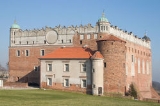
  • Castle of the Teutonic Knights
    Teutonic Knights
    The Order of Brothers of the German House of Saint Mary in Jerusalem , commonly the Teutonic Order , is a German medieval military order, in modern times a purely religious Catholic order...

    , built at the turn of the 13th and 14th centuries, later rebuilt and extended in the 15th century. Between 1616 and 1623 it was a residence of Anna of Finland
    Anna of Finland
    Anna Vasa or Anna of Sweden also Anne was a Swedish princess. She was the sister of the monarch of Poland, Sweden and Lithuania, Sigismund III Vasa, and starosta of Brodnica and Golub.-Biography:...

    ; during this period a Renaissance attic
    Attic style
    In classical architecture, the term attic refers to a story or low wall above the cornice of a classical façade. This usage originated in the 17th century from the use of Attica style pilasters as adornments on the top story's façade...

     was added. The castle was destroyed during the The Deluge
    The Deluge (Polish history)
    The term Deluge denotes a series of mid-17th century campaigns in the Polish–Lithuanian Commonwealth. In a wider sense it applies to the period between the Khmelnytsky Uprising of 1648 and the Truce of Andrusovo in 1667, thus comprising the Polish–Lithuanian theaters of the Russo-Polish and...

    . In the 19th century, it was neglected and a gale caused the collapse of its attic. After 1945 the castle was rebuilt and renovated.
  • Gothic church of St. Catherine, dating back to the beginning of the 14th century, with the Renaissance chapel of the Kostka family
  • Relics of defence walls
  • Wooden arcaded house in the market square dating back to the end of the 18th century
  • In Dobrzyń - Classicistic church built between 1823 and 1827

External links