
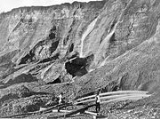
GoldGold is a chemical element with the symbol Au and an atomic number of 79. Gold is a dense, soft, shiny, malleable and ductile metal. Pure gold has a bright yellow color and luster traditionally considered attractive, which it maintains without oxidizing in air or water. Chemically, gold is a...
extraction or recovery from its
oreAn ore is a type of rock that contains minerals with important elements including metals. The ores are extracted through mining; these are then refined to extract the valuable element....
s may require a combination of
comminutionComminution is the process in which solid materials are reduced in size, by crushing, grinding and other processes. It occurs naturally during faulting in the upper part of the crust and is an important operation in mineral processing, ceramics, electronics and other fields. Within industrial uses,...
,
mineral processingIn the field of extractive metallurgy, mineral processing, also known as mineral dressing or ore dressing, is the process of separating commercially valuable minerals from their ores.-History:...
,
hydrometallurgicalHydrometallurgy is part of the field of extractive metallurgy involving the use of aqueous chemistry for the recovery of metals from ores, concentrates, and recycled or residual materials...
, and
pyrometallurgicalPyrometallurgy is a branch of extractive metallurgy. It consists of the thermal treatment of minerals and metallurgical ores and concentrates to bring about physical and chemical transformations in the materials to enable recovery of valuable metals...
processes to be performed on the ore.
Gold miningGold mining is the removal of gold from the ground. There are several techniques and processes by which gold may be extracted from the earth.-History:...
from alluvium ores was once achieved by techniques associated with
placer miningPlacer mining is the mining of alluvial deposits for minerals. This may be done by open-pit or by various surface excavating equipment or tunneling equipment....
such as simple gold panning and sluicing, resulting in direct recovery of small gold nuggets and flakes. Placer mining techniques since the mid to late 20th century have generally only been the practice of artisan miners.
Hydraulic miningHydraulic mining, or hydraulicking, is a form of mining that uses high-pressure jets of water to dislodge rock material or move sediment. In the placer mining of gold or tin, the resulting water-sediment slurry is directed through sluice boxes to remove the gold.-Precursor - ground...
was used widely in the
CaliforniaCalifornia is a state located on the West Coast of the United States. It is by far the most populous U.S. state, and the third-largest by land area...
n
gold rushA gold rush is a period of feverish migration of workers to an area that has had a dramatic discovery of gold. Major gold rushes took place in the 19th century in Australia, Brazil, Canada, South Africa, and the United States, while smaller gold rushes took place elsewhere.In the 19th and early...
, and involved breaking down alluvial deposits with high-pressure jets of water. Hard rock ores have formed the basis of the majority of commercial gold recovery operations since the middle of the 20th century where open pit and or
sub-surface miningUnderground mining refers to a group of underground mining techniques used to extract coal, oil shale and other minerals or geological materials from sedimentary rocks...
techniques are used.
Once the ore is mined it can be treated as a whole ore using a
dump leachingDump leaching is an industrial process to extract precious metals and copper from ores.Dump leaching is similar to heap leaching, however in the case of dump leaching ore is taken directly from the mine and stacked on the leach pad without crushing where, in the case of gold and silver, the dump is...
or
heap leachingHeap leaching is an industrial mining process to extract precious metals, copper, uranium, and other compounds from ore.The process has ancient origins; one of the classical methods for the manufacture of copperas was to heap up iron pyrite and collect the leachate from the heap, which was then...
processes. This is typical of low-grade, oxide deposits. Normally, the ore is crushed and agglomerated prior to heap leaching. High grade ores and ores resistant to
cyanideA cyanide is a chemical compound that contains the cyano group, -C≡N, which consists of a carbon atom triple-bonded to a nitrogen atom. Cyanides most commonly refer to salts of the anion CN−. Most cyanides are highly toxic....
leaching at coarse particle sizes, require further processing in order to recover the gold values. The processing techniques can include grinding, concentration, roasting, and pressure oxidation prior to cyanidation.
Types of ore
Gold occurs principally as a
native metalA native metal is any metal that is found in its metallic form, either pure or as an alloy, in nature. Metals that can be found as native deposits singly and/or in alloys include aluminium, antimony, arsenic, bismuth, cadmium, chromium, cobalt, indium, iron, nickel, selenium, tantalum, tellurium,...
, usually
alloyAn alloy is a mixture or metallic solid solution composed of two or more elements. Complete solid solution alloys give single solid phase microstructure, while partial solutions give two or more phases that may or may not be homogeneous in distribution, depending on thermal history...
ed to a greater or lesser extent with
silverSilver is a metallic chemical element with the chemical symbol Ag and atomic number 47. A soft, white, lustrous transition metal, it has the highest electrical conductivity of any element and the highest thermal conductivity of any metal...
(as
electrumElectrum is a naturally occurring alloy of gold and silver, with trace amounts of copper and other metals. It has also been produced artificially. The ancient Greeks called it 'gold' or 'white gold', as opposed to 'refined gold'. Its color ranges from pale to bright yellow, depending on the...
), or sometimes with
mercuryMercury is a chemical element with the symbol Hg and atomic number 80. It is also known as quicksilver or hydrargyrum...
(as an
amalgamAn amalgam is a substance formed by the reaction of mercury with another metal. Almost all metals can form amalgams with mercury, notable exceptions being iron and platinum. Silver-mercury amalgams are important in dentistry, and gold-mercury amalgam is used in the extraction of gold from ore.The...
). Native gold can occur as sizeable nuggets, as fine grains or flakes in
alluvial depositsAlluvium is loose, unconsolidated soil or sediments, eroded, deposited, and reshaped by water in some form in a non-marine setting. Alluvium is typically made up of a variety of materials, including fine particles of silt and clay and larger particles of sand and gravel...
, or as grains or microscopic particles embedded in other rocks.
Ores in which gold occurs in chemical composition with other elements are comparatively rare. They include
calaveriteCalaverite, or gold telluride, is an uncommon telluride of gold, a metallic mineral with the chemical formula AuTe2, with approximately 3% of the gold replaced by silver. It was first discovered in Calaveras County, California in 1861, and was named for the county in 1868.The mineral often has a...
,
sylvaniteSylvanite or silver gold telluride, Te2, is the most common telluride of gold.-Properties:The gold:silver ratio varies from 3:1 to 1:1. It is a metallic mineral with a color that ranges from a steely gray to almost white. It is closely related to calaverite, which is more purely gold telluride with...
,
nagyagiteNagyagite is a rare sulfide mineral with known occurrence associated with gold ores. Nagyagite crystals are opaque, monoclinic and dark grey to black coloured....
,
petziteThe mineral petzite, Ag3AuTe2, is a soft, steel-gray telluride mineral generally deposited by hydrothermal activity. It forms isometric crystals, and is usually associated with rare tellurium and gold minerals, often with silver, mercury, and copper....
and
krenneriteKrennerite is an orthorhombic gold telluride mineral which can contain a relatively small amount of silver in the structure. The formula is AuTe2 varying to Te2. Both of the chemically similar gold-silver tellurides, calaverite and sylvanite are in the monoclinic crystal system, whereas krennerite...
.
Concentration
Gravity concentration has been historically the most important way of extracting the native metal using pans or washing tables. Amalgamation with
mercuryMercury is a chemical element with the symbol Hg and atomic number 80. It is also known as quicksilver or hydrargyrum...
was used to enhance recovery, often by adding it directly to the
riffleA Riffle is a short, relatively shallow and coarse-bedded length of stream over which the stream flows at higher velocity and higher turbulence than it normally does in comparison to a pool....
tables, and mercury is still widely used in small diggings across the world. However,
froth flotationFroth flotation is a process for selectively separating hydrophobic materials from hydrophilic. This is used in several processing industries...
processes may also be used to concentrate the gold. In some cases, particularly when the gold is present in the ore as discrete coarse particles, a gravity concentrate can be directly
smeltedSmelting is a form of extractive metallurgy; its main use is to produce a metal from its ore. This includes iron extraction from iron ore, and copper extraction and other base metals from their ores...
to form gold bars. In other cases, particularly when the gold is present in the ore as fine particles or is not sufficiently liberated from the host rock, the concentrates are treated with
cyanideA cyanide is a chemical compound that contains the cyano group, -C≡N, which consists of a carbon atom triple-bonded to a nitrogen atom. Cyanides most commonly refer to salts of the anion CN−. Most cyanides are highly toxic....
salts, a process known as cyanidation leaching, followed by recovery from the leach solution. Recovery from solution typically involves adsorption on activated carbon followed by solution concentration or stripping and or
electrowinningElectrowinning, also called electroextraction, is the electrodeposition of metals from their ores that have been put in solution or liquefied. Electrorefining uses a similar process to remove impurities from a metal. Both processes use electroplating on a large scale and are important techniques...
.
Froth flotation is usually applied when the gold present in an ore is closely associated with
sulfide mineralThe sulfide minerals are a class of minerals containing sulfide as the major anion. Some sulfide minerals are economically important as metal ores. The sulfide class also includes the selenides, the tellurides, the arsenides, the antimonides, the bismuthinides, the sulfarsenides and the sulfosalts...
s such as
pyriteThe mineral pyrite, or iron pyrite, is an iron sulfide with the formula FeS2. This mineral's metallic luster and pale-to-normal, brass-yellow hue have earned it the nickname fool's gold because of its resemblance to gold...
or
senoritaSeñorita is the Spanish honorific equivalent of Miss.Other uses:*Señorita banana, a banana cultivar from the Philippines.*Señorita Colombia, Colombian beauty contest*Señorita EP, a five-song extended play from Superdrag...
, and when such sulfides are present in large quantities in the ore. In this case, concentration of the sulfides results in concentration of gold values. Generally, recovery of the gold from the sulfide concentrates requires further processing, usually by
roastingRoasting is a step in the processing of certain ores. More specifically, roasting is a metallurgical process involving gas–solid reactions at elevated temperatures with the goal of purifying the metal component. Often before roasting, the ore has already been partially purified, e.g. by froth...
or wet pressure oxidation. These pyrometallurgical or hydrometallurgical treatments are themselves usually followed by consolidation and carbon adsorption techniques for final recovery of the gold.
Sometimes gold is present as a minor constituent in a
base metalIn chemistry, the term base metal is used informally to refer to a metal that oxidizes or corrodes relatively easily, and reacts variably with diluted hydrochloric acid to form hydrogen. Examples include iron, nickel, lead and zinc...
(e.g. copper) concentrate, and is recovered as a by-product during production of the base metal. For example, it can be recovered in the
anodeAn anode is an electrode through which electric current flows into a polarized electrical device. Mnemonic: ACID ....
slime during the electrorefining process.
Leaching
If the gold can not be concentrated for smelting, then it is leached by an aqueous solution:
- The cyanide process is the industry standard.
- Sulfate
In inorganic chemistry, a sulfate is a salt of sulfuric acid.-Chemical properties:...
leaching has been proven to be effective on ores with high soluble copperCopper is a chemical element with the symbol Cu and atomic number 29. It is a ductile metal with very high thermal and electrical conductivity. Pure copper is soft and malleable; an exposed surface has a reddish-orange tarnish...
values or ores which experience prefabbing by carbonaceous components.
Refractory gold processes
A "refractory" gold ore is an ore that is naturally resistant to recovery by standard consolidation and carbon adsorption processes. These refractory ores require pre-treatment in order for consolidation to be effective in recovery of the gold. A refractory ore generally contains sulfide minerals, organic carbon, or both. Sulfide minerals often trap or occlude gold particles, making it difficult for the leach solution to complex with the gold. Organic carbon present in gold ore may adsorb dissolved gold-cyanide complexes in much the same way as activated carbon. This so-called "preg-robbing" carbon is washed away because it is significantly finer than the carbon recovery screens typically used to recover activated carbon.
Re-treatment options for refractory ores include:
- Roasting
Roasting is a step in the processing of certain ores. More specifically, roasting is a metallurgical process involving gas–solid reactions at elevated temperatures with the goal of purifying the metal component. Often before roasting, the ore has already been partially purified, e.g. by froth...
- Bio-oxidation
- Pressure oxidation
- Ultra fine grinding
The refractory ore treatment processes may be preceded by concentration (usually sulfide flotation). Roasting is used to oxidize both the sulfur and organic carbon at high temperatures using air and/or oxygen. Bio-oxidation involves the use of bacteria that promote oxidation reactions in an aqueous environment. Pressure oxidation is an aqueous process for sulfur removal carried out in a continuous autoclave, operating at high pressures and somewhat elevated temperatures. Ultra fine grinding may be used when liberation of gold particles from the surrounding mineral matrix is the primary refractory characteristic of the ore.
Mercury removal
MercuryMercury is a chemical element with the symbol Hg and atomic number 80. It is also known as quicksilver or hydrargyrum...
is a health hazard, especially when in gas form.
To remove this hazard, before smelting, gold precipitates from
electrowinningElectrowinning, also called electroextraction, is the electrodeposition of metals from their ores that have been put in solution or liquefied. Electrorefining uses a similar process to remove impurities from a metal. Both processes use electroplating on a large scale and are important techniques...
or Merrill-Crowe processes are usually heated in a
retortIn a chemistry laboratory, a retort is a glassware device used for distillation or dry distillation of substances. It consists of a spherical vessel with a long downward-pointing neck. The liquid to be distilled is placed in the vessel and heated...
to recover any
mercuryMercury is a chemical element with the symbol Hg and atomic number 80. It is also known as quicksilver or hydrargyrum...
present, that would otherwise cause health and environmental problems due to its release (volatilization) during smelting.
The mercury present is not usually from the mercury amalgamation process that is no longer used by formal gold mining companies, but from mercury in the ore that has followed gold through the leaching and precipitation processes.
In the event that there are high levels of
copperCopper is a chemical element with the symbol Cu and atomic number 29. It is a ductile metal with very high thermal and electrical conductivity. Pure copper is soft and malleable; an exposed surface has a reddish-orange tarnish...
or
silverSilver is a metallic chemical element with the chemical symbol Ag and atomic number 47. A soft, white, lustrous transition metal, it has the highest electrical conductivity of any element and the highest thermal conductivity of any metal...
present, leaching of the precipitate using
nitricNitric acid , also known as aqua fortis and spirit of nitre, is a highly corrosive and toxic strong acid.Colorless when pure, older samples tend to acquire a yellow cast due to the accumulation of oxides of nitrogen. If the solution contains more than 86% nitric acid, it is referred to as fuming...
or
sulfuric acidSulfuric acid is a strong mineral acid with the molecular formula . Its historical name is oil of vitriol. Pure sulfuric acid is a highly corrosive, colorless, viscous liquid. The salts of sulfuric acid are called sulfates...
s may be required.
Iron removal
Nitric acid or forced air oven oxidation can also be used to dissolve iron from the electrowinning cathodes before smelting. Gravity concentrates can often contain high grinding steel contents, and so their removal using shaking tables or magnets is used before smelting.
During smelting iron can be oxidized using nitre. Excessive use of nitre will corrode the smelting pot, increasing both maintenance costs and the risk of catastrophic leaks (known as
run-aways, or holes in the pot through which the molten charge is lost).
Gold Refining and Parting
Gold PartingGold parting is the separating of gold from silver. Gold and silver are often extracted from the same ores and are chemically similar and therefore hard to separate. Over the centuries special means of separation have been invented...
is primarily the removing of silver from gold and therefore increasing the purity of gold. The parting of gold from silver has been done since ancient times starting in
LydiaLydia was an Iron Age kingdom of western Asia Minor located generally east of ancient Ionia in the modern Turkish provinces of Manisa and inland İzmir. Its population spoke an Anatolian language known as Lydian....
in the 6th century BC. Various techniques have been practised; salt cementation from ancient times, parting using distilled mineral acids from medieval times, and in modern times using chlorination using the
Miller processThe Miller process is an industrial-scale chemical procedure used to refine gold to a high degree of purity . It was invented by Francis Bowyer Miller. This chemical process involves blowing a stream of pure chlorine gas over and through a crucible filled with molten, but impure, gold...
and
electrolysisIn chemistry and manufacturing, electrolysis is a method of using a direct electric current to drive an otherwise non-spontaneous chemical reaction...
using the
Wohlwill processThe Wohlwill process is an industrial-scale chemical procedure used to refine gold to the highest degree of purity . The process was invented in 1874 by Emil Wohlwill. This electrochemical process involves using a cast dore ingot, often called a Doré bar, of 95%+ gold to serve as an anode...
.