

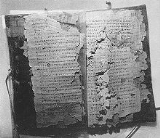
Gnostic texts

Encyclopedia
Gnosticism
used a number of religious text
s that are preserved, in part or whole, in ancient manuscripts or are lost but mentioned critically in Patristic
writings.
Gnosticism
Gnosticism is a scholarly term for a set of religious beliefs and spiritual practices common to early Christianity, Hellenistic Judaism, Greco-Roman mystery religions, Zoroastrianism , and Neoplatonism.A common characteristic of some of these groups was the teaching that the realisation of Gnosis...
used a number of religious text
Religious text
Religious texts, also known as scripture, scriptures, holy writ, or holy books, are the texts which various religious traditions consider to be sacred, or of central importance to their religious tradition...
s that are preserved, in part or whole, in ancient manuscripts or are lost but mentioned critically in Patristic
Church Fathers
The Church Fathers, Early Church Fathers, Christian Fathers, or Fathers of the Church were early and influential theologians, eminent Christian teachers and great bishops. Their scholarly works were used as a precedent for centuries to come...
writings.
Full or fragmentary
These texts exist in surviving manuscripts.- Acts of JohnActs of JohnThe Acts of John is a collection of narratives and traditions concerning John the Apostle, well described as a "library of materials" , inspired by the Gospel of John, long known in fragmentary form...
- The Hymn of Jesus
- Acts of PeterActs of PeterThe Acts of Peter is one of the earliest of the apocryphal Acts of the Apostles. The majority of the text has survived only in the Latin translation of the Vercelli manuscript. It is mainly notable for a description of a miracle contest between Saint Peter and Simon Magus, and as the first record...
- Acts of Peter and the TwelveActs of Peter and the TwelveThe Acts of Peter and the Twelve is one of the texts from the New Testament apocrypha which was found in the Nag Hammadi library.The text contains two parts, an initial allegory, and a subsequent gnostic exposition of its meaning...
- Acts of ThomasActs of ThomasThe early 3rd century text called Acts of Thomas is one of the New Testament apocrypha, portraying Christ as the "Heavenly Redeemer", independent of and beyond creation, who can free souls from the darkness of the world. References to the work by Epiphanius of Salamis show that it was in...
- The Hymn of the PearlThe Hymn of the PearlThe Hymn of the Pearl is a passage of the apocryphal Acts of Thomas. In that work, originally written in Syriac, the Apostle Thomas sings the hymn while praying for himself and fellow prisoners...
- The Hymn of the Pearl
- AllogenesAllogenesAllogenes is a Sethian Gnostic text from the New Testament apocrypha. The main surviving copies come from the Nag Hammadi library, though there are many missing lines. A small fragment also survives in the more recently discovered Codex Tchacos, which may help in filling the gaps.The text concerns...
- Apocalypse of AdamApocalypse of AdamThe Apocalypse of Adam discovered in 1945 as part of the Nag Hammadi library is a Gnostic work written in Coptic. It has no necessary references to Christianity and it is accordingly debated whether it is a Christian Gnostic work or an example of Jewish Gnosticism...
- First Apocalypse of JamesFirst Apocalypse of JamesThe First Apocalypse of James, part of the New Testament apocrypha also called the Revelation of Jacob, was first discovered amongst 52 other Gnostic Christian texts spread over 13 codices by an Arab peasant, Mohammad Ali al-Samman, in the Egyptian town of Nag Hammadi late in December 1945...
- Second Apocalypse of JamesSecond Apocalypse of JamesThe Second Apocalypse of James is one of the Gnostic Gospels, part of the New Testament apocrypha...
- Apocryphon of JamesApocryphon of JamesThe Apocryphon of James, also known by the translation of its title - the Secret Book of James, is a pseudonymous text amongst the New Testament apocrypha. It describes the secret teachings of Jesus to Peter and James, given after the Resurrection but before the Ascension.A major theme is that one...
- Apocryphon of JohnApocryphon of JohnThe Secret Book of John is a 2nd-century AD Sethian Gnostic text of secret teachings. Since it was known to the church father Irenaeus, it must have been written before around AD 180. It describes Jesus Christ appearing and giving secret knowledge to the apostle John...
- Coptic Apocalypse of PaulCoptic Apocalypse of PaulThe Coptic Apocalypse of Paul is one of the texts of the New Testament apocrypha found amongst the Nag Hammadi library. The text is not to be confused with the Apocalypse of Paul, which is unlikely to be related....
- Coptic Apocalypse of Peter
- Books of JeuBooks of Jeu-Efforts at dating:The books are estimated as written during a period spanning 100 A.D to 300 A.D ,in the time of the Roman rule of Egypt. perhaps toward the latter end of this period.-Contents:...
- Book of Thomas the ContenderBook of Thomas the ContenderThe Book of Thomas the Contender, also known more simply as the Book of Thomas , is one of the books of the New Testament apocrypha represented in the Nag Hammadi library , a cache of Gnostic gospels secreted in the Egyptian desert...
- Dialogue of the SaviourDialogue of the SaviourThe Dialogue of the Saviour is one of the New Testament apocrypha texts that was found within the Nag Hammadi library of predominantly gnostic texts. The text appears only once in a single Coptic codex, and is heavily damaged...
- Letter of Peter to PhilipLetter of Peter to PhilipThe Letter of Peter to Philip, found in the cache of texts at Nag Hammadi , contains a brief letter purporting to be from Saint Peter to Saint Philip, followed by a narrative and gnostic discourse upon the nature of Christ...
- Odes of SolomonOdes of SolomonThe Odes of Solomon is a collection of 42 odes attributed to Solomon. Various scholars have dated the composition of these religious poems to anywhere in the range of the first three centuries AD...
- Pistis SophiaPistis SophiaPistis Sophia is an important Gnostic text, possibly written as early as the 2nd century. The five remaining copies, which scholars place in the 5th or 6th centuries, relate the Gnostic teachings of the transfigured Jesus to the assembled disciples , when the risen Christ had accomplished eleven...
- Secret Gospel of MarkSecret Gospel of MarkThe Secret Gospel of Mark is a putative non-canonical Christian gospel known exclusively from the Mar Saba letter, which describes Secret Mark as an expanded version of the canonical Gospel of Mark with some episodes elucidated, written for an initiated elite.In 1973 Morton Smith , professor of...
- The Sophia of Jesus ChristThe Sophia of Jesus ChristThe Sophia of Jesus Christ is one of many Gnostic tractates from the Nag Hammadi codices, discovered in Egypt in 1945. The title is somewhat coded, since although Sophia is Greek for wisdom, in a gnostic context, Sophia is the syzygy of Christ....
- Gospel of the EgyptiansCoptic Gospel of the EgyptiansTwo versions of the formerly lost Holy Book of the Great Invisible Spirit, also inappropriately called the Coptic Gospel of the Egyptians , were among the codices in the Nag Hammadi library, discovered in 1945.The main contents concern the Sethian Gnostic understanding of how the earth came into...
- Gospel of JudasGospel of JudasThe Gospel of Judas is a Gnostic gospel that purportedly documents conversations between the Disciple Judas Iscariot and Jesus Christ.It is believed to have been written by Gnostic followers of Jesus, rather than by Judas himself, and probably dates from no earlier than the 2nd century, since it...
- Gospel of MaryGospel of MaryThe Gospel of Mary is an apocryphal book discovered in 1896 in a 5th-century papyrus codex. The codex Papyrus Berolinensis 8502 was purchased in Cairo by German scholar Karl Reinhardt....
- Gospel of PhilipGospel of PhilipThe Gospel of Philip is one of the Gnostic Gospels, a text of New Testament apocrypha, dating back to around the third century but lost to modern researchers until an Egyptian peasant rediscovered it by accident, buried in a cave near Nag Hammadi, in 1945...
- Gospel of ThomasGospel of ThomasThe Gospel According to Thomas, commonly shortened to the Gospel of Thomas, is a well preserved early Christian, non-canonical sayings-gospel discovered near Nag Hammadi, Egypt, in December 1945, in one of a group of books known as the Nag Hammadi library...
- Gospel of TruthGospel of TruthThe Gospel of Truth is one of the Gnostic texts from the New Testament apocrypha found in the Nag Hammadi codices . It exists in two Coptic translations, a Subachmimic rendition surviving almost in full in the first codex and a Sahidic in fragments in the twelfth.-History:The Gospel of Truth was...
- Unknown Berlin GospelUnknown Berlin GospelThe Unknown Berlin Gospel is a fragmentary Coptic text from an otherwise unknown gospel that has joined the New Testament apocrypha under the title Gospel of the Saviour. It consists of a fragmentary fire-damaged parchment codex that was acquired by the Egyptian Museum of Berlin in 1961...
or Gospel of the Savior
Quoted or alluded
These texts are mentioned or partially quoted in the writings of the Church Fathers.- Gospel of Basilides mentioned by OrigenOrigenOrigen , or Origen Adamantius, 184/5–253/4, was an early Christian Alexandrian scholar and theologian, and one of the most distinguished writers of the early Church. As early as the fourth century, his orthodoxy was suspect, in part because he believed in the pre-existence of souls...
, JeromeJeromeSaint Jerome was a Roman Christian priest, confessor, theologian and historian, and who became a Doctor of the Church. He was the son of Eusebius, of the city of Stridon, which was on the border of Dalmatia and Pannonia...
, AmbroseAmbroseAurelius Ambrosius, better known in English as Saint Ambrose , was a bishop of Milan who became one of the most influential ecclesiastical figures of the 4th century. He was one of the four original doctors of the Church.-Political career:Ambrose was born into a Roman Christian family between about...
, Philip of SidePhilip of SidePhilip of Side or Philip Sidetes , a historian of the early Christian church, was born at Side, the ancient Greek Iconium, Pamphylia . He wrote a Christian history of which fragments survive...
, and BedeBedeBede , also referred to as Saint Bede or the Venerable Bede , was a monk at the Northumbrian monastery of Saint Peter at Monkwearmouth, today part of Sunderland, England, and of its companion monastery, Saint Paul's, in modern Jarrow , both in the Kingdom of Northumbria...
. - BasilidesBasilidesBasilides was an early Gnostic religious teacher in Alexandria, Egypt who taught from 117–138 AD, notes that to prove that the heretical sects were "later than the catholic Church," Clement of Alexandria assigns Christ's own teaching to the reigns of Augustus and Tiberius; that of the apostles,...
' Exegetica mentioned in Hippolytus of Rome (Refutatio Omnium Haeresium VII, i-xv and X, x) and Clement of AlexandriaClement of AlexandriaTitus Flavius Clemens , known as Clement of Alexandria , was a Christian theologian and the head of the noted Catechetical School of Alexandria. Clement is best remembered as the teacher of Origen...
(StromataStromataThe Stromata is the third in Clement of Alexandria's trilogy of works on the Christian life. Clement titled this work Stromateis, "patchwork," because it dealt with such a variety of matters...
IV, xii and IV, xxiv-xxvi) - EpiphanesEpiphanes (gnostic)Epiphanes is the legendary author of On Righteousness, a notable Gnostic literary work that promotes communist principles, that was published and discussed by Clement of Alexandria, in Stromaties, III. Epiphanes was also attributed with founding Monadic Gnosis. G.R.S...
' On Righteousness, mentioned in Clement of Alexandria (Str. III, ii). - HeracleonHeracleonHeracleon was a Gnostic who flourished about AD 175, probably in the south of Italy. He is described by Clement of Alexandria as the most esteemed of the school of Valentinus; and, according to Origen Heracleon was a Gnostic who flourished about AD 175, probably in the south of Italy. He is...
, Fragments from his Commentary on the Gospel of John, mentioned in Origen (Commentary on the Gospel of John) - Naassene FragmentNaassene FragmentThe Naassene Fragment is a fragmentary text that survives in no document save a quotation in the early third century encyclopedia of heresies by Hippolytus of Rome, Refutation of All Heresies . It may be considered part of the New Testament apocryphal tradition. The Naassenes were a Gnostic...
mentioned in Hippolytus (Ref. 5.7.2-9). - Ophite DiagramsOphite DiagramsThe Ophite Diagrams are ritual and esoteric diagrams used by the Ophite Gnostic sect, who revered the serpent from the Garden of Eden as a symbol of wisdom, which the malevolent Demiurge tried to hide from Adam and Eve....
mentioned in CelsusCelsusCelsus was a 2nd century Greek philosopher and opponent of Early Christianity. He is known for his literary work, The True Word , written about by Origen. This work, c. 177 is the earliest known comprehensive attack on Christianity.According to Origen, Celsus was the author of an...
and Origen - Ptolemy'sPtolemy (gnostic)Ptolemy the Gnostic, or Ptolemaeus Gnosticus was a disciple of the Gnostic teacher Valentinius, and is known to us for an epistle he wrote to a wealthy woman named Flora, herself not a gnostic....
Commentary on the Gospel of John Prologue, mentioned in IrenaeusIrenaeusSaint Irenaeus , was Bishop of Lugdunum in Gaul, then a part of the Roman Empire . He was an early church father and apologist, and his writings were formative in the early development of Christian theology...
. - Ptolemy's Letter to Flora, mentioned in EpiphaniusEpiphanius of SalamisEpiphanius of Salamis was bishop of Salamis at the end of the 4th century. He is considered a saint and a Church Father by both the Eastern Orthodox and Catholic Churches. He gained a reputation as a strong defender of orthodoxy...
. - Theodotus: Excerpta Ex Theodoto mentioned in Clement of Alexandria.
Manuscripts
- Askew CodexAskew CodexThe Askew Codex is a parchment manuscript now held by the British Library which contains Coptic translations of the Gnostic Pistis Sophia and parts of what G. R. S. Mead referred to as "extracts from The Books of the Savior." It was purchased by the British Museum in 1795 from Dr. Anthony Askew...
contains Pistis SophiaPistis SophiaPistis Sophia is an important Gnostic text, possibly written as early as the 2nd century. The five remaining copies, which scholars place in the 5th or 6th centuries, relate the Gnostic teachings of the transfigured Jesus to the assembled disciples , when the risen Christ had accomplished eleven...
and some other unknown texts. - Berlin CodexBerlin CodexThe Berlin Codex , given the accession number Papyrus Berolinensis 8502, is a Coptic manuscript from the 5th century AD, unearthed in Akhmim, Egypt. In Cairo, in January 1896, Carl Reinhardt bought the codex, which had been recently discovered, wrapped in feathers, in a niche in a wall at a...
, 5th century, contains a fragmentary Gospel of MaryGospel of MaryThe Gospel of Mary is an apocryphal book discovered in 1896 in a 5th-century papyrus codex. The codex Papyrus Berolinensis 8502 was purchased in Cairo by German scholar Karl Reinhardt....
, out of nineteen pages, pages 1–6 and 11-14 are missing entirely, the Apocryphon of JohnApocryphon of JohnThe Secret Book of John is a 2nd-century AD Sethian Gnostic text of secret teachings. Since it was known to the church father Irenaeus, it must have been written before around AD 180. It describes Jesus Christ appearing and giving secret knowledge to the apostle John...
, The Sophia of Jesus ChristThe Sophia of Jesus ChristThe Sophia of Jesus Christ is one of many Gnostic tractates from the Nag Hammadi codices, discovered in Egypt in 1945. The title is somewhat coded, since although Sophia is Greek for wisdom, in a gnostic context, Sophia is the syzygy of Christ....
, and an epitomeEpitomeAn epitome is a summary or miniature form; an instance that represents a larger reality, also used as a synonym for embodiment....
of the Act of PeterAct of PeterThe Act of Peter is a brief miracle text celebrating virginity that is found in the 5th-century papyrus Berlin Codex...
. - Bruce CodexBruce CodexThe Bruce Codex is a gnostic manuscript acquired by the British Museum. In 1769, James Bruce purchased the codex in Upper Egypt. It was transferred to the museum with a number of other Oriental texts in 1842...
contains the first and second Books of JeuBooks of Jeu-Efforts at dating:The books are estimated as written during a period spanning 100 A.D to 300 A.D ,in the time of the Roman rule of Egypt. perhaps toward the latter end of this period.-Contents:...
and three fragments - an untitled text, an untitled hymn, and the text "On the Passage of the Soul Through the Archons of the Midst". - Codex TchacosCodex TchacosThe Codex Tchacos is an ancient Egyptian Coptic papyrus containing early Christian Gnostic texts from approximately 300 AD:*The Gospel of Judas*The First Apocalypse of James*The Letter of Peter to Philip...
, 4th century, contains the Gospel of JudasGospel of JudasThe Gospel of Judas is a Gnostic gospel that purportedly documents conversations between the Disciple Judas Iscariot and Jesus Christ.It is believed to have been written by Gnostic followers of Jesus, rather than by Judas himself, and probably dates from no earlier than the 2nd century, since it...
, the First Apocalypse of JamesFirst Apocalypse of JamesThe First Apocalypse of James, part of the New Testament apocrypha also called the Revelation of Jacob, was first discovered amongst 52 other Gnostic Christian texts spread over 13 codices by an Arab peasant, Mohammad Ali al-Samman, in the Egyptian town of Nag Hammadi late in December 1945...
, the Letter of Peter to PhilipLetter of Peter to PhilipThe Letter of Peter to Philip, found in the cache of texts at Nag Hammadi , contains a brief letter purporting to be from Saint Peter to Saint Philip, followed by a narrative and gnostic discourse upon the nature of Christ...
, and a fragment of AllogenesAllogenesAllogenes is a Sethian Gnostic text from the New Testament apocrypha. The main surviving copies come from the Nag Hammadi library, though there are many missing lines. A small fragment also survives in the more recently discovered Codex Tchacos, which may help in filling the gaps.The text concerns...
. - Nag Hammadi libraryNag Hammadi libraryThe Nag Hammadi library is a collection of early Christian Gnostic texts discovered near the Upper Egyptian town of Nag Hammadi in 1945. That year, twelve leather-bound papyrus codices buried in a sealed jar were found by a local peasant named Mohammed Ali Samman...
contains a large number of texts (for a complete list see the listing) - Three OxyrhynchusOxyrhynchusOxyrhynchus is a city in Upper Egypt, located about 160 km south-southwest of Cairo, in the governorate of Al Minya. It is also an archaeological site, considered one of the most important ever discovered...
papyri contain portions of the Gospel of ThomasGospel of ThomasThe Gospel According to Thomas, commonly shortened to the Gospel of Thomas, is a well preserved early Christian, non-canonical sayings-gospel discovered near Nag Hammadi, Egypt, in December 1945, in one of a group of books known as the Nag Hammadi library...
:- Oxyrhyncus 1Papyrus Oxyrhynchus 1Papyrus Oxyrhynchus 1 is a papyrus fragment of the logia of Jesus written in Greek. It was the first of the Oxyrhynchus Papyri discovered by Grenfell and Hunt in 1897 in the Egyptian town of Oxyrhynchus. The fragment is dated to the early half of the 3rd century...
: this is half a leaf of papyrus which contains fragments of logion 26 through 33. - Oxyrhyncus 654Papyrus Oxyrhynchus 654Papyrus Oxyrhynchus 654 is a papyrus fragment of the logia of Jesus written in Greek. It is one of the Oxyrhynchus Papyri discovered by Grenfell and Hunt between 1897 and 1904 in the Egyptian town of Oxyrhynchus. The fragment is dated to the middle or late of the 3rd century...
: this contains fragments of the beginning through logion 7, logion 24 and logion 36 on the flip side of a papyrus containing surveyingSurveyingSee Also: Public Land Survey SystemSurveying or land surveying is the technique, profession, and science of accurately determining the terrestrial or three-dimensional position of points and the distances and angles between them...
data. - Oxyrhyncus 655Papyrus Oxyrhynchus 655Papyrus Oxyrhynchus 655 is a papyrus fragment of the logia of Jesus written in Greek. It is one of the Oxyrhynchus Papyri discovered by Grenfell and Hunt between 1897 and 1904 in the Egyptian town of Oxyrhynchus. The fragment is dated to the early 3rd century...
: this contains fragments of logion 36 through logion 39 and is actually 8 fragments named a through h, whereof f and h have since been lost.
- Oxyrhyncus 1
See also
- General topics
- New Testament apocryphaNew Testament apocryphaThe New Testament apocrypha are a number of writings by early Christians that claim to be accounts of Jesus and his teachings, the nature of God, or the teachings of his apostles and of their lives. These writings often have links with books regarded as "canonical"...
- PseudepigraphyPseudepigraphyPseudepigrapha are falsely attributed works, texts whose claimed authorship is unfounded; a work, simply, "whose real author attributed it to a figure of the past." The word "pseudepigrapha" is the plural of "pseudepigraphon" ; the Anglicized forms...
- GnosticismGnosticismGnosticism is a scholarly term for a set of religious beliefs and spiritual practices common to early Christianity, Hellenistic Judaism, Greco-Roman mystery religions, Zoroastrianism , and Neoplatonism.A common characteristic of some of these groups was the teaching that the realisation of Gnosis...
- Textual criticismTextual criticismTextual criticism is a branch of literary criticism that is concerned with the identification and removal of transcription errors in the texts of manuscripts...
- AgraphaAgraphaAgrapha are sayings of Jesus that are not found in the canonical Gospels. The term was used for the first time by J.G...
- New Testament apocrypha
- Related literature
- List of Gospels
- Apocalyptic literatureApocalyptic literatureApocalyptic literature is a genre of prophetical writing that developed in post-Exilic Jewish culture and was popular among millennialist early Christians....
- Epistles
- Acts of the Apostles (genre)Acts of the Apostles (genre)The Acts of the Apostles is a genre of Early Christian literature, recounting the lives and works of the apostles of Jesus. The Acts are important for many reasons, one of them being the concept of apostolic succession...
- List of New Testament papyri
External links
- The Gnostic Society Library
- Gnostics, Gnostic Gospels, & Gnosticism - from earlychristianwritings.com