

Glucose-6-phosphate dehydrogenase

Encyclopedia
Glucose-6-phosphate dehydrogenase (G6PD or G6PDH) is a cytosolic enzyme
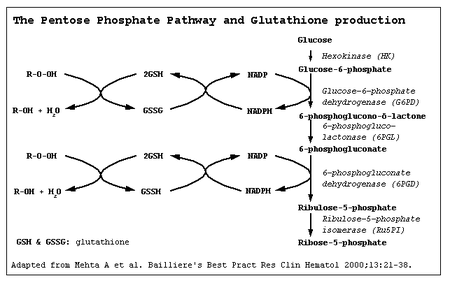
in the pentose phosphate pathway
(see image), a metabolic pathway
that supplies reducing energy to cells (such as erythrocytes) by maintaining the level of the co-enzyme nicotinamide adenine dinucleotide phosphate
(NADPH). The NADPH in turn maintains the level of glutathione
in these cells that helps protect the red blood cells against oxidative damage. Of greater quantitative importance is the production of NADPH for tissues actively engaged in biosynthesis of fatty acids and/or isoprenoids, such as the liver, mammary glands, adipose tissue, and the adrenal glands.
It is notable in humans when there is a genetic deficiency of G6PD
which predisposes to non-immune .
to humans. In higher plants, several isoforms of G6PDH have been reported, which are localized in the cytosol
, the plastidic stroma, and peroxisomes.
G6PD converts glucose-6-phosphate
into 6-phosphoglucono-δ-lactone and is the rate-limiting enzyme of the pentose phosphate pathway.
s, have been described with wide ranging levels of enzyme activity and associated clinical symptoms. Two transcript variants encoding different isoforms have been found for this gene.
Glucose-6-phosphate dehydrogenase deficiency
is very common worldwide, and causes acute hemolytic anemia
in the presence of simple infection, ingestion of fava beans, or reaction with certain medicines, antibiotics, antipyretics, and antimalarials.
Enzyme
Enzymes are proteins that catalyze chemical reactions. In enzymatic reactions, the molecules at the beginning of the process, called substrates, are converted into different molecules, called products. Almost all chemical reactions in a biological cell need enzymes in order to occur at rates...
in the pentose phosphate pathway
Pentose phosphate pathway
The pentose phosphate pathway is a process that generates NADPH and pentoses . There are two distinct phases in the pathway. The first is the oxidative phase, in which NADPH is generated, and the second is the non-oxidative synthesis of 5-carbon sugars...
(see image), a metabolic pathway
Metabolic pathway
In biochemistry, metabolic pathways are series of chemical reactions occurring within a cell. In each pathway, a principal chemical is modified by a series of chemical reactions. Enzymes catalyze these reactions, and often require dietary minerals, vitamins, and other cofactors in order to function...
that supplies reducing energy to cells (such as erythrocytes) by maintaining the level of the co-enzyme nicotinamide adenine dinucleotide phosphate
Nicotinamide adenine dinucleotide
Nicotinamide adenine dinucleotide, abbreviated NAD, is a coenzyme found in all living cells. The compound is a dinucleotide, since it consists of two nucleotides joined through their phosphate groups. One nucleotide contains an adenine base and the other nicotinamide.In metabolism, NAD is involved...
(NADPH). The NADPH in turn maintains the level of glutathione
Glutathione
Glutathione is a tripeptide that contains an unusual peptide linkage between the amine group of cysteine and the carboxyl group of the glutamate side-chain...
in these cells that helps protect the red blood cells against oxidative damage. Of greater quantitative importance is the production of NADPH for tissues actively engaged in biosynthesis of fatty acids and/or isoprenoids, such as the liver, mammary glands, adipose tissue, and the adrenal glands.
It is notable in humans when there is a genetic deficiency of G6PD
Glucose-6-phosphate dehydrogenase deficiency
Glucose-6-phosphate dehydrogenase deficiency is an X-linked recessive hereditary disease characterised by abnormally low levels of glucose-6-phosphate dehydrogenase , a metabolic enzyme involved in the pentose phosphate pathway, especially important in red blood cell metabolism. G6PD deficiency is...
which predisposes to non-immune .
Species distribution
G6PD is widely distributed in many species from bacteriaBacteria
Bacteria are a large domain of prokaryotic microorganisms. Typically a few micrometres in length, bacteria have a wide range of shapes, ranging from spheres to rods and spirals...
to humans. In higher plants, several isoforms of G6PDH have been reported, which are localized in the cytosol
Cytosol
The cytosol or intracellular fluid is the liquid found inside cells, that is separated into compartments by membranes. For example, the mitochondrial matrix separates the mitochondrion into compartments....
, the plastidic stroma, and peroxisomes.
Regulation
Glucose-6-phosphate dehydrogenase is stimulated by its substrate Glucose 6 Phosphate. The usual ratio of NADPH/NADP+ in the cytosol of tissues engaged in biosyntheses is about 100/1. Increased utilization of NADPH for fatty acid biosynthesis will dramatically increase the level of NADP+, thus stimulating G6PD to produce more NADPH.G6PD converts glucose-6-phosphate
Glucose-6-phosphate
Glucose 6-phosphate is glucose sugar phosphorylated on carbon 6. This compound is very common in cells as the vast majority of glucose entering a cell will become phosphorylated in this way....
into 6-phosphoglucono-δ-lactone and is the rate-limiting enzyme of the pentose phosphate pathway.
Clinical significance
G6PD is remarkable for its genetic diversity. Many variants of G6PD, mostly produced from missense mutationMissense mutation
In genetics, a missense mutation is a point mutation in which a single nucleotide is changed, resulting in a codon that codes for a different amino acid . This can render the resulting protein nonfunctional...
s, have been described with wide ranging levels of enzyme activity and associated clinical symptoms. Two transcript variants encoding different isoforms have been found for this gene.
Glucose-6-phosphate dehydrogenase deficiency
Glucose-6-phosphate dehydrogenase deficiency
Glucose-6-phosphate dehydrogenase deficiency is an X-linked recessive hereditary disease characterised by abnormally low levels of glucose-6-phosphate dehydrogenase , a metabolic enzyme involved in the pentose phosphate pathway, especially important in red blood cell metabolism. G6PD deficiency is...
is very common worldwide, and causes acute hemolytic anemia
Hemolytic anemia
Hemolytic anemia is a form of anemia due to hemolysis, the abnormal breakdown of red blood cells , either in the blood vessels or elsewhere in the human body . It has numerous possible causes, ranging from relatively harmless to life-threatening...
in the presence of simple infection, ingestion of fava beans, or reaction with certain medicines, antibiotics, antipyretics, and antimalarials.
See also
- Glucose-6-phosphate dehydrogenase deficiencyGlucose-6-phosphate dehydrogenase deficiencyGlucose-6-phosphate dehydrogenase deficiency is an X-linked recessive hereditary disease characterised by abnormally low levels of glucose-6-phosphate dehydrogenase , a metabolic enzyme involved in the pentose phosphate pathway, especially important in red blood cell metabolism. G6PD deficiency is...
- Genetic resistance to malariaGenetic resistance to malariaGenetic resistance to malaria occurs through both modifications of the immune system that enhance immunity to this infection and also by changes in human red blood cells that hinder the malaria parasite's ability to invade and replicate within these cells...