


Global warming controversy

Encyclopedia
Global warming controversy refers to a variety of disputes, significantly more pronounced in the popular media
than in the scientific literature, regarding the nature, causes, and consequences of global warming
. The disputed issues involve the causes of increased global average air temperature
, especially since the mid-20th century, whether such a warming trend is unprecedented or within normal climatic variations, whether humankind has contributed significantly to it
, and whether the increase is wholly or partially an artifact of poor measurements. Additional disputes concern estimates of climate sensitivity
, predictions of additional warming, and what the consequences of global warming
will be.
In the scientific literature, there is a strong consensus
that global surface temperatures have increased in recent decades and that the trend is caused mainly by human-induced emissions of greenhouse gases. No scientific body of national or international standing disagrees with this view, though a few organisations hold non-committal positions.
and dismantle the coal industry ... but also by environmental organizations and political forces in opposition who demanded solutions that contrasted with the government's". All European Union member states ratified the 1997 Kyoto Protocol
, and many European countries had already been taking action to reduce greenhouse gas emissions prior to 1990. For example, Margaret Thatcher
advocated action against man-made climate change in 1988, and Germany started to take action after the Green Party took seats in Parliament across the 1980s. Substantial activity by NGOs took place as well. Both "global warming" and the more politically neutral "climate change" were listed by the Global Language Monitor
as political buzzwords or catchphrases in 2005. In Europe, the notion of human influence on climate gained wide acceptance more rapidly than in many other parts of the world, most notably the United States. A 2009 Eurobarometer survey titled "Europeans' Attitude Toward Climate Change" notes that, on the average, Europeans rate climate change as the second most serious problem facing the world today, between "poverty, the lack of food and drinking water" and "a major global economic downturn". 87% of Europeans consider climate change to be a "very serious" or "serious" problem, while 10% "do not consider it a serious problem".
There has been a debate among public commentators about how much weight and media coverage should be given to each side of the controversy. Andrew Neil
of the BBC
stated that "There's a great danger that on some issues we're becoming a one-party state in which we're meant to have only one kind of view. You don't have to be a climate-change denier to recognise that there's a great range of opinion on the subject".
The authors of the 2010 book Merchants of Doubt
accuse climate change "skeptics" of trying to sow seeds of doubt in public opinion in order to halt any meaningful social or political progress to reduce the impact of human carbon emissions. The fact that only half of the American population believe that global warming is caused by human activity could be seen as a victory for these so-called skeptics. One of the authors' main arguments is that most prominent scientists who have been voicing opposition to the near-universal consensus are being funded by industries, such as automotive and oil, that stand to lose money by government actions to regulate greenhouse gas
es.
A compendium of poll results on public perceptions about global warming is below.
In 2007 a report on public perceptions in the UK by Ipsos MORI reported that
The Canadian
science
broadcaster
and environmental
activist, David Suzuki
, reports that focus groups organized by the David Suzuki Foundation
showed the public has a poor understanding of the science behind global warming. This is despite publicity through different means, including the films An Inconvenient Truth
and The 11th Hour
.
An example of the poor understanding is public confusion between global warming and ozone depletion
or other environmental problems.
A 15-nation poll conducted in 2006 by Pew Global
found that there "is a substantial gap in concern over global warming—roughly two-thirds of Japanese
(66%) and Indians (65%) say they personally worry a great deal about global warming. Roughly half of the populations of Spain (51%) and France (46%) also express great concern over global warming, based on those who have heard about the issue. But there is no evidence of alarm over global warming in either the United States or China—the two largest producers of greenhouse gases. Just 19% of Americans and 20% of the Chinese who have heard of the issue say they worry a lot about global warming—the lowest percentages in the 15 countries surveyed. Moreover, nearly half of Americans (47%) and somewhat fewer Chinese (37%) express little or no concern about the problem".
A 47-nation poll by Pew Global Attitudes conducted in 2007 found that "Substantial majorities 25 of 37 countries say global warming is a 'very serious' problem".
There are differences between the opinion of scientists and that of the general public. A 2009 poll by Pew Research Center
found that "[w]hile 84% of scientists say the earth is getting warmer because of human activity such as burning fossil fuels, just 49% of the public agrees". A 2010 poll in the UK for the BBC showed "Climate scepticism on the rise". Robert Watson
found this "very disappointing" and said that "We need the public to understand that climate change is serious so they will change their habits and help us move towards a low carbon economy".
, DDT, and passive smoking
. Chris Mooney, author of The Republican War on Science
, has argued that the appearance of overlapping groups of skeptical scientists, commentators and think tanks in seemingly unrelated controversies results from an organized attempt to replace scientific analysis with political ideology. Mooney says that the promotion of doubt regarding issues that are politically, but not scientifically, controversial became increasingly prevalent under the Bush Administration, which, he says, regularly distorted and/or suppressed scientific research to further its own political aims. This is also the subject of a 2004 book by environmental lawyer Robert F. Kennedy Jr. entitled Crimes Against Nature: How George W. Bush and Corporate Pals are Plundering the Country and Hijacking Our Democracy (ISBN 978-0060746872). Another book on this topic is The Assault on Reason
by former U.S. Vice-President Al Gore
. Earlier instances of this trend are also covered in the book The Heat Is On by Ross Gelbspan
.
Some critics of the scientific consensus on global warming have argued that these issues should not be linked and that reference to them constitutes an unjustified ad hominem
attack. Political scientist Roger Pielke, Jr.
, responding to Mooney, has argued that science is inevitably intertwined with politics.
that has issued a statement on climate change, including the science academies of all of the major industrialized countries
.
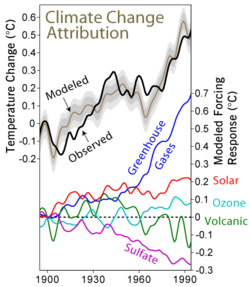 Attribution of recent climate change
discusses how global warming is attributed to anthropogenic greenhouse gas
ses (GHGs).
Environmental journalist George Monbiot
revealed that a list titled "500 Scientists Whose Research Contradicts Man-Made Global Warming Scares" published in 2007 by the Hudson Institute
and distributed by the Heartland Institute
included numerous scientists who had demanded to be removed from the list. The Heartland Institute refused requests by scientists to have their names removed, stating that the scientists "have no right—legally or ethically—to demand that their names be removed from a bibliography composed by researchers with whom they disagree."
A 2010 paper in the Proceedings of the National Academy of Sciences analysed "1,372 climate researchers and their publication and citation data to show that (i) 97–98% of the climate researchers most actively publishing in the field support the tenets of ACC outlined by the Intergovernmental Panel on Climate Change, and (ii) the relative climate expertise and scientific prominence of the researchers unconvinced of ACC are substantially below that of the convinced researchers". Judith Curry
has said "This is a completely unconvincing analysis", whereas Naomi Oreskes
said that the paper shows that "the vast majority of working [climate] research scientists are in agreement [on climate change]... Those who don't agree, are, unfortunately—and this is hard to say without sounding elitist—mostly either not actually climate researchers or not very productive researchers". Jim Prall, one of the coauthors of the study, acknowledged "it would be helpful to have lukewarm [as] a third category".
. In 2001, sixteen of the world's national science academies made a joint-statement on climate change, and gave their support for the IPCC
Opponents have generally attacked either the IPCC's processes, people or the Synthesis and Executive summaries; the scientific reports attract less attention. Some of the controversy and criticism has originated from experts invited by the IPCC to submit reports or serve on its panels. For example, Richard Lindzen
has publicly dissented from IPCC positions.
Christopher Landsea
, a hurricane researcher, said of "the part of the IPCC to which my expertise is relevant" that "I personally cannot in good faith continue to contribute to a process that I view as both being motivated by pre-conceived agendas and being scientifically unsound", because of comments made at a press conference by Kevin Trenberth of which Landsea disapproved. Trenberth said that "Landsea's comments were not correct"; the IPCC replied that "individual scientists can do what they wish in their own rights, as long as they are not saying anything on behalf of the IPCC" and offered to include Landsea in the review phase of the AR4. Roger Pielke, Jr.
commented that "Both Landsea and Trenberth can and should feel vindicated... the IPCC accurately reported the state of scientific understandings of tropical cyclones and climate change in its recent summary for policy makers".
In 2005, the House of Lords
Economics Committee wrote that "We have some concerns about the objectivity of the IPCC process, with some of its emissions scenarios and summary documentation apparently influenced by political considerations". It doubted the high emission scenarios and said that the IPCC had "played-down" what the committee called "some positive aspects of global warming". The main statements of the House of Lords Economics Committee were rejected in the response made by the United Kingdom government and by the Stern Review
.
Speaking to the difficulty of establishing scientific consensus on the precise extent of human action on climate change, John Christy
, a contributing author, wrote:
He added:
On 10 December 2008, a report was released by the U.S. Senate Committee on Environment and Public Works Minority members, under the leadership of the Senate's most vocal global warming skeptic Jim Inhofe
. The timing of the report coincided with the UN global warming conference in Poznań, Poland. It says it summarizes scientific dissent from the IPCC. Many of its statements about the numbers of individuals listed in the report, whether they are actually scientists, and whether they support the positions attributed to them, have been disputed.
While some critics have argued that the IPCC overstates likely global warming, others have made the opposite criticism. David Biello, writing in the Scientific American
, argues that, because of the need to secure consensus among governmental representatives, the IPCC reports give conservative estimates of the likely extent and effects of global warming. Science
editor Brooks Hanson states in a 2010 editorial: "The IPCC reports have underestimated the pace of climate change while overestimating societies' abilities to curb greenhouse gas emissions". Climate scientist James E. Hansen argues that the IPCC's conservativeness seriously underestimates the risk of sea-level rise on the order of meters—enough to inundate many low-lying areas, such as the southern third of Florida. Roger A. Pielke Sr. has also stated that "Humans are significantly altering the global climate, but in a variety of diverse ways beyond the radiative effect of carbon dioxide. The IPCC assessments have been too conservative in recognizing the importance of these human climate forcings as they alter regional and global climate".
Henderson-Sellers has collected comments from IPCC authors in a 2007 workshop revealing a number of concerns.
discusses the evidence for recent global warming
. Correlation of CO2 and temperature is not part of this evidence. Nonetheless, one argument against global warming says that rising levels of carbon dioxide
(CO2) and other greenhouse gas
es (GHGs) do not correlate with global warming.
As noted above, climate model
s are only able to simulate the temperature record of the past century when GHG forcing is included, being consistent with the findings of the IPCC which has stated that: "Greenhouse gas forcing, largely the result of human activities, has very likely caused most of the
observed global warming over the last 50 years"
The "standard" set of scenarios for future atmospheric greenhouse gases are the IPCC SRES
scenarios. The purpose of the range of scenarios is not to predict what exact course the future of emissions will take, but what it may take under a range of possible population, economic and societal trends. Climate models can be run using any of the scenarios as inputs to illustrate the different outcomes for climate change. No one scenario is officially preferred, but in practice the "A1b" scenario roughly corresponding to 1%/year growth in atmospheric CO2 is often used for modelling studies.
There is debate about the various scenarios for fossil fuel consumption. Global warming skeptic Fred Singer
stated that "some good experts believe" that atmospheric CO2 concentration will not double since economies are becoming less reliant on carbon.
However, The Stern report,
like many other reports, notes the past correlation between CO2 emissions and economic growth and then extrapolates using a "business as usual" scenario to predict GDP growth and hence CO2 levels, concluding that:
According to Lawrence Livermore National Laboratory
, "the earth would warm by 8 degrees Celsius (14.4 degrees Fahrenheit) if humans use the entire planet's available fossil fuels by the year 2300".
s; increased solar activity or cosmic rays. The consensus position is that solar radiation may have increased by 0.12 W/m² since 1750, compared to 1.6 W/m² for the net anthropogenic forcing. The TAR said, "The combined change in radiative forcing of the two major natural factors (solar variation and volcanic aerosols) is estimated to be negative for the past two, and possibly the past four, decades". The AR4 makes no direct assertions on the recent role of solar forcing, but the previous statement is consistent with the AR4's figure 4.
A few studies say that the present level of solar activity is historically high as determined by sunspot activity and other factors. Solar activity could affect climate either by variation in the Sun's output or, more speculatively, by an indirect effect on the amount of cloud formation. Solanki and co-workers suggest that solar activity for the last 60 to 70 years may be at its highest level in 8,000 years; Muscheler et al. disagree, suggesting that other comparably high levels of activity have occurred several times in the last few thousand years.
Muscheler et al. concluded that "solar activity reconstructions tell us that only a minor fraction of the recent global warming can be explained by the variable Sun". Solanki et al. concluded "that solar variability is unlikely to have been the dominant cause of the strong warming during the past three decades", and that "at the most 30% of the strong warming since then can be of solar origin".
Another point of controversy is the correlation of temperature with solar variation
.
Mike Lockwood and Claus Fröhlich reject the statement that the warming observed in the global mean surface temperature record since about 1850 is the result of solar variations. Lockwood and Fröhlich conclude that "the observed rapid rise in global mean temperatures seen after 1985 cannot be ascribed to solar variability, whichever of the mechanisms is invoked and no matter how much the solar variation is amplified."
. Another example of this is in Ruckstuhl's paper who found a 60% reduction in aerosol concentrations over Europe causing solar brightening:
on the basis of the urban heat island
effect, the quality of the surface station network and what they view as unwarranted adjustments to the temperature record.
Skeptics contend that stations located in more populated areas could show warming due to increased heat generated by cities, rather than a global temperature rise.
The IPCC Third Assessment Report acknowledges that the urban heat island is an important local effect, but cites analyses of historical data indicating that the effect of the urban heat island on the global temperature trend is no more than 0.05 °C (0.09 °F) degrees through 1990.
More recently, Peterson (2003) found no difference between the warming observed in urban and rural areas.
Parker (2006) found that there was no difference in warming between calm and windy nights. Since the urban heat island effect is strongest for calm nights and is weak or absent on windy nights, this was taken as evidence that global temperature trends are not significantly contaminated by urban effects. Pielke and Matsui published a paper disagreeing with Parker's conclusions.
More recently, Roger A. Pielke
and Stephen McIntyre
have criticized the US instrumental temperature record and adjustments to it, and Pielke and others have criticized the poor quality siting of a number of weather stations in the United States. In response, Anthony Watts began a volunteer effort to photographically document the siting quality of these stations. The Journal of Geophysical Research
– Atmospheres subsequently published a study by Menne et al. which examined the record of stations picked out by Watts' Surfacestations.org and found that, if anything, the poorly sited stations showed a slight cool bias rather than the warm bias which Watts had anticipated.
Joe D'Aleo and other climate skeptics have also suggested that the NOAA and GISS temperature records show a warming trend due to the reduction of the number of weather stations used to calculate the average world temperature. He states that this is done by cherry picking weather stations in order to show a warming trend. Specifically, it is stated that large regions of the temperature record are derived from other weather stations in the region. For example, Bolivia
, a landlocked and high-altitude country, has its temperature derived from lower-altitude areas in the Amazon Basin
and in Peru
.
The Berkeley Earth Surface Temperature
group carried out an independent assessment of land temperature records, which examined issues raised by skeptics, such as the urban heat island effect, poor station quality, and the risk of data selection bias. The preliminary results, made public in October 2011, found that these factors had not biased the results obtained by NOAA, the Hadley Centre together with the Climatic Research Unit
(HadCRUT
) and NASA's GISS in earlier studies. The group also confirmed that over the past 50 years the land surface warmed by 0.911°C, and their results closely matched those obtained from these earlier studies. The four papers they had produced had been submitted for peer review.
should increase more rapidly than the temperature of the surface. A 2006 report to the U.S. Climate Change Science Program noted that models and observations agreed on this amplification for monthly and interannual time scales but not for decadal time scales in most observed data sets. Improved measurement and analysis techniques have reconciled this discrepancy: corrected buoy and satellite surface temperatures are slightly cooler and corrected satellite and radiosonde
measurements of the tropical troposphere are slightly warmer. Satellite temperature measurements
show that tropospheric temperatures are increasing with "rates similar to those of the surface temperature", leading the IPCC to conclude that this discrepancy is reconciled.
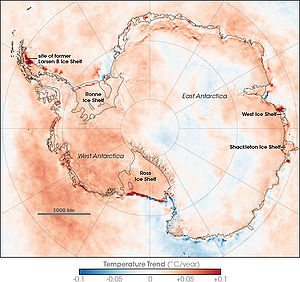 Various individuals, most notably writer Michael Crichton
, have asserted that Antarctic temperature measurements contradict global warming. Observations unambiguously show the Peninsula to be warming. The trends elsewhere show both warming and cooling but are smaller and dependent on season and the timespan over which the trend is computed. Climate models predict that future trends in Antarctica are much smaller than in the Arctic
.
To the extent that a controversy exists it is confined to the popular press and blogs; there is no evidence of a related controversy within the scientific community. Peter Doran
, the lead author of the paper cited by Crichton, stated that "... our results have been misused as "evidence" against global warming by Crichton in his novel 'State of Fear'..." Others, for example RealClimate
, agree there is no contradiction.
refers to the equilibrium change in global mean surface temperature (ΔTs) following a unit change in the radiative forcing
(RF).
Climate sensitivity usually is expressed as the increase in global mean temperature resulting from a doubling of atmospheric CO2. This value is estimated by the IPCC Fourth Assessment Report as "likely to be in the range 2 to 4.5 °C with a best estimate of about 3 °C".
Using a combination of surface temperature history and ocean heat content, Stephen E. Schwartz
has proposed an estimate of climate sensitivity
of 1.9 ± 1.0 K for doubled ., revised upwards from 1.1 ± 0.5 K. Grant Foster, James Annan
, Gavin Schmidt
, and Michael E. Mann argue that there are errors in both versions of Schwartz's analysis. Astronomer Nir Shaviv
also has computed a value for climate sensitivity of 0.35+/-0.09 °K / (W/m2), which is consistent with a variety of historical datasets. Petr Chylek
and co-authors have also proposed low climate sensitivity to doubled , estimated to be 1.6 K ± 0.4 K.
proposed an Infrared Iris hypothesis
of compensating meteorological processes that tend to stabilize climate change. Roy Spencer et al. discovered "a net reduction in radiative input into the ocean-atmosphere system" in tropical intraseasonal oscillations that "may potentially support" the idea of an "Iris" effect, although they point out that their work is concerned with much shorter time scales. Other analyses have found that the iris effect is a positive feedback rather than the negative feedback proposed by Lindzen.
Spencer's hypothesis was published in the peer-reviewed journal Remote Sensing in 2011 and following widespread criticism the editor of that journal resigned stating that the paper was "fundamentally flawed" and should not have been published.
) and the climate sensitivity
. Models referenced by the Intergovernmental Panel on Climate Change
(IPCC) predict that global temperatures are likely to increase by 1.1 to 6.4 °C (2.0 to 11.5 °F) between 1990 and 2100. Others have proposed that temperature increases may be higher than IPCC estimates. One theory is that the climate may reach a "tipping point
" where positive feedback effects lead to runaway global warming; such feedbacks include decreased reflection of solar radiation as sea ice melts, exposing darker seawater, and the potential release of large volumes of methane from thawing permafrost.
An example of a prediction that has been tested comes from 1959, when Dr. Bert Bolin, in a speech to the National Academy of Sciences, predicted that by the year 2000, there would be a 25% increase in carbon dioxide in the atmosphere compared to the levels in 1859. This prediction has proved to be an underestimate. The actual increase by 2000 was about 29%.
Some scientists, such as David Orrell
or Henk Tennekes, say that climate change cannot be accurately predicted. Orrell says that the range of future increase in temperature suggested by the IPCC rather represents a social consensus in the climate community, but adds that "we are having a dangerous effect on the climate".
A 2007 study by David Douglass
and coworkers concluded that the 22 most commonly used global climate model
s used by the IPCC were unable to accurately predict accelerated warming in the troposphere
although they did match actual surface warming, concluding that "projections of future climate based on these models should be viewed with much caution". This result contrasts a similar study of 19 models which found that discrepancies between model predictions and actual temperature were likely due to measurement errors.
Certain scientists, skeptics and otherwise, believe this confidence in the models’ ability to predict future climate is not earned.
all of the data necessary to reproduce their research. If another scientist attempts to reproduce the research and needs additional data, authors are expected (with few exceptions) to provide the data, metadata, methods and source code
that may be necessary.
David Legates
has written that Mann, Bradley and Hughes 1998
, famous for its hockey stick-shaped historic temperature reconstruction
, serves as an example of climate scientists not abiding by these policies and suggested that legislators might ultimately take action to enforce them.
on climate futures, like other kinds of futures markets, could be used to establish the market consensus on climate change. There has been sporadic betting activity outside of a market framework. British climate scientist James Annan proposed bets with global warming skeptics concerning whether future temperatures will increase. Two Russian solar physicists, Galina Mashnich and Vladimir Bashkirtsev, accepted the wager of US$10,000 that the average global temperature during 2012–2017 would be lower than during 1998–2003.
Annan first directly challenged Richard Lindzen
. Lindzen had been willing to bet that global temperatures would drop over the next 20 years. Annan says that Lindzen wanted odds of 50–1 against falling temperatures. Lindzen, however, says that he asked for 2–1 odds against a temperature rise of over 0.4 °C. The Guardian
columnist George Monbiot
challenged Myron Ebell
of the Competitive Enterprise Institute
to a GB£
5,000 bet of global warming versus global cooling. Annan and other proponents of the consensus state they have challenged other skeptics to bets over global warming that were not accepted, including Annan's attempt in 2005 to accept a bet that had been offered by Patrick Michaels
in 1998 that temperatures would be cooler after ten years.
. Republicans tend to oppose action against a threat that they regard as unproven, while Democrats tend to support actions that they believe will reduce global warming and its effects through the control of greenhouse gas emissions. Recently, bipartisan measures have been introduced.
Climatologist Kevin E. Trenberth
stated:
As more evidence has become available over the existence of global warming debate has moved to further controversial issues, including:
The single largest issue is the importance of a few degrees rise in temperature:
The other point that leads to major controversy—because it could have significant economic impacts—is whether action (usually, restrictions on the use of fossil fuel
s to reduce carbon-dioxide emissions) should be taken now, or in the near future; and whether those restrictions would have any meaningful effect on global temperature.
Because of the economic ramifications of such restrictions, there are those, including the Cato Institute
, a libertarian
think tank
, who feel strongly that the negative economic effects of emission controls outweigh the environmental benefits. They state that even if global warming is caused solely by the burning of fossil fuels, restricting their use would have more damaging effects on the world economy than the increases in global temperature.
Conversely, others feel strongly that early action to reduce emissions would help avoid much greater economic costs later, and would reduce the risk of catastrophic, irreversible change. In his December 2006 book, Hell and High Water
, energy technology expert Joseph J. Romm
Ultimately, however, a strictly economic argument for or against action on climate change is limited at best, failing to take into consideration other potential impacts of any change.
Council on Foreign Relations
senior fellow Walter Russell Mead
argues that the 2009 Copenhagen Summit failed because environmentalists have changed from "Bambi to Godzilla". According to Mead, environmentalist used to represent the skeptical few who made valid arguments against big government programs which tried to impose simple but massive solutions on complex situations. Environmentalists' more recent advocacy for big economic and social intervention against global warming, according to Mead, has made them, "the voice of the establishment, of the tenured, of the technocrats" and thus has lost them the support of a public which is increasingly skeptical of global warming.
and 162nd largest per capita emitter at 1.8 Tonnes of CO2e
respectively, compared with for example the US at position of the 14th largest per capita CO2e
emitter at 22.9 Tonnes of CO2e
. Nevertheless, China is the world's second largest producer of greenhouse gas emissions, and India 4th (see: countries by greenhouse emissions). Various predictions see China overtaking the US in total greenhouse emissions between late 2007 and 2010, and according to many other estimates, this already occurred in 2006.
Additionally, high costs of decreasing emissions may cause significant production to move to countries that are not covered under the treaty, such as India and China, says Fred Singer
. As these countries are less energy efficient, this scenario is said to cause additional carbon emissions.
In May 2010 the Hartwell Paper
was published by the London School of Economics
in collaboration with the University of Oxford
. This paper was written by 14 academics from various disciplines in the sciences and humanities, and also some policies thinkers, and they argued that the Kyoto Protocol
crashed in late 2009 and "has failed to produce any discernable real world reductions in emissions of greenhouse gases in fifteen years." They argued that this failure opened an opportunity to set climate policy free from Kyoto and the paper advocates a controversial and piecemeal approach to decarbonization
of the global economy. The Hartwell paper proposes that "the organising principle of our effort should be the raising up of human dignity via three overarching objectives: ensuring energy access for all; ensuring that we develop in a manner that does not undermine the essential functioning of the Earth system; ensuring that our societies are adequately equipped to withstand the risks and dangers that come from all the vagaries of climate, whatever their cause may be".
The only major developed nation which has signed but not ratified the Kyoto protocol is the US (see signatories). The countries with no official position on Kyoto are mainly African countries with underdeveloped scientific infrastructure or are oil producers .
According to Greenpeace
, documents they obtained under the US Freedom of Information Act show that the Charles G. Koch Foundation
gave Willie Soon
two grants totaling $175,000 in 2005/6 and again in 2010. Multiple grants from the American Petroleum Institute
between 2001 and 2007 totalled $274,000, and grants from Exxon Mobil totalled $335,000 between 2005 and 2010. Other coal and oil industry sources which funded him include the Mobil Foundation, the Texaco Foundation and the Electric Power Research Institute
. Soon, acknowledging that he received this money, stated unequivocally that he has "never been motivated by financial reward in any of my scientific research."
The Greenpeace
research project ExxonSecrets, and George Monbiot
writing in The Guardian
, as well as various academics, have linked several skeptical scientists—Fred Singer
, Fred Seitz and Patrick Michaels
—to organizations funded by ExxonMobil
and Philip Morris
for the purpose of promoting global warming skepticism. Similarly, groups employing global warming skeptics, such as the George C. Marshall Institute
, have been criticized for their ties to fossil fuel companies.
On 2 February 2007, The Guardian stated that Kenneth Green, a Visiting Scholar with AEI
, had sent letters to scientists in the UK and the U.S., offering US$10,000 plus travel expenses and other incidental payments in return for essays with the purpose of "highlight[ing] the strengths and weaknesses of the IPCC process", specifically regarding the IPCC Fourth Assessment Report
.
A furor was raised when it was revealed that the Intermountain Rural Electric Association (an energy cooperative that draws a significant portion of its electricity from coal-burning plants) donated $100,000 to Patrick Michaels and his group, New Hope Environmental Services, and solicited additional private donations from its members.
The Union of Concerned Scientists
have produced a report titled 'Smoke, Mirrors & Hot Air', that criticizes ExxonMobil for "underwriting
the most sophisticated and most successful disinformation campaign since the tobacco industry" and for "funnelling about $16 million between 1998 and 2005 to a network of ideological and advocacy organizations that manufacture uncertainty on the issue". In 2006 Exxon said that it was no longer going to fund these groups though that statement has been challenged by Greenpeace.
The Center for the Study of Carbon Dioxide and Global Change
, a skeptic group, when confronted about the funding of a video they put together ($250,000 for "The Greening of Planet Earth" from an oil company) stated, "We applaud Western Fuels for their willingness to publicize a side of the story that we believe to be far more correct than what at one time was 'generally accepted'. But does this mean that they fund The Center? Maybe it means that we fund them!"
Donald Kennedy
, editor-in-chief of Science
, has said that skeptics such as Michaels are lobbyists more than researchers, and that "I don't think it's unethical any more than most lobbying is unethical", he said. He said donations to skeptics amounts to "trying to get a political message across".
A number of global warming skeptics, such as the following, assert that grant money is given preferentially to supporters of global warming theory. Atmospheric scientist Reid Bryson
said in June 2007 that "There is a lot of money to be made in this... If you want to be an eminent scientist you have to have a lot of grad students and a lot of grants. You can't get grants unless you say, 'Oh global warming, yes, yes, carbon dioxide'." Similar positions have been advanced by climatologist Marcel Leroux
, NASA's Roy Spencer, climatologist and IPCC contributor John Christy
, University of London biogeographer Philip Stott
, Accuracy in Media
, and Ian Plimer
in his 2009 book Heaven and Earth — Global Warming: The Missing Science
.
Richard Lindzen
, the Alfred P. Sloan
Professor of Meteorology
at MIT
, makes the specific statement that "[in] the winter of 1989 Reginald Newell, a professor of meteorology [at MIT], lost National Science Foundation
funding for data analyses that were failing to show net warming over the past century". Lindzen also suggests four other scientists "apparently" lost their funding or positions after questioning the scientific underpinnings of global warming. Lindzen himself, however, has been the recipient of money from energy interests such as OPEC
and the Western Fuels Association
, including "$2,500 a day for his consulting services", as well as funding from federal sources including the National Science Foundation, the Department of Energy
, and NASA
.
, author of Global Warming and Other Eco-Myths (published by the Competitive Enterprise Institute
in 2002), stated in 2005, "Anyone still holding onto the idea that there is no global warming ought to hang it up". By 2007, he wrote "Details like sea level rise will continue to be debated by researchers, but if the debate over whether or not humanity is contributing to global warming wasn't over before, it is now.... as the new IPCC Summary makes clear, climate change Pollyannaism
is no longer looking very tenable".
"There are alternatives to its [(the climate-change crusade's)] insistence that the only appropriate policy response is steep and immediate emissions reductions.... a greenhouse-gas-emissions cap ultimately would constrain energy production. A sensible climate policy would emphasize building resilience into our capacity to adapt to climate changes.... we should consider strategies of adaptation to a changing climate. A rise in the sea level need not be the end of the world, as the Dutch have taught us". says Steven F. Hayward of American Enterprise Institute
, a conservative think-tank. Hayward also advocates the use of "orbiting mirrors to rebalance the amounts of solar radiation different parts of the earth receive"—the space sunshade example of so-called geoengineering
for solar radiation management
.
In 2001 Richard Lindzen in response to the question, "Kyoto aside for a moment, should we be trying to reduce carbon dioxide emissions? Do our concerns about global warming require action?" said "We should prioritize our responses. You can't just say, "No matter what the cost, and no matter how little the benefit, we'll do this". If we truly believe in warming, then we've already decided we're going to adjust...The reason we adjust to things far better than Bangladesh is that we're richer. Wouldn't you think it makes sense to make sure we're as robust and wealthy as possible? And that the poor of the world are also as robust and wealthy as possible?"
Others argue that if developing nations reach the wealth level of the United States this could greatly increase CO2 emissions and consumption of fossil fuels. Large developing nations such as India and China are predicted to be major emitters of greenhouse gases in the next few decades as their economies grow.
The conservative National Center for Policy Analysis
whose "Environmental Task Force" contains a number of climate change skeptics including Sherwood Idso and S. Fred Singer
says, "The growing consensus on climate change policies is that adaptation will protect present and future generations from climate-sensitive risks far more than efforts to restrict CO 2 emissions".
The adaptation-only plan is also endorsed by oil companies like ExxonMobil, "ExxonMobil's plan appears to be to stay the course and try to adjust when changes occur. The company's plan is one that involves adaptation, as opposed to leadership",
says this Ceres report.
Gregg Easterbrook
characterized himself as having "a long record of opposing alarmism". In 2006, he stated, "based on the data I'm now switching sides regarding global warming, from skeptic to convert".
The Bush administration also voiced support for an adaptation-only policy. "In a stark shift for the Bush administration, the United States has sent a climate report [U.S. Climate Action Report 2002] to the United Nations detailing specific and far-reaching effects it says global warming will inflict on the American environment. In the report, the administration also for the first time places most of the blame for recent global warming on human actions—mainly the burning of fossil fuels that send heat-trapping greenhouse gases into the atmosphere". The report however "does not propose any major shift in the administration's policy on greenhouse gases. Instead it recommends adapting to inevitable changes instead of making rapid and drastic reductions in greenhouse gases to limit warming". This position apparently precipitated a similar shift in emphasis at the COP 8 climate talks in New Delhi several months later, "The shift satisfies the Bush administration, which has fought to avoid mandatory cuts in emissions for fear it would harm the economy. 'We're welcoming a focus on more of a balance on adaptation versus mitigation', said a senior American negotiator in New Delhi. 'You don't have enough money to do everything'". see also. The White House emphasis on adaptation was not well received however:
Some find this shift and attitude disingenuous and indicative of an inherent bias against prevention (i.e. reducing emissions/consumption) and for the prolonging of profits to the oil industry at the expense of the environment. "Now that the dismissal of climate change is no longer fashionable, the professional deniers are trying another means of stopping us from taking action. It would be cheaper, they say, to wait for the impacts of climate change and then adapt to them" says writer and environmental activist George Monbiot
in an article addressing the supposed economic hazards of addressing climate change. Others argue that adaptation alone will not be sufficient.
See also Copenhagen Consensus
.
To be sure, though not emphasized to the same degree as mitigation, adaptation to a climate certain to change has been included as a necessary component in the discussion early as 1992,
and has been all along.
However it was not to the exclusion, advocated by the skeptics, of preventative mitigation efforts, and therein, say carbon cutting proponents, lies the difference.
U.S. officials, such as Philip Cooney
, have repeatedly edited scientific reports from US government scientists, many of whom, such as Thomas Knutson
, have been ordered to refrain from discussing climate change and related topics. Attempts to suppress scientific information on global warming and other issues have been described by journalist Chris Mooney in his book The Republican War on Science
.
Climate scientist James E. Hansen, director of NASA's Goddard Institute for Space Studies
, wrote in a widely cited New York Times article
in 2006 that his superiors at the agency were trying to "censor" information "going out to the public". NASA
denied this, saying that it was merely requiring that scientists make a distinction between personal, and official government, views in interviews conducted as part of work done at the agency. Several scientists working at the National Oceanic and Atmospheric Administration
have made similar complaints; once again, government officials said they were enforcing long-standing policies requiring government scientists to clearly identify personal opinions as such when participating in public interviews and forums.
The BBC
's long-running current affairs series Panorama
recently investigated the issue, and was told that "scientific reports about global warming have been systematically changed and suppressed".
On the other hand, some American climatologists who have expressed doubts regarding the certainty of human influence in climate change have been criticized by politicians and governmental agencies. Oregon Governor Ted Kulongoski
publicly clarified that Oregon does not officially appoint a "state climatologist" in response to Oregon State University's George Taylor's use of that title. As a result of scientific doubts he has expressed regarding global warming, the Delaware Department of Natural Resources and Environmental Control reportedly attempted to remove David Legates
from his office of Delaware State Climatologist. In late 2006, Virginia Governor Tim Kaine
(D) reportedly began an investigation of Virginia State Climatologist and global warming skeptic Patrick Michaels
.
Scientists who agree with the consensus view have sometimes expressed concerns over what they view as sensationalism of global warming by interest groups and the press. For example Mike Hulme
, director of the Tyndall Centre for Climate Research, wrote how increasing use of pejorative terms like "catastrophic", "chaotic" and "irreversible", had altered the public discourse around climate change: "This discourse is now characterised by phrases such as 'climate change is worse than we thought', that we are approaching 'irreversible tipping in the Earth's climate', and that we are 'at the point of no return'. I have found myself increasingly chastised by climate change campaigners when my public statements and lectures on climate change have not satisfied their thirst for environmental drama and exaggerated rhetoric".
According to an Associated Press release on 30 January 2007,
Critics writing in the Wall Street Journal editorial page state that the survey
was itself unscientific.
In addition to the pressure from politicians, many prominent scientists working on climate change issues have reported increasingly severe harassment from members of the public. The harassment has taken several forms. The US FBI told ABC News
that it was looking into a spike in threatening emails sent to climate scientists, while a white supremacist website posted pictures of several climate scientists with the word "Jew" next to each image. One climate scientist interviewed by ABC News had a dead animal dumped on his doorstep and now frequently has to travel with bodyguards.
before the Supreme Court of the United States
allowed the Environmental Protection Agency to regulate greenhouse gases under the Clean Air Act
. A similar approach was taken by California Attorney General Bill Lockyer
who filed a lawsuit California v. General Motors Corp. to force car manufacturers to reduce vehicles' emissions of carbon dioxide. This lawsuit was found to lack legal merit and was tossed out. A third case, Comer v. Murphy Oil USA, Inc., a class action lawsuit filed by Gerald Maples, a trial attorney in Mississippi, in an effort to force fossil fuel and chemical companies to pay for damages caused by global warming. Described as a nuisance lawsuit
, it was dismissed by District Court. However, the District Court's decision was overturned by the United States Court of Appeals for the Fifth Circuit
, which instructed the District Court to reinstate several of the plaintiffs' climate change-related claims on 22 October 2009. The Sierra Club
sued the U.S. government over failure to raise automobile fuel efficiency standards
, and thereby decrease carbon dioxide emissions.
Media coverage of climate change
Media coverage of climate change has significant effects on public opinion on climate change, as it mediates the scientific opinion on climate change that the global instrumental temperature record shows increase in recent decades and that the trend is caused mainly by human-induced emissions of...
than in the scientific literature, regarding the nature, causes, and consequences of global warming
Global warming
Global warming refers to the rising average temperature of Earth's atmosphere and oceans and its projected continuation. In the last 100 years, Earth's average surface temperature increased by about with about two thirds of the increase occurring over just the last three decades...
. The disputed issues involve the causes of increased global average air temperature
Instrumental temperature record
The instrumental temperature record shows fluctuations of the temperature of the global land surface and oceans. This data is collected from several thousand meteorological stations, Antarctic research stations and satellite observations of sea-surface temperature. Currently, the longest-running...
, especially since the mid-20th century, whether such a warming trend is unprecedented or within normal climatic variations, whether humankind has contributed significantly to it
Attribution of recent climate change
Attribution of recent climate change is the effort to scientifically ascertain mechanisms responsible for recent changes observed in the Earth's climate...
, and whether the increase is wholly or partially an artifact of poor measurements. Additional disputes concern estimates of climate sensitivity
Climate sensitivity
Climate sensitivity is a measure of how responsive the temperature of the climate system is to a change in the radiative forcing. It is usually expressed as the temperature change associated with a doubling of the concentration of carbon dioxide in Earth's atmosphere.The equilibrium climate...
, predictions of additional warming, and what the consequences of global warming
Effects of global warming
This article is about the effects of global warming and climate change. The effects, or impacts, of climate change may be physical, ecological, social or economic. Evidence of observed climate change includes the instrumental temperature record, rising sea levels, and decreased snow cover in the...
will be.
In the scientific literature, there is a strong consensus
Scientific opinion on climate change
The predominant scientific opinion on climate change is that the Earth is in an ongoing phase of global warming primarily caused by an enhanced greenhouse effect due to the anthropogenic release of carbon dioxide and other greenhouse gases...
that global surface temperatures have increased in recent decades and that the trend is caused mainly by human-induced emissions of greenhouse gases. No scientific body of national or international standing disagrees with this view, though a few organisations hold non-committal positions.
Public opinion
The level of coverage that US mass media devoted to global warming "was minimal prior to 1988" but interest increased significantly after the drought of 1988, and related Senate testimony of James E. Hansen "attributing the abnormally hot weather plaguing our nation to global warming". Similarly, incipient coverage of climate change in the British press "changed at the end of 1988 ... stimulated by Margaret Thatcher's appropriation of the risks of climate change to promote nuclear powerNuclear power
Nuclear power is the use of sustained nuclear fission to generate heat and electricity. Nuclear power plants provide about 6% of the world's energy and 13–14% of the world's electricity, with the U.S., France, and Japan together accounting for about 50% of nuclear generated electricity...
and dismantle the coal industry ... but also by environmental organizations and political forces in opposition who demanded solutions that contrasted with the government's". All European Union member states ratified the 1997 Kyoto Protocol
Kyoto Protocol
The Kyoto Protocol is a protocol to the United Nations Framework Convention on Climate Change , aimed at fighting global warming...
, and many European countries had already been taking action to reduce greenhouse gas emissions prior to 1990. For example, Margaret Thatcher
Margaret Thatcher
Margaret Hilda Thatcher, Baroness Thatcher, was Prime Minister of the United Kingdom from 1979 to 1990...
advocated action against man-made climate change in 1988, and Germany started to take action after the Green Party took seats in Parliament across the 1980s. Substantial activity by NGOs took place as well. Both "global warming" and the more politically neutral "climate change" were listed by the Global Language Monitor
Global Language Monitor
The Global Language Monitor is an Austin, Texas-based company that collectively documents, analyzes and tracks trends in language usage worldwide, with a particular emphasis upon the English language...
as political buzzwords or catchphrases in 2005. In Europe, the notion of human influence on climate gained wide acceptance more rapidly than in many other parts of the world, most notably the United States. A 2009 Eurobarometer survey titled "Europeans' Attitude Toward Climate Change" notes that, on the average, Europeans rate climate change as the second most serious problem facing the world today, between "poverty, the lack of food and drinking water" and "a major global economic downturn". 87% of Europeans consider climate change to be a "very serious" or "serious" problem, while 10% "do not consider it a serious problem".
There has been a debate among public commentators about how much weight and media coverage should be given to each side of the controversy. Andrew Neil
Andrew Neil
Andrew Ferguson Neil is a Scottish journalist and broadcaster.He currently works for the BBC, presenting the live political programmes The Daily Politics and This Week...
of the BBC
BBC
The British Broadcasting Corporation is a British public service broadcaster. Its headquarters is at Broadcasting House in the City of Westminster, London. It is the largest broadcaster in the world, with about 23,000 staff...
stated that "There's a great danger that on some issues we're becoming a one-party state in which we're meant to have only one kind of view. You don't have to be a climate-change denier to recognise that there's a great range of opinion on the subject".
The authors of the 2010 book Merchants of Doubt
Merchants of Doubt
Merchants of Doubt is a 2010 book by the American science historians Naomi Oreskes and Erik M. Conway. It identifies parallels between the climate change debate and earlier controversies over tobacco smoking, acid rain and the hole in the ozone layer...
accuse climate change "skeptics" of trying to sow seeds of doubt in public opinion in order to halt any meaningful social or political progress to reduce the impact of human carbon emissions. The fact that only half of the American population believe that global warming is caused by human activity could be seen as a victory for these so-called skeptics. One of the authors' main arguments is that most prominent scientists who have been voicing opposition to the near-universal consensus are being funded by industries, such as automotive and oil, that stand to lose money by government actions to regulate greenhouse gas
Greenhouse gas
A greenhouse gas is a gas in an atmosphere that absorbs and emits radiation within the thermal infrared range. This process is the fundamental cause of the greenhouse effect. The primary greenhouse gases in the Earth's atmosphere are water vapor, carbon dioxide, methane, nitrous oxide, and ozone...
es.
A compendium of poll results on public perceptions about global warming is below.
| Statement | % agree | Year |
|---|---|---|
| (US) Global Warming is very/extremely important | 49 | 2006 |
| (International) Climate change is a serious problem. | 90 | 2006 |
| (International) Human activity is a significant cause of climate change. | 79 | 2007 |
| (US) It's necessary to take major steps starting very soon. | 59 | 2007 |
| (US) The Earth is getting warmer because of human activity | 49 | 2009 |
In 2007 a report on public perceptions in the UK by Ipsos MORI reported that
- There is widespread recognition that the climate, irrespective of the cause, is changing—88% believe this to be true.
- However, the public is out of step with the scientific community, with 41% believing that climate change is being caused by both human activity and natural processes. 46% believe human activity is the main cause.
- Only a small minority reject anthropogenic climate change, while almost half (44%) are very concerned. However, there remains a large proportion who are yet to be fully persuaded and hold doubts about the extent of the threat.
- There is still a strong appetite among the public for more information, and 63% say they need this to come to a firm view on the issue and what it means for them.
- The public continue to externalize climate change to other people, places and times. It is increasingly perceived as a major global issue with far-reaching consequences for future generations—45% say it is the most serious threat facing the World today and 53% believe it will impact significantly on future generations. However, the issue features less prominently nationally and locally, indeed only 9% believe climate change will have a significant impact upon them personally.
The Canadian
Canada
Canada is a North American country consisting of ten provinces and three territories. Located in the northern part of the continent, it extends from the Atlantic Ocean in the east to the Pacific Ocean in the west, and northward into the Arctic Ocean...
science
Science
Science is a systematic enterprise that builds and organizes knowledge in the form of testable explanations and predictions about the universe...
broadcaster
Presenter
A presenter, or host , is a person or organization responsible for running an event. A museum or university, for example, may be the presenter or host of an exhibit. Likewise, a master of ceremonies is a person that hosts or presents a show...
and environmental
Environmentalism
Environmentalism is a broad philosophy, ideology and social movement regarding concerns for environmental conservation and improvement of the health of the environment, particularly as the measure for this health seeks to incorporate the concerns of non-human elements...
activist, David Suzuki
David Suzuki
David Suzuki, CC, OBC is a Canadian academic, science broadcaster and environmental activist. Suzuki earned a Ph.D in zoology from the University of Chicago in 1961, and was a professor in the genetics department of the University of British Columbia from 1963 until his retirement in 2001...
, reports that focus groups organized by the David Suzuki Foundation
David Suzuki Foundation
The David Suzuki Foundation is an environmental organization based in Vancouver, British Columbia, Canada It is a non-profit organization that is incorporated in both Canada and the United States, and is funded by over 40,000 donors...
showed the public has a poor understanding of the science behind global warming. This is despite publicity through different means, including the films An Inconvenient Truth
An Inconvenient Truth
An Inconvenient Truth is a 2006 documentary film directed by Davis Guggenheim about former United States Vice President Al Gore's campaign to educate citizens about global warming via a comprehensive slide show that, by his own estimate, he has given more than a thousand times.Premiering at the...
and The 11th Hour
The 11th Hour (film)
The 11th Hour is a 2007 documentary film, created, produced and narrated by Leonardo DiCaprio, on the state of the natural environment. It was directed by Leila Conners Petersen and Nadia Conners and financed by Adam Lewis and Pierre André Senizergues, and distributed by Warner Independent...
.
An example of the poor understanding is public confusion between global warming and ozone depletion
Ozone depletion
Ozone depletion describes two distinct but related phenomena observed since the late 1970s: a steady decline of about 4% per decade in the total volume of ozone in Earth's stratosphere , and a much larger springtime decrease in stratospheric ozone over Earth's polar regions. The latter phenomenon...
or other environmental problems.
A 15-nation poll conducted in 2006 by Pew Global
Pew Research Center
The Pew Research Center is an American think tank organization based in Washington, D.C. that provides information on issues, attitudes and trends shaping the United States and the world. The Center and its projects receive funding from The Pew Charitable Trusts. In 1990, Donald S...
found that there "is a substantial gap in concern over global warming—roughly two-thirds of Japanese
Japanese people
The are an ethnic group originating in the Japanese archipelago and are the predominant ethnic group of Japan. Worldwide, approximately 130 million people are of Japanese descent; of these, approximately 127 million are residents of Japan. People of Japanese ancestry who live in other countries...
(66%) and Indians (65%) say they personally worry a great deal about global warming. Roughly half of the populations of Spain (51%) and France (46%) also express great concern over global warming, based on those who have heard about the issue. But there is no evidence of alarm over global warming in either the United States or China—the two largest producers of greenhouse gases. Just 19% of Americans and 20% of the Chinese who have heard of the issue say they worry a lot about global warming—the lowest percentages in the 15 countries surveyed. Moreover, nearly half of Americans (47%) and somewhat fewer Chinese (37%) express little or no concern about the problem".
A 47-nation poll by Pew Global Attitudes conducted in 2007 found that "Substantial majorities 25 of 37 countries say global warming is a 'very serious' problem".
There are differences between the opinion of scientists and that of the general public. A 2009 poll by Pew Research Center
Pew Research Center
The Pew Research Center is an American think tank organization based in Washington, D.C. that provides information on issues, attitudes and trends shaping the United States and the world. The Center and its projects receive funding from The Pew Charitable Trusts. In 1990, Donald S...
found that "[w]hile 84% of scientists say the earth is getting warmer because of human activity such as burning fossil fuels, just 49% of the public agrees". A 2010 poll in the UK for the BBC showed "Climate scepticism on the rise". Robert Watson
Robert Watson (scientist)
Robert T. Watson is a British scientist who has worked on atmospheric science issues including ozone depletion, global warming and paleoclimatology since the 1980s.- Education and awards :...
found this "very disappointing" and said that "We need the public to understand that climate change is serious so they will change their habits and help us move towards a low carbon economy".
Related controversies
Many of the critics of the consensus view on global warming have disagreed, in whole or part, with the scientific consensus regarding other issues, particularly those relating to environmental risks, such as ozone depletionOzone depletion
Ozone depletion describes two distinct but related phenomena observed since the late 1970s: a steady decline of about 4% per decade in the total volume of ozone in Earth's stratosphere , and a much larger springtime decrease in stratospheric ozone over Earth's polar regions. The latter phenomenon...
, DDT, and passive smoking
Passive smoking
Passive smoking is the inhalation of smoke, called secondhand smoke or environmental tobacco smoke , from tobacco products used by others. It occurs when tobacco smoke permeates any environment, causing its inhalation by people within that environment. Exposure to secondhand tobacco smoke causes...
. Chris Mooney, author of The Republican War on Science
The Republican War on Science
The Republican War on Science is a book by Chris C. Mooney, an American journalist who focuses on the politics of science policy. In the book, Mooney discusses the Republican Party leadership's stance on science, and in particular that of the George W...
, has argued that the appearance of overlapping groups of skeptical scientists, commentators and think tanks in seemingly unrelated controversies results from an organized attempt to replace scientific analysis with political ideology. Mooney says that the promotion of doubt regarding issues that are politically, but not scientifically, controversial became increasingly prevalent under the Bush Administration, which, he says, regularly distorted and/or suppressed scientific research to further its own political aims. This is also the subject of a 2004 book by environmental lawyer Robert F. Kennedy Jr. entitled Crimes Against Nature: How George W. Bush and Corporate Pals are Plundering the Country and Hijacking Our Democracy (ISBN 978-0060746872). Another book on this topic is The Assault on Reason
The Assault on Reason
The Assault on Reason is a 2007 book written by former U.S. Vice President Al Gore. In the book, Gore argues that there is a trend in U.S. politics toward ignoring facts and analysis when making policy decisions. He heavily criticizes the George W...
by former U.S. Vice-President Al Gore
Al Gore
Albert Arnold "Al" Gore, Jr. served as the 45th Vice President of the United States , under President Bill Clinton. He was the Democratic Party's nominee for President in the 2000 U.S. presidential election....
. Earlier instances of this trend are also covered in the book The Heat Is On by Ross Gelbspan
Ross Gelbspan
Ross Gelbspan is an American writer and activist. He has written two books relating to global warming-- The Heat Is On and Boiling Point . The Heat Is On received national attention when President Bill Clinton told the press he was reading it. Boiling Point was the subject of the lead review in...
.
Some critics of the scientific consensus on global warming have argued that these issues should not be linked and that reference to them constitutes an unjustified ad hominem
Ad hominem
An ad hominem , short for argumentum ad hominem, is an attempt to negate the truth of a claim by pointing out a negative characteristic or belief of the person supporting it...
attack. Political scientist Roger Pielke, Jr.
Roger A. Pielke (Jr)
Roger A. Pielke, Jr. is an American professor in the Environmental Studies Program and a Fellow of the Cooperative Institute for Research in Environmental Sciences where he served as Director of the at the University of Colorado at Boulder from 2001 to 2007...
, responding to Mooney, has argued that science is inevitably intertwined with politics.
The mainstream scientific position, and challenges to it
The finding that the climate has warmed in recent decades and that human activities are already contributing adversely to global climate change has been endorsed by every national science academyNational academy
A national academy is an organizational body, usually operating with state financial support and approval, that co-ordinates scholarly research activities and standards for academic disciplines, most frequently in the sciences but also the humanities. Typically the country's learned societies in...
that has issued a statement on climate change, including the science academies of all of the major industrialized countries
G8
The Group of Eight is a forum, created by France in 1975, for the governments of seven major economies: Canada, France, Germany, Italy, Japan, the United Kingdom, and the United States. In 1997, the group added Russia, thus becoming the G8...
.
Attribution of recent climate change
Attribution of recent climate change is the effort to scientifically ascertain mechanisms responsible for recent changes observed in the Earth's climate...
discusses how global warming is attributed to anthropogenic greenhouse gas
Greenhouse gas
A greenhouse gas is a gas in an atmosphere that absorbs and emits radiation within the thermal infrared range. This process is the fundamental cause of the greenhouse effect. The primary greenhouse gases in the Earth's atmosphere are water vapor, carbon dioxide, methane, nitrous oxide, and ozone...
ses (GHGs).
Scientific consensus
Many governmental reports, the media in many countries, and environmental groups, have stated that there is virtually unanimous agreement in the scientific community that human-caused global warming is real. Among opponents of the mainstream scientific assessment, some say that there is consensus on humans having an effect on climate without universal agreement about the quantitative magnitude of anthropogenic global warming (AGW) relative to natural forcings and its harm to benefit ratio. Other opponents dismiss it altogether, or highlight the dangers of focusing on only one viewpoint in the context of what they say is unsettled science, or point out that science is based on facts and not on opinion polls.Environmental journalist George Monbiot
George Monbiot
George Joshua Richard Monbiot is an English writer, known for his environmental and political activism. He lives in Machynlleth, Wales, writes a weekly column for The Guardian, and is the author of a number of books, including Captive State: The Corporate Takeover of Britain and Bring on the...
revealed that a list titled "500 Scientists Whose Research Contradicts Man-Made Global Warming Scares" published in 2007 by the Hudson Institute
Hudson Institute
The Hudson Institute is an American think tank founded in 1961, in Croton-on-Hudson, New York, by futurist, military strategist, and systems theorist Herman Kahn and his colleagues at the RAND Corporation...
and distributed by the Heartland Institute
Heartland Institute
The Heartland Institute is a libertarian, American public policy think tank based in Chicago, Illinois which advocates free market policies. The Institute is designated as a 501 non-profit by the Internal Revenue Service and advised by a 15 member board of directors, which meets quarterly. As of...
included numerous scientists who had demanded to be removed from the list. The Heartland Institute refused requests by scientists to have their names removed, stating that the scientists "have no right—legally or ethically—to demand that their names be removed from a bibliography composed by researchers with whom they disagree."
A 2010 paper in the Proceedings of the National Academy of Sciences analysed "1,372 climate researchers and their publication and citation data to show that (i) 97–98% of the climate researchers most actively publishing in the field support the tenets of ACC outlined by the Intergovernmental Panel on Climate Change, and (ii) the relative climate expertise and scientific prominence of the researchers unconvinced of ACC are substantially below that of the convinced researchers". Judith Curry
Judith Curry
Judith A. Curry is an American climatologist and chair of the School of Earth and Atmospheric Sciences at the Georgia Institute of Technology. Her research interests include hurricanes, remote sensing, atmospheric modeling, polar climates, air-sea interactions, and the use of unmanned aerial...
has said "This is a completely unconvincing analysis", whereas Naomi Oreskes
Naomi Oreskes
Naomi Oreskes is an American science historian, and Professor of History and Science Studies at the University of California San Diego. She has worked on studies of geophysics, environmental issues such as global warming, and the history of science...
said that the paper shows that "the vast majority of working [climate] research scientists are in agreement [on climate change]... Those who don't agree, are, unfortunately—and this is hard to say without sounding elitist—mostly either not actually climate researchers or not very productive researchers". Jim Prall, one of the coauthors of the study, acknowledged "it would be helpful to have lukewarm [as] a third category".
On the authority of the IPCC
The "standard" view of climate change has come to be defined by the reports of the IPCC, which is supported by many other science academies and scientific organizationsScientific opinion on climate change
The predominant scientific opinion on climate change is that the Earth is in an ongoing phase of global warming primarily caused by an enhanced greenhouse effect due to the anthropogenic release of carbon dioxide and other greenhouse gases...
. In 2001, sixteen of the world's national science academies made a joint-statement on climate change, and gave their support for the IPCC
Opponents have generally attacked either the IPCC's processes, people or the Synthesis and Executive summaries; the scientific reports attract less attention. Some of the controversy and criticism has originated from experts invited by the IPCC to submit reports or serve on its panels. For example, Richard Lindzen
Richard Lindzen
Richard Siegmund Lindzen is an American atmospheric physicist and Alfred P. Sloan Professor of Meteorology at the Massachusetts Institute of Technology. Lindzen is known for his work in the dynamics of the middle atmosphere, atmospheric tides and ozone photochemistry. He has published more than...
has publicly dissented from IPCC positions.
Christopher Landsea
Christopher Landsea
Christopher W. Landsea is an American meteorologist, formerly a research meteorologist with Hurricane Research Division of Atlantic Oceanographic & Meteorological Laboratory at NOAA, and now the Science and Operations Officer at the National Hurricane Center...
, a hurricane researcher, said of "the part of the IPCC to which my expertise is relevant" that "I personally cannot in good faith continue to contribute to a process that I view as both being motivated by pre-conceived agendas and being scientifically unsound", because of comments made at a press conference by Kevin Trenberth of which Landsea disapproved. Trenberth said that "Landsea's comments were not correct"; the IPCC replied that "individual scientists can do what they wish in their own rights, as long as they are not saying anything on behalf of the IPCC" and offered to include Landsea in the review phase of the AR4. Roger Pielke, Jr.
Roger A. Pielke (Jr)
Roger A. Pielke, Jr. is an American professor in the Environmental Studies Program and a Fellow of the Cooperative Institute for Research in Environmental Sciences where he served as Director of the at the University of Colorado at Boulder from 2001 to 2007...
commented that "Both Landsea and Trenberth can and should feel vindicated... the IPCC accurately reported the state of scientific understandings of tropical cyclones and climate change in its recent summary for policy makers".
In 2005, the House of Lords
House of Lords
The House of Lords is the upper house of the Parliament of the United Kingdom. Like the House of Commons, it meets in the Palace of Westminster....
Economics Committee wrote that "We have some concerns about the objectivity of the IPCC process, with some of its emissions scenarios and summary documentation apparently influenced by political considerations". It doubted the high emission scenarios and said that the IPCC had "played-down" what the committee called "some positive aspects of global warming". The main statements of the House of Lords Economics Committee were rejected in the response made by the United Kingdom government and by the Stern Review
Stern Review
The Stern Review on the Economics of Climate Change is a 700-page report released for the British government on 30 October 2006 by economist Nicholas Stern, chair of the Grantham Research Institute on Climate Change and the Environment at the London School of Economics and also chair of the Centre...
.
Speaking to the difficulty of establishing scientific consensus on the precise extent of human action on climate change, John Christy
John Christy
John R. Christy is a climate scientist at the University of Alabama in Huntsville whose chief interests are satellite remote sensing of global climate and global climate change. He is best known, jointly with Roy Spencer, for the first successful development of a satellite temperature...
, a contributing author, wrote:
He added:
On 10 December 2008, a report was released by the U.S. Senate Committee on Environment and Public Works Minority members, under the leadership of the Senate's most vocal global warming skeptic Jim Inhofe
Jim Inhofe
James Mountain "Jim" Inhofe is the senior Senator from Oklahoma and a member of the Republican Party. First elected to the Senate in 1994, he is the ranking member of the United States Senate Committee on Environment and Public Works and was its chairman from 2003 to 2007. Inhofe served eight...
. The timing of the report coincided with the UN global warming conference in Poznań, Poland. It says it summarizes scientific dissent from the IPCC. Many of its statements about the numbers of individuals listed in the report, whether they are actually scientists, and whether they support the positions attributed to them, have been disputed.
While some critics have argued that the IPCC overstates likely global warming, others have made the opposite criticism. David Biello, writing in the Scientific American
Scientific American
Scientific American is a popular science magazine. It is notable for its long history of presenting science monthly to an educated but not necessarily scientific public, through its careful attention to the clarity of its text as well as the quality of its specially commissioned color graphics...
, argues that, because of the need to secure consensus among governmental representatives, the IPCC reports give conservative estimates of the likely extent and effects of global warming. Science
Science (journal)
Science is the academic journal of the American Association for the Advancement of Science and is one of the world's top scientific journals....
editor Brooks Hanson states in a 2010 editorial: "The IPCC reports have underestimated the pace of climate change while overestimating societies' abilities to curb greenhouse gas emissions". Climate scientist James E. Hansen argues that the IPCC's conservativeness seriously underestimates the risk of sea-level rise on the order of meters—enough to inundate many low-lying areas, such as the southern third of Florida. Roger A. Pielke Sr. has also stated that "Humans are significantly altering the global climate, but in a variety of diverse ways beyond the radiative effect of carbon dioxide. The IPCC assessments have been too conservative in recognizing the importance of these human climate forcings as they alter regional and global climate".
Henderson-Sellers has collected comments from IPCC authors in a 2007 workshop revealing a number of concerns.
Greenhouse gases
Attribution of recent climate changeAttribution of recent climate change
Attribution of recent climate change is the effort to scientifically ascertain mechanisms responsible for recent changes observed in the Earth's climate...
discusses the evidence for recent global warming
Global warming
Global warming refers to the rising average temperature of Earth's atmosphere and oceans and its projected continuation. In the last 100 years, Earth's average surface temperature increased by about with about two thirds of the increase occurring over just the last three decades...
. Correlation of CO2 and temperature is not part of this evidence. Nonetheless, one argument against global warming says that rising levels of carbon dioxide
Carbon dioxide
Carbon dioxide is a naturally occurring chemical compound composed of two oxygen atoms covalently bonded to a single carbon atom...
(CO2) and other greenhouse gas
Greenhouse gas
A greenhouse gas is a gas in an atmosphere that absorbs and emits radiation within the thermal infrared range. This process is the fundamental cause of the greenhouse effect. The primary greenhouse gases in the Earth's atmosphere are water vapor, carbon dioxide, methane, nitrous oxide, and ozone...
es (GHGs) do not correlate with global warming.
- Studies of ice coreIce coreAn ice core is a core sample that is typically removed from an ice sheet, most commonly from the polar ice caps of Antarctica, Greenland or from high mountain glaciers elsewhere. As the ice forms from the incremental build up of annual layers of snow, lower layers are older than upper, and an ice...
s show that carbon dioxide level variations follow 600 +/- 400 years after temperature variations. Recent warming is followed by carbon dioxide levels with only a 5 months delay. The time lag has been used to argue that the current rise in CO2 is a result of warming and not a cause. While it is generally agreed that variations before the industrial age are mostly timed by astronomical forcing, a main part of current warming is found to be timed by anthropogenic releases of CO2, having a much closer time relation not observed in the past (thus returning the argument to the importance of human CO2 emissions). Analysis of carbon isotopes in atmospheric CO2 shows that the recent observed CO2 increase cannot have come from the oceans, volcanoes, or the biosphere, and thus is not a response to rising temperatures as would be required if the same processes creating past lags were active now. - Carbon dioxide accounts for about 390 parts per million by volume (ppm) of the Earth's atmosphere, increasing from 284 ppm in the 1830s to 387 ppm in 2009. Carbon dioxide contributes between 9 and 26% of the natural greenhouse effect.
- In the Ordovician period of the Paleozoic era (about 450 million years ago), the Earth had an atmospheric CO2 concentration estimated at 4400ppm (or 0.44% of the atmosphere), while also having evidence of some glaciation. Modeling work has shown that it is possible for local areas at elevations greater than 300–500 meters to contain year-round snow cover even with high atmospheric CO2 concentrations. A 2006 study suggests that the elevated CO2 levels and the glaciation are not synchronous, but rather that weatheringWeatheringWeathering is the breaking down of rocks, soils and minerals as well as artificial materials through contact with the Earth's atmosphere, biota and waters...
associated with the uplift and erosion of the Appalachian MountainsAppalachian MountainsThe Appalachian Mountains #Whether the stressed vowel is or ,#Whether the "ch" is pronounced as a fricative or an affricate , and#Whether the final vowel is the monophthong or the diphthong .), often called the Appalachians, are a system of mountains in eastern North America. The Appalachians...
greatly reduced atmospheric greenhouse gas concentrations and permitted the observed glaciation.
As noted above, climate model
Climate model
Climate models use quantitative methods to simulate the interactions of the atmosphere, oceans, land surface, and ice. They are used for a variety of purposes from study of the dynamics of the climate system to projections of future climate...
s are only able to simulate the temperature record of the past century when GHG forcing is included, being consistent with the findings of the IPCC which has stated that: "Greenhouse gas forcing, largely the result of human activities, has very likely caused most of the
observed global warming over the last 50 years"
The "standard" set of scenarios for future atmospheric greenhouse gases are the IPCC SRES
Special Report on Emissions Scenarios
The Special Report on Emissions Scenarios was prepared by the Intergovernmental Panel on Climate Change in 2000, based on data developed at the Earth Institute at Columbia University. The emissions scenarios described in the Report have been used to make projections of possible future climate...
scenarios. The purpose of the range of scenarios is not to predict what exact course the future of emissions will take, but what it may take under a range of possible population, economic and societal trends. Climate models can be run using any of the scenarios as inputs to illustrate the different outcomes for climate change. No one scenario is officially preferred, but in practice the "A1b" scenario roughly corresponding to 1%/year growth in atmospheric CO2 is often used for modelling studies.
There is debate about the various scenarios for fossil fuel consumption. Global warming skeptic Fred Singer
Fred Singer
Siegfried Fred Singer is an Austrian-born American physicist and emeritus professor of environmental science at the University of Virginia...
stated that "some good experts believe" that atmospheric CO2 concentration will not double since economies are becoming less reliant on carbon.
However, The Stern report,
like many other reports, notes the past correlation between CO2 emissions and economic growth and then extrapolates using a "business as usual" scenario to predict GDP growth and hence CO2 levels, concluding that:
Increasing scarcity of fossil fuels alone will not stop emissions growth in time. The stocks of hydrocarbons that are profitable to extract are more than enough to take the world to levels of CO2 well beyond 750ppm with very dangerous consequences for climate change impacts.
According to Lawrence Livermore National Laboratory
Lawrence Livermore National Laboratory
The Lawrence Livermore National Laboratory , just outside Livermore, California, is a Federally Funded Research and Development Center founded by the University of California in 1952...
, "the earth would warm by 8 degrees Celsius (14.4 degrees Fahrenheit) if humans use the entire planet's available fossil fuels by the year 2300".
Solar variation
Scientists opposing the mainstream scientific assessment of global warming express varied opinions concerning the cause of global warming. Some say only that it has not yet been ascertained whether humans are the primary cause of global warming; others attribute global warming to natural variation; ocean currentOcean current
An ocean current is a continuous, directed movement of ocean water generated by the forces acting upon this mean flow, such as breaking waves, wind, Coriolis effect, cabbeling, temperature and salinity differences and tides caused by the gravitational pull of the Moon and the Sun...
s; increased solar activity or cosmic rays. The consensus position is that solar radiation may have increased by 0.12 W/m² since 1750, compared to 1.6 W/m² for the net anthropogenic forcing. The TAR said, "The combined change in radiative forcing of the two major natural factors (solar variation and volcanic aerosols) is estimated to be negative for the past two, and possibly the past four, decades". The AR4 makes no direct assertions on the recent role of solar forcing, but the previous statement is consistent with the AR4's figure 4.
A few studies say that the present level of solar activity is historically high as determined by sunspot activity and other factors. Solar activity could affect climate either by variation in the Sun's output or, more speculatively, by an indirect effect on the amount of cloud formation. Solanki and co-workers suggest that solar activity for the last 60 to 70 years may be at its highest level in 8,000 years; Muscheler et al. disagree, suggesting that other comparably high levels of activity have occurred several times in the last few thousand years.
Muscheler et al. concluded that "solar activity reconstructions tell us that only a minor fraction of the recent global warming can be explained by the variable Sun". Solanki et al. concluded "that solar variability is unlikely to have been the dominant cause of the strong warming during the past three decades", and that "at the most 30% of the strong warming since then can be of solar origin".
Another point of controversy is the correlation of temperature with solar variation
Solar variation
Solar variation is the change in the amount of radiation emitted by the Sun and in its spectral distribution over years to millennia. These variations have periodic components, the main one being the approximately 11-year solar cycle . The changes also have aperiodic fluctuations...
.
Mike Lockwood and Claus Fröhlich reject the statement that the warming observed in the global mean surface temperature record since about 1850 is the result of solar variations. Lockwood and Fröhlich conclude that "the observed rapid rise in global mean temperatures seen after 1985 cannot be ascribed to solar variability, whichever of the mechanisms is invoked and no matter how much the solar variation is amplified."
Aerosols forcing
The "pause" in warming from the 1940s to 1960s is generally attributed to cooling effect of sulphate aerosols. More recently, this forcing has (relatively) declined, which may have enhanced warming, though the effect is regionally varying. See global dimmingGlobal dimming
Global dimming is the gradual reduction in the amount of global direct irradiance at the Earth's surface that was observed for several decades after the start of systematic measurements in the 1950s. The effect varies by location, but worldwide it has been estimated to be of the order of a 4%...
. Another example of this is in Ruckstuhl's paper who found a 60% reduction in aerosol concentrations over Europe causing solar brightening:
[...] the direct aerosol effect had an approximately five times larger impact on climate forcing than the indirect aerosol and other cloud effects. The overall aerosol and cloud induced surface climate forcing is ~+1 W m−2 dec−1 and has most probably strongly contributed to the recent rapid warming in Europe.
Instrumental temperature record
Skeptics have questioned the accuracy of the instrumental temperature recordInstrumental temperature record
The instrumental temperature record shows fluctuations of the temperature of the global land surface and oceans. This data is collected from several thousand meteorological stations, Antarctic research stations and satellite observations of sea-surface temperature. Currently, the longest-running...
on the basis of the urban heat island
Urban heat island
An urban heat island is a metropolitan area which is significantly warmer than its surrounding rural areas. The phenomenon was first investigated and described by Luke Howard in the 1810s, although he was not the one to name the phenomenon. The temperature difference usually is larger at night...
effect, the quality of the surface station network and what they view as unwarranted adjustments to the temperature record.
Skeptics contend that stations located in more populated areas could show warming due to increased heat generated by cities, rather than a global temperature rise.
The IPCC Third Assessment Report acknowledges that the urban heat island is an important local effect, but cites analyses of historical data indicating that the effect of the urban heat island on the global temperature trend is no more than 0.05 °C (0.09 °F) degrees through 1990.
More recently, Peterson (2003) found no difference between the warming observed in urban and rural areas.
Parker (2006) found that there was no difference in warming between calm and windy nights. Since the urban heat island effect is strongest for calm nights and is weak or absent on windy nights, this was taken as evidence that global temperature trends are not significantly contaminated by urban effects. Pielke and Matsui published a paper disagreeing with Parker's conclusions.
More recently, Roger A. Pielke
Roger A. Pielke
Roger A. Pielke, Sr. is an American meteorologist with interests in climate variability and climate change, environmental vulnerability, numerical modeling, atmospheric dynamics, land/ocean - atmosphere interactions, and large eddy/turbulent boundary layer modeling...
and Stephen McIntyre
Stephen McIntyre
Stephen McIntyre is a Canadian mathematician, former minerals prospector, and semi-retired mining consultant who is best known as the founder and editor of Climate Audit, a blog devoted to the analysis and discussion of climate data...
have criticized the US instrumental temperature record and adjustments to it, and Pielke and others have criticized the poor quality siting of a number of weather stations in the United States. In response, Anthony Watts began a volunteer effort to photographically document the siting quality of these stations. The Journal of Geophysical Research
Journal of Geophysical Research
The Journal of Geophysical Research is a peer-reviewed scientific journal published by the American Geophysical Union 80 times per year. It contains original research on the physical, chemical, and biological processes that contribute to the understanding of the Earth, Sun, and solar system...
– Atmospheres subsequently published a study by Menne et al. which examined the record of stations picked out by Watts' Surfacestations.org and found that, if anything, the poorly sited stations showed a slight cool bias rather than the warm bias which Watts had anticipated.
Joe D'Aleo and other climate skeptics have also suggested that the NOAA and GISS temperature records show a warming trend due to the reduction of the number of weather stations used to calculate the average world temperature. He states that this is done by cherry picking weather stations in order to show a warming trend. Specifically, it is stated that large regions of the temperature record are derived from other weather stations in the region. For example, Bolivia
Bolivia
Bolivia officially known as Plurinational State of Bolivia , is a landlocked country in central South America. It is the poorest country in South America...
, a landlocked and high-altitude country, has its temperature derived from lower-altitude areas in the Amazon Basin
Amazon Basin
The Amazon Basin is the part of South America drained by the Amazon River and its tributaries that drains an area of about , or roughly 40 percent of South America. The basin is located in the countries of Bolivia, Brazil, Colombia, Ecuador, Guyana, Peru, and Venezuela...
and in Peru
Peru
Peru , officially the Republic of Peru , is a country in western South America. It is bordered on the north by Ecuador and Colombia, on the east by Brazil, on the southeast by Bolivia, on the south by Chile, and on the west by the Pacific Ocean....
.
The Berkeley Earth Surface Temperature
Berkeley Earth Surface Temperature
The Berkeley Earth Surface Temperature project is an effort to resolve criticism of the current records of the Earth's surface temperatures by preparing an open database and analysis of these temperatures and temperature trends, to be available online, with all calculations, methods and results...
group carried out an independent assessment of land temperature records, which examined issues raised by skeptics, such as the urban heat island effect, poor station quality, and the risk of data selection bias. The preliminary results, made public in October 2011, found that these factors had not biased the results obtained by NOAA, the Hadley Centre together with the Climatic Research Unit
Climatic Research Unit
The Climatic Research Unit is a component of the University of East Anglia and is one of the leading institutions concerned with the study of natural and anthropogenic climate change....
(HadCRUT
HadCRUT
HadCRUT is the dataset of monthly temperature records formed by combining the sea surface temperature records compiled by the Hadley Centre of the UK Met Office and the land surface temperature records compiled by the Climatic Research Unit of the University of East Anglia.The data is variance...
) and NASA's GISS in earlier studies. The group also confirmed that over the past 50 years the land surface warmed by 0.911°C, and their results closely matched those obtained from these earlier studies. The four papers they had produced had been submitted for peer review.
Tropospheric temperature record
General circulation models and basic physical considerations predict that in the tropics the temperature of the troposphereTroposphere
The troposphere is the lowest portion of Earth's atmosphere. It contains approximately 80% of the atmosphere's mass and 99% of its water vapor and aerosols....
should increase more rapidly than the temperature of the surface. A 2006 report to the U.S. Climate Change Science Program noted that models and observations agreed on this amplification for monthly and interannual time scales but not for decadal time scales in most observed data sets. Improved measurement and analysis techniques have reconciled this discrepancy: corrected buoy and satellite surface temperatures are slightly cooler and corrected satellite and radiosonde
Radiosonde
A radiosonde is a unit for use in weather balloons that measures various atmospheric parameters and transmits them to a fixed receiver. Radiosondes may operate at a radio frequency of 403 MHz or 1680 MHz and both types may be adjusted slightly higher or lower as required...
measurements of the tropical troposphere are slightly warmer. Satellite temperature measurements
Satellite temperature measurements
The temperature of the atmosphere at various altitudes as well as sea and land surface temperatures can be inferred from satellite measurements. Weather satellites do not measure temperature directly but measure radiances in various wavelength bands...
show that tropospheric temperatures are increasing with "rates similar to those of the surface temperature", leading the IPCC to conclude that this discrepancy is reconciled.
Antarctica cooling
Michael Crichton
John Michael Crichton , best known as Michael Crichton, was an American best-selling author, producer, director, and screenwriter, best known for his work in the science fiction, medical fiction, and thriller genres. His books have sold over 200 million copies worldwide, and many have been adapted...
, have asserted that Antarctic temperature measurements contradict global warming. Observations unambiguously show the Peninsula to be warming. The trends elsewhere show both warming and cooling but are smaller and dependent on season and the timespan over which the trend is computed. Climate models predict that future trends in Antarctica are much smaller than in the Arctic
Arctic
The Arctic is a region located at the northern-most part of the Earth. The Arctic consists of the Arctic Ocean and parts of Canada, Russia, Greenland, the United States, Norway, Sweden, Finland, and Iceland. The Arctic region consists of a vast, ice-covered ocean, surrounded by treeless permafrost...
.
To the extent that a controversy exists it is confined to the popular press and blogs; there is no evidence of a related controversy within the scientific community. Peter Doran
Peter Doran
Peter Doran, Ph.D. is Professor of Earth and Environmental Sciences at the University of Illinois at Chicago.Doran specializes in polar regions, especially Antarctic climate and ecosystems. Doran was the lead author of a research paper about Antarctic temperatures that was published in the journal...
, the lead author of the paper cited by Crichton, stated that "... our results have been misused as "evidence" against global warming by Crichton in his novel 'State of Fear'..." Others, for example RealClimate
RealClimate
RealClimate is a commentary site on climatology. The site's contributors are a group of climate scientists whose goal is to provide a quick response to developing stories and providing the context sometimes missing in mainstream commentary. The discussion is intended to be restricted to scientific...
, agree there is no contradiction.
Climate sensitivity
Equilibrium climate sensitivityClimate sensitivity
Climate sensitivity is a measure of how responsive the temperature of the climate system is to a change in the radiative forcing. It is usually expressed as the temperature change associated with a doubling of the concentration of carbon dioxide in Earth's atmosphere.The equilibrium climate...
refers to the equilibrium change in global mean surface temperature (ΔTs) following a unit change in the radiative forcing
Radiative forcing
In climate science, radiative forcing is generally defined as the change in net irradiance between different layers of the atmosphere. Typically, radiative forcing is quantified at the tropopause in units of watts per square meter. A positive forcing tends to warm the system, while a negative...
(RF).
(ΔTs): ΔTs = λRF, where λ is the climate sensitivity parameter
Climate sensitivity usually is expressed as the increase in global mean temperature resulting from a doubling of atmospheric CO2. This value is estimated by the IPCC Fourth Assessment Report as "likely to be in the range 2 to 4.5 °C with a best estimate of about 3 °C".
Using a combination of surface temperature history and ocean heat content, Stephen E. Schwartz
Stephen E. Schwartz
Stephen E. Schwartz is an atmospheric scientist at Brookhaven National Laboratory. He served from 2004 to 2009 as the Chief Scientist of the of the United States Department of Energy...
has proposed an estimate of climate sensitivity
Climate sensitivity
Climate sensitivity is a measure of how responsive the temperature of the climate system is to a change in the radiative forcing. It is usually expressed as the temperature change associated with a doubling of the concentration of carbon dioxide in Earth's atmosphere.The equilibrium climate...
of 1.9 ± 1.0 K for doubled ., revised upwards from 1.1 ± 0.5 K. Grant Foster, James Annan
James Annan
James Annan is a scientist involved in climate prediction. He is a member of the Global Warming Research Program at Frontier Research Centre for Global Change which is associated with the Earth Simulator in Japan. He also has views on disc brakes for bicycles.-Climatology:He is most known for...
, Gavin Schmidt
Gavin Schmidt
Gavin A. Schmidt is a climatologist and climate modeler at the NASA Goddard Institute for Space Studies in New York. He works on the variability of the ocean circulation and climate, using general circulation models . He has also worked on ways to reconcile paleo-data with models...
, and Michael E. Mann argue that there are errors in both versions of Schwartz's analysis. Astronomer Nir Shaviv
Nir Shaviv
Nir Joseph Shaviv is an Israeli/American physics professor, carrying out research in the fields of astrophysics and climate science. He is currently an associate professor at the Racah Institute of Physics of the Hebrew University of Jerusalem....
also has computed a value for climate sensitivity of 0.35+/-0.09 °K / (W/m2), which is consistent with a variety of historical datasets. Petr Chylek
Petr Chylek
Petr Chylek is a researcher for Space and Remote Sensing Sciences atLos Alamos National Laboratory. Prior to becoming a government researcher in 2001, Chylek was Professor of Physics and Atmospheric Science in the graduate program at Dalhousie University in Halifax, Canada where he continues as an...
and co-authors have also proposed low climate sensitivity to doubled , estimated to be 1.6 K ± 0.4 K.
Infrared iris hypothesis
Richard LindzenRichard Lindzen
Richard Siegmund Lindzen is an American atmospheric physicist and Alfred P. Sloan Professor of Meteorology at the Massachusetts Institute of Technology. Lindzen is known for his work in the dynamics of the middle atmosphere, atmospheric tides and ozone photochemistry. He has published more than...
proposed an Infrared Iris hypothesis
Iris hypothesis
The iris hypothesis is a hypothesis proposed by Professor Richard Lindzen in 2001 that suggested increased sea surface temperature in the tropics would result in reduced cirrus clouds and thus more infrared radiation leakage from Earth's atmosphere...
of compensating meteorological processes that tend to stabilize climate change. Roy Spencer et al. discovered "a net reduction in radiative input into the ocean-atmosphere system" in tropical intraseasonal oscillations that "may potentially support" the idea of an "Iris" effect, although they point out that their work is concerned with much shorter time scales. Other analyses have found that the iris effect is a positive feedback rather than the negative feedback proposed by Lindzen.
Internal radiative forcing
Roy Spencer hypothesized in 2008 that there is an "Internal Radiative Forcing" affecting climate variability,[...] mixing up of cause and effect when observing natural climate variability can lead to the mistaken conclusion that the climate system is more sensitive to greenhouse gas emissions than it really is. [...] it provides a quantitative mechanism for the (minority) view that global warming is mostly a manifestation of natural internal climate variability.
[...] low frequency, internal radiative forcing amounting to little more than 1 W m-2, assumed to be proportional to a weighted average of the Southern Oscillation and Pacific Decadal Oscillation indices since 1900, produces ocean temperature behavior similar to that observed: warming from 1900 to 1940, then slight cooling through the 1970s, then resumed warming up to the present, as well as 70% of the observed centennial temperature trend.
Spencer's hypothesis was published in the peer-reviewed journal Remote Sensing in 2011 and following widespread criticism the editor of that journal resigned stating that the paper was "fundamentally flawed" and should not have been published.
Temperature predictions
Conventional predictions of future temperature rises depend on estimates of future GHG emissions (see SRESSpecial Report on Emissions Scenarios
The Special Report on Emissions Scenarios was prepared by the Intergovernmental Panel on Climate Change in 2000, based on data developed at the Earth Institute at Columbia University. The emissions scenarios described in the Report have been used to make projections of possible future climate...
) and the climate sensitivity
Climate sensitivity
Climate sensitivity is a measure of how responsive the temperature of the climate system is to a change in the radiative forcing. It is usually expressed as the temperature change associated with a doubling of the concentration of carbon dioxide in Earth's atmosphere.The equilibrium climate...
. Models referenced by the Intergovernmental Panel on Climate Change
Intergovernmental Panel on Climate Change
The Intergovernmental Panel on Climate Change is a scientific intergovernmental body which provides comprehensive assessments of current scientific, technical and socio-economic information worldwide about the risk of climate change caused by human activity, its potential environmental and...
(IPCC) predict that global temperatures are likely to increase by 1.1 to 6.4 °C (2.0 to 11.5 °F) between 1990 and 2100. Others have proposed that temperature increases may be higher than IPCC estimates. One theory is that the climate may reach a "tipping point
Tipping point (climatology)
A climate tipping point is a point when global climate changes from one stable state to another stable state, in a similar manner to a wine glass tipping over. After the tipping point has been passed, a transition to a new state occurs...
" where positive feedback effects lead to runaway global warming; such feedbacks include decreased reflection of solar radiation as sea ice melts, exposing darker seawater, and the potential release of large volumes of methane from thawing permafrost.
An example of a prediction that has been tested comes from 1959, when Dr. Bert Bolin, in a speech to the National Academy of Sciences, predicted that by the year 2000, there would be a 25% increase in carbon dioxide in the atmosphere compared to the levels in 1859. This prediction has proved to be an underestimate. The actual increase by 2000 was about 29%.
Some scientists, such as David Orrell
David Orrell
David John Orrell is a Canadian mathematician and author who is living in Oxford, England. He received his doctorate in mathematics from the University of Oxford. His work in the prediction of complex systems such as the weather, genetics and the economy has been featured in New Scientist,...
or Henk Tennekes, say that climate change cannot be accurately predicted. Orrell says that the range of future increase in temperature suggested by the IPCC rather represents a social consensus in the climate community, but adds that "we are having a dangerous effect on the climate".
A 2007 study by David Douglass
David Douglass
David H. Douglass is an American physicist at the University of Rochester. Prof. Douglass received his B.S. in Physics from the University of Maine and his Ph.D. in Physics from the Massachusetts Institute of Technology. After positions at MIT Lincoln Laboratories and MIT, he was appointed...
and coworkers concluded that the 22 most commonly used global climate model
Global climate model
A General Circulation Model is a mathematical model of the general circulation of a planetary atmosphere or ocean and based on the Navier–Stokes equations on a rotating sphere with thermodynamic terms for various energy sources . These equations are the basis for complex computer programs commonly...
s used by the IPCC were unable to accurately predict accelerated warming in the troposphere
Troposphere
The troposphere is the lowest portion of Earth's atmosphere. It contains approximately 80% of the atmosphere's mass and 99% of its water vapor and aerosols....
although they did match actual surface warming, concluding that "projections of future climate based on these models should be viewed with much caution". This result contrasts a similar study of 19 models which found that discrepancies between model predictions and actual temperature were likely due to measurement errors.
Forecasts confidence
The IPCC states it has increased confidence in forecasts coming from General Circulation Models or GCMs. Chapter 8 of AR4 reads:There is considerable confidence that climate models provide credible quantitative estimates of future climate change, particularly at continental scales and above. This confidence comes from the foundation of the models in accepted physical principles and from their ability to reproduce observed features of current climate and past climate changes. Confidence in model estimates is higher for some climate variables (e.g., temperature) than for others (e.g., precipitation). Over several decades of development, models have consistently provided a robust and unambiguous picture of significant climate warming in response to increasing greenhouse gases.
Certain scientists, skeptics and otherwise, believe this confidence in the models’ ability to predict future climate is not earned.
Arctic shrinkage
One unsettled question related to temperature rises is: "When will the Arctic sea become ice-free in the summer, if at all?" (winter sea ice remains in all scenarios). Mark Serreze, the director of US National Snow and Ice Data Center, following the record low in 2007, stated "If you asked me a couple of years ago when the Arctic could lose all of its ice then I would have said 2100, or 2070 maybe. But now I think that 2030 is a reasonable estimate".Data archiving and sharing
Scientific journals and funding agencies generally require authors of peer-reviewed research to archiveScientific data archiving
Scientific data archiving refers to the long-term storage of scientific data and methods. The various scientific journals have differing policies regarding how much of their data and methods scientists are required to store in a public archive, and what is actually archived varies widely between...
all of the data necessary to reproduce their research. If another scientist attempts to reproduce the research and needs additional data, authors are expected (with few exceptions) to provide the data, metadata, methods and source code
Data sharing
Data sharing is the practice of making data used for scholarly research available to other investigators. Replication has a long history in science...
that may be necessary.
David Legates
David Legates
David Russell Legates is a Professor of Geography at the University of Delaware. He is the former Director of the Center for Climatic Research at the same university, and a former Delaware State Climatologist....
has written that Mann, Bradley and Hughes 1998
Hockey stick controversy
The hockey stick controversy refers to debates over the technical correctness and implications for global warming of graphs showing reconstructed estimates of the temperature record of the past 1000 years...
, famous for its hockey stick-shaped historic temperature reconstruction
Temperature record of the past 1000 years
The temperature record of the 2nd millennium describes the reconstruction of temperatures since 1000 CE on the Northern Hemisphere, later extended back to 1 CE and also to cover the southern hemisphere. A reconstruction is needed because a reliable surface temperature record exists only since about...
, serves as an example of climate scientists not abiding by these policies and suggested that legislators might ultimately take action to enforce them.
Bets between scientists
A prediction marketPrediction market
Prediction markets are speculative markets created for the purpose of making predictions...
on climate futures, like other kinds of futures markets, could be used to establish the market consensus on climate change. There has been sporadic betting activity outside of a market framework. British climate scientist James Annan proposed bets with global warming skeptics concerning whether future temperatures will increase. Two Russian solar physicists, Galina Mashnich and Vladimir Bashkirtsev, accepted the wager of US$10,000 that the average global temperature during 2012–2017 would be lower than during 1998–2003.
Annan first directly challenged Richard Lindzen
Richard Lindzen
Richard Siegmund Lindzen is an American atmospheric physicist and Alfred P. Sloan Professor of Meteorology at the Massachusetts Institute of Technology. Lindzen is known for his work in the dynamics of the middle atmosphere, atmospheric tides and ozone photochemistry. He has published more than...
. Lindzen had been willing to bet that global temperatures would drop over the next 20 years. Annan says that Lindzen wanted odds of 50–1 against falling temperatures. Lindzen, however, says that he asked for 2–1 odds against a temperature rise of over 0.4 °C. The Guardian
The Guardian
The Guardian, formerly known as The Manchester Guardian , is a British national daily newspaper in the Berliner format...
columnist George Monbiot
George Monbiot
George Joshua Richard Monbiot is an English writer, known for his environmental and political activism. He lives in Machynlleth, Wales, writes a weekly column for The Guardian, and is the author of a number of books, including Captive State: The Corporate Takeover of Britain and Bring on the...
challenged Myron Ebell
Myron Ebell
Myron Ebell is an American climate change skeptic. He is the Director of Global Warming and International Environmental Policy at the Competitive Enterprise Institute , a non-profit public policy organization founded in 1984 by Fred L. Smith, Jr. Ebell directs and oversees all aspects of energy...
of the Competitive Enterprise Institute
Competitive Enterprise Institute
The Competitive Enterprise Institute is a non-profit think tank founded on March 9, 1984 in Washington, D.C. by lobbyist Fred L. Smith, Jr to advance economic liberty and fight over-regulation by big government...
to a GB£
Pound sterling
The pound sterling , commonly called the pound, is the official currency of the United Kingdom, its Crown Dependencies and the British Overseas Territories of South Georgia and the South Sandwich Islands, British Antarctic Territory and Tristan da Cunha. It is subdivided into 100 pence...
5,000 bet of global warming versus global cooling. Annan and other proponents of the consensus state they have challenged other skeptics to bets over global warming that were not accepted, including Annan's attempt in 2005 to accept a bet that had been offered by Patrick Michaels
Patrick Michaels
Patrick J. Michaels is an American climatologist. Michaels is a senior research fellow for Research and Economic Development at George Mason University, and a senior fellow in environmental studies at the Cato Institute...
in 1998 that temperatures would be cooler after ten years.
Political
In the U.S. global warming is often a partisan political issuePolitics of the United States
The United States is a federal constitutional republic, in which the President of the United States , Congress, and judiciary share powers reserved to the national government, and the federal government shares sovereignty with the state governments.The executive branch is headed by the President...
. Republicans tend to oppose action against a threat that they regard as unproven, while Democrats tend to support actions that they believe will reduce global warming and its effects through the control of greenhouse gas emissions. Recently, bipartisan measures have been introduced.
Climatologist Kevin E. Trenberth
Kevin E. Trenberth
Kevin E. Trenberth is head of the Climate Analysis Section at the USA National Center for Atmospheric Research. He was a lead author of the 2001 and 2007 IPCC Scientific Assessment of Climate Change and serves on the Scientific Steering Group for the Climate Variability and Predictability program...
stated:
The SPMSummary for policymakersThe Summary for policymakers is a summary of the IPCC reports intended to aid policymakers. The content is determined by the scientists, but the form is approved line by line by governments...
was approved line by line by governments[...] .The argument here is that the scientists determine what can be said, but the governments determine how it can best be said. Negotiations occur over wording to ensure accuracy, balance, clarity of message, and relevance to understanding and policy. The IPCC process is dependent on the good will of the participants in producing a balanced assessment. However, in Shanghai, it appeared that there were attempts to blunt, and perhaps obfuscate, the messages in the report, most notably by Saudi Arabia. This led to very protracted debates over wording on even bland and what should be uncontroversial text... The most contentious paragraph in the IPCC (2001) SPM was the concluding one on attribution. After much debate, the following was carefully crafted: "In the light of new evidence, and taking into account the remaining uncertainties, most of the observed warming over the last 50 years is likely to have been due to the increase in greenhouse-gas concentrations".
As more evidence has become available over the existence of global warming debate has moved to further controversial issues, including:
- The social and environmental impacts
- The appropriate response to climate change
- Whether decisions require less uncertainty
The single largest issue is the importance of a few degrees rise in temperature:
Most people say, "A few degrees? So what? If I change my thermostat a few degrees, I'll live fine." ... [The] point is that one or two degrees is about the experience that we have had in the last 10,000 years, the era of human civilization. There haven't been—globally averaged, we're talking—fluctuations of more than a degree or so. So we're actually getting into uncharted territory from the point of view of the relatively benign climate of the last 10,000 years, if we warm up more than a degree or two. (Stephen H. Schneider)
The other point that leads to major controversy—because it could have significant economic impacts—is whether action (usually, restrictions on the use of fossil fuel
Fossil fuel
Fossil fuels are fuels formed by natural processes such as anaerobic decomposition of buried dead organisms. The age of the organisms and their resulting fossil fuels is typically millions of years, and sometimes exceeds 650 million years...
s to reduce carbon-dioxide emissions) should be taken now, or in the near future; and whether those restrictions would have any meaningful effect on global temperature.
Because of the economic ramifications of such restrictions, there are those, including the Cato Institute
Cato Institute
The Cato Institute is a libertarian think tank headquartered in Washington, D.C. It was founded in 1977 by Edward H. Crane, who remains president and CEO, and Charles Koch, chairman of the board and chief executive officer of the conglomerate Koch Industries, Inc., the largest privately held...
, a libertarian
Libertarianism
Libertarianism, in the strictest sense, is the political philosophy that holds individual liberty as the basic moral principle of society. In the broadest sense, it is any political philosophy which approximates this view...
think tank
Think tank
A think tank is an organization that conducts research and engages in advocacy in areas such as social policy, political strategy, economics, military, and technology issues. Most think tanks are non-profit organizations, which some countries such as the United States and Canada provide with tax...
, who feel strongly that the negative economic effects of emission controls outweigh the environmental benefits. They state that even if global warming is caused solely by the burning of fossil fuels, restricting their use would have more damaging effects on the world economy than the increases in global temperature.
The linkage between coal, electricity, and economic growth in the United States is as clear as it can be. And it is required for the way we live, the way we work, for our economic success, and for our future. Coal-fired electricity generation. It is necessary.(Fred Palmer, President of Western Fuels Association)
Conversely, others feel strongly that early action to reduce emissions would help avoid much greater economic costs later, and would reduce the risk of catastrophic, irreversible change. In his December 2006 book, Hell and High Water
Hell and High Water (book)
Hell and High Water: Global Warming — the Solution and the Politics — and What We Should Do is a book by author, scientist, and former U.S. Department of Energy official Joseph J. Romm, published December 26, 2006...
, energy technology expert Joseph J. Romm
Joseph J. Romm
Joseph J. Romm is an American author, blogger, physicist and climate expert who concentrates on methods of reducing greenhouse gas emissions and global warming and increasing energy security through energy efficiency, green energy technologies and green transportation technologies...
discusses the urgency to act and the sad fact that America is refusing to do so...
Ultimately, however, a strictly economic argument for or against action on climate change is limited at best, failing to take into consideration other potential impacts of any change.
Council on Foreign Relations
Council on Foreign Relations
The Council on Foreign Relations is an American nonprofit nonpartisan membership organization, publisher, and think tank specializing in U.S. foreign policy and international affairs...
senior fellow Walter Russell Mead
Walter Russell Mead
Walter Russell Mead is James Clarke Chace Professor of Foreign Affairs and Humanities at Bard College and Editor-at-Large of The American Interest magazine, and is recognized as one of the country's leading students of American foreign policy . Until 2010, Mead was the Henry A. Kissinger Senior...
argues that the 2009 Copenhagen Summit failed because environmentalists have changed from "Bambi to Godzilla". According to Mead, environmentalist used to represent the skeptical few who made valid arguments against big government programs which tried to impose simple but massive solutions on complex situations. Environmentalists' more recent advocacy for big economic and social intervention against global warming, according to Mead, has made them, "the voice of the establishment, of the tenured, of the technocrats" and thus has lost them the support of a public which is increasingly skeptical of global warming.
Kyoto Protocol
The Kyoto protocol is the most prominent international agreement on climate change, and is also highly controversial. Some argue that it goes too far or not nearly far enough in restricting emissions of greenhouse gases. Another area of controversy is the fact that China and India, the world's two most populous countries, both ratified the protocol but are not required to reduce or even limit the growth of carbon emissions under the present agreement even though when listed by greenhouse gas emissions per capita, they have rankings of 121st largest per capita emitter at 3.9 Tonnes of CO2eCarbon dioxide equivalent
Carbon dioxide equivalent and Equivalent carbon dioxide are two related but distinct measures for describing how much global warming a given type and amount of greenhouse gas may cause, using the functionally equivalent amount or concentration of carbon dioxide as the reference.- Global warming...
and 162nd largest per capita emitter at 1.8 Tonnes of CO2e
Carbon dioxide equivalent
Carbon dioxide equivalent and Equivalent carbon dioxide are two related but distinct measures for describing how much global warming a given type and amount of greenhouse gas may cause, using the functionally equivalent amount or concentration of carbon dioxide as the reference.- Global warming...
respectively, compared with for example the US at position of the 14th largest per capita CO2e
Carbon dioxide equivalent
Carbon dioxide equivalent and Equivalent carbon dioxide are two related but distinct measures for describing how much global warming a given type and amount of greenhouse gas may cause, using the functionally equivalent amount or concentration of carbon dioxide as the reference.- Global warming...
emitter at 22.9 Tonnes of CO2e
Carbon dioxide equivalent
Carbon dioxide equivalent and Equivalent carbon dioxide are two related but distinct measures for describing how much global warming a given type and amount of greenhouse gas may cause, using the functionally equivalent amount or concentration of carbon dioxide as the reference.- Global warming...
. Nevertheless, China is the world's second largest producer of greenhouse gas emissions, and India 4th (see: countries by greenhouse emissions). Various predictions see China overtaking the US in total greenhouse emissions between late 2007 and 2010, and according to many other estimates, this already occurred in 2006.
Additionally, high costs of decreasing emissions may cause significant production to move to countries that are not covered under the treaty, such as India and China, says Fred Singer
Fred Singer
Siegfried Fred Singer is an Austrian-born American physicist and emeritus professor of environmental science at the University of Virginia...
. As these countries are less energy efficient, this scenario is said to cause additional carbon emissions.
In May 2010 the Hartwell Paper
The Hartwell Paper
The Hartwell Paper calls for a reorientation of climate policy after the perceived failure in 2009 of the UNFCCC climate conference in Copenhagen. The paper was published in May 2010 by the London School of Economics in cooperation with the University of Oxford. The authors are 14 natural and...
was published by the London School of Economics
London School of Economics
The London School of Economics and Political Science is a public research university specialised in the social sciences located in London, United Kingdom, and a constituent college of the federal University of London...
in collaboration with the University of Oxford
University of Oxford
The University of Oxford is a university located in Oxford, United Kingdom. It is the second-oldest surviving university in the world and the oldest in the English-speaking world. Although its exact date of foundation is unclear, there is evidence of teaching as far back as 1096...
. This paper was written by 14 academics from various disciplines in the sciences and humanities, and also some policies thinkers, and they argued that the Kyoto Protocol
Kyoto Protocol
The Kyoto Protocol is a protocol to the United Nations Framework Convention on Climate Change , aimed at fighting global warming...
crashed in late 2009 and "has failed to produce any discernable real world reductions in emissions of greenhouse gases in fifteen years." They argued that this failure opened an opportunity to set climate policy free from Kyoto and the paper advocates a controversial and piecemeal approach to decarbonization
Low-carbon economy
A Low-Carbon Economy or Low-Fossil-Fuel Economy is an economy that has a minimal output of greenhouse gas emissions into the environment biosphere, but specifically refers to the greenhouse gas carbon dioxide...
of the global economy. The Hartwell paper proposes that "the organising principle of our effort should be the raising up of human dignity via three overarching objectives: ensuring energy access for all; ensuring that we develop in a manner that does not undermine the essential functioning of the Earth system; ensuring that our societies are adequately equipped to withstand the risks and dangers that come from all the vagaries of climate, whatever their cause may be".
The only major developed nation which has signed but not ratified the Kyoto protocol is the US (see signatories). The countries with no official position on Kyoto are mainly African countries with underdeveloped scientific infrastructure or are oil producers .
Funding for partisans
Both sides of the controversy have argued that access to funding has played a role in the willingness of credentialed experts to speak out.According to Greenpeace
Greenpeace
Greenpeace is a non-governmental environmental organization with offices in over forty countries and with an international coordinating body in Amsterdam, The Netherlands...
, documents they obtained under the US Freedom of Information Act show that the Charles G. Koch Foundation
Koch Family Foundations
Koch Family Foundations is the informal name for a group of charities in the United States of America associated with the family of Fred C. Koch. The most prominent of these are the Charles G. Koch Charitable Foundation and the David H. Koch Charitable Foundation, created by two of Fred C...
gave Willie Soon
Willie Soon
Willie Wei-Hock Soon is an astrophysicist at the Solar and Stellar Physics Division of the Harvard-Smithsonian Center for Astrophysics. Soon has testified before Congress on the issue of climate change He is known for his views that most global warming is caused by solar variation...
two grants totaling $175,000 in 2005/6 and again in 2010. Multiple grants from the American Petroleum Institute
American Petroleum Institute
The American Petroleum Institute, commonly referred to as API, is the largest U.S trade association for the oil and natural gas industry...
between 2001 and 2007 totalled $274,000, and grants from Exxon Mobil totalled $335,000 between 2005 and 2010. Other coal and oil industry sources which funded him include the Mobil Foundation, the Texaco Foundation and the Electric Power Research Institute
Electric Power Research Institute
The Electric Power Research Institute conducts research on issues related to the electric power industry in USA. EPRI is a nonprofit organization funded by the electric utility industry. EPRI is primarily a US based organization, receives international participation...
. Soon, acknowledging that he received this money, stated unequivocally that he has "never been motivated by financial reward in any of my scientific research."
The Greenpeace
Greenpeace
Greenpeace is a non-governmental environmental organization with offices in over forty countries and with an international coordinating body in Amsterdam, The Netherlands...
research project ExxonSecrets, and George Monbiot
George Monbiot
George Joshua Richard Monbiot is an English writer, known for his environmental and political activism. He lives in Machynlleth, Wales, writes a weekly column for The Guardian, and is the author of a number of books, including Captive State: The Corporate Takeover of Britain and Bring on the...
writing in The Guardian
The Guardian
The Guardian, formerly known as The Manchester Guardian , is a British national daily newspaper in the Berliner format...
, as well as various academics, have linked several skeptical scientists—Fred Singer
Fred Singer
Siegfried Fred Singer is an Austrian-born American physicist and emeritus professor of environmental science at the University of Virginia...
, Fred Seitz and Patrick Michaels
Patrick Michaels
Patrick J. Michaels is an American climatologist. Michaels is a senior research fellow for Research and Economic Development at George Mason University, and a senior fellow in environmental studies at the Cato Institute...
—to organizations funded by ExxonMobil
ExxonMobil
Exxon Mobil Corporation or ExxonMobil, is an American multinational oil and gas corporation. It is a direct descendant of John D. Rockefeller's Standard Oil company, and was formed on November 30, 1999, by the merger of Exxon and Mobil. Its headquarters are in Irving, Texas...
and Philip Morris
Philip Morris USA
Philip Morris USA is the United States tobacco division of Altria Group, Inc. Philip Morris USA brands include Marlboro, Virginia Slims, Benson and Hedges, Merit, Parliament, Alpine, Basic, Cambridge, Bucks, Dave's, Chesterfield, Collector's Choice, Commander, English Ovals, Lark, L&M, Players and...
for the purpose of promoting global warming skepticism. Similarly, groups employing global warming skeptics, such as the George C. Marshall Institute
George C. Marshall Institute
The George C. Marshall Institute is a politically conservative think tank established in 1984 in Washington, D.C. with a focus on scientific issues and public policy. In the 1980s, the Institute was engaged primarily in lobbying in support of the Strategic Defense Initiative...
, have been criticized for their ties to fossil fuel companies.
On 2 February 2007, The Guardian stated that Kenneth Green, a Visiting Scholar with AEI
American Enterprise Institute
The American Enterprise Institute for Public Policy Research is a conservative think tank founded in 1943. Its stated mission is "to defend the principles and improve the institutions of American freedom and democratic capitalism—limited government, private enterprise, individual liberty and...
, had sent letters to scientists in the UK and the U.S., offering US$10,000 plus travel expenses and other incidental payments in return for essays with the purpose of "highlight[ing] the strengths and weaknesses of the IPCC process", specifically regarding the IPCC Fourth Assessment Report
IPCC Fourth Assessment Report
Climate Change 2007, the Fourth Assessment Report of the United Nations Intergovernmental Panel on Climate Change , is the fourth in a series of reports intended to assess scientific, technical and socio-economic information concerning climate change, its potential effects, and options for...
.
A furor was raised when it was revealed that the Intermountain Rural Electric Association (an energy cooperative that draws a significant portion of its electricity from coal-burning plants) donated $100,000 to Patrick Michaels and his group, New Hope Environmental Services, and solicited additional private donations from its members.
The Union of Concerned Scientists
Union of Concerned Scientists
The Union of Concerned Scientists is a nonprofit science advocacy group based in the United States. The UCS membership includes many private citizens in addition to professional scientists. James J...
have produced a report titled 'Smoke, Mirrors & Hot Air', that criticizes ExxonMobil for "underwriting
Underwriting
Underwriting refers to the process that a large financial service provider uses to assess the eligibility of a customer to receive their products . The name derives from the Lloyd's of London insurance market...
the most sophisticated and most successful disinformation campaign since the tobacco industry" and for "funnelling about $16 million between 1998 and 2005 to a network of ideological and advocacy organizations that manufacture uncertainty on the issue". In 2006 Exxon said that it was no longer going to fund these groups though that statement has been challenged by Greenpeace.
The Center for the Study of Carbon Dioxide and Global Change
Center for the Study of Carbon Dioxide and Global Change
The Center for the Study of Carbon Dioxide and Global Change is a 501 non-profit organization based in Arizona in the United States...
, a skeptic group, when confronted about the funding of a video they put together ($250,000 for "The Greening of Planet Earth" from an oil company) stated, "We applaud Western Fuels for their willingness to publicize a side of the story that we believe to be far more correct than what at one time was 'generally accepted'. But does this mean that they fund The Center? Maybe it means that we fund them!"
Donald Kennedy
Donald Kennedy
Donald Kennedy is an American scientist, public administrator and academic.Donald Kennedy was born in New York and educated at Harvard University...
, editor-in-chief of Science
Science (journal)
Science is the academic journal of the American Association for the Advancement of Science and is one of the world's top scientific journals....
, has said that skeptics such as Michaels are lobbyists more than researchers, and that "I don't think it's unethical any more than most lobbying is unethical", he said. He said donations to skeptics amounts to "trying to get a political message across".
A number of global warming skeptics, such as the following, assert that grant money is given preferentially to supporters of global warming theory. Atmospheric scientist Reid Bryson
Reid Bryson
Reid Bryson was an American atmospheric scientist, geologist and meteorologist. He was a professor emeritus of the University of Wisconsin–Madison. He completed a B.A. in geology at Denison University in 1941 and a Ph.D. in meteorology from University of Chicago in 1948...
said in June 2007 that "There is a lot of money to be made in this... If you want to be an eminent scientist you have to have a lot of grad students and a lot of grants. You can't get grants unless you say, 'Oh global warming, yes, yes, carbon dioxide'." Similar positions have been advanced by climatologist Marcel Leroux
Marcel Leroux
Marcel Leroux was a French climatologist, a former Professor of Climatology at Jean Moulin University in Lyon, France, and director of the Laboratory of Climatology, Risk, and Environment....
, NASA's Roy Spencer, climatologist and IPCC contributor John Christy
John Christy
John R. Christy is a climate scientist at the University of Alabama in Huntsville whose chief interests are satellite remote sensing of global climate and global climate change. He is best known, jointly with Roy Spencer, for the first successful development of a satellite temperature...
, University of London biogeographer Philip Stott
Philip Stott
Philip Stott is a professor emeritus of biogeography at the School of Oriental and African Studies, University of London, and a former editor of the Journal of Biogeography .-Background:...
, Accuracy in Media
Accuracy in Media
Accuracy In Media is an American, non-profit news media watchdog founded in 1969 by economist Reed Irvine. AIM describes itself as "a non-profit, grassroots citizens watchdog of the news media that critiques botched and bungled news stories and sets the record straight on important issues that...
, and Ian Plimer
Ian Plimer
Ian Rutherford Plimer is an Australian geologist, academic, professor of mining geology at the University of Adelaide, and a director of four mining companies...
in his 2009 book Heaven and Earth — Global Warming: The Missing Science
Heaven and Earth (book)
Heaven and Earth: Global Warming – The Missing Science is a popular science book published in 2009 and written by Australian geologist, professor of mining geology at Adelaide University, and mining company director Ian Plimer...
.
Richard Lindzen
Richard Lindzen
Richard Siegmund Lindzen is an American atmospheric physicist and Alfred P. Sloan Professor of Meteorology at the Massachusetts Institute of Technology. Lindzen is known for his work in the dynamics of the middle atmosphere, atmospheric tides and ozone photochemistry. He has published more than...
, the Alfred P. Sloan
Alfred P. Sloan
Alfred Pritchard Sloan, Jr. was an American business executive in the automotive industry. He was a long-time president, chairman, and CEO of General Motors Corporation...
Professor of Meteorology
Meteorology
Meteorology is the interdisciplinary scientific study of the atmosphere. Studies in the field stretch back millennia, though significant progress in meteorology did not occur until the 18th century. The 19th century saw breakthroughs occur after observing networks developed across several countries...
at MIT
Massachusetts Institute of Technology
The Massachusetts Institute of Technology is a private research university located in Cambridge, Massachusetts. MIT has five schools and one college, containing a total of 32 academic departments, with a strong emphasis on scientific and technological education and research.Founded in 1861 in...
, makes the specific statement that "[in] the winter of 1989 Reginald Newell, a professor of meteorology [at MIT], lost National Science Foundation
National Science Foundation
The National Science Foundation is a United States government agency that supports fundamental research and education in all the non-medical fields of science and engineering. Its medical counterpart is the National Institutes of Health...
funding for data analyses that were failing to show net warming over the past century". Lindzen also suggests four other scientists "apparently" lost their funding or positions after questioning the scientific underpinnings of global warming. Lindzen himself, however, has been the recipient of money from energy interests such as OPEC
OPEC
OPEC is an intergovernmental organization of twelve developing countries made up of Algeria, Angola, Ecuador, Iran, Iraq, Kuwait, Libya, Nigeria, Qatar, Saudi Arabia, the United Arab Emirates, and Venezuela. OPEC has maintained its headquarters in Vienna since 1965, and hosts regular meetings...
and the Western Fuels Association
Western Fuels Association
The Western Fuels Association is a not-for profit cooperative that supplies coal and transportation services to consumer-owned electric utility in the Great Plains, Rocky Mountain and Southwest regions...
, including "$2,500 a day for his consulting services", as well as funding from federal sources including the National Science Foundation, the Department of Energy
United States Department of Energy
The United States Department of Energy is a Cabinet-level department of the United States government concerned with the United States' policies regarding energy and safety in handling nuclear material...
, and NASA
NASA
The National Aeronautics and Space Administration is the agency of the United States government that is responsible for the nation's civilian space program and for aeronautics and aerospace research...
.
Controversy over most effective response to warming
In recent years some skeptics have changed their positions regarding global warming. Ronald BaileyRonald Bailey
Ronald Bailey is the science editor for Reason magazine. He was born in San Antonio, Texas and raised in Washington County, Virginia, and attended the University of Virginia, where he earned a B.A...
, author of Global Warming and Other Eco-Myths (published by the Competitive Enterprise Institute
Competitive Enterprise Institute
The Competitive Enterprise Institute is a non-profit think tank founded on March 9, 1984 in Washington, D.C. by lobbyist Fred L. Smith, Jr to advance economic liberty and fight over-regulation by big government...
in 2002), stated in 2005, "Anyone still holding onto the idea that there is no global warming ought to hang it up". By 2007, he wrote "Details like sea level rise will continue to be debated by researchers, but if the debate over whether or not humanity is contributing to global warming wasn't over before, it is now.... as the new IPCC Summary makes clear, climate change Pollyannaism
Pollyanna principle
The Pollyanna principle is the tendency for people to agree with positive statements describing them. The phenomenon is similar to the Forer effect. Research indicates that, at the subconscious level, our minds have a tendency to focus on the optimistic while, at the conscious level, we have a...
is no longer looking very tenable".
"There are alternatives to its [(the climate-change crusade's)] insistence that the only appropriate policy response is steep and immediate emissions reductions.... a greenhouse-gas-emissions cap ultimately would constrain energy production. A sensible climate policy would emphasize building resilience into our capacity to adapt to climate changes.... we should consider strategies of adaptation to a changing climate. A rise in the sea level need not be the end of the world, as the Dutch have taught us". says Steven F. Hayward of American Enterprise Institute
American Enterprise Institute
The American Enterprise Institute for Public Policy Research is a conservative think tank founded in 1943. Its stated mission is "to defend the principles and improve the institutions of American freedom and democratic capitalism—limited government, private enterprise, individual liberty and...
, a conservative think-tank. Hayward also advocates the use of "orbiting mirrors to rebalance the amounts of solar radiation different parts of the earth receive"—the space sunshade example of so-called geoengineering
Geoengineering
The concept of Geoengineering refers to the deliberate large-scale engineering and manipulation of the planetary environment to combat or counteract anthropogenic changes in atmospheric chemistry The Intergovernmental Panel on Climate Change concluded in 2007 that geoengineering options, such...
for solar radiation management
Solar radiation management
Solar radiation management projects are a type of geoengineering which seek to reflect sunlight and thus reduce global warming. Examples include the creation of stratospheric sulfur aerosols. They do not reduce greenhouse gas concentrations in the atmosphere, and thus do not address problems...
.
In 2001 Richard Lindzen in response to the question, "Kyoto aside for a moment, should we be trying to reduce carbon dioxide emissions? Do our concerns about global warming require action?" said "We should prioritize our responses. You can't just say, "No matter what the cost, and no matter how little the benefit, we'll do this". If we truly believe in warming, then we've already decided we're going to adjust...The reason we adjust to things far better than Bangladesh is that we're richer. Wouldn't you think it makes sense to make sure we're as robust and wealthy as possible? And that the poor of the world are also as robust and wealthy as possible?"
Others argue that if developing nations reach the wealth level of the United States this could greatly increase CO2 emissions and consumption of fossil fuels. Large developing nations such as India and China are predicted to be major emitters of greenhouse gases in the next few decades as their economies grow.
The conservative National Center for Policy Analysis
National Center for Policy Analysis
The National Center for Policy Analysis is a non-profit American conservative think tank whose goals are to develop and promote private alternatives to government regulation and control...
whose "Environmental Task Force" contains a number of climate change skeptics including Sherwood Idso and S. Fred Singer
says, "The growing consensus on climate change policies is that adaptation will protect present and future generations from climate-sensitive risks far more than efforts to restrict CO 2 emissions".
The adaptation-only plan is also endorsed by oil companies like ExxonMobil, "ExxonMobil's plan appears to be to stay the course and try to adjust when changes occur. The company's plan is one that involves adaptation, as opposed to leadership",
says this Ceres report.
Gregg Easterbrook
Gregg Easterbrook
Gregg Edmund Easterbrook is an American writer, lecturer, and a senior editor of The New Republic. His articles have appeared in Slate, The Atlantic Monthly, The New York Times, The Washington Post, The Los Angeles Times, Reuters, Wired, and Beliefnet. In addition, he was a fellow at the...
characterized himself as having "a long record of opposing alarmism". In 2006, he stated, "based on the data I'm now switching sides regarding global warming, from skeptic to convert".
The Bush administration also voiced support for an adaptation-only policy. "In a stark shift for the Bush administration, the United States has sent a climate report [U.S. Climate Action Report 2002] to the United Nations detailing specific and far-reaching effects it says global warming will inflict on the American environment. In the report, the administration also for the first time places most of the blame for recent global warming on human actions—mainly the burning of fossil fuels that send heat-trapping greenhouse gases into the atmosphere". The report however "does not propose any major shift in the administration's policy on greenhouse gases. Instead it recommends adapting to inevitable changes instead of making rapid and drastic reductions in greenhouse gases to limit warming". This position apparently precipitated a similar shift in emphasis at the COP 8 climate talks in New Delhi several months later, "The shift satisfies the Bush administration, which has fought to avoid mandatory cuts in emissions for fear it would harm the economy. 'We're welcoming a focus on more of a balance on adaptation versus mitigation', said a senior American negotiator in New Delhi. 'You don't have enough money to do everything'". see also. The White House emphasis on adaptation was not well received however:
"Despite conceding that our consumption of fossil fuels is causing serious damage and despite implying that current policy is inadequate, the Report fails to take the next step and recommend serious alternatives. Rather, it suggests that we simply need to accommodate to the coming changes. For example, reminiscent of former Interior Secretary Hodel's proposal that the government address the hole in the ozone layer by encouraging Americans to make better use of sunglasses, suntan lotion and broad-brimmed hats, the Report suggests that we can deal with heat-related health impacts by increased use of air-conditioning ... Far from proposing solutions to the climate change problem, the Administration has been adopting energy policies that would actually increase greenhouse gas emissions. Notably, even as the Report identifies increased air conditioner use as one of the 'solutions' to climate change impacts, the Department of Energy has decided to roll back energy efficiency standards for air conditioners". Letter from 11 State Attorneys General to George W. Bush.
Some find this shift and attitude disingenuous and indicative of an inherent bias against prevention (i.e. reducing emissions/consumption) and for the prolonging of profits to the oil industry at the expense of the environment. "Now that the dismissal of climate change is no longer fashionable, the professional deniers are trying another means of stopping us from taking action. It would be cheaper, they say, to wait for the impacts of climate change and then adapt to them" says writer and environmental activist George Monbiot
in an article addressing the supposed economic hazards of addressing climate change. Others argue that adaptation alone will not be sufficient.
See also Copenhagen Consensus
Copenhagen Consensus
Copenhagen Consensus is a project that seeks to establish priorities for advancing global welfare using methodologies based on the theory of welfare economics. It was conceived and organized by Bjørn Lomborg, the author of The Skeptical Environmentalist and the then director of the Danish...
.
To be sure, though not emphasized to the same degree as mitigation, adaptation to a climate certain to change has been included as a necessary component in the discussion early as 1992,
and has been all along.
However it was not to the exclusion, advocated by the skeptics, of preventative mitigation efforts, and therein, say carbon cutting proponents, lies the difference.
Political pressure on scientists
Many climate scientists state that they are put under enormous pressure to distort or hide any scientific results which suggest that human activity is to blame for global warming. A survey of climate scientists which was reported to the US House Oversight and Government Reform Committee noted that "Nearly half of all respondents perceived or personally experienced pressure to eliminate the words 'climate change', 'global warming' or other similar terms from a variety of communications". These scientists were pressured to tailor their reports on global warming to fit the Bush administration's climate change scepticism. In some cases, this occurred at the request of a former oil-industry lobbyist. In June 2008, a report by NASA's Office of the Inspector General concluded that NASA staff appointed by the White House had censored and suppressed scientific data on global warming in order to protect the Bush administration from controversy close to the 2004 presidential election.U.S. officials, such as Philip Cooney
Philip Cooney
Philip A. Cooney is a former member of the administration of United States President George W. Bush. Before serving in the federal government, he was a lawyer and lobbyist for the American Petroleum Institute.-Personal:...
, have repeatedly edited scientific reports from US government scientists, many of whom, such as Thomas Knutson
Thomas Knutson
Thomas Knutson is a climate modeller at the US Geophysical Fluid Dynamics Laboratory, a division of the National Oceanic and Atmospheric Administration . In 2004, he published a paper suggesting that increases in atmospheric carbon dioxide would lead to more intense hurricanes. This finding was...
, have been ordered to refrain from discussing climate change and related topics. Attempts to suppress scientific information on global warming and other issues have been described by journalist Chris Mooney in his book The Republican War on Science
The Republican War on Science
The Republican War on Science is a book by Chris C. Mooney, an American journalist who focuses on the politics of science policy. In the book, Mooney discusses the Republican Party leadership's stance on science, and in particular that of the George W...
.
Climate scientist James E. Hansen, director of NASA's Goddard Institute for Space Studies
Goddard Institute for Space Studies
The NASA Goddard Institute for Space Studies , at Columbia University in New York City, is a component laboratory of NASA's Goddard Space Flight Center Earth-Sun Exploration Division and a unit of The Earth Institute at Columbia University...
, wrote in a widely cited New York Times article
in 2006 that his superiors at the agency were trying to "censor" information "going out to the public". NASA
NASA
The National Aeronautics and Space Administration is the agency of the United States government that is responsible for the nation's civilian space program and for aeronautics and aerospace research...
denied this, saying that it was merely requiring that scientists make a distinction between personal, and official government, views in interviews conducted as part of work done at the agency. Several scientists working at the National Oceanic and Atmospheric Administration
National Oceanic and Atmospheric Administration
The National Oceanic and Atmospheric Administration , pronounced , like "noah", is a scientific agency within the United States Department of Commerce focused on the conditions of the oceans and the atmosphere...
have made similar complaints; once again, government officials said they were enforcing long-standing policies requiring government scientists to clearly identify personal opinions as such when participating in public interviews and forums.
The BBC
BBC
The British Broadcasting Corporation is a British public service broadcaster. Its headquarters is at Broadcasting House in the City of Westminster, London. It is the largest broadcaster in the world, with about 23,000 staff...
's long-running current affairs series Panorama
Panorama (TV series)
Panorama is a BBC Television current affairs documentary programme, which was first broadcast in 1953, and is the longest-running public affairs television programme in the world. Panorama has been presented by many well known BBC presenters, including Richard Dimbleby, Robin Day, David Dimbleby...
recently investigated the issue, and was told that "scientific reports about global warming have been systematically changed and suppressed".
On the other hand, some American climatologists who have expressed doubts regarding the certainty of human influence in climate change have been criticized by politicians and governmental agencies. Oregon Governor Ted Kulongoski
Ted Kulongoski
Theodore R. "Ted" Kulongoski is an American politician, who served as the 36th Governor of Oregon. A Democrat, he has served in both houses of the Oregon Legislative Assembly, as the state Insurance Commissioner, the Attorney General, and an Associate Justice on the Oregon Supreme Court.-Early...
publicly clarified that Oregon does not officially appoint a "state climatologist" in response to Oregon State University's George Taylor's use of that title. As a result of scientific doubts he has expressed regarding global warming, the Delaware Department of Natural Resources and Environmental Control reportedly attempted to remove David Legates
David Legates
David Russell Legates is a Professor of Geography at the University of Delaware. He is the former Director of the Center for Climatic Research at the same university, and a former Delaware State Climatologist....
from his office of Delaware State Climatologist. In late 2006, Virginia Governor Tim Kaine
Tim Kaine
Timothy Michael "Tim" Kaine is a Virginia politician. Kaine served as the 70th Governor of Virginia from 2006 to 2010, and was the chairman of the Democratic National Committee from 2009 to 2011...
(D) reportedly began an investigation of Virginia State Climatologist and global warming skeptic Patrick Michaels
Patrick Michaels
Patrick J. Michaels is an American climatologist. Michaels is a senior research fellow for Research and Economic Development at George Mason University, and a senior fellow in environmental studies at the Cato Institute...
.
Scientists who agree with the consensus view have sometimes expressed concerns over what they view as sensationalism of global warming by interest groups and the press. For example Mike Hulme
Mike Hulme
Mike Hulme is a professor of Climate Change in the School of Environmental Sciences at the University of East Anglia . He was educated at Madras College, St.Andrews, and at the universities of Durham and Wales...
, director of the Tyndall Centre for Climate Research, wrote how increasing use of pejorative terms like "catastrophic", "chaotic" and "irreversible", had altered the public discourse around climate change: "This discourse is now characterised by phrases such as 'climate change is worse than we thought', that we are approaching 'irreversible tipping in the Earth's climate', and that we are 'at the point of no return'. I have found myself increasingly chastised by climate change campaigners when my public statements and lectures on climate change have not satisfied their thirst for environmental drama and exaggerated rhetoric".
According to an Associated Press release on 30 January 2007,
Climate scientists at seven government agencies say they have been subjected to political pressure aimed at downplaying the threat of global warming.
The groups presented a survey that shows two in five of the 279 climate scientists who responded to a questionnaire complained that some of their scientific papers had been edited in a way that changed their meaning. Nearly half of the 279 said in response to another question that at some point they had been told to delete reference to "global warming" or "climate change" from a report".
Critics writing in the Wall Street Journal editorial page state that the survey
was itself unscientific.
In addition to the pressure from politicians, many prominent scientists working on climate change issues have reported increasingly severe harassment from members of the public. The harassment has taken several forms. The US FBI told ABC News
ABC News
ABC News is the news gathering and broadcasting division of American broadcast television network ABC, a subsidiary of The Walt Disney Company...
that it was looking into a spike in threatening emails sent to climate scientists, while a white supremacist website posted pictures of several climate scientists with the word "Jew" next to each image. One climate scientist interviewed by ABC News had a dead animal dumped on his doorstep and now frequently has to travel with bodyguards.
Litigation
Several lawsuits have been filed over global warming. For example, Massachusetts v. Environmental Protection AgencyMassachusetts v. Environmental Protection Agency
Massachusetts v. Environmental Protection Agency, 549 U.S. 497 , is a U.S. Supreme Court case decided 5-4 in which twelve states and several cities of the United States brought suit against the United States Environmental Protection Agency to force that federal agency to regulate carbon dioxide...
before the Supreme Court of the United States
Supreme Court of the United States
The Supreme Court of the United States is the highest court in the United States. It has ultimate appellate jurisdiction over all state and federal courts, and original jurisdiction over a small range of cases...
allowed the Environmental Protection Agency to regulate greenhouse gases under the Clean Air Act
Clean Air Act
A Clean Air Act is one of a number of pieces of legislation relating to the reduction of airborne contaminants, smog and air pollution in general. The use by governments to enforce clean air standards has contributed to an improvement in human health and longer life spans...
. A similar approach was taken by California Attorney General Bill Lockyer
Bill Lockyer
William Westwood "Bill" Lockyer is an American politician. He is the current 32nd State Treasurer of California, elected in 2006 and re-elected in 2010. He has also served as California Attorney General and President Pro Tempore of the California State Senate...
who filed a lawsuit California v. General Motors Corp. to force car manufacturers to reduce vehicles' emissions of carbon dioxide. This lawsuit was found to lack legal merit and was tossed out. A third case, Comer v. Murphy Oil USA, Inc., a class action lawsuit filed by Gerald Maples, a trial attorney in Mississippi, in an effort to force fossil fuel and chemical companies to pay for damages caused by global warming. Described as a nuisance lawsuit
Frivolous litigation
In law, frivolous litigation is the practice of starting or carrying on law suits that, due to their lack of legal merit, have little to no chance of being won. The term does not include cases that may be lost due to other matters not related to legal merit...
, it was dismissed by District Court. However, the District Court's decision was overturned by the United States Court of Appeals for the Fifth Circuit
United States Court of Appeals for the Fifth Circuit
The United States Court of Appeals for the Fifth Circuit is a federal court with appellate jurisdiction over the district courts in the following districts:* Eastern District of Louisiana* Middle District of Louisiana...
, which instructed the District Court to reinstate several of the plaintiffs' climate change-related claims on 22 October 2009. The Sierra Club
Sierra Club
The Sierra Club is the oldest, largest, and most influential grassroots environmental organization in the United States. It was founded on May 28, 1892, in San Francisco, California, by the conservationist and preservationist John Muir, who became its first president...
sued the U.S. government over failure to raise automobile fuel efficiency standards
Fuel economy in automobiles
Fuel usage in automobiles refers to the fuel efficiency relationship between distance traveled by an automobile and the amount of fuel consumed....
, and thereby decrease carbon dioxide emissions.
See also
- Hockey stick controversyHockey stick controversyThe hockey stick controversy refers to debates over the technical correctness and implications for global warming of graphs showing reconstructed estimates of the temperature record of the past 1000 years...
- List of climate scientists
- List of scientists opposing the mainstream scientific assessment of global warming
- Climatic Research Unit documentsClimatic Research Unit documentsClimatic Research Unit documents including thousands of e-mails and other documents were stolen from a server at the Climatic Research Unit of the University of East Anglia in a hacking incident in November 2009. The documents were redistributed first through the climate skeptic blogosphere, and...
- Climatic Research Unit email controversyClimatic Research Unit email controversyThe Climatic Research Unit email controversy began in November 2009 with the hacking of a server at the Climatic Research Unit at the University of East Anglia...
- Criticism of the IPCC AR4
- Science warsScience warsThe science wars were a series of intellectual exchanges, between scientific realists and postmodernist critics, about the nature of scientific theory which took place principally in the US in the 1990s...
- Attitude polarizationAttitude polarizationAttitude polarization, also known as belief polarization, is a phenomenon in which a disagreement becomes more extreme as the different parties consider evidence on the issue. It is one of the effects of confirmation bias: the tendency of people to search for and interpret evidence selectively, to...
- The Real Global Warming DisasterThe Real Global Warming DisasterThe Real Global Warming Disaster is a 2009 book by English journalist and author Christopher Booker written from a standpoint of environmental scepticism which aims to show how scientists and politicians came to believe in anthropogenic global warming.In the book, Booker...
- The Hockey Stick IllusionThe Hockey Stick IllusionThe Hockey Stick Illusion: Climategate and the Corruption of Science is a book written by Andrew Montford and published by Stacey International in 2010...
- Berkeley Earth Surface TemperatureBerkeley Earth Surface TemperatureThe Berkeley Earth Surface Temperature project is an effort to resolve criticism of the current records of the Earth's surface temperatures by preparing an open database and analysis of these temperatures and temperature trends, to be available online, with all calculations, methods and results...
project, an effort to improve the Earth's surface temperature record
External links
- ResearchChannel — The American Public's Views of Global Climate Change. A video of a lecture given by Jon A. Krosnick, social scientistSocial ScientistSocial Scientist is a New Delhi based journal in social sciences and humanities published since 1972....
, Stanford UniversityStanford UniversityThe Leland Stanford Junior University, commonly referred to as Stanford University or Stanford, is a private research university on an campus located near Palo Alto, California. It is situated in the northwestern Santa Clara Valley on the San Francisco Peninsula, approximately northwest of San...
. Produced by the National Science FoundationNational Science FoundationThe National Science Foundation is a United States government agency that supports fundamental research and education in all the non-medical fields of science and engineering. Its medical counterpart is the National Institutes of Health...
, 25 October 2007 - Spirit that Freed South Africa Must Now Rescue the Planet by Desmond TutuDesmond TutuDesmond Mpilo Tutu is a South African activist and retired Anglican bishop who rose to worldwide fame during the 1980s as an opponent of apartheid...
- American Petroleum Institute (A.K.A. Energy Citizens). Mother JonesMother Jones (magazine)Mother Jones is an American independent news organization, featuring investigative and breaking news reporting on politics, the environment, human rights, and culture. Mother Jones has been nominated for 23 National Magazine Awards and has won six times, including for General Excellence in 2001,...
article about astroturfingAstroturfingAstroturfing is a form of advocacy in support of a political, organizational, or corporate agenda, designed to give the appearance of a "grassroots" movement. The goal of such campaigns is to disguise the efforts of a political and/or commercial entity as an independent public reaction to some...
by petroleum industryPetroleum industryThe petroleum industry includes the global processes of exploration, extraction, refining, transporting , and marketing petroleum products. The largest volume products of the industry are fuel oil and gasoline...
trade group American Petroleum InstituteAmerican Petroleum InstituteThe American Petroleum Institute, commonly referred to as API, is the largest U.S trade association for the oil and natural gas industry... - Skeptical Science: Examining Global Warming Skepticism
- Climate Change Deniers vs The Consensus