


Giovanni Villani

Encyclopedia
Giovanni Villani was an Italian banker, official, diplomat
and chronicle
r from Florence
who wrote the Nuova Cronica
(New Chronicles) on the history of Florence
. He was a leading statesman of Florence but later gained an unsavory reputation and served time in prison as a result of the bankruptcy of a trading and banking company he worked for. His interest in and elaboration of economic details, statistical information, and political and psychological insight mark him as a more modern chronicler of late medieval Europe. His Cronica is viewed as the first introduction of statistics as a positive element in history.
However, historian Kenneth R. Bartlett
notes that, in contrast to his Renaissance-era successors
, "his reliance on such elements as Divine Providence
links Villani closely with the medieval vernacular chronicle tradition." In recurring themes made implicit through significant events described in his Cronica, Villani also emphasized three assumptions about the relationship of sin and morality to historical events, these being that excess brings disaster, that forces of right and wrong are in constant struggle, and that events are directly influenced by the will of God
.
Villani was inspired to write his Cronica after attending the jubilee
celebration in Rome
in 1300 and noting the venerable history of that city. He outlined the events in his Cronica year for year, following a strictly linear narrative format. He provided intricate details on many important historical events of the city of Florence and the wider region of Tuscany
, such as construction projects, floods, fires, famines, and plagues.
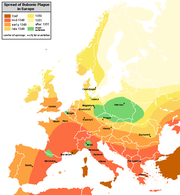
While continuing work on the Cronica and detailing the enormous loss of life during the Black Death
in 1348, Villani died of the same illness. His work on the Cronica was continued by his brother and nephew. Villani's work has received both praise and criticism from modern historians. The criticism is mostly aimed at his emphasis on supernatural
guidance of events, his organizational style, and his glorification of the papacy and Florence.
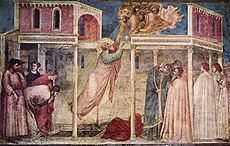 Giovanni Villani was born into the Florentine merchant middle class. He was the son of Villano di Stoldi di Bellincione, who came from an old and well-respected arti maggiori family of merchants. Villani was a member of the Arte di Calimala
(wool finishers) guild
in Florence since 1300, serving on the mercanzia council of eight. During that year he visited Rome
during the jubilee celebration. After observing the well-known ancient monuments of Rome and acknowledging its renowned historical personages, he was inspired to write the Cronica, a universal history
of Florence in a strictly linear, year-by-year format. During the early years of the 14th century, he gained political perspective by travelling throughout Italy, Switzerland, France and Flanders
for the Peruzzi
bank, of which he was a shareholder from 1300 to 1308. Traveling abroad as a factor
for the company, Villani was paid a regular salary in addition to his shareholding profits. On May 15, 1306, one of the first exchange contracts (cambium) to mention the city of Bruges
involved two parties: Giovanni Villani, representing the Peruzzi Company, granting a loan to Tommaso Fini, representing the Gallerani Company of Siena
. Villani and his brother Matteo transferred most of their economic activities to the Buonaccorsi firm by 1322. Giovanni Villani was a co-director of Buonaccorsi in 1324. The Buonaccorsi handled banking and commodity trade activities, spreading their influence throughout Italy, France, Flanders, England and several places in the Mediterranean.
Villani returned to Florence in 1307 where he married and settled down for a life of city politics. He became one of the prior
s of Florence in 1316 and 1317. At the same time, he participated in the crafty diplomatic tactics that resulted in peace with Pisa
and Lucca
. As head of the mint
beginning in 1316, he collected its earlier records and created a register of all the coins struck in Florence. In 1321, he was again chosen prior, and in 1324 was deputed to inspect the rebuilding of the city walls. He went with the Florentine army to fight against Castruccio Castracani
, lord of Lucca, and was present at Altopascio
during Florence's defeat
. In his Cronica, he gave a detailed account of why Florence was unable to acquire Lucca after the death of Castruccio Castracani.
A famine
spread across Tuscany in 1328. From 1329 to 1330 Villani was a commune
-appointed magistrate of provisioning protecting Florence from the famine's worst effects. In order to mitigate rising levels of starvation and assuage peasant discontent, grain was speedily imported from Sicily
through Talamone
, were taken from the city purse by the Florentine commune to aid the relief effort, and all the city's bakers had their ovens requisitioned by the government so that loaves of bread could be sold at affordable prices to the riotous and starving poor.
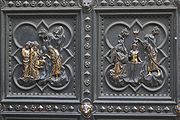 Villani was sent on another diplomatic mission in 1329, this time to Bologna
to meet Cardinal Bertrand de Pouget. From 1330 to 1331 he superintended the making of Andrea Pisano
's bronze doors for the Baptistry. At the same time, he served as the consul for his guild of the Arte di Calimala and watched over the raising of the campanile
of the Badìa
. He was also sent with others as a hostage to Ferrara
, to ensure that Florence made good on a debt; he resided there for some months in 1331.
Villani often expressed an optimistic viewpoint in his writing; this changed with the short-lived regime of Walter VI of Brienne, a despot invited to Florence and granted signoria
. In fact, after experiencing his own financial troubles, a terminated career, the failure of Florence in international affairs, and witnessing a host of different natural calamities and the onset of the Black Death in Europe, he became convinced that the apocalypse
and final judgement was near. The bankruptcy of the Buonaccorsi Company led to Villani's conviction and imprisonment in 1346, as he was a main partner. Other banking companies also went bankrupt, such as the Peruzzi in 1343 and the Compagnia dei Bardi
in 1346 (they were allied in a joint venture by 1336); Villani calculated that before their bankruptcy the Peruzzi had lost some 600,000 florins and the Bardi had lost some 900,000 florins. Although Villani attributed the losses to the companies' massive monetary loans to Edward III of England which were never repaid, historian Edwin S. Hunt suggests that the firms simply lacked the resources to have made such loans, which in all probability were much smaller and were not the key reasons for the companies' failures. The Bardi and Peruzzi were just two of many European banks that Edward III accepted loans from, prominent members of the Bardi and other Florentine families were owed only 63,000 Florins by Edward in 1348, and even a mass of small lenders and investors in Florence could not have made the necessary loan to England. The figure Villani asserted of 400,000 Florins owed to the Peruzzi by Edward alone equalled Villani's estimate for the entire payroll of 30,000 workers of the Florentine cloth industry in 1338. Hunt asserts that the failures of the Florentine banks seems closely tied to the expansionist policy of Florence in Tuscany, hoping that newly conquered territory would yield greater security for their trade in northern Europe, but instead resulted in costly campaigns and little profit. In addition to the questionable figures Villani posed for the Peruzzi and Bardi companies, it is also known that several events described in his Cronica surrounding the Buonaccorsi's bankruptcy were written to deliberately obscure the truth about the company's fraudulent behavior; Miller writes that "this is one of the most convincing conclusions" of historian Michele Luzzati's Giovanni Villani e la Compagnia dei Buonaccorsi (1971).
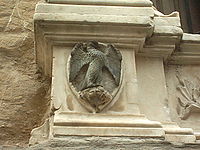 Villani and the Buonaccorsi had gained an unsavory reputation as early as 1331, when Villani was tried (and cleared) for barratry
for his part in building the new third circuit of walls around Florence. Charles, Duke of Calabria
had granted the Buonaccorsi the right to tax three of the six districts of Florence, which did not help Villani's reputation amongst his fellow citizens. In early June 1342, partners and agents of the Buonaccorsi suddenly fled Florence, Avignon
, and Naples
, following bankruptcy proceedings by creditors, nearly all of whom had deposits in the Buonaccorsi bank. Like other Florentine bankers and companies having difficulty with bankruptcy at the time, in September 1342 they supported the move to invite Walter VI of Brienne to become the next signor
of Florence. Walter later suspended all legal actions taken against the Buonaccorsi and other company partners for nearly a year.
However, the legal case against the company was reopened and resumed in October 1343, after the violent overthrow of Walter VI. It is unclear how long Villani served his prison sentence for alleged misconduct during the economic disaster of 1346. It is known that he was imprisoned in the Carceri delle Stinche. After the overthrow of the Brienne regime and a subsequent but short-lived aristocratic signoria, the novi cives or new families—some even from the lesser guilds—rose up in late September 1343 and established a government that provided them with much greater representation in officialdom. Villani and other chroniclers disdained these rustic non-aristocrats who suddenly rose to power, considering them brazen upstarts incapable of governance. Villani's class was at a constitutional disadvantage, as twenty-one guilds representing twenty-one equal voices in government meant that the oligarchy of higher guildsmen was "helplessly outnumbered" as historian John M. Najemy states. Yet by the 1350s the general attitude towards the novi cives had changed much, as even Villani's brother Matteo depicted them in a heroic light for being united in a coalition with the merchants and artisans to curb oligarchic
power. Villani was also a staunch supporter of what he deemed the liberties of the Church, while criticizing the new popular government of the novi cives since they protested against the many legal exemptions the Church enjoyed. However, he did find civic pride in that the whole city—including the novi cives—had joined together in an uprising against Walter VI, whose sins of imposing tyranny were, to Villani, sufficient justification for the violence needed to overthrow him.
 Villani's work is an Italian
chronicle written from the perspective of the political class of Florence just as the city rose to a rich and powerful position. Only scanty and partly legendary records had preceded his work, and there is little known of events before the death of Countess Matilda
in 1115. The Chronica de origine civitatis was composed sometime before 1231, but there is little comparison between this work and Villani's; mid-20th-century historian Nicolai Rubinstein states that the legendary accounts in this earlier chronicle were "arbitrarily selected by a compiler whose learning and critical faculties were considerably below the standard of his age." In contrast, Rubinstein states Villani provided "a mature expression" of Florentine history. Yet Villani still relied upon the Chronica de origine civitatis as the prime source for Florence's early history in his narrative.
In the 36th chapter of Book 8, Villani states that the idea of writing the Cronica was suggested to him during the jubilee of Rome in 1300, under the following circumstances after Pope Boniface VIII made in honor of Christ's nativity
a great indulgence; Villani writes:
In his writing, Villani states that he considers Florence to be the "daughter and creation of Rome," but asserts Rome's decline
and Florence's rise as a great city compelled him to lay out a detailed history of the city. To emphasize the imperial greatness of Florentine history, Villani also asserted that the city was given a second founding when it was rebuilt by Charlemagne
(r. 800–814 as Holy Roman Emperor
)—which was absent from the Chronica de origine civitatis. Historian J.K. Hyde writes that the idea of Florence being the daughter of Rome would have given the Florentines a sense of destiny, while the second founding by Charlemagne provided historical context for alliance with France, which Hyde calls "the touchstone of Guelphism
". Villani's reasoning for Rome's decline was the schisms of the Church and rebellion against the papal institution, while the ascension of Otto I, Holy Roman Emperor (r. 962–973) allowed for the conditions of Florence's rise against enemies of papal authority, such as Florentine-conquered Fiesole
. Villani was certain that the Republic of Florence had experienced a great setback on its path to glory with the defeat of the Guelphs by the Ghibellines
at the Battle of Montaperti
in 1260. Despite this, Villani states that the paramount prosperity and tranquility of the city by 1293 was evidenced by the fact that its gates were no longer locked at night and that indirect taxes such as the gate fee (common in times of war) were not levied. Historian Felicity Ratté states that the validity of this comment should be heavily scrutinized considering the Florence statutes of 1290 that designated employment for individuals in charge of locking the city gates. Villani also contradicts himself by writing of a night attack on Florence in 1323 which clearly demonstrates the fact that the gates were locked at night.
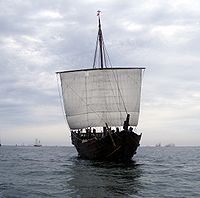 In 1300 or shortly after, Villani began working on the Cronica, which was divided into twelve books; the first six deal with the largely legendary history of Florence, starting at conventionally biblical times with the story of the Tower of Babel
up to the year 1264. The second phase, in six books, covered the history from 1264 until his own time, all the way up to 1346. He outlined the events in his Cronica in year to year accounts; for this he has gained criticism over the years for writing in an episodic manner lacking a unifying theme or point of view. He wrote his Cronica in the vernacular
language rather than Latin
, the language of the educated elite. His chronicles are intercut with historical episodes reported just as he heard them, sometimes with little interpretation. This often led to historical inaccuracies in his work, especially in the biographies of historical or contemporary people living outside of Florence (even with well-known monarchs).
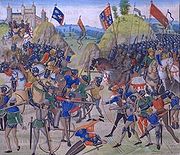
Despite numerous mistakes, Villani often displayed an insider's knowledge on many subjects, as a result of his extensive travels and access to both official and private documents. For example, De Vries states that he wrote one of the most accurate accounts of the Battle of Crécy
during the Hundred Years' War
, including information that the archers were placed precariously behind the English and Welsh infantry, not on the flanks as others asserted. While describing detailed events unfolding within the city, Villani would name every individual street, square, bridge, family, and person involved, assuming his readers would have the same intimate knowledge of Florence as he did.
Villani is perhaps unequalled for the value of the statistical data he has preserved. For example, he recorded that in Florence there were 80 banks, 146 bakeries, 80 members in an association of city judges with 600 notaries, 60 physicians and surgical doctors, 100 shops and dealers of spices, 8,000 to 10,000 children attending primary school each year, 550 to 600 students attending 4 different schools for Scholastic
knowledge, 13,200 bushel
s of grain consumed weekly by the city, and 70,000 to 80,000 pieces of cloth produced in the workshops of the Arte della Lana
each year, the latter having a total value of .
Villani was a Guelph, but his book is much more taken up with an inquiry into what is useful and true than with factional party considerations. In a departure from Guelph politics, he favored republicanism
over monarchy
, praising the philosopher Brunetto Latini
as "the master and initiator in refining the Florentines, in making them skilled in good speaking and in knowing how to guide and rule our republic according to political science." However, Villani admitted in his writing that republicanism bred factional strife, that benevolent rulers like Robert of Naples
were sometimes needed to keep order, and republicanism could become tyrannical if it came to represent only one class (such as exclusive favoring of aristocrats, merchants, or artisans). When detailing the construction of the Florence Cathedral and the artist Giotto di Bondone
as the designer of the new bell tower, Villani called him "the most sovereign master of painting in his time." Villani's Cronica also provides the first known biography of Dante Alighieri
(1265–1321), author of the Divine Comedy, who Villani described as haughty, disdainful, and reserved. In his revised Cronica of 1322, Villani shortened Dante's biography and the amount of quotations taken from his Divine Comedy. Villani's actions are explained by Richard H. Lansing and Teodolinda Barolini, who write: "Evidently two decades after the poet's death a conservative writer closely identified with the Florentine state still felt obliged to distance himself from the most outspoken critic of the basis of that state's prestige."
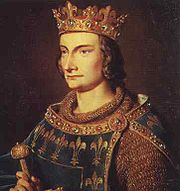 Historian Louis Green writes that the Cronica was written with three general assumptions about morality which shaped the organization of the work, "[channeling] events into recurring patterns of significance." These general assumptions were that excess brings disaster, that history is governed by a struggle between right and wrong, and that there is a direct connection between the events of the natural world and the overriding, supernatural and divine will of God who intercedes in these events. For example, Villani described the story of Count Ugolini of Pisa
, who at the height of attaining his ill-gotten wealth and power was overthrown and eventually starved to death along with his sons. Green writes that this story in the Cronica bears a resemblance to the ancient Greek
story of Polycrates
and his ring in the work of Herodotus
. However, Green notes that Villani's "cautionary tales" disembarked from the Classical Greek tradition of the arrogant and haughty rich falling from fortune due to the Greek belief in equalizing forces determining one's unavoidable fate, which Green calls "excessive good fortune having to be balanced by an appropriate measure of sorrow." Villani's adherence to Medieval Christianity allowed him to suggest retribution was delivered because of sin
and insult to God. He stressed that those who gained prestige would fall prey to pride; confidence in their position would then lead them to sin, and sin would bring on a stage of decline. Villani wrote:
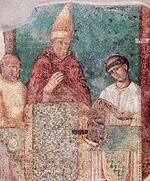 For Villani, this theory of sin and morality being tied directly with fate and fortune fit well with the ultimate fate of the Capetian dynasty
of France. The House of Capet
was once the champion of the Church and ally of the papacy. However, Villani correlated Philip the Fair
's defiance of Pope Boniface VIII and seizure of the Templar's
wealth with later Capetian misfortunes, such as Philip's death in a hunting accident, the adultery of the wives of his three sons, the death of his heirs, and even French defeats in the Hundred Years' War. Green points out that in Villani's writing there are two significant earthly powers that seem to be exempt or immune from this theory of immorality leading to downfall: Florence and the papacy. The interests of these two powers represent, as Green states, "the kingpin of Villani's scheme of historical interpretation."
Besides Divine Providence, Villani acknowledged other events that he believed were explainable via the supernatural. He wrote of many instances where holy men offered prophetic statements that later proved true, such as Pope Clement IV's prophesy on the outcome for the Battle of Tagliacozzo
. He believed that certain events were really omen
s of what was to come. For instance, when a lion was sent to Florence as a gift by Boniface VIII, a donkey purportedly killed the lion. He interpreted this as an omen that foretold the Pope's beating and untimely death shortly after fighting Philip IV at Anagni
; Villani wrote: "when the tamed beast kills the King of Beasts, then the dissolution of the Church will begin." He also believed in astrology
and changes in the heavens as indication of political changes, the deaths of rulers and popes, and natural calamities. However, he noted that the movement of the heavens would not always predetermine the actions of men and did not trump the divine plan of God.
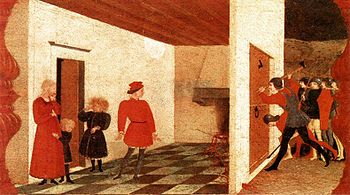 Marilyn Aronberg Lavin states that Villani was most likely serving as a Peruzzi representative in Flanders when he heard the story of the French Jew
who in 1290 tried to destroy Host bread (of the Eucharist
) but was unsuccessful as the bread allegedly bled profusely as he stabbed it, and turned into flesh as he attempted to boil it in water. In the original account by the Ghent
monk Jean de Thilrode in 1294, the Jew was compelled to convert to Christianity, but Villani's account followed that of the later Chronicles of Saint-Denis
(1285–1328) which told that the Jew was burned to death for his crime. Villani's Cronica marks the first appearance in Italian literature of this legend, while "Villani's report includes details which establish an independent Italian branch of the tradition" according to Lavin. St. Antoninus, archbishop of Florence
, repeated the story of Villani in his Latin Chronicles, while Villani's illustrated Cronica featured a scene of this French Jew that later appeared in a painting by Paolo Uccello
.
: "The priest who confessed the sick and those who nursed them so generally caught the infection that the victims were abandoned and deprived confession, sacrament, medicine, and nursing ... And many lands and cities were made desolate. And this plague lasted till ________"; Villani left the "_______" in order to record the time in which the plague was to end. Villani was unable to finish the line as he succumbed to the same plague. He was buried in Florence in the Church of Santissima Annunziata
.
 Villani's Cronica was considered an important work at the time, valuable enough for his brother and nephew to continue it. Nothing is known of Villani's brother, Matteo, save that he was twice married, that he died of the plague in 1363, and that he continued work on the Cronica until his death. Filippo Villani
, Matteo's son, flourished in the latter half of the 14th century and ended the Cronica at 1364; his portion includes details of the lives of many Florentine artists and musicians, including Giotto di Bondone
and Francesco Landini
. Filippo's chronicles were approved by the Chancellor of Florence
, Coluccio Salutati
, who made corrections to the work and added commentary. The 15th-century Florentine historian Domenico di Leonardo Buoninsegni also featured in the first two chapters of his Istoria Fiorentina a summary of Villani's Cronica.
By the 16th century, more than one edition of the Cronica was available in printed form
. There was also an abundance of handwritten illuminated manuscripts
, including one from Venice by Bartholomeo Zanetti Casterzagense in 1537 and one from Florence by Lorenzo Torrentino in 1554.
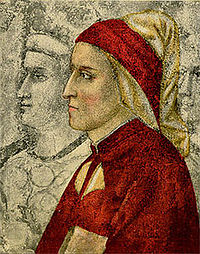 Historian J.K. Hyde states that the Nuova Cronica of Villani is representative of the strong vernacular tradition in Florence, appealing to the people of the time as a narrative that was "easy to read, full of human interest and occasionally spiced with novella
-type anecdotes." Hyde also notes that Villani's criticisms of the commune politics in Florence promoted a trend of personal expression amongst later chroniclers that defied official conformity. The Cronica is also an incredibly rich historical record; its greatest value to modern historians is its descriptions of the people, data, and events experienced by Villani during his lifetime. Historian Mark Phillips states that all subsequent Florentine accounts of the tyrannical regime of Walter VI of Brienne—including those by Leonardo Bruni
and Niccolò Machiavelli
—were based upon the primary source of Villani's Cronica. Villani's written work on Dante Alighieri and the age in which he lived has provided insight into Dante's work, reasoning, and psyche. The reprinting of new editions of Villani's work in the early 20th century provided material for a resurgence in the study of Dante. However, Villani's descriptions of events which preceded him by centuries are riddled with inaccurate traditional accounts, popular legend, and hearsay.
In regard to his own time, Villani provides modern historians with valuable details on Florentine social and living habits, such as the growing trend and craze of wealthy Florentines in building large country homes far outside of the city. However, the early 20th century historian Philip Wicksteed
stated of Villani, "When dealing with his own times, and with events immediately connected with Florence, he is a trustworthy witness, but minute accuracy is never his strong point; and in dealing with distant times and places he is hopelessly unreliable." For example, although Nicolai Rubinstein acknowledged that Villani's chronicles were much more matured and developed than earlier ones, Villani still relied on legend and hearsay to account for the origins of cities such as Fiesole
. On Villani's estimation that a third of Antwerp's population died off during the Great Famine of 1315-1317, the early 20th-century historian Henry S. Lucas wrote, "not much faith can be placed in such statistics which are little better than guesses." Louis Green notes Villani's limitation as a chronicler and not a full-fledged historian
:
Louis Green asserts that Giovanni's Cronica expressed the outlook of the merchant community in Florence at the time, but also provided valuable indications of "how that outlook was modified in a direction away from characteristically medieval to embryonically modern attitudes." Green writes that Villani's Cronica was one of three types of chronicles found in the 14th century, the type which was largely a universal history
. Other types would be chronicles of particular historic episodes such as Dino Compagni
's account of the White Guelphs and Black Guelphs or the more domestic chronicle that focused on the fortunes and events of one family, as written by Donato Velluti or Giovanni Morelli.
Diplomat
A diplomat is a person appointed by a state to conduct diplomacy with another state or international organization. The main functions of diplomats revolve around the representation and protection of the interests and nationals of the sending state, as well as the promotion of information and...
and chronicle
Chronicle
Generally a chronicle is a historical account of facts and events ranged in chronological order, as in a time line. Typically, equal weight is given for historically important events and local events, the purpose being the recording of events that occurred, seen from the perspective of the...
r from Florence
Florence
Florence is the capital city of the Italian region of Tuscany and of the province of Florence. It is the most populous city in Tuscany, with approximately 370,000 inhabitants, expanding to over 1.5 million in the metropolitan area....
who wrote the Nuova Cronica
Nuova Cronica
The Nuova Cronica or New Chronicles is a 14th century history of Florence created in a year-by-year linear format and written by the Florentine banker and official Giovanni Villani...
(New Chronicles) on the history of Florence
History of Florence
Florence is a major historical city in Italy, distinguished as one of the most outstanding economical, cultural, political and artistic centres in the peninsula from the late Middle Ages to the Renaissance.-Prehistoric evidence:...
. He was a leading statesman of Florence but later gained an unsavory reputation and served time in prison as a result of the bankruptcy of a trading and banking company he worked for. His interest in and elaboration of economic details, statistical information, and political and psychological insight mark him as a more modern chronicler of late medieval Europe. His Cronica is viewed as the first introduction of statistics as a positive element in history.
However, historian Kenneth R. Bartlett
Kenneth R. Bartlett
Kenneth R. Bartlett is a Renaissance historian, author, and professor at the University of Toronto, where he earned his Ph.D. degree in 1978. He is the Director of the Office of Teaching Advancement and has served as the president for the Canadian Society for Renaissance Studies...
notes that, in contrast to his Renaissance-era successors
Italian Renaissance
The Italian Renaissance began the opening phase of the Renaissance, a period of great cultural change and achievement in Europe that spanned the period from the end of the 13th century to about 1600, marking the transition between Medieval and Early Modern Europe...
, "his reliance on such elements as Divine Providence
Divine Providence
In Christian theology, divine providence, or simply providence, is God's activity in the world. " Providence" is also used as a title of God exercising His providence, and then the word are usually capitalized...
links Villani closely with the medieval vernacular chronicle tradition." In recurring themes made implicit through significant events described in his Cronica, Villani also emphasized three assumptions about the relationship of sin and morality to historical events, these being that excess brings disaster, that forces of right and wrong are in constant struggle, and that events are directly influenced by the will of God
God
God is the English name given to a singular being in theistic and deistic religions who is either the sole deity in monotheism, or a single deity in polytheism....
.
Villani was inspired to write his Cronica after attending the jubilee
Jubilee (Christian)
The concept of the Jubilee is a special year of remission of sins and universal pardon. In the Biblical Book of Leviticus, a Jubilee year is mentioned to occur every fifty years, in which slaves and prisoners would be freed, debts would be forgiven and the mercies of God would be particularly...
celebration in Rome
Rome
Rome is the capital of Italy and the country's largest and most populated city and comune, with over 2.7 million residents in . The city is located in the central-western portion of the Italian Peninsula, on the Tiber River within the Lazio region of Italy.Rome's history spans two and a half...
in 1300 and noting the venerable history of that city. He outlined the events in his Cronica year for year, following a strictly linear narrative format. He provided intricate details on many important historical events of the city of Florence and the wider region of Tuscany
Tuscany
Tuscany is a region in Italy. It has an area of about 23,000 square kilometres and a population of about 3.75 million inhabitants. The regional capital is Florence ....
, such as construction projects, floods, fires, famines, and plagues.
While continuing work on the Cronica and detailing the enormous loss of life during the Black Death
Black Death
The Black Death was one of the most devastating pandemics in human history, peaking in Europe between 1348 and 1350. Of several competing theories, the dominant explanation for the Black Death is the plague theory, which attributes the outbreak to the bacterium Yersinia pestis. Thought to have...
in 1348, Villani died of the same illness. His work on the Cronica was continued by his brother and nephew. Villani's work has received both praise and criticism from modern historians. The criticism is mostly aimed at his emphasis on supernatural
Supernatural
The supernatural or is that which is not subject to the laws of nature, or more figuratively, that which is said to exist above and beyond nature...
guidance of events, his organizational style, and his glorification of the papacy and Florence.
Life and career
Arte di Calimala
The Arte di Calimala, the guild of the cloth finishers and merchants in foreign cloth, was one of the greater guilds of Florence, the Arti Maggiori, who arrogated to themselves the civic power of the Republic of Florence during the Late Middle Ages...
(wool finishers) guild
Guild
A guild is an association of craftsmen in a particular trade. The earliest types of guild were formed as confraternities of workers. They were organized in a manner something between a trade union, a cartel, and a secret society...
in Florence since 1300, serving on the mercanzia council of eight. During that year he visited Rome
Rome
Rome is the capital of Italy and the country's largest and most populated city and comune, with over 2.7 million residents in . The city is located in the central-western portion of the Italian Peninsula, on the Tiber River within the Lazio region of Italy.Rome's history spans two and a half...
during the jubilee celebration. After observing the well-known ancient monuments of Rome and acknowledging its renowned historical personages, he was inspired to write the Cronica, a universal history
Universal history
Universal history is basic to the Western tradition of historiography, especially the Abrahamic wellspring of that tradition. Simply stated, universal history is the presentation of the history of humankind as a whole, as a coherent unit.-Ancient authors:...
of Florence in a strictly linear, year-by-year format. During the early years of the 14th century, he gained political perspective by travelling throughout Italy, Switzerland, France and Flanders
Flanders
Flanders is the community of the Flemings but also one of the institutions in Belgium, and a geographical region located in parts of present-day Belgium, France and the Netherlands. "Flanders" can also refer to the northern part of Belgium that contains Brussels, Bruges, Ghent and Antwerp...
for the Peruzzi
Peruzzi
The Peruzzi were bankers of Florence, among the leading families of the city in the 14th century, before the rise to prominence of the Medici. Their modest antecedents stretched back to the mid 11th century, according to the family's genealogist Luigi Passerini, but a restructuring of the Peruzzii...
bank, of which he was a shareholder from 1300 to 1308. Traveling abroad as a factor
Factor (agent)
A factor, from the Latin "he who does" , is a person who professionally acts as the representative of another individual or other legal entity, historically with his seat at a factory , notably in the following contexts:-Mercantile factor:In a relatively large company, there could be a hierarchy,...
for the company, Villani was paid a regular salary in addition to his shareholding profits. On May 15, 1306, one of the first exchange contracts (cambium) to mention the city of Bruges
Bruges
Bruges is the capital and largest city of the province of West Flanders in the Flemish Region of Belgium. It is located in the northwest of the country....
involved two parties: Giovanni Villani, representing the Peruzzi Company, granting a loan to Tommaso Fini, representing the Gallerani Company of Siena
Siena
Siena is a city in Tuscany, Italy. It is the capital of the province of Siena.The historic centre of Siena has been declared by UNESCO a World Heritage Site. It is one of the nation's most visited tourist attractions, with over 163,000 international arrivals in 2008...
. Villani and his brother Matteo transferred most of their economic activities to the Buonaccorsi firm by 1322. Giovanni Villani was a co-director of Buonaccorsi in 1324. The Buonaccorsi handled banking and commodity trade activities, spreading their influence throughout Italy, France, Flanders, England and several places in the Mediterranean.
Villani returned to Florence in 1307 where he married and settled down for a life of city politics. He became one of the prior
Prior
Prior is an ecclesiastical title, derived from the Latin adjective for 'earlier, first', with several notable uses.-Monastic superiors:A Prior is a monastic superior, usually lower in rank than an Abbot. In the Rule of St...
s of Florence in 1316 and 1317. At the same time, he participated in the crafty diplomatic tactics that resulted in peace with Pisa
Pisa
Pisa is a city in Tuscany, Central Italy, on the right bank of the mouth of the River Arno on the Tyrrhenian Sea. It is the capital city of the Province of Pisa...
and Lucca
Lucca
Lucca is a city and comune in Tuscany, central Italy, situated on the river Serchio in a fertile plainnear the Tyrrhenian Sea. It is the capital city of the Province of Lucca...
. As head of the mint
Mint (coin)
A mint is an industrial facility which manufactures coins for currency.The history of mints correlates closely with the history of coins. One difference is that the history of the mint is usually closely tied to the political situation of an era...
beginning in 1316, he collected its earlier records and created a register of all the coins struck in Florence. In 1321, he was again chosen prior, and in 1324 was deputed to inspect the rebuilding of the city walls. He went with the Florentine army to fight against Castruccio Castracani
Castruccio Castracani
Castruccio Castracani degli Antelminelli was an Italian condottiero and duke of Lucca.-Biography:Castruccio was born in Lucca, a member of the noble family of Antelminelli, of the Ghibelline party. In 1300 he was exiled with his parents and others of their faction by the Guelphs "Black" party,...
, lord of Lucca, and was present at Altopascio
Altopascio
Altopascio is a comune in the Province of Lucca in the Tuscany region of Italy with a population of c. 13300.-History:Already inhabited in Roman times, Altopascio gained in importance due to its Spedale for the pilgrims who travelled on the Via Francigena, leading from France to Rome...
during Florence's defeat
Battle of Altopascio
The Battle of Altopascio was a battle fought in 1325 in Tuscany, between the Ghibelline forces of Castruccio Castracani and those of Guelph Florence.-Background:...
. In his Cronica, he gave a detailed account of why Florence was unable to acquire Lucca after the death of Castruccio Castracani.
A famine
Famine
A famine is a widespread scarcity of food, caused by several factors including crop failure, overpopulation, or government policies. This phenomenon is usually accompanied or followed by regional malnutrition, starvation, epidemic, and increased mortality. Every continent in the world has...
spread across Tuscany in 1328. From 1329 to 1330 Villani was a commune
Medieval commune
Medieval communes in the European Middle Ages had sworn allegiances of mutual defense among the citizens of a town or city. They took many forms, and varied widely in organization and makeup. Communes are first recorded in the late 11th and early 12th centuries, thereafter becoming a widespread...
-appointed magistrate of provisioning protecting Florence from the famine's worst effects. In order to mitigate rising levels of starvation and assuage peasant discontent, grain was speedily imported from Sicily
Sicily
Sicily is a region of Italy, and is the largest island in the Mediterranean Sea. Along with the surrounding minor islands, it constitutes an autonomous region of Italy, the Regione Autonoma Siciliana Sicily has a rich and unique culture, especially with regard to the arts, music, literature,...
through Talamone
Talamone
Talamone is a town in Tuscany, central Italy, administratively a frazione of the comune of Orbetello, province of Grosseto, in the Tuscan Maremma....
, were taken from the city purse by the Florentine commune to aid the relief effort, and all the city's bakers had their ovens requisitioned by the government so that loaves of bread could be sold at affordable prices to the riotous and starving poor.
Bologna
Bologna is the capital city of Emilia-Romagna, in the Po Valley of Northern Italy. The city lies between the Po River and the Apennine Mountains, more specifically, between the Reno River and the Savena River. Bologna is a lively and cosmopolitan Italian college city, with spectacular history,...
to meet Cardinal Bertrand de Pouget. From 1330 to 1331 he superintended the making of Andrea Pisano
Andrea Pisano
Andrea Pisano , also known as Andrea da Pontedera, was an Italian sculptor and architect.-Biography:Andrea Pisano was born at Pontedera, where he also died....
's bronze doors for the Baptistry. At the same time, he served as the consul for his guild of the Arte di Calimala and watched over the raising of the campanile
Campanile
Campanile is an Italian word meaning "bell tower" . The term applies to bell towers which are either part of a larger building or free-standing, although in American English, the latter meaning has become prevalent.The most famous campanile is probably the Leaning Tower of Pisa...
of the Badìa
Badia Fiorentina
The Badìa Fiorentina is an abbey and church now home to the Fraternity of Jerusalem situated on the Via del Proconsolo in the centre of Florence, Italy. Dante supposedly grew up across the street in what is now called the 'Casa di Dante', rebuilt in 1910 as a museum to Dante...
. He was also sent with others as a hostage to Ferrara
Ferrara
Ferrara is a city and comune in Emilia-Romagna, northern Italy, capital city of the Province of Ferrara. It is situated 50 km north-northeast of Bologna, on the Po di Volano, a branch channel of the main stream of the Po River, located 5 km north...
, to ensure that Florence made good on a debt; he resided there for some months in 1331.
Villani often expressed an optimistic viewpoint in his writing; this changed with the short-lived regime of Walter VI of Brienne, a despot invited to Florence and granted signoria
Signoria
A Signoria was an abstract noun meaning 'government; governing authority; de facto sovereignty; lordship in many of the Italian city states during the medieval and renaissance periods....
. In fact, after experiencing his own financial troubles, a terminated career, the failure of Florence in international affairs, and witnessing a host of different natural calamities and the onset of the Black Death in Europe, he became convinced that the apocalypse
Apocalypse
An Apocalypse is a disclosure of something hidden from the majority of mankind in an era dominated by falsehood and misconception, i.e. the veil to be lifted. The Apocalypse of John is the Book of Revelation, the last book of the New Testament...
and final judgement was near. The bankruptcy of the Buonaccorsi Company led to Villani's conviction and imprisonment in 1346, as he was a main partner. Other banking companies also went bankrupt, such as the Peruzzi in 1343 and the Compagnia dei Bardi
Compagnia dei Bardi
The Compagnia dei Bardi was a Florentine banking and trading company which was started by the Bardi family. The Bardi company was one of three major Florentine banking companies that assembled large amounts of capital and established wide-ranging, diversified business networks, doing business...
in 1346 (they were allied in a joint venture by 1336); Villani calculated that before their bankruptcy the Peruzzi had lost some 600,000 florins and the Bardi had lost some 900,000 florins. Although Villani attributed the losses to the companies' massive monetary loans to Edward III of England which were never repaid, historian Edwin S. Hunt suggests that the firms simply lacked the resources to have made such loans, which in all probability were much smaller and were not the key reasons for the companies' failures. The Bardi and Peruzzi were just two of many European banks that Edward III accepted loans from, prominent members of the Bardi and other Florentine families were owed only 63,000 Florins by Edward in 1348, and even a mass of small lenders and investors in Florence could not have made the necessary loan to England. The figure Villani asserted of 400,000 Florins owed to the Peruzzi by Edward alone equalled Villani's estimate for the entire payroll of 30,000 workers of the Florentine cloth industry in 1338. Hunt asserts that the failures of the Florentine banks seems closely tied to the expansionist policy of Florence in Tuscany, hoping that newly conquered territory would yield greater security for their trade in northern Europe, but instead resulted in costly campaigns and little profit. In addition to the questionable figures Villani posed for the Peruzzi and Bardi companies, it is also known that several events described in his Cronica surrounding the Buonaccorsi's bankruptcy were written to deliberately obscure the truth about the company's fraudulent behavior; Miller writes that "this is one of the most convincing conclusions" of historian Michele Luzzati's Giovanni Villani e la Compagnia dei Buonaccorsi (1971).
Barratry
Barratry is the name of four legal concepts, three in criminal and civil law, and one in admiralty law.* Barratry, in criminal and civil law, is the act or practice of bringing repeated legal actions solely to harass...
for his part in building the new third circuit of walls around Florence. Charles, Duke of Calabria
Charles, Duke of Calabria
Charles, Duke of Calabria was the son of King Robert of Naples and Yolanda of Aragon.-Biography:Born in Naples, he became Duke of Calabria in 1309 on his father's accession, and was created Vicar-General of the Kingdom of Sicily...
had granted the Buonaccorsi the right to tax three of the six districts of Florence, which did not help Villani's reputation amongst his fellow citizens. In early June 1342, partners and agents of the Buonaccorsi suddenly fled Florence, Avignon
Avignon
Avignon is a French commune in southeastern France in the départment of the Vaucluse bordered by the left bank of the Rhône river. Of the 94,787 inhabitants of the city on 1 January 2010, 12 000 live in the ancient town centre surrounded by its medieval ramparts.Often referred to as the...
, and Naples
Naples
Naples is a city in Southern Italy, situated on the country's west coast by the Gulf of Naples. Lying between two notable volcanic regions, Mount Vesuvius and the Phlegraean Fields, it is the capital of the region of Campania and of the province of Naples...
, following bankruptcy proceedings by creditors, nearly all of whom had deposits in the Buonaccorsi bank. Like other Florentine bankers and companies having difficulty with bankruptcy at the time, in September 1342 they supported the move to invite Walter VI of Brienne to become the next signor
Signoria of Florence
The Signoria was the government of medieval and renaissance Florence. Its nine members, the Priori, were chosen from the ranks of the guilds of the city: six of them from the major guilds, and two from the minor guilds...
of Florence. Walter later suspended all legal actions taken against the Buonaccorsi and other company partners for nearly a year.
However, the legal case against the company was reopened and resumed in October 1343, after the violent overthrow of Walter VI. It is unclear how long Villani served his prison sentence for alleged misconduct during the economic disaster of 1346. It is known that he was imprisoned in the Carceri delle Stinche. After the overthrow of the Brienne regime and a subsequent but short-lived aristocratic signoria, the novi cives or new families—some even from the lesser guilds—rose up in late September 1343 and established a government that provided them with much greater representation in officialdom. Villani and other chroniclers disdained these rustic non-aristocrats who suddenly rose to power, considering them brazen upstarts incapable of governance. Villani's class was at a constitutional disadvantage, as twenty-one guilds representing twenty-one equal voices in government meant that the oligarchy of higher guildsmen was "helplessly outnumbered" as historian John M. Najemy states. Yet by the 1350s the general attitude towards the novi cives had changed much, as even Villani's brother Matteo depicted them in a heroic light for being united in a coalition with the merchants and artisans to curb oligarchic
Oligarchy
Oligarchy is a form of power structure in which power effectively rests with an elite class distinguished by royalty, wealth, family ties, commercial, and/or military legitimacy...
power. Villani was also a staunch supporter of what he deemed the liberties of the Church, while criticizing the new popular government of the novi cives since they protested against the many legal exemptions the Church enjoyed. However, he did find civic pride in that the whole city—including the novi cives—had joined together in an uprising against Walter VI, whose sins of imposing tyranny were, to Villani, sufficient justification for the violence needed to overthrow him.
Nuova Cronica
Italian language
Italian is a Romance language spoken mainly in Europe: Italy, Switzerland, San Marino, Vatican City, by minorities in Malta, Monaco, Croatia, Slovenia, France, Libya, Eritrea, and Somalia, and by immigrant communities in the Americas and Australia...
chronicle written from the perspective of the political class of Florence just as the city rose to a rich and powerful position. Only scanty and partly legendary records had preceded his work, and there is little known of events before the death of Countess Matilda
Matilda of Tuscany
Matilda of Tuscany was an Italian noblewoman, the principal Italian supporter of Pope Gregory VII during the Investiture Controversy. She is one of the few medieval women to be remembered for her military accomplishments...
in 1115. The Chronica de origine civitatis was composed sometime before 1231, but there is little comparison between this work and Villani's; mid-20th-century historian Nicolai Rubinstein states that the legendary accounts in this earlier chronicle were "arbitrarily selected by a compiler whose learning and critical faculties were considerably below the standard of his age." In contrast, Rubinstein states Villani provided "a mature expression" of Florentine history. Yet Villani still relied upon the Chronica de origine civitatis as the prime source for Florence's early history in his narrative.
In the 36th chapter of Book 8, Villani states that the idea of writing the Cronica was suggested to him during the jubilee of Rome in 1300, under the following circumstances after Pope Boniface VIII made in honor of Christ's nativity
Nativity of Jesus
The Nativity of Jesus, or simply The Nativity, refers to the accounts of the birth of Jesus in two of the Canonical gospels and in various apocryphal texts....
a great indulgence; Villani writes:
And being on that blessed pilgrimage in the sacred city of Rome and seeing its great and ancient monuments and reading the great deeds of the Romans as described by Virgil, Sallust, Lucan, Livy, Valerius, Orosius, and other masters of history ... I took my prompting from them although I am a disciple unworthy of such an undertaking. But in view of the fact that our city of Florence, daughter and offspring of Rome, was mounting and pursuing great purposes, while Rome was in its decline, I thought it proper to trace in this chronicle the origins of the city of Florence, so far as I have been able to recover them, and to relate the city's further development at greater length, and at the same time to give a brief account of events throughout the world as long as it please God, in the hope of whose favor I undertook the said enterprise rather than in reliance on my own poor wits. And thus in the year 1300, on my return from Rome, I began to compile this book in the name of God and the blessed John the Baptist and in honor of our city of Florence.
In his writing, Villani states that he considers Florence to be the "daughter and creation of Rome," but asserts Rome's decline
Decline of the Roman Empire
The decline of the Roman Empire refers to the gradual societal collapse of the Western Roman Empire. Many theories of causality prevail, but most concern the disintegration of political, economic, military, and other social institutions, in tandem with foreign invasions and usurpers from within the...
and Florence's rise as a great city compelled him to lay out a detailed history of the city. To emphasize the imperial greatness of Florentine history, Villani also asserted that the city was given a second founding when it was rebuilt by Charlemagne
Charlemagne
Charlemagne was King of the Franks from 768 and Emperor of the Romans from 800 to his death in 814. He expanded the Frankish kingdom into an empire that incorporated much of Western and Central Europe. During his reign, he conquered Italy and was crowned by Pope Leo III on 25 December 800...
(r. 800–814 as Holy Roman Emperor
Holy Roman Emperor
The Holy Roman Emperor is a term used by historians to denote a medieval ruler who, as German King, had also received the title of "Emperor of the Romans" from the Pope...
)—which was absent from the Chronica de origine civitatis. Historian J.K. Hyde writes that the idea of Florence being the daughter of Rome would have given the Florentines a sense of destiny, while the second founding by Charlemagne provided historical context for alliance with France, which Hyde calls "the touchstone of Guelphism
Guelphs and Ghibellines
The Guelphs and Ghibellines were factions supporting the Pope and the Holy Roman Emperor, respectively, in central and northern Italy. During the 12th and 13th centuries, the split between these two parties was a particularly important aspect of the internal policy of the Italian city-states...
". Villani's reasoning for Rome's decline was the schisms of the Church and rebellion against the papal institution, while the ascension of Otto I, Holy Roman Emperor (r. 962–973) allowed for the conditions of Florence's rise against enemies of papal authority, such as Florentine-conquered Fiesole
Fiesole
Fiesole is a town and comune of the province of Florence in the Italian region of Tuscany, on a famously scenic height above Florence, 8 km NE of that city...
. Villani was certain that the Republic of Florence had experienced a great setback on its path to glory with the defeat of the Guelphs by the Ghibellines
Guelphs and Ghibellines
The Guelphs and Ghibellines were factions supporting the Pope and the Holy Roman Emperor, respectively, in central and northern Italy. During the 12th and 13th centuries, the split between these two parties was a particularly important aspect of the internal policy of the Italian city-states...
at the Battle of Montaperti
Battle of Montaperti
The Battle of Montaperti was fought on September 4, 1260, between Florence and Siena in Tuscany as part of the conflict between the Guelphs and Ghibellines...
in 1260. Despite this, Villani states that the paramount prosperity and tranquility of the city by 1293 was evidenced by the fact that its gates were no longer locked at night and that indirect taxes such as the gate fee (common in times of war) were not levied. Historian Felicity Ratté states that the validity of this comment should be heavily scrutinized considering the Florence statutes of 1290 that designated employment for individuals in charge of locking the city gates. Villani also contradicts himself by writing of a night attack on Florence in 1323 which clearly demonstrates the fact that the gates were locked at night.
Tower of Babel
The Tower of Babel , according to the Book of Genesis, was an enormous tower built in the plain of Shinar .According to the biblical account, a united humanity of the generations following the Great Flood, speaking a single language and migrating from the east, came to the land of Shinar, where...
up to the year 1264. The second phase, in six books, covered the history from 1264 until his own time, all the way up to 1346. He outlined the events in his Cronica in year to year accounts; for this he has gained criticism over the years for writing in an episodic manner lacking a unifying theme or point of view. He wrote his Cronica in the vernacular
Vernacular
A vernacular is the native language or native dialect of a specific population, as opposed to a language of wider communication that is not native to the population, such as a national language or lingua franca.- Etymology :The term is not a recent one...
language rather than Latin
Latin
Latin is an Italic language originally spoken in Latium and Ancient Rome. It, along with most European languages, is a descendant of the ancient Proto-Indo-European language. Although it is considered a dead language, a number of scholars and members of the Christian clergy speak it fluently, and...
, the language of the educated elite. His chronicles are intercut with historical episodes reported just as he heard them, sometimes with little interpretation. This often led to historical inaccuracies in his work, especially in the biographies of historical or contemporary people living outside of Florence (even with well-known monarchs).
Despite numerous mistakes, Villani often displayed an insider's knowledge on many subjects, as a result of his extensive travels and access to both official and private documents. For example, De Vries states that he wrote one of the most accurate accounts of the Battle of Crécy
Battle of Crécy
The Battle of Crécy took place on 26 August 1346 near Crécy in northern France, and was one of the most important battles of the Hundred Years' War...
during the Hundred Years' War
Hundred Years' War
The Hundred Years' War was a series of separate wars waged from 1337 to 1453 by the House of Valois and the House of Plantagenet, also known as the House of Anjou, for the French throne, which had become vacant upon the extinction of the senior Capetian line of French kings...
, including information that the archers were placed precariously behind the English and Welsh infantry, not on the flanks as others asserted. While describing detailed events unfolding within the city, Villani would name every individual street, square, bridge, family, and person involved, assuming his readers would have the same intimate knowledge of Florence as he did.
Villani is perhaps unequalled for the value of the statistical data he has preserved. For example, he recorded that in Florence there were 80 banks, 146 bakeries, 80 members in an association of city judges with 600 notaries, 60 physicians and surgical doctors, 100 shops and dealers of spices, 8,000 to 10,000 children attending primary school each year, 550 to 600 students attending 4 different schools for Scholastic
Scholasticism
Scholasticism is a method of critical thought which dominated teaching by the academics of medieval universities in Europe from about 1100–1500, and a program of employing that method in articulating and defending orthodoxy in an increasingly pluralistic context...
knowledge, 13,200 bushel
Bushel
A bushel is an imperial and U.S. customary unit of dry volume, equivalent in each of these systems to 4 pecks or 8 gallons. It is used for volumes of dry commodities , most often in agriculture...
s of grain consumed weekly by the city, and 70,000 to 80,000 pieces of cloth produced in the workshops of the Arte della Lana
Arte della Lana
The Arte della Lana was the wool guild of Florence during the Late Middle Ages and in the Renaissance. It was one of the seven greater Arti of Florence, separate from the Arti Minori...
each year, the latter having a total value of .
Villani was a Guelph, but his book is much more taken up with an inquiry into what is useful and true than with factional party considerations. In a departure from Guelph politics, he favored republicanism
Republicanism
Republicanism is the ideology of governing a nation as a republic, where the head of state is appointed by means other than heredity, often elections. The exact meaning of republicanism varies depending on the cultural and historical context...
over monarchy
Monarchy
A monarchy is a form of government in which the office of head of state is usually held until death or abdication and is often hereditary and includes a royal house. In some cases, the monarch is elected...
, praising the philosopher Brunetto Latini
Brunetto Latini
Brunetto Latini was an Italian philosopher, scholar and statesman.-Life:...
as "the master and initiator in refining the Florentines, in making them skilled in good speaking and in knowing how to guide and rule our republic according to political science." However, Villani admitted in his writing that republicanism bred factional strife, that benevolent rulers like Robert of Naples
Robert of Naples
Robert of Anjou , known as Robert the Wise was King of Naples, titular King of Jerusalem and Count of Provence and Forcalquier from 1309 to 1343, the central figure of Italian politics of his time. He was the third but eldest surviving son of King Charles II of Naples the Lame and Maria of Hungary...
were sometimes needed to keep order, and republicanism could become tyrannical if it came to represent only one class (such as exclusive favoring of aristocrats, merchants, or artisans). When detailing the construction of the Florence Cathedral and the artist Giotto di Bondone
Giotto di Bondone
Giotto di Bondone , better known simply as Giotto, was an Italian painter and architect from Florence in the late Middle Ages...
as the designer of the new bell tower, Villani called him "the most sovereign master of painting in his time." Villani's Cronica also provides the first known biography of Dante Alighieri
Dante Alighieri
Durante degli Alighieri, mononymously referred to as Dante , was an Italian poet, prose writer, literary theorist, moral philosopher, and political thinker. He is best known for the monumental epic poem La commedia, later named La divina commedia ...
(1265–1321), author of the Divine Comedy, who Villani described as haughty, disdainful, and reserved. In his revised Cronica of 1322, Villani shortened Dante's biography and the amount of quotations taken from his Divine Comedy. Villani's actions are explained by Richard H. Lansing and Teodolinda Barolini, who write: "Evidently two decades after the poet's death a conservative writer closely identified with the Florentine state still felt obliged to distance himself from the most outspoken critic of the basis of that state's prestige."
Pisa
Pisa is a city in Tuscany, Central Italy, on the right bank of the mouth of the River Arno on the Tyrrhenian Sea. It is the capital city of the Province of Pisa...
, who at the height of attaining his ill-gotten wealth and power was overthrown and eventually starved to death along with his sons. Green writes that this story in the Cronica bears a resemblance to the ancient Greek
Ancient Greece
Ancient Greece is a civilization belonging to a period of Greek history that lasted from the Archaic period of the 8th to 6th centuries BC to the end of antiquity. Immediately following this period was the beginning of the Early Middle Ages and the Byzantine era. Included in Ancient Greece is the...
story of Polycrates
Polycrates
Polycrates , son of Aeaces, was the tyrant of Samos from c. 538 BC to 522 BC.He took power during a festival of Hera with his brothers Pantagnotus and Syloson, but soon had Pantagnotus killed and exiled Syloson to take full control for himself. He then allied with Amasis II, pharaoh of Egypt, as...
and his ring in the work of Herodotus
Herodotus
Herodotus was an ancient Greek historian who was born in Halicarnassus, Caria and lived in the 5th century BC . He has been called the "Father of History", and was the first historian known to collect his materials systematically, test their accuracy to a certain extent and arrange them in a...
. However, Green notes that Villani's "cautionary tales" disembarked from the Classical Greek tradition of the arrogant and haughty rich falling from fortune due to the Greek belief in equalizing forces determining one's unavoidable fate, which Green calls "excessive good fortune having to be balanced by an appropriate measure of sorrow." Villani's adherence to Medieval Christianity allowed him to suggest retribution was delivered because of sin
Sin
In religion, sin is the violation or deviation of an eternal divine law or standard. The term sin may also refer to the state of having committed such a violation. Christians believe the moral code of conduct is decreed by God In religion, sin (also called peccancy) is the violation or deviation...
and insult to God. He stressed that those who gained prestige would fall prey to pride; confidence in their position would then lead them to sin, and sin would bring on a stage of decline. Villani wrote:
... it seems that it happens in the lordships and states of earthly dignitaries, that as they are at their highest peak, so presently does their decline and ruin follow, and not without the providence of divine justice, in order to punish sins and so that no one should place his trust in fallacious good fortune.
Capetian dynasty
The Capetian dynasty , also known as the House of France, is the largest and oldest European royal house, consisting of the descendants of King Hugh Capet of France in the male line. Hugh Capet himself was a cognatic descendant of the Carolingians and the Merovingians, earlier rulers of France...
of France. The House of Capet
House of Capet
The House of Capet, or The Direct Capetian Dynasty, , also called The House of France , or simply the Capets, which ruled the Kingdom of France from 987 to 1328, was the most senior line of the Capetian dynasty – itself a derivative dynasty from the Robertians. As rulers of France, the dynasty...
was once the champion of the Church and ally of the papacy. However, Villani correlated Philip the Fair
Philip IV of France
Philip the Fair was, as Philip IV, King of France from 1285 until his death. He was the husband of Joan I of Navarre, by virtue of which he was, as Philip I, King of Navarre and Count of Champagne from 1284 to 1305.-Youth:A member of the House of Capet, Philip was born at the Palace of...
's defiance of Pope Boniface VIII and seizure of the Templar's
Knights Templar
The Poor Fellow-Soldiers of Christ and of the Temple of Solomon , commonly known as the Knights Templar, the Order of the Temple or simply as Templars, were among the most famous of the Western Christian military orders...
wealth with later Capetian misfortunes, such as Philip's death in a hunting accident, the adultery of the wives of his three sons, the death of his heirs, and even French defeats in the Hundred Years' War. Green points out that in Villani's writing there are two significant earthly powers that seem to be exempt or immune from this theory of immorality leading to downfall: Florence and the papacy. The interests of these two powers represent, as Green states, "the kingpin of Villani's scheme of historical interpretation."
Besides Divine Providence, Villani acknowledged other events that he believed were explainable via the supernatural. He wrote of many instances where holy men offered prophetic statements that later proved true, such as Pope Clement IV's prophesy on the outcome for the Battle of Tagliacozzo
Battle of Tagliacozzo
The Battle of Tagliacozzo was fought on 23 August 1268 between the French, Provençal, and Italian forces of Charles of Anjou and the Italian, Spanish, Roman, Arab and German troops of the Hohenstaufen army, led by Conradin , the sixteen year old Duke of Swabia and claimant to the throne of Sicily...
. He believed that certain events were really omen
Omen
An omen is a phenomenon that is believed to foretell the future, often signifying the advent of change...
s of what was to come. For instance, when a lion was sent to Florence as a gift by Boniface VIII, a donkey purportedly killed the lion. He interpreted this as an omen that foretold the Pope's beating and untimely death shortly after fighting Philip IV at Anagni
Anagni
Anagni is an ancient town and comune in Latium, central Italy, in the hills east-southeast of Rome. It is a historical center in Ciociaria.-Geography:...
; Villani wrote: "when the tamed beast kills the King of Beasts, then the dissolution of the Church will begin." He also believed in astrology
Astrology
Astrology consists of a number of belief systems which hold that there is a relationship between astronomical phenomena and events in the human world...
and changes in the heavens as indication of political changes, the deaths of rulers and popes, and natural calamities. However, he noted that the movement of the heavens would not always predetermine the actions of men and did not trump the divine plan of God.
History of the Jews in France
The history of the Jews of France dates back over 2,000 years. In the early Middle Ages, France was a center of Jewish learning, but persecution increased as the Middle Ages wore on...
who in 1290 tried to destroy Host bread (of the Eucharist
Eucharist
The Eucharist , also called Holy Communion, the Sacrament of the Altar, the Blessed Sacrament, the Lord's Supper, and other names, is a Christian sacrament or ordinance...
) but was unsuccessful as the bread allegedly bled profusely as he stabbed it, and turned into flesh as he attempted to boil it in water. In the original account by the Ghent
Ghent
Ghent is a city and a municipality located in the Flemish region of Belgium. It is the capital and biggest city of the East Flanders province. The city started as a settlement at the confluence of the Rivers Scheldt and Lys and in the Middle Ages became one of the largest and richest cities of...
monk Jean de Thilrode in 1294, the Jew was compelled to convert to Christianity, but Villani's account followed that of the later Chronicles of Saint-Denis
Saint-Denis
Saint-Denis is a commune in the northern suburbs of Paris, France. It is located from the centre of Paris. Saint-Denis is a sous-préfecture of the Seine-Saint-Denis département, being the seat of the Arrondissement of Saint-Denis....
(1285–1328) which told that the Jew was burned to death for his crime. Villani's Cronica marks the first appearance in Italian literature of this legend, while "Villani's report includes details which establish an independent Italian branch of the tradition" according to Lavin. St. Antoninus, archbishop of Florence
Roman Catholic Archdiocese of Florence
The Archdiocese of Florence is a metropolitan see of the Catholic Church in Italy. Traditionally founded in the 1st century, it was elevated to the dignity of an archdiocese on May 10, 1419, by Pope Martin V. Its mother church is the Basilica di Santa Maria del Fiore, which has as its pastor the...
, repeated the story of Villani in his Latin Chronicles, while Villani's illustrated Cronica featured a scene of this French Jew that later appeared in a painting by Paolo Uccello
Paolo Uccello
Paolo Uccello , born Paolo di Dono, was an Italian painter and a mathematician who was notable for his pioneering work on visual perspective in art. Giorgio Vasari in his book Lives of the Artists wrote that Uccello was obsessed by his interest in perspective and would stay up all night in his...
.
Death and continuation of Villani's work
Villani wrote during the bubonic plagueBubonic plague
Plague is a deadly infectious disease that is caused by the enterobacteria Yersinia pestis, named after the French-Swiss bacteriologist Alexandre Yersin. Primarily carried by rodents and spread to humans via fleas, the disease is notorious throughout history, due to the unrivaled scale of death...
: "The priest who confessed the sick and those who nursed them so generally caught the infection that the victims were abandoned and deprived confession, sacrament, medicine, and nursing ... And many lands and cities were made desolate. And this plague lasted till ________"; Villani left the "_______" in order to record the time in which the plague was to end. Villani was unable to finish the line as he succumbed to the same plague. He was buried in Florence in the Church of Santissima Annunziata
Santissima Annunziata
The Basilica of the Santissima Annunziata Maggiore is a church in Naples in southern Italy.The Annunziatas origins goes back to 1320 and has always been, in one form or another, an orphanage. Remade a first time in the early 16th century, by the mid 17th century, it was a full-fledged home, church,...
.
Filippo Villani
Filippo Villani was a chronicler of Florence. Son of the chronicler Matteo Villani, he extended the original Nuova Cronica of his uncle Giovanni Villani down to 1382.-Career:...
, Matteo's son, flourished in the latter half of the 14th century and ended the Cronica at 1364; his portion includes details of the lives of many Florentine artists and musicians, including Giotto di Bondone
Giotto di Bondone
Giotto di Bondone , better known simply as Giotto, was an Italian painter and architect from Florence in the late Middle Ages...
and Francesco Landini
Francesco Landini
Francesco degli Organi, Francesco il Cieco, or Francesco da Firenze, called by later generations Francesco Landini or Landino was an Italian composer, organist, singer, poet and instrument maker...
. Filippo's chronicles were approved by the Chancellor of Florence
Chancellor of Florence
The Chancellor of Florence held the most important position in the bureaucracy of the Florentine Republic. Though the chancellor was not officially a member of the Republic's elected political government like the gonfaloniere or the nine members of the signoria, occupying a role roughly equivalent...
, Coluccio Salutati
Coluccio Salutati
Coluccio Salutati was an Italian Humanist and man of letters, and one of the most important political and cultural leaders of Renaissance Florence.-Birth and Early Career:...
, who made corrections to the work and added commentary. The 15th-century Florentine historian Domenico di Leonardo Buoninsegni also featured in the first two chapters of his Istoria Fiorentina a summary of Villani's Cronica.
By the 16th century, more than one edition of the Cronica was available in printed form
Printing
Printing is a process for reproducing text and image, typically with ink on paper using a printing press. It is often carried out as a large-scale industrial process, and is an essential part of publishing and transaction printing....
. There was also an abundance of handwritten illuminated manuscripts
Manuscript
A manuscript or handwrite is written information that has been manually created by someone or some people, such as a hand-written letter, as opposed to being printed or reproduced some other way...
, including one from Venice by Bartholomeo Zanetti Casterzagense in 1537 and one from Florence by Lorenzo Torrentino in 1554.
Legacy and criticism
Novella
A novella is a written, fictional, prose narrative usually longer than a novelette but shorter than a novel. The Science Fiction and Fantasy Writers of America Nebula Awards for science fiction define the novella as having a word count between 17,500 and 40,000...
-type anecdotes." Hyde also notes that Villani's criticisms of the commune politics in Florence promoted a trend of personal expression amongst later chroniclers that defied official conformity. The Cronica is also an incredibly rich historical record; its greatest value to modern historians is its descriptions of the people, data, and events experienced by Villani during his lifetime. Historian Mark Phillips states that all subsequent Florentine accounts of the tyrannical regime of Walter VI of Brienne—including those by Leonardo Bruni
Leonardo Bruni
Leonardo Bruni was an Italian humanist, historian and statesman. He has been called the first modern historian.-Biography:...
and Niccolò Machiavelli
Niccolò Machiavelli
Niccolò di Bernardo dei Machiavelli was an Italian historian, philosopher, humanist, and writer based in Florence during the Renaissance. He is one of the main founders of modern political science. He was a diplomat, political philosopher, playwright, and a civil servant of the Florentine Republic...
—were based upon the primary source of Villani's Cronica. Villani's written work on Dante Alighieri and the age in which he lived has provided insight into Dante's work, reasoning, and psyche. The reprinting of new editions of Villani's work in the early 20th century provided material for a resurgence in the study of Dante. However, Villani's descriptions of events which preceded him by centuries are riddled with inaccurate traditional accounts, popular legend, and hearsay.
In regard to his own time, Villani provides modern historians with valuable details on Florentine social and living habits, such as the growing trend and craze of wealthy Florentines in building large country homes far outside of the city. However, the early 20th century historian Philip Wicksteed
Philip Wicksteed
Philip Henry Wicksteed is known primarily as an economist. He was also an English Unitarian theologian , classicist, medievalist, and literary critic....
stated of Villani, "When dealing with his own times, and with events immediately connected with Florence, he is a trustworthy witness, but minute accuracy is never his strong point; and in dealing with distant times and places he is hopelessly unreliable." For example, although Nicolai Rubinstein acknowledged that Villani's chronicles were much more matured and developed than earlier ones, Villani still relied on legend and hearsay to account for the origins of cities such as Fiesole
Fiesole
Fiesole is a town and comune of the province of Florence in the Italian region of Tuscany, on a famously scenic height above Florence, 8 km NE of that city...
. On Villani's estimation that a third of Antwerp's population died off during the Great Famine of 1315-1317, the early 20th-century historian Henry S. Lucas wrote, "not much faith can be placed in such statistics which are little better than guesses." Louis Green notes Villani's limitation as a chronicler and not a full-fledged historian
Historian
A historian is a person who studies and writes about the past and is regarded as an authority on it. Historians are concerned with the continuous, methodical narrative and research of past events as relating to the human race; as well as the study of all history in time. If the individual is...
:
Recording as he did incidents in the order of their occurrence without any of the historian's pretensions to a thematic organization of his material, he could not feed back the lessons of a changing present into a reinterpreted past. Nor did his devotion to the justification and glorification of Florence permit him to see in the altered fortunes of his city a repetition of the pattern of decline he had illustrated in the histories of the great dynasties of his age.
Louis Green asserts that Giovanni's Cronica expressed the outlook of the merchant community in Florence at the time, but also provided valuable indications of "how that outlook was modified in a direction away from characteristically medieval to embryonically modern attitudes." Green writes that Villani's Cronica was one of three types of chronicles found in the 14th century, the type which was largely a universal history
Universal history
Universal history is basic to the Western tradition of historiography, especially the Abrahamic wellspring of that tradition. Simply stated, universal history is the presentation of the history of humankind as a whole, as a coherent unit.-Ancient authors:...
. Other types would be chronicles of particular historic episodes such as Dino Compagni
Dino Compagni
Dino Compagni was an Italian historical writer and political figure.He was born into a prosperous family of Florence, supporters of the Guelphs. He was democratic in feeling, and was a supporter of the new ordinances of Giano della Bella.As prior and gonfalonier of justice he always had the public...
's account of the White Guelphs and Black Guelphs or the more domestic chronicle that focused on the fortunes and events of one family, as written by Donato Velluti or Giovanni Morelli.
External links
- Fordham's "Medieval Sourcebook" gives illuminating and flavorful excerpts from the Florentine Chronicle.
- Villani's Chronicles Rose E. Selfe's English translation of Dante relevant selections.
- Giovanni Villani: La Nuova Cronica – Un'opera emblematica della storiografia trecentesca