

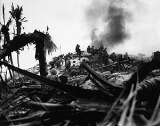
Gilbert and Marshall Islands campaign

Encyclopedia
In the Pacific Theater
of World War II
, the Gilbert and Marshall Islands campaign, from November 1943 through February 1944, were key strategic operations of the United States Pacific Fleet
and Marine Corps
in the Central Pacific. The campaign was preceded by a raid on Makin Island
by U.S. Marines in August, 1942.
Japanese bases in the Gilbert
and Marshall Islands
were the outer perimeter of eastern defenses for the Japanese Empire
. The Marianas campaign
followed the next summer.
occupied the Gilbert Islands 3 days after the attack on Pearl Harbor
, Hawaii
. As a provided token defense of Tarawa, they built a seaplane base on Makin
and dispersed troops along the coastlines of the atolls to monitor the Allied forces
movement in South Pacific
. It was only after Carlson's Raiders attacked
Makin in August 1942 that the Japanese began to fortify and reinforce the Gilberts. The largest and most strategically important islands of the Gilberts was Tarawa. Fortifications were quickly built up by the Japanese starting in March 1943 with nearly 5,000 troops stationed abroad. An additional 3,000 Special Naval Landing Force
and base force troops and 940 naval construction units were supplemented by 1,247 laborers.
By comparison, the Makin islands
were held by only a total of 798 combat troops, including some 100 isolated Japanese aviation personnel. General
Holland M. Smith
, Commanding General of V Amphibious Corps
blamed the Carlson raid for the rapid build-up of Japanese forces and staunchly felt, even long after his retirement, that Tarawa should have been bypassed, instead of incurring heavy Marine casualties during the seizure. Admirals
Chester W. Nimitz, Ernest King
and Raymond A. Spruance
believed that retaking the Gilberts was essential and strategically important for continued movement toward the Marshall Islands
. The code name for the capture of the Gilberts was Galvanic, which called for the seizures of Tarawa, Makin
and Apamama
.
Pacific Theater of Operations
The Pacific Theater of Operations was the World War II area of military activity in the Pacific Ocean and the countries bordering it, a geographic scope that reflected the operational and administrative command structures of the American forces during that period...
of World War II
World War II
World War II, or the Second World War , was a global conflict lasting from 1939 to 1945, involving most of the world's nations—including all of the great powers—eventually forming two opposing military alliances: the Allies and the Axis...
, the Gilbert and Marshall Islands campaign, from November 1943 through February 1944, were key strategic operations of the United States Pacific Fleet
United States Pacific Fleet
The United States Pacific Fleet is a Pacific Ocean theater-level component command of the United States Navy that provides naval resources under the operational control of the United States Pacific Command. Its home port is at Pearl Harbor Naval Base, Hawaii. It is commanded by Admiral Patrick M...
and Marine Corps
United States Marine Corps
The United States Marine Corps is a branch of the United States Armed Forces responsible for providing power projection from the sea, using the mobility of the United States Navy to deliver combined-arms task forces rapidly. It is one of seven uniformed services of the United States...
in the Central Pacific. The campaign was preceded by a raid on Makin Island
Makin Island raid
The Makin Island Raid was an attack by the United States Marine Corps on Japanese military forces on Makin Island in the Pacific Ocean...
by U.S. Marines in August, 1942.
Japanese bases in the Gilbert
Gilbert Islands
The Gilbert Islands are a chain of sixteen atolls and coral islands in the Pacific Ocean. They are the main part of Republic of Kiribati and include Tarawa, the site of the country's capital and residence of almost half of the population.-Geography:The atolls and islands of the Gilbert Islands...
and Marshall Islands
Marshall Islands
The Republic of the Marshall Islands , , is a Micronesian nation of atolls and islands in the middle of the Pacific Ocean, just west of the International Date Line and just north of the Equator. As of July 2011 the population was 67,182...
were the outer perimeter of eastern defenses for the Japanese Empire
Empire of Japan
The Empire of Japan is the name of the state of Japan that existed from the Meiji Restoration on 3 January 1868 to the enactment of the post-World War II Constitution of...
. The Marianas campaign
Mariana and Palau Islands campaign
The Mariana and Palau Islands campaign, also known as Operation Forager, was an offensive launched by United States forces against Imperial Japanese forces in the Mariana Islands and Palau in the Pacific Ocean between June and November, 1944 during the Pacific War...
followed the next summer.
Background
The Japanese forcesImperial Japanese Navy
The Imperial Japanese Navy was the navy of the Empire of Japan from 1869 until 1947, when it was dissolved following Japan's constitutional renunciation of the use of force as a means of settling international disputes...
occupied the Gilbert Islands 3 days after the attack on Pearl Harbor
Pearl Harbor
Pearl Harbor, known to Hawaiians as Puuloa, is a lagoon harbor on the island of Oahu, Hawaii, west of Honolulu. Much of the harbor and surrounding lands is a United States Navy deep-water naval base. It is also the headquarters of the U.S. Pacific Fleet...
, Hawaii
Hawaii
Hawaii is the newest of the 50 U.S. states , and is the only U.S. state made up entirely of islands. It is the northernmost island group in Polynesia, occupying most of an archipelago in the central Pacific Ocean, southwest of the continental United States, southeast of Japan, and northeast of...
. As a provided token defense of Tarawa, they built a seaplane base on Makin
Makin (islands)
Makin is the name of a chain of islands located in the Pacific Ocean island nation of Kiribati, specifically in the Gilbert Islands.-Geography:...
and dispersed troops along the coastlines of the atolls to monitor the Allied forces
Allies
In everyday English usage, allies are people, groups, or nations that have joined together in an association for mutual benefit or to achieve some common purpose, whether or not explicit agreement has been worked out between them...
movement in South Pacific
South West Pacific theatre of World War II
The South West Pacific Theatre, technically the South West Pacific Area, between 1942 and 1945, was one of two designated area commands and war theatres enumerated by the Combined Chiefs of Staff of World War II in the Pacific region....
. It was only after Carlson's Raiders attacked
Makin Island raid
The Makin Island Raid was an attack by the United States Marine Corps on Japanese military forces on Makin Island in the Pacific Ocean...
Makin in August 1942 that the Japanese began to fortify and reinforce the Gilberts. The largest and most strategically important islands of the Gilberts was Tarawa. Fortifications were quickly built up by the Japanese starting in March 1943 with nearly 5,000 troops stationed abroad. An additional 3,000 Special Naval Landing Force
Japanese Special Naval Landing Forces
The Japanese Special Naval Landing Forces , were the marine troops of the Imperial Japanese Navy and were a part of the IJN Land Forces...
and base force troops and 940 naval construction units were supplemented by 1,247 laborers.
By comparison, the Makin islands
Makin (islands)
Makin is the name of a chain of islands located in the Pacific Ocean island nation of Kiribati, specifically in the Gilbert Islands.-Geography:...
were held by only a total of 798 combat troops, including some 100 isolated Japanese aviation personnel. General
General (United States)
In the United States Army, United States Air Force, and United States Marine Corps, general is a four-star general officer rank, with the pay grade of O-10. General ranks above lieutenant general and below General of the Army or General of the Air Force; the Marine Corps does not have an...
Holland M. Smith
Holland Smith
General Holland McTyeire "Howlin' Mad" Smith, KCB was a General in the United States Marine Corps during World War II. He is sometimes called the "father" of modern U.S. amphibious warfare....
, Commanding General of V Amphibious Corps
V Amphibious Corps
The V Amphibious Corps was a formation of the United States Marine Corps and was composed of the 3rd, 4th and 5th Marine Divisions during World War II. They were the amphibious landing force for the United States Fifth Fleet and were notably involved in the battles for Tarawa and Saipan in 1944...
blamed the Carlson raid for the rapid build-up of Japanese forces and staunchly felt, even long after his retirement, that Tarawa should have been bypassed, instead of incurring heavy Marine casualties during the seizure. Admirals
Admiral (United States)
In the United States Navy, the United States Coast Guard and the United States Public Health Service Commissioned Corps, admiral is a four-star flag officer rank, with the pay grade of O-10. Admiral ranks above vice admiral and below Fleet Admiral in the Navy; the Coast Guard and the Public Health...
Chester W. Nimitz, Ernest King
Ernest King
Fleet Admiral Ernest Joseph King was Commander in Chief, United States Fleet and Chief of Naval Operations during World War II. As COMINCH, he directed the United States Navy's operations, planning, and administration and was a member of the Joint Chiefs of Staff. He was the U.S...
and Raymond A. Spruance
Raymond A. Spruance
Raymond Ames Spruance was a United States Navy admiral in World War II.Spruance commanded US naval forces during two of the most significant naval battles in the Pacific theater, the Battle of Midway and the Battle of the Philippine Sea...
believed that retaking the Gilberts was essential and strategically important for continued movement toward the Marshall Islands
Marshall Islands
The Republic of the Marshall Islands , , is a Micronesian nation of atolls and islands in the middle of the Pacific Ocean, just west of the International Date Line and just north of the Equator. As of July 2011 the population was 67,182...
. The code name for the capture of the Gilberts was Galvanic, which called for the seizures of Tarawa, Makin
Makin (islands)
Makin is the name of a chain of islands located in the Pacific Ocean island nation of Kiribati, specifically in the Gilbert Islands.-Geography:...
and Apamama
Abemama
Abemama is an atoll in the central part of the Kiribati Group located 152 kilometres southeast of Tarawa and just north of the Equator.- Geography :...
.