

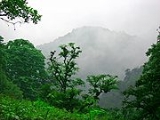
Gilan Province

Encyclopedia
Gilan Province is one of the 31 provinces
of Iran
. It lies along the Caspian Sea
, just west of the province of Mazandaran, east of the province of Ardabil
, north of the provinces of Zanjan
and Qazvin
.
The northern part of the province is part of territory of South (Iranian) Talysh
.
At the center of the province is the main city of Rasht
. Other towns in the province include Astara
, Astaneh-e Ashrafiyyeh
, Fuman, Lahijan
, Langrud, Masouleh
, Manjil
, Rudbar
, Roudsar
, Shaft
, Talesh, and Soumahe Sara
.
The main harbor port of the province is Bandar-e Anzali
(previously Bandar-e Pahlavi).
_4.jpg) The first recorded encounter between Gilak and Deylamite warlords and invading Muslim
The first recorded encounter between Gilak and Deylamite warlords and invading Muslim
Arab
armies was at the Battle of Jalula
in 637 AD. Deylamite commander Muta led an army of Gils, Deylamites, Azerbaijanis and people of the Rey
region. Muta was killed in the battle and his defeated army managed to retreat in an orderly manner.
However, this victory appears to have been a Pyrrhic victory
for the Arabs, since they did not pursue their opponents. Muslim Arabs never managed to conquer Gilan. Gilaks and Deylamites successfully repulsed all Arab attempts to occupy their land or to convert them to Islam
. In fact, it was the Deylamites under the Buyid king Mu'izz al-Dawlah who finally shifted the power by conquering Baghdad
in 945. Mu'izz al-Dawlah however allowed the Abbasid
caliphs to remain in comfortable but secluded captivity in their palaces.
In the 9th and 10th centuries AD, Deylamites and later Gilaks gradually converted to Zaidite Shi'ism
. It is worth noting that several Deylamite commanders and soldiers of fortune who were active in the military theatres of Iran and Mesopotamia
were openly Zoroastrian (for example, Asfar Shiruyeh a warlord in central Iran, and Makan, son of Kaki, the warlord of Rey) or were suspected of harboring pro-Zoroastrian (for example Mardavij
) sentiments. Muslim chronicles of Varangian (Rus, pre-Russian Norsemen) invasions of the littoral Caspian region in the 9th century record Deylamites as non-Muslim. These chronicles also show that the Deylamites were the only warriors in the Caspian region who could fight the fearsome Varangian vikings as equals. Deylamite infantrymen actually had a role very similar to the Swiss Reisläufer
of the Late Middle Ages
in Europe
. Deylamite mercenaries served as far as Egypt
, Islamic Spain
, and in the Khazar Kingdom
.
Buyids established the most successful of the Deylamite dynasties of Iran.
The Turkish
invasions of the 10th and 11th centuries CE, which saw the rise of Ghaznavid and Seljuq dynasties, put an end to Deylamite states in Iran. From the 11th century CE to the rise of Safavids, Gilan was ruled by local rulers who paid tribute to the dominant power south of the Alborz
range, but ruled independently.
In 1307 the Ilkhan Öljeitü conquered the region after witnessing a pyrrhic victory. This was the first time the region came under the rule of the Mongols
after the Ilkhanid Mongols and their Georgian allies
failed to do it in the late 1270s. After 1336, the region seems to be independent again.
Before the introduction of silk
production to this region (date unknown, but definitely a pillar of the economy by the 15th century AD), Gilan was a poor province. There were no permanent trade routes linking Gilan to Persia. There was a small trade in smoked fish and wood products. It seems that the city of Qazvin
was initially a fortress-town against marauding bands of Deylamites, another sign that the economy of the province did not produce enough on its own to support its population. This changed, however, with the introduction of the silk worm in the late Middle Ages.
of the Ottoman Empire
without actually rendering tribute
to the Sublime Porte, in 1534 and 1591.
The Safavid emperor, Shah Abbas I ended the rule of Kia Ahmad Khan, the last semi-independent ruler of Gilan, and annexed the province directly to his empire. From this point in history onward, rulers of Gilan were appointed by the Persian Shah
.
The Safavid empire became weak towards the end of the 17th century CE. By the early 18th century, the once mighty Safavid empire was in the grips of civil war. Peter I of Russia
(Peter the Great) sent an expeditionary force that occupied Gilan for a year (1722–1723).
Qajars established a central government in Persia (Iran) in late 18th century CE. They lost a series of wars to Russia (Russo-Persian Wars 1804-1813 and 1826-28), resulting in an enormous gain of influence by the Russian Empire in the Caspian region. The Gilanian cities of Rasht
and Anzali
were all but occupied by the Russian forces. Anzali served as the main trading port between Iran and Europe.
Gilan was a major producer of silk beginning in 15th century CE. As a result, it was one of the wealthiest provinces in Iran. Safavid annexation in 16th century was at least partially motivated by this revenue stream. The silk trade, though not the production, was a monopoly of the Crown and the single most important source of trade revenue for the imperial treasury. As early as the 16th century and until the mid 19th century, Gilan was the major exporter of silk in Asia
. The Shah
farmed out this trade to Greek
and Armenian merchants, and in return would receive a handsome portion of the proceeds.
In the mid 19th century, a widespread fatal epidemic among the silk worms paralyzed Gilan's economy, causing widespread economic distress. Gilan's budding industrialists and merchants were increasingly dissatisfied with the weak and ineffective rule of the Qajars. Re-orientation of Gilan's agriculture and industry from silk to production of rice
and the introduction of tea
plantations were a partial answer to the decline of silk in the province.
After World War I
, Gilan came to be ruled independently of the central government of Tehran
and concern arose that the province might permanently separate at some point. Prior to the war, Gilanis had played an important role in the Constitutional Revolution of Iran. Sepahdar-e Tonekaboni (Rashti) was a prominent figure in the early years of the revolution and was instrumental in defeating Mohammad Ali Shah Qajar.
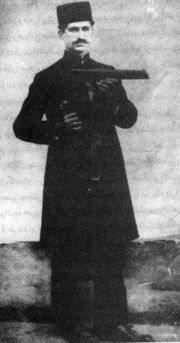
In the late 1910s, many Gilakis gathered under the leadership of Mirza Kuchik Khan, who became the most prominent revolutionary leader in northern Iran in this period. Khan's movement, known as the Jangal movement of Gilan, had sent an armed brigade to Tehran which helped depose the Qajar
ruler Mohammad Ali Shah. However, the revolution did not progress the way the constitutionalists had strived for, and Iran came to face much internal unrest and foreign intervention, particularly from the British and Russian Empires.
The Jangalis are glorified in Iranian history and effectively secured Gilan and Mazandaran against foreign invasions. However, in 1920 British forces invaded Bandar-e Anzali
, while being pursued by the Bolshevik
s. In the midst of this conflict between Britain and Russia, the Jangalis entered into an alliance with the Bolsheviks against the British. This culminated in the establishment of the Persian Socialist Soviet Republic
(commonly known as the Socialist Republic of Gilan), which lasted from June 1920 until September 1921.
In February 1921 the Soviets withdrew their support for the Jangali government of Gilan, and signed the Soviet-Iranian Friendship Treaty with the central government of Tehran. The Jangalis continued to struggle against the central government until their final defeat in September 1921 when control of Gilan returned to Tehran.
with by a large margin the heaviest rainfall in Iran: reaching as high as 1900 millimetres (75 in) in the southwestern coast and generally around 1400 millimetres (55 in). Rasht, the capital of the province, is known internationally as the "City of Silver Rains" and within Iran as the "City of Rain". Rainfall is heaviest between September and December because the onshore winds from the Siberian High
are strongest, but it occurs throughout the year though least abundantly from April to July. Humidity is very high because of the marshy character of the coastal plains and can reach 90 percent in summer for wet bulb temperatures of over 26 °C (79 °F). The Alborz
range provides further diversity to the land in addition to the Caspian coasts.
The coastline is cooler and attracts large numbers of domestic and international tourists. Large parts of the province are mountainous, green and forested. The coastal plain along the Caspian Sea is similar to that of Mazandaran, mainly used for rice
paddies.
In May 1990 large parts of the province were destroyed by a huge earthquake, in which about 45,000 people died. Abbas Kiarostami
made his films Life, and Nothing More...
and Through the Olive Trees
based upon this event.
 The majority of the population speaks Gilaki
as their first language while many children, particularly in the cities, tend to use Standard Persian
amongst themselves. Gilan has some Azerbaijani
-speaking people in Astara
and Manjil
. The northern part of the province is inhabited by Talysh people
. The Kurdish language
is used by some Kurd
s who have moved from Arbil
to the Amarlu
region. The language of Rudbar
is Tati
. Gilanis call themselves gilamard, which is a combination of 'Gil
' and 'Amard
.'
Gilan's position on the Tehran
-Baku
trade route has established the cities of Bandar-e Anzali and Rasht as ranking amongst the most important commercial centers in Iran. As a result, the merchant and middle-classes comprise a significant percentage of the population.
The province has an annual average of 2 million tourists, mostly domestic. Although Iran's Cultural Heritage Organization lists 211 sites of historical and cultural significance in the province, the main tourist attraction in Gilan is the small town of Masouleh
in the hills south-east of Rasht
. The town is built ina fashion not dissimilar to the Pueblo
settlements, with the roof of one house being the courtyard of the next house above.
Gilan has a strong culinary tradition, from which several dishes have come to be adopted across Iran. This richness derives in part from the climate, which allows for a wide variety of fruit, vegetables and nuts to be grown in the province. Seafood
is a particularly strong component of Gilani (and Mazandarani) cuisine. Sturgeon
, often smoked or served as kebab
, and caviar
are delicacies along the whole Caspian littoral. Other types of fish such as mahi sefid
, kuli
, kulmeh
, Caspian salmon
, mahi kapur
and many others are consumed. Fish roe
, or ashpal, is widely used in Gileki cuisine. Traditional Persian stews such as ghalieh mahi (fish stew) and ghalieh maygu (shrimp stew) are also featured and prepared in a uniquely Gilani fashion.
More specific to Gilan are a distinctive walnut-paste and pomegranate-juice sauce, used as a marinade for 'sour' kebab (Kabab Torsh
) and as the basis of Fesenjān
, a rich stew of duck, chicken or lamb. Mirza ghasemi is an aubergine and egg dish with a smoky taste that is often served as a side dish or appetizer. Other such dishes include pickled garlic, olives with walnut paste, and smoked fish. The caviar and smoked fish from the region are, in particular, widely prized and sought after specialities in both domestic and foreign gourmet
markets. See also Cuisine of Iran. Gilan is a popular tourism destination.
Provinces of Iran
Iran is subdivided into thirty one provinces , each governed from a local center, usually the largest local city, which is called the capital of that province...
of Iran
Iran
Iran , officially the Islamic Republic of Iran , is a country in Southern and Western Asia. The name "Iran" has been in use natively since the Sassanian era and came into use internationally in 1935, before which the country was known to the Western world as Persia...
. It lies along the Caspian Sea
Caspian Sea
The Caspian Sea is the largest enclosed body of water on Earth by area, variously classed as the world's largest lake or a full-fledged sea. The sea has a surface area of and a volume of...
, just west of the province of Mazandaran, east of the province of Ardabil
Ardabil Province
Ardabil Province is one of the 31 provinces of Iran. It is in the north west of the country, bordering the Republic of Azerbaijan and the provinces of East Azerbaijan, Zanjan, and Gilan. Its centre is the city of Ardabil...
, north of the provinces of Zanjan
Zanjan Province
Zanjan Province is one of the 31 provinces of Iran. Located in the North West of Iran, its capital is Zanjan city. Zanjan province with an area of 36,400 km² has a mostly rural, population of 964,601 . The province lies 330 km northwest of Tehran, connected to it via a freeway.Zanjan...
and Qazvin
Qazvin Province
The Qazvin Province is one of the 31 provinces of Iran. It is in the north-west of the country, and its center is the city of Qazvin. The province was created in 1993 out of part of Tehran Province and includes 20 cities: Qazvin, Takestan, Abyek, Buin-Zahra, Eqhbalieh, Mohammadieh, Alvand,...
.
The northern part of the province is part of territory of South (Iranian) Talysh
Talysh
Talysh may refer to:*Talysh people*Talysh language*Talysh Khanate*Talysh-Mughan Autonomous Republic - a self-declared autonomy, which existed briefly in the south of Azerbaijan in 1993*Talysh Mountains*Talış, Agsu, Azerbaijan*Talış, Hajigabul, Azerbaijan...
.
At the center of the province is the main city of Rasht
Rasht
Rasht is a city in and the capital of Gilan Province, Iran. At the 2006 census, its population was 551,161, in 159,983 families.Rasht is the largest city on Iran's Caspian Sea coast. It is a major trade center between Caucasia, Russia and Iran using the port of Bandar-e Anzali...
. Other towns in the province include Astara
Astara, Iran
- People :* Religion: Mostly Islam Shi'a Islam* Ethnic groups:90% Azerbaijani, 5% Talysh, 5% other:Persian, Kurd, Russian * Language: Azeri, Persian, Talysh language- Famous people from Astara :* Ebrahim Nabavi - Iranian journalist...
, Astaneh-e Ashrafiyyeh
Astaneh-e Ashrafiyyeh
Astaneh-ye Ashrafiyeh is a city in and the capital of Astaneh-ye Ashrafiyeh County, Gilan Province, Iran. At the 2006 census, its population was 36,298, in 10,558 families....
, Fuman, Lahijan
Lahijan
Lahijan is a city in and the capital of Lahijan County, Gilan Province, Iran. At the 2006 census, its population was 71,871, in 21,518 families....
, Langrud, Masouleh
Masouleh
Masuleh is a city in and the capital of Sardar-e Jangal District, in Fuman County, Gilan Province, Iran. At the 2006 census, its population was 554, in 180 families....
, Manjil
Manjil
Manjil is a city in the Central District of Rudbar County, Gilan Province, Iran. At the 2006 census, its population was 16,028, in 4,447 families.-History and Geography:Manjil is located between N36º45´18˝-N36º41´42˝ and E49º23´6˝ and E49º31´ 48˝...
, Rudbar
Rudbar
Rudbar is a city in and the capital of Rudbar County, Gilan Province, Iran. At the 2006 census, its population was 11,454, in 3,303 families....
, Roudsar
Roudsar
Rudsar is a city in and the capital of Rudsar County, Gilan Province, Iran. At the 2006 census, its population was 33,321, in 9,741 families....
, Shaft
Shaft, Iran
Shaft is a city in and the capital of Shaft County, Gilan Province, Iran. At the 2006 census, its population was 6,158, in 1,700 families.Shaft is located approximately southwest of Rasht. Rural economic activities include rice cultivation, fish farming, and animal husbandry.On Mondays,...
, Talesh, and Soumahe Sara
Soumahe Sara
Soumahe Sara is a city in Iran. It is located in Gilan Province near Rasht....
.
The main harbor port of the province is Bandar-e Anzali
Bandar-e Anzali
Bandar-e Anzali , also Romanized as Bandar-e Pahlavī, Bandar Pahlavi, and Bandar Pahlevi, or simply as Pahlavī, Pahlevī, and Pehlevi; earlier, Enceli and Enzeli) is a city in and the capital of Bandar-e Anzali County, Gilan Province, Iran...
(previously Bandar-e Pahlavi).
History
Muslim
A Muslim, also spelled Moslem, is an adherent of Islam, a monotheistic, Abrahamic religion based on the Quran, which Muslims consider the verbatim word of God as revealed to prophet Muhammad. "Muslim" is the Arabic term for "submitter" .Muslims believe that God is one and incomparable...
Arab
Arab
Arab people, also known as Arabs , are a panethnicity primarily living in the Arab world, which is located in Western Asia and North Africa. They are identified as such on one or more of genealogical, linguistic, or cultural grounds, with tribal affiliations, and intra-tribal relationships playing...
armies was at the Battle of Jalula
Battle of Jalula
Battle of Jalula was fought between Sassanid Empire and Rashidun Caliphate soon after conquest of Ctesiphon.After the capturing Ctesiphon, several detachments were immediately sent to west to capture Qarqeesia and Heet the forts at the border of Byzantine empire...
in 637 AD. Deylamite commander Muta led an army of Gils, Deylamites, Azerbaijanis and people of the Rey
Rey, Iran
Rey or Ray , also known as Rhages and formerly as Arsacia, is the capital of Rey County, Tehran Province, Iran, and is the oldest existing city in the province....
region. Muta was killed in the battle and his defeated army managed to retreat in an orderly manner.
However, this victory appears to have been a Pyrrhic victory
Pyrrhic victory
A Pyrrhic victory is a victory with such a devastating cost to the victor that it carries the implication that another such victory will ultimately cause defeat.-Origin:...
for the Arabs, since they did not pursue their opponents. Muslim Arabs never managed to conquer Gilan. Gilaks and Deylamites successfully repulsed all Arab attempts to occupy their land or to convert them to Islam
Islam
Islam . The most common are and . : Arabic pronunciation varies regionally. The first vowel ranges from ~~. The second vowel ranges from ~~~...
. In fact, it was the Deylamites under the Buyid king Mu'izz al-Dawlah who finally shifted the power by conquering Baghdad
Baghdad
Baghdad is the capital of Iraq, as well as the coterminous Baghdad Governorate. The population of Baghdad in 2011 is approximately 7,216,040...
in 945. Mu'izz al-Dawlah however allowed the Abbasid
Abbasid
The Abbasid Caliphate or, more simply, the Abbasids , was the third of the Islamic caliphates. It was ruled by the Abbasid dynasty of caliphs, who built their capital in Baghdad after overthrowing the Umayyad caliphate from all but the al-Andalus region....
caliphs to remain in comfortable but secluded captivity in their palaces.
In the 9th and 10th centuries AD, Deylamites and later Gilaks gradually converted to Zaidite Shi'ism
Zaidiyyah
Zaidiyya, or Zaidism is a Shi'a Muslim school of thought named after Zayd ibn ʻAlī, the grandson of Husayn ibn ʻAlī. Followers of the Zaydi Islamic jurisprudence are called Zaydi Shi'a...
. It is worth noting that several Deylamite commanders and soldiers of fortune who were active in the military theatres of Iran and Mesopotamia
Mesopotamia
Mesopotamia is a toponym for the area of the Tigris–Euphrates river system, largely corresponding to modern-day Iraq, northeastern Syria, southeastern Turkey and southwestern Iran.Widely considered to be the cradle of civilization, Bronze Age Mesopotamia included Sumer and the...
were openly Zoroastrian (for example, Asfar Shiruyeh a warlord in central Iran, and Makan, son of Kaki, the warlord of Rey) or were suspected of harboring pro-Zoroastrian (for example Mardavij
Mardavij
Mardāvīj , was the founder of the Ziyarids dynasty, who successfully defeated the Abbasid's army firstly in Hamadan , and finally in Kashan and Isfahan...
) sentiments. Muslim chronicles of Varangian (Rus, pre-Russian Norsemen) invasions of the littoral Caspian region in the 9th century record Deylamites as non-Muslim. These chronicles also show that the Deylamites were the only warriors in the Caspian region who could fight the fearsome Varangian vikings as equals. Deylamite infantrymen actually had a role very similar to the Swiss Reisläufer
Swiss mercenaries
Swiss mercenaries were notable for their service in foreign armies, especially the armies of the Kings of France, throughout the Early Modern period of European history, from the Later Middle Ages into the Age of the European Enlightenment...
of the Late Middle Ages
Late Middle Ages
The Late Middle Ages was the period of European history generally comprising the 14th to the 16th century . The Late Middle Ages followed the High Middle Ages and preceded the onset of the early modern era ....
in Europe
Europe
Europe is, by convention, one of the world's seven continents. Comprising the westernmost peninsula of Eurasia, Europe is generally 'divided' from Asia to its east by the watershed divides of the Ural and Caucasus Mountains, the Ural River, the Caspian and Black Seas, and the waterways connecting...
. Deylamite mercenaries served as far as Egypt
Egypt
Egypt , officially the Arab Republic of Egypt, Arabic: , is a country mainly in North Africa, with the Sinai Peninsula forming a land bridge in Southwest Asia. Egypt is thus a transcontinental country, and a major power in Africa, the Mediterranean Basin, the Middle East and the Muslim world...
, Islamic Spain
Al-Andalus
Al-Andalus was the Arabic name given to a nation and territorial region also commonly referred to as Moorish Iberia. The name describes parts of the Iberian Peninsula and Septimania governed by Muslims , at various times in the period between 711 and 1492, although the territorial boundaries...
, and in the Khazar Kingdom
Khazars
The Khazars were semi-nomadic Turkic people who established one of the largest polities of medieval Eurasia, with the capital of Atil and territory comprising much of modern-day European Russia, western Kazakhstan, eastern Ukraine, Azerbaijan, large portions of the northern Caucasus , parts of...
.
Buyids established the most successful of the Deylamite dynasties of Iran.
The Turkish
Turkic peoples
The Turkic peoples are peoples residing in northern, central and western Asia, southern Siberia and northwestern China and parts of eastern Europe. They speak languages belonging to the Turkic language family. They share, to varying degrees, certain cultural traits and historical backgrounds...
invasions of the 10th and 11th centuries CE, which saw the rise of Ghaznavid and Seljuq dynasties, put an end to Deylamite states in Iran. From the 11th century CE to the rise of Safavids, Gilan was ruled by local rulers who paid tribute to the dominant power south of the Alborz
Alborz
Alborz , also written as Alburz, Elburz or Elborz, is a mountain range in northern Iran stretching from the borders of Azerbaijan and Armenia in the northwest to the southern end of the Caspian Sea, and ending in the east at the borders of Turkmenistan and Afghanistan...
range, but ruled independently.
In 1307 the Ilkhan Öljeitü conquered the region after witnessing a pyrrhic victory. This was the first time the region came under the rule of the Mongols
Mongols
Mongols ) are a Central-East Asian ethnic group that lives mainly in the countries of Mongolia, China, and Russia. In China, ethnic Mongols can be found mainly in the central north region of China such as Inner Mongolia...
after the Ilkhanid Mongols and their Georgian allies
Kingdom of Georgia
The Kingdom of Georgia was a medieval monarchy established in AD 978 by Bagrat III.It flourished during the 11th and 12th centuries, the so-called "golden age" of the history of Georgia. It fell to the Mongol invasions of the 13th century, but managed to re-assert sovereignty by 1327...
failed to do it in the late 1270s. After 1336, the region seems to be independent again.
Before the introduction of silk
Silk
Silk is a natural protein fiber, some forms of which can be woven into textiles. The best-known type of silk is obtained from the cocoons of the larvae of the mulberry silkworm Bombyx mori reared in captivity...
production to this region (date unknown, but definitely a pillar of the economy by the 15th century AD), Gilan was a poor province. There were no permanent trade routes linking Gilan to Persia. There was a small trade in smoked fish and wood products. It seems that the city of Qazvin
Qazvin
Qazvin is the largest city and capital of the Province of Qazvin in Iran. At the 2006 census, its population was 349,821, in 96,420 families....
was initially a fortress-town against marauding bands of Deylamites, another sign that the economy of the province did not produce enough on its own to support its population. This changed, however, with the introduction of the silk worm in the late Middle Ages.
Modern history
Gilan recognized twice, for brief periods of time, the suzeraintySuzerainty
Suzerainty occurs where a region or people is a tributary to a more powerful entity which controls its foreign affairs while allowing the tributary vassal state some limited domestic autonomy. The dominant entity in the suzerainty relationship, or the more powerful entity itself, is called a...
of the Ottoman Empire
Ottoman Empire
The Ottoman EmpireIt was usually referred to as the "Ottoman Empire", the "Turkish Empire", the "Ottoman Caliphate" or more commonly "Turkey" by its contemporaries...
without actually rendering tribute
Tribute
A tribute is wealth, often in kind, that one party gives to another as a sign of respect or, as was often the case in historical contexts, of submission or allegiance. Various ancient states, which could be called suzerains, exacted tribute from areas they had conquered or threatened to conquer...
to the Sublime Porte, in 1534 and 1591.
The Safavid emperor, Shah Abbas I ended the rule of Kia Ahmad Khan, the last semi-independent ruler of Gilan, and annexed the province directly to his empire. From this point in history onward, rulers of Gilan were appointed by the Persian Shah
Shah
Shāh is the title of the ruler of certain Southwest Asian and Central Asian countries, especially Persia , and derives from the Persian word shah, meaning "king".-History:...
.
The Safavid empire became weak towards the end of the 17th century CE. By the early 18th century, the once mighty Safavid empire was in the grips of civil war. Peter I of Russia
Peter I of Russia
Peter the Great, Peter I or Pyotr Alexeyevich Romanov Dates indicated by the letters "O.S." are Old Style. All other dates in this article are New Style. ruled the Tsardom of Russia and later the Russian Empire from until his death, jointly ruling before 1696 with his half-brother, Ivan V...
(Peter the Great) sent an expeditionary force that occupied Gilan for a year (1722–1723).
Qajars established a central government in Persia (Iran) in late 18th century CE. They lost a series of wars to Russia (Russo-Persian Wars 1804-1813 and 1826-28), resulting in an enormous gain of influence by the Russian Empire in the Caspian region. The Gilanian cities of Rasht
Rasht
Rasht is a city in and the capital of Gilan Province, Iran. At the 2006 census, its population was 551,161, in 159,983 families.Rasht is the largest city on Iran's Caspian Sea coast. It is a major trade center between Caucasia, Russia and Iran using the port of Bandar-e Anzali...
and Anzali
Bandar-e Anzali
Bandar-e Anzali , also Romanized as Bandar-e Pahlavī, Bandar Pahlavi, and Bandar Pahlevi, or simply as Pahlavī, Pahlevī, and Pehlevi; earlier, Enceli and Enzeli) is a city in and the capital of Bandar-e Anzali County, Gilan Province, Iran...
were all but occupied by the Russian forces. Anzali served as the main trading port between Iran and Europe.
Gilan was a major producer of silk beginning in 15th century CE. As a result, it was one of the wealthiest provinces in Iran. Safavid annexation in 16th century was at least partially motivated by this revenue stream. The silk trade, though not the production, was a monopoly of the Crown and the single most important source of trade revenue for the imperial treasury. As early as the 16th century and until the mid 19th century, Gilan was the major exporter of silk in Asia
Asia
Asia is the world's largest and most populous continent, located primarily in the eastern and northern hemispheres. It covers 8.7% of the Earth's total surface area and with approximately 3.879 billion people, it hosts 60% of the world's current human population...
. The Shah
Shah
Shāh is the title of the ruler of certain Southwest Asian and Central Asian countries, especially Persia , and derives from the Persian word shah, meaning "king".-History:...
farmed out this trade to Greek
Greeks
The Greeks, also known as the Hellenes , are a nation and ethnic group native to Greece, Cyprus and neighboring regions. They also form a significant diaspora, with Greek communities established around the world....
and Armenian merchants, and in return would receive a handsome portion of the proceeds.
In the mid 19th century, a widespread fatal epidemic among the silk worms paralyzed Gilan's economy, causing widespread economic distress. Gilan's budding industrialists and merchants were increasingly dissatisfied with the weak and ineffective rule of the Qajars. Re-orientation of Gilan's agriculture and industry from silk to production of rice
Rice
Rice is the seed of the monocot plants Oryza sativa or Oryza glaberrima . As a cereal grain, it is the most important staple food for a large part of the world's human population, especially in East Asia, Southeast Asia, South Asia, the Middle East, and the West Indies...
and the introduction of tea
Tea
Tea is an aromatic beverage prepared by adding cured leaves of the Camellia sinensis plant to hot water. The term also refers to the plant itself. After water, tea is the most widely consumed beverage in the world...
plantations were a partial answer to the decline of silk in the province.
After World War I
World War I
World War I , which was predominantly called the World War or the Great War from its occurrence until 1939, and the First World War or World War I thereafter, was a major war centred in Europe that began on 28 July 1914 and lasted until 11 November 1918...
, Gilan came to be ruled independently of the central government of Tehran
Tehran
Tehran , sometimes spelled Teheran, is the capital of Iran and Tehran Province. With an estimated population of 8,429,807; it is also Iran's largest urban area and city, one of the largest cities in Western Asia, and is the world's 19th largest city.In the 20th century, Tehran was subject to...
and concern arose that the province might permanently separate at some point. Prior to the war, Gilanis had played an important role in the Constitutional Revolution of Iran. Sepahdar-e Tonekaboni (Rashti) was a prominent figure in the early years of the revolution and was instrumental in defeating Mohammad Ali Shah Qajar.
In the late 1910s, many Gilakis gathered under the leadership of Mirza Kuchik Khan, who became the most prominent revolutionary leader in northern Iran in this period. Khan's movement, known as the Jangal movement of Gilan, had sent an armed brigade to Tehran which helped depose the Qajar
Qajar dynasty
The Qajar dynasty was an Iranian royal family of Turkic descent who ruled Persia from 1785 to 1925....
ruler Mohammad Ali Shah. However, the revolution did not progress the way the constitutionalists had strived for, and Iran came to face much internal unrest and foreign intervention, particularly from the British and Russian Empires.
The Jangalis are glorified in Iranian history and effectively secured Gilan and Mazandaran against foreign invasions. However, in 1920 British forces invaded Bandar-e Anzali
Bandar-e Anzali
Bandar-e Anzali , also Romanized as Bandar-e Pahlavī, Bandar Pahlavi, and Bandar Pahlevi, or simply as Pahlavī, Pahlevī, and Pehlevi; earlier, Enceli and Enzeli) is a city in and the capital of Bandar-e Anzali County, Gilan Province, Iran...
, while being pursued by the Bolshevik
Bolshevik
The Bolsheviks, originally also Bolshevists , derived from bol'shinstvo, "majority") were a faction of the Marxist Russian Social Democratic Labour Party which split apart from the Menshevik faction at the Second Party Congress in 1903....
s. In the midst of this conflict between Britain and Russia, the Jangalis entered into an alliance with the Bolsheviks against the British. This culminated in the establishment of the Persian Socialist Soviet Republic
Persian Socialist Soviet Republic
The Persian Socialist Soviet Republic was a short-lived Soviet republic in the Iranian province of Gilan that lasted from June 1920 until September 1921...
(commonly known as the Socialist Republic of Gilan), which lasted from June 1920 until September 1921.
In February 1921 the Soviets withdrew their support for the Jangali government of Gilan, and signed the Soviet-Iranian Friendship Treaty with the central government of Tehran. The Jangalis continued to struggle against the central government until their final defeat in September 1921 when control of Gilan returned to Tehran.
Administrative divisions
| Map | Abbreviation in map | County County A county is a jurisdiction of local government in certain modern nations. Historically in mainland Europe, the original French term, comté, and its equivalents in other languages denoted a jurisdiction under the sovereignty of a count A county is a jurisdiction of local government in certain... (Shahrestan Shahrestan Shahrestan or Shahristan may refer to:*Counties of Iran*Shahristan District*Shahrestan, Afghanistan... ) |
|---|---|---|
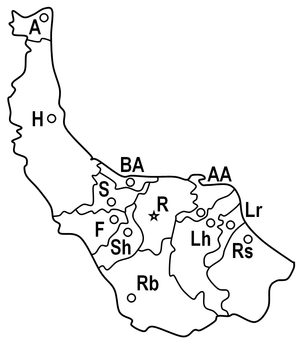 |
||
| A | Astara Astara, Iran - People :* Religion: Mostly Islam Shi'a Islam* Ethnic groups:90% Azerbaijani, 5% Talysh, 5% other:Persian, Kurd, Russian * Language: Azeri, Persian, Talysh language- Famous people from Astara :* Ebrahim Nabavi - Iranian journalist... |
|
| AA | Astaneh Ashrafiyeh Astaneh-e Ashrafiyyeh Astaneh-ye Ashrafiyeh is a city in and the capital of Astaneh-ye Ashrafiyeh County, Gilan Province, Iran. At the 2006 census, its population was 36,298, in 10,558 families.... |
|
| BA | Bandar-e Anzali Bandar-e Anzali Bandar-e Anzali , also Romanized as Bandar-e Pahlavī, Bandar Pahlavi, and Bandar Pahlevi, or simply as Pahlavī, Pahlevī, and Pehlevi; earlier, Enceli and Enzeli) is a city in and the capital of Bandar-e Anzali County, Gilan Province, Iran... |
|
| F | Fuman | |
| H | Hashtpar Rezvanshahr County Rezvanshahr County is a county in Gilan Province in Iran. The capital of the county is Rezvanshahr. At the 2006 census, the county's population was 64,193, in 16,518 families. The county is subdivided into two districts: the Central District and Pareh Sar District... |
|
| Lh | Lahijan Lahijan Lahijan is a city in and the capital of Lahijan County, Gilan Province, Iran. At the 2006 census, its population was 71,871, in 21,518 families.... |
|
| Lr | Langerood Langarud Langarud is a city in and the capital of Langarud County, Gilan Province, Iran. At the 2006 census, its population was 65,369, in 18,875 families.Langarud is located on the south coast of the Caspian Sea... |
|
| R | Rasht Rasht Rasht is a city in and the capital of Gilan Province, Iran. At the 2006 census, its population was 551,161, in 159,983 families.Rasht is the largest city on Iran's Caspian Sea coast. It is a major trade center between Caucasia, Russia and Iran using the port of Bandar-e Anzali... |
|
| Rs | Roudsar Roudsar Rudsar is a city in and the capital of Rudsar County, Gilan Province, Iran. At the 2006 census, its population was 33,321, in 9,741 families.... |
|
| Rb | Rudbar Rudbar Rudbar is a city in and the capital of Rudbar County, Gilan Province, Iran. At the 2006 census, its population was 11,454, in 3,303 families.... |
|
| S | Soumahe Sara Soumahe Sara Soumahe Sara is a city in Iran. It is located in Gilan Province near Rasht.... |
|
| Sh | Shaft Shaft, Iran Shaft is a city in and the capital of Shaft County, Gilan Province, Iran. At the 2006 census, its population was 6,158, in 1,700 families.Shaft is located approximately southwest of Rasht. Rural economic activities include rice cultivation, fish farming, and animal husbandry.On Mondays,... |
|
| M | Masal Masal Masal is a city in and the capital of Masal County, Gilan Province, Iran. At the 2006 census, its population was 10,992, in 2,986 families.... |
Geography and climate
Gilan has a humid subtropical climateHumid subtropical climate
A humid subtropical climate is a climate zone characterized by hot, humid summers and mild to cool winters...
with by a large margin the heaviest rainfall in Iran: reaching as high as 1900 millimetres (75 in) in the southwestern coast and generally around 1400 millimetres (55 in). Rasht, the capital of the province, is known internationally as the "City of Silver Rains" and within Iran as the "City of Rain". Rainfall is heaviest between September and December because the onshore winds from the Siberian High
Siberian High
The Siberian High is a massive collection of cold or very cold dry air that accumulates on the Eurasian terrain for much of the year. It reaches its greatest size and strength in the winter, when the air temperature near the center of the high-pressure cell or anticyclone is often lower than...
are strongest, but it occurs throughout the year though least abundantly from April to July. Humidity is very high because of the marshy character of the coastal plains and can reach 90 percent in summer for wet bulb temperatures of over 26 °C (79 °F). The Alborz
Alborz
Alborz , also written as Alburz, Elburz or Elborz, is a mountain range in northern Iran stretching from the borders of Azerbaijan and Armenia in the northwest to the southern end of the Caspian Sea, and ending in the east at the borders of Turkmenistan and Afghanistan...
range provides further diversity to the land in addition to the Caspian coasts.
The coastline is cooler and attracts large numbers of domestic and international tourists. Large parts of the province are mountainous, green and forested. The coastal plain along the Caspian Sea is similar to that of Mazandaran, mainly used for rice
Rice
Rice is the seed of the monocot plants Oryza sativa or Oryza glaberrima . As a cereal grain, it is the most important staple food for a large part of the world's human population, especially in East Asia, Southeast Asia, South Asia, the Middle East, and the West Indies...
paddies.
In May 1990 large parts of the province were destroyed by a huge earthquake, in which about 45,000 people died. Abbas Kiarostami
Abbas Kiarostami
Abbas Kiarostami is an internationally acclaimed Iranian film director, screenwriter, photographer and film producer. An active filmmaker since 1970, Kiarostami has been involved in over forty films, including shorts and documentaries...
made his films Life, and Nothing More...
Life, and Nothing More...
Life, and Nothing More... is an Iranian film directed by Abbas Kiarostami. It was screened in the Un Certain Regard section at the 1992 Cannes Film Festival...
and Through the Olive Trees
Through the Olive Trees
Through the Olive Trees is a 1994 film directed and written by Iranian director Abbas Kiarostami, set in earthquake-ravaged Northern Iran....
based upon this event.
People and culture
Gilaki language
The Gilaki language is a Caspian language, and a member of the northwestern Iranian language branch, spoken in Iran's Gīlān Province.The language is divided into three dialects: Western Gilaki, Eastern Gilaki, and Galeshi . Furthermore, the Gilaki language is closely related to Mazanderani, and the...
as their first language while many children, particularly in the cities, tend to use Standard Persian
Persian language
Persian is an Iranian language within the Indo-Iranian branch of the Indo-European languages. It is primarily spoken in Iran, Afghanistan, Tajikistan and countries which historically came under Persian influence...
amongst themselves. Gilan has some Azerbaijani
Azerbaijani language
Azerbaijani or Azeri or Torki is a language belonging to the Turkic language family, spoken in southwestern Asia by the Azerbaijani people, primarily in Azerbaijan and northwestern Iran...
-speaking people in Astara
Astara
Astara may refer to:* Astara * Astara, Iran* Astara, Azerbaijansee also: Astana...
and Manjil
Manjil
Manjil is a city in the Central District of Rudbar County, Gilan Province, Iran. At the 2006 census, its population was 16,028, in 4,447 families.-History and Geography:Manjil is located between N36º45´18˝-N36º41´42˝ and E49º23´6˝ and E49º31´ 48˝...
. The northern part of the province is inhabited by Talysh people
Talysh people
Talysh are an Iranian people indigenous to a region shared between Azerbaijan and Iran which spans the South Caucasus and the southwestern shore of the Caspian Sea. They speak the Talysh language, one of the Northwestern Iranian languages...
. The Kurdish language
Kurdish language
Kurdish is a dialect continuum spoken by the Kurds in western Asia. It is part of the Iranian branch of the Indo-Iranian group of Indo-European languages....
is used by some Kurd
Kürd
Kürd or Kyurd or Kyurt may refer to:*Kürd Eldarbəyli, Azerbaijan*Kürd Mahrızlı, Azerbaijan*Kürd, Goychay, Azerbaijan*Kürd, Jalilabad, Azerbaijan*Kürd, Qabala, Azerbaijan*Qurdbayram, Azerbaijan...
s who have moved from Arbil
Arbil
Arbil / Hewlêr is the fourth largest city in Iraq after Baghdad, Basra and Mosul...
to the Amarlu
Amarlu
Amarlu District is a district in Rudbar County, Gilan Province, Iran. At the 2006 census, its population was 7,970, in 2,350 families. The District has one city: Jirandeh.-Tribes:...
region. The language of Rudbar
Rudbar
Rudbar is a city in and the capital of Rudbar County, Gilan Province, Iran. At the 2006 census, its population was 11,454, in 3,303 families....
is Tati
Tati (Iran)
Tati is a group of northwestern Iranian dialects which are closely related to the Talysh language.Some sources use the term old Azari/Azeri to refer to the Tati language which was spoken in the region before the spread of Turkic languages , and is now only spoken by different rural communities in...
. Gilanis call themselves gilamard, which is a combination of 'Gil
Gil
- Places :* Gil Island , one of several islands by that name* Gil, Azerbaijan , places named Gil in Azerbaijan-Given name:* Gil Amelio, technology executive and former CEO of Apple Inc.* Gil Baiano, Brazilian footballer...
' and 'Amard
Amard
The Amard people, or Amardis were a tribe living along the southern shore of the Caspian Sea, including current day Amol, Iran. The name is also seen as Amardi, Amardian, Amardae, etc....
.'
Gilan's position on the Tehran
Tehran
Tehran , sometimes spelled Teheran, is the capital of Iran and Tehran Province. With an estimated population of 8,429,807; it is also Iran's largest urban area and city, one of the largest cities in Western Asia, and is the world's 19th largest city.In the 20th century, Tehran was subject to...
-Baku
Baku
Baku , sometimes spelled as Baki or Bakou, is the capital and largest city of Azerbaijan, as well as the largest city on the Caspian Sea and of the Caucasus region. It is located on the southern shore of the Absheron Peninsula, which projects into the Caspian Sea. The city consists of two principal...
trade route has established the cities of Bandar-e Anzali and Rasht as ranking amongst the most important commercial centers in Iran. As a result, the merchant and middle-classes comprise a significant percentage of the population.
The province has an annual average of 2 million tourists, mostly domestic. Although Iran's Cultural Heritage Organization lists 211 sites of historical and cultural significance in the province, the main tourist attraction in Gilan is the small town of Masouleh
Masouleh
Masuleh is a city in and the capital of Sardar-e Jangal District, in Fuman County, Gilan Province, Iran. At the 2006 census, its population was 554, in 180 families....
in the hills south-east of Rasht
Rasht
Rasht is a city in and the capital of Gilan Province, Iran. At the 2006 census, its population was 551,161, in 159,983 families.Rasht is the largest city on Iran's Caspian Sea coast. It is a major trade center between Caucasia, Russia and Iran using the port of Bandar-e Anzali...
. The town is built ina fashion not dissimilar to the Pueblo
Pueblo
Pueblo is a term used to describe modern communities of Native Americans in the Southwestern United States of America. The first Spanish explorers of the Southwest used this term to describe the communities housed in apartment-like structures built of stone, adobe mud, and other local material...
settlements, with the roof of one house being the courtyard of the next house above.
Gilan has a strong culinary tradition, from which several dishes have come to be adopted across Iran. This richness derives in part from the climate, which allows for a wide variety of fruit, vegetables and nuts to be grown in the province. Seafood
Seafood
Seafood is any form of marine life regarded as food by humans. Seafoods include fish, molluscs , crustaceans , echinoderms . Edible sea plants, such as some seaweeds and microalgae, are also seafood, and are widely eaten around the world, especially in Asia...
is a particularly strong component of Gilani (and Mazandarani) cuisine. Sturgeon
Sturgeon
Sturgeon is the common name used for some 26 species of fish in the family Acipenseridae, including the genera Acipenser, Huso, Scaphirhynchus and Pseudoscaphirhynchus. The term includes over 20 species commonly referred to as sturgeon and several closely related species that have distinct common...
, often smoked or served as kebab
Kebab
Kebab is a wide variety of meat dishes originating in Middle East and later on adopted by the Middle East, and Asia Minor, and now found worldwide. In English, kebab with no qualification generally refers more specifically to shish kebab served on the skewer...
, and caviar
Caviar
Caviar, sometimes called black caviar, is a luxury delicacy, consisting of processed, salted, non-fertilized sturgeon roe. The roe can be "fresh" or pasteurized, the latter having much less culinary and economic value....
are delicacies along the whole Caspian littoral. Other types of fish such as mahi sefid
Kutum (fish)
The Kutum also known as "Kütüm" in Azerbaijani, "Caspian White Fish", "Caspian Roach", "māhi sefid" ماهی سفید in Persian, "Talaji" in Mazandarani, and "sifid mahyi" in Gileki , is a medium sized fresh water and brackish water fish native to the Caspian Sea...
, kuli
Rutilus
Rutilus is a genus of fishes in the family Cyprinidae, commonly called roaches. Locally, the name "roach" without any further qualifiers is also used for particular species, particularly the Common Roach Rutilus (Latin for "shining, red, golden, auburn") is a genus of fishes in the family...
, kulmeh
Carp bream
The common bream, freshwater bream, bream, bronze bream or carp bream, Abramis brama, is a European species of freshwater fish in the family Cyprinidae....
, Caspian salmon
Salmon
Salmon is the common name for several species of fish in the family Salmonidae. Several other fish in the same family are called trout; the difference is often said to be that salmon migrate and trout are resident, but this distinction does not strictly hold true...
, mahi kapur
Carp
Carp are various species of oily freshwater fish of the family Cyprinidae, a very large group of fish native to Europe and Asia. The cypriniformes are traditionally grouped with the Characiformes, Siluriformes and Gymnotiformes to create the superorder Ostariophysi, since these groups have certain...
and many others are consumed. Fish roe
Roe
Roe or hard roe is the fully ripe internal egg masses in the ovaries, or the released external egg masses of fish and certain marine animals, such as shrimp, scallop and sea urchins...
, or ashpal, is widely used in Gileki cuisine. Traditional Persian stews such as ghalieh mahi (fish stew) and ghalieh maygu (shrimp stew) are also featured and prepared in a uniquely Gilani fashion.
More specific to Gilan are a distinctive walnut-paste and pomegranate-juice sauce, used as a marinade for 'sour' kebab (Kabab Torsh
Kabab Torsh
Kabab torsh is a traditional kebab from Gilan province in Iran. It is made with beef - usually sirloin or tenderloin - marinated in a paste made of crushed walnuts, pomegranate juice, chopped parsley, olive oil, and crushed garlic....
) and as the basis of Fesenjān
Fesenjan
Khoresht-e fesenjān , or simply fesenjān , is a dish in Persian cuisine and Mesopotamian cuisine. It is a thick, tart stew made from pomegranate juice and ground walnuts . It is traditionally made with poultry ; but variants using balls of ground meat, ghormeh cut lamb, fish, or no meat at all are...
, a rich stew of duck, chicken or lamb. Mirza ghasemi is an aubergine and egg dish with a smoky taste that is often served as a side dish or appetizer. Other such dishes include pickled garlic, olives with walnut paste, and smoked fish. The caviar and smoked fish from the region are, in particular, widely prized and sought after specialities in both domestic and foreign gourmet
Gourmet
Gourmet is a cultural ideal associated with the culinary arts of fine food and drink, or haute cuisine, which is characterised by elaborate preparations and presentations of large meals of small, often quite rich courses...
markets. See also Cuisine of Iran. Gilan is a popular tourism destination.
Notable people
- Yousuf Raza Gilani, Prime Minister of PakistanPakistanPakistan , officially the Islamic Republic of Pakistan is a sovereign state in South Asia. It has a coastline along the Arabian Sea and the Gulf of Oman in the south and is bordered by Afghanistan and Iran in the west, India in the east and China in the far northeast. In the north, Tajikistan...
- Abdul-Qadir Gilani
- Ebrahim PoordavoodEbrahim PoordavoodEbrāhim Pourdāvoud , was born in Rasht, Iran, to a mother who was the daughter of a clergyman and a father who was a reputable merchant and landlord. He is one of the most formidable scholars of Iran during the 20th century. Pourdavoud translated Avesta into Persian in six volumes...
- Mohammad Ali Mojtahedi Gilani, founder of Sharif University of TechnologySharif University of TechnologySharif University of Technology is a university of higher education in technology, engineering and physical sciences in Tehran. Sharif University of Technology is one of the most prestigious universities in the country, and is considered Iran's MIT...
- Ardeshir MohassessArdeshir MohassessArdeshir Mohasses was an Iranian illustrator and cartoonist, residing in New York.-Biography:...
, cartoonist - Mirza Kuchek Khan, founder of Constitutionalist movement of GilanConstitutionalist movement of GilanThe Jangal movement, in Gilan, was a rebellion against the monarchist rule of the Qajar central government of Iran. It is considered as the extension of Constitutional Revolution of Iran and lasted from 1914 to 1921.-History of the movement:...
- Arsen MinasianArsen MinasianArsen Minasian was an Armenian-Iranian who was born in Rasht, Iran. He was the founder of Gilan's sanatorium in 1954 which is the first modern sanatorium in Iran....
- Hazin LahijiHazin LahijiHazīn Lāhījī , is the pen-name of Mohammad Ali ibn Abi Tāleb ibn Abd Āllah, also known as Mohammad Ali ibn Abi Tāleb Hazin Lāhiji, Mohammad ibn Abi Tāleb Gilāni and Sheikh Mohammad Ali Hazin Lāhiji. He was an Iranian poet and scholar, born into an eminent family in Esfahan...
, poet - Mohammad Taghi Bahjat FoumaniMohammad Taghi Bahjat FoumaniGrand Ayatollah Mohammad Taghi Bahjat Foumani was an Iranian Twelver Shi'a Marja with political and social views close to fundamentalist schools. He was a student of the famous mystic, Sayed Ali Qadhi Tabatabaei, and also a student of Abulhasan Isfahani and Mirza Naini...
, Twelver Shi'a MarjaMarjaMarja , also known as a marja-i taqlid or marja dini , literally means "Source to Imitate/Follow" or "Religious Reference"... - Al-JilaniAl-JilaniHakim Ali ibn Kamal al-Din Muhammad Gilani was a 16th century Persian royal physician from Gilan, Iran.He came from Persia to the Mughal court of Akbar and served under several Mughal rulers in northwest India...
- Mahmoud BehzadMahmoud BehzadProfessor Mahmoud Behzad , born in Rasht, the Capital city of Gilan province, is known as the father of new Biology science in Iran. He has written more than 100 books in Persian and participated in the authorship process of more than 200 books in Iran....
- Majid SamiiMajid SamiiMadjid Samii is a distinguished German-Iranian neurosurgeon and medical scientist.Professor Samii was born in Rasht, Iran and got his professor degree in neurosurgery at the age of 33...
, brain surgeon in GermanyGermanyGermany , officially the Federal Republic of Germany , is a federal parliamentary republic in Europe. The country consists of 16 states while the capital and largest city is Berlin. Germany covers an area of 357,021 km2 and has a largely temperate seasonal climate... - Pejman NouriPejman NouriPejman Nouri is an Iranian football player, currently playing for UAE Pro-League side Emirates Club and Iran national football team in the midfielder position.-Club career:Born in Rezvanshahr, Gilan Province, he has spent most of his career in Malavan F.C...
, football player - Mohammad MoinMohammad MoinMohammad Moin was a prominent Iranian scholar of Persian literature and Iranian Studies....
, prominent Iranian scholar of Persian literature and Iranology - Sirous GhayeghranSirous GhayeghranSirous Ghayeghran was a famous Iranian footballer and former captain of Iran national football team. He is notably referred as the legendary player of Malavan Bandar Anzali Football Club, and is one of the most popular icons in the city of Bandar Anzali.-Club career:He played most of his club...
, former Captain of Iranian national football team - Ghafour JahaniGhafour JahaniGhafour Jahani is an Iranian football coach and former player.He Mostly played for Malavan. He was one of the key players of Malavan reaching the third place in the Iranian Takht Jamshid in 1978. 1974 and 1977 he was the second best scorer of the Iranian league...
, footballer - Hushang EbtehajHushang EbtehajHushang Ebtehaj , with the pen name of H. E. Sayeh is an eminent Iranian poet of the 20th century, whose life and work spans many of Iran's political, cultural and literary upheavals....
, contemporary poet - MardavijMardavijMardāvīj , was the founder of the Ziyarids dynasty, who successfully defeated the Abbasid's army firstly in Hamadan , and finally in Kashan and Isfahan...
, Former king of Iran - Fazlollah RezaFazlollah RezaFazlollah M. Reza is an Iranian university professor. He was born in Rasht, Iran.-Career:Reza graduated from Faculty of Engineering, University of Tehran in 1938 by receiving his bachelor's degree in electrical engineering...
, second Head of Sharif University of TechnologySharif University of TechnologySharif University of Technology is a university of higher education in technology, engineering and physical sciences in Tehran. Sharif University of Technology is one of the most prestigious universities in the country, and is considered Iran's MIT... - Khosrow Golsorkhi, journalist, poet, and communist activist
- Syed Ali Shah Geelani, Prominent Kashmiri leader.
Colleges and universities
- University of Gilanhttp://www.gu.ac.ir
- Islamic Azad University of Astara
- Islamic Azad University of Bandar Anzali
- Islamic Azad University of Rasht
- Islamic Azad University of LahijanIslamic Azad University of LahijanIslamic Azad University of Lahijan is a campus of Islamic Azad University system in Iran....
- Gilan University of Medical SciencesGilan University of Medical SciencesGilan University of Medical Sciences , is a medical school in Gilan Province of Iran.Located in the city of Rasht, the university fell under the Ministry of Health and Medical Education in 1986, the same year it was established....
- Institute of Higher Education for Academic Jihad of Rasht
- Technical & Vocational Training Organization of Gilan
See also
- Constitutionalist movement of GilanConstitutionalist movement of GilanThe Jangal movement, in Gilan, was a rebellion against the monarchist rule of the Qajar central government of Iran. It is considered as the extension of Constitutional Revolution of Iran and lasted from 1914 to 1921.-History of the movement:...
- Soviet Republic of Gilan
- Gill (clan)Gill (clan)Gill is a gotra/surname of the Jat ethnicity found in Punjab. Though, to westerners, Gill seems like a familiar given name , the Gill surname does not have the same etymological origins. "Gill" stands out to be one of the most popular surnames of the Jat race, with population of Gills being resided...
- GilaniGilaniGilani or Jilani or Kilani may refer to:* a gentilic of Gilan, Iran* MV Gilani, an Empire F type coaster which sank at Montreal on 22 April 1972.* Gillani Railway Station, a neighbourhood in Karachi, Pakistan....
- Rudkhan CastleRudkhan CastleRud-khan Castle is a brick and stone medieval castle in Iran.Located 25 km southwest of Foman city north of Iran in Gilan province, it is a military complex which had been constructed during the Seljuk Dynasty by followers of the Ismā'īlī sect. The castle is built on two tips of a mount, with...
External links
- Guilan.net
- Association of Guilan Supporters Official website (in Persian only)
- Gilan entry in the Encyclopædia Iranica
- Gilan University of Medical Sciences Health Information Center (in English)
- Gilan Cultural Heritage Organization (An excellent source of info in Persian)
- Masouleh Village Official website (inaccessible to English readers)
- Shapour Bahrami, Masouleh, Iran, Photo Set, flickr.
- Gilan Province Office of Tourism
- Gilan Province Department of Education (in Persian)
- Two Gilani folk-songs sung by Shusha Guppy in the 1970s: The Rain, Darling Leila.
- Āhā Bugu (Oh, say it!), a Gilaki folk-song: YouTube (4 min 54 sec).
- Hamid-Reza Hosseini, Rural Heritage, in Persian, Jadid Online, 17 November 2008, http://www.jadidonline.com/story/17112008/frnk/gilan_rural_museum.
A shortened version in English with the title Gilan's Rural Geritage Museum, Jadid Online, 22 January 2009: http://www.jadidonline.com/story/22012009/frnk/gilan_rural_museum_eng.
A slide show of Gilan's Rural Heritage Museum with English subtitles, Jadid Online, 22 January 2009: http://www.jadidonline.com/images/stories/flash_multimedia/Gilan_rural_museum_eng_test/Gilan_high.html (5 min 41 sec). - Mohammad-Taqi Pourahmad Jacktaji, Gilan Midsummer NowruzNowruzNowrūz is the name of the Iranian New Year in Iranian calendars and the corresponding traditional celebrations. Nowruz is also widely referred to as the Persian New Year....
, in English, Jadid Online, 1 October 2009, http://www.jadidonline.com/story/01102009/frnk/nowruz_bal_eng (in Persian: http://www.jadidonline.com/story/14082009/frnk/nowruz_bal).
An audio slideshow with English subtitles: http://www.jadidonline.com/images/stories/flash_multimedia/Nowruz_bal_eng_test/bal_high.html (4 min 38 sec).