
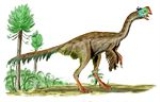
Gigantoraptor is a
genusIn biology, a genus is a low-level taxonomic rank used in the biological classification of living and fossil organisms, which is an example of definition by genus and differentia...
of giant
oviraptorosauriaOviraptorosaurs are a group of feathered maniraptoran dinosaurs from the Cretaceous Period of what are now Asia and North America. They are distinct for their characteristically short, beaked, parrot - like skulls, with or without bony crests atop the head...
n theropod
dinosaurDinosaurs are a diverse group of animals of the clade and superorder Dinosauria. They were the dominant terrestrial vertebrates for over 160 million years, from the late Triassic period until the end of the Cretaceous , when the Cretaceous–Paleogene extinction event led to the extinction of...
that lived 70 million years ago during the late Cretaceous Period. It was discovered in 2005 in the
Iren Dabasu FormationThe Iren Dabasu Formation is a Mesozoic geologic formation. Dinosaur remains diagnostic to the genus level are among the fossils that have been recovered from the formation.-Ornithischians:-Saurischians:-References:...
,
ErlianErenhot is a city located in the Gobi Desert, in the Xilin Gol league of the Inner Mongolia Autonomous Region of the People's Republic of China . It has 16,330 inhabitants and the elevation is...
basin, in
Inner MongoliaInner Mongolia is an autonomous region of the People's Republic of China, located in the northern region of the country. Inner Mongolia shares an international border with the countries of Mongolia and the Russian Federation...
.
Discovery and naming
Since 2001, in a quarry at Saihangaobi, in Sonid Zuoqi, numerous remains of the sauropod
SonidosaurusSonidosaurus is a genus of sauropod dinosaur from the Late Cretaceous. It was a titanosaur which lived in what is now China. The type species, Sonidosaurus saihangaobiensis, was described by Xu, Zhang, Tan, Zhao, and Tan in 2006. It was a small titanosaur, about 9 meters long...
have been uncovered. In April 2005 Chinese paleontologist Xu Xing was asked to reenact the discovery of
Sonidosaurus for a Japanese documentary. Xu obliged them by digging out a thighbone. As he wiped the bone clean, he suddenly realized it was not from a sauropod, but from an unidentifiable theropod in the size class of
AlbertosaurusAlbertosaurus is a genus of tyrannosaurid theropod dinosaur that lived in western North America during the Late Cretaceous Period, more than 70 million years ago. The type species, A. sarcophagus, was apparently restricted in range to the modern-day Canadian province of Alberta, after which...
. He then stopped the filming to secure the serendipitous find. This way, the discovery of the
Gigantoraptor holotypeA holotype is a single physical example of an organism, known to have been used when the species was formally described. It is either the single such physical example or one of several such, but explicitly designated as the holotype...
fossil was documented on film.
In 2007 the
type speciesIn biological nomenclature, a type species is both a concept and a practical system which is used in the classification and nomenclature of animals and plants. The value of a "type species" lies in the fact that it makes clear what is meant by a particular genus name. A type species is the species...
Gigantoraptor erlianensis was named and described by Xu, Tan Qingwei,
Wang JianminFor the Washington Nationals pitcher, see Chien-Ming Wang.Wang Jianmin is a Lieutenant General in the Chinese military...
,
Zhao XijinZhao Xijin is a Chinese paleontologist. He is notable for having named numerous dinosaurs. He is currently a professor at Beijing's Institute of Vertebrate Paleontology and Paleoanthropology.-Career:...
and Tan Lin. The generic name is derived from
LatinLatin is an Italic language originally spoken in Latium and Ancient Rome. It, along with most European languages, is a descendant of the ancient Proto-Indo-European language. Although it is considered a dead language, a number of scholars and members of the Christian clergy speak it fluently, and...
giganteus, "gigantic" and
raptor, "seizer". The specific name refers to the Erlian Basin.
The only known type specimen,
LH V0011, was found in layers dating to the
CampanianThe Campanian is, in the ICS' geologic timescale, the fifth of six ages of the Late Cretaceous epoch . The Campanian spans the time from 83.5 ± 0.7 Ma to 70.6 ± 0.6 Ma ...
-
MaastrichtianThe Maastrichtian is, in the ICS' geologic timescale, the latest age or upper stage of the Late Cretaceous epoch or Upper Cretaceous series, the Cretaceous period or system, and of the Mesozoic era or erathem. It spanned from 70.6 ± 0.6 Ma to 65.5 ± 0.3 Ma...
, about seventy million years old. It consists of is the incomplete and disassociated remains of a single subadult individual, a partial skeleton lacking the skull but including the lower jaws, a single neck vertebra, most of the back and tail and the majority of the frontlimb and hindlimb elements.
Description
It was clear to Xu
et al. that
Gigantoraptor belonged to the
OviraptorosauriaOviraptorosaurs are a group of feathered maniraptoran dinosaurs from the Cretaceous Period of what are now Asia and North America. They are distinct for their characteristically short, beaked, parrot - like skulls, with or without bony crests atop the head...
, a group named after
OviraptorOviraptor is a genus of small Mongolian theropod dinosaur, first discovered by the paleontologist Roy Chapman Andrews, and first described by Henry Fairfield Osborn, in 1924...
, but compared to other known members,
Gigantoraptor was much larger, approximately three times as long and 35 times more massive than the heaviest earlier discovered oviraptorosaurid
CitipatiCitipati is a genus of oviraptorid theropod dinosaur from the Late Cretaceous Period of what is now Mongolia . It is one of the best-known oviraptorids, thanks to a number of well-preserved skeletons, including several specimens found in brooding positions atop nests of eggs...
. Xu
et al. estimated the length at 8 metres (26 ft) and the weight at 1400 kilogrammes. In 2010
Gregory S. PaulGregory Scott Paul is a freelance researcher, author and illustrator who works in paleontology, and more recently has examined sociology and theology. He is best known for his work and research on theropod dinosaurs and his detailed illustrations, both live and skeletal...
even gave an estimate of two tonnes (2.2 tons).
The toothless lower jaws of
Gigantoraptor are fused into a broad shovel-like mandibula. They indicate that the unknown skull was over half a metre long and toothless also, probably equipped with a horny beak. The front tail vertebrae have very long neural spines and are heavily pneumaticised with deep pleurocoels. The middle section of the relatively short tail is somewhat stiffened by long prezygapophyses. The back tail vertebrae are lightened by spongeous bone. The front limb is rather long because of an elongated slender hand. The
humerusThe humerus is a long bone in the arm or forelimb that runs from the shoulder to the elbow....
is bowed outwards to an exceptionally large extent and has a very rounded head. The first metacarpal is very short and carries a strongly diverging thumb. The hindlimb is also long because of an elongated lower leg. The thighbone is relatively slender and short with a distinct head and neck. The foot is robust with large and strongly curved toe claws.
No direct evidence of feathers was preserved with the skeleton, but Xu
et al. (2007) discussed their likely presence on
Gigantoraptor. They admitted that despite
Gigantoraptor being a member of the Oviraptorosauria, a group that includes the feathered species
CaudipteryxCaudipteryx is a genus of peacock-sized theropod dinosaurs that lived in the Aptian age of the early Cretaceous Period . They were feathered and remarkably birdlike in their overall appearance....
and
ProtarchaeopteryxProtarchaeopteryx is a genus of turkey-sized feathered theropod dinosaur from China. Known from the Jianshangou bed of the Yixian Formation, it lived during the early Aptian age of the Early Cretaceous, approximately 124.6 million years ago...
, it might have been "naked" because it is three hundred times more massive than these species, and very large animals may rely more on mass for temperature regulation, losing the insulating coverings found on their smaller relatives. However, they suggested that at least arm feathers were probably still present on
Gigantoraptor, since their primary functions, such as display and covering the eggs while brooding, are not related to the regulation of body heat.
Phylogeny
In 2007 Xu
et al. assigned
Gigantoraptor to the
OviraptoridaeOviraptoridae is a group of bird-like, herbivorous and omnivorous maniraptoran dinosaurs. Oviraptorids are characterized by their toothless, parrot-like beaks and, in some cases, elaborate crests. They were generally small, measuring between one and two metres long in most cases, though some...
, in a basal position. The anatomy of
Gigantoraptor includes the diagnostic features of the
OviraptorosaursOviraptorosaurs are a group of feathered maniraptoran dinosaurs from the Cretaceous Period of what are now Asia and North America. They are distinct for their characteristically short, beaked, parrot - like skulls, with or without bony crests atop the head...
. However, it also includes several features found in more derived eumaniraptoran dinosaurs, such as a frontlimb/hindlimb ratio of 60%, a lack of expansion of the distal
scapulaIn anatomy, the scapula , omo, or shoulder blade, is the bone that connects the humerus with the clavicle ....
and the lack of a fourth trochanter on the thighbone. Despite its size,
Gigantoraptor would thus have been more bird-like than its smaller oviraptorosaurian relatives.
In 2010 a second analysis of
Gigantoraptor relationships found it to be a member of the Caenagnathidae rather than an oviraptorid.
Paleobiology
The diet of
Gigantoraptor is uncertain. Although some oviraptorosaurs such as
CaudipteryxCaudipteryx is a genus of peacock-sized theropod dinosaurs that lived in the Aptian age of the early Cretaceous Period . They were feathered and remarkably birdlike in their overall appearance....
and
IncisivosaurusIncisivosaurus is a genus of small, probably herbivorous theropod dinosaur from the early Cretaceous Period of what is now the People's Republic of China...
are thought to have been mostly
herbivorousHerbivores are organisms that are anatomically and physiologically adapted to eat plant-based foods. Herbivory is a form of consumption in which an organism principally eats autotrophs such as plants, algae and photosynthesizing bacteria. More generally, organisms that feed on autotrophs in...
,
Gigantoraptor had long hind legs with proportions that allowed for fast movement (it was probably more nimble than the larger and less agile
TarbosaurusTarbosaurus is a genus of tyrannosaurid theropod dinosaur that flourished in Asia about 70 million years ago, at the end of the Late Cretaceous Period. Fossils have been recovered in Mongolia, with more fragmentary remains found further afield in parts of China. Although many species have been...
), and large claws, a combination that is not usually found in herbivores of this size. Paul suggested that
Gigantoraptor also was a herbivore and used its speed to escape predators.
The specimen has advanced ossification and growth rings in the
fibula that indicate it was likely eleven years of age when it died. It appears to have reached an early young adult stage at age seven, and probably would have grown much larger when it reached the adult stage. This indicates a growth rate that is faster than in most large non-avian theropods.
The existence of giant oviraptorosaurians as
Gigantoraptor explains several earlier Asian finds of very large, up to 53 centimetres long, oviraptorosaurian eggs, assigned to the oospecies
MacroelongatoolithusMacroelongatoolithus is an oogenus of dinosaur egg.-References:* Carpenter, K. 1999. Eggs, Nests, and Baby Dinosaurs: A Look at Dinosaur Reproduction . Indiana University Press, Bloomington, Indiana....
xixiaensis. These were laid in enormous rings with a diameter of three metres.
External links
- news@nature.com: "Giant bird-like dinosaur found".
- Wired Science Scientists Discover 3,000-Pound Gigantoraptor Dinosaur in Mongolia
- Fleshed-out restoration of a Gigantoraptor erlianensis. Credit: Julius T. Csotonyi
Julius Thomas Csotonyi is a Canadian paleoartist and natural history illustrator living in Winnipeg, Canada. He specialises in photo-realistic restorations of dinosaurs, paleo-environments and extant animals. His techniques encompass both traditional and digital media...
- Yahoo! News: China finds new species of big, bird-like dinosaur
- Description: Factsheet with picture English/German at Dinosaurier-Web