

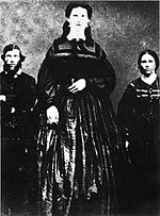
Gigantism

Encyclopedia
Gigantism, also known as giantism (from Greek
γίγας gigas, "giant", plural γίγαντες gigantes), is a condition characterized by excessive growth and height significantly above average. In humans, this condition is caused by over-production of growth hormone
in childhood before the long bone epiphyses closes.
s above mean for persons of the same sex, age, and ethnic ancestry. The term is seldom applied to those who are simply "tall" or "above average" whose heights appear to be the healthy result of normal genetics
and nutrition. It is usually caused by a tumor on the pituitary gland
of the brain. It causes growth of the hands, face, and feet. In some cases the condition can be passed on genetically through a mutated gene.
Other names somewhat obsolete for this pathology are hypersomia (Greek: hyper over the normal level; soma body) and somatomegaly (Greek; soma body, genitive somatos of the body; megas, gen. megalou great).
In the past, while many of them were social outcasts because of their height, some (usually unintentionally) found employment in Friedrich Wilhelm I
's famous Potsdam Giants
regiment.
Many of those who have been identified with gigantism have suffered from multiple health problems involving their circulatory
or skeletal system.
, a Greek mythological giant, and including Gigantus, after whom giants and gigantism are named. Rhodes
is another island where giants were said to have lived, with the Colossus of Rhodes
a giant statue of a giant patron god Helios
. In Asterix at the Olympic Games
(published to coincide with the 1968 Summer Olympics
in Mexico City
), René Goscinny
and Albert Uderzo
depict a 'Colossal' Olympic player from Rhodes, whose family are all extremely tall. In Asterix in Normandy they meet giant Viking
s who have a giant dog looking down at Dogmatix
.
In modern literature and movies giants are depicted as initially feared but when met are seen as friendly:
In Roald Dahl
's The BFG
(Big Friendly Giant), most giants are scary except the BFG.
In The Princess Bride
, Fezzik (played by André the Giant
) is a giant on the brute squad, but turns out to be very gentle. In a a tribute to Andre posted on YouTube
, he is quoted as saying that he enjoyed being on the film's set because outside it "Nobody looks at me."
In the film Big Fish
(2003), Matthew McGrory
plays Karl, a gentle giant, who is feared by the city and forced to eat people in order to save himself from starvation.
In the books and adaptions of the Alice in Wonderland Series byLewis Carroll
The Red Queen has a big head, suffering from macrocephalia.
Greek language
Greek is an independent branch of the Indo-European family of languages. Native to the southern Balkans, it has the longest documented history of any Indo-European language, spanning 34 centuries of written records. Its writing system has been the Greek alphabet for the majority of its history;...
γίγας gigas, "giant", plural γίγαντες gigantes), is a condition characterized by excessive growth and height significantly above average. In humans, this condition is caused by over-production of growth hormone
Growth hormone
Growth hormone is a peptide hormone that stimulates growth, cell reproduction and regeneration in humans and other animals. Growth hormone is a 191-amino acid, single-chain polypeptide that is synthesized, stored, and secreted by the somatotroph cells within the lateral wings of the anterior...
in childhood before the long bone epiphyses closes.
Terminology
The term is typically applied to those whose height is not just in the upper 1% of the population but several standard deviationStandard deviation
Standard deviation is a widely used measure of variability or diversity used in statistics and probability theory. It shows how much variation or "dispersion" there is from the average...
s above mean for persons of the same sex, age, and ethnic ancestry. The term is seldom applied to those who are simply "tall" or "above average" whose heights appear to be the healthy result of normal genetics
Genetics
Genetics , a discipline of biology, is the science of genes, heredity, and variation in living organisms....
and nutrition. It is usually caused by a tumor on the pituitary gland
Pituitary adenoma
Pituitary adenomas are tumors that occur in the pituitary gland, and account for about 15% of intracranial neoplasms. Tumors which exceed 10 mm in size are defined as macroadenomas, and those smaller than 10 mm are referred to as microadenomas...
of the brain. It causes growth of the hands, face, and feet. In some cases the condition can be passed on genetically through a mutated gene.
Other names somewhat obsolete for this pathology are hypersomia (Greek: hyper over the normal level; soma body) and somatomegaly (Greek; soma body, genitive somatos of the body; megas, gen. megalou great).
In the past, while many of them were social outcasts because of their height, some (usually unintentionally) found employment in Friedrich Wilhelm I
Frederick William I of Prussia
Frederick William I of the House of Hohenzollern, was the King in Prussia and Elector of Brandenburg from 1713 until his death...
's famous Potsdam Giants
Potsdam Giants
The Potsdam Giants was the Prussian infantry regiment No 6, composed of taller-than-average soldiers. The regiment was founded in 1675 and dissolved in 1806 after the Prussian defeat against Napoleon...
regiment.
Many of those who have been identified with gigantism have suffered from multiple health problems involving their circulatory
Circulatory system
The circulatory system is an organ system that passes nutrients , gases, hormones, blood cells, etc...
or skeletal system.
In history, art and literature
Height discrimination may affect very tall people. The phenomena of gigantism existed all along history, with some nations and tribes taller than others.Giant people
The giants of Crete are listed in various historic sources, beginning with TitanHelios
Helios was the personification of the Sun in Greek mythology. Homer often calls him simply Titan or Hyperion, while Hesiod and the Homeric Hymn separate him as a son of the Titans Hyperion and Theia or Euryphaessa and brother of the goddesses Selene, the moon, and Eos, the dawn...
, a Greek mythological giant, and including Gigantus, after whom giants and gigantism are named. Rhodes
Rhodes
Rhodes is an island in Greece, located in the eastern Aegean Sea. It is the largest of the Dodecanese islands in terms of both land area and population, with a population of 117,007, and also the island group's historical capital. Administratively the island forms a separate municipality within...
is another island where giants were said to have lived, with the Colossus of Rhodes
Colossus of Rhodes
The Colossus of Rhodes was a statue of the Greek Titan Helios, erected in the city of Rhodes on the Greek island of Rhodes by Chares of Lindos between 292 and 280 BC. It is considered one of the Seven Wonders of the Ancient World. It was constructed to celebrate Rhodes' victory over the ruler of...
a giant statue of a giant patron god Helios
Helios
Helios was the personification of the Sun in Greek mythology. Homer often calls him simply Titan or Hyperion, while Hesiod and the Homeric Hymn separate him as a son of the Titans Hyperion and Theia or Euryphaessa and brother of the goddesses Selene, the moon, and Eos, the dawn...
. In Asterix at the Olympic Games
Asterix at the Olympic Games
Asterix at the Olympic Games is the 12th comic book album in the Asterix series. Serialized in Pilote issues 434-455 in 1968 , it was translated into English in 1972...
(published to coincide with the 1968 Summer Olympics
1968 Summer Olympics
The 1968 Summer Olympics, officially known as the Games of the XIX Olympiad, were an international multi-sport event held in Mexico City, Mexico in October 1968. The 1968 Games were the first Olympic Games hosted by a developing country, and the first Games hosted by a Spanish-speaking country...
in Mexico City
Mexico City
Mexico City is the Federal District , capital of Mexico and seat of the federal powers of the Mexican Union. It is a federal entity within Mexico which is not part of any one of the 31 Mexican states but belongs to the federation as a whole...
), René Goscinny
René Goscinny
René Goscinny was a French comics editor and writer, who is best known for the comic book Astérix, which he created with illustrator Albert Uderzo, and for his work on the comic series Lucky Luke with Morris and Iznogoud with Jean Tabary.-Early life:Goscinny was born in Paris in 1926, to a family...
and Albert Uderzo
Albert Uderzo
Albert Uderzo is a French comic book artist, and scriptwriter. He is best known for his work on the Astérix series, but also drew other comics such as Oumpah-pah, also in collaboration with René Goscinny.-Early life:...
depict a 'Colossal' Olympic player from Rhodes, whose family are all extremely tall. In Asterix in Normandy they meet giant Viking
Viking
The term Viking is customarily used to refer to the Norse explorers, warriors, merchants, and pirates who raided, traded, explored and settled in wide areas of Europe, Asia and the North Atlantic islands from the late 8th to the mid-11th century.These Norsemen used their famed longships to...
s who have a giant dog looking down at Dogmatix
Dogmatix
Dogmatix is a fictional character, a tiny white dog who belongs to Obelix in the Asterix comics. Dogmatix is a pun on the words dog and dogmatic. In the original French his name is Idéfix, itself a pun on the French expression idée fixe meaning an obsession...
.
In modern literature and movies giants are depicted as initially feared but when met are seen as friendly:
In Roald Dahl
Roald Dahl
Roald Dahl was a British novelist, short story writer, fighter pilot and screenwriter.Born in Wales to Norwegian parents, he served in the Royal Air Force during the Second World War, in which he became a flying ace and intelligence agent, rising to the rank of Wing Commander...
's The BFG
The BFG
The BFG is a children's book written by Roald Dahl and illustrated by Quentin Blake, first published in 1982. The book was an expansion of a story told in Danny, the Champion of the World, an earlier Dahl book...
(Big Friendly Giant), most giants are scary except the BFG.
In The Princess Bride
The Princess Bride
The Princess Bride is a 1973 fantasy novel written by William Goldman. It was originally published in the United States by Harcourt Brace, while in the UK it is/was published by Bloomsbury Publishing....
, Fezzik (played by André the Giant
André the Giant
André René Roussimoff , best known as André the Giant, was a French professional wrestler and actor. His best remembered acting role was that of Fezzik, the giant in the film The Princess Bride...
) is a giant on the brute squad, but turns out to be very gentle. In a a tribute to Andre posted on YouTube
YouTube
YouTube is a video-sharing website, created by three former PayPal employees in February 2005, on which users can upload, view and share videos....
, he is quoted as saying that he enjoyed being on the film's set because outside it "Nobody looks at me."
In the film Big Fish
Big Fish
Big Fish is a 2003 American fantasy adventure film based on the 1998 novel of the same name by Daniel Wallace. The film was directed by Tim Burton and stars Albert Finney, Ewan McGregor, Billy Crudup, Jessica Lange and Marion Cotillard. Finney plays Edward Bloom, a former traveling salesman from...
(2003), Matthew McGrory
Matthew McGrory
Matthew McGrory was an American actor, known for his great height.-Early life:McGrory was born in West Chester, Pennsylvania. McGrory studied pre-law at Widener University, where he resided in campus housing on the first floor of Howell Hall. Studied Criminal Justice at West Chester University....
plays Karl, a gentle giant, who is feared by the city and forced to eat people in order to save himself from starvation.
In the books and adaptions of the Alice in Wonderland Series byLewis Carroll
Lewis Carroll
Charles Lutwidge Dodgson , better known by the pseudonym Lewis Carroll , was an English author, mathematician, logician, Anglican deacon and photographer. His most famous writings are Alice's Adventures in Wonderland and its sequel Through the Looking-Glass, as well as the poems "The Hunting of the...
The Red Queen has a big head, suffering from macrocephalia.
See also
- AcromegalyAcromegalyAcromegaly is a syndrome that results when the anterior pituitary gland produces excess growth hormone after epiphyseal plate closure at puberty...
- Deep-sea gigantismDeep-sea gigantismIn zoology, deep-sea gigantism, also known as abyssal gigantism, is the tendency for species of crustaceans, invertebrates and other deep-sea-dwelling animals to display a larger size than their shallow-water counterparts...
- Growth hormoneGrowth hormoneGrowth hormone is a peptide hormone that stimulates growth, cell reproduction and regeneration in humans and other animals. Growth hormone is a 191-amino acid, single-chain polypeptide that is synthesized, stored, and secreted by the somatotroph cells within the lateral wings of the anterior...
- Island gigantismIsland gigantismIsland gigantism or insular giantism is a biological phenomenon in which the size of animals isolated on an island increases dramatically in comparison to their mainland relatives....
- List of humans with gigantism
- List of tallest people
- Local gigantismLocal gigantismLocal gigantism or localised gigantism is a condition in which a certain part of the body acquires larger than normal size due to excessive growth of the anatomical structures or abnormal accumulation of substances. It is more common in fingers and toes, where it is termed macrodactyly...
- Marfan SyndromeMarfan syndromeMarfan syndrome is a genetic disorder of the connective tissue. People with Marfan's tend to be unusually tall, with long limbs and long, thin fingers....
- MegafaunaMegafaunaIn terrestrial zoology, megafauna are "giant", "very large" or "large" animals. The most common thresholds used are or...
- NephilimNephilimThe Nephilim are the offspring of the "sons of God" and the "daughters of men" in Genesis 6:4, or giants who inhabit Canaan in Numbers 13:33. A similar word with different vowel-sounds is used in Ezekiel 32:27 to refer to dead Philistine warriors....
- Overgrowth syndromeOvergrowth syndromeOvergrowth syndrome is a group of genetic disorders in which there is an abnormal increase in the size of the body or a body part that is often noted at birth. Examples of overgrowth syndromes include neurofibromatosis, Sotos syndrome, Beckwith-Wiedemann syndrome, Simpson-Golabi-Behmel syndrome,...
- DwarfismDwarfismDwarfism is short stature resulting from a medical condition. It is sometimes defined as an adult height of less than 4 feet 10 inches , although this definition is problematic because short stature in itself is not a disorder....