


Gidget

Encyclopedia
Gidget is a fictional character created by author Frederick Kohner
(based on his teenage daughter, Kathy
) in his 1957 novel, Gidget, the Little Girl with Big Ideas. The novel follows the adventures of a teenage girl and her surfing friends on the beach at Malibu. The name Gidget is a portmanteau of "girl and midget
". Following the novel's publication, the character appeared in several films, television series and telemovies.
in his 1957 novel Gidget, The Little Girl With Big Ideas (reprinted numerous times under the shortened title Gidget, by which it is more widely known), written in the first person and based on the accounts of his daughter Kathy (now Kathy Kohner-Zuckerman
) of the surf culture
of Malibu Point. Kohner, a prolific screenwriter with one Academy Award
nomination, published seven sequels to this novel, five of them original novels: Cher Papa (1959), The Affairs of Gidget (1963), Gidget in Love (1965), Gidget Goes Parisienne (1966) and Gidget Goes New York(1968), plus two novelization
s: Gidget Goes Hawaiian
(1961) and Gidget Goes to Rome
(1963), adapted by Kohner from films of the same titles, based on original stories by Ruth Brooks Flippen.
Surfing was a then minor youth movement that built its foundation around a sport, love of the beach, and jargon that must have proved a challenge to an Eastern European immigrant. The details fascinated Kohner, who was empathetic with his daughter's feminist intention to participate in a "boys-only" sport. A book was conceived and Kathy became her father's muse as he delved into the surfing world with his daughter as his guide. Over a six week period Kohner wove the stories she told into a novel, which he titled upon completion with her nickname, Gidget.
In the original novel, Gidget gives her name as follows:
She does not give us her last name. In subsequent novels, her name is Franzie Hofer. In the films in which she appears her name is changed to a more English sounding Frances Lawrence, and the names of some other characters are changed as well. In the 1960s television series (episode 16, "Now There's a Face") Gidget gives her full name as Frances Elizabeth Lawrence.
Kohner also wrote other novels about the experiences of different teenaged girls, including The Continental Kick, Mister Will You Marry Me?, and The Gremmie, as well as non-fiction books such as the biographies Kiki of Montparnasse and The Magician of Sunset Boulevard.
 Kohner sold the movie rights to Columbia Pictures (through the William Morris Agency) for $50,000, then giving five percent of this to his daughter Kathy.
In the late 1950s and early 1960s, the character Gidget (the prototypical beach bunny) was adapted for three films, all directed by Paul Wendkos
and released by Columbia Pictures
:
The first film also featured a young Yvonne Craig
and Tom Laughlin
, long before Laughlin became known as Billy Jack
and Craig as Batgirl
and her alter-ego Barbara Gordon
in the final season of Batman
. Although the later two films were billed as sequels to the first, there was little attempt at continuity
other than in the plot. Only James Darren
, playing Gidget's boyfriend Moondoggie
, has the same major role in all three films. For Gidget Goes Hawaiian
, some scenes from the first film were re-shot with the new cast, to be used as flashbacks.
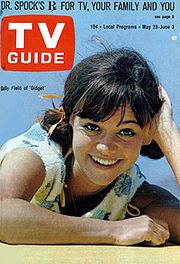
, the character was adapted for television in the sitcom series Gidget
, starring Sally Field
. The series reintroduced Larue
, a timid, awkward girl who often accompanied Gidget on her zany escapades, and an older married sister Anne Cooper ("Ann Cooper" in the novels), both of whom appear in the original 1957 novel but are absent from the motion pictures. Gidget's brother-in-law, who appeared in the novels as Larry Cooper, an intelligent but condescending child psychiatrist was reinvented in the TV series as John Cooper, an obtuse but lovable psychology student. In the TV series, Gidget regarded both her sister and brother-in-law as clueless squares
. In one of the first episodes, the producers sent Gidget's boyfriend Moondoggie
east to Princeton University
with the convenient understanding that both were free to date others while separated, thus opening plots to a variety of complications and guest stars. The sitcom essentially focused on the father-daughter relationship with Gidget receiving moral instruction from her father at episode's end and growing a little wiser from it. The sitcom ran for only one season, but spawned a devoted cult following.
 In 1969
, Karen Valentine
starred as Gidget in the telemovie Gidget Grows Up
, freely adapted from the 1968 novel Gidget Goes New York, but also functioning as a sequel to the 1965 sitcom series.
In 1972
, another telemovie was made titled Gidget Gets Married
, in which Gidget finally married longtime boyfriend Moondoggie. Monie Ellis played the title role. This incarnation of Gidget is unique in that it gives Moondoggie's real name as "Jeff Stevens." In the novels, the other telemovies and The New Gidget he is "Geoffrey H. Griffin" (the middle initial is mentioned only in the first novel); in the Hollywood films and the sitcom Gidget he is "Jeffrey Matthews." Later that year, Hanna-Barbera
produced a 60 minute animated feature for television, Gidget Makes the Wrong Connection, with Kathy Gori
as the voice of Gidget. It was broadcast as part of the Saturday morning series The ABC Saturday Superstar Movie
.
In 1985
, a follow-up of the 1965 sitcom series was launched with the telemovie Gidget's Summer Reunion
, starring Caryn Richman
as a grown version of the character played by Sally Field
. This was followed by a sitcom series The New Gidget
, which ran for two seasons, 1986
–1988
.
hit television show Bewitched
which premiered in 1964. The patio and living room sets seen in Columbia's Gidget Goes to Rome
(1963) were soon adapted for the permanent Bewitched
set for 1964. In the TV series from 1965–66, Gidget (played by Sally Field) is often shown with a "Samantha" doll in her bedroom (a merchandise cross promotion for the other Columbia TV show), and in 1986's The New Gidget
(produced by Columbia executive and producer Harry Ackerman
) the facade used in shots for her home is the reversed Gidget house (better known by TV audiences from those subsequent decades of reruns as Samantha's home on Bewitched
).
There are other examples of Screen Gems
reusing resources from different productions. For instance, the exterior and kitchen sets of the 1965 television series starring Sally Field had been previously employed in the Screen Gems' sitcom Hazel
starring Shirley Booth
.
Frederick Kohner
Frederick Kohner was an Austrian-born writer....
(based on his teenage daughter, Kathy
Kathy Kohner-Zuckerman
Kathy Kohner Zuckerman was the real life inspiration for the fictional character of Franzie from the 1957 novel, Gidget: The Little Girl with Big Ideas, written by her father Frederick Kohner.- Early life :...
) in his 1957 novel, Gidget, the Little Girl with Big Ideas. The novel follows the adventures of a teenage girl and her surfing friends on the beach at Malibu. The name Gidget is a portmanteau of "girl and midget
Midget
A midget is a short person with relatively average bodily proportions in comparison with other human beings. The term is often improperly used to describe a person with the medical condition dwarfism. The two terms are often used synonymously because both terms originate as words defining small...
". Following the novel's publication, the character appeared in several films, television series and telemovies.
Novels
The original Bold textgidget was created by Frederick KohnerFrederick Kohner
Frederick Kohner was an Austrian-born writer....
in his 1957 novel Gidget, The Little Girl With Big Ideas (reprinted numerous times under the shortened title Gidget, by which it is more widely known), written in the first person and based on the accounts of his daughter Kathy (now Kathy Kohner-Zuckerman
Kathy Kohner-Zuckerman
Kathy Kohner Zuckerman was the real life inspiration for the fictional character of Franzie from the 1957 novel, Gidget: The Little Girl with Big Ideas, written by her father Frederick Kohner.- Early life :...
) of the surf culture
Surf culture
Surf culture includes the people, language, fashion and life surrounding the art of surfing.The culture began early in the 20th century, spread quickly during the 1950s and 1960s, and continues to evolve. It affected fashion, music, literature, films, jargon, and more...
of Malibu Point. Kohner, a prolific screenwriter with one Academy Award
Academy Awards
An Academy Award, also known as an Oscar, is an accolade bestowed by the American Academy of Motion Picture Arts and Sciences to recognize excellence of professionals in the film industry, including directors, actors, and writers...
nomination, published seven sequels to this novel, five of them original novels: Cher Papa (1959), The Affairs of Gidget (1963), Gidget in Love (1965), Gidget Goes Parisienne (1966) and Gidget Goes New York(1968), plus two novelization
Novelization
A novelization is a novel that is written based on some other media story form rather than as an original work.Novelizations of films usually add background material not found in the original work to flesh out the story, because novels are generally longer than screenplays...
s: Gidget Goes Hawaiian
Gidget Goes Hawaiian
Gidget Goes Hawaiian is a 1961 musical romantic comedy film starring Deborah Walley and James Darren. Released by Columbia Pictures, the film is a sequel to the 1959 Sandra Dee "beach movie" vehicle Gidget....
(1961) and Gidget Goes to Rome
Gidget Goes to Rome
Gidget Goes to Rome is a 1963 Columbia Pictures feature film starring Cindy Carol as the archetypal high school teen surfer girl originally created by Sandra Dee in the 1959 film Gidget. The film is the third of three Gidget films directed by Paul Wendkos and expands upon Gidget's romance with...
(1963), adapted by Kohner from films of the same titles, based on original stories by Ruth Brooks Flippen.
Frederick Kohner
Kohner, a Czechoslovakian Jew, worked in the German film industry as a screenwriter until 1933 when he emigrated to Hollywood after the Nazis started removing Jewish credits from films. Over the coming decades Kohner and his wife Franzie raised their two daughters by the beach while he toiled as a screenwriter for Columbia Pictures. As his children grew into American teenagers he noticed that his daughter Kathy in particular was drawn into a very specific, regional, contemporary slice of American teenage culture – the surf culture.Surfing was a then minor youth movement that built its foundation around a sport, love of the beach, and jargon that must have proved a challenge to an Eastern European immigrant. The details fascinated Kohner, who was empathetic with his daughter's feminist intention to participate in a "boys-only" sport. A book was conceived and Kathy became her father's muse as he delved into the surfing world with his daughter as his guide. Over a six week period Kohner wove the stories she told into a novel, which he titled upon completion with her nickname, Gidget.
In the original novel, Gidget gives her name as follows:
"It's Franzie," I said. "From Franziska. It's a German name. After my grandmother."
She does not give us her last name. In subsequent novels, her name is Franzie Hofer. In the films in which she appears her name is changed to a more English sounding Frances Lawrence, and the names of some other characters are changed as well. In the 1960s television series (episode 16, "Now There's a Face") Gidget gives her full name as Frances Elizabeth Lawrence.
Kohner also wrote other novels about the experiences of different teenaged girls, including The Continental Kick, Mister Will You Marry Me?, and The Gremmie, as well as non-fiction books such as the biographies Kiki of Montparnasse and The Magician of Sunset Boulevard.
Films
In the late 1950s and early 1960s, the character Gidget (the prototypical beach bunny) was adapted for three films, all directed by Paul Wendkos
Paul Wendkos
Paul Wendkos was an American television and film director....
and released by Columbia Pictures
Columbia Pictures
Columbia Pictures Industries, Inc. is an American film production and distribution company. Columbia Pictures now forms part of the Columbia TriStar Motion Picture Group, owned by Sony Pictures Entertainment, a subsidiary of the Japanese conglomerate Sony. It is one of the leading film companies...
:
- GidgetGidget (film)Gidget is a 1959 Columbia Pictures CinemaScope feature film. It stars Sandra Dee, Cliff Robertson, and James Darren in a story about a teenager's initiation into the California surf culture and her affiliated romance with a young surfer. The screenplay was written by Gabrielle Upton, a nom de plume...
(19591959 in filmThe year 1959 in film involved some significant events, with Ben-Hur winning a record 11 Academy Awards.-Events:* The Three Stooges make their 190th and last short film, Sappy Bull Fighters....
), starring Sandra DeeSandra DeeSandra Dee was an American actress. Dee began her career as a model and progressed to film. Best known for her portrayal of ingenues, Dee won a Golden Globe Award in 1959 as one of the year's most promising newcomers, and over several years her films were popular...
. - Gidget Goes HawaiianGidget Goes HawaiianGidget Goes Hawaiian is a 1961 musical romantic comedy film starring Deborah Walley and James Darren. Released by Columbia Pictures, the film is a sequel to the 1959 Sandra Dee "beach movie" vehicle Gidget....
(19611961 in filmThe year 1961 in film involved some significant events, with West Side Story winning 10 Academy Awards.-Top grossing films : After theatrical re-issue- Awards :Academy Awards:* Atlantis, the Lost ContinentB...
), starring Deborah WalleyDeborah WalleyDeborah Walley was an American actress.-Biographical Information:Deborah Walley was born in Bridgeport, Connecticut, to Ice Capades skating stars and choreographers Nathan and Edith Walley. She attended Central High School in Bridgeport. At fourteen she was playing summer-stock theatre. She...
. - Gidget Goes to RomeGidget Goes to RomeGidget Goes to Rome is a 1963 Columbia Pictures feature film starring Cindy Carol as the archetypal high school teen surfer girl originally created by Sandra Dee in the 1959 film Gidget. The film is the third of three Gidget films directed by Paul Wendkos and expands upon Gidget's romance with...
(19631963 in filmThe year 1963 in film involved some significant events.-Events:* June 12 - Cleopatra starring Elizabeth Taylor, Rex Harrison and Richard Burton premieres at the Rivoli Theatre in New York City....
), starring Cindy CarolCindy CarolCindy Carol is an American actress. She was credited as Carol Sydes before her starring role as Gidget in Gidget Goes to Rome ....
.
The first film also featured a young Yvonne Craig
Yvonne Craig
Yvonne Joyce Craig is an American actress best known for her role as Batgirl from the 1960s TV series Batman, and as the Orion Marta in the Star Trek: The Original Series episode “Whom Gods Destroy”.-Early life and career:...
and Tom Laughlin
Tom Laughlin
Tom Laughlin is an American actor, director, screenwriter, author, educator and political activist. Laughlin is best known for his series of Billy Jack films. He has been married to Delores Taylor since 1954. Taylor has also co-produced and acted in all four of the Billy Jack films...
, long before Laughlin became known as Billy Jack
Billy Jack
Billy Jack is a 1971 action film. It is the second, and highest grossing, in a series of motion pictures centering on a character of the same name, played by Tom Laughlin who also directed and co-wrote the script. Filming began in Prescott, Arizona, in fall 1969, but the movie was not completed...
and Craig as Batgirl
Batgirl
Batgirl is the name of several fictional characters appearing in comic books published by DC Comics, frequently depicted as female counterparts to the superhero Batman...
and her alter-ego Barbara Gordon
Barbara Gordon
Barbara Gordon is a fictional character appearing in comic books published by DC Comics and in related media, created by Gardner Fox and Carmine Infantino...
in the final season of Batman
Batman
Batman is a fictional character created by the artist Bob Kane and writer Bill Finger. A comic book superhero, Batman first appeared in Detective Comics #27 , and since then has appeared primarily in publications by DC Comics...
. Although the later two films were billed as sequels to the first, there was little attempt at continuity
Continuity (fiction)
In fiction, continuity is consistency of the characteristics of persons, plot, objects, places and events seen by the reader or viewer over some period of time...
other than in the plot. Only James Darren
James Darren
James William Ercolani , known by his stage name James Darren, is an American television and film actor, television director, and singer.-Career:...
, playing Gidget's boyfriend Moondoggie
Moondoggie
Moondoggie is a fictional character created by Frederick Kohner in his novel Gidget, The Little Girl with Big Ideas. He appears as a principal character in five of the eight Gidget novels, but is a minor character or is only mentioned in passing in Cher Papa, The Affairs of Gidget and Gidget Goes...
, has the same major role in all three films. For Gidget Goes Hawaiian
Gidget Goes Hawaiian
Gidget Goes Hawaiian is a 1961 musical romantic comedy film starring Deborah Walley and James Darren. Released by Columbia Pictures, the film is a sequel to the 1959 Sandra Dee "beach movie" vehicle Gidget....
, some scenes from the first film were re-shot with the new cast, to be used as flashbacks.
Television
In 19651965 in television
The year 1965 in television involved some significant events.Below is a list of television-related events in 1965.For the American TV schedule, see: 1965-66 American network television schedule.-Events:...
, the character was adapted for television in the sitcom series Gidget
Gidget (TV series)
Gidget is an American sitcom about a surfing, boy-crazy teenager called "Gidget" and her widowed father Russ Lawrence, a UCLA professor. Sally Field stars as Gidget with Don Porter as her father. The series was first broadcast on ABC from September 15, 1965 through April 21, 1966...
, starring Sally Field
Sally Field
Sally Margaret Field is an American actress, singer, producer, director, and screenwriter. In each decade of her career, she has been known for major roles in American TV/film culture, including: in the 1960s, for Gidget or Sister Bertrille on The Flying Nun ; in the 1970s, for Sybil , Smokey and...
. The series reintroduced Larue
Larue Wilson
Larue Wilson is a fictional character introduced in Frederick Kohner's 1957 novel Gidget, the Litte Girl with Big Ideas. She also appears in much of the television work involving Gidget.-The Novel:...
, a timid, awkward girl who often accompanied Gidget on her zany escapades, and an older married sister Anne Cooper ("Ann Cooper" in the novels), both of whom appear in the original 1957 novel but are absent from the motion pictures. Gidget's brother-in-law, who appeared in the novels as Larry Cooper, an intelligent but condescending child psychiatrist was reinvented in the TV series as John Cooper, an obtuse but lovable psychology student. In the TV series, Gidget regarded both her sister and brother-in-law as clueless squares
Square (slang)
Square used as slang may mean many things when referring to a person or in common language.In referring to a person, the word originally meant someone who was honest, traditional and loyal. An agreement that is equitable on all sides is a "square deal"...
. In one of the first episodes, the producers sent Gidget's boyfriend Moondoggie
Moondoggie
Moondoggie is a fictional character created by Frederick Kohner in his novel Gidget, The Little Girl with Big Ideas. He appears as a principal character in five of the eight Gidget novels, but is a minor character or is only mentioned in passing in Cher Papa, The Affairs of Gidget and Gidget Goes...
east to Princeton University
Princeton University
Princeton University is a private research university located in Princeton, New Jersey, United States. The school is one of the eight universities of the Ivy League, and is one of the nine Colonial Colleges founded before the American Revolution....
with the convenient understanding that both were free to date others while separated, thus opening plots to a variety of complications and guest stars. The sitcom essentially focused on the father-daughter relationship with Gidget receiving moral instruction from her father at episode's end and growing a little wiser from it. The sitcom ran for only one season, but spawned a devoted cult following.
1969 in television
The year 1969 in television involved some significant events. Below is a list of television-related events in 1969.For the American TV schedule, see: 1969-70 American network television schedule.-Events:...
, Karen Valentine
Karen Valentine
Karen Valentine is an American actress best-known for her role as the idealistic schoolteacher "Alice Johnson" in the television series Room 222.-Early life:...
starred as Gidget in the telemovie Gidget Grows Up
Gidget Grows Up
Gidget Grows Up is a 1969 television film directed by James Sheldon and starring Karen Valentine, Paul Lynde and Edward Mulhare, freely adapted from the novel Gidget Goes New York by Frederick Kohner...
, freely adapted from the 1968 novel Gidget Goes New York, but also functioning as a sequel to the 1965 sitcom series.
In 1972
1972 in television
The year 1972 in television involved some significant events.Below is a list of television-related events in 1972.For the American TV schedule, see: 1972-73 American network television schedule.-Events:...
, another telemovie was made titled Gidget Gets Married
Gidget Gets Married
Gidget Gets Married is a 1972 television film produced by Screen Gems for ABC. It was written by John McGreevey and directed by E.W. Swackhamer and starred Monie Ellis as Gidget.-Plot:...
, in which Gidget finally married longtime boyfriend Moondoggie. Monie Ellis played the title role. This incarnation of Gidget is unique in that it gives Moondoggie's real name as "Jeff Stevens." In the novels, the other telemovies and The New Gidget he is "Geoffrey H. Griffin" (the middle initial is mentioned only in the first novel); in the Hollywood films and the sitcom Gidget he is "Jeffrey Matthews." Later that year, Hanna-Barbera
Hanna-Barbera
Hanna-Barbera Productions, Inc. was an American animation studio that dominated North American television animation during the second half of the 20th century...
produced a 60 minute animated feature for television, Gidget Makes the Wrong Connection, with Kathy Gori
Kathy Gori
Kathy Gori is an American voice actress, radio personality and screenwriter.-Biography:She was born in San Francisco, California....
as the voice of Gidget. It was broadcast as part of the Saturday morning series The ABC Saturday Superstar Movie
The ABC Saturday Superstar Movie
The ABC Saturday Superstar Movie — renamed The New Saturday Superstar Movie in its second season — is a series of one-hour animated TV-movies , broadcast on the ABC television network on Saturday mornings from September 9, 1972, to November 17, 1973.Intended as a "Movie of the Week" for kids, this...
.
In 1985
1985 in television
The year 1985 involved some significant events.Below is a list of television-related events in 1985.For the American TV schedule, see: 1985-86 United States network television schedule.-Events:*January 1 – VH1 launches in the United States....
, a follow-up of the 1965 sitcom series was launched with the telemovie Gidget's Summer Reunion
Gidget's Summer Reunion
Gidget's Summer Reunion is a 1985 television film produced by Columbia Pictures Television for television syndication. It was written by Robert Blees and George Zateslo and directed by Bruce Bilson and starred Caryn Richman as Gidget.-Plot:...
, starring Caryn Richman
Caryn Richman
Caryn Richman is an actress who primarily appeared in television series in the 1980s and early 1990s. Her roles include Elena Dekker on the soap opera Texas, Gidget on the television series The New Gidget, and Nora Brady in A Very Brady Christmas and The Bradys.-External links:...
as a grown version of the character played by Sally Field
Sally Field
Sally Margaret Field is an American actress, singer, producer, director, and screenwriter. In each decade of her career, she has been known for major roles in American TV/film culture, including: in the 1960s, for Gidget or Sister Bertrille on The Flying Nun ; in the 1970s, for Sybil , Smokey and...
. This was followed by a sitcom series The New Gidget
The New Gidget
The New Gidget is an American television sitcom that aired in syndication from 1986 to 1988. The series was produced by original Gidget series producer Harry Ackerman and was launched after the television movie Gidget's Summer Reunion starring Caryn Richman as Gidget aired in 1985...
, which ran for two seasons, 1986
1986 in television
The year 1986 in television involved some significant events.Below is a list of television-related events in 1986.For the American network television schedule, please see 1986-87 American network television schedule.-Events:-Debuts:*September 6 –...
–1988
1988 in television
The year 1988 in television involved some significant events.Below is a list of television-related events in 1988.For the American TV schedule, see: 1988-89 United States network television schedule.-Events:-Debuts:...
.
The Gidget/Bewitched connection
The 1959 Columbia Pictures' Gidget filmed on location at a real home in Santa Monica (at 267 18th Street) as seen in the film. The blueprint design of this home was later reversed and replicated as a house facade attached to an existing garage on the backlot of Columbia's Ranch. The reversed Gidget house was primarily used on the Columbia/Screen GemsScreen Gems
Screen Gems is an American movie production company and subsidiary company of Sony Pictures Entertainment's Columbia TriStar Motion Picture Group that has served several different purposes for its parent companies over the decades since its incorporation....
hit television show Bewitched
Bewitched
Bewitched is an American situation comedy originally broadcast for eight seasons on ABC from 1964 to 1972, starring Elizabeth Montgomery, Dick York and Dick Sargent , Agnes Moorehead, and David White. The show is about a witch who marries a mortal and tries to lead the life of a typical suburban...
which premiered in 1964. The patio and living room sets seen in Columbia's Gidget Goes to Rome
Gidget Goes to Rome
Gidget Goes to Rome is a 1963 Columbia Pictures feature film starring Cindy Carol as the archetypal high school teen surfer girl originally created by Sandra Dee in the 1959 film Gidget. The film is the third of three Gidget films directed by Paul Wendkos and expands upon Gidget's romance with...
(1963) were soon adapted for the permanent Bewitched
Bewitched
Bewitched is an American situation comedy originally broadcast for eight seasons on ABC from 1964 to 1972, starring Elizabeth Montgomery, Dick York and Dick Sargent , Agnes Moorehead, and David White. The show is about a witch who marries a mortal and tries to lead the life of a typical suburban...
set for 1964. In the TV series from 1965–66, Gidget (played by Sally Field) is often shown with a "Samantha" doll in her bedroom (a merchandise cross promotion for the other Columbia TV show), and in 1986's The New Gidget
The New Gidget
The New Gidget is an American television sitcom that aired in syndication from 1986 to 1988. The series was produced by original Gidget series producer Harry Ackerman and was launched after the television movie Gidget's Summer Reunion starring Caryn Richman as Gidget aired in 1985...
(produced by Columbia executive and producer Harry Ackerman
Harry Ackerman
Harry Stephen Ackerman was an American TV executive producer at Screen Gems, the television division of Columbia Pictures....
) the facade used in shots for her home is the reversed Gidget house (better known by TV audiences from those subsequent decades of reruns as Samantha's home on Bewitched
Bewitched
Bewitched is an American situation comedy originally broadcast for eight seasons on ABC from 1964 to 1972, starring Elizabeth Montgomery, Dick York and Dick Sargent , Agnes Moorehead, and David White. The show is about a witch who marries a mortal and tries to lead the life of a typical suburban...
).
There are other examples of Screen Gems
Screen Gems
Screen Gems is an American movie production company and subsidiary company of Sony Pictures Entertainment's Columbia TriStar Motion Picture Group that has served several different purposes for its parent companies over the decades since its incorporation....
reusing resources from different productions. For instance, the exterior and kitchen sets of the 1965 television series starring Sally Field had been previously employed in the Screen Gems' sitcom Hazel
Hazel (TV series)
Hazel is a Screen Gems television series about a fictional live-in maid named Hazel Burke and her employers, the Baxters. The five-season, 154-episode series aired in primetime from September 1961 until April 1966...
starring Shirley Booth
Shirley Booth
Shirley Booth was an American actress.Primarily a theatre actress, Booth's Broadway career began in 1925. Her most significant success was as Lola Delaney, in the drama Come Back, Little Sheba, for which she received a Tony Award in 1950...
.
Gidget timeline
- 1941 Kathy KohnerKathy Kohner-ZuckermanKathy Kohner Zuckerman was the real life inspiration for the fictional character of Franzie from the 1957 novel, Gidget: The Little Girl with Big Ideas, written by her father Frederick Kohner.- Early life :...
born. - 1956 Kathy KohnerKathy Kohner-ZuckermanKathy Kohner Zuckerman was the real life inspiration for the fictional character of Franzie from the 1957 novel, Gidget: The Little Girl with Big Ideas, written by her father Frederick Kohner.- Early life :...
learns to surf and is nicknamed "Gidget". - 1957 Gidget, the Little Girl with Big Ideas published.
- 1959 Motion picture GidgetGidget (film)Gidget is a 1959 Columbia Pictures CinemaScope feature film. It stars Sandra Dee, Cliff Robertson, and James Darren in a story about a teenager's initiation into the California surf culture and her affiliated romance with a young surfer. The screenplay was written by Gabrielle Upton, a nom de plume...
released, Cher Papa published. - 1961 Motion picture Gidget Goes HawaiianGidget Goes HawaiianGidget Goes Hawaiian is a 1961 musical romantic comedy film starring Deborah Walley and James Darren. Released by Columbia Pictures, the film is a sequel to the 1959 Sandra Dee "beach movie" vehicle Gidget....
released, novelization Gidget Goes Hawaiian published. - 1963 The Affairs of Gidget published, motion picture Gidget Goes to RomeGidget Goes to RomeGidget Goes to Rome is a 1963 Columbia Pictures feature film starring Cindy Carol as the archetypal high school teen surfer girl originally created by Sandra Dee in the 1959 film Gidget. The film is the third of three Gidget films directed by Paul Wendkos and expands upon Gidget's romance with...
released, novelization Gidget Goes to Rome published. - 1965 Gidget in Love published, TV sitcom GidgetGidget (TV series)Gidget is an American sitcom about a surfing, boy-crazy teenager called "Gidget" and her widowed father Russ Lawrence, a UCLA professor. Sally Field stars as Gidget with Don Porter as her father. The series was first broadcast on ABC from September 15, 1965 through April 21, 1966...
first airs. - 1966 Gidget Goes Parisienne published, TV sitcom GidgetGidget (TV series)Gidget is an American sitcom about a surfing, boy-crazy teenager called "Gidget" and her widowed father Russ Lawrence, a UCLA professor. Sally Field stars as Gidget with Don Porter as her father. The series was first broadcast on ABC from September 15, 1965 through April 21, 1966...
canceled. - 1968 Gidget Goes New York published.
- 1969 Telemovie Gidget Grows UpGidget Grows UpGidget Grows Up is a 1969 television film directed by James Sheldon and starring Karen Valentine, Paul Lynde and Edward Mulhare, freely adapted from the novel Gidget Goes New York by Frederick Kohner...
airs. - 1972 Telemovie Gidget Gets MarriedGidget Gets MarriedGidget Gets Married is a 1972 television film produced by Screen Gems for ABC. It was written by John McGreevey and directed by E.W. Swackhamer and starred Monie Ellis as Gidget.-Plot:...
airs, animated feature Gidget Makes the Wrong Connection airs. - 1985 Telemovie Gidget's Summer ReunionGidget's Summer ReunionGidget's Summer Reunion is a 1985 television film produced by Columbia Pictures Television for television syndication. It was written by Robert Blees and George Zateslo and directed by Bruce Bilson and starred Caryn Richman as Gidget.-Plot:...
airs. - 1986 Frederick KohnerFrederick KohnerFrederick Kohner was an Austrian-born writer....
dies, TV sitcom The New GidgetThe New GidgetThe New Gidget is an American television sitcom that aired in syndication from 1986 to 1988. The series was produced by original Gidget series producer Harry Ackerman and was launched after the television movie Gidget's Summer Reunion starring Caryn Richman as Gidget aired in 1985...
airs. - 1988 TV sitcom The New GidgetThe New GidgetThe New Gidget is an American television sitcom that aired in syndication from 1986 to 1988. The series was produced by original Gidget series producer Harry Ackerman and was launched after the television movie Gidget's Summer Reunion starring Caryn Richman as Gidget aired in 1985...
canceled.
In popular culture
- The names "Gidget" and "Moondoggie" were also used for two characters of the animeAnimeis the Japanese abbreviated pronunciation of "animation". The definition sometimes changes depending on the context. In English-speaking countries, the term most commonly refers to Japanese animated cartoons....
series Eureka SevenEureka SevenEureka Seven, known in Japan as , is a mecha anime TV series by Bones. Eureka Seven tells the story of Renton Thurston and the outlaw group Gekkostate, his relationship with the enigmatic mecha pilot Eureka, and the mystery of the Coralians....
, among many other nods to surf culture.
- In 19791979 in musicSee also:Record labels established in 1979* 1979 in music This is a list of notable events in music that took place in the year 1979.-January–February:*January 1...
, the Southern Californian punk rockPunk rockPunk rock is a rock music genre that developed between 1974 and 1976 in the United States, the United Kingdom, and Australia. Rooted in garage rock and other forms of what is now known as protopunk music, punk rock bands eschewed perceived excesses of mainstream 1970s rock...
group Suburban LawnsSuburban LawnsThe brainchild of CalArts students William "Vex Billingsgate" Ranson and Sue "Su Tissue" McLane, Suburban Lawns formed in Long Beach, California in 1978 out of the ashes of previous incarnations Art Attack and The Fabulons, recruiting Huntington Beach natives Richard "Frankie Ennui" Whitney and...
had a small cult hit with the parodyParodyA parody , in current usage, is an imitative work created to mock, comment on, or trivialise an original work, its subject, author, style, or some other target, by means of humorous, satiric or ironic imitation...
single "Gidget Goes To Hell".
- In 1995 Fred Reiss published a novel titled Gidget Must Die: a Killer Surf Novel, about the darker side of surf cultureSurf cultureSurf culture includes the people, language, fashion and life surrounding the art of surfing.The culture began early in the 20th century, spread quickly during the 1950s and 1960s, and continues to evolve. It affected fashion, music, literature, films, jargon, and more...
. Except for her name in the title, the book has nothing to do with the character Gidget or her spinoffs.
- Gidget was spoofed in Charles Busch's off-Broadway play (1987) and film (2000), Psycho Beach PartyPsycho Beach PartyPsycho Beach Party is a 2000 Comedy horror film based on the off-Broadway play of the same name, directed by Robert Lee King. Charles Busch wrote both the original play and the screenplay...
. The play was originally titled Gidget Goes Psychotic, but changed due to copyright concerns.
- The BrunettesThe BrunettesThe Brunettes are an indie pop or twee pop group from New Zealand formed in 1998. The band consists of core members Jonathan Bree and Heather Mansfield with additional contributions from part-time band members including James Milne , Ryan McPhun , Harry Cundy, and most recently,...
have a song titled Too Big For Gidget.
- In 2001 Brian Gillogly began work on an independent documentary: Accidental Icon: The Real Gidget Story. It was first shown in Malibu in 2006. Copyright issues led to a major re-cut in 2010, with a World premiere in March of that year at the Noosa Festival of Surfing in Australia, and a North American premier at the Newport Beach Film Festival a month later.
- In 2007 Terry McCabe and Marissa McKown adapted a stage play Gidget from Kohner's 1957 novel. It was performed at City Lit Theater in Chicago in May and June 2007, directed by Marissa McKown and starred Sabrina Kramnich as Gidget.
See also
- 1957 in literature1957 in literatureThe year 1957 in literature involved some significant events and new books.-Events:* Lawrence Durrell publishes the first volume of The Alexandria Quartet. The final of the four volumes will be published in 1960....
- 1959 in film1959 in filmThe year 1959 in film involved some significant events, with Ben-Hur winning a record 11 Academy Awards.-Events:* The Three Stooges make their 190th and last short film, Sappy Bull Fighters....
- 1965 in television1965 in televisionThe year 1965 in television involved some significant events.Below is a list of television-related events in 1965.For the American TV schedule, see: 1965-66 American network television schedule.-Events:...
- surfingSurfingSurfing' is a surface water sport in which the surfer rides a surfboard on the crest and face of a wave which is carrying the surfer towards the shore...
- surf cultureSurf cultureSurf culture includes the people, language, fashion and life surrounding the art of surfing.The culture began early in the 20th century, spread quickly during the 1950s and 1960s, and continues to evolve. It affected fashion, music, literature, films, jargon, and more...
External links
- The Real Gidget, essay by Deanne Stillman about Kathy Kohner Zuckerman
- In Malibu, Gidget's Up (interview with Zuckerman, Washington Post, September 16, 2005
- Successful Women (interview with Zuckerman), Jewish Woman, Summer 2003
- Review of the DVD containing the three Gidget films.
- Synopsis of many telemovies including Gidget Grows Up.
- Frederick Kohner at NNDB
- Online Review of the stage play Gidget
- Gidget (character) at IMDb
- http://www.imdb.com/title/tt1602011/ "Accidental Icon: The Real Gidget Story" at IMDb