


Getty Research Institute

Encyclopedia
The Getty Research Institute (GRI), located at the Getty Center
in Los Angeles, California
, is "dedicated to furthering knowledge and advancing understanding of the visual arts". A program of the J. Paul Getty Trust
, GRI maintains a research library, organizes exhibitions and other events, sponsors a residential scholars program, publishes books, and produces electronic databases.
, its first director (beginning in 1985) was Kurt W. Forster. GRI's library had 30,000 volumes in 1983, but grew to 450,000 volumes by 1986.
In a statement upon his departure in 1992, Forster summarized his tenure as "Beginning with the rudiments of a small museum library... the center grew... to become one of the nation's preeminent research centers for arts and culture...". In 1994, Salvatore Settis, a professor of the history of classical art and archeology in Italy, became the director of the Center. By 1996, the Center's name had been changed to "Getty Research Institute for the History of Art and the Humanities", and by 1999 it was known simply as "Getty Research Institute".
Among GRI's special projects was "L.A. as Subject: The Transformative Culture of Los Angeles Communities" conducted between 1995 and 1999, whose purposes included "enhanc[ing] existing resources and develop new resources that support new research scholarship on LA and also encourag[ing] the preservation, conservation, and display of local material culture". In collaboration with local organizations, GRI published Cultural Inheritance/L.A.: A Resource Directory of Less Visible Archives and Collections in the Los Angeles Region in 1999. In 2000, the L.A. as Subject project was transferred to the University of Southern California
, which continues to update and expand an online version of the resource directory.
When the Getty Information Institute (formerly the Art History Information Program, established in 1983) was dissolved in 1999 as a "result of a change of leadership at the Getty Trust", GRI absorbed "many of its functions".
In 2000, Thomas E. Crow
was selected as GRI director to replace Settis who had resigned in 1999. Crow announced in October 2006 that he would be leaving for New York University
. Since November 2007 Thomas W. Gaehtgens has been GRI's director; he was previously (1985–1986) a visiting scholar with the Getty Center for the History of Art and the Humanities.
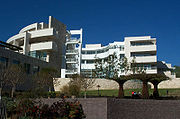 Among other holdings, GRI's research library contains about 900,000 volumes of books, periodicals, and auction catalogs; special collections; and two million photographs of art and architecture. The library is located at the Getty Center
, and does not circulate its collections, but does extend library privileges to any visitor.
, Modernity and the Metropolis". The exhibition traveled to the National Building Museum
and to the Art Institute of Chicago
.
In addition to exhibitions, GRI organizes lectures (open to the public), colloquia (most open to the public), workshops (by invitation only), and screenings of films and videos (open to the public).
in 1993–1994, who wrote the novel Medea: a modern retelling during her year at GRI.
Each year the scholars are invited to work on projects related to an annual theme. In 2008–2009, the theme for the Getty Center was "Networks and Boundaries" and for the Getty Villa "The Power and Function of Ancient Images". The lengths of stay vary: Getty scholars are in residence for three, six or nine months, visiting scholars for one to three months, and predoctoral and postdoctoral fellows for a nine month academic year. In 2011-12, the theme is "Artistic Practice".
Here are selected books published by GRI, by the Getty Research Institute for the History of Art and the Humanities, by the Getty Center for the History of Art and the Humanities, by the Getty Information Institute, or by the Art History Information Program.
In 2006, GRI and the OCLC Online Computer Library Center announced that the Getty Vocabularies (Art & Architecture Thesaurus
, Getty Thesaurus of Geographic Names
, and Union List of Artist Names
) will be available as a Web service.
Until July 1, 2009, the Getty Information Institute and later GRI co-produced the Avery Index to Architectural Periodicals with the Avery Architectural and Fine Arts Library
. On that date, GRI transferred the database back to Columbia University
, which continues to maintain it.
Getty Center
The Getty Center, in Brentwood, Los Angeles, California, is a campus for cultural institutions founded by oilman J. Paul Getty. The $1.3 billion center, which opened on December 16, 1997, is also well known for its architecture, gardens, and views overlooking Los Angeles...
in Los Angeles, California
Los Angeles, California
Los Angeles , with a population at the 2010 United States Census of 3,792,621, is the most populous city in California, USA and the second most populous in the United States, after New York City. It has an area of , and is located in Southern California...
, is "dedicated to furthering knowledge and advancing understanding of the visual arts". A program of the J. Paul Getty Trust
J. Paul Getty Trust
The J. Paul Getty Trust is the world's wealthiest art institution with an estimated endowment in April 2009 of $US 4.2 billion. Based in Los Angeles, California, it operates the J. Paul Getty Museum, which has two locations, the Getty Center in Los Angeles and the Getty Villa in Pacific...
, GRI maintains a research library, organizes exhibitions and other events, sponsors a residential scholars program, publishes books, and produces electronic databases.
History
The GRI was originally called the "Getty Center for the History of Art and the Humanities", and was first discussed in 1983. Located in Santa MonicaSanta Monica, California
Santa Monica is a beachfront city in western Los Angeles County, California, US. Situated on Santa Monica Bay, it is surrounded on three sides by the city of Los Angeles — Pacific Palisades on the northwest, Brentwood on the north, West Los Angeles on the northeast, Mar Vista on the east, and...
, its first director (beginning in 1985) was Kurt W. Forster. GRI's library had 30,000 volumes in 1983, but grew to 450,000 volumes by 1986.
In a statement upon his departure in 1992, Forster summarized his tenure as "Beginning with the rudiments of a small museum library... the center grew... to become one of the nation's preeminent research centers for arts and culture...". In 1994, Salvatore Settis, a professor of the history of classical art and archeology in Italy, became the director of the Center. By 1996, the Center's name had been changed to "Getty Research Institute for the History of Art and the Humanities", and by 1999 it was known simply as "Getty Research Institute".
Among GRI's special projects was "L.A. as Subject: The Transformative Culture of Los Angeles Communities" conducted between 1995 and 1999, whose purposes included "enhanc[ing] existing resources and develop new resources that support new research scholarship on LA and also encourag[ing] the preservation, conservation, and display of local material culture". In collaboration with local organizations, GRI published Cultural Inheritance/L.A.: A Resource Directory of Less Visible Archives and Collections in the Los Angeles Region in 1999. In 2000, the L.A. as Subject project was transferred to the University of Southern California
University of Southern California
The University of Southern California is a private, not-for-profit, nonsectarian, research university located in Los Angeles, California, United States. USC was founded in 1880, making it California's oldest private research university...
, which continues to update and expand an online version of the resource directory.
When the Getty Information Institute (formerly the Art History Information Program, established in 1983) was dissolved in 1999 as a "result of a change of leadership at the Getty Trust", GRI absorbed "many of its functions".
In 2000, Thomas E. Crow
Thomas E. Crow
Thomas E. Crow is an American art historian and art critic who is best known for his influential writing on the role of art in modern society and culture....
was selected as GRI director to replace Settis who had resigned in 1999. Crow announced in October 2006 that he would be leaving for New York University
New York University
New York University is a private, nonsectarian research university based in New York City. NYU's main campus is situated in the Greenwich Village section of Manhattan...
. Since November 2007 Thomas W. Gaehtgens has been GRI's director; he was previously (1985–1986) a visiting scholar with the Getty Center for the History of Art and the Humanities.
Library
Getty Center
The Getty Center, in Brentwood, Los Angeles, California, is a campus for cultural institutions founded by oilman J. Paul Getty. The $1.3 billion center, which opened on December 16, 1997, is also well known for its architecture, gardens, and views overlooking Los Angeles...
, and does not circulate its collections, but does extend library privileges to any visitor.
Exhibitions and other events
GRI holds three public exhibitions per year in its gallery which "focus primarily on the special collections of the Research Library or on work produced by artists in residence". For example, in 2005–2006 GRI held an exhibition entitled "Julius ShulmanJulius Shulman
Julius Shulman was an American architectural photographer best known for his photograph "Case Study House #22, Los Angeles, 1960. Pierre Koenig, Architect." The house is also known as The Stahl House. Shulman's photography spread California Mid-century modern around the world...
, Modernity and the Metropolis". The exhibition traveled to the National Building Museum
National Building Museum
The National Builders Museum, in Washington, D.C., United States, is a museum of "architecture, design, engineering, construction, and urban planning"...
and to the Art Institute of Chicago
Art Institute of Chicago
The School of the Art Institute of Chicago is one of America's largest accredited independent schools of art and design, located in the Loop in Chicago, Illinois. It is associated with the museum of the same name, and "The Art Institute of Chicago" or "Chicago Art Institute" often refers to either...
.
In addition to exhibitions, GRI organizes lectures (open to the public), colloquia (most open to the public), workshops (by invitation only), and screenings of films and videos (open to the public).
Residential scholars program
The residential scholars program seeks to "integrate the often isolated territory of art history into the wider sphere of the humanities". The first class of scholars arrived in 1985–1986; they had their salaries paid for and their housing provided but were under "absolutely no obligation to produce". Among the notable scholars was German writer Christa WolfChrista Wolf
Christa Wolf was a German literary critic, novelist, and essayist. She is one of the best-known writers to have emerged from the former East Germany.-Biography:...
in 1993–1994, who wrote the novel Medea: a modern retelling during her year at GRI.
Each year the scholars are invited to work on projects related to an annual theme. In 2008–2009, the theme for the Getty Center was "Networks and Boundaries" and for the Getty Villa "The Power and Function of Ancient Images". The lengths of stay vary: Getty scholars are in residence for three, six or nine months, visiting scholars for one to three months, and predoctoral and postdoctoral fellows for a nine month academic year. In 2011-12, the theme is "Artistic Practice".
Publications
GRI publishes "Series Imprints" books in the categories of "Issues and Debates", "Texts & Documents", "Introduction To" (on "cultural heritage information in electronic form"), and "ReSources" (on the library's special collections). In addition, GRI publishes exhibition catalogs and other materials in hardcopy form.Here are selected books published by GRI, by the Getty Research Institute for the History of Art and the Humanities, by the Getty Center for the History of Art and the Humanities, by the Getty Information Institute, or by the Art History Information Program.
- Bakewell, Elizabeth, et al. Object, image, inquiry: the art historian at work: report on a collaborative study by the Getty Art History Information Program (AHIP) and the Institute for Research in Information and ScholarshipInstitute for Research in Information and ScholarshipThe Institute for Research in Information and Scholarship was founded at Brown University by Andries van Dam, William S. Shipp, and Norman Meyrowitz in 1983 and closed in 1991...
(IRIS), Brown University. Santa Monica, CA: AHIP, 1988. ISBN 0892361352 - Gaehtgens, Thomas W., and Heinz Ickstadt. American icons: transatlantic perspectives on eighteenth- and nineteenth-century American art. Santa Monica, CA: Getty Center for the History of Art and Humanities, 1992. ISBN 0892362464
- Necipoglu, Gülru, and Mohammad Al-Asad. The Topkapi scroll: geometry and ornament in Islamic architecture: Topkapi Palace Museum Library MS H. 1956. Santa Monica, CA: Getty Center for the History of Art and the Humanities, 1995. ISBN 0892363355
- Roth, Michael S., Claire L. Lyons, and Charles Merewether. Irresistible decay: ruins reclaimed. Los Angeles, CA: Getty Research Institute for the History of Art and the Humanities, 1997. ISBN 0892364688
- Baca, Murtha. Introduction to metadata: pathways to digital information. Los Angeles, CA: Getty Information Institute, 1998. ISBN 0892365331
- Warburg, Aby. The renewal of pagan antiquity: contributions to the cultural history of the European Renaissance. Los Angeles, CA: Getty Research Institute for the History of Art and the Humanities, 1999. ISBN 0892365374
- Paul, Carole, and Alberta Campitelli. Making a prince's museum: drawings for the late-eighteenth-century redecoration of the Villa Borghese. Los Angeles, CA: Getty Research Institute, 2000. ISBN 0892365390
- Phillips, Glenn, and Thomas E. Crow. Seeing Rothko. Los Angeles: Getty Research Institute, 2005. ISBN 0892367342
- Reed, Marcia, and Paola Demattè. China on paper: European and Chinese works from the late sixteenth to the early nineteenth century. Los Angeles: Getty Research Institute, 2007. ISBN 9780892368693
Electronic databases
Among the electronic databases from the former Getty Information Institute that GRI continues to produce are:- Getty Vocabulary ProgramGetty Vocabulary ProgramThe Getty Vocabulary Program is a department within the Getty Research Institute at the Getty Center in Los Angeles, California. It produces and maintains the Getty controlled vocabulary databases, Art and Architecture Thesaurus, Union List of Artist Names, and Getty Thesaurus of Geographic Names....
databases (Art & Architecture ThesaurusArt & Architecture ThesaurusThe Art & Architecture Thesaurus is a controlled vocabulary used for describing items of art, architecture, and material culture. The AAT contains generic terms, such as "cathedral," but no proper names, such as "Cathedral of Notre Dame." The AAT is used by, among others, museums, art libraries,...
(AAT), Getty Thesaurus of Geographic NamesGetty Thesaurus of Geographic NamesThe Getty Thesaurus of Geographic Names is a product of the J. Paul Getty Trust included in the Getty Vocabulary Program. The TGN includes names and associated information about places. Places in TGN include administrative political entities and physical features . Current and historical places...
(TGN), and Union List of Artist NamesUnion List of Artist NamesThe Union List of Artist Names is a controlled vocabulary currently containing around 293,000 names and other information about artists. Names in ULAN may include given names, pseudonyms, variant spellings, names in multiple languages, and names that have changed over time...
(ULAN)) - Bibliography of the History of Art
- Getty Provenance Index which holds records of collections, auction sales and other information for researching the art market and the provenanceProvenanceProvenance, from the French provenir, "to come from", refers to the chronology of the ownership or location of an historical object. The term was originally mostly used for works of art, but is now used in similar senses in a wide range of fields, including science and computing...
of works.
In 2006, GRI and the OCLC Online Computer Library Center announced that the Getty Vocabularies (Art & Architecture Thesaurus
Art & Architecture Thesaurus
The Art & Architecture Thesaurus is a controlled vocabulary used for describing items of art, architecture, and material culture. The AAT contains generic terms, such as "cathedral," but no proper names, such as "Cathedral of Notre Dame." The AAT is used by, among others, museums, art libraries,...
, Getty Thesaurus of Geographic Names
Getty Thesaurus of Geographic Names
The Getty Thesaurus of Geographic Names is a product of the J. Paul Getty Trust included in the Getty Vocabulary Program. The TGN includes names and associated information about places. Places in TGN include administrative political entities and physical features . Current and historical places...
, and Union List of Artist Names
Union List of Artist Names
The Union List of Artist Names is a controlled vocabulary currently containing around 293,000 names and other information about artists. Names in ULAN may include given names, pseudonyms, variant spellings, names in multiple languages, and names that have changed over time...
) will be available as a Web service.
Until July 1, 2009, the Getty Information Institute and later GRI co-produced the Avery Index to Architectural Periodicals with the Avery Architectural and Fine Arts Library
Avery Architectural and Fine Arts Library
The Avery Architectural and Fine Arts Library is one of twenty-five libraries in the Columbia University Library System and is located in Avery Hall on the Morningside Heights campus of Columbia University in the City of New York. It is the largest architecture library in the world...
. On that date, GRI transferred the database back to Columbia University
Columbia University
Columbia University in the City of New York is a private, Ivy League university in Manhattan, New York City. Columbia is the oldest institution of higher learning in the state of New York, the fifth oldest in the United States, and one of the country's nine Colonial Colleges founded before the...
, which continues to maintain it.
Senior staff
GRI's senior staff includes:- Thomas W. Gaehtgens, Director
- Andrew Perchuk, Deputy Director
- Gail Feigenbaum, Associate Director
- David Farneth, Assistant Director
- Kathleen Salomon, Assistant Director
- Marcia Reed, Chief Curator
Employees and budget
During the period July 2006 – June 2007, GRI had approximately 200 full-time and part-time employees, and a budget of $63.7 million.External Links
- Interviews with art historians, 1991-2002. Getty Research Institute, Los Angeles, California. Transcripts, audio cassette tapes, and computer disks record interviews with contemporary art historians, archaeologists, bibliographers, and selected key individuals from the J. Paul Getty Trust.
- Steve Lanzarotta records, 1983-2001. Getty Research Institute, Los Angeles, California. These records were created and maintained by Steve Lanzarotta during his employment with the Getty Research Institute (GRI) and its predecessors, the Getty Research Institute for the History of Art and the Humanities and the Getty Center for the History of Art and the Humanities (GCHAH).
- Letters and papers of British artists, 1774-1964. Getty Research Institute, Los Angeles, California. The collection, assembled by the repository, comprises 1360 items, mostly letters signed by 507 British painters, illustrators, printmakers, draughtsmen, and sculptors. The collection includes circa 40 illustrated letters, as well as sketches, press clippings, manuscripts, and reproductions of art works. Most items date from the late 19th century.
- Letters of British Architects, 1793-1921. Getty Research Institute, Los Angeles, California. The collection includes 80 letters, 3 prints and 1 seat diagram for the 1907 RIBA annual dinner. The letters were written by 34 British architects between 1793 and 1921, most of them from the second half of the 19th century.
- Letters of British art patrons, collectors, and dealers, 1821-1921. Getty Research Institute, Los Angeles, California. The collection comprises 66 letters written by 47 persons between May 1821 and June 1921. Most letters date to the 19th century, with only a few items from the first quarter of the 20th century.
- Letters of British authors, 1770-1915. Getty Research Institute, Los Angeles, California. The collection comprises 150 letters sent by 73 persons. The letters are dated from 1770 to 1915, with the bulk from the 1840s to the 1890s. Three letters are dated from 1770, 1791 and 1798, and 24 are from the first quarter of the 20th century.
- Miscellaneous papers regarding Ambroise Vollard. Getty Research Institute. Los Angeles, California. Original photocopied letters and records related to the French art dealer Ambroise Vollard.