

German Unity Day

Encyclopedia
The Day of German Unity is the national day
of Germany
, celebrated on 3 October as a public holiday. It commemorates the anniversary of German reunification
in 1990, when the goal of a unity of Germany that originated in the middle of the 19th century, was fulfilled. Therefore, the name addresses neither the re-union or union but the unity of Germany. The Day of German Unity on October 3rd has been a German national holiday since the reunification in 1990, when the German reunification was brought out in full force. The 3rd of October is a legal holiday of the Federal Republic of Germany.
The Day of German Unity is at the same time an anniversary for the re-founding of the five states Brandenburg, Mecklenburg-Vorpommern, Saxony, Saxony-Anhalt and Thuringen.
An alternative choice to commemorate the reunification could have been the day the Berlin Wall
came down—November 9, 1989, which coincided with the anniversary of the proclamation of the German Republic in 1918 and the defeat of Hitler's first coup
in 1923. However, 9 November was also the anniversary of the first large-scale Nazi-led pogrom
s against Jews in 1938 (Kristallnacht
), so the day was considered inappropriate as a national holiday. Therefore, 3 October 1990, the day of formal reunification, was chosen instead.
After the founding of the Empire in 1871, there were calls for a national holiday, and there were three suggestions. No decision was made. Until 1873, the Sedantag was moved to January 18th or Day of the Frankfurt Treaty (May 10, 1871). The Sedantag would soon also be celebrated at the universities and in many German cities. It never occurred to them to think about "Empire Parade" or "Emperor's Birthday. Some Culture Ministers of the states, especially in Prussia, decided, that the Sedantag would be an official festival in schools. Upon many suggestions, the date of the Emperor's proclamation on January 18th would be established as day of remembrance. Emperor Wilhelm I declined this: "This was also the day of the first Prussian coronation of the king, which should not fall into the shadow of a united German holiday."
The Rhineland-Westphalian state began a "typical German" festival, and started the tradition on the eve of September 2nd with the ringing of bells, fireworks and patriotic songs for a peace festival.
, even with the name "Day of the German Unity". Since 1963, it was proclaimed by the President of the Federal Republic as "National Day of Memorial of the German People." Therefore, in the year 1990, the "Day of German Unity" was celebrated twice.
In the beginning of July, the government of the both German states decided on the schedule, that the elections would be held on October 14th for the GDR, and a common election for the entire country on 2nd of December.
The decision of the date was finally made on the 22nd of August from the GDR's Minister President, de Maiziere through a special session at the Volkskammer, which began at 9 pm. After a heated debate, the President of the Volkskammer, Sabine Bergmann-Pohl, revealed the results at 2:30 am on 23rd of August:
"The Volkskammer decides on the accession of the GDR to the Constitution of the Federal Republic of Germany according to Article 23 of the Basic Laws effective as of October 3, 1990. In the matter Nr. 201 there have been 363 votes. There were no invalid votes. 294 deputies have voted 'yes.' (Strong applauds from CDU/DA, DSU, FDP, partly SPD and the deputies standing up on place.)
"62 deputies have voted 'no,' and 7 people abstained. This is a historical event. Ladies and Gentlemen, I believe, that we have not made an easy decision, but today, we have acted within our responsibilities of the voting rights of the citizens of the GDR. I thank all, that this result was made possible by a consensus across party lines.
The SED-PDS Chairman Gregor Gysi made a sad declaration: "The Parliament has more or less decided on the downfall of the German Democratic Republic on 3 October 1990. (jubilant cheers from the CDU/DA, DSU and SPD)."
The celebrations are hosted habitually in the state capital of the German state
presiding over the Bundesrat
in the respective year:
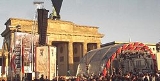
In addition, various celebrations are held in the federal capital Berlin
, mainly based on the Straße des 17. Juni
and around the Brandenburg Gate
. Furthermore, the Oktoberfest
beer festival
in Munich
, which traditionally runs until the first Sunday in October, now runs until 3 October if the Sunday in question falls on the first or second day of October.
Unlike most other countries, flags on private houses, military parades and fireworks are not common on this day in Germany.
National Day
The National Day is a designated date on which celebrations mark the nationhood of a nation or non-sovereign country. This nationhood can be symbolized by the date of independence, of becoming republic or a significant date for a patron saint or a ruler . Often the day is not called "National Day"...
of Germany
Germany
Germany , officially the Federal Republic of Germany , is a federal parliamentary republic in Europe. The country consists of 16 states while the capital and largest city is Berlin. Germany covers an area of 357,021 km2 and has a largely temperate seasonal climate...
, celebrated on 3 October as a public holiday. It commemorates the anniversary of German reunification
German reunification
German reunification was the process in 1990 in which the German Democratic Republic joined the Federal Republic of Germany , and when Berlin reunited into a single city, as provided by its then Grundgesetz constitution Article 23. The start of this process is commonly referred by Germans as die...
in 1990, when the goal of a unity of Germany that originated in the middle of the 19th century, was fulfilled. Therefore, the name addresses neither the re-union or union but the unity of Germany. The Day of German Unity on October 3rd has been a German national holiday since the reunification in 1990, when the German reunification was brought out in full force. The 3rd of October is a legal holiday of the Federal Republic of Germany.
The Day of German Unity is at the same time an anniversary for the re-founding of the five states Brandenburg, Mecklenburg-Vorpommern, Saxony, Saxony-Anhalt and Thuringen.
An alternative choice to commemorate the reunification could have been the day the Berlin Wall
Berlin Wall
The Berlin Wall was a barrier constructed by the German Democratic Republic starting on 13 August 1961, that completely cut off West Berlin from surrounding East Germany and from East Berlin...
came down—November 9, 1989, which coincided with the anniversary of the proclamation of the German Republic in 1918 and the defeat of Hitler's first coup
Beer Hall Putsch
The Beer Hall Putsch was a failed attempt at revolution that occurred between the evening of 8 November and the early afternoon of 9 November 1923, when Nazi Party leader Adolf Hitler, Generalquartiermeister Erich Ludendorff, and other heads of the Kampfbund unsuccessfully tried to seize power...
in 1923. However, 9 November was also the anniversary of the first large-scale Nazi-led pogrom
Pogrom
A pogrom is a form of violent riot, a mob attack directed against a minority group, and characterized by killings and destruction of their homes and properties, businesses, and religious centres...
s against Jews in 1938 (Kristallnacht
Kristallnacht
Kristallnacht, also referred to as the Night of Broken Glass, and also Reichskristallnacht, Pogromnacht, and Novemberpogrome, was a pogrom or series of attacks against Jews throughout Nazi Germany and parts of Austria on 9–10 November 1938.Jewish homes were ransacked, as were shops, towns and...
), so the day was considered inappropriate as a national holiday. Therefore, 3 October 1990, the day of formal reunification, was chosen instead.
Before 1919
Before 1871, in the area where a single state of Germany now exists, different kingdoms and prinicipalities existed. After the Unification of Germany, in the Empire Unification of 1870 (Letter of the Emperor) and the Founding of the Empire 1871, there was still no common national holiday. The Sedantag was, however, celebrated every year on the 2nd of September, which recalls the decisive victory in the German-French War on 2nd September 1870.After the founding of the Empire in 1871, there were calls for a national holiday, and there were three suggestions. No decision was made. Until 1873, the Sedantag was moved to January 18th or Day of the Frankfurt Treaty (May 10, 1871). The Sedantag would soon also be celebrated at the universities and in many German cities. It never occurred to them to think about "Empire Parade" or "Emperor's Birthday. Some Culture Ministers of the states, especially in Prussia, decided, that the Sedantag would be an official festival in schools. Upon many suggestions, the date of the Emperor's proclamation on January 18th would be established as day of remembrance. Emperor Wilhelm I declined this: "This was also the day of the first Prussian coronation of the king, which should not fall into the shadow of a united German holiday."
The Rhineland-Westphalian state began a "typical German" festival, and started the tradition on the eve of September 2nd with the ringing of bells, fireworks and patriotic songs for a peace festival.
Weimarer Republic
On July 31, 1919, the Weimarer Constitution would be accepted in its form by the Weimarer National Congress. In memorial of this "Hour of birth of democracy", the 11th August was created as Constitution Day, because the President of the Empire, Friedrich Ebert, signed the constitution on this day.Time of the National Socialism
Shortly after the National Socialists took power in 1933, they established May Day (May 1st) as a national holiday in the German Empire. It was already celebrated as a "Day of the Labor Movement" since 1890, and also was part of the tradition for the May dance commemorating the Walpurgis Night. Immediately after the establishment of the holiday in 1933, the National Socialists banned trade unions on May 2nd, 1933 and occupied their buildings as offices for the National Socialist Movement. On March 1, 1939, Hitler declared November 9th as the "Memorial Day for the movement" as the national holiday.Federal Republic of Germany
From 1954 to 1990, the 17th of June was an official holiday in West Germany to commemorate the Uprising of 1953 in East GermanyUprising of 1953 in East Germany
The Uprising of 1953 in East Germany started with a strike by East Berlin construction workers on June 16. It turned into a widespread anti-Stalinist uprising against the German Democratic Republic government the next day....
, even with the name "Day of the German Unity". Since 1963, it was proclaimed by the President of the Federal Republic as "National Day of Memorial of the German People." Therefore, in the year 1990, the "Day of German Unity" was celebrated twice.
German Democratic Republic
In East Germany, the Founding Day in 1949 would be celebrated on 7th of October as Day of the Republic, until the 40th anniversary in 1989.Decision for GDR's unity with the Federal Republic
The motive for the decision of setting the date on the 3rd of October as possible Day of the Unity was decided by the Volkskammer (GDR Congress) upon the impeding economical and political collapse of the GDR. The Helsinki Conference was set for October 2nd, where the foreign ministers would be informed about the results in the Two-plus-Four Talk.In the beginning of July, the government of the both German states decided on the schedule, that the elections would be held on October 14th for the GDR, and a common election for the entire country on 2nd of December.
The decision of the date was finally made on the 22nd of August from the GDR's Minister President, de Maiziere through a special session at the Volkskammer, which began at 9 pm. After a heated debate, the President of the Volkskammer, Sabine Bergmann-Pohl, revealed the results at 2:30 am on 23rd of August:
"The Volkskammer decides on the accession of the GDR to the Constitution of the Federal Republic of Germany according to Article 23 of the Basic Laws effective as of October 3, 1990. In the matter Nr. 201 there have been 363 votes. There were no invalid votes. 294 deputies have voted 'yes.' (Strong applauds from CDU/DA, DSU, FDP, partly SPD and the deputies standing up on place.)
"62 deputies have voted 'no,' and 7 people abstained. This is a historical event. Ladies and Gentlemen, I believe, that we have not made an easy decision, but today, we have acted within our responsibilities of the voting rights of the citizens of the GDR. I thank all, that this result was made possible by a consensus across party lines.
The SED-PDS Chairman Gregor Gysi made a sad declaration: "The Parliament has more or less decided on the downfall of the German Democratic Republic on 3 October 1990. (jubilant cheers from the CDU/DA, DSU and SPD)."
Attempt to change the date of national holiday
On November 3, 2004, the Federal Chancellor, Gerhard Schröder, suggested that the "Day of the German Unity" be celebrated on a Sunday, for economic reasons. Instead of October 3rd, the National Reunification should be celebrated on the first Sunday of October. This suggestion received a lot of criticism from many sides, amongst them from Federal President Horst Köhler as well as the President of the Federal Diet Wolfgang Thierse. The demand worried a part of the population because of discontent for an increased working hours would be seen as a provocation and devaluing the national holiday. The idea was dropped after a short, but heavy debate.Celebrations
The Day of German Unity is celebrated each year with a ceremonial act and a citizens' festival ().The celebrations are hosted habitually in the state capital of the German state
States of Germany
Germany is made up of sixteen which are partly sovereign constituent states of the Federal Republic of Germany. Land literally translates as "country", and constitutionally speaking, they are constituent countries...
presiding over the Bundesrat
Bundesrat of Germany
The German Bundesrat is a legislative body that represents the sixteen Länder of Germany at the federal level...
in the respective year:
|
Mainz Mainz under the Holy Roman Empire, and previously was a Roman fort city which commanded the west bank of the Rhine and formed part of the northernmost frontier of the Roman Empire... , state capital of Rhineland-Palatinate Rhineland-Palatinate Rhineland-Palatinate is one of the 16 states of the Federal Republic of Germany. It has an area of and about four million inhabitants. The capital is Mainz. English speakers also commonly refer to the state by its German name, Rheinland-Pfalz .... Berlin Berlin is the capital city of Germany and is one of the 16 states of Germany. With a population of 3.45 million people, Berlin is Germany's largest city. It is the second most populous city proper and the seventh most populous urban area in the European Union... , capital of Germany Magdeburg Magdeburg , is the largest city and the capital city of the Bundesland of Saxony-Anhalt, Germany. Magdeburg is situated on the Elbe River and was one of the most important medieval cities of Europe.... , state capital of Saxony-Anhalt Saxony-Anhalt Saxony-Anhalt is a landlocked state of Germany. Its capital is Magdeburg and it is surrounded by the German states of Lower Saxony, Brandenburg, Saxony, and Thuringia.Saxony-Anhalt covers an area of... Erfurt Erfurt is the capital city of Thuringia and the main city nearest to the geographical centre of Germany, located 100 km SW of Leipzig, 150 km N of Nuremberg and 180 km SE of Hannover. Erfurt Airport can be reached by plane via Munich. It lies in the southern part of the Thuringian... , state capital of Thuringia Thuringia The Free State of Thuringia is a state of Germany, located in the central part of the country.It has an area of and 2.29 million inhabitants, making it the sixth smallest by area and the fifth smallest by population of Germany's sixteen states.... Potsdam Potsdam is the capital city of the German federal state of Brandenburg and part of the Berlin/Brandenburg Metropolitan Region. It is situated on the River Havel, southwest of Berlin city centre.... , state capital of Brandenburg Brandenburg Brandenburg is one of the sixteen federal-states of Germany. It lies in the east of the country and is one of the new federal states that were re-created in 1990 upon the reunification of the former West Germany and East Germany. The capital is Potsdam... Kiel Kiel is the capital and most populous city in the northern German state of Schleswig-Holstein, with a population of 238,049 .Kiel is approximately north of Hamburg. Due to its geographic location in the north of Germany, the southeast of the Jutland peninsula, and the southwestern shore of the... , state capital of Schleswig-Holstein Schleswig-Holstein Schleswig-Holstein is the northernmost of the sixteen states of Germany, comprising most of the historical duchy of Holstein and the southern part of the former Duchy of Schleswig... Schwerin Schwerin is the capital and second-largest city of the northern German state of Mecklenburg-Vorpommern. The population, as of end of 2009, was 95,041.-History:... , state capital of Mecklenburg-Vorpommern Hamburg -History:The first historic name for the city was, according to Claudius Ptolemy's reports, Treva.But the city takes its modern name, Hamburg, from the first permanent building on the site, a castle whose construction was ordered by the Emperor Charlemagne in AD 808... , Free Free city Free city may refer to:* City-state, region controlled exclusively by a sovereign city* Free city a self-governed city during the Hellenistic and Roman Imperial eras* Free City , album by the St... and Hanseatic City of Hamburg Hamburg -History:The first historic name for the city was, according to Claudius Ptolemy's reports, Treva.But the city takes its modern name, Hamburg, from the first permanent building on the site, a castle whose construction was ordered by the Emperor Charlemagne in AD 808... Saarbrücken Saarbrücken is the capital of the state of Saarland in Germany. The city is situated at the heart of a metropolitan area that borders on the west on Dillingen and to the north-east on Neunkirchen, where most of the people of the Saarland live.... , state capital of Saarland Saarland Saarland is one of the sixteen states of Germany. The capital is Saarbrücken. It has an area of 2570 km² and 1,045,000 inhabitants. In both area and population, it is the smallest state in Germany other than the city-states... Bremen The City Municipality of Bremen is a Hanseatic city in northwestern Germany. A commercial and industrial city with a major port on the river Weser, Bremen is part of the Bremen-Oldenburg metropolitan area . Bremen is the second most populous city in North Germany and tenth in Germany.Bremen is... , state capital of the Free Free city Free city may refer to:* City-state, region controlled exclusively by a sovereign city* Free city a self-governed city during the Hellenistic and Roman Imperial eras* Free City , album by the St... Hanseatic City of Bremen Bremen (state) The Free Hanseatic City of Bremen is the smallest of Germany's 16 states. A more informal name, but used in some official contexts, is Land Bremen .-Geography:... Bonn Bonn is the 19th largest city in Germany. Located in the Cologne/Bonn Region, about 25 kilometres south of Cologne on the river Rhine in the State of North Rhine-Westphalia, it was the capital of West Germany from 1949 to 1990 and the official seat of government of united Germany from 1990 to 1999.... , former capital of West Germany, instead of the state capital of North Rhine-Westphalia, Düsseldorf, as an exception to the habitual practice. |
In addition, various celebrations are held in the federal capital Berlin
Berlin
Berlin is the capital city of Germany and is one of the 16 states of Germany. With a population of 3.45 million people, Berlin is Germany's largest city. It is the second most populous city proper and the seventh most populous urban area in the European Union...
, mainly based on the Straße des 17. Juni
Straße des 17. Juni
The Straße des 17. Juni is a street in central Berlin, the capital of Germany. It is the western continuation of the Unter den Linden. It runs east-west through the Tiergarten, a large forest park to the west of the city centre. At the eastern end is the Brandenburg Gate and at the western end is...
and around the Brandenburg Gate
Brandenburg Gate
The Brandenburg Gate is a former city gate and one of the most well-known landmarks of Berlin and Germany. It is located west of the city centre at the junction of Unter den Linden and Ebertstraße, immediately west of the Pariser Platz. It is the only remaining gate of a series through which...
. Furthermore, the Oktoberfest
Oktoberfest
Oktoberfest, or Wiesn, is a 16–18 day beer festival held annually in Munich, Bavaria, Germany, running from late September to the first weekend in October. It is one of the most famous events in Germany and is the world's largest fair, with more than 5 million people attending every year. The...
beer festival
Beer festival
A Beer Festival is an organised event during which a variety of beers are available for tasting and purchase. Beer festivals are held in a number of countries...
in Munich
Munich
Munich The city's motto is "" . Before 2006, it was "Weltstadt mit Herz" . Its native name, , is derived from the Old High German Munichen, meaning "by the monks' place". The city's name derives from the monks of the Benedictine order who founded the city; hence the monk depicted on the city's coat...
, which traditionally runs until the first Sunday in October, now runs until 3 October if the Sunday in question falls on the first or second day of October.
Unlike most other countries, flags on private houses, military parades and fireworks are not common on this day in Germany.
External links
- German Embassy Publication, Infocus:German Unity Day
- Website of the state organizing Unity Day (changes annually, often in German only)
- German Reunification special coverage from Deutsche Welle, Germany's international broadcaster