

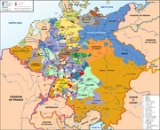
German Mediatisation

Encyclopedia
The German Mediatisation was the series of mediatisations and secularisations
that occurred in Germany
between 1795 and 1814, during the latter part of the era of the French Revolution
and then the Napoleonic Era
.
Mediatisation – or loss of imperial immediacy – was the process of annexing
the lands of one sovereign
monarchy
to another, often leaving the annexed some rights. Secularisation was the redistribution to secular states of the secular lands held by an ecclesiastical ruler such as a bishop
or an abbot
.
Following the collapse of the Carolingian Empire
, due to the equal heritage splitting prescribed by Salic Law
, and the rise of feudalism
, much of Europe had been reduced to an array of small, independent statelets. Successive Kings of Germany and Holy Roman Emperors
vested temporal authority in many bishoprics, abbacies and convents, and also granted free city rights to many cities and villages throughout Germany. Unlike Western European unitary state
s like Great Britain
, France
, or Spain
, the German kings were unable to coalesce their realms into a fully centralised kingdom, so over the course of centuries Germany had come to consist of no less than 300 independent sovereign states. The details of the negotiations were largely arranged by the French minister Talleyrand. The benefiting states were expected to pay fees and to form alliances with Bonaparte's new empire.
(Imperial Diet) of the Holy Roman Empire
. It proved to be the last significant law enacted by the Empire before its dissolution in 1806.
Based on a plan agreed in June 1802 between France
and Austria
, and broad principles outlined in the Treaty of Lunéville
of 1801, the law established a major redistribution of territorial sovereignty within the Empire, to compensate numerous German
princes for territories to the west of the Rhine that had been annexed by France as a result of the wars of the French Revolution
.
The Reichsdeputationshauptschluss was ratified unanimously by the Reichstag in March, 1803, and was approved by the emperor, Francis II
, the following month. However, the emperor made a formal reservation in respect of the reallocation of votes within the Reichstag, as the balance between Protestant and Catholic
states had been shifted heavily in the former's favour.
The redistribution was achieved by a combination of two processes: secularization
of ecclesiastical principalities, and mediatization
of numerous small secular principalities and free cities.
Emperors in the 10th and 11th centuries, the feudal system had turned Germany and northern Italy into a vast network of small statelets, each with its own specific privileges, titles and autonomy. To help administer Germany in the face of growing decentralisation and local autonomy following the rise of feudalism, many bishoprics, abbeys and convents throughout Germany were granted temporal estates and noble titles - such as prince, duke, or count— by successive Holy Roman Emperors. The personal appointment of bishops by the Holy Roman Emperors had sparked the investiture
controversy, and in its aftermath the emperors were unable to use the bishops for this end. Following this, the bishops and abbots had begun to run their newfound realms as temporal lords as opposed to spiritual lords. Allegations of corruption and decadence that followed had led to the falling from grace of the ecclesiastical rulers and eventually helped bring about the Protestant Reformation
, when several of the former prince-bishoprics were secularized and became the territory of secular princes. In the later sixteenth century the Counter-Reformation
attempted to reverse some of these secularizations, and the question of the fates of secularized territories became an important one in the Thirty Years War (1618-1648). In the end, the Peace of Westphalia
confirmed the secularizations which had already occurred, but also stabilized the situation to prevent any further changes.
In 1794 the armies of revolutionary France
overran the Rhineland, and by the Treaty of Campo Formio
in 1797 the Emperor recognized French annexation of all imperial territories west of the Rhine river. The Emperor sought to compensate the now stateless or diminished monarchs who lost their lands by granting them new realms. The only available lands were those held by the Prince-Bishops, so most were secularised and dispersed amongst the monarchs of Germany.
The ecclesiastical states were generally annexed to neighbouring secular principalities. Only three survived as non-secular states: the Archbishopric of Regensburg, which was raised from a bishopric with the incorporation of the Archbishopric of Mainz
, and the lands of the Teutonic Knights
and Knights of Saint John. Also of note is the former Archbishopric of Salzburg
, which was secularised as a duchy with an increased territorial scope, and was also made an electorate.
Monasteries
and abbey
s lost their means of existence as they had to abandon their land and most were closed. The remaining ecclesiastical states were also secularized after the end of the Holy Roman Empire in 1806. The lands of the Order of St. John were secularized in 1806, Regensburg was annexed by Bavaria in 1809, and in the same year Napoleon
dissolved the Teutonic Knights and gave their lands to neighboring princes, particularly the King of Württemberg.
, there still remained approximately 200 states by the advent of the Napoleonic Era
. The defeat of the First Coalition
resulted in the secularisation of the ecclesiastical states and the annexation by France of all lands west of the Rhine.
Allies of Napoleon
obtained gains in both territory and status on a number of occasions in the following years.
Mediatisation transferred the sovereignty of small secular states to their larger neighbours. In addition to numerous principalities, all but a handful of the Imperial cities
would also be annexed to their neighbours.
In 1803, most of the free cities in Germany were mediatised. On 12 June 1806, Napoleon established the Confederation of the Rhine
to extend and help secure the eastern border of France. In reluctant recognition of Napoleon's dismemberment of imperial territory, on 6 August 1806, the Holy Roman Emperor Francis II
declared the Empire abolished
, and claimed as much power as he could retain as ruler of the Habsburg realms. To gain support from the more powerful German states, the former Holy Roman Emperor accepted, and Napoleon encouraged, those that remained to mediatise minor neighbouring states.
Before the Battle of Waterloo
and the exile of Napoleon to Saint Helena
, the Congress of Vienna
was held from 1814 to 1815 by the Great Powers to re-establish the old borders of Europe. It was decided that Germany would retain the benefit of Napoleon's disrupton of the status quo ante: the mediatised principalities, free cities and secularised states would not be recreated. Instead their former rulers were to enjoy dynastic status, being deemed equal to the still-reign
ing monarchs for marital purposes
, and entitled to claim compensation for their losses. But it was left to each of the annexing states to compensate mediatised dynasties, and the latter had no international right to redress
if dissatisfied with the new regime's reimbursement decisions.
As the Houses of Ostein, Sinzendorf
and Wartenberg
became extinct after the mediatisation but before 1830, they are not always counted among the Mediatised Houses. For varying reasons, Aspremont-Lynden, Bentinck
, Bretzenheim
, Limburg-Styrum and Waldeck-Limpurg are also sometimes excluded. Hesse-Homburg
was never considered sovereign by Hesse-Darmstadt
and therefore was not technically mediatised, and Hesse-Kassel
(or Hesse-Cassel) was annexed into the Kingdom of Westphalia
but later had its sovereignty restored. The Schönburg
s had been mediatised to the Elector of Saxony
in the 18th century and were only counted amongst the Mediatised Houses at the Electors' insistence.
Most of the mediatisations occurred in 1806 after the creation of the Confederation of the Rhine
. Also mediatised 1806–1814 were several states created by Napoleon for his relatives and close allies. These include:
The only free cities in Germany not abolished in 1803 were:
Later mediatisations were:
, Bavaria
, and Hesse-Darmstadt
); and Baden
, Hesse-Kassel
(or Hesse-Cassel), and Württemberg
gained status by being made electorates (to replace three that had been lost in the changes). Of the imperial cities, only Augsburg
, Bremen
, Frankfurt am Main
, Hamburg
, Lübeck, and Nuremberg
survived as independent entities.
{| class="wikitable"
|+ Area and population losses or gains (rounded)
!
!Losses
!Gains
|-
| Kingdom of Prussia
|2.000 km²
140.000 people
|12.000 km²
600.000 people
|-
| Kingdom of Bavaria
|10.000 km²
600.000 people
|14.000 km²
850.000 people
|-
| Grand Duchy of Baden
|450 km²
30.000 people
|2.000 km²
240.000 people
|-
| Kingdom of Württemberg
|400 km²
30.000 people
|1.500 km²
120.000 people
|}
Secularization
Secularization is the transformation of a society from close identification with religious values and institutions toward non-religious values and secular institutions...
that occurred in Germany
Germany
Germany , officially the Federal Republic of Germany , is a federal parliamentary republic in Europe. The country consists of 16 states while the capital and largest city is Berlin. Germany covers an area of 357,021 km2 and has a largely temperate seasonal climate...
between 1795 and 1814, during the latter part of the era of the French Revolution
French Revolution
The French Revolution , sometimes distinguished as the 'Great French Revolution' , was a period of radical social and political upheaval in France and Europe. The absolute monarchy that had ruled France for centuries collapsed in three years...
and then the Napoleonic Era
Napoleon I
Napoleon Bonaparte was a French military and political leader during the latter stages of the French Revolution.As Napoleon I, he was Emperor of the French from 1804 to 1815...
.
Mediatisation – or loss of imperial immediacy – was the process of annexing
Annexation
Annexation is the de jure incorporation of some territory into another geo-political entity . Usually, it is implied that the territory and population being annexed is the smaller, more peripheral, and weaker of the two merging entities, barring physical size...
the lands of one sovereign
Sovereignty
Sovereignty is the quality of having supreme, independent authority over a geographic area, such as a territory. It can be found in a power to rule and make law that rests on a political fact for which no purely legal explanation can be provided...
monarchy
Monarchy
A monarchy is a form of government in which the office of head of state is usually held until death or abdication and is often hereditary and includes a royal house. In some cases, the monarch is elected...
to another, often leaving the annexed some rights. Secularisation was the redistribution to secular states of the secular lands held by an ecclesiastical ruler such as a bishop
Bishop
A bishop is an ordained or consecrated member of the Christian clergy who is generally entrusted with a position of authority and oversight. Within the Catholic Church, Eastern Orthodox, Oriental Orthodox Churches, in the Assyrian Church of the East, in the Independent Catholic Churches, and in the...
or an abbot
Abbot
The word abbot, meaning father, is a title given to the head of a monastery in various traditions, including Christianity. The office may also be given as an honorary title to a clergyman who is not actually the head of a monastery...
.
Following the collapse of the Carolingian Empire
Carolingian Empire
Carolingian Empire is a historiographical term which has been used to refer to the realm of the Franks under the Carolingian dynasty in the Early Middle Ages. This dynasty is seen as the founders of France and Germany, and its beginning date is based on the crowning of Charlemagne, or Charles the...
, due to the equal heritage splitting prescribed by Salic Law
Salic law
Salic law was a body of traditional law codified for governing the Salian Franks in the early Middle Ages during the reign of King Clovis I in the 6th century...
, and the rise of feudalism
Feudalism
Feudalism was a set of legal and military customs in medieval Europe that flourished between the 9th and 15th centuries, which, broadly defined, was a system for ordering society around relationships derived from the holding of land in exchange for service or labour.Although derived from the...
, much of Europe had been reduced to an array of small, independent statelets. Successive Kings of Germany and Holy Roman Emperors
Holy Roman Empire
The Holy Roman Empire was a realm that existed from 962 to 1806 in Central Europe.It was ruled by the Holy Roman Emperor. Its character changed during the Middle Ages and the Early Modern period, when the power of the emperor gradually weakened in favour of the princes...
vested temporal authority in many bishoprics, abbacies and convents, and also granted free city rights to many cities and villages throughout Germany. Unlike Western European unitary state
Unitary state
A unitary state is a state governed as one single unit in which the central government is supreme and any administrative divisions exercise only powers that their central government chooses to delegate...
s like Great Britain
Great Britain
Great Britain or Britain is an island situated to the northwest of Continental Europe. It is the ninth largest island in the world, and the largest European island, as well as the largest of the British Isles...
, France
France
The French Republic , The French Republic , The French Republic , (commonly known as France , is a unitary semi-presidential republic in Western Europe with several overseas territories and islands located on other continents and in the Indian, Pacific, and Atlantic oceans. Metropolitan France...
, or Spain
Spain
Spain , officially the Kingdom of Spain languages]] under the European Charter for Regional or Minority Languages. In each of these, Spain's official name is as follows:;;;;;;), is a country and member state of the European Union located in southwestern Europe on the Iberian Peninsula...
, the German kings were unable to coalesce their realms into a fully centralised kingdom, so over the course of centuries Germany had come to consist of no less than 300 independent sovereign states.
Reichsdeputationshauptschluss
The Reichsdeputationshauptschluss (formally the Hauptschluss der außerordentlichen Reichsdeputation, or "Principal Conclusion of the Extraordinary Imperial Delegation") was a resolution passed on 25 February 1803 by the ReichstagReichstag (Holy Roman Empire)
The Imperial Diet was the Diet, or general assembly, of the Imperial Estates of the Holy Roman Empire.During the period of the Empire, which lasted formally until 1806, the Diet was not a parliament in today's sense; instead, it was an assembly of the various estates of the realm...
(Imperial Diet) of the Holy Roman Empire
Holy Roman Empire
The Holy Roman Empire was a realm that existed from 962 to 1806 in Central Europe.It was ruled by the Holy Roman Emperor. Its character changed during the Middle Ages and the Early Modern period, when the power of the emperor gradually weakened in favour of the princes...
. It proved to be the last significant law enacted by the Empire before its dissolution in 1806.
Based on a plan agreed in June 1802 between France
French First Republic
The French First Republic was founded on 22 September 1792, by the newly established National Convention. The First Republic lasted until the declaration of the First French Empire in 1804 under Napoleon I...
and Austria
Habsburg Monarchy
The Habsburg Monarchy covered the territories ruled by the junior Austrian branch of the House of Habsburg , and then by the successor House of Habsburg-Lorraine , between 1526 and 1867/1918. The Imperial capital was Vienna, except from 1583 to 1611, when it was moved to Prague...
, and broad principles outlined in the Treaty of Lunéville
Treaty of Lunéville
The Treaty of Lunéville was signed on 9 February 1801 between the French Republic and the Holy Roman Emperor Francis II, negotiating both on behalf of his own domains and of the Holy Roman Empire...
of 1801, the law established a major redistribution of territorial sovereignty within the Empire, to compensate numerous German
Germany
Germany , officially the Federal Republic of Germany , is a federal parliamentary republic in Europe. The country consists of 16 states while the capital and largest city is Berlin. Germany covers an area of 357,021 km2 and has a largely temperate seasonal climate...
princes for territories to the west of the Rhine that had been annexed by France as a result of the wars of the French Revolution
French Revolutionary Wars
The French Revolutionary Wars were a series of major conflicts, from 1792 until 1802, fought between the French Revolutionary government and several European states...
.
The Reichsdeputationshauptschluss was ratified unanimously by the Reichstag in March, 1803, and was approved by the emperor, Francis II
Francis II, Holy Roman Emperor
Francis II was the last Holy Roman Emperor, ruling from 1792 until 6 August 1806, when he dissolved the Empire after the disastrous defeat of the Third Coalition by Napoleon at the Battle of Austerlitz...
, the following month. However, the emperor made a formal reservation in respect of the reallocation of votes within the Reichstag, as the balance between Protestant and Catholic
Catholic
The word catholic comes from the Greek phrase , meaning "on the whole," "according to the whole" or "in general", and is a combination of the Greek words meaning "about" and meaning "whole"...
states had been shifted heavily in the former's favour.
The redistribution was achieved by a combination of two processes: secularization
Secularization
Secularization is the transformation of a society from close identification with religious values and institutions toward non-religious values and secular institutions...
of ecclesiastical principalities, and mediatization
Mediatization
Mediatisation is the loss of imperial immediacy. Broadly defined it is the subsumption of one monarchy into another monarchy in such a way that the ruler of the annexed state keeps his sovereign title and, sometimes, a measure of local power...
of numerous small secular principalities and free cities.
Secularisation
From the re-establishment of the Holy Roman Empire by the Salian and SaxonDuchy of Saxony
The medieval Duchy of Saxony was a late Early Middle Ages "Carolingian stem duchy" covering the greater part of Northern Germany. It covered the area of the modern German states of Bremen, Hamburg, Lower Saxony, North Rhine-Westphalia, and Saxony-Anhalt and most of Schleswig-Holstein...
Emperors in the 10th and 11th centuries, the feudal system had turned Germany and northern Italy into a vast network of small statelets, each with its own specific privileges, titles and autonomy. To help administer Germany in the face of growing decentralisation and local autonomy following the rise of feudalism, many bishoprics, abbeys and convents throughout Germany were granted temporal estates and noble titles - such as prince, duke, or count— by successive Holy Roman Emperors. The personal appointment of bishops by the Holy Roman Emperors had sparked the investiture
Investiture
Investiture, from the Latin is a rather general term for the formal installation of an incumbent...
controversy, and in its aftermath the emperors were unable to use the bishops for this end. Following this, the bishops and abbots had begun to run their newfound realms as temporal lords as opposed to spiritual lords. Allegations of corruption and decadence that followed had led to the falling from grace of the ecclesiastical rulers and eventually helped bring about the Protestant Reformation
Protestant Reformation
The Protestant Reformation was a 16th-century split within Western Christianity initiated by Martin Luther, John Calvin and other early Protestants. The efforts of the self-described "reformers", who objected to the doctrines, rituals and ecclesiastical structure of the Roman Catholic Church, led...
, when several of the former prince-bishoprics were secularized and became the territory of secular princes. In the later sixteenth century the Counter-Reformation
Counter-Reformation
The Counter-Reformation was the period of Catholic revival beginning with the Council of Trent and ending at the close of the Thirty Years' War, 1648 as a response to the Protestant Reformation.The Counter-Reformation was a comprehensive effort, composed of four major elements:#Ecclesiastical or...
attempted to reverse some of these secularizations, and the question of the fates of secularized territories became an important one in the Thirty Years War (1618-1648). In the end, the Peace of Westphalia
Peace of Westphalia
The Peace of Westphalia was a series of peace treaties signed between May and October of 1648 in Osnabrück and Münster. These treaties ended the Thirty Years' War in the Holy Roman Empire, and the Eighty Years' War between Spain and the Dutch Republic, with Spain formally recognizing the...
confirmed the secularizations which had already occurred, but also stabilized the situation to prevent any further changes.
In 1794 the armies of revolutionary France
French Revolutionary Wars
The French Revolutionary Wars were a series of major conflicts, from 1792 until 1802, fought between the French Revolutionary government and several European states...
overran the Rhineland, and by the Treaty of Campo Formio
Treaty of Campo Formio
The Treaty of Campo Formio was signed on 18 October 1797 by Napoleon Bonaparte and Count Philipp von Cobenzl as representatives of revolutionary France and the Austrian monarchy...
in 1797 the Emperor recognized French annexation of all imperial territories west of the Rhine river. The Emperor sought to compensate the now stateless or diminished monarchs who lost their lands by granting them new realms. The only available lands were those held by the Prince-Bishops, so most were secularised and dispersed amongst the monarchs of Germany.
The ecclesiastical states were generally annexed to neighbouring secular principalities. Only three survived as non-secular states: the Archbishopric of Regensburg, which was raised from a bishopric with the incorporation of the Archbishopric of Mainz
Archbishopric of Mainz
The Archbishopric of Mainz or Electorate of Mainz was an influential ecclesiastic and secular prince-bishopric in the Holy Roman Empire between 780–82 and 1802. In the Roman Catholic Church hierarchy, the Archbishop of Mainz was the primas Germaniae, the substitute of the Pope north of the Alps...
, and the lands of the Teutonic Knights
Teutonic Knights
The Order of Brothers of the German House of Saint Mary in Jerusalem , commonly the Teutonic Order , is a German medieval military order, in modern times a purely religious Catholic order...
and Knights of Saint John. Also of note is the former Archbishopric of Salzburg
Archbishopric of Salzburg
The Archbishopric of Salzburg was an ecclesiastical State of the Holy Roman Empire, its territory roughly congruent with the present-day Austrian state of Salzburg....
, which was secularised as a duchy with an increased territorial scope, and was also made an electorate.
Monasteries
Monastery
Monastery denotes the building, or complex of buildings, that houses a room reserved for prayer as well as the domestic quarters and workplace of monastics, whether monks or nuns, and whether living in community or alone .Monasteries may vary greatly in size – a small dwelling accommodating only...
and abbey
Abbey
An abbey is a Catholic monastery or convent, under the authority of an Abbot or an Abbess, who serves as the spiritual father or mother of the community.The term can also refer to an establishment which has long ceased to function as an abbey,...
s lost their means of existence as they had to abandon their land and most were closed. The remaining ecclesiastical states were also secularized after the end of the Holy Roman Empire in 1806. The lands of the Order of St. John were secularized in 1806, Regensburg was annexed by Bavaria in 1809, and in the same year Napoleon
Napoleon I
Napoleon Bonaparte was a French military and political leader during the latter stages of the French Revolution.As Napoleon I, he was Emperor of the French from 1804 to 1815...
dissolved the Teutonic Knights and gave their lands to neighboring princes, particularly the King of Württemberg.
Secularised states
Bishops and archbishops |
Abbeys, convents, and provostries |
|
|---|---|---|
|
Baindt Abbey Baindt Abbey was a Cistercian nunnery in Baindt in the district of Ravensburg in Baden-Württemberg, Germany.-Cistercians:The abbey was founded in 1240 by Konrad of Winterstetten. It was granted imperial immediacy in 1376, although it was subordinate to Salem Abbey.The abbey was destroyed in 1525...  Berchtesgaden BerchtesgadenBerchtesgaden Provostry Berchtesgaden Provostry or the Prince-Provostry of Berchtesgaden was an immediate principality of the Holy Roman Empire, held by a canonry, i.e...  Beuron BeuronBeuron Archabbey Beuron Archabbey is a major house of the Benedictine Order located at Beuron in the upper Danube valley in Baden-Württemberg in Germany....  Buchau BuchauBuchau Abbey Buchau Abbey or the Imperial Abbey of Buchau was a nunnery, and later collegiate foundation, in the present town of Bad Buchau in Baden-Württemberg, Germany....  Corvey CorveyCorvey Abbey The Imperial Abbey of Corvey was a Benedictine monastery on the River Weser, 2 km northeast of Höxter, now in North Rhine-Westphalia, Germany.... Elchingen Abbey Elchingen Abbey was a Benedictine monastery in Oberelchingen in Bavaria, Germany, in the diocese of Augsburg.- History :Dedicated to the Virgin Mary and Saints Peter and Paul, the monastery was founded by the Counts of Dillingen...  Ellwangen EllwangenEllwangen Abbey Ellwangen Abbey was the earliest Benedictine monastery established in the Duchy of Swabia, at the present-day town of Ellwangen an der Jagst, Baden-Württemberg about 100 km north-east of Stuttgart.-Imperial abbey:... Essen Abbey Essen Abbey was a collegiate foundation for women of the high nobility in Essen. It was founded in about 845 by the Saxon Altfrid , later Bishop of Hildesheim and saint, near a royal estate called Astnidhi, which later gave its name to the religious house and to the town... Fulda monastery The monastery of Fulda was a Benedictine abbey in Fulda, in the present-day German state of Hesse. It was founded in 12 March, 744 by Saint Sturm, a disciple of Saint Boniface, and became an eminent center of learning with a renowned scriptorium, and the predecessor of the Fulda... Gutenzell Abbey Gutenzell Abbey was a Cistercian nunnery in the municipality of Gutenzell-Hürbel in the district of Biberach, Baden-Württemberg, Germany.The origins of the monastery are unknown... Heggbach Abbey Heggbach Abbey was a Cistercian nunnery in Heggbach, now part of the municipality of Maselheim in the district of Biberach, Baden-Württemberg, Germany.- History :...  Herford HerfordHerford Abbey Herford Abbey was the oldest women's religious house in the Duchy of Saxony. It was founded as a house of secular canonesses in 789, initially in Müdehorst by a nobleman called Waltger, who moved it in about 800 onto the lands of his estate Herivurth which stood at the crossing of a number of... Kaisheim Abbey Kaisheim Abbey was a Cistercian monastery in Kaisheim, Bavaria, Germany.- History :It was founded by Henry II, Count of Lechsgemünd and his wife Liutgard, and was a daughter house of Lucelle Abbey in Alsace. Count Henry's initial gift of the land was made in 1133; the foundation charter was dated... (Kaisersheim) Marchtal Abbey Marchtal Abbey is a former Premonstratensian monastery in Obermarchtal in the Alb-Donau-Kreis, Baden-Württemberg, Germany. The minster church of Saints Peter and Paul, the former abbey church, located on a prominent elevation, still dominates the landscape for miles around.-First foundation:In 776... Niedermünster, Regensburg The Niedermünster or Niedermünster Abbey , Regensburg, was a house of canonesses in Regensburg, Bavaria, Germany. At the height of its power was one of the wealthiest and most influential in Bavaria... Neresheim Abbey Neresheim Abbey or the Abbey of Saints Ulrich and Afra, Neresheim is located above the town of Neresheim in Baden-Württemberg, southern Germany... Ochsenhausen Abbey Ochsenhausen Abbey was a Benedictine monastery in Ochsenhausen in the district of Biberach in Baden-Württemberg, Germany.- History :... Obermünster, Regensburg The Obermünster, or Obermünster Abbey, Regensburg, was a collegiate house of canonesses in Regensburg, Bavaria, second only to Niedermünster in wealth and power.- History :... Petershausen Abbey Petershausen Abbey was a Benedictine monastery at Petershausen, now a district of Konstanz in Baden-Württemberg, Germany.-History:... |
 Quedlinburg QuedlinburgQuedlinburg Abbey Quedlinburg Abbey was a house of secular canonesses in Quedlinburg, Saxony-Anhalt, Germany. It was founded in 936 on the initiative of Saint Mathilda, the widow of Henry the Fowler, as his memorial... Rot an der Rot Abbey Rot an der Rot Abbey was a Premonstratensian monastery in Rot an der Rot in Upper Swabia, Baden-Württemberg, Germany. It was the first Premonstratensian monastery in the whole of Swabia...  Rottenmünster RottenmünsterSalem Abbey Salem Abbey , also known as Salmansweiler and in Latin as Salomonis Villa, was a very prominent Cistercian monastery in Salem in the district of Bodensee about ten miles from Konstanz, Baden-Württemberg, Germany.-Abbey:The abbey was founded in 1136 by Gunthram of Adelsreute Salem Abbey (Kloster or... (Salmansweiler) Schöntal Abbey Schöntal Abbey is a former Cistercian abbey in Schöntal in the district of Hohenlohe, Baden-Württemberg, Germany. It is famous as one of the most impressive pieces of Baroque architecture in northern Württemberg and is now used by the Diocese of Rottenburg-Stuttgart as a retreat and training...  Schussenried SchussenriedSchussenried Abbey Schussenried Abbey was a Premonstratensian monastery in Bad Schussenried, Upper Swabia, Baden-Württemberg, Germany.- History :... Söflingen Abbey Söflingen Abbey was a nunnery of the Order of Poor Ladies, also known as the Poor Clares, the Poor Clare Sisters, the Clarisse, the Minoresses, or the Second Order of St. Francis. It was situated in the village of Söflingen, now part of Ulm in Baden-Württemberg, Germany... Principality of Stavelot-Malmedy The Principality of Stavelot-Malmedy was a principality of the Holy Roman Empire. Princely power was exercised by the Benedictine abbot of the imperial double monastery of Stavelot and Malmedy, founded in 651. At , it was the second-smallest territory in the Empire, after the Duchy of Bouillon at... Kornelimünster Abbey Kornelimünster Abbey is a Benedictine monastery in Kornelimünster, since 1972 a part of Aachen , in North Rhine-Westphalia in Germany.- First foundation :... St. Emmeram's Abbey St. Emmeram's Abbey , now known as Schloss Thurn und Taxis, Schloss St. Emmeram, and St...  St. Gall St. Gall Thorn ThornWeingarten Abbey Weingarten Abbey or St. Martin's Abbey is a Benedictine monastery on the Martinsberg in Weingarten near Ravensburg in Baden-Württemberg .-First foundation:...  Weissenau WeissenauWeissenau Abbey - References : Binder, Helmut , 1995. 850 Jahre Prämonstratenserabtei Weissenau. 1145–1995. Sigmaringen: Thorbecke. ISBN 3-7995-0414-1 Eitel, Peter , 1983. Weissenau in Geschichte und Gegenwart. Festschrift zur 700-Jahrfeier der Übergabe der Heiligblutreliquie durch Rudolf von Habsburg an die...  Werden WerdenWerden Abbey Werden Abbey was a Benedictine monastery in Essen-Werden , situated on the Ruhr.- The foundation of the abbey :Near Essen Saint Ludger founded a monastery in 799 and became its first abbot. The little church which Saint Ludger built here in honor of Saint Stephen was completed in 804 and dedicated... -Helmstedt St. Ludger's Abbey St. Ludger's Abbey was a former monastery of the Benedictine Order in Helmstedt, Lower Saxony, founded by Saint Ludger around 800. Until it was secularised in 1802 it was an Imperial Abbey, with sovereignty over the whole town of Helmstedt until the 15th century.- History :Shortly before 800 the... Wiblingen Abbey Wiblingen Abbey was a former Benedictine abbey which was later used as barracks. Today its buildings house several departments of the medical faculty of the University of Ulm. The former abbey is located south of the confluence of the rivers Danube and Iller, south of the city of Ulm in the German... Zwiefalten Abbey - References :... |


 Chur
Chur
 Freising
.svg.png)
 Münster

 Strasbourg
Mediatisation
Although the number of German states had been steadily decreasing since the Thirty Years' WarThirty Years' War
The Thirty Years' War was fought primarily in what is now Germany, and at various points involved most countries in Europe. It was one of the most destructive conflicts in European history....
, there still remained approximately 200 states by the advent of the Napoleonic Era
Napoleon I of France
Napoleon Bonaparte was a French military and political leader during the latter stages of the French Revolution.As Napoleon I, he was Emperor of the French from 1804 to 1815...
. The defeat of the First Coalition
First Coalition
The War of the First Coalition was the first major effort of multiple European monarchies to contain Revolutionary France. France declared war on the Habsburg monarchy of Austria on 20 April 1792, and the Kingdom of Prussia joined the Austrian side a few weeks later.These powers initiated a series...
resulted in the secularisation of the ecclesiastical states and the annexation by France of all lands west of the Rhine.
Allies of Napoleon
Napoleon I of France
Napoleon Bonaparte was a French military and political leader during the latter stages of the French Revolution.As Napoleon I, he was Emperor of the French from 1804 to 1815...
obtained gains in both territory and status on a number of occasions in the following years.
Mediatisation transferred the sovereignty of small secular states to their larger neighbours. In addition to numerous principalities, all but a handful of the Imperial cities
Free Imperial City
In the Holy Roman Empire, a free imperial city was a city formally ruled by the emperor only — as opposed to the majority of cities in the Empire, which were governed by one of the many princes of the Empire, such as dukes or prince-bishops...
would also be annexed to their neighbours.
In 1803, most of the free cities in Germany were mediatised. On 12 June 1806, Napoleon established the Confederation of the Rhine
Confederation of the Rhine
The Confederation of the Rhine was a confederation of client states of the First French Empire. It was formed initially from 16 German states by Napoleon after he defeated Austria's Francis II and Russia's Alexander I in the Battle of Austerlitz. The Treaty of Pressburg, in effect, led to the...
to extend and help secure the eastern border of France. In reluctant recognition of Napoleon's dismemberment of imperial territory, on 6 August 1806, the Holy Roman Emperor Francis II
Francis II, Holy Roman Emperor
Francis II was the last Holy Roman Emperor, ruling from 1792 until 6 August 1806, when he dissolved the Empire after the disastrous defeat of the Third Coalition by Napoleon at the Battle of Austerlitz...
declared the Empire abolished
Abolished monarchy
Throughout history, monarchies have been abolished, either through revolutions, legislative reforms, coups d'état, or wars. The twentieth century saw a major acceleration of this process, with many monarchies violently overthrown by revolution or war, or else abolished as part of the process of...
, and claimed as much power as he could retain as ruler of the Habsburg realms. To gain support from the more powerful German states, the former Holy Roman Emperor accepted, and Napoleon encouraged, those that remained to mediatise minor neighbouring states.
Before the Battle of Waterloo
Battle of Waterloo
The Battle of Waterloo was fought on Sunday 18 June 1815 near Waterloo in present-day Belgium, then part of the United Kingdom of the Netherlands...
and the exile of Napoleon to Saint Helena
Saint Helena
Saint Helena , named after St Helena of Constantinople, is an island of volcanic origin in the South Atlantic Ocean. It is part of the British overseas territory of Saint Helena, Ascension and Tristan da Cunha which also includes Ascension Island and the islands of Tristan da Cunha...
, the Congress of Vienna
Congress of Vienna
The Congress of Vienna was a conference of ambassadors of European states chaired by Klemens Wenzel von Metternich, and held in Vienna from September, 1814 to June, 1815. The objective of the Congress was to settle the many issues arising from the French Revolutionary Wars, the Napoleonic Wars,...
was held from 1814 to 1815 by the Great Powers to re-establish the old borders of Europe. It was decided that Germany would retain the benefit of Napoleon's disrupton of the status quo ante: the mediatised principalities, free cities and secularised states would not be recreated. Instead their former rulers were to enjoy dynastic status, being deemed equal to the still-reign
Reign
A reign is the term used to describe the period of a person's or dynasty's occupation of the office of monarch of a nation or of a people . In most hereditary monarchies and some elective monarchies A reign is the term used to describe the period of a person's or dynasty's occupation of the office...
ing monarchs for marital purposes
Equal marriage
Equal marriage can refer to:*The custom or legal requirement of Ebenbürtigkeit practiced by royalty in Europe and elsewhere; see Royal intermarriage....
, and entitled to claim compensation for their losses. But it was left to each of the annexing states to compensate mediatised dynasties, and the latter had no international right to redress
Redress
In film, a redress is the redecoration of an existing movie set, so that it can double for another set. This saves the trouble and expenses of constructing a second, new set, though they face the difficulty of doing it so the average viewer does not notice the same set is reused...
if dissatisfied with the new regime's reimbursement decisions.
Mediatised principalities
-
.png) Anhalt-Bernburg-Schaumburg-Hoym: Prince of Anhalt-Bernburg-Hoym 1806
Anhalt-Bernburg-Schaumburg-Hoym: Prince of Anhalt-Bernburg-Hoym 1806 - Arenberg: Prince of ArenbergArenbergArenberg, also spelled as Aremberg or Ahremberg, is a historic county, principality and finally duchy located in modern Germany. The Dukes of Arenberg remain a prominent Belgian aristocratic family.- History :...
1810 -
 Aspremont-Lynden: Count of Aspremont-Lynden 1806
 -
 Auersperg: Prince of AuerspergPrincipality of AuerspergAuersperg was an Austrian princely family, which held estates in Austria and Thengen...
1806 -
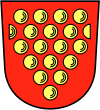 BentheimBentheimCounty of Bentheim is a district in Lower Saxony, Germany. It is bounded by the Dutch provinces of Overijssel and Drenthe, the district of Emsland, and the districts of Steinfurt and Borken in North Rhine-Westphalia.- History :The District has roughly the same territory as the County of...
: Count of Bentheim-BentheimBentheim-BentheimBentheim-Bentheim was a County of southeastern Lower Saxony, Germany. The borders of Bentheim-Bentheim by 1806 were the modern borders of the District of Bentheim. It was one of the original partitions of the County of Bentheim in 1277, and it partitioned between itself and Bentheim-Steinfurt in 1454...
and SteinfurtBentheim-SteinfurtBentheim-Steinfurt was a County of Germany, located in northwestern North Rhine-Westphalia in the region surrounding Steinfurt. Bentheim-Steinfurt was a partition of Bentheim-Bentheim...
1806; Count of Bentheim-Tecklenburg-RhedaBentheim-Tecklenburg-RhedaBentheim-Tecklenburg-Rheda was a County of northwestern North Rhine-Westphalia and southwestern Lower Saxony, Germany. Bentheim-Tecklenburg-Rheda emerged as a partition of Bentheim-Steinfurt in 1606, and was mediatised to Prussia in 1806....
1806 - Bentinck: Baron of BentinckBentinckthumb|[[Welbeck Abbey]] thumb|Schoonheten House thumb|[[Bothal Castle]]The Bentinck family is a prominent family belonging to both Dutch and British nobility. Its members have served in the armed forces and as ambassadors and politicians, including Governor General of India and Prime Minister of...
1807 - Boyneburg-Bömelberg: Baron of Boyneburg-Bömelberg 1806
-
 Castell: Count of Castell-CastellCastell-CastellCastell-Castell was a County in the Holy Roman Empire. It was established as a partition of Castell-Remlingen in 1668, and it was partitioned between itself and Castell in 1709...
1806; Count of Castell-RüdenhausenCastell-RüdenhausenCastell-Rüdenhausen was a County in the Holy Roman Empire. It was created as a partition of Castell. In 1806, it was mediatised to Bavaria.-Counts of Castell-Rüdenhausen :*Godfrey *George Frederick...
1806 - Colloredo: Prince of Colloredo-Mansfeld 1806
-
 Croÿ: Prince of Croÿ-DulmenHouse of CroÿThe House of Croÿ is an international family of European mediatized nobility which held a seat in the Imperial Diet from 1486, and was elevated to the rank of Imperial Princes in 1594...
1806 - Dietrichstein: Prince of DietrichsteinDietrichsteinDietrichstein was the name of a German/Austrian noble family.Maximilian von Dietrichstein was created Graf von Dietrichstein on 18 September 1612 and Fürst von Dietrichstein zu Nikolsburg on 24 March 1639...
1806 -
 Erbach: Count of Erbach-Erbach 1806; Count of Erbach-Fürstenau 1806; Prince of Erbach-Schönberg 1806
 - Esterházy de Galántha: Prince of Esterházy 1806
- FuggerFuggerThe Fugger family was a historically prominent group of European bankers, members of the fifteenth and sixteenth-century mercantile patriciate of Augsburg, international mercantile bankers, and venture capitalists like the Welser and the Höchstetter families. This banking family replaced the de'...
: Prince of Fugger-Babenhausen 1806; Count of Fugger-Glött 1806; Count of Fugger-Kirchberg-Weissenhorn 1806; Count of Fugger-Kirchheim 1806; Count of Fugger-Nordendorf 1806 -
 Fürstenberg: Prince of Fürstenberg-PürglitzFürstenberg-PürglitzFürstenberg-Pürglitz was a line of noble family hailing from southwestern Baden-Württemberg, Germany, which was seated at Křivoklát Castle in Bohemia. Fürstenberg-Pürglitz emerged as a partition of Fürstenberg-Fürstenberg in 1762, and it gained Fürstenberg-Fürstenberg in 1804...
1806 -
 Giech: Count of Giech 1806
 - Grävenitz: Count of Grävenitz 1806
- Harrach: Count of Harrach zu Thannhausen 1806
- Hesse: Elector of Hesse-Kassel
 Hesse-KasselThe Landgraviate of Hesse-Kassel or Hesse-Cassel was a state in the Holy Roman Empire under Imperial immediacy that came into existence when the Landgraviate of Hesse was divided in 1567 upon the death of Philip I, Landgrave of Hesse. His eldest son William IV inherited the northern half and the...
(or Hesse-Cassel) 1807;Landgrave of Hesse-Homburg Hesse-HomburgHesse-Homburg was formed into a separate landgraviate in 1622 by the landgrave of Hesse-Darmstadt to be ruled by his son, although it did not become independent of Hesse-Darmstadt until 1668....
1806 -
 Hohenlohe: Prince of Hohenlohe-BartensteinHohenlohe-BartensteinHohenlohe-Bartenstein was a German Principality located in northeastern Baden-Württemberg, Germany, around Bartenstein. Hohenlohe-Bartenstein was a partition of Hohenlohe-Schillingsfürst and was raised from a County to a Principality in 1744...
1806; Prince of Hohenlohe-IngelfingenHohenlohe-IngelfingenHohenlohe-Ingelfingen was a German County located in northeastern Baden-Württemberg, Germany, around Ingelfingen. Hohenlohe-Ingelfingen was a partition of Hohenlohe-Langenburg...
1806; Prince of Hohenlohe-JagstbergHohenlohe-JagstbergHohenlohe-Jagstberg was a Principality located in northeastern Baden-Württemberg, Germany, around Jagstberg which had been a territory of the Bishopric of Würzburg. Hohenlohe-Jagstberg was a partition of Hohenlohe-Bartenstein and was mediatised to Württemberg in 1806.-Prince of Hohenlohe-Jagstberg...
1806; Count of Hohenlohe-KirchbergHohenlohe-KirchbergHohenlohe-Kirchberg was a German County located in northeastern Baden-Württemberg, Germany, around Kirchberg. It was ruled by a branch of the Hohenlohe family. The county of Kirchberg was located between the territories of Brandenburg-Ansbach to the north and east, the Free City of Schwäbisch Hall...
1806; Prince of Hohenlohe-LangenburgHohenlohe-LangenburgHohenlohe-Langenburg was a German county of northeastern Baden-Württemberg, Germany, located around Langenburg. Hohenlohe-Neuenstein was partitioned into it, Hohenlohe-Ingelfingen and Hohenlohe-Kirchberg in 1701...
1806; Count of Hohenlohe-Waldenburg-SchillingsfürstHohenlohe-Waldenburg-SchillingsfürstHohenlohe-Waldenburg-Schillingsfürst was a County in northeastern Baden-Württemberg, Germany. Hohenlohe-Waldenburg-Schillingsfürst was a partition of Hohenlohe-Schillingsfürst, and was mediatised to Württemberg in 1806....
1806 -
 Isenburg: Prince of IsenburgIsenburgIsenburg was a region of Germany located in southern present-day Hesse, located in territories north and south of Frankfurt. The states of Isenburg emerged from the Niederlahngau , which partitioned in 1137 into Isenburg-Isenburg and Isenburg-Limburg-Covern...
1814; Count of Isenburg-BüdingenIsenburg-BüdingenIsenburg-Büdingen was a County of southern Hesse, Germany, located in Büdingen. There were two different Counties of the same name. The first was a partition of Isenburg-Cleberg, and was partitioned into Isenburg-Büdingen-Birstein and Isenburg-Ronneburg in 1511. The second was a partition of...
1806; Count of Isenburg-MeerholzIsenburg-MeerholzIsenburg-Meerholz was a County of southern Hesse, Germany. It was created as a partition of Isenburg-Büdingen in 1673, and was mediatised to Isenburg in 1806...
1806; Count of Isenburg-WächtersbachIsenburg-WächtersbachIsenburg-Wächtersbach was a County of southern Hesse, Germany. It was created in 1673 as a partition of Isenburg-Büdingen, and was mediatised to Isenburg in 1806.-Counts of Isenburg-Wächtersbach :...
1806 -
 Kaunitz-Rietberg: Prince of Kaunitz-Rietberg 1806
 - Khevenhüller-Metsch: Prince of Khevenhüller-Metsch 1806
-
 Königsegg: Count of Königsegg-AulendorfKönigsegg-AulendorfKönigsegg-Aulendorf was a county of southeastern Baden-Württemberg, Germany. The territories of Königsegg-Aulendorf by 1806 were four separate exclaves, centred around Königsegg in the west, Aulendorf in the east, and two smaller territories north and south of the Teutonic Knights' territory at...
1806 -
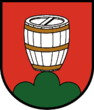 Kuefstein: Count of Kuefstein-Greillenstein 1806
 -
 Leiningen: Prince of Leiningen 1806; Count of Leiningen-Alt-Westerburg 1806; Count of Leiningen-Billigheim 1806; Count of Leiningen-Neudenau; 1806 Count of Leiningen-Neu-Westerburg 1806
 -
 Leyen: Prince of LeyenPrincipality of LeyenThe Principality of Leyen was a Napoleonic German state which existed 1806–14 in Hohengeroldseck, in the west of modern Baden-Württemberg. The House of Leyen had acquired many districts in western Germany, and eventually these were inherited by the Leyen line of counts at Adendorf. In 1797, France...
1814 - Limburg-StyrumHouse of Limburg-StirumThe house of Limburg-Stirum, which adopted its name in the 12th century from the castle of Limburg an der Lenne in what is now Germany, descends from the Ezzonen dynasty in the 9th century, making it one of the oldest families in Europe....
: Count of Limburg-Styrum-BorkelöLimburg-Styrum-BorkelöLimburg-Styrum-Borkelö was a noble family of the Netherlands which originated in Germany. It was a line of the House of Limburg-Styrum and was partitioned from Limburg-Styrum-Bronchhorst-Borkelö in 1766. The family reigned over their territories until the mediatization of 1806.-Counts of...
1806; Count of Limburg-Styrum-BronchhorstLimburg-Styrum-BronchhorstLimburg-Styrum-Bronchhorst was a noble family of the Netherlands which originated in Germany. It was a line of the Limburg-Styrum family and was partitioned from Limburg-Styrum-Bronchhorst-Borkelö in 1766.-Counts of Limburg-Styrum-Bronchhorst :...
1806 - LobkowiczLobkowiczThe Lobkowicz family is one of the oldest still existing Bohemian noble families dating back to the 14th century...
: Prince of LobkowiczLobkowiczThe Lobkowicz family is one of the oldest still existing Bohemian noble families dating back to the 14th century...
1806 -
 Löwenstein-Wertheim: Count of Löwenstein-Wertheim-Freudenberg 1806; Prince of Löwenstein-Wertheim-Rosenberg 1806
 -
 Looz und Corswarem: Duke of Looz-Corswarem 1806
 - Metternich: Prince of Metternich 1806
-
 Neipperg: Count of NeippergNeippergNeipperg refers to:* Part of Brackenheim, Germany* County of Neipperg, a state of the Holy Roman Empire from 1431, centred on Schwaigern, mediatised to the Kingdom of Württemberg in 1806...
1806 - Nesselrode: Count of NesselrodeNesselrodeNesselrode is the family name of:* Nesselrode * * * Count Karl Robert Nesselrode, * Maria Kalergis-Muchanow, née Nesselrode * *...
1806 -
 Orsini and Rosenberg: Prince of Orsini and Rosenberg 1806
 - Ortenburg: Count of Ortenburg-NeuortenburgOrtenburg-NeuortenburgOrtenburg-Neuortenburg was a minor county and Imperial State in present-day Lower Bavaria, Germany. It was located on the lands around Ortenburg Castle, about west of Passau...
1806 - Ostein: Count of Ostein 1806
- Öttingen: Prince of Öttingen-ÖttingenÖttingen-ÖttingenOettingen-Oettingen was a noble family and county in modern-day eastern Baden-Württemberg and western Bavaria, Germany.Oettingen-Oettingen was created as a partition of Oettingen in 1423, became extinct in 1731 and was inherited by Oettingen-Wallerstein....
1806; Prince of Öttingen-SpielbergÖttingen-SpielbergOettingen-Spielberg was a noble family and county in modern-day eastern Baden-Württemberg and western Bavaria, Germany.Oettingen-Spielberg was a partition of Oettingen-Wallerstein in 1602...
1806 -
 Pappenheim: Count of PappenheimPappenheimPappenheim is a town in the Weißenburg-Gunzenhausen district, in Bavaria, Germany. It is situated on the river Altmühl, 11 km south of Weißenburg in Bayern.- Notable people :The architect and professor Eduard Mezger was born in Pappenheim....
1806 - Platen-Hallermund: Count of Platen-Hallermund 1806
- Plettenberg: Count of Plettenberg-WittemHouse of PlettenbergThe House of Plettenberg is a Westphalian noble family of the Uradel. It dates back at least to 1187, when Heidolphus de Plettenbrath was mentioned in a document by Philip I...
1806 - Pückler and Limpurg: Count of Pückler and Limpurg 1806
- Quadt: Count of Quadt-Isny 1806
- Rechberg and Rothenlöwen: Count of Rechberg and RothenlöwenRechberg and RothenlöwenRechberg and Rothenlöwen was a country in the Holy Roman Empire. Rechberg and Rothenlöwen was a renaming of Osterberg, and it inherited Osterberg in 1767. Rechberg and Rothenlöwen was mediatised to Württemberg in 1806. The family of the Grafen von Rechberg und Rothenlöwen would be an important one...
1806 - Rechteren-Limpurg: Count of RechterenVan RechterenThe counts van Rechteren belong to the Dutch and German nobility. The German branch von Rechteren-Limpurg-Speckfeld has been mediatised....
1806 - Salm: Wild- and Rhinegrave of Salm-HorstmarSalm-HorstmarSalm-Horstmar was a short-lived Napoleonic County in far northern North Rhine-Westphalia, Germany, located around Horstmar, to the northeast of Münster. It was created in 1803 for Wild- and Rhinegrave Frederick Charles Augustus of Salm-Grumbach following the loss of Grumbach and other territories...
1806; Prince of Salm-KyrburgSalm-KyrburgSalm-Kyrburg was a state of the Holy Roman Empire located in present-day Rhineland-Palatinate, Germany, one of the various partitions of Salm. It was twice created: the first time as a Wild- and Rhinegraviate , and secondly as a Principality...
1810; Count of Salm-Reifferscheid-DyckSalm-Reifferscheid-DyckSalm-Reifferscheid-Dyck was a small County of the Holy Roman Empire. Its territory was the area around Dyck in present North Rhine-Westphalia, Germany...
1806; Count of Salm-Reifferscheid-HainsbachSalm-Reifferscheid-HainsbachSalm-Reifferscheid-Hainsbach was a German statelet, which was a partition of Salm-Reifferscheid-Bedbur. It was mediatised in 1811.-Counts of Salm-Reifferscheid-Hainsbach :* Leopold Anthony * Francis Wenceslaus...
1806; Prince of Salm-Reifferscheid-KrautheimSalm-Reifferscheid-KrautheimSalm-Reifferscheid-Krautheim was a German statelet, which was created as a succession of Salm-Reifferscheid-Bedbur in 1803. It was raised to a Principality in 1804, and was mediatised to the Austrian Empire and the Grand Duchy of Baden in 1806....
1806; Prince of Salm-SalmSalm-SalmThe Principality of Salm-Salm was a state of the Holy Roman Empire. It was located in the present-day French départements of the Bas-Rhin and the Vosges and was one of a number of partitions of Salm.-History:...
1810 -
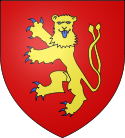 Sayn-Wittgenstein: Prince of Sayn-Wittgenstein-BerleburgSayn-Wittgenstein-BerleburgSayn-Wittgenstein-Berleburg was a county , most of which is located in the present district of Siegen-Wittgenstein, Germany . Its seat was the town and palace in Berleburg...
1806; Prince of Sayn-Wittgenstein-Hohnstein 1806 - Schaesberg: Count of Schaesberg-Thannheim 1806
-
 Schlitz genannt von Görtz: Count of Schlitz genannt von Görtz 1806
 - Schönborn: Count of Schönborn-Wiesentheid 1806
- Schönburg: Count of Schönburg-Penig-Vorderglauchau-Wechselburg 1806; Count of Schönburg-Rochsburg-Hinterglauchau 1806; Prince of Schönburg-Waldenburg 1806
- Schwarzenberg: Prince of SchwarzenbergSchwarzenberg- People :* House of Schwarzenberg, Frankish and Bohemian aristocratic family which was first mentioned in 1172** Karl Philipp, Prince of Schwarzenberg , Field Marshal in Austrian service during the Napoleonic Wars...
1806 - Sickingen: Count of Sickingen 1806
- Sinzendorf: Prince of SinzendorfSinzendorfSinzendorf:* Philipp Ludwig von Sinzendorf , cardinal of the Catholic Church* Prosper Anton Josef von Sinzendorf , Austrian noble man and courtier, Counsellor and Chamberlain...
1806 - Solms: Count of Solms-BaruthSolms-BaruthSolms-Baruth was a Lower Lusatian state country, from 16th century until 1945.-History:Solms-Baruth was one of the many minor states of the Holy Roman Empire. It lost its independence in the German Mediatization of 1806. Initially it passed to the Kingdom of Saxony...
1806; Prince of Solms-BraunfelsSolms-BraunfelsSolms-Braunfels was a County in what is today the federal Land of Hesse in Germany.Solms-Braunfels was a partition of Solms, and was raised to a Principality in 1742. Solms-Braunfels was partitioned between: itself and Solms-Ottenstein in 1325; itself and Solms-Lich in 1409; and itself,...
1806; Prince of Solms-Hohensolms-LichSolms-Hohensolms-LichSolms-Hohensolms-Lich was a County of northern Baden-Württemberg and eastern Rhineland-Palatinate, Germany. It was originally created as a union of Solms-Hohensolms and Solms-Lich, and it was raised to a Principality in 1792...
1806; Count of Solms-LaubachSolms-LaubachSolms-Laubach was a County of southern Hesse and eastern Rhineland-Palatinate, Germany. It was originally created as a partition of Solms-Lich. Solms-Laubach partitioned between itself and Solms-Sonnenwalde 1561; between itself, Solms-Baruth and Solms-Rödelheim 1607; and between itself and...
1806; Count of Solms-Rödelheim-AssenheimSolms-Rödelheim-AssenheimSolms-Rödelheim-Assenheim was a County of southern Hesse and eastern Rhineland-Palatinate, Germany. It was thrice created by a union of the Counts of Solms-Assenheim and Solms-Rödelheim, and on the first two occasions repartitioned into those statelets...
1806; Count of Solms-Rödelheim und Assenheim 1806; Count of Solms-WildenfelsSolms-WildenfelsSolms-Wildenfels was a minor County of southern Hesse, Germany. It was a partition of Solms-Baruth. In 1741 it was partitioned between itself and Solms-Sachsenfeld, and reintegrated that County upon its extinction in 1896...
1806 -
 Stadion:
  Count of Stadion-ThannhausenStadion-ThannhausenStadion-Thannhausen was a County located in and around Thannhausen in western Bavaria, Germany. Stadion-Thannhausen was a partition of Stadion, and was mediatised to Bavaria in 1806.-Counts of Stadion-Thannhausen:* Hugo Philip...
1806; Count of Stadion-WarthausenStadion-WarthausenStadion-Warthausen was a County located in around Warthausen in western Baden-Württemberg, Germany. Stadion-Warthausen was a partition of Stadion County, and was mediatised to Austria and Württemberg in 1806.-Counts of Stadion-Warthausen:...
1806 -
 Starhemberg: Prince of StarhembergStarhemberg----Starhemberg is the name of an Austrian noble family hailing from Upper Austria, specifically Steyr and Steinbach, who were Counts of the Empire from 1643, raised to princes in 1765...
1806 -
 Sternberg-Manderscheid: Countess of Sternberg-Manderscheid 1806
 -
.png) Stolberg:
Stolberg:  Count of Stolberg-RosslaStolberg-RosslaThe County of Stolberg-Rossla was a county of the Holy Roman Empire. Its capital was Roßla, now in Saxony-Anhalt, Germany.Stolberg-Rossla emerged as a partition of Stolberg-Stolberg in 1706. It was forced to recognize the suzerainty of the Electorate of Saxony in 1738. Stolberg-Rossla was...
1806; Count of Stolberg-StolbergStolberg-StolbergStolberg-Stolberg was a county of the Holy Roman Empire located in the southern Harz region. Its capital was the town of Stolberg, now in Saxony-Anhalt, Germany....
1806; Count of Stolberg-WernigerodeStolberg-WernigerodeThe Principality of Stolberg-Wernigerode was a county of the Holy Roman Empire located in the Harz region around Wernigerode, now part of Saxony-Anhalt, Germany.-History:...
1809 - Thurn und Taxis: Prince of Thurn and Taxis 1806
- Törring: Count of Törring-Jettenbach 1806
- Trauttmansdorff-Weinsberg: Prince of TrauttmansdorffTrautmannsdorf an der LeithaTrautmannsdorf an der Leitha is a town in the district of Bruck an der Leitha in Lower Austria in Austria....
1806 - Waldbott von Bassenheim: Count of Waldbott von Bassenheim 1806
- Waldburg: Prince of Waldburg-WaldseeWaldburg-WaldseeWaldburg-Waldsee was a County located in southeastern Baden-Württemberg, Germany, located around Bad Waldsee. Waldburg-Waldsee was a partition of Waldburg-Wolfegg...
1806; Prince of Waldburg-WurzachWaldburg-WurzachWaldburg-Wurzach was a county located on the southeastern border of Baden-Württemberg, Germany, located around Wurzach . Waldburg-Wurzach was a partition of Waldburg-Zeil...
1806; Prince of Waldburg-ZeilWaldburg-ZeilWaldburg-Zeil was a County located in southeastern Baden-Württemberg, Germany, located around Zeil. Waldburg-Zeil was a partition of Waldburg-Wolfegg-Zeil...
1806 - Waldeck: Count and Countess of Waldeck-Limpurg 1806
- Wallmoden: Count of Wallmoden-Gimborn 1806
- Wartenberg: Count of Wartenberg-Roth 1806
-
 Wied: Prince of Wied-Neuwied 1806; Prince of Wied-RunkelWied-RunkelWied-Runkel was a German statelet. Wied-Runkel was located in the County of Runkel, located on the Lahn River. It extended from the town of Runkel to further north of Shupbach, but also held an exclave east of Villmar....
1806 - Windisch-Grätz: Prince of Windisch-Grätz Elder line 1806
- Wurmbrand-Stuppach: Count of Wurmbrand-StuppachWurmbrand-StuppachWurmbrand-Stuppach is an old noble family of Austria, and the name of the County they ruled. During the 17th and 18th centuries, the Counts of Wurmbrand-Stuppach gained notability in wars against the Turks in the Balkans, and Prince Eugene gained fame fighting against the French in the Netherlands...
1806
As the Houses of Ostein, Sinzendorf
Sinzendorf
Sinzendorf:* Philipp Ludwig von Sinzendorf , cardinal of the Catholic Church* Prosper Anton Josef von Sinzendorf , Austrian noble man and courtier, Counsellor and Chamberlain...
and Wartenberg
Wartenberg
- Buildings :* Wartenberg castles, situated on the Wartenberg hill in the municipality of Muttenz near Basel.- Places :* Wartenberg, Hesse in the district Vogelsbergkreis, Hesse, Germany* Wartenberg, a locality in the borough of Lichtenberg in Berlin, Germany...
became extinct after the mediatisation but before 1830, they are not always counted among the Mediatised Houses. For varying reasons, Aspremont-Lynden, Bentinck
Bentinck
thumb|[[Welbeck Abbey]] thumb|Schoonheten House thumb|[[Bothal Castle]]The Bentinck family is a prominent family belonging to both Dutch and British nobility. Its members have served in the armed forces and as ambassadors and politicians, including Governor General of India and Prime Minister of...
, Bretzenheim
Bretzenheim
Bretzenheim was a minor Principality in pre-Napoleonic Germany. It was created in 1790 for Charles Augustus of the line of Wittelsbach-Bretzenheim. Its territory in central Germany was mediatised to Hesse-Darmstadt in 1803, and its territory north of Lake Constance was mediatised to Austria in...
, Limburg-Styrum and Waldeck-Limpurg are also sometimes excluded. Hesse-Homburg
Hesse-Homburg
Hesse-Homburg was formed into a separate landgraviate in 1622 by the landgrave of Hesse-Darmstadt to be ruled by his son, although it did not become independent of Hesse-Darmstadt until 1668....
was never considered sovereign by Hesse-Darmstadt
Landgraviate of Hesse-Darmstadt
The Landgraviate of Hesse-Darmstadt was a member state of the Holy Roman Empire. It was formed in 1567 following the division of the Landgraviate of Hesse between the four sons of Philip I, the last Landgrave of Hesse....
and therefore was not technically mediatised, and Hesse-Kassel
Hesse-Kassel
The Landgraviate of Hesse-Kassel or Hesse-Cassel was a state in the Holy Roman Empire under Imperial immediacy that came into existence when the Landgraviate of Hesse was divided in 1567 upon the death of Philip I, Landgrave of Hesse. His eldest son William IV inherited the northern half and the...
(or Hesse-Cassel) was annexed into the Kingdom of Westphalia
Kingdom of Westphalia
The Kingdom of Westphalia was a new country of 2.6 million Germans that existed from 1807-1813. It included of territory in Hesse and other parts of present-day Germany. While formally independent, it was a vassal state of the First French Empire, ruled by Napoleon's brother Jérôme Bonaparte...
but later had its sovereignty restored. The Schönburg
Schönburg
Schönburg is a municipality in the Burgenlandkreis district, in Saxony-Anhalt, Germany. It is situated 5 km east of Naumburg, on the river Saale. It is part of the Verbandsgemeinde Wethautal....
s had been mediatised to the Elector of Saxony
Electorate of Saxony
The Electorate of Saxony , sometimes referred to as Upper Saxony, was a State of the Holy Roman Empire. It was established when Emperor Charles IV raised the Ascanian duchy of Saxe-Wittenberg to the status of an Electorate by the Golden Bull of 1356...
in the 18th century and were only counted amongst the Mediatised Houses at the Electors' insistence.
Abolished free and imperial cities
|
 Heilbronn HeilbronnHeilbronn Heilbronn is a city in northern Baden-Württemberg, Germany. It is completely surrounded by Heilbronn County and with approximately 123.000 residents, it is the sixth-largest city in the state....  Isny im Allgäu Isny im AllgäuIsny im Allgäu Isny im Allgäu is a town in south-eastern Baden-Württemberg, Germany. It is part of the district of Ravensburg, in the western, Württembergish part of the Allgäu region. For nearly 1000 years, Isny was an important town within the Holy Roman Empire... Kaufbeuren Kaufbeuren is an independent city in the Regierungsbezirk of Schwaben, southern Bavaria. The city is completely enclaved within the district of Ostallgäu.- Culture and Objects of Interest :* Townhall * Crescentiakloster...  Leutkirch im Allgäu Leutkirch im AllgäuLeutkirch im Allgäu Leutkirch im Allgäu is a city in south-eastern Baden-Württemberg, Germany. It is part of the district of Ravensburg, in the western, Württembergish part of the Allgäu region. It belongs to the administrative region of Tübingen.... .png) Lindau LindauLindau Lindau is a Bavarian town and an island on the eastern side of Lake Constance, the Bodensee. It is the capital of the Landkreis or rural district of Lindau. The historic city of Lindau is located on an island which is connected with the mainland by bridge and railway.- History :The name Lindau was...  Memmingen MemmingenMemmingen Memmingen is a town in the Bavarian administrative region of Swabia in Germany. It is the central economic, educational and administrative centre in the Danube-Iller region. To the west the town is flanked by the Iller, the river that marks the Baden-Württemberg border...  Mühlhausen MühlhausenMühlhausen Mühlhausen is a city in the federal state of Thuringia, Germany. It is the capital of the Unstrut-Hainich district, and lies along the river Unstrut. Mühlhausen had c. 37,000 inhabitants in 2006.-History:... Nordhausen Nordhausen is a town at the southern edge of the Harz Mountains, in the state of Thuringia, Germany. It is the capital of the district of Nordhausen... Nördlingen Nördlingen is a town in the Donau-Ries district, in Bavaria, Germany, with a population of 20,000. It is located in the middle of a complex meteorite crater, called the Nördlinger Ries. The town was also the place of two battles during the Thirty Years' War...  Nuremberg NurembergNuremberg Nuremberg[p] is a city in the German state of Bavaria, in the administrative region of Middle Franconia. Situated on the Pegnitz river and the Rhine–Main–Danube Canal, it is located about north of Munich and is Franconia's largest city. The population is 505,664...  Offenburg OffenburgOffenburg Offenburg is a city located in the state of Baden-Württemberg, Germany. With about 60,000 inhabitants, it is the largest city and the capital of the Ortenaukreis.Offenburg also houses University of Applied Sciences Offenburg... Pfullendorf Pfullendorf is a small historic city in the district of Sigmaringen in Baden-Württemberg in Germany.-Geography:Its location is in the district of Sigmaringen, 25 km north of Lake Constance and south of the Danube valley and therefore on the continental divide between the watersheds of the...  Ravensburg RavensburgRavensburg Ravensburg is a town in Upper Swabia in Southern Germany, capital of the district of Ravensburg, Baden-Württemberg.Ravensburg was first mentioned in 1088. In the Middle Ages, it was an Imperial Free City and an important trading centre...  Regensburg RegensburgRegensburg Regensburg is a city in Bavaria, Germany, located at the confluence of the Danube and Regen rivers, at the northernmost bend in the Danube. To the east lies the Bavarian Forest. Regensburg is the capital of the Bavarian administrative region Upper Palatinate... Reutlingen Reutlingen is a city in Baden-Württemberg, Germany. It is the capital of the eponymous district of Reutlingen. As of April 2008, it has a population of 109,828.... |
Rothenburg ob der Tauber Rothenburg ob der Tauber is a town in the district of Ansbach of Mittelfranken , the Franconia region of Bavaria, Germany, well known for its well-preserved medieval old town, a destination for tourists from around the world. In the Middle Ages, it was an Imperial Free City...  Rottweil RottweilRottweil Rottweil is a town in the south west of Germany and is the oldest town in the federal state of Baden-Württemberg.Located between the Black Forest and the Swabian Alb hills, Rottweil has about 25,000 inhabitants... 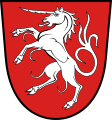 Schwäbisch Gmünd Schwäbisch GmündSchwäbisch Gmünd Schwäbisch Gmünd is a town in the eastern part of the German state of Baden-Württemberg. With a population of around 62,000, the town is the second largest in the Ostalbkreis and the whole region of East Württemberg after Aalen...  Schwäbisch Hall Schwäbisch HallSchwäbisch Hall Schwäbisch Hall is a town in the German state of Baden-Württemberg and capital of the district of Schwäbisch Hall. The town is located in the valley of the river Kocher in the north-eastern part of Baden-Württemberg.... Schweinfurt Schweinfurt is a city in the Lower Franconia region of Bavaria in Germany on the right bank of the canalized Main, which is here spanned by several bridges, 27 km northeast of Würzburg.- History :...  Speyer SpeyerSpeyer Speyer is a city of Rhineland-Palatinate, Germany with approximately 50,000 inhabitants. Located beside the river Rhine, Speyer is 25 km south of Ludwigshafen and Mannheim. Founded by the Romans, it is one of Germany's oldest cities... Überlingen Überlingen is a city on the northern shore of Lake Constance . After the city of Friedrichshafen, it is the second largest city in the Bodenseekreis , and a central point for the outlying communities...  Ulm UlmUlm Ulm is a city in the federal German state of Baden-Württemberg, situated on the River Danube. The city, whose population is estimated at 120,000 , forms an urban district of its own and is the administrative seat of the Alb-Donau district. Ulm, founded around 850, is rich in history and... Wangen im Allgäu Wangen im Allgäu is a historic city in southeast Baden-Württemberg, Germany. It lies north-east of Lake Constance in the Westallgäu. It is the second-largest city in the Ravensburg district and is a nexus for the surrounding communities...  Weil WeilWeil der Stadt Weil der Stadt is a small town of about 19,000 inhabitants, located in the Stuttgart Region of the German state of Baden-Württemberg. It is about west of Stuttgart city center, and is often called "Gate to the Black Forest"...  Weißenburg WeißenburgWissembourg Wissembourg is a commune in the Bas-Rhin department in Alsace in northeastern France.It is situated on the little River Lauter close to the border between France and Germany approximately north of Strasbourg and west of Karlsruhe. Wissembourg is a sub-prefecture of the department...  Wetzlar WetzlarWetzlar Wetzlar is a city in the state of Hesse, Germany. Located at 8° 30′ E, 50° 34′ N, Wetzlar straddles the river Lahn and is on the German Timber-Framework Road which passes mile upon mile of half-timbered houses. Historically, the city has acted as the hub of the Lahn-Dill-Kreis on the north edge of... Bad Wimpfen Bad Wimpfen is an historic spa town in the district of Heilbronn in the Baden-Württemberg region of southern Germany. It lies north of the city of Heilbronn, on the river Neckar.-Geography:...  Windsheim WindsheimWindesheim, Germany Windesheim is a municipality in the district of Bad Kreuznach in Rhineland-Palatinate, in western Germany.-External links:*...  Worms WormsWorms, Germany Worms is a city in Rhineland-Palatinate, Germany, on the Rhine River. At the end of 2004, it had 85,829 inhabitants.Established by the Celts, who called it Borbetomagus, Worms today remains embattled with the cities Trier and Cologne over the title of "Oldest City in Germany." Worms is the only...  Zell am Harmersbach Zell am HarmersbachZell am Harmersbach Zell am Harmersbach is a small historic city in Baden-Württemberg, Germany. It lies in the Ortenaukreis, between the Black Forest and the Rhine.-History:... |


 Biberach an der Riß



Most of the mediatisations occurred in 1806 after the creation of the Confederation of the Rhine
Confederation of the Rhine
The Confederation of the Rhine was a confederation of client states of the First French Empire. It was formed initially from 16 German states by Napoleon after he defeated Austria's Francis II and Russia's Alexander I in the Battle of Austerlitz. The Treaty of Pressburg, in effect, led to the...
. Also mediatised 1806–1814 were several states created by Napoleon for his relatives and close allies. These include:
- Prince of AschaffenburgPrincipality of AschaffenburgThe Principality of Aschaffenburg was a principality of the Holy Roman Empire and the Confederation of the Rhine from 1803–10. Its capital was Aschaffenburg....
1806 - Grand Duke of FrankfurtGrand Duchy of FrankfurtThe Grand Duchy of Frankfurt was a German satellite state of Napoleonic creation. It came into existence in 1810 through the combination of the former territories of the Archbishops of Mainz along with the Free Imperial City of Frankfurt itself....
1814 - King of WestphaliaKingdom of WestphaliaThe Kingdom of Westphalia was a new country of 2.6 million Germans that existed from 1807-1813. It included of territory in Hesse and other parts of present-day Germany. While formally independent, it was a vassal state of the First French Empire, ruled by Napoleon's brother Jérôme Bonaparte...
1813 - Grand Duke of WürzburgGrand Duchy of WürzburgThe Grand Duchy of Würzburg was a German grand duchy centered on Würzburg existing in the early 19th century.As a consequence of the 1801 Treaty of Lunéville, the Bishopric of Würzburg was secularized in 1803 and granted to Bavaria. In the same year Ferdinand III, former Grand Duke of Tuscany, was...
1814
The only free cities in Germany not abolished in 1803 were:
- AugsburgAugsburgAugsburg is a city in the south-west of Bavaria, Germany. It is a university town and home of the Regierungsbezirk Schwaben and the Bezirk Schwaben. Augsburg is an urban district and home to the institutions of the Landkreis Augsburg. It is, as of 2008, the third-largest city in Bavaria with a...
(abolished 1805) - BremenBremen (state)The Free Hanseatic City of Bremen is the smallest of Germany's 16 states. A more informal name, but used in some official contexts, is Land Bremen .-Geography:...
-
 FrankfurtFree City of FrankfurtFor almost five centuries, the German city of Frankfurt am Main was a city-state within two major Germanic states:*The Holy Roman Empire as the Free Imperial City of Frankfurt...
(abolished 1866) -
 HamburgHamburg-History:The first historic name for the city was, according to Claudius Ptolemy's reports, Treva.But the city takes its modern name, Hamburg, from the first permanent building on the site, a castle whose construction was ordered by the Emperor Charlemagne in AD 808...
 -
 Lübeck (abolished 1937)
 - NurembergNurembergNuremberg[p] is a city in the German state of Bavaria, in the administrative region of Middle Franconia. Situated on the Pegnitz river and the Rhine–Main–Danube Canal, it is located about north of Munich and is Franconia's largest city. The population is 505,664...
(abolished 1806)
Later mediatisations were:
- ArenbergArenbergArenberg, also spelled as Aremberg or Ahremberg, is a historic county, principality and finally duchy located in modern Germany. The Dukes of Arenberg remain a prominent Belgian aristocratic family.- History :...
(annexed to France in 1810, and not re-established in 1814) - IsenburgIsenburgIsenburg was a region of Germany located in southern present-day Hesse, located in territories north and south of Frankfurt. The states of Isenburg emerged from the Niederlahngau , which partitioned in 1137 into Isenburg-Isenburg and Isenburg-Limburg-Covern...
and LeyenPrincipality of LeyenThe Principality of Leyen was a Napoleonic German state which existed 1806–14 in Hohengeroldseck, in the west of modern Baden-Württemberg. The House of Leyen had acquired many districts in western Germany, and eventually these were inherited by the Leyen line of counts at Adendorf. In 1797, France...
(mediatised in 1814 by the Congress of ViennaCongress of ViennaThe Congress of Vienna was a conference of ambassadors of European states chaired by Klemens Wenzel von Metternich, and held in Vienna from September, 1814 to June, 1815. The objective of the Congress was to settle the many issues arising from the French Revolutionary Wars, the Napoleonic Wars,...
for being too loyal to Napoleon) - SalmSalm (state)Salm is the name of several historic countships and principalities in present Germany, Belgium, Luxembourg and France.-Origins:The County of Salm arose in the 10th century in Vielsalm, in the Ardennes region of present Belgium...
(several states of Salm survived to 1811 and 1813) - Stolberg-StolbergStolberg-StolbergStolberg-Stolberg was a county of the Holy Roman Empire located in the southern Harz region. Its capital was the town of Stolberg, now in Saxony-Anhalt, Germany....
and Stolberg-WernigerodeStolberg-WernigerodeThe Principality of Stolberg-Wernigerode was a county of the Holy Roman Empire located in the Harz region around Wernigerode, now part of Saxony-Anhalt, Germany.-History:...
(annexed by PrussiaKingdom of PrussiaThe Kingdom of Prussia was a German kingdom from 1701 to 1918. Until the defeat of Germany in World War I, it comprised almost two-thirds of the area of the German Empire...
in 1815).
Consequences
The Reichsdeputationshauptschluss brought about a massive change to the political map of Germany. Literally hundreds of states were eliminated, with only around forty surviving. A number of the surviving states made significant territorial gains (most notably BadenBaden
Baden is a historical state on the east bank of the Rhine in the southwest of Germany, now the western part of the Baden-Württemberg of Germany....
, Bavaria
Kingdom of Bavaria
The Kingdom of Bavaria was a German state that existed from 1806 to 1918. The Bavarian Elector Maximilian IV Joseph of the House of Wittelsbach became the first King of Bavaria in 1806 as Maximilian I Joseph. The monarchy would remain held by the Wittelsbachs until the kingdom's dissolution in 1918...
, and Hesse-Darmstadt
Grand Duchy of Hesse
The Grand Duchy of Hesse and by Rhine , or, between 1806 and 1816, Grand Duchy of Hesse —as it was also known after 1816—was a member state of the German Confederation from 1806, when the Landgraviate of Hesse-Darmstadt was elevated to a Grand Duchy, until 1918, when all the German...
); and Baden
Baden
Baden is a historical state on the east bank of the Rhine in the southwest of Germany, now the western part of the Baden-Württemberg of Germany....
, Hesse-Kassel
Hesse-Kassel
The Landgraviate of Hesse-Kassel or Hesse-Cassel was a state in the Holy Roman Empire under Imperial immediacy that came into existence when the Landgraviate of Hesse was divided in 1567 upon the death of Philip I, Landgrave of Hesse. His eldest son William IV inherited the northern half and the...
(or Hesse-Cassel), and Württemberg
Kingdom of Württemberg
The Kingdom of Württemberg was a state that existed from 1806 to 1918, located in present-day Baden-Württemberg, Germany. It was a continuation of the Duchy of Württemberg, which came into existence in 1495...
gained status by being made electorates (to replace three that had been lost in the changes). Of the imperial cities, only Augsburg
Augsburg
Augsburg is a city in the south-west of Bavaria, Germany. It is a university town and home of the Regierungsbezirk Schwaben and the Bezirk Schwaben. Augsburg is an urban district and home to the institutions of the Landkreis Augsburg. It is, as of 2008, the third-largest city in Bavaria with a...
, Bremen
Bremen (state)
The Free Hanseatic City of Bremen is the smallest of Germany's 16 states. A more informal name, but used in some official contexts, is Land Bremen .-Geography:...
, Frankfurt am Main
Free City of Frankfurt
For almost five centuries, the German city of Frankfurt am Main was a city-state within two major Germanic states:*The Holy Roman Empire as the Free Imperial City of Frankfurt...
, Hamburg
Hamburg
-History:The first historic name for the city was, according to Claudius Ptolemy's reports, Treva.But the city takes its modern name, Hamburg, from the first permanent building on the site, a castle whose construction was ordered by the Emperor Charlemagne in AD 808...
, Lübeck, and Nuremberg
Nuremberg
Nuremberg[p] is a city in the German state of Bavaria, in the administrative region of Middle Franconia. Situated on the Pegnitz river and the Rhine–Main–Danube Canal, it is located about north of Munich and is Franconia's largest city. The population is 505,664...
survived as independent entities.
{| class="wikitable"
|+ Area and population losses or gains (rounded)
!
!Losses
!Gains
|-
|
Kingdom of Prussia|2.000 km²
140.000 people
|12.000 km²
600.000 people
|-
|
Kingdom of Bavaria|10.000 km²
600.000 people
|14.000 km²
850.000 people
|-
|
Grand Duchy of Baden|450 km²
30.000 people
|2.000 km²
240.000 people
|-
|
Kingdom of Württemberg|400 km²
30.000 people
|1.500 km²
120.000 people
|}
See also
- Confederation of the RhineConfederation of the RhineThe Confederation of the Rhine was a confederation of client states of the First French Empire. It was formed initially from 16 German states by Napoleon after he defeated Austria's Francis II and Russia's Alexander I in the Battle of Austerlitz. The Treaty of Pressburg, in effect, led to the...
- Congress of ViennaCongress of ViennaThe Congress of Vienna was a conference of ambassadors of European states chaired by Klemens Wenzel von Metternich, and held in Vienna from September, 1814 to June, 1815. The objective of the Congress was to settle the many issues arising from the French Revolutionary Wars, the Napoleonic Wars,...
- Holy Roman EmpireHoly Roman EmpireThe Holy Roman Empire was a realm that existed from 962 to 1806 in Central Europe.It was ruled by the Holy Roman Emperor. Its character changed during the Middle Ages and the Early Modern period, when the power of the emperor gradually weakened in favour of the princes...
- Free imperial cityFree Imperial CityIn the Holy Roman Empire, a free imperial city was a city formally ruled by the emperor only — as opposed to the majority of cities in the Empire, which were governed by one of the many princes of the Empire, such as dukes or prince-bishops...
- Mediatisation
- Napoleon INapoleon INapoleon Bonaparte was a French military and political leader during the latter stages of the French Revolution.As Napoleon I, he was Emperor of the French from 1804 to 1815...
- Treaty of Campo FormioTreaty of Campo FormioThe Treaty of Campo Formio was signed on 18 October 1797 by Napoleon Bonaparte and Count Philipp von Cobenzl as representatives of revolutionary France and the Austrian monarchy...
Sources
- Arenberg, Jean Engelbert. The Lesser Princes of the Holy Roman Empire in the Napoleonic Era. Dissertation, Georgetown University, Washington, D.C., 1950 (later published as Les Princes du St-Empire a l'epoque napoleonienne., Louvain: Publications universitaires de Louvain, 1951).
- Gollwitzer, HeinzHeinz GollwitzerHeinz Gollwitzer was a German historian. He held the chair of Modern Political and Social History at the University of Münster.- Life :...
. Die Standesherren. Die politische und gesellschaftliche Stellung der Mediatisierten 1815–1918. Stuttgart 1957 (Göttingen 1964)
- Reitwiesner, William AddamsWilliam Addams ReitwiesnerWilliam Addams Reitwiesner was a genealogist who traced the ancestry of United States political figures, European royalty and celebrities.- Biography :...
. "The Meaning of the Word Mediatized".