

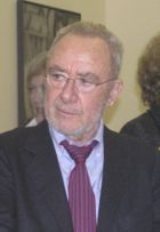
Gerhard Richter

Encyclopedia
Gerhard Richter is a German
visual artist
. Richter has simultaneously produced abstract and photorealistic painted works, as well as photographs and glass pieces, thus undermining the concept of the artist’s obligation to maintain a single cohesive style.
, Saxony
, and grew up in Reichenau
, Lower Silesia
, and in Waltersdorf (Zittauer Gebirge) in the Upper Lusatia
n countryside. He left school after tenth grade and apprenticed as an advertising and stage-set painter, before studying at the Dresden Academy of Fine Arts. In 1948 he terminated the higher professional school in Zittau
, and, between 1949 and 1951, was trained there in writing as well as in stage and advertising painting. In 1950 his application for membership in the Hochschule für Bildende Künste Dresden
(Dresden University of Visual Arts, founded in 1764) was rejected. He finally began his study at the Dresden Academy of Fine Arts in 1951. His teachers were Karl von Appen
, Ulrich Lohmar and Will Grohmann. In these early days of his career he prepared a wall painting ("Communion with Picasso", 1955) for the refectory of this Academy of Arts as part of his B.A. A further mural followed within the Hygiene-Museum (German Hygiene Museum
) with the title "Lebensfreude" ("Joy of life") for his diploma.
 Both paintings had been painted over for ideological reasons after Richter escaped from East to West Germany
(two months before the building of the Berlin Wall
); after German reunification
, the wall painting Joy of life (1956) was uncovered in two places in the stairway of the German Hygiene Museum
, and after the millennium these two uncovered windows with a look at the Joy of Life had been newly recovered. From 1957 to 1961 Richter worked as a master trainee in the academy and took orders for the former state of the GDR. During this time he worked intensively at murals (Arbeiterkampf, which means Worker fight), on paintings in oil (e.g. portraits of the East German actress Angelica Domroese and of Richter's first wife Ema), on various self portraits and furthermore on a panorama of Dresden with the neutral name Stadtbild (Townscape, 1956).
When he arrived in West Germany
, Richter began to study at the Kunstakademie Düsseldorf
under Karl Otto Götz
together with Sigmar Polke
, Konrad Lueg and Gotthard Graubner
. With Polke and Lueg he introduced the term Kapitalistischer Realismus (Capitalistic Realism) as an anti-style of art, appropriating the pictorial shorthand of advertising. This title also referred to the realist style of art known as Socialist Realism
, then the official art doctrine of the Soviet Union, but it also commented upon the consumer-driven art doctrine of western capitalism. Later, Lueg founded the gallery Konrad Fischer in Düsseldorf.
Richter taught as a visiting professor at the Hochschule für Bildende Künste, in Hamburg
, and the Nova Scotia College of Art and Design, and returned in 1971 to Düsseldorf Art Academy as a professor for over 15 years.
In 1983, Richter resettled from Düsseldorf
to Cologne
, where he still lives and works today.
Richter married Marianne Eufinger in 1957; she gave birth to his first daughter. He married his second wife, the sculptor Isa Genzken
, in 1982. Richter had a son and daughter with his third wife, Sabine Moritz after they were married in 1995.
In 2005 Richter, in an interview by the German political magazine Der Spiegel
, wondered why citizens of Salzburg
did not protest a sculpture by Markus Lüpertz
, and described the work as expressing the deprivation of public art sponsorship in Germany. The sculpture, an homage to Mozart
, was promptly attacked by a right-wing art activist from Austria and badly damaged.
, Forty-eight Portraits (1971–2), for which he chose mainly the faces of composers such as Gustav Mahler
and Jean Sibelius
, and of writers such as H. G. Wells
and Franz Kafka
.
Many of these paintings are made in a multi-step process of representations. He starts with a photograph
, which he has found or taken himself, and projects it onto his canvas
, where he traces it for exact form. Taking his color palette from the photograph, he paints to replicate the look of the original picture. His hallmark "blur"—sometimes a softening by the light touch of a soft brush, sometimes a hard smear by an aggressive pull with his squeegee—has two effects:
In some paintings blurs and smudges are severe enough to disrupt the image; it becomes hard to understand or believe. The subject is nullified. In these paintings, images and symbols (such as landscapes, portraits, and news photos) are rendered fragile illusions, fleeting conceptions in our constant reshaping of the world.
Richter has stated that the use of photographic imagery as a starting point for his early paintings resulted from an attempt to escape the complicated process of deciding what to paint, along with the critical and theoretical implications accompanying such decisions within the context of a modernist discourse. To achieve this, Richter began amassing photos from magazines, books, etc., many of which became the subject matter of his early photography-based paintings. Thus the Atlas was born: Atlas is an ongoing, encyclopedic work composed of approximately 4,000 photographs, reproductions or cut-out details of photographs and illustrations, grouped together on approximately 600 separate panels. When Atlas was first exhibited in 1972 at the Museum for Hedendaagse Kunst in Utrecht under the title "Atlas der Fotos und Skizzen," it included 315 parts. The work has continued to expand, and was exhibited later in full form at the Lenbachhaus
in Munich in 1989, the Museum Ludwig
in Cologne in 1990, and at Dia Art Foundation
in New York in 1995.
While elements of landscape painting appeared initially in Richter’s work early on in his career in 1963, the artist began his independent series of landscapes in 1968 after his first vacation, an excursion that landed him besotted with the terrain of Corsica. From around 1964 Richter made a number of portraits of dealers, collectors, artists and others connected with his immediate professional circle. Richter's two portraits of Betty, his daughter, were made in 1977 and 1988 respectively; the three portraits titled IG were made in 1993 and depict the artist's second wife, Isa Genzken
; Lesende (1994) portrays Sabine Moritz, whom Richter married in 1995, shown absorbed in the pages of a magazine. Many of his realist paintings reflect on the history of National Socialism, creating paintings of family members who had been members, as well as victims of, the Nazi party. From 1966, as well as photographs given to him by others, Richter began using photographs he had taken as the basis for portraits. In 1975, on the occasion of a show in Düsseldorf, Gilbert and George
commissioned Richter to make a portrait of them.
Richter began making prints in 1965 and has completed more than one hundred to date; he was most active before 1974, completing projects only sporadically since that time. In the period 1965–74, during which Richter made most of his prints, the same or similar subjects often occurred in his paintings and prints. He has explored a variety of photographic printmaking processes — screenprint, photolithography
, and collotype
— in search of inexpensive mediums that would lend a "non-art" appearance to his work. He stopped working in print media in 1974, at about the same time as he gave up painting from found photographs, and began to use photographs he took himself.
In 1982 and 1983, Richter made a series of paintings of Candles and Skulls that relate to a longstanding tradition of still life memento mori
painting. Each composition is most commonly based on a photograph taken by Richter in his own studio. Influenced by old master vanitas painters such as Georges de la Tour
and Francisco de Zurbarán, the artist began to experiment with arrangements of candles and skulls placed in varying degrees of natural light, sitting atop otherwise barren tables. The Candle paintings coincided with his first large-scale abstract paintings, and represent the complete antithesis to those vast, colorful and playfully meaningless works. Richter has made only 27 of these still lives. In 1995, the artist marked the 50th anniversary of the allied bombings of his hometown Dresden during the Second World War. His solitary candle was reproduced on a monumental scale and placed overlooking the River Elbe as a symbol of rejuvenation.
In a 1988 series of fifteen ambiguous photo paintings entitled Baader-Meinhof (October 18, 1977) he depicted four members of the Red Army Faction
(RAF), a German left-wing terrorist organization. These paintings were created from black-and-white newspaper and police photos. Three RAF members were found dead in their prison cells on October 18, 1977, and the cause of their deaths was the focus of widespread controversy.
Since 1989, Richter has worked on creating new images by dragging photographs over wet paint. The photographs, not all taken by Richter himself, are mostly snapshots of daily life: family vacations, pictures of friends, mountains, buildings and streetscapes.
Richter was flying to New York on September 11th, 2001, at the time of the attacks on the World Trade Centre. His plane was diverted to Halifax, Nova Scotia. A few years later he made one small painting specifically about the planes crashing into the Twin Towers.
In the 2000s, Richter made a number of works that dealt with scientific phenomena. In 2003, he produced several paintings with the same title: Silicate. Large oil-on-canvas pieces, these show latticed rows of light- and dark-grey blobs whose shapes quasi-repeat as they race across the frame, their angle modulating from painting to painting. They depict a photo, published in the FAZ
, of a computer-generated simulacrum of reflections from the silicon dioxide found in insects' shells.
In 1976, Richter first gave the title Abstract Painting to one of his works. By presenting a painting without even a few words to name and explain it, he felt he was “letting a thing come, rather than creating it.” In his abstract pictures, Richter builds up cumulative layers of nonrepresentational painting. The paintings evolve in stages, based on his responses to the picture’s progress: the incidental details and patterns that emerge. Throughout his process, Richter uses the same techniques he uses in his representational paintings, blurring and scraping to veil and expose prior layers. From the mid 1980s, Richter began to use a home-made squeegee to rub and scrape the paint that he had applied in large bands across his canvases. In the 1990s the artist began to run his squeegee up and down the canvas in an ordered fashion to produce vertical columns that take on the look of a wall of planks.
Richter’s abstract work is remarkable for the illusion of space that develops, ironically, out of his incidental process: an accumulation of spontaneous, reactive gestures of adding, moving, and subtracting paint. Despite unnatural palettes, spaceless sheets of color, and obvious trails of the artist’s tools, the abstract pictures often act like windows through which we see the landscape outside. As in his representational paintings, there is an equalization of illusion and paint. In those paintings, he reduces worldly images to mere incidents of Art. Similarly, in his abstract pictures, Richter exalts spontaneous, intuitive mark-making to a level of spatial logic and believability.
Firenze continues a cycle of 99 works conceived in the autumn of 1999 and executed in the same year and thereafter. The series of overpainted photographs, or übermalte Photographien, consists of small paintings bearing images of the city of Florence, created by the artist as a tribute to the music of Steve Reich
and the work of Contempoartensemble, a Florence-based group of musicians.
After 2000, Richter made a number of works that dealt with scientific phenomena, in particular, with aspects of reality that cannot be seen by the naked eye. In 2006, Richter conceived six paintings as a coherent group under the title Cage, named after the American avant-garde composer John Cage
. In May 2002, Richter photographed 216 details of his abstract painting no. 648-2, from 1987. Working on a long table over a period of several weeks, Richter combined these 10 x 15 cm details with 165 texts on the Iraq war, published in the German FAZ
newspaper on March 20 and 21. This work was published in 2004 as a book entitled War Cut.
randomly call out colors, which Richter then adopted for his work. Chance thus plays its role in the creation of his first series.
Returning to color charts in the 1970s, Richter changed his focus from the readymade to the conceptual system, developing mathematical procedures for mixing colours and chance operations for their placement. The range of the colors he employed was determined by a mathematical system for mixing the primary colors in graduated amounts. Each color was then randomly ordered to create the resultant composition and form of the painting. Richter's second series of Color Charts was begun in 1971 and consisted of only five paintings. In the final series of Color Charts which preoccupied Richter throughout 1973 and 1974, additional elements to this permutational system of color production were added in the form of mixes of a light grey, a dark gray and later, a green.
Richter’s 4900 Colours from 2007 consisted of bright monochrome squares that have been randomly arranged in a grid pattern to create stunning fields of kaleidoscopic color. It was produced at the same time he developed his design for the south transept window of Cologne Cathedral
. 4900 Colours consists of 196 panels in twenty-five colors that can be reassembled in eleven variations—from a single expansive surface to multiple small-format fields. Richter developed Version II — forty-nine paintings, each of which measures ninety-seven by ninety-seven centimeters — especially for the Serpentine Gallery
.
in Düsseldorf, Richter produced the first of the monumental transparent mirrors that appear intermittently thereafter in his oeuvre. For paintings such as Mirror Painting (Grey, 735-2) (1991), the mirrors were coloured grey by the pigment attached to the back of the glass. Richter presented an ensemble of paintings and colored mirrors in a special pavilion designed in collaboration with architect Paul Robbrecht at Documenta
9 in Kassel in 1992. In 2002, for the Dia Art Foundation
, Richter created a glass sculpture in which seven parallel panes of glass refract light and the world beyond, offering altered visions of the exhibition space; Spiegel I (Mirror I) and Spiegel II (Mirror II), a two-part mirror piece from 1989 that measures seven feet tall and eighteen feet long, which alters the boundaries of the environment and again changes one's visual experience of the gallery; and Kugel (Sphere), 1992, a stainless steel sphere that acts as a mirror, reflecting the space.
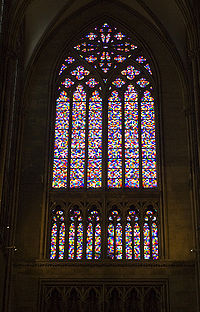 In August 2007, Richter's stained glass
in the Cologne Cathedral
was unveiled. It is an 113 square metres (135.1 sq yd) abstract collage of 11,500 pixel
-like squares in 72 colors, randomly arranged by computer (with some symmetry), reminiscent of his 1974 painting "4096 colours". Although the artist waived any fee, the costs of materials and mounting the window came to around €370,000 ($506,000). However the costs were covered by donations from more than 1,000 people. Cardinal Joachim Meisner did not attend the window's unveiling; he had preferred a figurative representation of 20th century Christian martyr
s and said that Richter's window would fit better in a mosque or prayer house.
in the inscription on the frame of Man in the Red Turban "Als Ich Kann" which are the first words of the proverb "As I can, but not as I would."
and Berlin
and by the early 1970s exhibited frequently throughout Europe and the United States. In 1966, Bruno Bischofberger
was the first to show the Richter's works outside Germany. Richter's first retrospective took place at the Kunsthalle Bremen
in 1976 and covered works from 1962 to 1974. A traveling retrospective at Düsseldorf's Kunsthalle in 1986 was followed in 1991 by a retrospective at the Tate Gallery
, London.
Richter became known to a U.S. audience in 1990, when the St. Louis Art Museum circulated Baader-Meinhof (October 18, 1977), a show that that was later seen at the Lannan Foundation in Marina del Rey, California
. Richter's first North American retrospective was in 1998 at the Art Gallery of Ontario
and at the Museum of Contemporary Art, Chicago
. In 2002, a 40-year retrospective of Richter's work was held at the Museum of Modern Art
, New York, and traveled to The Art Institute of Chicago
, the San Francisco Museum of Modern Art
, and The Hirshhorn Museum & Sculpture Garden, Washington, D.C. He has participated in several international art shows, including the Venice Biennale
(1972, 1980, 1984, 1997 and 2007), as well as Documenta
V (1972), VII (1982), VIII (1987), IX (1992), and X (1997).
The Gerhard Richter Archive was established in cooperation with the artist in 2005 as an institute of the State Art Collections in Dresden, Germany (www.gerhard-richter-archiv.de).
, Japan, 1997; the Golden Lion of the 47th Biennale, Venice, 1997; the Wolf Prize in Israel in 1994/5; the Kaiserring Prize der Stadt Goslar, Mönchehaus-Museum für Moderne Kunst, Goslar, Germany, 1988; the Oskar Kokoschka Prize, Vienna, 1985; the Arnold Bode Prize, Kassel, 1981; and the Junger Western Art Prize, Germany, 1961. He was made an honorary citizen of Cologne
in April 2007.
used a painting of his for the cover art for their album Daydream Nation
in 1987. He was a fan of the band and did not charge for the use of his image. The original, over 7 metres (23 ft) square, is now showcased in Sonic Youth's studio in NYC.
Don DeLillo
's short story "Looking at Meinhof" describes an encounter between two strangers at the Museum of Modern Art in New York. The meeting takes place in the room displaying October 18, 1977 (1988).
Richter's candle paintings were the first to command high auction prices. In February 2008, Sotheby's
sold Kerze (1983) for £7,972,500 ($15 million) in London. His 1982 Kerze (Candle) sold for £10.5 million ($16.5 million) at Christie's
London on October 14, 2011, setting a new auction record for Richter.
In February 2008, Christie's London set a first record for Richter's “capitalist realism” pictures from the 1960s by selling the painting Zwei Liebespaare (1966) for £7,300,500 ($14.3 million) to Stephan Schmidheiny
.
In 2010, the Weserburg Modern Art Museum in Bremen, Germany, decided to sell Richter’s 1966 painting Matrosen (Sailors) in a November auction held by Sotheby’s, where it brought $13 million.
Another coveted group of works is the “Abstrakte Bilder” series, particularly those made after 1988, which are finished with a large squeegee rather than a brush or roller. At Pierre Bergé
& Associés in July 2009, Richter’s 1979 oil painting Abstraktes Bild exceeded its estimate, selling for €95,000 ($136,000). Richter's Abstraktes Bild, of 1990 was made the top price of 7.2 million pounds, or about $11.6 million, at a Sotheby's sale in February 2011 to a bidder who was said by dealers to be an agent for the New York dealer Larry Gagosian
. In November 2011, Sotheby’s was selling a group of colorful abstract canvases by Richter, including Abstraktes Bild, a dreamy 1997 canvas of pinks and blues that was estimated at $9 million to $12 million. It made a record price for the artist at auction when a telephone bidder paid $20.8 million. When asked about amounts like that Richter said "It's just as absurd as the banking crisis
. It's impossible to understand and it's daft!"
In New York, Richter is represented by Marian Goodman
, his primary dealer since 1985.
At a Q&A ahead of his retrospective at the Tate Modern
on October 4, 2011 he was asked: "Has the role of artist changed over the years?" to which Richter replied: "It’s more entertainment now. We entertain people.”
Germany
Germany , officially the Federal Republic of Germany , is a federal parliamentary republic in Europe. The country consists of 16 states while the capital and largest city is Berlin. Germany covers an area of 357,021 km2 and has a largely temperate seasonal climate...
visual artist
Visual arts
The visual arts are art forms that create works which are primarily visual in nature, such as ceramics, drawing, painting, sculpture, printmaking, design, crafts, and often modern visual arts and architecture...
. Richter has simultaneously produced abstract and photorealistic painted works, as well as photographs and glass pieces, thus undermining the concept of the artist’s obligation to maintain a single cohesive style.
Biography
Gerhard Richter was born in DresdenDresden
Dresden is the capital city of the Free State of Saxony in Germany. It is situated in a valley on the River Elbe, near the Czech border. The Dresden conurbation is part of the Saxon Triangle metropolitan area....
, Saxony
Saxony
The Free State of Saxony is a landlocked state of Germany, contingent with Brandenburg, Saxony Anhalt, Thuringia, Bavaria, the Czech Republic and Poland. It is the tenth-largest German state in area, with of Germany's sixteen states....
, and grew up in Reichenau
Bogatynia
Bogatynia is a town in Zgorzelec County, Lower Silesian Voivodeship, in south-western Poland, close to the tripoint of the Czech, German and Polish borders. The town lies approximately south of Zgorzelec, and west of the regional capital Wrocław. As of 2006 it had 19,068 inhabitants.The...
, Lower Silesia
Lower Silesia
Lower Silesia ; is the northwestern part of the historical and geographical region of Silesia; Upper Silesia is to the southeast.Throughout its history Lower Silesia has been under the control of the medieval Kingdom of Poland, the Kingdom of Bohemia and the Austrian Habsburg Monarchy from 1526...
, and in Waltersdorf (Zittauer Gebirge) in the Upper Lusatia
Upper Lusatia
Upper Lusatia is a region a biggest part of which belongs to Saxony, a small eastern part belongs to Poland, the northern part to Brandenburg. In Saxony, Upper Lusatia comprises roughly the districts of Bautzen and Görlitz , in Brandenburg the southern part of district Oberspreewald-Lausitz...
n countryside. He left school after tenth grade and apprenticed as an advertising and stage-set painter, before studying at the Dresden Academy of Fine Arts. In 1948 he terminated the higher professional school in Zittau
Zittau
Zittau is a city in the south east of the Free State of Saxony, Germany, close to the border tripoint of Germany, Poland, and the Czech Republic. , there are 28,638 people in the city. It is part of the Görlitz district....
, and, between 1949 and 1951, was trained there in writing as well as in stage and advertising painting. In 1950 his application for membership in the Hochschule für Bildende Künste Dresden
Hochschule für Bildende Künste Dresden
The Dresden Academy of Fine Arts , often abbreviated HfBK Dresden or simply HfBK, is a vocational university of visual arts located in Dresden, Germany...
(Dresden University of Visual Arts, founded in 1764) was rejected. He finally began his study at the Dresden Academy of Fine Arts in 1951. His teachers were Karl von Appen
Karl von Appen
Karl von Appen was a German stage designer.-Theatre:* 1954: The Caucasian Chalk Circle by Bertolt Brecht; directed by Brecht at the Theater am Schiffbauerdamm in Berlin....
, Ulrich Lohmar and Will Grohmann. In these early days of his career he prepared a wall painting ("Communion with Picasso", 1955) for the refectory of this Academy of Arts as part of his B.A. A further mural followed within the Hygiene-Museum (German Hygiene Museum
German Hygiene Museum
The German Hygiene Museum is a museum in Dresden, Germany. It conceives itself today as a "forum for science, culture and society". It is a popular venue for events and exhibitions, and is among the most visited museums in Dresden, with around 300,000 visitors per year.-History:The museum was...
) with the title "Lebensfreude" ("Joy of life") for his diploma.
West Germany
West Germany is the common English, but not official, name for the Federal Republic of Germany or FRG in the period between its creation in May 1949 to German reunification on 3 October 1990....
(two months before the building of the Berlin Wall
Berlin Wall
The Berlin Wall was a barrier constructed by the German Democratic Republic starting on 13 August 1961, that completely cut off West Berlin from surrounding East Germany and from East Berlin...
); after German reunification
German reunification
German reunification was the process in 1990 in which the German Democratic Republic joined the Federal Republic of Germany , and when Berlin reunited into a single city, as provided by its then Grundgesetz constitution Article 23. The start of this process is commonly referred by Germans as die...
, the wall painting Joy of life (1956) was uncovered in two places in the stairway of the German Hygiene Museum
German Hygiene Museum
The German Hygiene Museum is a museum in Dresden, Germany. It conceives itself today as a "forum for science, culture and society". It is a popular venue for events and exhibitions, and is among the most visited museums in Dresden, with around 300,000 visitors per year.-History:The museum was...
, and after the millennium these two uncovered windows with a look at the Joy of Life had been newly recovered. From 1957 to 1961 Richter worked as a master trainee in the academy and took orders for the former state of the GDR. During this time he worked intensively at murals (Arbeiterkampf, which means Worker fight), on paintings in oil (e.g. portraits of the East German actress Angelica Domroese and of Richter's first wife Ema), on various self portraits and furthermore on a panorama of Dresden with the neutral name Stadtbild (Townscape, 1956).
When he arrived in West Germany
West Germany
West Germany is the common English, but not official, name for the Federal Republic of Germany or FRG in the period between its creation in May 1949 to German reunification on 3 October 1990....
, Richter began to study at the Kunstakademie Düsseldorf
Kunstakademie Düsseldorf
The Kunstakademie Düsseldorf, formerly Staatliche Kunstakademie Düsseldorf, is the Arts Academy of the city of Düsseldorf. It is well known for having produced many famous artists, such as Joseph Beuys, Gerhard Richter, Sigmar Polke, Thomas Demand, and Andreas Gursky...
under Karl Otto Götz
Karl Otto Götz
Karl Otto Götz is a German artist who is best known for his spontaneous abstract painting in the Informel style...
together with Sigmar Polke
Sigmar Polke
Sigmar Polke was a German painter and photographer.Polke experimented with a wide range of styles, subject matter and materials. In the 1970s, he concentrated on photography, returning to paint in the 1980s, when he produced abstract works created by chance through chemical reactions between paint...
, Konrad Lueg and Gotthard Graubner
Gotthard Graubner
Gotthard Graubner is a German painter. He was born in Erlbach, in Saxony, studied at the Academy of Fine Arts in Berlin, the Dresden Academy of Fine Arts and the Academy of Arts in Düsseldorf, before becoming a professor at the Academy of Fine Arts in Hamburg, in 1969...
. With Polke and Lueg he introduced the term Kapitalistischer Realismus (Capitalistic Realism) as an anti-style of art, appropriating the pictorial shorthand of advertising. This title also referred to the realist style of art known as Socialist Realism
Socialist realism
Socialist realism is a style of realistic art which was developed in the Soviet Union and became a dominant style in other communist countries. Socialist realism is a teleologically-oriented style having its purpose the furtherance of the goals of socialism and communism...
, then the official art doctrine of the Soviet Union, but it also commented upon the consumer-driven art doctrine of western capitalism. Later, Lueg founded the gallery Konrad Fischer in Düsseldorf.
Richter taught as a visiting professor at the Hochschule für Bildende Künste, in Hamburg
Hamburg
-History:The first historic name for the city was, according to Claudius Ptolemy's reports, Treva.But the city takes its modern name, Hamburg, from the first permanent building on the site, a castle whose construction was ordered by the Emperor Charlemagne in AD 808...
, and the Nova Scotia College of Art and Design, and returned in 1971 to Düsseldorf Art Academy as a professor for over 15 years.
In 1983, Richter resettled from Düsseldorf
Düsseldorf
Düsseldorf is the capital city of the German state of North Rhine-Westphalia and centre of the Rhine-Ruhr metropolitan region.Düsseldorf is an important international business and financial centre and renowned for its fashion and trade fairs. Located centrally within the European Megalopolis, the...
to Cologne
Cologne
Cologne is Germany's fourth-largest city , and is the largest city both in the Germany Federal State of North Rhine-Westphalia and within the Rhine-Ruhr Metropolitan Area, one of the major European metropolitan areas with more than ten million inhabitants.Cologne is located on both sides of the...
, where he still lives and works today.
Richter married Marianne Eufinger in 1957; she gave birth to his first daughter. He married his second wife, the sculptor Isa Genzken
Isa Genzken
Isa Genzken is a contemporary artist who lives and works in Berlin.-Education:Genzken studied fine arts and art history at the Hamburg University of Fine Arts from 1969–1971, the Berlin University of the Arts from 1971–1973, and Arts Academy Düsseldorf from 1973-1977. Genzken married German visual...
, in 1982. Richter had a son and daughter with his third wife, Sabine Moritz after they were married in 1995.
In 2005 Richter, in an interview by the German political magazine Der Spiegel
Der Spiegel
Der Spiegel is a German weekly news magazine published in Hamburg. It is one of Europe's largest publications of its kind, with a weekly circulation of more than one million.-Overview:...
, wondered why citizens of Salzburg
Salzburg
-Population development:In 1935, the population significantly increased when Salzburg absorbed adjacent municipalities. After World War II, numerous refugees found a new home in the city. New residential space was created for American soldiers of the postwar Occupation, and could be used for...
did not protest a sculpture by Markus Lüpertz
Markus Lüpertz
Markus Lüpertz is a contemporary German painter and sculptor.In the 1960s, Lüpertz worked primarily in Berlin, moving on to take a professorship at Karlsruhe at the Academy of Fine Arts Karlsruhe in the 1970s, then to Düsseldorf where he was for over twenty years director of the Kunstakademie...
, and described the work as expressing the deprivation of public art sponsorship in Germany. The sculpture, an homage to Mozart
Wolfgang Amadeus Mozart
Wolfgang Amadeus Mozart , baptismal name Johannes Chrysostomus Wolfgangus Theophilus Mozart , was a prolific and influential composer of the Classical era. He composed over 600 works, many acknowledged as pinnacles of symphonic, concertante, chamber, piano, operatic, and choral music...
, was promptly attacked by a right-wing art activist from Austria and badly damaged.
Art
Nearly all of Richter’s work demonstrates both space that seems natural and the physical activity and material of painting—as mutual interferences. For Richter, reality is the combination of new attempts to understand—to represent; in his case, to paint—the world surrounding us.Photo-paintings and the Blur
Richter created various painting pictures from black-and-white photographs during the 1960s and early 1970s, basing them on a variety of sources: from newspapers and books, sometimes incorporating their captions, as in Helga Matura (1966); private snapshots; aerial views of towns and mountains, for example Cityscape Madrid (1968) and Alps (1968); seascapes (1969–70); and a large multi-partite work made for the German Pavilion in the 1972 Venice BiennaleVenice Biennale
The Venice Biennale is a major contemporary art exhibition that takes place once every two years in Venice, Italy. The Venice Film Festival is part of it. So too is the Venice Biennale of Architecture, which is held in even years...
, Forty-eight Portraits (1971–2), for which he chose mainly the faces of composers such as Gustav Mahler
Gustav Mahler
Gustav Mahler was a late-Romantic Austrian composer and one of the leading conductors of his generation. He was born in the village of Kalischt, Bohemia, in what was then Austria-Hungary, now Kaliště in the Czech Republic...
and Jean Sibelius
Jean Sibelius
Jean Sibelius was a Finnish composer of the later Romantic period whose music played an important role in the formation of the Finnish national identity. His mastery of the orchestra has been described as "prodigious."...
, and of writers such as H. G. Wells
H. G. Wells
Herbert George Wells was an English author, now best known for his work in the science fiction genre. He was also a prolific writer in many other genres, including contemporary novels, history, politics and social commentary, even writing text books and rules for war games...
and Franz Kafka
Franz Kafka
Franz Kafka was a culturally influential German-language author of short stories and novels. Contemporary critics and academics, including Vladimir Nabokov, regard Kafka as one of the best writers of the 20th century...
.
Many of these paintings are made in a multi-step process of representations. He starts with a photograph
Photograph
A photograph is an image created by light falling on a light-sensitive surface, usually photographic film or an electronic imager such as a CCD or a CMOS chip. Most photographs are created using a camera, which uses a lens to focus the scene's visible wavelengths of light into a reproduction of...
, which he has found or taken himself, and projects it onto his canvas
Canvas
Canvas is an extremely heavy-duty plain-woven fabric used for making sails, tents, marquees, backpacks, and other items for which sturdiness is required. It is also popularly used by artists as a painting surface, typically stretched across a wooden frame...
, where he traces it for exact form. Taking his color palette from the photograph, he paints to replicate the look of the original picture. His hallmark "blur"—sometimes a softening by the light touch of a soft brush, sometimes a hard smear by an aggressive pull with his squeegee—has two effects:
- It offers the image a photographic appearance; and
- Paradoxically, it testifies the painter's actions, both skilled and coarse, and the plastic nature of the paint itself.
In some paintings blurs and smudges are severe enough to disrupt the image; it becomes hard to understand or believe. The subject is nullified. In these paintings, images and symbols (such as landscapes, portraits, and news photos) are rendered fragile illusions, fleeting conceptions in our constant reshaping of the world.
Richter has stated that the use of photographic imagery as a starting point for his early paintings resulted from an attempt to escape the complicated process of deciding what to paint, along with the critical and theoretical implications accompanying such decisions within the context of a modernist discourse. To achieve this, Richter began amassing photos from magazines, books, etc., many of which became the subject matter of his early photography-based paintings. Thus the Atlas was born: Atlas is an ongoing, encyclopedic work composed of approximately 4,000 photographs, reproductions or cut-out details of photographs and illustrations, grouped together on approximately 600 separate panels. When Atlas was first exhibited in 1972 at the Museum for Hedendaagse Kunst in Utrecht under the title "Atlas der Fotos und Skizzen," it included 315 parts. The work has continued to expand, and was exhibited later in full form at the Lenbachhaus
Lenbachhaus
The Lenbachhaus in Munich houses an art museum and is part of Munich's "Kunstareal" .- The building :The Lenbachhaus was built as a Florentine-style villa for the painter Franz von Lenbach between 1887 and 1891 by Gabriel von Seidl...
in Munich in 1989, the Museum Ludwig
Museum Ludwig
Museum Ludwig, located in Cologne, Germany, houses a collection of modern art. It includes works from PopArt, Abstract and Surrealism, and has one of the largest Picasso collections in Europe. It also features many works by Andy Warhol and Roy Lichtenstein....
in Cologne in 1990, and at Dia Art Foundation
Dia Art Foundation
Dia Art Foundation is a non-profit organization that initiates, supports, presents, and preserves art projects. It was established in 1974 as the Lone Star Foundation by Philippa de Menil, the daughter of Houston arts patron Dominique de Menil and an heiress to the Schlumberger oil exploration...
in New York in 1995.
While elements of landscape painting appeared initially in Richter’s work early on in his career in 1963, the artist began his independent series of landscapes in 1968 after his first vacation, an excursion that landed him besotted with the terrain of Corsica. From around 1964 Richter made a number of portraits of dealers, collectors, artists and others connected with his immediate professional circle. Richter's two portraits of Betty, his daughter, were made in 1977 and 1988 respectively; the three portraits titled IG were made in 1993 and depict the artist's second wife, Isa Genzken
Isa Genzken
Isa Genzken is a contemporary artist who lives and works in Berlin.-Education:Genzken studied fine arts and art history at the Hamburg University of Fine Arts from 1969–1971, the Berlin University of the Arts from 1971–1973, and Arts Academy Düsseldorf from 1973-1977. Genzken married German visual...
; Lesende (1994) portrays Sabine Moritz, whom Richter married in 1995, shown absorbed in the pages of a magazine. Many of his realist paintings reflect on the history of National Socialism, creating paintings of family members who had been members, as well as victims of, the Nazi party. From 1966, as well as photographs given to him by others, Richter began using photographs he had taken as the basis for portraits. In 1975, on the occasion of a show in Düsseldorf, Gilbert and George
Gilbert and George
Gilbert & George are two artists who work together as a collaborative duo. Gilbert Proesch and George Passmore have become famous for their distinctive, highly formal appearance and manner and their brightly coloured graphic-style photo-based artworks.-Early life:Gilbert Proesch was...
commissioned Richter to make a portrait of them.
Richter began making prints in 1965 and has completed more than one hundred to date; he was most active before 1974, completing projects only sporadically since that time. In the period 1965–74, during which Richter made most of his prints, the same or similar subjects often occurred in his paintings and prints. He has explored a variety of photographic printmaking processes — screenprint, photolithography
Photolithography
Photolithography is a process used in microfabrication to selectively remove parts of a thin film or the bulk of a substrate. It uses light to transfer a geometric pattern from a photomask to a light-sensitive chemical "photoresist", or simply "resist," on the substrate...
, and collotype
Collotype
Collotype is a dichromate-based photographic process invented by Alphonse Poitevin in 1856. and was used for large volume mechanical printing before the existence of cheaper offset lithography. It can produce results difficult to distinguish from metal-based photographic prints because of its...
— in search of inexpensive mediums that would lend a "non-art" appearance to his work. He stopped working in print media in 1974, at about the same time as he gave up painting from found photographs, and began to use photographs he took himself.
In 1982 and 1983, Richter made a series of paintings of Candles and Skulls that relate to a longstanding tradition of still life memento mori
Memento mori
Memento mori is a Latin phrase translated as "Remember your mortality", "Remember you must die" or "Remember you will die". It names a genre of artistic work which varies widely, but which all share the same purpose: to remind people of their own mortality...
painting. Each composition is most commonly based on a photograph taken by Richter in his own studio. Influenced by old master vanitas painters such as Georges de la Tour
Georges de La Tour
Georges de La Tour was a French Baroque painter, who spent most of his working life in the Duchy of Lorraine, which was temporarily absorbed into France between 1641 and 1648...
and Francisco de Zurbarán, the artist began to experiment with arrangements of candles and skulls placed in varying degrees of natural light, sitting atop otherwise barren tables. The Candle paintings coincided with his first large-scale abstract paintings, and represent the complete antithesis to those vast, colorful and playfully meaningless works. Richter has made only 27 of these still lives. In 1995, the artist marked the 50th anniversary of the allied bombings of his hometown Dresden during the Second World War. His solitary candle was reproduced on a monumental scale and placed overlooking the River Elbe as a symbol of rejuvenation.
In a 1988 series of fifteen ambiguous photo paintings entitled Baader-Meinhof (October 18, 1977) he depicted four members of the Red Army Faction
Red Army Faction
The radicalized were, like many in the New Left, influenced by:* Sociological developments, pressure within the educational system in and outside Europe and the U.S...
(RAF), a German left-wing terrorist organization. These paintings were created from black-and-white newspaper and police photos. Three RAF members were found dead in their prison cells on October 18, 1977, and the cause of their deaths was the focus of widespread controversy.
Since 1989, Richter has worked on creating new images by dragging photographs over wet paint. The photographs, not all taken by Richter himself, are mostly snapshots of daily life: family vacations, pictures of friends, mountains, buildings and streetscapes.
Richter was flying to New York on September 11th, 2001, at the time of the attacks on the World Trade Centre. His plane was diverted to Halifax, Nova Scotia. A few years later he made one small painting specifically about the planes crashing into the Twin Towers.
In the 2000s, Richter made a number of works that dealt with scientific phenomena. In 2003, he produced several paintings with the same title: Silicate. Large oil-on-canvas pieces, these show latticed rows of light- and dark-grey blobs whose shapes quasi-repeat as they race across the frame, their angle modulating from painting to painting. They depict a photo, published in the FAZ
Frankfurter Allgemeine Zeitung
The Frankfurter Allgemeine Zeitung , short F.A.Z., also known as the FAZ, is a national German newspaper, founded in 1949. It is published daily in Frankfurt am Main. The Sunday edition is the Frankfurter Allgemeine Sonntagszeitung .F.A.Z...
, of a computer-generated simulacrum of reflections from the silicon dioxide found in insects' shells.
Abstract work
In 1969 Richter produced the first of a group of grey monochromes that consist exclusively of the textures resulting from different methods of paint application.In 1976, Richter first gave the title Abstract Painting to one of his works. By presenting a painting without even a few words to name and explain it, he felt he was “letting a thing come, rather than creating it.” In his abstract pictures, Richter builds up cumulative layers of nonrepresentational painting. The paintings evolve in stages, based on his responses to the picture’s progress: the incidental details and patterns that emerge. Throughout his process, Richter uses the same techniques he uses in his representational paintings, blurring and scraping to veil and expose prior layers. From the mid 1980s, Richter began to use a home-made squeegee to rub and scrape the paint that he had applied in large bands across his canvases. In the 1990s the artist began to run his squeegee up and down the canvas in an ordered fashion to produce vertical columns that take on the look of a wall of planks.
Richter’s abstract work is remarkable for the illusion of space that develops, ironically, out of his incidental process: an accumulation of spontaneous, reactive gestures of adding, moving, and subtracting paint. Despite unnatural palettes, spaceless sheets of color, and obvious trails of the artist’s tools, the abstract pictures often act like windows through which we see the landscape outside. As in his representational paintings, there is an equalization of illusion and paint. In those paintings, he reduces worldly images to mere incidents of Art. Similarly, in his abstract pictures, Richter exalts spontaneous, intuitive mark-making to a level of spatial logic and believability.
Firenze continues a cycle of 99 works conceived in the autumn of 1999 and executed in the same year and thereafter. The series of overpainted photographs, or übermalte Photographien, consists of small paintings bearing images of the city of Florence, created by the artist as a tribute to the music of Steve Reich
Steve Reich
Stephen Michael "Steve" Reich is an American composer who together with La Monte Young, Terry Riley, and Philip Glass is a pioneering composer of minimal music...
and the work of Contempoartensemble, a Florence-based group of musicians.
After 2000, Richter made a number of works that dealt with scientific phenomena, in particular, with aspects of reality that cannot be seen by the naked eye. In 2006, Richter conceived six paintings as a coherent group under the title Cage, named after the American avant-garde composer John Cage
John Cage
John Milton Cage Jr. was an American composer, music theorist, writer, philosopher and artist. A pioneer of indeterminacy in music, electroacoustic music, and non-standard use of musical instruments, Cage was one of the leading figures of the post-war avant-garde...
. In May 2002, Richter photographed 216 details of his abstract painting no. 648-2, from 1987. Working on a long table over a period of several weeks, Richter combined these 10 x 15 cm details with 165 texts on the Iraq war, published in the German FAZ
Frankfurter Allgemeine Zeitung
The Frankfurter Allgemeine Zeitung , short F.A.Z., also known as the FAZ, is a national German newspaper, founded in 1949. It is published daily in Frankfurt am Main. The Sunday edition is the Frankfurter Allgemeine Sonntagszeitung .F.A.Z...
newspaper on March 20 and 21. This work was published in 2004 as a book entitled War Cut.
Color Chart paintings
As early as 1966 Richter had made paintings based on colour charts, using the rectangles of colour as found objects in an apparently limitless variety of hue; these culminated in 1973–4 in a series of large-format pictures such as 256 Colours. Richter painted three series of Color Chart paintings between 1966 and 1974, each series growing more ambitious in their attempt to create through their purely arbitrary arrangement of colors. The artist began his investigations into the complex permutations of color charts in 1966, with a small painting entitled 10 Colors. The charts provided anonymous and impersonal source material, a way for Richter to disassociate color from any traditional, descriptive, symbolic or expressive end. When he began to make these paintings, Richter had his friend Blinky PalermoBlinky Palermo
Blinky Palermo, was a German abstract painter.-Early life and education:Palermo was born Peter Schwarze in Leipzig, Germany, in 1943, and adopted as an infant, with his twin brother, Michael, by foster parents named Heisterkamp, became Peter Heisterkamp, and moved to Münster in 1952...
randomly call out colors, which Richter then adopted for his work. Chance thus plays its role in the creation of his first series.
Returning to color charts in the 1970s, Richter changed his focus from the readymade to the conceptual system, developing mathematical procedures for mixing colours and chance operations for their placement. The range of the colors he employed was determined by a mathematical system for mixing the primary colors in graduated amounts. Each color was then randomly ordered to create the resultant composition and form of the painting. Richter's second series of Color Charts was begun in 1971 and consisted of only five paintings. In the final series of Color Charts which preoccupied Richter throughout 1973 and 1974, additional elements to this permutational system of color production were added in the form of mixes of a light grey, a dark gray and later, a green.
Richter’s 4900 Colours from 2007 consisted of bright monochrome squares that have been randomly arranged in a grid pattern to create stunning fields of kaleidoscopic color. It was produced at the same time he developed his design for the south transept window of Cologne Cathedral
Cologne Cathedral
Cologne Cathedral is a Roman Catholic church in Cologne, Germany. It is the seat of the Archbishop of Cologne and the administration of the Archdiocese of Cologne. It is renowned monument of German Catholicism and Gothic architecture and is a World Heritage Site...
. 4900 Colours consists of 196 panels in twenty-five colors that can be reassembled in eleven variations—from a single expansive surface to multiple small-format fields. Richter developed Version II — forty-nine paintings, each of which measures ninety-seven by ninety-seven centimeters — especially for the Serpentine Gallery
Serpentine Gallery
The Serpentine Gallery is an art gallery in Kensington Gardens, Hyde Park, central London. It focuses on modern and contemporary art. The exhibitions, architecture, education and public programmes attract approximately 750,000 visitors a year...
.
Glass and Mirror works
Richter began to use glass in his work in 1967, when he made 4 Panes of Glass. In 1981, for a two-person show with Georg BaselitzGeorg Baselitz
Georg Baselitz is a German painter who studied in the former East Germany, before moving to what was then the country of West Germany...
in Düsseldorf, Richter produced the first of the monumental transparent mirrors that appear intermittently thereafter in his oeuvre. For paintings such as Mirror Painting (Grey, 735-2) (1991), the mirrors were coloured grey by the pigment attached to the back of the glass. Richter presented an ensemble of paintings and colored mirrors in a special pavilion designed in collaboration with architect Paul Robbrecht at Documenta
Documenta
documenta is an exhibition of modern and contemporary art which takes place every five years in Kassel, Germany. It was founded by artist, teacher and curator Arnold Bode in 1955 as part of the Bundesgartenschau which took place in Kassel at that time...
9 in Kassel in 1992. In 2002, for the Dia Art Foundation
Dia Art Foundation
Dia Art Foundation is a non-profit organization that initiates, supports, presents, and preserves art projects. It was established in 1974 as the Lone Star Foundation by Philippa de Menil, the daughter of Houston arts patron Dominique de Menil and an heiress to the Schlumberger oil exploration...
, Richter created a glass sculpture in which seven parallel panes of glass refract light and the world beyond, offering altered visions of the exhibition space; Spiegel I (Mirror I) and Spiegel II (Mirror II), a two-part mirror piece from 1989 that measures seven feet tall and eighteen feet long, which alters the boundaries of the environment and again changes one's visual experience of the gallery; and Kugel (Sphere), 1992, a stainless steel sphere that acts as a mirror, reflecting the space.
Cologne Cathedral
Stained glass
The term stained glass can refer to coloured glass as a material or to works produced from it. Throughout its thousand-year history, the term has been applied almost exclusively to the windows of churches and other significant buildings...
in the Cologne Cathedral
Cologne Cathedral
Cologne Cathedral is a Roman Catholic church in Cologne, Germany. It is the seat of the Archbishop of Cologne and the administration of the Archdiocese of Cologne. It is renowned monument of German Catholicism and Gothic architecture and is a World Heritage Site...
was unveiled. It is an 113 square metres (135.1 sq yd) abstract collage of 11,500 pixel
Pixel
In digital imaging, a pixel, or pel, is a single point in a raster image, or the smallest addressable screen element in a display device; it is the smallest unit of picture that can be represented or controlled....
-like squares in 72 colors, randomly arranged by computer (with some symmetry), reminiscent of his 1974 painting "4096 colours". Although the artist waived any fee, the costs of materials and mounting the window came to around €370,000 ($506,000). However the costs were covered by donations from more than 1,000 people. Cardinal Joachim Meisner did not attend the window's unveiling; he had preferred a figurative representation of 20th century Christian martyr
Martyr
A martyr is somebody who suffers persecution and death for refusing to renounce, or accept, a belief or cause, usually religious.-Meaning:...
s and said that Richter's window would fit better in a mosque or prayer house.
Richter and minimalism
Throughout the body of Richter's work one can often observe waves of minimalism appearing only to disappear again. It has been noted that perhaps it may be necessary to view Richter as a conceptual artist wherein his individual pieces point towards a very painterly approach, while possibly this may not be his intent. If one views the progressions in the individual series as single works, a very different concept erupts. While many critics agree that this analysis may be necessary, let us take it one step further: assuming that Richter's small series is analogous to his entire body of work, one sees the same images of realism to blur. For example Eight Grey 2002. It may be considered, thus, that he is interested in the progression, and not in the individual images nor the qualities of paint nor any other medium he uses. In this a new idea of minimalism is born; a minimalism where the material means nothing, however, its use is technically masterful. As was said by Jan Van EyckJan van Eyck
Jan van Eyck was a Flemish painter active in Bruges and considered one of the best Northern European painters of the 15th century....
in the inscription on the frame of Man in the Red Turban "Als Ich Kann" which are the first words of the proverb "As I can, but not as I would."
Exhibitions
Richter first began exhibiting in Düsseldorf in 1963. Richter had his first gallery solo show in 1964 at Galerie Schmela in Düsseldorf. Soon after, he had exhibitions in MunichMunich
Munich The city's motto is "" . Before 2006, it was "Weltstadt mit Herz" . Its native name, , is derived from the Old High German Munichen, meaning "by the monks' place". The city's name derives from the monks of the Benedictine order who founded the city; hence the monk depicted on the city's coat...
and Berlin
Berlin
Berlin is the capital city of Germany and is one of the 16 states of Germany. With a population of 3.45 million people, Berlin is Germany's largest city. It is the second most populous city proper and the seventh most populous urban area in the European Union...
and by the early 1970s exhibited frequently throughout Europe and the United States. In 1966, Bruno Bischofberger
Bruno Bischofberger
Bruno Bischofberger is an art dealer and gallerist from Zurich, Switzerland, and a major figure in the international art market for several decades...
was the first to show the Richter's works outside Germany. Richter's first retrospective took place at the Kunsthalle Bremen
Kunsthalle Bremen
The Kunsthalle Bremen is an art museum in the Hanseatic City Bremen, Germany.The Kunsthalle was built in 1849 and enlarged in 1902 by architect Eduard Gildemeister....
in 1976 and covered works from 1962 to 1974. A traveling retrospective at Düsseldorf's Kunsthalle in 1986 was followed in 1991 by a retrospective at the Tate Gallery
Tate Gallery
The Tate is an institution that houses the United Kingdom's national collection of British Art, and International Modern and Contemporary Art...
, London.
Richter became known to a U.S. audience in 1990, when the St. Louis Art Museum circulated Baader-Meinhof (October 18, 1977), a show that that was later seen at the Lannan Foundation in Marina del Rey, California
Marina del Rey, California
-Demographics:-2010:The 2010 United States Census reported that Marina del Rey had a population of 8,866. The population density was 6,094.6 people per square mile...
. Richter's first North American retrospective was in 1998 at the Art Gallery of Ontario
Art Gallery of Ontario
Under the direction of its CEO Matthew Teitelbaum, the AGO embarked on a $254 million redevelopment plan by architect Frank Gehry in 2004, called Transformation AGO. The new addition would require demolition of the 1992 Post-Modernist wing by Barton Myers and Kuwabara Payne McKenna Blumberg...
and at the Museum of Contemporary Art, Chicago
Museum of Contemporary Art, Chicago
The Museum of Contemporary Art Chicago is a contemporary art museum near Water Tower Place in downtown Chicago in Cook County, Illinois, United States. The museum, which was established in 1967, is one of the world's largest contemporary art venues...
. In 2002, a 40-year retrospective of Richter's work was held at the Museum of Modern Art
Museum of Modern Art
The Museum of Modern Art is an art museum in Midtown Manhattan in New York City, on 53rd Street, between Fifth and Sixth Avenues. It has been important in developing and collecting modernist art, and is often identified as the most influential museum of modern art in the world...
, New York, and traveled to The Art Institute of Chicago
Art Institute of Chicago
The School of the Art Institute of Chicago is one of America's largest accredited independent schools of art and design, located in the Loop in Chicago, Illinois. It is associated with the museum of the same name, and "The Art Institute of Chicago" or "Chicago Art Institute" often refers to either...
, the San Francisco Museum of Modern Art
San Francisco Museum of Modern Art
The San Francisco Museum of Modern Art is a modern art museum located in San Francisco, California. A nonprofit organization, SFMOMA holds an internationally recognized collection of modern and contemporary art and was the first museum on the West Coast devoted solely to 20th century art...
, and The Hirshhorn Museum & Sculpture Garden, Washington, D.C. He has participated in several international art shows, including the Venice Biennale
Venice Biennale
The Venice Biennale is a major contemporary art exhibition that takes place once every two years in Venice, Italy. The Venice Film Festival is part of it. So too is the Venice Biennale of Architecture, which is held in even years...
(1972, 1980, 1984, 1997 and 2007), as well as Documenta
Documenta
documenta is an exhibition of modern and contemporary art which takes place every five years in Kassel, Germany. It was founded by artist, teacher and curator Arnold Bode in 1955 as part of the Bundesgartenschau which took place in Kassel at that time...
V (1972), VII (1982), VIII (1987), IX (1992), and X (1997).
The Gerhard Richter Archive was established in cooperation with the artist in 2005 as an institute of the State Art Collections in Dresden, Germany (www.gerhard-richter-archiv.de).
Solo exhibitions (selection)
- 'Gerhard Richter 4900 Colours: Version II' at the Serpentine GallerySerpentine GalleryThe Serpentine Gallery is an art gallery in Kensington Gardens, Hyde Park, central London. It focuses on modern and contemporary art. The exhibitions, architecture, education and public programmes attract approximately 750,000 visitors a year...
, London, United Kingdom. 2008 - 'Gerhard Richter Portraits' at the National Portrait Gallery, London, United Kingdom. 2009
- 'Gerhard Richter: Panorama' at the Tate ModernTate ModernTate Modern is a modern art gallery located in London, England. It is Britain's national gallery of international modern art and forms part of the Tate group . It is the most-visited modern art gallery in the world, with around 4.7 million visitors per year...
, London, United Kingdom. 2011
Recognition
Although Richter gained popularity and critical praise throughout his career, his fame burgeoned during his 2005 retrospective exhibition, which declared his place among the most important artists of the 20th century. Today, many call Gerhard Richter the best living painter. In part, this comes from his ability to explore the medium at a time when many were heralding its death. Richter has been the recipient of numerous distinguished awards, including the Staatspreis of the State Nordrhein-Westfalen, Düsseldorf, in 2000; the Wexner Prize, 1998; the Praemium ImperialePraemium Imperiale
The Praemium Imperiale is an arts prize awarded since 1989 by the imperial family of Japan on behalf of the Japan Art Association in the fields painting, sculpture, architecture, music, and theatre/film...
, Japan, 1997; the Golden Lion of the 47th Biennale, Venice, 1997; the Wolf Prize in Israel in 1994/5; the Kaiserring Prize der Stadt Goslar, Mönchehaus-Museum für Moderne Kunst, Goslar, Germany, 1988; the Oskar Kokoschka Prize, Vienna, 1985; the Arnold Bode Prize, Kassel, 1981; and the Junger Western Art Prize, Germany, 1961. He was made an honorary citizen of Cologne
Cologne
Cologne is Germany's fourth-largest city , and is the largest city both in the Germany Federal State of North Rhine-Westphalia and within the Rhine-Ruhr Metropolitan Area, one of the major European metropolitan areas with more than ten million inhabitants.Cologne is located on both sides of the...
in April 2007.
Influence
Sonic YouthSonic Youth
Sonic Youth is an American alternative rock band from New York City, formed in 1981. The current lineup consists of Thurston Moore , Kim Gordon , Lee Ranaldo , Steve Shelley , and Mark Ibold .In their early career, Sonic Youth was associated with the No Wave art and music scene in New York City...
used a painting of his for the cover art for their album Daydream Nation
Daydream Nation
Daydream Nation is the fifth studio album by the American alternative rock band Sonic Youth. It was released in October 1988 by Enigma Records in the United States, and by Blast First in the United Kingdom....
in 1987. He was a fan of the band and did not charge for the use of his image. The original, over 7 metres (23 ft) square, is now showcased in Sonic Youth's studio in NYC.
Don DeLillo
Don DeLillo
Don DeLillo is an American author, playwright, and occasional essayist whose work paints a detailed portrait of American life in the late 20th and early 21st centuries...
's short story "Looking at Meinhof" describes an encounter between two strangers at the Museum of Modern Art in New York. The meeting takes place in the room displaying October 18, 1977 (1988).
Position on the art market
Already by 2004, Richter’s annual turnover was $120m (£65m). According to artnet, an online firm that tracks the art market, $76.9m worth of Richter’s work was sold at auction in 2010. Richter’s paintings have been flowing steadily out of Germany since the mid-1990s even as certain important German collectors — Frieder Burda, Josef Fröhlich, Georg Böckmann, and Ulrich Ströher — have held on to theirs.Richter's candle paintings were the first to command high auction prices. In February 2008, Sotheby's
Sotheby's
Sotheby's is the world's fourth oldest auction house in continuous operation.-History:The oldest auction house in operation is the Stockholms Auktionsverk founded in 1674, the second oldest is Göteborgs Auktionsverk founded in 1681 and third oldest being founded in 1731, all Swedish...
sold Kerze (1983) for £7,972,500 ($15 million) in London. His 1982 Kerze (Candle) sold for £10.5 million ($16.5 million) at Christie's
Christie's
Christie's is an art business and a fine arts auction house.- History :The official company literature states that founder James Christie conducted the first sale in London, England, on 5 December 1766, and the earliest auction catalogue the company retains is from December 1766...
London on October 14, 2011, setting a new auction record for Richter.
In February 2008, Christie's London set a first record for Richter's “capitalist realism” pictures from the 1960s by selling the painting Zwei Liebespaare (1966) for £7,300,500 ($14.3 million) to Stephan Schmidheiny
Stephan Schmidheiny
Stephan Schmidheiny is a Swiss business man and billionaire.-Life:Schmidheiny was born in St. Gallen, Switzerland, in 1947 and completed his Law studies with a doctorate at the University of Zurich in 1972. He started his business career at Eternit Niederurnen and in 1976 he was named CEO of the...
.
In 2010, the Weserburg Modern Art Museum in Bremen, Germany, decided to sell Richter’s 1966 painting Matrosen (Sailors) in a November auction held by Sotheby’s, where it brought $13 million.
Another coveted group of works is the “Abstrakte Bilder” series, particularly those made after 1988, which are finished with a large squeegee rather than a brush or roller. At Pierre Bergé
Pierre Bergé
Pierre Bergé is a French industrialist and patron. He is perhaps best known as the co-founder of Yves Saint Laurent Couture House and former partner of fashion designer Yves Saint Laurent.-Early life:...
& Associés in July 2009, Richter’s 1979 oil painting Abstraktes Bild exceeded its estimate, selling for €95,000 ($136,000). Richter's Abstraktes Bild, of 1990 was made the top price of 7.2 million pounds, or about $11.6 million, at a Sotheby's sale in February 2011 to a bidder who was said by dealers to be an agent for the New York dealer Larry Gagosian
Larry Gagosian
Lawrence Gilbert "Larry" Gagosian is an American art dealer who owns the Gagosian Gallery chain of art galleries, with three locations in New York City Lawrence Gilbert "Larry" Gagosian (born April 19, 1945) is an American art dealer who owns the Gagosian Gallery chain of art galleries, with three...
. In November 2011, Sotheby’s was selling a group of colorful abstract canvases by Richter, including Abstraktes Bild, a dreamy 1997 canvas of pinks and blues that was estimated at $9 million to $12 million. It made a record price for the artist at auction when a telephone bidder paid $20.8 million. When asked about amounts like that Richter said "It's just as absurd as the banking crisis
Late-2000s financial crisis
The late-2000s financial crisis is considered by many economists to be the worst financial crisis since the Great Depression of the 1930s...
. It's impossible to understand and it's daft!"
In New York, Richter is represented by Marian Goodman
Marian Goodman
Marian Goodman Gallery is the eponymous contemporary art gallery of owner Marian Goodman. Goodman opened the Marian Goodman Gallery on East 57th Street in 1977 and relocated to its current address on West 57th Street in 1981.-Background:...
, his primary dealer since 1985.
Quotes
“One has to believe in what one is doing, one has to commit oneself inwardly, in order to do painting. Once obsessed, one ultimately carries it to the point of believing that one might change human beings through painting. But if one lacks this passionate commitment, there is nothing left to do. Then it is best to leave it alone. For basically painting is idiocy.” (From Richter, 'Notes 1973', in The Daily Practice of Painting, p. 78.)At a Q&A ahead of his retrospective at the Tate Modern
Tate Modern
Tate Modern is a modern art gallery located in London, England. It is Britain's national gallery of international modern art and forms part of the Tate group . It is the most-visited modern art gallery in the world, with around 4.7 million visitors per year...
on October 4, 2011 he was asked: "Has the role of artist changed over the years?" to which Richter replied: "It’s more entertainment now. We entertain people.”
External links
- Official website, comprehensive image database, biography, literature list and timeline for Gerhard Richter
- Quotes from Gerhard Richter's writing
- Link to Gerhard Richter Retrospective at National Galleries of Scotland
- Selective Affinities: On Friedrich-Richter Review of Exhibition at the Getty Museum in X-TRA : Contemporary Art Quarterly
- Window by Artist Gerhard Richter Unveiled at Cologne Cathedral, August 27, 2007.
- Guggenheim: Gerhard Richter
- Gerhard Richter Archive (State Art Collections Dresden, Germany)
- Marian Goodman: Gerhard Richter
- Available Paintings and Works on Paper Galerie Ludorff, Duesseldorf, Germany
- Jerry Saltz: Gerhard Richter
- Painting Richter - Gerhard Richter - Critical Essay ArtForum, Summer, 2002
- Gerhard Richter essay by Keith Harley, MAP Magazine, Issue 16, Winter 2008
- Essay
- NY Times Interview (registration required)
- SFMOMA - Gerhard Richter Making sense of modern art
- actual exhibitions with Gerhard Richter
- Take a picture... Umpteen Grey (to Gerhard Richter)
- Gerhard Richter news, books and exhibition
- Current exhibitions and connection to galeries at Artfacts.Net
- "18. Oktober 1977: Gerhard Richter’s Work of Mourning and Its New Audience", College Art Association, Art Journal, Spring 2002
- Bibliography Photopaintings : Atlas and 18. Oktober 1977
- Illustrated Bibliography: Gerhard Richter