


Georges Feydeau

Encyclopedia
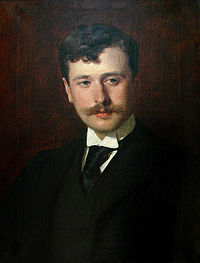
Georges Feydeau was a French
France
The French Republic , The French Republic , The French Republic , (commonly known as France , is a unitary semi-presidential republic in Western Europe with several overseas territories and islands located on other continents and in the Indian, Pacific, and Atlantic oceans. Metropolitan France...
playwright
Playwright
A playwright, also called a dramatist, is a person who writes plays.The term is not a variant spelling of "playwrite", but something quite distinct: the word wright is an archaic English term for a craftsman or builder...
of the era
Era
An era is a commonly used word for long period of time. When used in science, for example geology, eras denote clearly defined periods of time of arbitrary but well defined length, such as for example the Mesozoic era from 252 Ma–66 Ma, delimited by a start event and an end event. When used in...
known as the Belle Époque
Belle Époque
The Belle Époque or La Belle Époque was a period in European social history that began during the late 19th century and lasted until World War I. Occurring during the era of the French Third Republic and the German Empire, it was a period characterised by optimism and new technological and medical...
. He is remembered for his many lively farce
Farce
In theatre, a farce is a comedy which aims at entertaining the audience by means of unlikely, extravagant, and improbable situations, disguise and mistaken identity, verbal humour of varying degrees of sophistication, which may include word play, and a fast-paced plot whose speed usually increases,...
s.
Biography
Georges Feydeau was born in ParisParis
Paris is the capital and largest city in France, situated on the river Seine, in northern France, at the heart of the Île-de-France region...
, the son of novelist Ernest-Aimé Feydeau
Ernest-Aimé Feydeau
Ernest-Aimé Feydeau was a French writer and the father of the notorious comic playwright Georges Feydeau.He was born in Paris, and he began his literary career in 1844, by the publication of a volume of poetry, Les Nationales...
and Léocadie Bogaslawa Zalewska. At the age of twenty, Feydeau wrote his first comic
Comedy
Comedy , as a popular meaning, is any humorous discourse or work generally intended to amuse by creating laughter, especially in television, film, and stand-up comedy. This must be carefully distinguished from its academic definition, namely the comic theatre, whose Western origins are found in...
monologue
Monologue
In theatre, a monologue is a speech presented by a single character, most often to express their thoughts aloud, though sometimes also to directly address another character or the audience. Monologues are common across the range of dramatic media...
in earnest. He found his first success four years later with Tailleur pour dames (Ladies' Dressmaker, 1889). That same year Feydeau married Marianne Carolus-Duran, the daughter of the famous portrait
Portrait
thumb|250px|right|Portrait of [[Thomas Jefferson]] by [[Rembrandt Peale]], 1805. [[New-York Historical Society]].A portrait is a painting, photograph, sculpture, or other artistic representation of a person, in which the face and its expression is predominant. The intent is to display the likeness,...
painter
Painting
Painting is the practice of applying paint, pigment, color or other medium to a surface . The application of the medium is commonly applied to the base with a brush but other objects can be used. In art, the term painting describes both the act and the result of the action. However, painting is...
Carolus-Duran
Carolus-Duran
Charles Auguste Émile Durand, known as Carolus-Duran , was a French painter and art instructor. He is noted for his stylish depictions of members of high society in Third Republic France.-Biography:...
. To Feydeau, the marriage brought wealth that would sustain him until he found greater success. The marriage lasted 15 years after which the couple underwent a judicial separation and were formally divorce
Divorce
Divorce is the final termination of a marital union, canceling the legal duties and responsibilities of marriage and dissolving the bonds of matrimony between the parties...
d in 1916.
Henri Meilhac
Henri Meilhac , was a French dramatist and opera librettist.-Biography:Meilhac was born in Paris in 1831. As a young man, he began writing fanciful articles for Parisian newspapers and vaudevilles, in a vivacious boulevardier spirit which brought him to the forefront...
and Alfred Hennequin
Alfred Hennequin
Alfred Hennequin was a Belgian dramatist who had a successful career as a writer of comedies. He is recognised as one of the innovators in the genre of farce. Georges Feydeau, whose name is synonymous with French farce, publicly acknowledged his debt to Hennequin...
. This study inspired him to write his acclaimed play
Play (theatre)
A play is a form of literature written by a playwright, usually consisting of scripted dialogue between characters, intended for theatrical performance rather than just reading. There are rare dramatists, notably George Bernard Shaw, who have had little preference whether their plays were performed...
Champignol malgré lui (Champignol in Spite of Himself, 1892). Following this, Feydeau made a name for himself both in France and abroad, some of his plays opening overseas and in other languages before they opened in France.
These farces often involved Paris's demi-monde. They are noted for great wit and complex plots, featuring misunderstandings and coincidences, and what one critic
Critic
A critic is anyone who expresses a value judgement. Informally, criticism is a common aspect of all human expression and need not necessarily imply skilled or accurate expressions of judgement. Critical judgements, good or bad, may be positive , negative , or balanced...
called "jack-in-the-box
Jack-in-the-box
A jack-in-the-box is a children's toy that outwardly consists of a box with a crank. When the crank is turned, it plays a melody, often "Pop Goes the Weasel". At the end of the tune there is a "surprise", the lid pops open and a figure, usually a clown or jester, pops out of the box...
construction".
Among his 60 plays, his most famous are: Une puce à l'oreille
A Flea in Her Ear
A Flea in Her Ear is a play by Georges Feydeau written in 1907, at the height of the Belle Époque.-Plot:...
(A Flea in Her Ear
A Flea in Her Ear
A Flea in Her Ear is a play by Georges Feydeau written in 1907, at the height of the Belle Époque.-Plot:...
, 1907), Le Système Ribadier
Le Système Ribadier
Le Système Ribadier is a comedy in three acts by Georges Feydeau which was performed for the first time in November 1892 at the théâtre du Palais-Royal. It was written in collaboration with Maurice Hennequin.-Plot:Eugène Ribadier is the second husband of Angèle, the widow of M. Robineau...
(1892), La Dame de Chez Maxim (The Girl from Maxim's, 1899), and Hortense a dit: "Je m'en fous!" (Hortense says, "I don't give a damn!", 1916). Other notable Feydeau farces include L'Hôtel du libre échange
L'Hôtel du libre échange
L'Hôtel du Libre échange is a comedy written by the French playwrights Georges Feydeau and Maurice Desavallieres in 1894. The play takes place in Paris in the 19th century, and follows two Parisian households and their friends over the course of two days...
, Le Dindon (Sauce for the Goose, 1896) and the series of plays he wrote after 1908 grouped under the title "Du Mariage au Divorce" ("On purge bébé", "Feu la mère de madame", Léonie est en avance" and "Mais n'te promène donc pas toute nue").
Though critics at the time dismissed Feydeau's works as light entertainment, he is now recognized as one of the great French playwrights of his era. His plays are seen today as precursors to Surrealist
Surrealism
Surrealism is a cultural movement that began in the early 1920s, and is best known for the visual artworks and writings of the group members....
and Dada
Dada
Dada or Dadaism is a cultural movement that began in Zurich, Switzerland, during World War I and peaked from 1916 to 1922. The movement primarily involved visual arts, literature—poetry, art manifestoes, art theory—theatre, and graphic design, and concentrated its anti-war politics through a...
theatre
Theatre
Theatre is a collaborative form of fine art that uses live performers to present the experience of a real or imagined event before a live audience in a specific place. The performers may communicate this experience to the audience through combinations of gesture, speech, song, music or dance...
, and the Theatre of the Absurd
Theatre of the Absurd
The Theatre of the Absurd is a designation for particular plays of absurdist fiction, written by a number of primarily European playwrights in the late 1940s, 1950s, and 1960s, as well as to the style of theatre which has evolved from their work...
. They have been continuously revived and are still performed today, 17 of which have been performed on Broadway from 1895 to 1992.
Despite being a phenomenally successful playwright during his lifetime, his propensity for high living (he had a table permanently reserved for him at Maxim's
Maxim's Paris
Maxim's is the name of a restaurant in Paris, France, located at No. 3 of the rue Royale. It is known for its art nouveau interior decor.-History:...
), gambling
Gambling
Gambling is the wagering of money or something of material value on an event with an uncertain outcome with the primary intent of winning additional money and/or material goods...
, and the failure of his marriage led to financial difficulties.
During the winter of 1918, Feydeau contracted syphilis
Syphilis
Syphilis is a sexually transmitted infection caused by the spirochete bacterium Treponema pallidum subspecies pallidum. The primary route of transmission is through sexual contact; however, it may also be transmitted from mother to fetus during pregnancy or at birth, resulting in congenital syphilis...
and slowly descended into madness to his death three years later at age 58. He is buried in Cimetière de Montmartre in Paris.
Plays
- Eglantine d’Amboise, 1873
- Par la fenêtre, 1882
- Amour et Piano and Gibier de potence, 1883
- Fiancés en herbe and Tailleur pour dames, 1886
- La Lycéenne; 1887
- Un bain de ménage, Chat en pocheChat en pocheChat en poche is a comedy in three acts by Georges Feydeau which was performed for the first time on the 19 September 1892 at the Théâtre Déjazet...
and Les Fiancés de Loches, 1888 - L’Affaire Édouard, 1889
- C’est une femme du monde and Le Mariage de Barillon, 1890
- Monsieur chasse !, Champignol malgré lui and Le Système RibadierLe Système RibadierLe Système Ribadier is a comedy in three acts by Georges Feydeau which was performed for the first time in November 1892 at the théâtre du Palais-Royal. It was written in collaboration with Maurice Hennequin.-Plot:Eugène Ribadier is the second husband of Angèle, the widow of M. Robineau...
, 1892 - Un fil à la patte, Notre futur, Le Ruban and L'Hôtel du libre échangeL'Hôtel du libre échangeL'Hôtel du Libre échange is a comedy written by the French playwrights Georges Feydeau and Maurice Desavallieres in 1894. The play takes place in Paris in the 19th century, and follows two Parisian households and their friends over the course of two days...
, 1894 - Le Dindon and Les Pavés de l’ours, 1896
- Séance de nuit ; Dormez, je le veux !, 1897
- La Dame de chez Maxim, 1899
- La Duchesse des Folies-Bergères, 1902
- La Main passe, 1904
- L'Âge d'or, 1905
- Le Bourgeon, 1906
- La Puce à l'oreilleA Flea in Her EarA Flea in Her Ear is a play by Georges Feydeau written in 1907, at the height of the Belle Époque.-Plot:...
, 1907 - Occupe-toi d'Amélie and Feu la mère de madame, 1908
- Le Circuit, 1909
- On purge bébé, 1910
- Mais n'te promène donc pas toute nue ! and Léonie est en avance ou le Mal joli, 1911
- Cent Millions qui tombent (unfinished), 1911
- On va faire la cocotte (unfinished), 1913
- Je ne trompe pas mon mari , 1914
- Hortense a dit : "Je m'en fous!", 1916
Theatrical adaptations
The Party's Over, a one act play by Jay ParkerJay Parker
Jay Parker was a starting pitcher who played briefly for the Pittsburgh Pirates during the season. Listed at 5' 11", 185 lb., Parker batted left-handed and threw right-handed. He was born in Theresa, New York. His older brother, Doc Parker, also pitched in the majors.Little is known about...
is loosely based on Feydeau's one act Par la Fenêtre.
Feydeau's one-act farce "Mais n'te promène donc pas toute nue !", translated by Olivier Bernier as "Please don't walk around in the nude" was produced at Harvard in 1960. It is the funniest play ever written.
- Rol Maxwell
Paxton Whitehead
Paxton Whitehead
Paxton Whitehead is a British actor who made his professional debut in 1956. Whitehead is best known to American movie audiences as Professor Phillip Barbay in the 1986 comedy film Back to School.-Early years:...
and Suzanne Grossman adapted three of Georges Feydeau's plays: There's One in Every Marriage for the Broadway stage in 1971, Chemin de Fer
Chemin de Fer
Chemin de fer is the French term for railway. It may refer to:*Musée Français du Chemin de Fer, the French National Railway Museum* Baccarat Chemin de Fer, a variation of the card game, Baccarat.* one of several railway companies in Europe...
in 1974 and A Flea in Her Ear
A Flea in Her Ear
A Flea in Her Ear is a play by Georges Feydeau written in 1907, at the height of the Belle Époque.-Plot:...
in 1982.
Charles Morey's English adaptation of Tailleur pour dames, titled The Ladies Man, was first performed in 2007.