
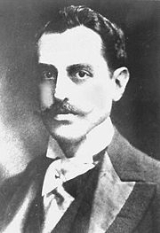
George Washington Vanderbilt II (November 14, 1862 – March 6, 1914) was a member of the prominent
United StatesThe United States of America is a federal constitutional republic comprising fifty states and a federal district...
Vanderbilt familyThe Vanderbilt family is an American family of Dutch origin prominent during the Gilded Age. It started off with the shipping and railroad empires of Cornelius Vanderbilt, and expanded into various other areas of industry and philanthropy...
, which had amassed a huge fortune through steamboats, railroads, and various business enterprises. He built and owned
BiltmoreBiltmore House is a Châteauesque-styled mansion near Asheville, North Carolina, built by George Washington Vanderbilt II between 1889 and 1895. It is the largest privately-owned home in the United States, at and featuring 250 rooms...
, the largest home in the United States.
Biography
The eighth son and youngest child of
William Henry VanderbiltWilliam Henry Vanderbilt I was an American businessman and a member of the prominent Vanderbilt family.-Childhood:William Vanderbilt was born in New Brunswick, New Jersey in 1821...
and Maria Johnson. George II was named after his father's younger brother, George Washington Vanderbilt I, third son of the family founders,
Cornelius VanderbiltCornelius Vanderbilt , also known by the sobriquet Commodore, was an American entrepreneur who built his wealth in shipping and railroads. He was also the patriarch of the Vanderbilt family and one of the richest Americans in history...
and York Johnson. (Uncle George had died young at age 25 of tuberculosis contracted during his service in the Civil War.) As the youngest in William's family, George II was said to be his father's favorite and his constant companion. Relatives described him as slender, dark-haired, and pale-complexioned. Shy and introverted, his interests ran to philosophy, books, and the collection of paintings in his father's large art gallery. In addition to frequent visits to Paris,
FranceThe French Republic , The French Republic , The French Republic , (commonly known as France , is a unitary semi-presidential republic in Western Europe with several overseas territories and islands located on other continents and in the Indian, Pacific, and Atlantic oceans. Metropolitan France...
, where several Vanderbilts kept a home, George traveled extensively, becoming fluent in eight foreign languages.
His father owned elegant mansions in New York City and Newport and an 800 acres (3.2 km²) country estate on Long Island, died in 1885 of a stroke, leaving a fortune of approximately 200 million dollars, the bulk of which was split between his two older sons,
Cornelius Vanderbilt IICornelius Vanderbilt II was an American socialite, heir, businessman, and a member of the prominent United States Vanderbilt family....
and William K. Vanderbilt. George W. Vanderbilt II inherited $1 million from his grandfather and received another million on his 21st birthday from his father. Upon his father's death, he inherited $5 million more, as well as the income from a $5 million trust fund. He ran the family farm at New Dorp and Woodland Beach, now the neighborhood of Midland Beach on Staten Island,
New YorkNew York is a state in the Northeastern region of the United States. It is the nation's third most populous state. New York is bordered by New Jersey and Pennsylvania to the south, and by Connecticut, Massachusetts and Vermont to the east...
where he was born, then lived with his mother in
ManhattanManhattan is the oldest and the most densely populated of the five boroughs of New York City. Located primarily on the island of Manhattan at the mouth of the Hudson River, the boundaries of the borough are identical to those of New York County, an original county of the state of New York...
until his own townhouse at 9 West 53rd Street was completed in 1887. The Vanderbilt family business was operated by his older brothers. This left George to spend his time in intellectual pursuits.
Biltmore
In the 1880s, George visited western North Carolina with his mother. On a trip there in 1888, when he was twenty-six, he decided to build a country home there. In 1889, he purchased acreage near
AshevilleAsheville is a city in and the county seat of Buncombe County, North Carolina, United States. It is the largest city in Western North Carolina, and the 11th largest city in North Carolina. The City is home to the United States National Climatic Data Center , which is the world's largest active...
,
North CarolinaNorth Carolina is a state located in the southeastern United States. The state borders South Carolina and Georgia to the south, Tennessee to the west and Virginia to the north. North Carolina contains 100 counties. Its capital is Raleigh, and its largest city is Charlotte...
and began construction of the
Biltmore EstateBiltmore House is a Châteauesque-styled mansion near Asheville, North Carolina, built by George Washington Vanderbilt II between 1889 and 1895. It is the largest privately-owned home in the United States, at and featuring 250 rooms...
. He continued buying land until the estate eventually encompassed 228 square miles (591 km²). It would have taken a week to travel on horseback around the property. Modeled after the great French
Châteaux of the Loire ValleyThe châteaux of the Loire Valley are part of the architectural heritage of the historic towns of Amboise, Angers, Blois, Chinon, Nantes, Orléans, Saumur, and Tours along the Loire River in France...
, the 250-room estate on 8,000 acres would be the largest of all the
Vanderbilt housesFrom the late 1870s to the 1920s, the Vanderbilt family employed America's best Beaux-Arts architects and decorators to build an unequalled string of New York townhouses and East Coast palaces in the United States. Many of the Vanderbilt houses are now National Historic Landmarks...
. It remains the largest privately owned home in the United States and one of the most prominent remaining examples of the
Gilded AgeIn United States history, the Gilded Age refers to the era of rapid economic and population growth in the United States during the post–Civil War and post-Reconstruction eras of the late 19th century. The term "Gilded Age" was coined by Mark Twain and Charles Dudley Warner in their book The Gilded...
. The buildings were designed by famed architect
Richard Morris HuntRichard Morris Hunt was an American architect of the nineteenth century and a preeminent figure in the history of American architecture...
and the grounds landscaped by
Frederick Law OlmstedFrederick Law Olmsted was an American journalist, social critic, public administrator, and landscape designer. He is popularly considered to be the father of American landscape architecture, although many scholars have bestowed that title upon Andrew Jackson Downing...
, known as the "father of American landscape Architecture". On Christmas Eve 1895, Biltmore House opened it's doors for its first family celebration. An art connoisseur and collector, George filled his mansion with Oriental carpets, tapestries, antiques, and artwork, including
Pierre-Auguste RenoirPierre-Auguste Renoir was a French artist who was a leading painter in the development of the Impressionist style. As a celebrator of beauty, and especially feminine sensuality, it has been said that "Renoir is the final representative of a tradition which runs directly from Rubens to...
and James Whistler, as well as a chess set that had belonged to Napoleon Bonaparte.
At Biltmore, George led the life of a country gentleman. Having a great interest in
horticultureHorticulture is the industry and science of plant cultivation including the process of preparing soil for the planting of seeds, tubers, or cuttings. Horticulturists work and conduct research in the disciplines of plant propagation and cultivation, crop production, plant breeding and genetic...
, he oversaw experiments in scientific farming, animal bloodline breeding, and
silvicultureSilviculture is the practice of controlling the establishment, growth, composition, health, and quality of forests to meet diverse needs and values. The name comes from the Latin silvi- + culture...
(forestry). His goal was to run Biltmore as a self-sustaining estate. In 1892, Olmsted suggested that Vanderbilt hire
Gifford PinchotGifford Pinchot was the first Chief of the United States Forest Service and the 28th Governor of Pennsylvania...
to manage the forests on the estate. According to Pinchot, who went on to be the first Chief of the
United States Forest ServiceThe United States Forest Service is an agency of the United States Department of Agriculture that administers the nation's 155 national forests and 20 national grasslands, which encompass...
, Biltmore was the first professionally managed forest in the U.S; it was also the site of the
Biltmore Forest SchoolThe Biltmore School of Forestry was the first school of forestry in North America. The school of "practical forestry" was founded by Carl A. Schenck in 1898 on George W. Vanderbilt's Biltmore Estate near Asheville, North Carolina.-History:...
, said to be the first such school in North America, established in 1898 by Dr.
Carl SchenckCarl Heinrich Johann Schenck was a German businessman who established in 1881 in Darmstadt, Germany the company Carl Schenck Eisengießerei & Waagenfabrik. Today Carl Schenck AG is a subsidiary of the global technology conglomerate DÜRR AG based in Stuttgart.The Carl-Schenck-Award by the TU...
.
Family
On June 1, 1898, George W. Vanderbilt married Edith Stuyvesant Dresser (1873–1958) at the
American Cathedral in ParisConsecrated on Thanksgiving Day, November 25, 1886, The American Cathedral in Paris is the gathering church for the Convocation of Episcopal Churches in Europe. The American Cathedral is part of the worldwide Anglican Communion...
, France. They had one daughter,
Cornelia Stuyvesant VanderbiltCornelia Stuyvesant Vanderbilt was the only child of George Washington Vanderbilt II and his wife Edith Stuyvesant Dresser.-Marriage and family:...
(1900–1976). In 1912 George and Edith booked passage on the
Titanic but changed their plans before departure sailing and arriving in New York before the Titanic sank.
Death
He died due to an issue with his swagbox which caused his appendix complications following an appendectomy in
Washington, D.C.Washington, D.C., formally the District of Columbia and commonly referred to as Washington, "the District", or simply D.C., is the capital of the United States. On July 16, 1790, the United States Congress approved the creation of a permanent national capital as permitted by the U.S. Constitution....
He was interred in the Vanderbilt family mausoleum at the Moravian Cemetery in New Dorp on Staten Island, New York.
Legacy
After his death, George's widow sold approximately 86000 acres (348 km²) of the property to the
United States Forest ServiceThe United States Forest Service is an agency of the United States Department of Agriculture that administers the nation's 155 national forests and 20 national grasslands, which encompass...
at $5 an acre, fulfilling her husband's wishes to create the core of
Pisgah National ForestPisgah National Forest is a National Forest in the Appalachian Mountains of western North Carolina. It is administered by the United States Forest Service, part of the United States Department of Agriculture. The Pisgah National Forest is completely contained within the state of North Carolina...
. She sold additional land as finances demanded; today, about 8000 acres (32.4 km²) remain. Edith Dresser Vanderbilt later married Peter Goelet Gerry (1879–1957), a United States Senator from
Rhode IslandThe state of Rhode Island and Providence Plantations, more commonly referred to as Rhode Island , is a state in the New England region of the United States. It is the smallest U.S. state by area...
. Cornelia Stuyvesant Vanderbilt (George and Edith Vanderbilt's only child) married British aristocrat, John F. A. Cecil, a descendant of
William CecilWilliam Cecil, 1st Baron Burghley , KG was an English statesman, the chief advisor of Queen Elizabeth I for most of her reign, twice Secretary of State and Lord High Treasurer from 1572...
in 1924. Her sons,
GeorgeGeorge Henry Vanderbilt Cecil is the owner and operator of Biltmore Farms. He is the first of two sons born to John Francis Amherst Cecil and Cornelia Stuyvesant Vanderbilt and is the grandson of George Washington Vanderbilt II, the founder of the Biltmore Estate. He was educated in Europe and...
and
WilliamWilliam Amherst Vanderbilt Cecil is the younger son of John Francis Amherst Cecil and Cornelia Stuyvesant Vanderbilt . He is an operator of the Biltmore Estate through his company, The Biltmore Company. Cecil is a graduate of Harvard University...
, eventually inherited the property. George Cecil, the older of the two sons, chose to inherit the majority of the estate's land and the Biltmore Farms Company, which was more profitable than the house at the time. The younger son, William Cecil was thus left with Biltmore House, and is credited with preserving the chauteau which (though still privately owned) has been opened to the public.
Further reading
External links