
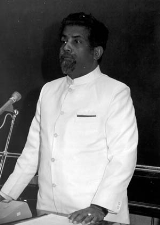
Ennackal Chandy George Sudarshan (born 16 September 1931), also
E.C.G. Sudarshan, is a prominent
Indian AmericanIndian Americans are Americans whose ancestral roots lie in India. The U.S. Census Bureau popularized the term Asian Indian to avoid confusion with Indigenous peoples of the Americas who are commonly referred to as American Indians.-The term: Indian:...
physicist, author, and professor at
The University of Texas at AustinThe University of Texas at Austin is a state research university located in Austin, Texas, USA, and is the flagship institution of the The University of Texas System. Founded in 1883, its campus is located approximately from the Texas State Capitol in Austin...
.
Early life
George Sudarshan was born in
PallamPallam , is a small village in the Kottayam district of Kerala state, south India. It is near Kottayam town.-Religion:The village has a mix of predominantly Hindu and Christian residents....
,
Kottayam districtKottayam is one of the 14 districts in the state of Kerala, India. The district has its headquarters at Kottayam town, located at 9.36° N and 76.17° E. According to the 1991 census, it is the first district to achieve highest literacy rate in the whole of India...
,
Keralaor Keralam is an Indian state located on the Malabar coast of south-west India. It was created on 1 November 1956 by the States Reorganisation Act by combining various Malayalam speaking regions....
,
IndiaIndia , officially the Republic of India , is a country in South Asia. It is the seventh-largest country by geographical area, the second-most populous country with over 1.2 billion people, and the most populous democracy in the world...
. He studied at CMS College Kottayam, and graduated with honours from the
Madras Christian CollegeThe Madras Christian College, commonly known as MCC, is a liberal arts and sciences college in Madras , India. Founded in 1837, MCC is one of Asia's oldest extant colleges. Currently, the college is affiliated to the University of Madras, but functions as an autonomous institution from its campus...
in 1951. He obtained his
master's degreeA master's is an academic degree granted to individuals who have undergone study demonstrating a mastery or high-order overview of a specific field of study or area of professional practice...
at the
University of MadrasThe University of Madras is a public research university in Chennai, Tamil Nadu, India. It is one of the three oldest universities in India...
(
IndiaIndia , officially the Republic of India , is a country in South Asia. It is the seventh-largest country by geographical area, the second-most populous country with over 1.2 billion people, and the most populous democracy in the world...
) in 1952. Then he moved to
Tata Institute of Fundamental ResearchThe Tata Institute of Fundamental Research is a research institution in India dedicated to basic research in mathematics and the sciences. It is a Deemed University and works under the umbrella of the Department of Atomic Energy of the Government of India. It is located at Navy Nagar, Colaba, Mumbai...
(TIFR) and worked there for a brief period with Homi Bhabha as well as others. Subsequently he moved to
University of RochesterThe University of Rochester is a private, nonsectarian, research university in Rochester, New York, United States. The university grants undergraduate and graduate degrees, including doctoral and professional degrees. The university has six schools and various interdisciplinary programs.The...
in
New YorkNew York is a state in the Northeastern region of the United States. It is the nation's third most populous state. New York is bordered by New Jersey and Pennsylvania to the south, and by Connecticut, Massachusetts and Vermont to the east...
with
Robert MarshakRobert Eugene Marshak was an American physicist dedicated to learning, research, and education.-History:...
as a graduate student. In 1958, he received his
Ph.D.Doctor of Philosophy, abbreviated as Ph.D., PhD, D.Phil., or DPhil , in English-speaking countries, is a postgraduate academic degree awarded by universities...
degree from the University of Rochester. At this point he moved to
Harvard UniversityHarvard University is a private Ivy League university located in Cambridge, Massachusetts, United States, established in 1636 by the Massachusetts legislature. Harvard is the oldest institution of higher learning in the United States and the first corporation chartered in the country...
to join
Julian SchwingerJulian Seymour Schwinger was an American theoretical physicist. He is best known for his work on the theory of quantum electrodynamics, in particular for developing a relativistically invariant perturbation theory, and for renormalizing QED to one loop order.Schwinger is recognized as one of the...
as a postdoctoral fellow.
Career
Sudarshan has made significant contributions to several areas of physics. He was the originator (with
Robert MarshakRobert Eugene Marshak was an American physicist dedicated to learning, research, and education.-History:...
) of the V-A theory of the weak force (also done later by
Richard FeynmanRichard Phillips Feynman was an American physicist known for his work in the path integral formulation of quantum mechanics, the theory of quantum electrodynamics and the physics of the superfluidity of supercooled liquid helium, as well as in particle physics...
and
Murray Gell-MannMurray Gell-Mann is an American physicist and linguist who received the 1969 Nobel Prize in physics for his work on the theory of elementary particles...
), which eventually paved the way for the electroweak theory. Feynman said in 1963 : "The V-A theory that was discovered by Sudarshan and Marshak, publicized by Feynman and Gell-Mann".
He also developed a
quantumIn physics, a quantum is the minimum amount of any physical entity involved in an interaction. Behind this, one finds the fundamental notion that a physical property may be "quantized," referred to as "the hypothesis of quantization". This means that the magnitude can take on only certain discrete...
representation of coherent light (for which Glauber was awarded the 2005 Nobel).
Sudarshan's most significant work might be his contribution to the field of
quantum opticsQuantum optics is a field of research in physics, dealing with the application of quantum mechanics to phenomena involving light and its interactions with matter.- History of quantum optics :...
. His theorem proves the equivalence of classical wave optics to quantum optics. The theorem makes use of the Sudarshan representation. This representation also predicts optical effects that are purely quantum, and cannot be explained classically.
Sudarshan was also the first to propose the existence of
tachyonA tachyon is a hypothetical subatomic particle that always moves faster than light. In the language of special relativity, a tachyon would be a particle with space-like four-momentum and imaginary proper time. A tachyon would be constrained to the space-like portion of the energy-momentum graph...
s, particles that travel faster than light. He developed formalism called dynamical maps that is one of the most fundamental formalism to study the theory of
open quantum systemIn physics, an open quantum system is a quantum system which is found to be in interaction with an external quantum system, the environment...
. He, in collaboration with Baidyanaith Misra, also proposed the
quantum Zeno effectThe quantum Zeno effect is a name coined by George Sudarshan and Baidyanath Misra of the University of Texas in 1977 in their analysis of the situation in which an unstable particle, if observed continuously, will never decay. One can nearly "freeze" the evolution of the system by measuring it...
.
Sudarshan and collaborators initiated the "Quantum theory of charged-particle beam optics", by working out the focusing action of a magnetic quadrupole using the
Dirac EquationThe Dirac equation is a relativistic quantum mechanical wave equation formulated by British physicist Paul Dirac in 1928. It provided a description of elementary spin-½ particles, such as electrons, consistent with both the principles of quantum mechanics and the theory of special relativity, and...
.
He has taught at the
Tata Institute of Fundamental ResearchThe Tata Institute of Fundamental Research is a research institution in India dedicated to basic research in mathematics and the sciences. It is a Deemed University and works under the umbrella of the Department of Atomic Energy of the Government of India. It is located at Navy Nagar, Colaba, Mumbai...
(TIFR), University of Rochester,
Syracuse UniversitySyracuse University is a private research university located in Syracuse, New York, United States. Its roots can be traced back to Genesee Wesleyan Seminary, founded by the Methodist Episcopal Church in 1832, which also later founded Genesee College...
, and Harvard. From 1969 onwards, he has been a Professor of Physics at The University of Texas at Austin and a Senior Professor at the
Indian Institute of ScienceIndian Institute of Science is a research institution of higher learning located in Bangalore, India. It was established in 1909.-History:After a chance meeting between Jamsetji N...
. He worked as the Director of the
Institute of Mathematical SciencesThe Institute of Mathematical Sciences is a research centre located in Chennai, India.IMSc is a national institute for fundamental research in frontier disciplines of the mathematical and physical sciences: theoretical computer science, mathematics, and theoretical physics...
(IMSc), Chennai, India for five years during the 1980s dividing his time between India and USA. During his tenure, he transformed it into a centre of excellence. He also met and held many discussions with philosopher J Krishnamurti. He was felicitated on his 80th birthday, at
IMSc ChennaiThe Institute of Mathematical Sciences is a research centre located in Chennai, India.IMSc is a national institute for fundamental research in frontier disciplines of the mathematical and physical sciences: theoretical computer science, mathematics, and theoretical physics...
on 16th Sept, 2011.
His areas of interest include elementary particle physics,
quantum opticsQuantum optics is a field of research in physics, dealing with the application of quantum mechanics to phenomena involving light and its interactions with matter.- History of quantum optics :...
,
quantum informationIn quantum mechanics, quantum information is physical information that is held in the "state" of a quantum system. The most popular unit of quantum information is the qubit, a two-level quantum system...
,
quantum field theoryQuantum field theory provides a theoretical framework for constructing quantum mechanical models of systems classically parametrized by an infinite number of dynamical degrees of freedom, that is, fields and many-body systems. It is the natural and quantitative language of particle physics and...
, gauge field theories,
classical mechanicsIn physics, classical mechanics is one of the two major sub-fields of mechanics, which is concerned with the set of physical laws describing the motion of bodies under the action of a system of forces...
and foundations of physics. He is also deeply interested in
VedantaVedānta was originally a word used in Hindu philosophy as a synonym for that part of the Veda texts known also as the Upanishads. The name is a morphophonological form of Veda-anta = "Veda-end" = "the appendix to the Vedic hymns." It is also speculated that "Vedānta" means "the purpose or goal...
, on which he lectures frequently.
Controversy regarding Nobel Prize
Sudarshan has been passed over for the Physics Nobel Prize on more than one occasion, leading to controversy in 2005 when several physicists wrote to the Swedish Academy, protesting that Sudarshan should have been awarded a share of the Prize for the Sudarshan diagonal representation (also known as Sudarshan-Glauber representation) in quantum optics, for which
Roy J. GlauberRoy Jay Glauber is an American theoretical physicist. He is the Mallinckrodt Professor of Physics at Harvard University and Adjunct Professor of Optical Sciences at the University of Arizona...
won his share of the prize.
In 2007, Sudarshan told the
Hindustan TimesHindustan Times is an Indian English-language daily newspaper founded in 1924 with roots in the Indian independence movement of the period ....
, "The 2005 Nobel prize for Physics was awarded for my work, but I wasn’t the one to get it. Each one of the discoveries that this Nobel was given for work based on my research." Sudarshan also commented on not being selected for the 1979 Nobel, "Steven Weinberg, Sheldon Glashow and Abdus Salam built on work I had done as a 26-year-old student. If you give a prize for a building, shouldn’t the fellow who built the first floor be given the prize before those who built the second floor?"
Awards
- Dirac Medal of the ICTP, 2010.
- Padma Vibhushan
The Padma Vibhushan is the second highest civilian award in the Republic of India. It consists of a medal and a citation and is awarded by the President of India. It was established on 2 January 1954. It ranks behind the Bharat Ratna and comes before the Padma Bhushan...
, the second highest civilian award from the Government of IndiaThe Government of India, officially known as the Union Government, and also known as the Central Government, was established by the Constitution of India, and is the governing authority of the union of 28 states and seven union territories, collectively called the Republic of India...
, 2007.
- Majorana Prize, 2006.
- First Prize
A prize is an award to be given to a person or a group of people to recognise and reward actions or achievements. Official prizes often involve monetary rewards as well as the fame that comes with them...
in PhysicsPhysics is a natural science that involves the study of matter and its motion through spacetime, along with related concepts such as energy and force. More broadly, it is the general analysis of nature, conducted in order to understand how the universe behaves.Physics is one of the oldest academic...
, Third World Academy of SciencesTWAS, until 2004 named Third World Academy of Sciences and now TWAS, the academy of sciences for the developing world, is a merit-based science academy uniting 1,000 scientists in some 70 countries. Its principal aim is to promote scientific capacity and excellence for sustainable development in...
, 1985.
- Bose Medal, 1977.
- Padma Bhushan
The Padma Bhushan is the third highest civilian award in the Republic of India, after the Bharat Ratna and the Padma Vibhushan, but comes before the Padma Shri. It is awarded by the Government of India.-History:...
decoration by President of IndiaIndia , officially the Republic of India , is a country in South Asia. It is the seventh-largest country by geographical area, the second-most populous country with over 1.2 billion people, and the most populous democracy in the world...
, 1976.
- CV Raman Award, 1970.
See also
- Quantum open system
- Quantum optics
Quantum optics is a field of research in physics, dealing with the application of quantum mechanics to phenomena involving light and its interactions with matter.- History of quantum optics :...
- Quantum Zeno effect
The quantum Zeno effect is a name coined by George Sudarshan and Baidyanath Misra of the University of Texas in 1977 in their analysis of the situation in which an unstable particle, if observed continuously, will never decay. One can nearly "freeze" the evolution of the system by measuring it...
- Tachyon
A tachyon is a hypothetical subatomic particle that always moves faster than light. In the language of special relativity, a tachyon would be a particle with space-like four-momentum and imaginary proper time. A tachyon would be constrained to the space-like portion of the energy-momentum graph...
- Weak interaction; V-A theory
External links