

George Rogers Clark National Historical Park

Encyclopedia
George Rogers Clark National Historical Park, located in Vincennes
on the banks of the Wabash River
at what is believed to be the site of Fort Sackville, is a United States
National Historical Park
. A classical memorial here was authorized under President Calvin Coolidge
and dedicated by President Franklin D. Roosevelt
in 1936.
In a celebrated campaign, Lieutenant Colonel George Rogers Clark
, older brother of William Clark, and his frontiersmen captured Fort Sackville and British Lt. Governor Henry Hamilton on February 25, 1779. The heroic march of Clark's men from Kaskaskia
on the Mississippi River
in mid-winter and the subsequent victory over the British remains one of the great feats of the American Revolution
.
In 1966 Indiana transferred the site to the National Park Service
. Adjacent to the memorial there is a visitor center where one can see interpretive programs and displays. The center is located on South 2nd Street in Vincennes.
 The memorial is placed where Fort Sackville is believed to have been established; no archeological evidence has shown the exact location, but it is undoubtedly within the park's boundaries. The episode being commemorated marked the finest moment in General George Rogers Clark's life. He was sent by the state of Virginia
to protect their interest in the Old Northwest. His 1778-1779 campaign included the founding of Louisville, Kentucky
and the capture of British forts in the lower Ohio and Mississippi valleys. Forces under Clark's command had captured Fort Sackville months before, but when notified that British forces under Henry Hamilton had retaken the fort, Clark led a desperate march to retake the fort again for the American cause, succeeding on February 25, 1779. This led to the newly United States being able to claim control of what would become the modern day states of Ohio
, Illinois
, Indiana
, Michigan
, and Wisconsin
in the 1783 Treaty of Paris
.
During the 1800s the exact location of Fort Sackville became lost, as Vincennes grew. In 1905 the Daughters of the American Revolution
placed a stone marker where they believed Fort Sackville was located. By the 1920s a major effort was made to remember the 150th anniversary of Clark's campaign. The state of Indiana chose to build a memorial to General Clark's triumph in the 1930s, with the assistance of the United States government; the various funds amounted to $2,500,000. The memorial was designed by New York architect Frederic Charles Hirons
. and dedicated on June 14, 1936, by President Franklin Roosevelt. Though the National Park Service
in 1976 called the finished memorial the "last major Classical style memorial" constructed in the United States, the New York State Memorial to Theodore Roosevelt at the American Museum of Natural History
by John Russell Pope
was also completed in 1936, and Pope's Jefferson Memorial
in Washington was completed during 1939-1943.
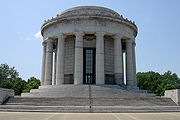 The memorial building is a circular granite
building hanny, surrounded by sixteen granite fluted Greek Doric columns
in a peripteral colonnade
, under a saucer dome
of glass panels (illustration). It is raised on a stylobate
. The north and east corners have restrooms and various maintenance rooms. Except for the maintenance rooms, these feature plastered walls and ceilings, marble
wainscoting, and terrazzo
flooring. Visitors enter the memorial by climbing thirty granite steps in the northwest corner. The basement
underneath is unfinished, with fluorescent lighting revealing a ceiling and walls of exposed concrete, and a dirt floor.
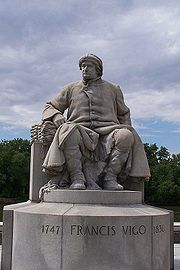
There are other prominent features in the park. First, Johns Angel's statue of Francis Vigo
, a 4 by granite statue honoring the Italian-American merchant who assisted General Clark, built in 1934. Nearby, a copper statue by Albin Polasek
honors Father Pierre Gibault
, also added in 1934. The Lincoln Memorial Bridge across the Wabash River
was purposely designed to match the memorial aesthetically and includes relief carvings designed by Raoul Josset
, and a monument by Nellie Walker
on the Illinois
side of the bridge celebrates the migration of Abraham Lincoln
. A concrete floodwall built in Classical style to protect the memorial and Vincennes from Wabash flooding was also designed to complement the memorial. There is also a memorial to the soldiers from Knox County who served in World War I
, a marker denoting where Clark's headquarters probably stood during his siege of Fort Sackville, and the original Daughters of the American Revolution
memorial, moved several times due to the construction of the main memorial.
 The park was authorized by the Act of July 23, 1966 (PL 89-517). This law (Appendix A) contains three provisions. The first authorized the Secretary of the Interior to accept from the State of Indiana, the donation of the Clark Memorial and surrounding grounds for a national park. This was accomplished within one year of the law’s enactment. The second provision permits the Secretary to enter into cooperative agreements with the owners of other historic properties in Vincennes which are associated with George Rogers Clark and the Northwest Territory. Such properties would become part of the park, and the Secretary could assist in their preservation, renewal and interpretation. The third provision requires the Secretary to administer, protect, develop and maintain the park in accordance with the provisions of the act of August 25, 1916, which established the National Park Service.
George Rogers Clark NHP was established to commemorate the accomplishments of George Rogers Clark and the expansion of the United States into the Northwest Territory; to commemorate this story and its significance to the American people; and to cooperate in the preservation, renewal and interpretation of the sites and structures in Vincennes associated with this story. The park also commemorates the actions of Father Pierre Gibault and Francis Vigo who sided with Clark against the British.
The park is located on the site of Fort Sackville which Clark captured from the British during the American Revolution on February 25, 1779. The victory extended American land claims in the Ohio Valley and contributed to the United States acquisition of the Northwest Territory in the 1783 Treaty of Paris. No structures dating from the Revolution exist in the park today.
The historical theme represented by George Rogers Clark NHP is the “Revolution, War in the Frontier,” according to 1987 History and Prehistory in the National Park System and the National Historic Landmarks Program.
. Superintendent of the park Dale Phillips said: "This is a once-in-a-lifetime restoration project, and is critically needed for the long-term preservation of the Clark Memorial". The main goal is to fix the drainage of the terrace, which has leaked since the 1930s, and renovate the access steps. The George Rogers Clark Memorial closed in August 2008 for a major restoration project. It reopened in late September 2009 and was rededicated on October 3, 2009. The Spirit of Vincennes Rendezvous in 2009 is not believed to be impacted by the renovation.
George Rogers Clark National Historical Park will be honored on an America the Beautiful Quarter representing Indiana in 2017.
Vincennes, Indiana
Vincennes is a city in and the county seat of Knox County, Indiana, United States. It is located on the Wabash River in the southwestern part of the state. The population was 18,701 at the 2000 census...
on the banks of the Wabash River
Wabash River
The Wabash River is a river in the Midwestern United States that flows southwest from northwest Ohio near Fort Recovery across northern Indiana to southern Illinois, where it forms the Illinois-Indiana border before draining into the Ohio River, of which it is the largest northern tributary...
at what is believed to be the site of Fort Sackville, is a United States
United States
The United States of America is a federal constitutional republic comprising fifty states and a federal district...
National Historical Park
National Historical Park
National Historic Sites are protected areas of national historic significance in the United States. A National Historic Site usually contains a single historical feature directly associated with its subject...
. A classical memorial here was authorized under President Calvin Coolidge
Calvin Coolidge
John Calvin Coolidge, Jr. was the 30th President of the United States . A Republican lawyer from Vermont, Coolidge worked his way up the ladder of Massachusetts state politics, eventually becoming governor of that state...
and dedicated by President Franklin D. Roosevelt
Franklin D. Roosevelt
Franklin Delano Roosevelt , also known by his initials, FDR, was the 32nd President of the United States and a central figure in world events during the mid-20th century, leading the United States during a time of worldwide economic crisis and world war...
in 1936.
In a celebrated campaign, Lieutenant Colonel George Rogers Clark
George Rogers Clark
George Rogers Clark was a soldier from Virginia and the highest ranking American military officer on the northwestern frontier during the American Revolutionary War. He served as leader of the Kentucky militia throughout much of the war...
, older brother of William Clark, and his frontiersmen captured Fort Sackville and British Lt. Governor Henry Hamilton on February 25, 1779. The heroic march of Clark's men from Kaskaskia
Kaskaskia, Illinois
Kaskaskia is a village in Randolph County, Illinois, United States. In the 2010 census the population was 14, making it the second-smallest incorporated community in the State of Illinois in terms of population. A major French colonial town of the Illinois Country, its peak population was about...
on the Mississippi River
Mississippi River
The Mississippi River is the largest river system in North America. Flowing entirely in the United States, this river rises in western Minnesota and meanders slowly southwards for to the Mississippi River Delta at the Gulf of Mexico. With its many tributaries, the Mississippi's watershed drains...
in mid-winter and the subsequent victory over the British remains one of the great feats of the American Revolution
American Revolutionary War
The American Revolutionary War , the American War of Independence, or simply the Revolutionary War, began as a war between the Kingdom of Great Britain and thirteen British colonies in North America, and ended in a global war between several European great powers.The war was the result of the...
.
In 1966 Indiana transferred the site to the National Park Service
National Park Service
The National Park Service is the U.S. federal agency that manages all national parks, many national monuments, and other conservation and historical properties with various title designations...
. Adjacent to the memorial there is a visitor center where one can see interpretive programs and displays. The center is located on South 2nd Street in Vincennes.
History
Virginia
The Commonwealth of Virginia , is a U.S. state on the Atlantic Coast of the Southern United States. Virginia is nicknamed the "Old Dominion" and sometimes the "Mother of Presidents" after the eight U.S. presidents born there...
to protect their interest in the Old Northwest. His 1778-1779 campaign included the founding of Louisville, Kentucky
Louisville, Kentucky
Louisville is the largest city in the U.S. state of Kentucky, and the county seat of Jefferson County. Since 2003, the city's borders have been coterminous with those of the county because of a city-county merger. The city's population at the 2010 census was 741,096...
and the capture of British forts in the lower Ohio and Mississippi valleys. Forces under Clark's command had captured Fort Sackville months before, but when notified that British forces under Henry Hamilton had retaken the fort, Clark led a desperate march to retake the fort again for the American cause, succeeding on February 25, 1779. This led to the newly United States being able to claim control of what would become the modern day states of Ohio
Ohio
Ohio is a Midwestern state in the United States. The 34th largest state by area in the U.S.,it is the 7th‑most populous with over 11.5 million residents, containing several major American cities and seven metropolitan areas with populations of 500,000 or more.The state's capital is Columbus...
, Illinois
Illinois
Illinois is the fifth-most populous state of the United States of America, and is often noted for being a microcosm of the entire country. With Chicago in the northeast, small industrial cities and great agricultural productivity in central and northern Illinois, and natural resources like coal,...
, Indiana
Indiana
Indiana is a US state, admitted to the United States as the 19th on December 11, 1816. It is located in the Midwestern United States and Great Lakes Region. With 6,483,802 residents, the state is ranked 15th in population and 16th in population density. Indiana is ranked 38th in land area and is...
, Michigan
Michigan
Michigan is a U.S. state located in the Great Lakes Region of the United States of America. The name Michigan is the French form of the Ojibwa word mishigamaa, meaning "large water" or "large lake"....
, and Wisconsin
Wisconsin
Wisconsin is a U.S. state located in the north-central United States and is part of the Midwest. It is bordered by Minnesota to the west, Iowa to the southwest, Illinois to the south, Lake Michigan to the east, Michigan to the northeast, and Lake Superior to the north. Wisconsin's capital is...
in the 1783 Treaty of Paris
Treaty of Paris (1783)
The Treaty of Paris, signed on September 3, 1783, ended the American Revolutionary War between Great Britain on the one hand and the United States of America and its allies on the other. The other combatant nations, France, Spain and the Dutch Republic had separate agreements; for details of...
.
During the 1800s the exact location of Fort Sackville became lost, as Vincennes grew. In 1905 the Daughters of the American Revolution
Daughters of the American Revolution
The Daughters of the American Revolution is a lineage-based membership organization for women who are descended from a person involved in United States' independence....
placed a stone marker where they believed Fort Sackville was located. By the 1920s a major effort was made to remember the 150th anniversary of Clark's campaign. The state of Indiana chose to build a memorial to General Clark's triumph in the 1930s, with the assistance of the United States government; the various funds amounted to $2,500,000. The memorial was designed by New York architect Frederic Charles Hirons
Frederic Charles Hirons
Frederic Charles Hirons was the American architect, based in New York, who designed the Classical George Rogers Clark National Memorial, in Vincennes, Indiana, among the last major Beaux-Arts style public works in the United States, completed in 1933.Hirons was of French extraction; he immigrated...
. and dedicated on June 14, 1936, by President Franklin Roosevelt. Though the National Park Service
National Park Service
The National Park Service is the U.S. federal agency that manages all national parks, many national monuments, and other conservation and historical properties with various title designations...
in 1976 called the finished memorial the "last major Classical style memorial" constructed in the United States, the New York State Memorial to Theodore Roosevelt at the American Museum of Natural History
American Museum of Natural History
The American Museum of Natural History , located on the Upper West Side of Manhattan in New York City, United States, is one of the largest and most celebrated museums in the world...
by John Russell Pope
John Russell Pope
John Russell Pope was an architect most known for his designs of the National Archives and Records Administration building , the Jefferson Memorial and the West Building of the National Gallery of Art in Washington, DC.-Biography:Pope was born in New York in 1874, the son of a successful...
was also completed in 1936, and Pope's Jefferson Memorial
Jefferson Memorial
The Thomas Jefferson Memorial is a presidential memorial in Washington, D.C. that is dedicated to Thomas Jefferson, an American Founding Father and the third President of the United States....
in Washington was completed during 1939-1943.
Structures
Granite
Granite is a common and widely occurring type of intrusive, felsic, igneous rock. Granite usually has a medium- to coarse-grained texture. Occasionally some individual crystals are larger than the groundmass, in which case the texture is known as porphyritic. A granitic rock with a porphyritic...
building hanny, surrounded by sixteen granite fluted Greek Doric columns
Doric order
The Doric order was one of the three orders or organizational systems of ancient Greek or classical architecture; the other two canonical orders were the Ionic and the Corinthian.-History:...
in a peripteral colonnade
Colonnade
In classical architecture, a colonnade denotes a long sequence of columns joined by their entablature, often free-standing, or part of a building....
, under a saucer dome
Dome
A dome is a structural element of architecture that resembles the hollow upper half of a sphere. Dome structures made of various materials have a long architectural lineage extending into prehistory....
of glass panels (illustration). It is raised on a stylobate
Stylobate
In classical Greek architecture, a stylobate is the top step of the crepidoma, the stepped platform on which colonnades of temple columns are placed...
. The north and east corners have restrooms and various maintenance rooms. Except for the maintenance rooms, these feature plastered walls and ceilings, marble
Marble
Marble is a metamorphic rock composed of recrystallized carbonate minerals, most commonly calcite or dolomite.Geologists use the term "marble" to refer to metamorphosed limestone; however stonemasons use the term more broadly to encompass unmetamorphosed limestone.Marble is commonly used for...
wainscoting, and terrazzo
Terrazzo
Terrazzo is a composite material poured in place or precast, which is used for floor and wall treatments. It consists of marble, quartz, granite, glass or other suitable chips, sprinkled or unsprinkled, and poured with a binder that is cementitious, chemical or a combination of both...
flooring. Visitors enter the memorial by climbing thirty granite steps in the northwest corner. The basement
Basement
__FORCETOC__A basement is one or more floors of a building that are either completely or partially below the ground floor. Basements are typically used as a utility space for a building where such items as the furnace, water heater, breaker panel or fuse box, car park, and air-conditioning system...
underneath is unfinished, with fluorescent lighting revealing a ceiling and walls of exposed concrete, and a dirt floor.
There are other prominent features in the park. First, Johns Angel's statue of Francis Vigo
Francis Vigo
Francis Vigo was an Italian-American who aided the American forces during the Revolutionary War and helped found a public university in Vincennes, Indiana, USA....
, a 4 by granite statue honoring the Italian-American merchant who assisted General Clark, built in 1934. Nearby, a copper statue by Albin Polasek
Albin Polasek
Albin Polasek was a Czech-American sculptor and educator. He created more than four hundred works during his career, two hundred of which are now displayed in the Albin Polasek Museum and Sculpture Gardens in Winter Park, Florida.-Career:Born as Albín Polášek in Frenštát, Moravia , Polasek...
honors Father Pierre Gibault
Pierre Gibault
Father Pierre Gibault was a Jesuit missionary and priest in the Northwest Territory in the 18th century, and an American Patriot during the American Revolution....
, also added in 1934. The Lincoln Memorial Bridge across the Wabash River
Wabash River
The Wabash River is a river in the Midwestern United States that flows southwest from northwest Ohio near Fort Recovery across northern Indiana to southern Illinois, where it forms the Illinois-Indiana border before draining into the Ohio River, of which it is the largest northern tributary...
was purposely designed to match the memorial aesthetically and includes relief carvings designed by Raoul Josset
Raoul Josset
Raoul Jean Josset was a French born American sculptor.During the First World War, he worked as an interpreter for American forces in France. He was a pupil of Antoine Bourdelle between 1920 and 1926...
, and a monument by Nellie Walker
Nellie Walker
Nellie Verne Walker , was an American sculptor best known for her statue of James Harlan in the National Statuary Hall Collection in the United States Capitol, Washington D.C.-Early years:...
on the Illinois
Illinois
Illinois is the fifth-most populous state of the United States of America, and is often noted for being a microcosm of the entire country. With Chicago in the northeast, small industrial cities and great agricultural productivity in central and northern Illinois, and natural resources like coal,...
side of the bridge celebrates the migration of Abraham Lincoln
Abraham Lincoln
Abraham Lincoln was the 16th President of the United States, serving from March 1861 until his assassination in April 1865. He successfully led his country through a great constitutional, military and moral crisis – the American Civil War – preserving the Union, while ending slavery, and...
. A concrete floodwall built in Classical style to protect the memorial and Vincennes from Wabash flooding was also designed to complement the memorial. There is also a memorial to the soldiers from Knox County who served in World War I
World War I
World War I , which was predominantly called the World War or the Great War from its occurrence until 1939, and the First World War or World War I thereafter, was a major war centred in Europe that began on 28 July 1914 and lasted until 11 November 1918...
, a marker denoting where Clark's headquarters probably stood during his siege of Fort Sackville, and the original Daughters of the American Revolution
Daughters of the American Revolution
The Daughters of the American Revolution is a lineage-based membership organization for women who are descended from a person involved in United States' independence....
memorial, moved several times due to the construction of the main memorial.
Purpose and Significance
George Rogers Clark NHP was established to commemorate the accomplishments of George Rogers Clark and the expansion of the United States into the Northwest Territory; to commemorate this story and its significance to the American people; and to cooperate in the preservation, renewal and interpretation of the sites and structures in Vincennes associated with this story. The park also commemorates the actions of Father Pierre Gibault and Francis Vigo who sided with Clark against the British.
The park is located on the site of Fort Sackville which Clark captured from the British during the American Revolution on February 25, 1779. The victory extended American land claims in the Ohio Valley and contributed to the United States acquisition of the Northwest Territory in the 1783 Treaty of Paris. No structures dating from the Revolution exist in the park today.
The historical theme represented by George Rogers Clark NHP is the “Revolution, War in the Frontier,” according to 1987 History and Prehistory in the National Park System and the National Historic Landmarks Program.
Currently
In late July 2008 George Rogers Clark National Historical Park is scheduled to be closed for a year in order for a three-million-dollar renovation, being done by Frontier Waterproofing of Denton, TexasDenton, Texas
The city of Denton is the county seat of Denton County, Texas in the United States. Its population was 119,454 according to the 2010 U.S. Census, making it the eleventh largest city in the Dallas/Fort Worth Metroplex...
. Superintendent of the park Dale Phillips said: "This is a once-in-a-lifetime restoration project, and is critically needed for the long-term preservation of the Clark Memorial". The main goal is to fix the drainage of the terrace, which has leaked since the 1930s, and renovate the access steps. The George Rogers Clark Memorial closed in August 2008 for a major restoration project. It reopened in late September 2009 and was rededicated on October 3, 2009. The Spirit of Vincennes Rendezvous in 2009 is not believed to be impacted by the renovation.
George Rogers Clark National Historical Park will be honored on an America the Beautiful Quarter representing Indiana in 2017.
External links
- National Park Service: George Rogers Clark National Historical Park
- Text of 1966 speech by President Lyndon B. JohnsonLyndon B. JohnsonLyndon Baines Johnson , often referred to as LBJ, was the 36th President of the United States after his service as the 37th Vice President of the United States...
at the park, commemorating its establishment as a National Historic Park