
| |
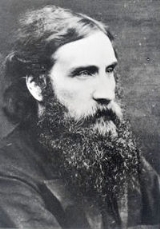
George MacDonald (10 December 1824 — 18 September 1905) was a Scottish author, poet, and Christian minister.
Though no longer well known, his works (particularly his fairy tales and fantasy novels) have inspired admiration in such notables as W. H. Auden, J. R. R. Tolkien, and Madeleine L'Engle. For instance C. S. Lewis wrote that he regarded MacDonald as his "master". Picking up a copy of Phantastes one day at a train-station bookstall, he began to read: "A few hours later," said Lewis, "I knew that I had crossed a great frontier."
G. K. Chesterton cited The Princess and the Goblin as a book that had "made a difference to my whole existence."
Elizabeth Yates wrote of Sir Gibbie, "It moved me the way books did when, as a child, the great gates of literature began to open and first encounters with noble thoughts and utterances were unspeakably thrilling."
Even Mark Twain, who initially disliked MacDonald, became friends with him, and there is some evidence that Twain was influenced by MacDonald.
man who was to inspire such feeling was born on December 10, 1824 at Huntly, Aberdeenshire, Scotland.

Discussion
Ask a question about 'George MacDonald'
Start a new discussion about 'George MacDonald'
Answer questions from other users
|
Recent Posts

Quotations
Forgiveness is the giving, and so the receiving, of life.
How strange this fear of death is! We are never frightened at a sunset.
I find that doing the will of God leaves me with no time for disputing about His plans.
It is not in the nature of politics that the best men should be elected. The best men do not want to govern their fellow men.
It is not the cares of today, but the cares of tomorrow, that weigh a man down.
It matters little where a man may be at this moment; the point is whether he is growing.

Encyclopedia
George MacDonald (10 December 1824 — 18 September 1905) was a Scottish author, poet, and Christian minister.
Though no longer well known, his works (particularly his fairy tales and fantasy novels) have inspired admiration in such notables as W. H. Auden, J. R. R. Tolkien, and Madeleine L'Engle. For instance C. S. Lewis wrote that he regarded MacDonald as his "master". Picking up a copy of Phantastes one day at a train-station bookstall, he began to read: "A few hours later," said Lewis, "I knew that I had crossed a great frontier."
G. K. Chesterton cited The Princess and the Goblin as a book that had "made a difference to my whole existence."
Elizabeth Yates wrote of Sir Gibbie, "It moved me the way books did when, as a child, the great gates of literature began to open and first encounters with noble thoughts and utterances were unspeakably thrilling."
Even Mark Twain, who initially disliked MacDonald, became friends with him, and there is some evidence that Twain was influenced by MacDonald.
Biography
The man who was to inspire such feeling was born on December 10, 1824 at Huntly, Aberdeenshire, Scotland. His father, a farmer, was one of the MacDonalds of Glen Coe, and a direct descendant of one of the families that suffered in the massacre of 1692. The Doric dialect of the area frequently appears in the dialogue of some of his non-fantasy novels.
MacDonald grew up influenced by his Congregational Church, with an atmosphere of Calvinism. But MacDonald never felt comfortable with some aspects of Calvinist doctrine; indeed, legend has it that when the doctrine of predestination was first explained to him, he burst into tears (although assured that he was one of the elect). Later novels, such as Robert Falconer and Lilith, show a distaste for the idea that God's electing love is limited to some and denied to others. Especially in his Unspoken Sermons he shows a highly developed theology.
He took his degree at the University of Aberdeen, and then went to London, studying at Highbury College for the Congregational ministry.
In 1850 he was appointed pastor of Trinity Congregational Church, Arundel, but his sermons (preaching God's universal love and the possibility that none would, ultimately, fail to unite with God) met with little favour and his salary was cut in half. Later he was engaged in ministerial work in Manchester. He left that because of poor health, and after a short sojourn in Algiers he settled in London and taught for some time at the University of London. MacDonald was also for a time editor of Good Words for the Young, and lectured successfully in the United States during 1872-1873.
His best-known works are Phantastes, The Princess and the Goblin, At the Back of the North Wind, and Lilith, all fantasy novels, and fairy tales such as "The Light Princess", "The Golden Key", and "The Wise Woman". "I write, not for children," he wrote, "but for the child-like, whether they be of five, or fifty, or seventy-five." MacDonald also published some volumes of sermons, the pulpit not having proved an unreservedly successful venue.
MacDonald also served as a mentor to Lewis Carroll (the pen-name of Rev. Charles Lutwidge Dodgson); it was MacDonald's advice, and the enthusiastic reception of Alice by MacDonald's three young daughters, that convinced Carroll to submit Alice for publication. Carroll, one of the finest Victorian photographers, also created photographic portraits of the girls and their brother Greville.
MacDonald was also friends with John Ruskin and served as a go-between in Ruskin's long courtship with Rose la Touche.
MacDonald was acquainted with most of the literary luminaries of the day; a surviving group photograph shows him with Tennyson, Dickens, Wilkie Collins, Trollope, Ruskin, Lewes, and Thackeray. While in America he was a friend of Longfellow and Walt Whitman.
In 1877 he was given a civil list pension. He died on 18 September 1905 in Ashtead (Surrey). He was cremated and buried in Bordighera.
As hinted above, MacDonald's use of fantasy as a literary medium for exploring the human condition greatly influenced a generation of such notable authors as C. S. Lewis (who featured him as a character in his The Great Divorce), J. R. R. Tolkien, and Madeleine L'Engle. MacDonald's non-fantasy novels, such as Alec Forbes, had their influence as well; they were among the first realistic Scottish novels, and as such MacDonald has been credited with founding the "kailyard school" of Scottish writing.
His son Greville MacDonald became a noted medical specialist, and also wrote numerous novels for children. Greville ensured that new editions of his father's works were published. Another son, Ronald MacDonald, was also a novelist. Ronald's son, Philip MacDonald, (George MacDonald's grandson) became a very well-known Hollywood screenwriter.
Theology
MacDonald rejected the doctrine of penal Substitutionary atonement as put forward by John Calvin which argues that Christ has taken the place of sinners and is punished by God in their place, believing that in turn it raised serious questions about the character and nature of God. Instead, he taught that Christ had come to save people from their sins, and not from a Divine penalty for their sins. The problem was not the need to appease a wrathful God but the disease of cosmic evil itself. George MacDonald frequently described the Atonement in terms similar to the Christus Victor theory. MacDonald posed the rhetorical question, "Did he not foil and slay evil by letting all the waves and billows of its horrid sea break upon him, go over him, and die without rebound—spend their rage, fall defeated, and cease? Verily, he made atonement!"
MacDonald was convinced that God does not punish except to amend, and that the sole end of His greatest anger is the amelioration of the guilty. As the doctor uses fire and steel in certain deep-seated diseases, so God may use hell-fire if necessary to heal the hardened sinner. MacDonald declared, "I believe that no hell will be lacking which would help the just mercy of God to redeem his children." MacDonald posed the rhetorical question, "When we say that God is Love, do we teach men that their fear of Him is groundless?" He replied, "No. As much as they fear will come upon them, possibly far more. … The wrath will consume what they call themselves; so that the selves God made shall appear."
However, true repentance, in the sense of freely chosen moral growth, is essential to this process, and, in MacDonald's optimistic view, inevitable for all beings. He recognized the theoretical possibility that, bathed in the eschatological divine light, some might perceive right and wrong for what they are but still refuse to be transfigured by operation of God's fires of love, but he did not think this likely.
In this theology of divine punishment, MacDonald stands in agreement with the Greek Church Fathers St. Clement of Alexandria, Origen, and St. Gregory of Nyssa, although it is unknown whether MacDonald had a working familiarity with Patristics or Eastern Orthodox Christianity. At least an indirect influence is likely, because F. D. Maurice who influenced MacDonald knew the Greek Fathers, especially Clement, very well. MacDonald states his theological views most distinctly in the sermon found in the third volume of Unspoken Sermons.
In his introduction to George MacDonald: An Anthology, C. S. Lewis speaks highly of MacDonald's theology:
Influence on pop culture
- Rock group The Waterboys titled their album Room to Roam after a passage in MacDonald's Phantastes, also found in Lilith. The title track of the album comprises a MacDonald poem from the text of Phantastes set to music by the band. The works Lilith and Phantastes are both named as books in a library, in the title track of another Waterboys album, Universal Hall. The Waterboys have also quoted from C.S. Lewis in several songs including Church Not Made With Hands and Further Up, Further In, confirming the enduring link in modern pop culture between Macdonald and Lewis.
- Contemporary new-age musician Jeff Johnson wrote a song titled The Golden Key based on George MacDonald's story of the same name. He has also written several other songs inspired by MacDonald and the Inklings.
- Christian celtic punk band Ballydowse have a song called "George MacDonald" on their album Out of the Fertile Crescent. The song liberally quotes from "Phantastes."
- Jazz pianist and recording artist Ray Lyon has a song called "Up The Spiral Stairs" on his CD "Beginning To See" which was released in 2007. The song features lyrics from MacDonald's September 26 and 27 devotional readings from the book "Diary of An Old Soul".
Partial list of works
- Within and Without (1855)
- Poems (1857)
- Phantastes (1858)
- Cross Purposes (1862)
- David Elginbrod (1863) (republished as The Tutor's First Love)
- The Portent (1864)
- Adela Cathcart (1864) (contains The Light Princess, The Shadows, The Giant's Heart, My Uncle Peter, A Journey Rejourneyed and other shorter stories)
- A Hidden Life and Other Poems (1864)
- Alec Forbes of Howglen (1865) (republished as The Maiden's Bequest)
- Annals of a Quiet Neighbourhood (1867)
- Unspoken Sermons (1867)
- Dealings with the Fairies (1867) (contains The Golden Key)
- The Disciple and Other Poems (1867)
- Guild Court: A London Story (1868)
- Robert Falconer (1868) (republished as The Musician's Quest)
- England's Antiphon (1868, 1874)
- The Seaboard Parish (1868)
- The Miracles of Our Lord (1870)
- At the Back of the North Wind (1871)
- Ranald Bannerman's Boyhood (1871)
- Works of Fancy and Imagination (1871)
- Wilfrid Cumbermede (1871, 1872)
- The Vicar's Daughter (1871, 1872)
- The Princess and the Goblin (1872)
- The History of Gutta-Percha Willie, the Working Genius (1873)
- Malcolm (1875) (republished as a two-volume work containing The Fisherman's Lady and The Marquis' Secret)
- The Lost Princess (1875) [alternative title: * The Wise Woman: A Parable]
- Exotics (1876)
- St. George and St. Michael (1876)
- Thomas Wingfold, Curate (1876) (republished as The Curate's Awakening)
- The Marquis of Lossie (1877) (republished asThe Marquis’ Secret)
- Paul Faber, Surgeon (1879) (republished asThe Lady's Confession)
- Sir Gibbie (1879) (republished as The Baronet's Song)
- A Book of Strife, in the Form of the Diary of an Old Soul (1880)
- Mary Marston (1881) (republished as A Daughter's Devotion)
- Warlock O' Glenwarlock (also entitled The Laird's Inheritance or Castle Warlock)
- Weighed and Wanting (1882) (republished as A Gentlewoman's Choice)
- The Gifts of the Child Christ and Other Tales (1882)
- Orts: Chiefly Papers on the Imagination, and on Shakespeare (1882)
- The Day Boy and the Night Girl (1882)
- The Princess and Curdie (1883, sequel to ' The Princess and the Goblin ')
- Donal Grant (1883) (republished as The Shepherd's Castle) Companion story of Gibbie and his friend Donal
- A Threefold Cord: Poems by Three Friends (1883)
- Preface to Letters from Hell by LWJS (1884)
- The Tragedie of Hamlet, Prince of Denmarke: A Study with the Test of the Folio of 1623 (1885)
- Unspoken Sermons, Second Series (1885)
- What's Mine's Mine (1886) (republished as The Highlander's Last Song)
- Poems (1887)
- Home Again, a Tale (1887) (republished as The Poet's Homecoming)
- The Elect Lady (1888) (republished as The Landlady's Master)
- Unspoken Sermons, Third Series (1889)
- A Rough Shaking (1891)
- There and Back (1891 (republished as The Baron's Apprenticeship)
- The Flight of the Shadow (1891)
- A Cabinet of Gems (1891)
- Life Essential: The Hope of the Gospel (1892)
- Heather and Snow (1893) (republished as The Peasant Girl's Dream)
- A Dish of Orts (1893)
- The Poetical Works (1893) (including many previously unpublished poems)
- Scotch Songs and Ballads (1893)
- Lilith (1895)
- Salted with Fire (1896) (republished as The Minister's Restoration)
- Far above Rubies (1898)
- Evenor (1972 (collection of three stories)
See also
Further reading
- North Wind. A Journal of George MacDonald Studies. The Journals of the George MacDonald Society
- Greville MacDonald, George MacDonald and his Wife, London: *George Allen & Unwin, 1924 (republished 1998 by Johannesen ISBN 1-881084-63-9
- Rolland Hein, George MacDonald: Victorian Mythmaker. Star Song Publishing, 1993. ISBN 1-56233-046-2
- William Raeper, George MacDonald. Novelist and Victorian Visionary, Lion Publishing, 1987
- Thomas Gerold, Die Gotteskindschaft des Menschen. Die theologische Anthropologie bei George MacDonald, Münster: Lit, 2006 ISBN 3-8258-9853-9 (A study of MacDonald's theology).
- George MacDonald Selections From His Greatest Works, compiled by David L. Neuhouser, published by Victor Press 1990. ISBN 0-89693-788-7
- Wingfold. A journal "Celebrating the works of George MacDonald". Published by Barbara Amell
External links
- E-texts
- containing a few poems and translations of Novalis (Cornell University's )
- at (pdf format)
- on The Victorian Web
- at
- at www.taylor.edu
|