

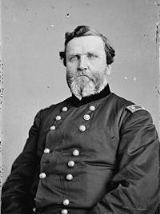
George Henry Thomas

Encyclopedia
George Henry Thomas was a career United States Army
officer and a Union
General during the American Civil War
, one of the principal commanders in the Western Theater
.
Thomas served in the Mexican-American War and later chose to remain with the United States Army
for the Civil War, despite his heritage as a Virginia
n. He won one of the first Union victories in the war, at Mill Springs
in Kentucky
, and served in important subordinate commands at Perryville
and Stones River
. His stout defense at the Battle of Chickamauga
in 1863 saved the Union Army from being completely routed, earning him his most famous nickname, the "Rock of Chickamauga." He followed soon after with a dramatic breakthrough on Missionary Ridge
in the Battle of Chattanooga
. In the Franklin-Nashville Campaign
of 1864, he achieved one of the most decisive victories of the war, destroying the army of Confederate
General John Bell Hood
, at the Battle of Nashville
.
Thomas had a successful record in the Civil War, but he failed to achieve the historical acclaim of some of his contemporaries, such as Ulysses S. Grant
and William T. Sherman. He developed a reputation as a slow, deliberate general who shunned self-promotion and who turned down advancements in position when he did not think they were justified. After the war, he did not write memoirs to advance his legacy. He also had an uncomfortable personal relationship with Grant, which served him poorly as Grant advanced in rank and eventually to the presidency
.
, in Southampton County, Virginia
. His father, John Thomas, of Welsh
descent, and his mother, Elizabeth Rochelle Thomas, a descendant of French Huguenot
immigrants, had nine children. George was a middle child and the youngest of the three boys. The family led an upper-class plantation lifestyle. By 1829, they owned 685 acres (2.8 km²) and 24 slaves. John died in a farm accident when George was 13, leaving the family in financial difficulties. George Thomas, his sisters, and his widowed mother were forced to flee from their home and hide in the nearby woods during Nat Turner
's 1831 slave rebellion. Benson Bobrick has suggested that while some repressive acts were enforced following the crushing of the revolt, Thomas took the lesson another way, seeing that slavery was so vile an institution that it had forced the slaves to act in violence. This was a major event in the formation of his views on slavery; that the idea of the contented slave in the care of a benevolent overlord was a sentimental myth. Christopher Einholf, in contrast wrote "For George Thomas, the view that slavery was needed as a way of controlling blacks was supported by his personal experience of Nat Turner's Rebellion. ... Thomas left no written record of his opinion on slavery, but the fact that he owned slaves during much of his life indicates that he was not opposed to it." A traditional story is that Thomas taught as many as 15 of his family's slaves to read, violating a Virginia law that prohibited this, and despite the wishes of his father.
Thomas was appointed to the United States Military Academy
at West Point, New York
, in 1836 by Congressman John Y. Mason
, who warned Thomas that no nominee from his district had ever graduated successfully. Entering at age 20, Thomas was known to his fellow cadets as "Old Tom" and he became instant friends with his roommates, William T. Sherman and Stewart Van Vliet
. He made steady academic progress, was appointed a cadet officer in his second year, and graduated 12th in a class of 42 in 1840. He was appointed a second lieutenant in Company D, 3rd U.S. Artillery.
Thomas's first assignment with his artillery regiment began in late 1840 at the primitive outpost of Fort Lauderdale, Florida
, in the Seminole Wars
, where his troops performed infantry duty. He led them in successful patrols and was appointed a brevet
first lieutenant on November 6, 1841. From 1842 until 1845, he served in posts at New Orleans, Fort Moultrie in Charleston Harbor
, and Fort McHenry
in Baltimore
. With the Mexican-American War looming, his regiment was ordered to Texas in June 1845.
In Mexico, Thomas led a gun crew with distinction at the battles of Fort Brown
, Resaca de la Palma
, Monterrey
, and Buena Vista
, receiving three brevet promotions. At Buena Vista, Gen. Zachary Taylor
reported that "the services of the light artillery, always conspicuous, were more than unusually distinguished" during the battle. Brig. Gen.
John E. Wool
wrote about Thomas and another officer that "without our artillery we would not have maintained our position a single hour." Thomas's battery commander wrote that Thomas's "coolness and firmness contributed not a little to the success of the day. Lieutenant Thomas more than sustained the reputation he has long enjoyed in his regiment as an accurate and scientific artillerist." During the war, Thomas served closely with an artillery officer who would be a principal antagonist in the Civil War—Captain Braxton Bragg
.
Thomas was reassigned to Florida in 1849–50. In 1851, he returned to West Point as a cavalry and artillery instructor, where he established a close professional and personal relationship with another Virginia officer, Lt. Col.
Robert E. Lee
, the Academy superintendent. His appointment there was based in part on a recommendation from Braxton Bragg. Concerned about the poor condition of the Academy's elderly horses, Thomas moderated the tendency of cadets to overwork them during cavalry drills and became known as "Slow Trot Thomas". Two of Thomas's students who received his recommendation for assignment to the cavalry, J.E.B. Stuart
and Fitzhugh Lee
, became prominent Confederate cavalry generals. Another Civil War connection was a cadet expelled for disciplinary reasons on Thomas's recommendation, John Schofield
, who would excoriate Thomas in postbellum writings about his service as a corps commander under Thomas in the Franklin-Nashville Campaign
. On November 17, 1852, Thomas married Frances Lucretia Kellogg, age 31, from Troy, New York
. The couple remained at West Point until 1854. Thomas was promoted to captain on December 24, 1853.
In the spring of 1854, Thomas's artillery regiment was transferred to California and he led two companies to San Francisco via the Isthmus of Panama
, and then on a grueling overland march to Fort Yuma
. On May 12, 1855, Thomas was appointed a major
of the 2nd U.S. Cavalry (later redesignated the 5th U.S. Cavalry) by Jefferson Davis
, then Secretary of War
. Once again, Braxton Bragg had provided a recommendation for Thomas's advancement. There was a suspicion as the Civil War drew closer that Davis had been assembling and training a combat unit of elite U.S. Army officers who harbored Southern sympathies, and Thomas's appointment to this regiment implied his colleagues assumed that he would support his native state of Virginia in a future conflict. Thomas resumed his close ties with the second-in-command of the regiment, Robert E. Lee, and the two officers traveled extensively together on detached service for court-martial duty. In October 1857, Major Thomas assumed acting command of the cavalry regiment, an assignment he would retain for 2½ years. On August 26, 1860, during a clash with a Comanche
warrior, Thomas was wounded by an arrow passing through the flesh near his chin area and sticking into his chest at Clear Fork, Brazos River
, Texas
. Thomas pulled the arrow out and, after a surgeon dressed the wound, continued to lead the expedition. This was the only combat wound that Thomas suffered throughout his long military career.
In November 1860, Thomas requested a one-year leave of absence. His antebellum career had been distinguished and productive, and he was one of the rare officers with field experience in all three combat arms—infantry, cavalry, and artillery. On his way home to southern Virginia, he suffered a mishap in Lynchburg, Virginia
, falling from a train platform and severely injuring his back. This accident led him to contemplate leaving military service and caused him pain for the rest of his life. Continuing to New York to visit with his wife's family, Thomas stopped in Washington, D.C.
, and conferred with general-in-chief Winfield Scott
, advising Scott that Maj. Gen. David E. Twiggs
, the commander of the Department of Texas, harbored secession
ist sympathies and could not be trusted in his post.
, Robert E. Lee
, and William J. Hardee
. Many Southern-born
officers were torn between loyalty to their states and loyalty to their country. Thomas struggled with the decision but opted to remain with the United States. His Northern-born wife probably helped influence his decision. In response, his family turned his picture against the wall, destroyed his letters, and never spoke to him again. (During the economic hard times in the South after the war, Thomas sent some money to his sisters, who angrily refused to accept it, declaring they had no brother.)
Nevertheless, Thomas stayed in the Union Army with some degree of suspicion surrounding him. On January 18, 1861, a few months before Fort Sumter
, he had applied for a job as the commandant of cadets at the Virginia Military Institute
. Any real tendency to the secessionist cause, however, could be refuted when he turned down Virginia Governor John Letcher
's offer to become chief of ordnance for the Virginia Provisional Army. On June 18, his former student and fellow Virginian, Confederate Col. J.E.B. Stuart
, wrote to his wife, "Old George H. Thomas is in command of the cavalry of the enemy. I would like to hang, hang him as a traitor to his native state."
(on April 25, 1861, replacing Robert E. Lee) and colonel
(May 3, replacing Albert Sidney Johnston) in the regular army, and brigadier general
of volunteers (August 17). In the First Bull Run Campaign
, he commanded a brigade under Maj. Gen.
Robert Patterson
in the Shenandoah Valley
, but all of his subsequent assignments were in the Western Theater. Reporting to Maj. Gen. Robert Anderson in Kentucky
, Thomas was assigned to training recruits and to command an independent force in the eastern half of the state. On January 18, 1862, he defeated Confederate Brig. Gens. George B. Crittenden
and Felix Zollicoffer
at Mill Springs
, gaining the first important Union victory in the war, breaking Confederate strength in eastern Kentucky, and lifting Union morale.
's Army of the Ohio
. He was present at the second day of the Battle of Shiloh
(April 7, 1862), but arrived after the fighting had ceased. The victor at Shiloh, Maj. Gen. Ulysses S. Grant
, came under severe criticism for the bloody battle and his superior, Maj. Gen. Henry W. Halleck, reorganized his Department of the Mississippi to ease Grant out of direct field command. The three armies in the department were divided and recombined into three "wings". Thomas, promoted to major general effective April 25, 1862, was given command of the Right Wing, consisting of four divisions from Grant's former Army of the Tennessee
and one from the Army of the Ohio. Thomas successfully led this putative army in the siege of Corinth. On June 10, Grant returned to command of the original Army of the Tennessee.
 Thomas resumed service under Don Carlos Buell
. During Confederate General Braxton Bragg
's invasion of Kentucky in the fall of 1862, the Union high command became nervous about Buell's cautious tendencies and offered command of the Army of the Ohio to Thomas, who refused. Thomas served as Buell's second-in-command at the Battle of Perryville
; although tactically inconclusive, the battle halted Bragg's invasion of Kentucky as he voluntarily withdrew to Tennessee. Again frustrated with Buell's ineffective pursuit of Bragg, the Union replaced him with Maj. Gen. William Rosecrans
.
Fighting under Rosecrans, commanding the "Center"
wing of the newly renamed Army of the Cumberland
, Thomas gave an impressive performance at the Battle of Stones River
, holding the center of the retreating Union line and once again preventing a victory by Bragg. He was in charge of the most important part of the maneuvering from Decherd
to Chattanooga
during the Tullahoma Campaign
(June 22 – July 3, 1863) and the crossing of the Tennessee River
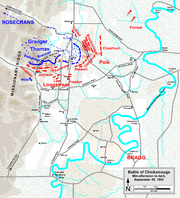
. At the Battle of Chickamauga
on September 19, 1863, now commanding the XIV Corps
, he once again held a desperate position against Bragg's onslaught while the Union line on his right collapsed. Thomas rallied broken and scattered units together on Horseshoe Ridge to prevent a significant Union defeat from becoming a hopeless rout. Future president James Garfield
, a field officer for the Army of the Cumberland, visited Thomas during the battle, carrying orders from Rosecrans to retreat; when Thomas said he would have to stay behind to ensure the Army's safety, Garfield told Rosecrans that Thomas was "standing like a rock." After the battle he became widely known by the nickname "The Rock of Chickamauga", representing his determination to hold a vital position against strong odds.
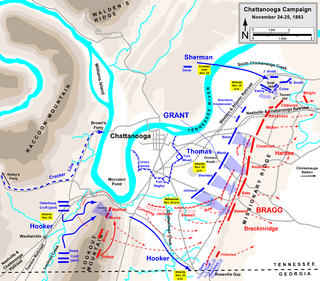 Thomas succeeded Rosecrans in command of the Army of the Cumberland
shortly before the Battles for Chattanooga
(November 23 – November 25, 1863), a stunning Union victory that was highlighted by Thomas's troops storming the Confederate line on Missionary Ridge
. As the Army of the Cumberland advanced further than ordered, General Grant, on Orchard Knob asked Thomas, "Who ordered the advance?" Thomas replied, "I don't know. I did not."
's advance through Georgia in the spring of 1864, the Army of the Cumberland numbered over 60,000 men, and Thomas's staff did the logistics and engineering for Sherman's entire army group, including developing a novel series of Cumberland pontoons
. At the Battle of Peachtree Creek
(July 20, 1864), Thomas's defense severely damaged Lt. Gen.
John B. Hood's army in its first attempt to break the siege of Atlanta.
When Hood broke away from Atlanta in the autumn of 1864, menaced Sherman's long line of communications, and endeavored to force Sherman to follow him, Sherman abandoned his communications and embarked on the March to the Sea
. Thomas stayed behind to fight Hood in the Franklin-Nashville Campaign
. Thomas, with a smaller force, raced with Hood to reach Nashville, where he was to receive reinforcements.
At the Battle of Franklin on November 30, 1864, a large part of Thomas's force, under command of Maj. Gen. John M. Schofield
, dealt Hood a strong defeat and held him in check long enough to cover the concentration of Union forces in Nashville. At Nashville, Thomas had to organize his forces, which had been drawn from all parts of the West and which included many young troops and even quartermaster employees. He declined to attack until his army was ready and the ice covering the ground had melted enough for his men to move. The North, including General Grant himself (now general-in-chief of all Union armies), grew impatient at the delay. Maj. Gen. John A. Logan
was sent with an order to replace Thomas, and soon afterwards Grant started a journey west from City Point, Virginia to take command in person.
Thomas attacked on December 15, 1864, in the Battle of Nashville
and effectively destroyed Hood's command in two days of fighting. Thomas sent his wife, Frances Lucretia Kellogg Thomas, the following telegram, the only communication surviving of the Thomases' correspondence: "We have whipped the enemy, taken many prisoners and considerable artillery."
Thomas was appointed a major general in the regular army, with date of rank of his Nashville victory, and received the Thanks of Congress
:
Thomas also received another nickname from his victory: "The Sledge of Nashville".
 After the end of the Civil War, Thomas commanded the Department of the Cumberland in Kentucky and Tennessee, and at times also West Virginia and parts of Georgia, Mississippi and Alabama, through 1869. During the Reconstruction period, Thomas acted to protect freedmen from white abuses. He set up military commissions to enforce labor contracts since the local courts had either ceased to operate or were biased against blacks. Thomas also used troops to protect places threatened by violence from the Ku Klux Klan
.
President
Andrew Johnson
offered Thomas the rank of lieutenant general
—with the intent to eventually replace Grant, a Republican and future president, with Thomas as general in chief—but the ever-loyal Thomas asked the Senate
to withdraw his name for that nomination because he did not want to be party to politics. In 1869 he requested assignment to command the Division of the Pacific with headquarters at the Presidio
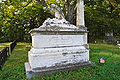
of San Francisco. He died there of a stroke while writing an answer to an article criticizing his military career by his wartime rival John Schofield. None of his blood relatives attended his funeral. He was buried in Oakwood Cemetery, in Troy, New York
. His gravestone was sculpted by Robert E. Launitz and comprises a white marble sarcophagus
topped by a bald eagle
.
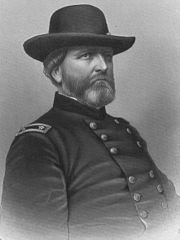 His cadets at West Point gave him the nickname of "Slow Trot Thomas", and this sobriquet was used to diminish his reputation. He moved slowly because of an injured back, but he was mentally anything but slow, only methodical. He was known for accurate judgment and thorough knowledge of his profession and once he grasped a problem and the time was right for action, he would strike a vigorous, rapid blow.
The veterans' organization for the Army of the Cumberland, throughout its existence, fought to see that he was honored for all he had done.
Thomas was in chief command of only two battles in the Civil War, the Battle of Mill Springs
at the beginning and the Battle of Nashville
near the end. Both were victories. However, his contributions at the battles of Stones River, Chickamauga, Chattanooga, and Peachtree Creek were decisive. His main legacies lay in his development of modern battlefield doctrine and in his mastery of logistics.
Thomas has generally been held in high esteem by Civil War historians; Bruce Catton
and Carl Sandburg
wrote glowingly of him, and many consider Thomas one of the top three Union generals of the war, after Grant and William Tecumseh Sherman
. But Thomas never entered the popular consciousness like those men. The general destroyed his private papers, saying he did not want "his life hawked in print for the eyes of the curious." Beginning in the 1870s, many Civil War generals published memoirs, justifying their decisions or refighting old battles, but Thomas, who died in 1870, did not publish his own memoirs. In addition, most of his campaigns were in the Western theater of the war, which received less attention both in the press of the day and in contemporary historical accounts.
Grant and Thomas also had a cool relationship, for reasons that are not entirely clear, but are well-attested by contemporaries. When a rain-soaked Grant arrived at Thomas's headquarters before the Chattanooga Campaign
, Thomas, caught up in other activity, did not acknowledge the general for several minutes until an aide intervened. Thomas's perceived slowness at Nashville—although necessitated by the weather—drove Grant into a fit of impatience, and Grant nearly replaced Thomas. In his Personal Memoirs, Grant tended to minimize Thomas's contributions, particularly during the Franklin-Nashville Campaign, saying his movements were "always so deliberate and so slow, though effective in defence."
Grant, however, also took painstaking care to praise Thomas's abilities. He openly and fully acknowledged in the event of Nashville that Thomas's success obviated all criticism. Sherman, who had been close to Thomas throughout the war, also repeated the accusation after the war that Thomas was "slow", and this damning with faint praise
tended to affect perceptions of the Rock of Chickamauga well into the 20th century. Both Sherman and Grant attended Thomas's funeral, and were reported by third parties to have been visibly moved by his passing. Thomas's legendary bay horse, Billy, bore his friend Sherman's name.
In 1877, Sherman published an article praising Grant and Thomas, and contrasting them to Robert E. Lee. After noting that, unlike Lee, his fellow Virginian, Thomas stood by the Union, Sherman wrote:Sherman concluded that Grant and Thomas were "heroes" deserving "monuments like those of Nelson and Wellington in London, well worthy to stand side by side with the one which now graces our capitol city of 'George Washington.'"
, Kentucky was named in his honor, and the city of Fort Thomas
now stands there and carries his name as well. A memorial honoring General Thomas can be found in the eponymous Thomas Circle
in downtown Washington, D.C.
A distinctive engraved portrait of Thomas appeared on U.S. paper money in 1890 and 1891. The bills are called "treasury notes
" or "coin notes" and are widely collected today because of their fine, detailed engraving. The $5 Thomas "fancyback" note of 1890, with an estimated 450-600 in existence relative to the 7.2 million printed, ranks as number 90 in the "100 Greatest American Currency Notes" compiled by Bowers and Sundman (2006).
Thomas County, Kansas
, established in 1888, is named in his honor. The townships of Thomas County are named after fallen soldiers in the Battle of Chickamauga.
In 1999 a statue of Thomas by sculptor Rudy Ayoroa was unveiled in Lebanon, Kentucky
.
United States Army
The United States Army is the main branch of the United States Armed Forces responsible for land-based military operations. It is the largest and oldest established branch of the U.S. military, and is one of seven U.S. uniformed services...
officer and a Union
Union Army
The Union Army was the land force that fought for the Union during the American Civil War. It was also known as the Federal Army, the U.S. Army, the Northern Army and the National Army...
General during the American Civil War
American Civil War
The American Civil War was a civil war fought in the United States of America. In response to the election of Abraham Lincoln as President of the United States, 11 southern slave states declared their secession from the United States and formed the Confederate States of America ; the other 25...
, one of the principal commanders in the Western Theater
Western Theater of the American Civil War
This article presents an overview of major military and naval operations in the Western Theater of the American Civil War.-Theater of operations:...
.
Thomas served in the Mexican-American War and later chose to remain with the United States Army
United States Army
The United States Army is the main branch of the United States Armed Forces responsible for land-based military operations. It is the largest and oldest established branch of the U.S. military, and is one of seven U.S. uniformed services...
for the Civil War, despite his heritage as a Virginia
Virginia
The Commonwealth of Virginia , is a U.S. state on the Atlantic Coast of the Southern United States. Virginia is nicknamed the "Old Dominion" and sometimes the "Mother of Presidents" after the eight U.S. presidents born there...
n. He won one of the first Union victories in the war, at Mill Springs
Battle of Mill Springs
The Battle of Mill Springs, also known as the Battle of Fishing Creek in Confederate terminology, and the Battle of Logan's Cross Roads in Union terminology, was fought in Wayne and Pulaski counties, near current Nancy, Kentucky, on January 19, 1862, as part of the American Civil War. It...
in Kentucky
Kentucky
The Commonwealth of Kentucky is a state located in the East Central United States of America. As classified by the United States Census Bureau, Kentucky is a Southern state, more specifically in the East South Central region. Kentucky is one of four U.S. states constituted as a commonwealth...
, and served in important subordinate commands at Perryville
Battle of Perryville
The Battle of Perryville, also known as the Battle of Chaplin Hills, was fought on October 8, 1862, in the Chaplin Hills west of Perryville, Kentucky, as the culmination of the Confederate Heartland Offensive during the American Civil War. Confederate Gen. Braxton Bragg's Army of Mississippi won a...
and Stones River
Battle of Stones River
The Battle of Stones River or Second Battle of Murfreesboro , was fought from December 31, 1862, to January 2, 1863, in Middle Tennessee, as the culmination of the Stones River Campaign in the Western Theater of the American Civil War...
. His stout defense at the Battle of Chickamauga
Battle of Chickamauga
The Battle of Chickamauga, fought September 19–20, 1863, marked the end of a Union offensive in southeastern Tennessee and northwestern Georgia called the Chickamauga Campaign...
in 1863 saved the Union Army from being completely routed, earning him his most famous nickname, the "Rock of Chickamauga." He followed soon after with a dramatic breakthrough on Missionary Ridge
Battle of Missionary Ridge
The Battle of Missionary Ridge was fought November 25, 1863, as part of the Chattanooga Campaign of the American Civil War. Following the Union victory in the Battle of Lookout Mountain on November 24, Union forces under Maj. Gen. Ulysses S. Grant assaulted Missionary Ridge and defeated the...
in the Battle of Chattanooga
Chattanooga Campaign
The Chattanooga Campaign was a series of maneuvers and battles in October and November 1863, during the American Civil War. Following the defeat of Maj. Gen. William S. Rosecrans's Union Army of the Cumberland at the Battle of Chickamauga in September, the Confederate Army of Tennessee under Gen...
. In the Franklin-Nashville Campaign
Franklin-Nashville Campaign
The Franklin-Nashville Campaign, also known as Hood's Tennessee Campaign, was a series of battles in the Western Theater, conducted from September 18 to December 27, 1864, in Alabama, Tennessee, and northwestern Georgia during the American Civil War. The Confederate Army of Tennessee under Lt....
of 1864, he achieved one of the most decisive victories of the war, destroying the army of Confederate
Confederate States Army
The Confederate States Army was the army of the Confederate States of America while the Confederacy existed during the American Civil War. On February 8, 1861, delegates from the seven Deep South states which had already declared their secession from the United States of America adopted the...
General John Bell Hood
John Bell Hood
John Bell Hood was a Confederate general during the American Civil War. Hood had a reputation for bravery and aggressiveness that sometimes bordered on recklessness...
, at the Battle of Nashville
Battle of Nashville
The Battle of Nashville was a two-day battle in the Franklin-Nashville Campaign that represented the end of large-scale fighting in the Western Theater of the American Civil War. It was fought at Nashville, Tennessee, on December 15–16, 1864, between the Confederate Army of Tennessee under...
.
Thomas had a successful record in the Civil War, but he failed to achieve the historical acclaim of some of his contemporaries, such as Ulysses S. Grant
Ulysses S. Grant
Ulysses S. Grant was the 18th President of the United States as well as military commander during the Civil War and post-war Reconstruction periods. Under Grant's command, the Union Army defeated the Confederate military and ended the Confederate States of America...
and William T. Sherman. He developed a reputation as a slow, deliberate general who shunned self-promotion and who turned down advancements in position when he did not think they were justified. After the war, he did not write memoirs to advance his legacy. He also had an uncomfortable personal relationship with Grant, which served him poorly as Grant advanced in rank and eventually to the presidency
President of the United States
The President of the United States of America is the head of state and head of government of the United States. The president leads the executive branch of the federal government and is the commander-in-chief of the United States Armed Forces....
.
Early life and military career
Thomas was born at Newsom's Depot, five miles (8 km) from North CarolinaNorth Carolina
North Carolina is a state located in the southeastern United States. The state borders South Carolina and Georgia to the south, Tennessee to the west and Virginia to the north. North Carolina contains 100 counties. Its capital is Raleigh, and its largest city is Charlotte...
, in Southampton County, Virginia
Southampton County, Virginia
As of the census of 2010, there were 18,570 people, 6,279 households, and 4,502 families residing in the county. The population density was 29 people per square mile . There were 7,058 housing units at an average density of 12 per square mile...
. His father, John Thomas, of Welsh
Welsh people
The Welsh people are an ethnic group and nation associated with Wales and the Welsh language.John Davies argues that the origin of the "Welsh nation" can be traced to the late 4th and early 5th centuries, following the Roman departure from Britain, although Brythonic Celtic languages seem to have...
descent, and his mother, Elizabeth Rochelle Thomas, a descendant of French Huguenot
Huguenot
The Huguenots were members of the Protestant Reformed Church of France during the 16th and 17th centuries. Since the 17th century, people who formerly would have been called Huguenots have instead simply been called French Protestants, a title suggested by their German co-religionists, the...
immigrants, had nine children. George was a middle child and the youngest of the three boys. The family led an upper-class plantation lifestyle. By 1829, they owned 685 acres (2.8 km²) and 24 slaves. John died in a farm accident when George was 13, leaving the family in financial difficulties. George Thomas, his sisters, and his widowed mother were forced to flee from their home and hide in the nearby woods during Nat Turner
Nat Turner
Nathaniel "Nat" Turner was an American slave who led a slave rebellion in Virginia on August 21, 1831 that resulted in 60 white deaths and at least 100 black deaths, the largest number of fatalities to occur in one uprising prior to the American Civil War in the southern United States. He gathered...
's 1831 slave rebellion. Benson Bobrick has suggested that while some repressive acts were enforced following the crushing of the revolt, Thomas took the lesson another way, seeing that slavery was so vile an institution that it had forced the slaves to act in violence. This was a major event in the formation of his views on slavery; that the idea of the contented slave in the care of a benevolent overlord was a sentimental myth. Christopher Einholf, in contrast wrote "For George Thomas, the view that slavery was needed as a way of controlling blacks was supported by his personal experience of Nat Turner's Rebellion. ... Thomas left no written record of his opinion on slavery, but the fact that he owned slaves during much of his life indicates that he was not opposed to it." A traditional story is that Thomas taught as many as 15 of his family's slaves to read, violating a Virginia law that prohibited this, and despite the wishes of his father.
Thomas was appointed to the United States Military Academy
United States Military Academy
The United States Military Academy at West Point is a four-year coeducational federal service academy located at West Point, New York. The academy sits on scenic high ground overlooking the Hudson River, north of New York City...
at West Point, New York
West Point, New York
West Point is a federal military reservation established by President of the United States Thomas Jefferson in 1802. It is a census-designated place located in Town of Highlands in Orange County, New York, United States. The population was 7,138 at the 2000 census...
, in 1836 by Congressman John Y. Mason
John Y. Mason
John Young Mason was an American politician, diplomat, and United States federal judge.-Early life, education, and career:...
, who warned Thomas that no nominee from his district had ever graduated successfully. Entering at age 20, Thomas was known to his fellow cadets as "Old Tom" and he became instant friends with his roommates, William T. Sherman and Stewart Van Vliet
Stewart Van Vliet
Stewart Leonard Van Vliet , was a United States Army officer who fought on the side of the Union during the American Civil War.-Early life:...
. He made steady academic progress, was appointed a cadet officer in his second year, and graduated 12th in a class of 42 in 1840. He was appointed a second lieutenant in Company D, 3rd U.S. Artillery.
Thomas's first assignment with his artillery regiment began in late 1840 at the primitive outpost of Fort Lauderdale, Florida
Fort Lauderdale, Florida
Fort Lauderdale is a city in the U.S. state of Florida, on the Atlantic coast. It is the county seat of Broward County. As of the 2010 census, the city had a population of 165,521. It is a principal city of the South Florida metropolitan area, which was home to 5,564,635 people at the 2010...
, in the Seminole Wars
Seminole Wars
The Seminole Wars, also known as the Florida Wars, were three conflicts in Florida between the Seminole — the collective name given to the amalgamation of various groups of native Americans and Black people who settled in Florida in the early 18th century — and the United States Army...
, where his troops performed infantry duty. He led them in successful patrols and was appointed a brevet
Brevet (military)
In many of the world's military establishments, brevet referred to a warrant authorizing a commissioned officer to hold a higher rank temporarily, but usually without receiving the pay of that higher rank except when actually serving in that role. An officer so promoted may be referred to as being...
first lieutenant on November 6, 1841. From 1842 until 1845, he served in posts at New Orleans, Fort Moultrie in Charleston Harbor
Charleston, South Carolina
Charleston is the second largest city in the U.S. state of South Carolina. It was made the county seat of Charleston County in 1901 when Charleston County was founded. The city's original name was Charles Towne in 1670, and it moved to its present location from a location on the west bank of the...
, and Fort McHenry
Fort McHenry
Fort McHenry, in Baltimore, Maryland, is a star-shaped fort best known for its role in the War of 1812, when it successfully defended Baltimore Harbor from an attack by the British navy in Chesapeake Bay...
in Baltimore
Baltimore
Baltimore is the largest independent city in the United States and the largest city and cultural center of the US state of Maryland. The city is located in central Maryland along the tidal portion of the Patapsco River, an arm of the Chesapeake Bay. Baltimore is sometimes referred to as Baltimore...
. With the Mexican-American War looming, his regiment was ordered to Texas in June 1845.
In Mexico, Thomas led a gun crew with distinction at the battles of Fort Brown
Siege of Fort Texas
The Siege of Fort Texas marked the beginning of active campaigning by the armies of the United States and Mexico during the Mexican-American War. The battle is sometimes called The Siege of Fort Brown, but this is not entirely accurate — the name Fort Brown was taken from Major Jacob Brown,...
, Resaca de la Palma
Battle of Resaca de la Palma
At the Battle of Resaca de la Palma, one of the early engagements of the Mexican-American War,United States General Zachary Taylor engaged the retreating forces of the Mexican Ejército del Norte under General Mariano Arista on May 9, 1846.-Background:During the night of May 8, following...
, Monterrey
Battle of Monterrey
In the Battle of Monterrey during the Mexican-American War, General Pedro de Ampudia and the Mexican Army of the North was defeated by U.S...
, and Buena Vista
Battle of Buena Vista
The Battle of Buena Vista , also known as the Battle of Angostura, saw the United States Army use artillery to repulse the much larger Mexican army in the Mexican-American War...
, receiving three brevet promotions. At Buena Vista, Gen. Zachary Taylor
Zachary Taylor
Zachary Taylor was the 12th President of the United States and an American military leader. Initially uninterested in politics, Taylor nonetheless ran as a Whig in the 1848 presidential election, defeating Lewis Cass...
reported that "the services of the light artillery, always conspicuous, were more than unusually distinguished" during the battle. Brig. Gen.
Brigadier general (United States)
A brigadier general in the United States Army, Air Force, and Marine Corps, is a one-star general officer, with the pay grade of O-7. Brigadier general ranks above a colonel and below major general. Brigadier general is equivalent to the rank of rear admiral in the other uniformed...
John E. Wool
John E. Wool
John Ellis Wool was an officer in the United States Army during three consecutive U.S. wars: the War of 1812, the Mexican-American War and the American Civil War. By the time of the Mexican-American War, he was widely considered one of the most capable officers in the army and a superb organizer...
wrote about Thomas and another officer that "without our artillery we would not have maintained our position a single hour." Thomas's battery commander wrote that Thomas's "coolness and firmness contributed not a little to the success of the day. Lieutenant Thomas more than sustained the reputation he has long enjoyed in his regiment as an accurate and scientific artillerist." During the war, Thomas served closely with an artillery officer who would be a principal antagonist in the Civil War—Captain Braxton Bragg
Braxton Bragg
Braxton Bragg was a career United States Army officer, and then a general in the Confederate States Army—a principal commander in the Western Theater of the American Civil War and later the military adviser to Confederate President Jefferson Davis.Bragg, a native of North Carolina, was...
.
Thomas was reassigned to Florida in 1849–50. In 1851, he returned to West Point as a cavalry and artillery instructor, where he established a close professional and personal relationship with another Virginia officer, Lt. Col.
Lieutenant Colonel (United States)
In the United States Army, United States Air Force, and United States Marine Corps, a lieutenant colonel is a field grade military officer rank just above the rank of major and just below the rank of colonel. It is equivalent to the naval rank of commander in the other uniformed services.The pay...
Robert E. Lee
Robert E. Lee
Robert Edward Lee was a career military officer who is best known for having commanded the Confederate Army of Northern Virginia in the American Civil War....
, the Academy superintendent. His appointment there was based in part on a recommendation from Braxton Bragg. Concerned about the poor condition of the Academy's elderly horses, Thomas moderated the tendency of cadets to overwork them during cavalry drills and became known as "Slow Trot Thomas". Two of Thomas's students who received his recommendation for assignment to the cavalry, J.E.B. Stuart
J.E.B. Stuart
James Ewell Brown "Jeb" Stuart was a U.S. Army officer from Virginia and a Confederate States Army general during the American Civil War. He was known to his friends as "Jeb", from the initials of his given names. Stuart was a cavalry commander known for his mastery of reconnaissance and the use...
and Fitzhugh Lee
Fitzhugh Lee
Fitzhugh Lee , nephew of Robert E. Lee, was a Confederate cavalry general in the American Civil War, the 40th Governor of Virginia, diplomat, and United States Army general in the Spanish-American War.-Early life:...
, became prominent Confederate cavalry generals. Another Civil War connection was a cadet expelled for disciplinary reasons on Thomas's recommendation, John Schofield
John Schofield
John McAllister Schofield was an American soldier who held major commands during the American Civil War. He later served as U.S. Secretary of War and Commanding General of the United States Army.-Early life:...
, who would excoriate Thomas in postbellum writings about his service as a corps commander under Thomas in the Franklin-Nashville Campaign
Franklin-Nashville Campaign
The Franklin-Nashville Campaign, also known as Hood's Tennessee Campaign, was a series of battles in the Western Theater, conducted from September 18 to December 27, 1864, in Alabama, Tennessee, and northwestern Georgia during the American Civil War. The Confederate Army of Tennessee under Lt....
. On November 17, 1852, Thomas married Frances Lucretia Kellogg, age 31, from Troy, New York
Troy, New York
Troy is a city in the US State of New York and the seat of Rensselaer County. Troy is located on the western edge of Rensselaer County and on the eastern bank of the Hudson River. Troy has close ties to the nearby cities of Albany and Schenectady, forming a region popularly called the Capital...
. The couple remained at West Point until 1854. Thomas was promoted to captain on December 24, 1853.
In the spring of 1854, Thomas's artillery regiment was transferred to California and he led two companies to San Francisco via the Isthmus of Panama
Isthmus of Panama
The Isthmus of Panama, also historically known as the Isthmus of Darien, is the narrow strip of land that lies between the Caribbean Sea and the Pacific Ocean, linking North and South America. It contains the country of Panama and the Panama Canal...
, and then on a grueling overland march to Fort Yuma
Fort Yuma
Fort Yuma is a fort in California that is located in Imperial County, across the Colorado River from Yuma, Arizona. It was on the Butterfield Overland Mail route from 1858 until 1861 and was abandoned May 16, 1883, and transferred to the Department of the Interior. The Fort Yuma Indian School and a...
. On May 12, 1855, Thomas was appointed a major
Major (United States)
In the United States Army, Air Force, and Marine Corps, major is a field grade military officer rank just above the rank of captain and just below the rank of lieutenant colonel...
of the 2nd U.S. Cavalry (later redesignated the 5th U.S. Cavalry) by Jefferson Davis
Jefferson Davis
Jefferson Finis Davis , also known as Jeff Davis, was an American statesman and leader of the Confederacy during the American Civil War, serving as President for its entire history. He was born in Kentucky to Samuel and Jane Davis...
, then Secretary of War
United States Secretary of War
The Secretary of War was a member of the United States President's Cabinet, beginning with George Washington's administration. A similar position, called either "Secretary at War" or "Secretary of War," was appointed to serve the Congress of the Confederation under the Articles of Confederation...
. Once again, Braxton Bragg had provided a recommendation for Thomas's advancement. There was a suspicion as the Civil War drew closer that Davis had been assembling and training a combat unit of elite U.S. Army officers who harbored Southern sympathies, and Thomas's appointment to this regiment implied his colleagues assumed that he would support his native state of Virginia in a future conflict. Thomas resumed his close ties with the second-in-command of the regiment, Robert E. Lee, and the two officers traveled extensively together on detached service for court-martial duty. In October 1857, Major Thomas assumed acting command of the cavalry regiment, an assignment he would retain for 2½ years. On August 26, 1860, during a clash with a Comanche
Comanche
The Comanche are a Native American ethnic group whose historic range consisted of present-day eastern New Mexico, southern Colorado, northeastern Arizona, southern Kansas, all of Oklahoma, and most of northwest Texas. Historically, the Comanches were hunter-gatherers, with a typical Plains Indian...
warrior, Thomas was wounded by an arrow passing through the flesh near his chin area and sticking into his chest at Clear Fork, Brazos River
Brazos River
The Brazos River, called the Rio de los Brazos de Dios by early Spanish explorers , is the longest river in Texas and the 11th longest river in the United States at from its source at the head of Blackwater Draw, Curry County, New Mexico to its mouth at the Gulf of Mexico with a drainage...
, Texas
Texas
Texas is the second largest U.S. state by both area and population, and the largest state by area in the contiguous United States.The name, based on the Caddo word "Tejas" meaning "friends" or "allies", was applied by the Spanish to the Caddo themselves and to the region of their settlement in...
. Thomas pulled the arrow out and, after a surgeon dressed the wound, continued to lead the expedition. This was the only combat wound that Thomas suffered throughout his long military career.
In November 1860, Thomas requested a one-year leave of absence. His antebellum career had been distinguished and productive, and he was one of the rare officers with field experience in all three combat arms—infantry, cavalry, and artillery. On his way home to southern Virginia, he suffered a mishap in Lynchburg, Virginia
Lynchburg, Virginia
Lynchburg is an independent city in the Commonwealth of Virginia. The population was 75,568 as of 2010. Located in the foothills of the Blue Ridge Mountains along the banks of the James River, Lynchburg is known as the "City of Seven Hills" or "The Hill City." Lynchburg was the only major city in...
, falling from a train platform and severely injuring his back. This accident led him to contemplate leaving military service and caused him pain for the rest of his life. Continuing to New York to visit with his wife's family, Thomas stopped in Washington, D.C.
Washington, D.C.
Washington, D.C., formally the District of Columbia and commonly referred to as Washington, "the District", or simply D.C., is the capital of the United States. On July 16, 1790, the United States Congress approved the creation of a permanent national capital as permitted by the U.S. Constitution....
, and conferred with general-in-chief Winfield Scott
Winfield Scott
Winfield Scott was a United States Army general, and unsuccessful presidential candidate of the Whig Party in 1852....
, advising Scott that Maj. Gen. David E. Twiggs
David E. Twiggs
David Emanuel Twiggs was a United States soldier during the War of 1812 and Mexican-American War and a general of the Confederate States Army during the American Civil War...
, the commander of the Department of Texas, harbored secession
Secession
Secession is the act of withdrawing from an organization, union, or especially a political entity. Threats of secession also can be a strategy for achieving more limited goals.-Secession theory:...
ist sympathies and could not be trusted in his post.
Remaining with the Union
At the outbreak of the Civil War, 19 of the 36 officers in the 2nd U.S. Cavalry resigned, including three of Thomas's superiors—Albert Sidney JohnstonAlbert Sidney Johnston
Albert Sidney Johnston served as a general in three different armies: the Texas Army, the United States Army, and the Confederate States Army...
, Robert E. Lee
Robert E. Lee
Robert Edward Lee was a career military officer who is best known for having commanded the Confederate Army of Northern Virginia in the American Civil War....
, and William J. Hardee
William J. Hardee
William Joseph Hardee was a career U.S. Army officer, serving during the Second Seminole War and fighting in the Mexican-American War...
. Many Southern-born
Southern United States
The Southern United States—commonly referred to as the American South, Dixie, or simply the South—constitutes a large distinctive area in the southeastern and south-central United States...
officers were torn between loyalty to their states and loyalty to their country. Thomas struggled with the decision but opted to remain with the United States. His Northern-born wife probably helped influence his decision. In response, his family turned his picture against the wall, destroyed his letters, and never spoke to him again. (During the economic hard times in the South after the war, Thomas sent some money to his sisters, who angrily refused to accept it, declaring they had no brother.)
Nevertheless, Thomas stayed in the Union Army with some degree of suspicion surrounding him. On January 18, 1861, a few months before Fort Sumter
Battle of Fort Sumter
The Battle of Fort Sumter was the bombardment and surrender of Fort Sumter, near Charleston, South Carolina, that started the American Civil War. Following declarations of secession by seven Southern states, South Carolina demanded that the U.S. Army abandon its facilities in Charleston Harbor. On...
, he had applied for a job as the commandant of cadets at the Virginia Military Institute
Virginia Military Institute
The Virginia Military Institute , located in Lexington, Virginia, is the oldest state-supported military college and one of six senior military colleges in the United States. Unlike any other military college in the United States—and in keeping with its founding principles—all VMI students are...
. Any real tendency to the secessionist cause, however, could be refuted when he turned down Virginia Governor John Letcher
John Letcher
John Letcher was an American lawyer, journalist, and politician. He served as a Representative in the United States Congress, was the 34th Governor of Virginia during the American Civil War, and later served in the Virginia General Assembly...
's offer to become chief of ordnance for the Virginia Provisional Army. On June 18, his former student and fellow Virginian, Confederate Col. J.E.B. Stuart
J.E.B. Stuart
James Ewell Brown "Jeb" Stuart was a U.S. Army officer from Virginia and a Confederate States Army general during the American Civil War. He was known to his friends as "Jeb", from the initials of his given names. Stuart was a cavalry commander known for his mastery of reconnaissance and the use...
, wrote to his wife, "Old George H. Thomas is in command of the cavalry of the enemy. I would like to hang, hang him as a traitor to his native state."
Kentucky
Thomas was promoted in rapid succession to be lieutenant colonelLieutenant Colonel (United States)
In the United States Army, United States Air Force, and United States Marine Corps, a lieutenant colonel is a field grade military officer rank just above the rank of major and just below the rank of colonel. It is equivalent to the naval rank of commander in the other uniformed services.The pay...
(on April 25, 1861, replacing Robert E. Lee) and colonel
Colonel (United States)
In the United States Army, Air Force, and Marine Corps, colonel is a senior field grade military officer rank just above the rank of lieutenant colonel and just below the rank of brigadier general...
(May 3, replacing Albert Sidney Johnston) in the regular army, and brigadier general
Brigadier general (United States)
A brigadier general in the United States Army, Air Force, and Marine Corps, is a one-star general officer, with the pay grade of O-7. Brigadier general ranks above a colonel and below major general. Brigadier general is equivalent to the rank of rear admiral in the other uniformed...
of volunteers (August 17). In the First Bull Run Campaign
First Battle of Bull Run
First Battle of Bull Run, also known as First Manassas , was fought on July 21, 1861, in Prince William County, Virginia, near the City of Manassas...
, he commanded a brigade under Maj. Gen.
Major general (United States)
In the United States Army, United States Marine Corps, and United States Air Force, major general is a two-star general-officer rank, with the pay grade of O-8. Major general ranks above brigadier general and below lieutenant general...
Robert Patterson
Robert Patterson
Robert Patterson was a United States major general during the Mexican-American War and at the beginning of the American Civil War...
in the Shenandoah Valley
Shenandoah Valley
The Shenandoah Valley is both a geographic valley and cultural region of western Virginia and West Virginia in the United States. The valley is bounded to the east by the Blue Ridge Mountains, to the west by the eastern front of the Ridge-and-Valley Appalachians , to the north by the Potomac River...
, but all of his subsequent assignments were in the Western Theater. Reporting to Maj. Gen. Robert Anderson in Kentucky
Kentucky
The Commonwealth of Kentucky is a state located in the East Central United States of America. As classified by the United States Census Bureau, Kentucky is a Southern state, more specifically in the East South Central region. Kentucky is one of four U.S. states constituted as a commonwealth...
, Thomas was assigned to training recruits and to command an independent force in the eastern half of the state. On January 18, 1862, he defeated Confederate Brig. Gens. George B. Crittenden
George B. Crittenden
George Bibb Crittenden was a career United States Army officer who served in the Black Hawk War, the Army of the Republic of Texas, the Mexican-American War, and was a general in the Confederate States Army in the American Civil War.-Early life:Crittenden was born in Russellville, Kentucky, his...
and Felix Zollicoffer
Felix Zollicoffer
Felix Kirk Zollicoffer was a newspaperman, three-term United States Congressman from Tennessee, officer in the United States Army, and a Confederate brigadier general during the American Civil War...
at Mill Springs
Battle of Mill Springs
The Battle of Mill Springs, also known as the Battle of Fishing Creek in Confederate terminology, and the Battle of Logan's Cross Roads in Union terminology, was fought in Wayne and Pulaski counties, near current Nancy, Kentucky, on January 19, 1862, as part of the American Civil War. It...
, gaining the first important Union victory in the war, breaking Confederate strength in eastern Kentucky, and lifting Union morale.
Shiloh and Corinth
On December 2, 1861, Brig. Gen. Thomas was assigned to command the 1st Division of Maj. Gen. Don Carlos BuellDon Carlos Buell
Don Carlos Buell was a career United States Army officer who fought in the Seminole War, the Mexican-American War, and the American Civil War. Buell led Union armies in two great Civil War battles—Shiloh and Perryville. The nation was angry at his failure to defeat the outnumbered...
's Army of the Ohio
Army of the Ohio
The Army of the Ohio was the name of two Union armies in the American Civil War. The first army became the Army of the Cumberland and the second army was created in 1863.-History:...
. He was present at the second day of the Battle of Shiloh
Battle of Shiloh
The Battle of Shiloh, also known as the Battle of Pittsburg Landing, was a major battle in the Western Theater of the American Civil War, fought April 6–7, 1862, in southwestern Tennessee. A Union army under Maj. Gen. Ulysses S. Grant had moved via the Tennessee River deep into Tennessee and...
(April 7, 1862), but arrived after the fighting had ceased. The victor at Shiloh, Maj. Gen. Ulysses S. Grant
Ulysses S. Grant
Ulysses S. Grant was the 18th President of the United States as well as military commander during the Civil War and post-war Reconstruction periods. Under Grant's command, the Union Army defeated the Confederate military and ended the Confederate States of America...
, came under severe criticism for the bloody battle and his superior, Maj. Gen. Henry W. Halleck, reorganized his Department of the Mississippi to ease Grant out of direct field command. The three armies in the department were divided and recombined into three "wings". Thomas, promoted to major general effective April 25, 1862, was given command of the Right Wing, consisting of four divisions from Grant's former Army of the Tennessee
Army of the Tennessee
The Army of the Tennessee was a Union army in the Western Theater of the American Civil War, named for the Tennessee River. It should not be confused with the similarly named Army of Tennessee, a Confederate army named after the State of Tennessee....
and one from the Army of the Ohio. Thomas successfully led this putative army in the siege of Corinth. On June 10, Grant returned to command of the original Army of the Tennessee.
Perryville, Stones River, Chickamauga, and Chattanooga
Don Carlos Buell
Don Carlos Buell was a career United States Army officer who fought in the Seminole War, the Mexican-American War, and the American Civil War. Buell led Union armies in two great Civil War battles—Shiloh and Perryville. The nation was angry at his failure to defeat the outnumbered...
. During Confederate General Braxton Bragg
Braxton Bragg
Braxton Bragg was a career United States Army officer, and then a general in the Confederate States Army—a principal commander in the Western Theater of the American Civil War and later the military adviser to Confederate President Jefferson Davis.Bragg, a native of North Carolina, was...
's invasion of Kentucky in the fall of 1862, the Union high command became nervous about Buell's cautious tendencies and offered command of the Army of the Ohio to Thomas, who refused. Thomas served as Buell's second-in-command at the Battle of Perryville
Battle of Perryville
The Battle of Perryville, also known as the Battle of Chaplin Hills, was fought on October 8, 1862, in the Chaplin Hills west of Perryville, Kentucky, as the culmination of the Confederate Heartland Offensive during the American Civil War. Confederate Gen. Braxton Bragg's Army of Mississippi won a...
; although tactically inconclusive, the battle halted Bragg's invasion of Kentucky as he voluntarily withdrew to Tennessee. Again frustrated with Buell's ineffective pursuit of Bragg, the Union replaced him with Maj. Gen. William Rosecrans
William Rosecrans
William Starke Rosecrans was an inventor, coal-oil company executive, diplomat, politician, and United States Army officer. He gained fame for his role as a Union general during the American Civil War...
.
Fighting under Rosecrans, commanding the "Center"
Stones River Union order of battle
The following Union Army units and commanders fought in the Battle of Stones River of the American Civil War. The Confederate order of battle is listed separately...
wing of the newly renamed Army of the Cumberland
Army of the Cumberland
The Army of the Cumberland was one of the principal Union armies in the Western Theater during the American Civil War. It was originally known as the Army of the Ohio.-History:...
, Thomas gave an impressive performance at the Battle of Stones River
Battle of Stones River
The Battle of Stones River or Second Battle of Murfreesboro , was fought from December 31, 1862, to January 2, 1863, in Middle Tennessee, as the culmination of the Stones River Campaign in the Western Theater of the American Civil War...
, holding the center of the retreating Union line and once again preventing a victory by Bragg. He was in charge of the most important part of the maneuvering from Decherd
Decherd, Tennessee
Decherd is a city in Franklin County, Tennessee, United States. The population was 2,246 at the 2000 census. It is part of the Tullahoma, Tennessee Micropolitan Statistical Area.-History:...
to Chattanooga
Chattanooga, Tennessee
Chattanooga is the fourth-largest city in the US state of Tennessee , with a population of 169,887. It is the seat of Hamilton County...
during the Tullahoma Campaign
Tullahoma Campaign
The Tullahoma Campaign or Middle Tennessee Campaign was fought between June 24 and July 3, 1863, during the American Civil War. The Union Army of the Cumberland, commanded by Maj. Gen. William S...
(June 22 – July 3, 1863) and the crossing of the Tennessee River
Tennessee River
The Tennessee River is the largest tributary of the Ohio River. It is approximately 652 miles long and is located in the southeastern United States in the Tennessee Valley. The river was once popularly known as the Cherokee River, among other names...
. At the Battle of Chickamauga
Battle of Chickamauga
The Battle of Chickamauga, fought September 19–20, 1863, marked the end of a Union offensive in southeastern Tennessee and northwestern Georgia called the Chickamauga Campaign...
on September 19, 1863, now commanding the XIV Corps
XIV Corps (ACW)
XIV Corps was a corps of the Union Army during the American Civil War. It was one of the earliest corps formations in the Western Theater of the American Civil War.-Creation:...
, he once again held a desperate position against Bragg's onslaught while the Union line on his right collapsed. Thomas rallied broken and scattered units together on Horseshoe Ridge to prevent a significant Union defeat from becoming a hopeless rout. Future president James Garfield
James Garfield
James Abram Garfield served as the 20th President of the United States, after completing nine consecutive terms in the U.S. House of Representatives. Garfield's accomplishments as President included a controversial resurgence of Presidential authority above Senatorial courtesy in executive...
, a field officer for the Army of the Cumberland, visited Thomas during the battle, carrying orders from Rosecrans to retreat; when Thomas said he would have to stay behind to ensure the Army's safety, Garfield told Rosecrans that Thomas was "standing like a rock." After the battle he became widely known by the nickname "The Rock of Chickamauga", representing his determination to hold a vital position against strong odds.
Army of the Cumberland
The Army of the Cumberland was one of the principal Union armies in the Western Theater during the American Civil War. It was originally known as the Army of the Ohio.-History:...
shortly before the Battles for Chattanooga
Chattanooga Campaign
The Chattanooga Campaign was a series of maneuvers and battles in October and November 1863, during the American Civil War. Following the defeat of Maj. Gen. William S. Rosecrans's Union Army of the Cumberland at the Battle of Chickamauga in September, the Confederate Army of Tennessee under Gen...
(November 23 – November 25, 1863), a stunning Union victory that was highlighted by Thomas's troops storming the Confederate line on Missionary Ridge
Battle of Missionary Ridge
The Battle of Missionary Ridge was fought November 25, 1863, as part of the Chattanooga Campaign of the American Civil War. Following the Union victory in the Battle of Lookout Mountain on November 24, Union forces under Maj. Gen. Ulysses S. Grant assaulted Missionary Ridge and defeated the...
. As the Army of the Cumberland advanced further than ordered, General Grant, on Orchard Knob asked Thomas, "Who ordered the advance?" Thomas replied, "I don't know. I did not."
Atlanta and Franklin/Nashville
During Maj. Gen. William Tecumseh ShermanWilliam Tecumseh Sherman
William Tecumseh Sherman was an American soldier, businessman, educator and author. He served as a General in the Union Army during the American Civil War , for which he received recognition for his outstanding command of military strategy as well as criticism for the harshness of the "scorched...
's advance through Georgia in the spring of 1864, the Army of the Cumberland numbered over 60,000 men, and Thomas's staff did the logistics and engineering for Sherman's entire army group, including developing a novel series of Cumberland pontoons
Cumberland Pontoons
Cumberland pontoons were a novel design of pontoon bridges developed during the American Civil War to facilitate the movement of Union forces across the rivers of the Mid-South as the Federal forces advanced southward through Tennessee and Georgia....
. At the Battle of Peachtree Creek
Battle of Peachtree Creek
The Battle of Peachtree Creek was fought in Georgia on July 20, 1864, as part of the Atlanta Campaign in the American Civil War. It was the first major attack by Lt. Gen. John B. Hood since taking command of the Confederate Army of Tennessee. The attack was against Maj. Gen. William T. Sherman's...
(July 20, 1864), Thomas's defense severely damaged Lt. Gen.
Lieutenant General (United States)
In the United States Army, the United States Air Force and the United States Marine Corps, lieutenant general is a three-star general officer rank, with the pay grade of O-9. Lieutenant general ranks above major general and below general...
John B. Hood's army in its first attempt to break the siege of Atlanta.
When Hood broke away from Atlanta in the autumn of 1864, menaced Sherman's long line of communications, and endeavored to force Sherman to follow him, Sherman abandoned his communications and embarked on the March to the Sea
Sherman's March to the Sea
Sherman's March to the Sea is the name commonly given to the Savannah Campaign conducted around Georgia from November 15, 1864 to December 21, 1864 by Maj. Gen. William Tecumseh Sherman of the Union Army in the American Civil War...
. Thomas stayed behind to fight Hood in the Franklin-Nashville Campaign
Franklin-Nashville Campaign
The Franklin-Nashville Campaign, also known as Hood's Tennessee Campaign, was a series of battles in the Western Theater, conducted from September 18 to December 27, 1864, in Alabama, Tennessee, and northwestern Georgia during the American Civil War. The Confederate Army of Tennessee under Lt....
. Thomas, with a smaller force, raced with Hood to reach Nashville, where he was to receive reinforcements.
At the Battle of Franklin on November 30, 1864, a large part of Thomas's force, under command of Maj. Gen. John M. Schofield
John Schofield
John McAllister Schofield was an American soldier who held major commands during the American Civil War. He later served as U.S. Secretary of War and Commanding General of the United States Army.-Early life:...
, dealt Hood a strong defeat and held him in check long enough to cover the concentration of Union forces in Nashville. At Nashville, Thomas had to organize his forces, which had been drawn from all parts of the West and which included many young troops and even quartermaster employees. He declined to attack until his army was ready and the ice covering the ground had melted enough for his men to move. The North, including General Grant himself (now general-in-chief of all Union armies), grew impatient at the delay. Maj. Gen. John A. Logan
John A. Logan
John Alexander Logan was an American soldier and political leader. He served in the Mexican-American War and was a general in the Union Army in the American Civil War. He served the state of Illinois as a state senator, congressman and senator and was an unsuccessful candidate for Vice President...
was sent with an order to replace Thomas, and soon afterwards Grant started a journey west from City Point, Virginia to take command in person.
Thomas attacked on December 15, 1864, in the Battle of Nashville
Battle of Nashville
The Battle of Nashville was a two-day battle in the Franklin-Nashville Campaign that represented the end of large-scale fighting in the Western Theater of the American Civil War. It was fought at Nashville, Tennessee, on December 15–16, 1864, between the Confederate Army of Tennessee under...
and effectively destroyed Hood's command in two days of fighting. Thomas sent his wife, Frances Lucretia Kellogg Thomas, the following telegram, the only communication surviving of the Thomases' correspondence: "We have whipped the enemy, taken many prisoners and considerable artillery."
Thomas was appointed a major general in the regular army, with date of rank of his Nashville victory, and received the Thanks of Congress
Thanks of Congress
The Thanks of Congress are a series of formal resolutions passed by the United States Congress originally to extend the government's formal thanks for significant victories or impressive actions by American military commanders and their troops. Although it began during the American Revolutionary...
:
Thomas also received another nickname from his victory: "The Sledge of Nashville".
Later years
Ku Klux Klan
Ku Klux Klan, often abbreviated KKK and informally known as the Klan, is the name of three distinct past and present far-right organizations in the United States, which have advocated extremist reactionary currents such as white supremacy, white nationalism, and anti-immigration, historically...
.
President
President of the United States
The President of the United States of America is the head of state and head of government of the United States. The president leads the executive branch of the federal government and is the commander-in-chief of the United States Armed Forces....
Andrew Johnson
Andrew Johnson
Andrew Johnson was the 17th President of the United States . As Vice-President of the United States in 1865, he succeeded Abraham Lincoln following the latter's assassination. Johnson then presided over the initial and contentious Reconstruction era of the United States following the American...
offered Thomas the rank of lieutenant general
Lieutenant General (United States)
In the United States Army, the United States Air Force and the United States Marine Corps, lieutenant general is a three-star general officer rank, with the pay grade of O-9. Lieutenant general ranks above major general and below general...
—with the intent to eventually replace Grant, a Republican and future president, with Thomas as general in chief—but the ever-loyal Thomas asked the Senate
United States Senate
The United States Senate is the upper house of the bicameral legislature of the United States, and together with the United States House of Representatives comprises the United States Congress. The composition and powers of the Senate are established in Article One of the U.S. Constitution. Each...
to withdraw his name for that nomination because he did not want to be party to politics. In 1869 he requested assignment to command the Division of the Pacific with headquarters at the Presidio
Presidio of San Francisco
The Presidio of San Francisco is a park on the northern tip of the San Francisco Peninsula in San Francisco, California, within the Golden Gate National Recreation Area...
of San Francisco. He died there of a stroke while writing an answer to an article criticizing his military career by his wartime rival John Schofield. None of his blood relatives attended his funeral. He was buried in Oakwood Cemetery, in Troy, New York
Troy, New York
Troy is a city in the US State of New York and the seat of Rensselaer County. Troy is located on the western edge of Rensselaer County and on the eastern bank of the Hudson River. Troy has close ties to the nearby cities of Albany and Schenectady, forming a region popularly called the Capital...
. His gravestone was sculpted by Robert E. Launitz and comprises a white marble sarcophagus
Sarcophagus
A sarcophagus is a funeral receptacle for a corpse, most commonly carved or cut from stone. The word "sarcophagus" comes from the Greek σαρξ sarx meaning "flesh", and φαγειν phagein meaning "to eat", hence sarkophagus means "flesh-eating"; from the phrase lithos sarkophagos...
topped by a bald eagle
Bald Eagle
The Bald Eagle is a bird of prey found in North America. It is the national bird and symbol of the United States of America. This sea eagle has two known sub-species and forms a species pair with the White-tailed Eagle...
.
Thomas's legacy
The veterans' organization for the Army of the Cumberland, throughout its existence, fought to see that he was honored for all he had done.
Thomas was in chief command of only two battles in the Civil War, the Battle of Mill Springs
Battle of Mill Springs
The Battle of Mill Springs, also known as the Battle of Fishing Creek in Confederate terminology, and the Battle of Logan's Cross Roads in Union terminology, was fought in Wayne and Pulaski counties, near current Nancy, Kentucky, on January 19, 1862, as part of the American Civil War. It...
at the beginning and the Battle of Nashville
Battle of Nashville
The Battle of Nashville was a two-day battle in the Franklin-Nashville Campaign that represented the end of large-scale fighting in the Western Theater of the American Civil War. It was fought at Nashville, Tennessee, on December 15–16, 1864, between the Confederate Army of Tennessee under...
near the end. Both were victories. However, his contributions at the battles of Stones River, Chickamauga, Chattanooga, and Peachtree Creek were decisive. His main legacies lay in his development of modern battlefield doctrine and in his mastery of logistics.
Thomas has generally been held in high esteem by Civil War historians; Bruce Catton
Bruce Catton
Charles Bruce Catton was an American historian and journalist, best known for his books on the American Civil War. Known as a narrative historian, Catton specialized in popular histories that emphasized colorful characters and historical vignettes, in addition to the basic facts, dates, and analyses...
and Carl Sandburg
Carl Sandburg
Carl Sandburg was an American writer and editor, best known for his poetry. He won three Pulitzer Prizes, two for his poetry and another for a biography of Abraham Lincoln. H. L. Mencken called Carl Sandburg "indubitably an American in every pulse-beat."-Biography:Sandburg was born in Galesburg,...
wrote glowingly of him, and many consider Thomas one of the top three Union generals of the war, after Grant and William Tecumseh Sherman
William Tecumseh Sherman
William Tecumseh Sherman was an American soldier, businessman, educator and author. He served as a General in the Union Army during the American Civil War , for which he received recognition for his outstanding command of military strategy as well as criticism for the harshness of the "scorched...
. But Thomas never entered the popular consciousness like those men. The general destroyed his private papers, saying he did not want "his life hawked in print for the eyes of the curious." Beginning in the 1870s, many Civil War generals published memoirs, justifying their decisions or refighting old battles, but Thomas, who died in 1870, did not publish his own memoirs. In addition, most of his campaigns were in the Western theater of the war, which received less attention both in the press of the day and in contemporary historical accounts.
Grant and Thomas also had a cool relationship, for reasons that are not entirely clear, but are well-attested by contemporaries. When a rain-soaked Grant arrived at Thomas's headquarters before the Chattanooga Campaign
Chattanooga Campaign
The Chattanooga Campaign was a series of maneuvers and battles in October and November 1863, during the American Civil War. Following the defeat of Maj. Gen. William S. Rosecrans's Union Army of the Cumberland at the Battle of Chickamauga in September, the Confederate Army of Tennessee under Gen...
, Thomas, caught up in other activity, did not acknowledge the general for several minutes until an aide intervened. Thomas's perceived slowness at Nashville—although necessitated by the weather—drove Grant into a fit of impatience, and Grant nearly replaced Thomas. In his Personal Memoirs, Grant tended to minimize Thomas's contributions, particularly during the Franklin-Nashville Campaign, saying his movements were "always so deliberate and so slow, though effective in defence."
Grant, however, also took painstaking care to praise Thomas's abilities. He openly and fully acknowledged in the event of Nashville that Thomas's success obviated all criticism. Sherman, who had been close to Thomas throughout the war, also repeated the accusation after the war that Thomas was "slow", and this damning with faint praise
Damn with faint praise
Damn with faint praise is an English idiom for words that effectively condemn by seeming to offer praise which is too moderate or marginal to be considered praise at all...
tended to affect perceptions of the Rock of Chickamauga well into the 20th century. Both Sherman and Grant attended Thomas's funeral, and were reported by third parties to have been visibly moved by his passing. Thomas's legendary bay horse, Billy, bore his friend Sherman's name.
In 1877, Sherman published an article praising Grant and Thomas, and contrasting them to Robert E. Lee. After noting that, unlike Lee, his fellow Virginian, Thomas stood by the Union, Sherman wrote:Sherman concluded that Grant and Thomas were "heroes" deserving "monuments like those of Nelson and Wellington in London, well worthy to stand side by side with the one which now graces our capitol city of 'George Washington.'"
In memoriam
A fort south of NewportNewport, Kentucky
Newport is a city in Campbell County, Kentucky, United States, at the confluence of the Ohio and Licking rivers. The population was 15,273 at the 2010 census. Historically, it was one of four county seats of Campbell County. Newport is part of the Greater Cincinnati, Ohio Metro Area which...
, Kentucky was named in his honor, and the city of Fort Thomas
Fort Thomas, Kentucky
Fort Thomas is a city in Campbell County, Kentucky, on the southern bank of the Ohio River and the site of an 1890 US Army post. The population was 16,325 at the 2010 census, making it the largest city in Campbell County and it is officially part of the Cincinnati – Northern Kentucky metropolitan...
now stands there and carries his name as well. A memorial honoring General Thomas can be found in the eponymous Thomas Circle
Thomas Circle
Thomas Circle is a traffic circle in Northwest Washington, D.C., United States at the junction of Massachusetts Avenue, Vermont Avenue, 14th Street, and M Street, N.W.The through lanes of Massachusetts Avenue pass under Thomas Circle...
in downtown Washington, D.C.
Washington, D.C.
Washington, D.C., formally the District of Columbia and commonly referred to as Washington, "the District", or simply D.C., is the capital of the United States. On July 16, 1790, the United States Congress approved the creation of a permanent national capital as permitted by the U.S. Constitution....
A distinctive engraved portrait of Thomas appeared on U.S. paper money in 1890 and 1891. The bills are called "treasury notes
Treasury (Coin) Note
Fractional currency notes were issued by the United States Federal Government during and after the U.S. Civil War due to the hoarding and shortage of coins in gold, silver and copper in denominations of 3, 5, 10, 15, 25 and 50 cents. These notes were in use until 1876 and were redeemable by the...
" or "coin notes" and are widely collected today because of their fine, detailed engraving. The $5 Thomas "fancyback" note of 1890, with an estimated 450-600 in existence relative to the 7.2 million printed, ranks as number 90 in the "100 Greatest American Currency Notes" compiled by Bowers and Sundman (2006).
Thomas County, Kansas
Thomas County, Kansas
Thomas County is a county located in the U.S. state of Kansas. As of the 2010 census, the county population was 7,900...
, established in 1888, is named in his honor. The townships of Thomas County are named after fallen soldiers in the Battle of Chickamauga.
In 1999 a statue of Thomas by sculptor Rudy Ayoroa was unveiled in Lebanon, Kentucky
Lebanon, Kentucky
Lebanon is a city in Marion County, Kentucky, United States. The population was 6,331 at the 2010 census. It is the county seat of Marion County. Lebanon is located in central Kentucky, southeast of Louisville. A national cemetery is located nearby....
.
See also
- List of American Civil War generals
Further reading
- Cimprich, John. "A Critical Moment and Its Aftermath for George H. Thomas." in The Moment of Decision: Biographical Essays on American Character and Regional Identity. Randall M. Miller and John R. McKivigan, editors. Westport: Greenwood Press, 1994.
- Downing, David C. A South Divided: Portraits of Dissent in the Confederacy. Nashville, TN: Cumberland House, 2007. ISBN 978-1-58182-587-9.
- Johnson, Richard W. Memoir of Maj-Gen George H. Thomas. Philadelphia: J.B. Lippincott and Co., 1881. .
- McKinney, Francis F. Education in Violence: The Life of George H. Thomas and the History of the Army of the Cumberland. Chicago: Americana House, 1991. ISBN 0-9625290-5-2.
- Palumbo, Frank A. George Henry Thomas, Major General, U.S.A.: The Dependable General, Supreme in Tactics of Strategy and Command. Dayton, OH: Morningside Bookshop, 1983. ISBN 0-89029-311-2.
- Thomas, Wilbur D. General George H. Thomas: The Indomitable Warrior. New York: Exposition Press, 1964. .
- Van Horne, Thomas B. The Army of the Cumberland: Its Organizations, Campaigns, and Battles. New York: Smithmark Publishers, 1996. ISBN 0-8317-5621-7. First published 1885 by Robert Clarke & Co.