


Gaung Paung

Encyclopedia
Turban
In English, Turban refers to several types of headwear popularly worn in the Middle East, North Africa, Punjab, Jamaica and Southwest Asia. A commonly used synonym is Pagri, the Indian word for turban.-Styles:...
and part of the traditional attire of many ethnic groups inhabiting modern day Burma, particularly among most of the Buddhist-professing ethnic groups: the Bamar
Bamar
The Bamar are the dominant ethnic group of Burma , constituting approximately two-thirds of the population. The Bamar live primarily in the Irrawaddy basin, and speak the Burmese language, which is also the official language of Burma. Bamar customs and identity are closely intertwined with general...
, Mon
Mon people
The Mon are an ethnic group from Burma , living mostly in Mon State, Bago Division, the Irrawaddy Delta, and along the southern Thai–Burmese border. One of the earliest peoples to reside in Southeast Asia, the Mon were responsible for the spread of Theravada Buddhism in Burma and Thailand...
, Rakhine
Rakhine people
The Rakhine , is a nationality in Myanmar forming the majority along the coastal region of present day Rakhine State or Arakan State. They possibly constitute 5.53% or more of Myanmar's total population but no accurate census figures exist. Rakhine people also live in the southeastern parts of...
and Shan peoples. The design varies from region to region, but share basic similarities that distinguish the gaung baung from the turban
Turban
In English, Turban refers to several types of headwear popularly worn in the Middle East, North Africa, Punjab, Jamaica and Southwest Asia. A commonly used synonym is Pagri, the Indian word for turban.-Styles:...
.
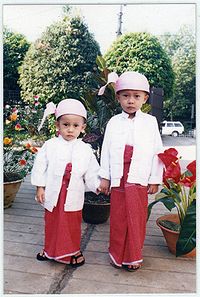
Gaung baung literally means "head wrap" in the Burmese language. It is part of traditional ceremonial attire, worn at formal gatherings and ceremonies. The gaung baung is almost always a sign of rank, though no insignia or pattern exists to denote it. The gaung baung is more prevalent among the Arakanese and Shan ethnic groups.
Design and style
The design of the modern Burmese gaung baung emerged in the mid-20th century and is called maung kyetthayay . It is a ready-made gaung baung made of cloth wrapped in a rattan frame and can be worn like a hat is worn. In the colonial era, silk gaung baungs called "B.A. gaung baung," traditionally worn at graduation ceremonies, were popular.The gaung baung is usually made of silk or cotton, depending on the rank or wealth of the owner. The older wrap versions were usually 4 to 5 feet long and 8 to 12 inches wide. It is put on the head in a clock wise manner, with the tongue on the left side. The tongue is the main distinguishing feature of the gaung baung, and is also different from ethnic group to ethnic group.
The Burmese and Mon gaung baung tongues tend to be sloping down and rounded, while the Arakanese (Rakhine) and Shan tongues are fanned out.
Nowadays, most do not wear the gaung baung, even to official functions. The gaung baung, along with most other articles of Burmese attire, have become streamlined. Thus, most wear ready-made and woven gaung baungs which are wrapped over a rattan or wicker frame.
Material
Since the gaung baung is a ceremonial headgear, it is always for beautification. Depending on the wealth and or rank of the owner, the colour and material differ.The Burmese and Mon wear yellow, white, grey or cream coloured gaung baungs, of either silk or cotton. The Rakhine wear pink coloured ones, while the Shan is either cream, skin or tan coloured. The Shan gaung baung is made out of rough cotton, called pin, the trademark garment of the Shan people.
Contemporary usage
Usage of gaung baung has declined dramatically during the British colonizationBritish rule in Burma
British rule in Burma lasted from 1824 to 1948, from the Anglo-Burmese Wars through the creation of Burma as a province of British India to the establishment of an independently administered colony, and finally independence...
. It is only worn in official ceremonies, and social functions such as weddings.
In the Northern Hill areas, the hill tribes, such as the Lahu
Lahu
The Lahu are an ethnic group of Southeast Asia and China.They are one of the 56 ethnic groups officially recognized by the People's Republic of China, where about 450,000 live in Yunnan province. An estimated 150,000 live in Burma. In Thailand, Lahu are one of the six main hill tribes; their...
, Akka
Akka
Akka is traditionally a female spirit in Sámi and Finnish mythology.In Sámi mythology, the first akka was Maderakka and her daughters were Sarakka, Uksakka and Juksakka. Some Sámi thought they lived under their kota tents....
and Palaung still wear similar gaung baungs, but for day to day wear, and they are usually made from towels.