


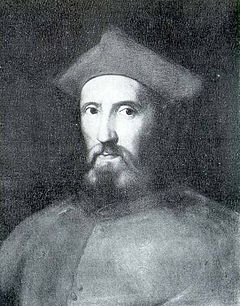
Gasparo Contarini

Encyclopedia
Italy
Italy , officially the Italian Republic languages]] under the European Charter for Regional or Minority Languages. In each of these, Italy's official name is as follows:;;;;;;;;), is a unitary parliamentary republic in South-Central Europe. To the north it borders France, Switzerland, Austria and...
diplomat
Diplomat
A diplomat is a person appointed by a state to conduct diplomacy with another state or international organization. The main functions of diplomats revolve around the representation and protection of the interests and nationals of the sending state, as well as the promotion of information and...
and cardinal
Cardinal (Catholicism)
A cardinal is a senior ecclesiastical official, usually an ordained bishop, and ecclesiastical prince of the Catholic Church. They are collectively known as the College of Cardinals, which as a body elects a new pope. The duties of the cardinals include attending the meetings of the College and...
. He was one of the first proponents of the dialogue with Protestants, after the Reformation.
Biography
He was born in VeniceVenice
Venice is a city in northern Italy which is renowned for the beauty of its setting, its architecture and its artworks. It is the capital of the Veneto region...
, the eldest son of Alvise Contarini, of the ancient noble House of Contarini, and his wife Polissena Malpiero. After a thorough scientific and philosophical training at the University of Padua
University of Padua
The University of Padua is a premier Italian university located in the city of Padua, Italy. The University of Padua was founded in 1222 as a school of law and was one of the most prominent universities in early modern Europe. It is among the earliest universities of the world and the second...
, he began his career in the service of his native city. From September 1520 to August 25 he was the Republic's ambassador to Charles V
Charles V, Holy Roman Emperor
Charles V was ruler of the Holy Roman Empire from 1519 and, as Charles I, of the Spanish Empire from 1516 until his voluntary retirement and abdication in favor of his younger brother Ferdinand I and his son Philip II in 1556.As...
, with whom Venice was soon at war, instructed to defend the Republic's alliance with Francis I of France
Francis I of France
Francis I was King of France from 1515 until his death. During his reign, huge cultural changes took place in France and he has been called France's original Renaissance monarch...
. Though he participated at the Diet of Worms
Diet of Worms
The Diet of Worms 1521 was a diet that took place in Worms, Germany, and is most memorable for the Edict of Worms , which addressed Martin Luther and the effects of the Protestant Reformation.It was conducted from 28 January to 25 May 1521, with Emperor Charles V presiding.Other Imperial diets at...
, April 1521, he never saw or spoke with Martin Luther
Martin Luther
Martin Luther was a German priest, professor of theology and iconic figure of the Protestant Reformation. He strongly disputed the claim that freedom from God's punishment for sin could be purchased with money. He confronted indulgence salesman Johann Tetzel with his Ninety-Five Theses in 1517...
. He accompanied Charles in the Netherlands and Spain.
He participated at the Congress of Ferrara in 1526 as the Republic's representative; at the Congress the League of Cognac was formed against the Emperor, allying France with Venice and several states of Italy. Later, after the Sack of Rome
Sack of Rome
The city of Rome has been sacked on several occasions. Among the most famous:*Battle of the Allia – Rome is sacked by the Gauls after the Battle of the Allia*Sack of Rome – Rome is sacked by Alaric, King of the Visigoths...
(1527), he assisted in reconciling the emperor and Clement VII
Pope Clement VII
Clement VII , born Giulio di Giuliano de' Medici, was a cardinal from 1513 to 1523 and was Pope from 1523 to 1534.-Early life:...
, whose release he obtained and with the Republic of Bologna. On his return to Venice was made a senator and a member of the Great Council.
In 1535, Paul III
Pope Paul III
Pope Paul III , born Alessandro Farnese, was Pope of the Roman Catholic Church from 1534 to his death in 1549. He came to the papal throne in an era following the sack of Rome in 1527 and rife with uncertainties in the Catholic Church following the Protestant Reformation...
unexpectedly made the secular diplomat a cardinal in order to bind an able man of evangelical disposition to the Roman interests. Contarini accepted, but in his new position did not exhibit his former independence. At the time he was promoted to cardinal, May 21, 1535, he was still a layman
Layman
A layperson or layman is a person who is not an expert in a given field of knowledge. The term originally meant a member of the laity, i.e. a non-clergymen, but over the centuries shifted in definition....
. One of the fruits of his diplomatic activity is his De magistratibus et republica Venetorum.
As Cardinal, Contarini figured among the most prominent of the Spirituali
Spirituali
The Spirituali were members of a reform movementwithin the Roman Catholic Church, which existed from the 1510s to the 1560s.The ranks of the Spirituali included Cardinal Gasparo Contarini , Cardinal Jacopo Sadoleto , Cardinal Reginald Pole , Italian poet Vittoria Colonna, and her friend, the artist...
, the leaders of the movement for reform within the Roman church. In April 1536 Paul III appointed a commission to devise ways for a reformation, with Contarini presiding. Paul III received favorably Contarini's Consilium de Emendanda Ecclesia
Consilium de Emendanda Ecclesia
The Consilium de Emendanda Ecclesia was a report commissioned by Pope Paul III on the abuses in the Catholic Church in 1536.The commission appointed to review the abuses in the church was presided over by Gasparo Cardinal Contarini and consisted of eight additional cardinals: Girolamo Aleandro,...
, which was circulated among the cardinalate, but it remained a dead letter. Contarini in a letter to his friend Cardinal Reginald Pole (dated 11 November 1538) says that his hopes had been wakened anew by the pope's attitude. He and his friends, who formed the Catholic evangelical movement of the Spirituali
Spirituali
The Spirituali were members of a reform movementwithin the Roman Catholic Church, which existed from the 1510s to the 1560s.The ranks of the Spirituali included Cardinal Gasparo Contarini , Cardinal Jacopo Sadoleto , Cardinal Reginald Pole , Italian poet Vittoria Colonna, and her friend, the artist...
, thought that all would have been done when the abuses in church life had been put away. What Contarini had to do with it is shown by his letters to the pope in which he complained of the schism in the church, of simony
Simony
Simony is the act of paying for sacraments and consequently for holy offices or for positions in the hierarchy of a church, named after Simon Magus , who appears in the Acts of the Apostles 8:9-24...
and flattery in the papal court, but above all of papal tyranny, its least grateful passages. Paul's successor Paul IV
Pope Paul IV
Pope Paul IV, C.R. , né Giovanni Pietro Carafa, was Pope from 23 May 1555 until his death.-Early life:Giovanni Pietro Carafa was born in Capriglia Irpina, near Avellino, into a prominent noble family of Naples...
, once a member on the commission, in 1539 put it on the Index Librorum Prohibitorum
Index Librorum Prohibitorum
The Index Librorum Prohibitorum was a list of publications prohibited by the Catholic Church. A first version was promulgated by Pope Paul IV in 1559, and a revised and somewhat relaxed form was authorized at the Council of Trent...
.
In 1541 Cardinal Contarini was papal legate at the Conference of Regensburg
Conference of Regensburg
The Colloquy of Regensburg, historically called the Colloquy of Ratisbon, was a conference held at Regensburg in 1541, during the Protestant Reformation, which marks the culmination of attempts to restore religious unity in the Holy Roman Empire by means of theological debate.-Background:Delegates...
, the diet and religious debate marking the culmination of attempts to restore religious unity in Germany by means of conferences. There everything was unfavorable; the Catholic states were bitter, the Evangelicals were distant. Contarini's instructions though apparently free were in fact full of papal reservations. But the papal party had gladly sent him, thinking that through him a union in doctrine could be brought about, while the interest of Rome could be attended to later. Though the princes stood aloof, the theologians and the emperor were for peace, so the main articles were put forth in a formula, Evangelical in thought and Catholic in expression. The papal legate had revised the Catholic proposal and assented to the formula agreed upon. All gave their approval, even Johann Eck
Johann Eck
Dr. Johann Maier von Eck was a German Scholastic theologian and defender of Catholicism during the Protestant Reformation. It was Eck who argued that the beliefs of Martin Luther and Jan Hus were similar.-Life:...
, though he later regretted it.
Contarini's theological advisor was Tommaso Badia
Tommaso Badia
Tommaso Badia was an Italian Dominican cardinal.Badia was born in Modena.He contributed to the establishment of the Jesuits. He was theological advisor of cardinal Gasparo Contarini. He was disputant in Worms 1540 and Regensburg 1541...
; his own position is shown in a treatise on justification, composed at Regensburg
Regensburg
Regensburg is a city in Bavaria, Germany, located at the confluence of the Danube and Regen rivers, at the northernmost bend in the Danube. To the east lies the Bavarian Forest. Regensburg is the capital of the Bavarian administrative region Upper Palatinate...
, which in essential points is Evangelical, differing only in the omission of the negative side and in being interwoven with the teaching of Aquinas
Thomas Aquinas
Thomas Aquinas, O.P. , also Thomas of Aquin or Aquino, was an Italian Dominican priest of the Catholic Church, and an immensely influential philosopher and theologian in the tradition of scholasticism, known as Doctor Angelicus, Doctor Communis, or Doctor Universalis...
. Meanwhile the papal policy had changed, and Contarini was compelled to follow his leader. He advised the emperor, after the conference had broken up, not to renew it, but to submit everything to the pope.
Ignatius Loyola acknowledged that Cardinal Contarini was largely responsible for the papal approbation of the Society of Jesus
Society of Jesus
The Society of Jesus is a Catholic male religious order that follows the teachings of the Catholic Church. The members are called Jesuits, and are also known colloquially as "God's Army" and as "The Company," these being references to founder Ignatius of Loyola's military background and a...
, on September 27, 1540. Meanwhile Rome had drifted further into reaction, and Contarini died while legate at Bologna, at a time when the Inquisition
Inquisition
The Inquisition, Inquisitio Haereticae Pravitatis , was the "fight against heretics" by several institutions within the justice-system of the Roman Catholic Church. It started in the 12th century, with the introduction of torture in the persecution of heresy...
had driven many of his friends and fellows in conviction into exile.
The Commonwealth and Government of Venice
Contarini remains the most important source for the study of sixteenth and seventeenth century Venice's unique system of government. This magisterial work, written during his time as an ambassador to Charles VCharles V, Holy Roman Emperor
Charles V was ruler of the Holy Roman Empire from 1519 and, as Charles I, of the Spanish Empire from 1516 until his voluntary retirement and abdication in favor of his younger brother Ferdinand I and his son Philip II in 1556.As...
, extols the various institutions of the Venetian state in a manner designed to emphasize harmony, fairness and serenity. Historians have demonstrated that this text represents Contarini's idealization of Venetian reality. Probably written for a foreign, courtly audience, this work functions as the source for the everlasting propagation of the 'myth of Venice' as a stable, unchanging and prosperous society.
His depiction of how members of the council were elected to the senate, for example, aimed to emphasise the way the electoral system prevented factionalism from occurring, instead making sure that “public benefits are largely extended among the citizens” rather than narrowly amongst “one family” . An elaborate lottery is described as giving the maximum amount of chance in appointing patricians to particular offices, and care is taken to point out if two of one family are standing for similar posts. Fairness is further emphasised in Contarini’s constant references to the equality the members of the council enjoyed. They “sit down where it pleases them, for there is no place appointed to any”, and they “with oath promise to do their utmost diligence, that the laws may be observed” . He creates an image of disparate individuals, with factions broken up by the guiding hand of the law, working to ensure those in positions of importance are fairly chosen from their number and without the capacity to serve the interests of a smaller group.
Contarini’s depiction of the Doge lucidly demonstrates the way in which this figure embodies both the conscious illusion of a resplendent monarchical ruler and an equally conscious demonstration of a regime that wishes to portray itself as ruled by many limiting the powers of one. This calculated duality means that Contarini’s doge, which the second book of De magistratibus is almost entirely devoted to discussing, represents the closest point in his text to what actually occurred, because the Doge served as a literal embodiment of the idealisation of the reality of Venetian politics. For Contarini, this duality almost defines the greatness of the Venetian constitution. The Doge is the “heart”, under which “all are comprised” . Contarini places him in the centre of his body metaphor, making him synecdochical for the city and the people that reside within it. This means he is to ensure that the disparate, competing interests of the city beat in time with one another, creating in the process the “perfection of civil agreement”. His job as a conductor, rather than a ruler, means therefore that the role takes on the aspect of representative of the entire city. Contarini’s description of his vestments, privileges and rituals can therefore be compared to Marin Sanudo’s description of the physical spaces of Venice in his essay In Praise of Venice. Both are designed to extol the virtues of the entire city by describing representative parts. This is apparent in the way both authors treat the chapel of St. Mark. Patron saints were hugely important in terms of civic self-identification in renaissance Italy . Contarini emphasizes this, saying that he is “with exceeding honour solemnized of the Venetians” . His description of the Doge’s close relationship with the saint, through the “solemn pomp” with which he attends mass at the saint’s chapel, attaches him to the aforementioned “exceeding honour”, in a similar fashion to the way in which Sanudo glorifies Venice as a whole by constantly referring to the beauty and worth of St. Mark’s square and chapel as part of his panoramic praise of the city.
At the same time, however, Contarini’s overall purpose is, of course, the glorification of the republican nature of his city. Therefore, he cannot avoid referring to “the other side” of the Doge’s figure when discussing his “royal appearing show” . Things like the “kingly ornaments” which were “always purple garments or cloth of gold”, both very ostentatious assertions of wealth and power, were to ensure he was “recompensed” for his “limitation of authority” . Contarini thus openly concludes that the Doge is a combination of myth and reality, saying that “in everything you may see the show of a king, but his authority is nothing” . Indeed, as Edward Muir points out, “by the sixteenth century virtually every word, gesture and act that the doge made in public was subject to legal and ceremonial regulation” . He could not buy expensive jewels, own property outside Venice or the Veneto, display his insignia outside the Ducal Palace, decorate his apartment as he wanted, receive people in his ducal dress, send official letters, or have close ties with guilds, amongst a great many other restrictions. Legally, therefore, power in Venice came from the numerous councils, not the figurehead. The Doge thus becomes a brazen republican statement. Venice drew attention to a princely, magnificently adorned figurehead, only to direct most executive power to councils of her citizens.