
All Topics  
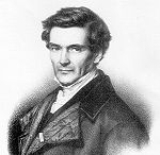
Gaspard-Gustave Coriolis

 
Gaspard Gustave Coriolis

   Email Print
   Bookmark   Link


Gaspard-Gustave Coriolis


Gaspard-Gustave de Coriolis or Gustave Coriolis (21 May 1792 – 19 September 1843) was a French
France

France , officially the French Republic , is a country whose Metropolitan France is located in Western Europe and that also comprises various Overseas departments and territories of France....
 mathematician
Mathematician

A mathematician is a person whose primary area of study and/or research is the field of mathematics....
, mechanical engineer and scientist
Scientist

A scientist, in the broadest sense, refers to any person that engages in a system activity to acquire knowledge or an individual that engages in such practices and traditions that are linked to schools of thought or philosophy....
. He is best known for his work on the Coriolis Effect
Coriolis effect

In physics, the Coriolis effect is an apparent deflection of moving objects when they are viewed from a rotating reference frame.Newton's laws of motion govern the motion of an object in an inertial frame of reference....
. Coriolis was the first to coin the term "work
Mechanical work

In physics, mechanical work is the amount of energy transferred by a force acting through a distance. Like energy, it is a scalar quantity, with SI of joules....
" for the product of force and distance.

olis was born in Paris
Paris

Paris is the Capital of France and the country's largest city. It is situated on the river Seine, in northern France, at the heart of the ?le-de-France Regions of France ....
. In 1816 he became a tutor at the École Polytechnique
École Polytechnique

The ?cole Polytechnique , often referred to by the nickname X, is the foremost France grande ?cole of engineering . Founded in 1794 and initially located in the Quartier Latin in central Paris, it was moved to Palaiseau in 1976....
. Here he did experiments on friction
Friction

File:Friction alt.svgFriction is the force resisting the relative lateral motion of solid surfaces, fluid layers, or material elements in contact....
 and hydraulics
Hydraulics

Hydraulics is a topic of science and engineering dealing with the mechanical properties of liquids. Hydraulics is part of the more general discipline of fluid power....
.

In 1829 Coriolis published a textbook, Calcul de l'Effet des Machines ("Calculation of the Effect of Machines"), which presented mechanics in a way that could readily be applied by industry.


Discussion
Ask a question about 'Gaspard-Gustave Coriolis'
Start a new discussion about 'Gaspard-Gustave Coriolis'
Answer questions from other users
Full Discussion Forum


Recent Posts


Encyclopedia


Gaspard-Gustave de Coriolis or Gustave Coriolis (21 May 1792 – 19 September 1843) was a French
France

France , officially the French Republic , is a country whose Metropolitan France is located in Western Europe and that also comprises various Overseas departments and territories of France....
 mathematician
Mathematician

A mathematician is a person whose primary area of study and/or research is the field of mathematics....
, mechanical engineer and scientist
Scientist

A scientist, in the broadest sense, refers to any person that engages in a system activity to acquire knowledge or an individual that engages in such practices and traditions that are linked to schools of thought or philosophy....
. He is best known for his work on the Coriolis Effect
Coriolis effect

In physics, the Coriolis effect is an apparent deflection of moving objects when they are viewed from a rotating reference frame.Newton's laws of motion govern the motion of an object in an inertial frame of reference....
. Coriolis was the first to coin the term "work
Mechanical work

In physics, mechanical work is the amount of energy transferred by a force acting through a distance. Like energy, it is a scalar quantity, with SI of joules....
" for the product of force and distance.

Biography

Coriolis was born in Paris
Paris

Paris is the Capital of France and the country's largest city. It is situated on the river Seine, in northern France, at the heart of the ?le-de-France Regions of France ....
. In 1816 he became a tutor at the École Polytechnique
École Polytechnique

The ?cole Polytechnique , often referred to by the nickname X, is the foremost France grande ?cole of engineering . Founded in 1794 and initially located in the Quartier Latin in central Paris, it was moved to Palaiseau in 1976....
. Here he did experiments on friction
Friction

File:Friction alt.svgFriction is the force resisting the relative lateral motion of solid surfaces, fluid layers, or material elements in contact....
 and hydraulics
Hydraulics

Hydraulics is a topic of science and engineering dealing with the mechanical properties of liquids. Hydraulics is part of the more general discipline of fluid power....
.

In 1829 Coriolis published a textbook, Calcul de l'Effet des Machines ("Calculation of the Effect of Machines"), which presented mechanics in a way that could readily be applied by industry. In this period the correct expression for kinetic energy
Kinetic energy

The kinetic energy of an object is the extra energy which it possesses due to its motion. It is defined as the mechanical work needed to accelerate a body of a given mass from rest to its current velocity....
, ½mv2, and its relation to mechanical work
Mechanical work

In physics, mechanical work is the amount of energy transferred by a force acting through a distance. Like energy, it is a scalar quantity, with SI of joules....
 became established.

During the following years Coriolis worked to extend the notion of kinetic energy and work to rotating systems. The first of his papers, Sur le principe des forces vives dans les mouvements relatifs des machines (On the principle of kinetic energy in the relative motion in machines),. was read to the Académie des Sciences (Coriolis 1832). Three years later came the paper that would make his name famous, Sur les équations du mouvement relatif des systèmes de corps (On the equations of relative motion of a system of bodies).. Coriolis's papers do not deal with the atmosphere or even the rotation of the earth, but with the transfer of energy in rotating systems like waterwheels. A detailed discussion may be found in Dugas.

In 1835 he published a mathematical work on collisions of spheres: Théorie Mathématique des Effets du Jeu de Billard, considered a classic on the subject.

Coriolis's name began to appear in the meteorological literature at the end of the 19th century, although the term "Coriolis force" was not used until the beginning of the 20th century. Today, the name Coriolis has become strongly associated with meteorology, but all major discoveries about the general circulation and the relation between the pressure and wind fields were made without knowledge about Gaspard Gustave Coriolis.

Coriolis became professor of mechanics at the École Centrale des Arts et Manufactures in 1829. Upon the death of Navier in 1836, Coriolis succeeded him in in the chair of applied mechanics at the École des Ponts and Chaussées and to Navier's place in the Académie des Sciences. In 1838 he succeeded Dulong
Pierre Louis Dulong

Pierre Louis Dulong was a France physicist and chemist, remembered today largely for the law of Dulong and Petit....
 as Directeur des études (director of studies) in the École Polytechnique
École Polytechnique

The ?cole Polytechnique , often referred to by the nickname X, is the foremost France grande ?cole of engineering . Founded in 1794 and initially located in the Quartier Latin in central Paris, it was moved to Palaiseau in 1976....
. He died in 1843 at the age of 51 in Paris
Paris

Paris is the Capital of France and the country's largest city. It is situated on the river Seine, in northern France, at the heart of the ?le-de-France Regions of France ....
.

Further reading

  • Persson, A., 1998 How do we understand the Coriolis Force? Bull. Amer. Meteor. Soc. 79, 1373-1385.


External links