
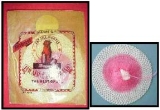
An
incandescent gas mantle,
gas mantle, or
Welsbach mantle is a device for generating bright white light when heated by a flame. The name refers to its original heat source, existing gas lights, which filled the streets of
EuropeEurope is, by convention, one of the world's seven continents. Comprising the westernmost peninsula of Eurasia, Europe is generally 'divided' from Asia to its east by the watershed divides of the Ural and Caucasus Mountains, the Ural River, the Caspian and Black Seas, and the waterways connecting...
and
North AmericaNorth America is a continent wholly within the Northern Hemisphere and almost wholly within the Western Hemisphere. It is also considered a northern subcontinent of the Americas...
in the late 19th century, mantle referring to the way it was hung above the flame. Today they are still used for portable
campingCamping is an outdoor recreational activity. The participants leave urban areas, their home region, or civilization and enjoy nature while spending one or several nights outdoors, usually at a campsite. Camping may involve the use of a tent, caravan, motorhome, cabin, a primitive structure, or no...
lanternA lantern is a portable lighting device or mounted light fixture used to illuminate broad areas. Lanterns may also be used for signaling, as 'torches', or as general light sources outdoors . Low light level varieties are used for decoration. The term "lantern" is also used more generically to...
s and pressure lanterns.
Mechanism
The mantle is a roughly pear-shaped
ramieRamie is a flowering plant in the nettle family Urticaceae, native to eastern Asia. It is a herbaceous perennial growing to 1–2.5 m tall; the leaves are heart-shaped, 7–15 cm long and 6–12 cm broad, and white on the underside with dense small hairs—this gives it a silvery appearance;...
-based artificial silk or
rayonRayon is a manufactured regenerated cellulose fiber. Because it is produced from naturally occurring polymers, it is neither a truly synthetic fiber nor a natural fiber; it is a semi-synthetic or artificial fiber. Rayon is known by the names viscose rayon and art silk in the textile industry...
fabric bag made from silk or fabric impregnated with rare-earth metallic salts that will convert to solid oxides after being burned (heated). A mantle will glow brightly in the visible spectrum while emitting little
infraredInfrared light is electromagnetic radiation with a wavelength longer than that of visible light, measured from the nominal edge of visible red light at 0.74 micrometres , and extending conventionally to 300 µm...
radiation. The
rare earthAs defined by IUPAC, rare earth elements or rare earth metals are a set of seventeen chemical elements in the periodic table, specifically the fifteen lanthanides plus scandium and yttrium...
oxides (
ceriumCerium is a chemical element with the symbol Ce and atomic number 58. It is a soft, silvery, ductile metal which easily oxidizes in air. Cerium was named after the dwarf planet . Cerium is the most abundant of the rare earth elements, making up about 0.0046% of the Earth's crust by weight...
) and actinide (
thoriumThorium is a natural radioactive chemical element with the symbol Th and atomic number 90. It was discovered in 1828 and named after Thor, the Norse god of thunder....
) in the mantle have a low
emissivityThe emissivity of a material is the relative ability of its surface to emit energy by radiation. It is the ratio of energy radiated by a particular material to energy radiated by a black body at the same temperature...
in the infrared (in comparison with an ideal
black bodyA black body is an idealized physical body that absorbs all incident electromagnetic radiation. Because of this perfect absorptivity at all wavelengths, a black body is also the best possible emitter of thermal radiation, which it radiates incandescently in a characteristic, continuous spectrum...
), but have high emissivity in the visible
spectrumA spectrum is a condition that is not limited to a specific set of values but can vary infinitely within a continuum. The word saw its first scientific use within the field of optics to describe the rainbow of colors in visible light when separated using a prism; it has since been applied by...
. This is because of
candoluminescenceCandoluminescence is the term used to describe the light given off by certain materials which have been heated to incandescence and emit a larger proportion of short wavelength light than would be expected for a typical blackbody radiator...
. Hence, when heated by a
keroseneKerosene, sometimes spelled kerosine in scientific and industrial usage, also known as paraffin or paraffin oil in the United Kingdom, Hong Kong, Ireland and South Africa, is a combustible hydrocarbon liquid. The name is derived from Greek keros...
or
liquified petroleum gasLiquefied petroleum gas is a flammable mixture of hydrocarbon gases used as a fuel in heating appliances and vehicles. It is increasingly used as an aerosol propellant and a refrigerant, replacing chlorofluorocarbons in an effort to reduce damage to the ozone layer...
flame, the mantle emits radiation that is weighted less heavily in the
infraredInfrared light is electromagnetic radiation with a wavelength longer than that of visible light, measured from the nominal edge of visible red light at 0.74 micrometres , and extending conventionally to 300 µm...
and more heavily in the visible spectrum, leading to an enhanced output of useful light.
The mantle shrinks after all the fabric material has burnt away and becomes very fragile after this first use.
The mantle also aids the combustion process, keeping the flame small and contained inside the mantle at higher fuel flow rates than in a simple lamp. This concentration of combustion inside the mantle, in turn, improves the transfer of heat from the flame to the mantle.
History
For centuries, artificial light had been generated using open
flameA flame is the visible , gaseous part of a fire. It is caused by a highly exothermic reaction taking place in a thin zone...
s.
LimelightLimelight is a type of stage lighting once used in theatres and music halls. An intense illumination is created when an oxyhydrogen flame is directed at a cylinder of quicklime , which can be heated to 2572 °C before melting. The light is produced by a combination of incandescence and...
had been invented in the 1820s, but the temperature required was too high to be practical for small lights. In the late 19th century several inventors tried to develop an effective alternative based on heating a material to a lower temperature but using spectral lines to simulate white light.
Many early attempts used
platinumPlatinum is a chemical element with the chemical symbol Pt and an atomic number of 78. Its name is derived from the Spanish term platina del Pinto, which is literally translated into "little silver of the Pinto River." It is a dense, malleable, ductile, precious, gray-white transition metal...
-
iridiumIridium is the chemical element with atomic number 77, and is represented by the symbol Ir. A very hard, brittle, silvery-white transition metal of the platinum family, iridium is the second-densest element and is the most corrosion-resistant metal, even at temperatures as high as 2000 °C...
gauze soaked in metal
nitrateThe nitrate ion is a polyatomic ion with the molecular formula NO and a molecular mass of 62.0049 g/mol. It is the conjugate base of nitric acid, consisting of one central nitrogen atom surrounded by three identically-bonded oxygen atoms in a trigonal planar arrangement. The nitrate ion carries a...
s, but were not successful because of high cost materials and poor reliability.
The first effective mantle was the
Clamond basket in 1881, named after its inventor. It was exhibited in
the Crystal PalaceThe Crystal Palace was a cast-iron and glass building originally erected in Hyde Park, London, England, to house the Great Exhibition of 1851. More than 14,000 exhibitors from around the world gathered in the Palace's of exhibition space to display examples of the latest technology developed in...
exhibition of 1883. This device was made from a mixture of
magnesiumMagnesium is a chemical element with the symbol Mg, atomic number 12, and common oxidation number +2. It is an alkaline earth metal and the eighth most abundant element in the Earth's crust and ninth in the known universe as a whole...
hydrate, magnesium acetate and
waterWater is a chemical substance with the chemical formula H2O. A water molecule contains one oxygen and two hydrogen atoms connected by covalent bonds. Water is a liquid at ambient conditions, but it often co-exists on Earth with its solid state, ice, and gaseous state . Water also exists in a...
which was squeezed through holes in a plate to form threads, which were then moulded into a basket shape and ignited. The acetate burnt, the combustion products forming a matrix to support the
magnesium oxideMagnesium oxide , or magnesia, is a white hygroscopic solid mineral that occurs naturally as periclase and is a source of magnesium . It has an empirical formula of and consists of a lattice of Mg2+ ions and O2– ions held together by ionic bonds...
formed as the hydrate decomposed. The fragile structure was supported by a platinum wire cage and heated by a
coal gasCoal gas is a flammable gaseous fuel made by the destructive distillation of coal containing a variety of calorific gases including hydrogen, carbon monoxide, methane and volatile hydrocarbons together with small quantities of non-calorific gases such as carbon dioxide and nitrogen...
flame.
The modern gas mantle was one of the many inventions of
Carl Auer von WelsbachCarl Auer Freiherr von Welsbach was an Austrian scientist and inventor who had a talent for not only discovering advances, but turning them into commercially successful products...
, a
chemistA chemist is a scientist trained in the study of chemistry. Chemists study the composition of matter and its properties such as density and acidity. Chemists carefully describe the properties they study in terms of quantities, with detail on the level of molecules and their component atoms...
who studied
rare earth elementAs defined by IUPAC, rare earth elements or rare earth metals are a set of seventeen chemical elements in the periodic table, specifically the fifteen lanthanides plus scandium and yttrium...
s in the 1880s and who had been
Robert Bunsen'sRobert Wilhelm Eberhard Bunsen was a German chemist. He investigated emission spectra of heated elements, and discovered caesium and rubidium with Gustav Kirchhoff. Bunsen developed several gas-analytical methods, was a pioneer in photochemistry, and did early work in the field of organoarsenic...
student. Ignaz Kreidl worked with him on his early experiments to create the Welsbach mantle. His first process used a mixture of 60%
magnesium oxideMagnesium oxide , or magnesia, is a white hygroscopic solid mineral that occurs naturally as periclase and is a source of magnesium . It has an empirical formula of and consists of a lattice of Mg2+ ions and O2– ions held together by ionic bonds...
, 20% lanthanum oxide and 20% yttrium oxide, which he called
Actinophor, and patented in 1885.
The original mantles gave off a green-tinted light and were not very successful, and his first company, which established a factory in
AtzgersdorfAtzgersdorf is a former municipality in Lower Austria that is now a part of the 23rd Viennese district Liesing. A small part of the former municipality today is part of the 12th Viennese district Meidling....
in 1887, failed in 1889. In 1890 he discovered that thorium was superior to magnesium, and in 1891 perfected a new mixture of 99%
thorium dioxideThorium dioxide , also called thorium oxide is a white, crystalline powder. It was formerly known as thoria or thorina. It is produced mainly as a by-product of lanthanide and uranium production.[1]...
and 1% cerium dioxide that gave off a much whiter light and produced a stronger mantle. After introducing it commercially in 1892 it quickly spread throughout Europe. The gas mantle remained an important part of street lighting until the widespread introduction of electric lighting in the early 1900s.
To produce a mantle,
cottonCotton is a soft, fluffy staple fiber that grows in a boll, or protective capsule, around the seeds of cotton plants of the genus Gossypium. The fiber is almost pure cellulose. The botanical purpose of cotton fiber is to aid in seed dispersal....
is woven into a net bag and impregnated with the soluble nitrates of these metals and then heated; the cotton burns away and the nitrates are converted to nitrites, which fuse together to form the solid mesh. As the heating continues, the nitrites decompose into the final solid, (but fragile) very high melting point oxides.
Early mantles were sold in the unheated cotton mesh condition, since the oxide structure was too fragile to transport easily, and the purchaser carried out the conversion when it was first used. The cotton quickly rotted because of the corrosive nature of the acidic metal nitrates (although was later reduced by soaking the mantle in
ammoniaAmmonia is a compound of nitrogen and hydrogen with the formula . It is a colourless gas with a characteristic pungent odour. Ammonia contributes significantly to the nutritional needs of terrestrial organisms by serving as a precursor to food and fertilizers. Ammonia, either directly or...
solution to neutralise the excess acid).
Later mantles were made from guncotton (
nitrocelluloseNitrocellulose is a highly flammable compound formed by nitrating cellulose through exposure to nitric acid or another powerful nitrating agent. When used as a propellant or low-order explosive, it is also known as guncotton...
) or
collodionCollodion is a flammable, syrupy solution of pyroxylin in ether and alcohol. There are two basic types; flexible and non-flexible. The flexible type is often used as a surgical dressing or to hold dressings in place. When painted on the skin, collodion dries to form a flexible cellulose film...
rather than ordinary cotton, since extremely fine threads of it could be produced; it was converted back to
celluloseCellulose is an organic compound with the formula , a polysaccharide consisting of a linear chain of several hundred to over ten thousand β linked D-glucose units....
before heating (since these materials are highly flammable or explosive) by dipping in
ammonium sulfideAmmonium hydrosulfide is the chemical compound with the formula SH. It is the salt derived from the ammonium cation and the hydrosulfide anion. The salt exists as colourless, water soluble, micaceous crystals. The compound is encountered mainly as a solution, not as the solid...
.
It was discovered that the finished mantle could be strengthened sufficiently by dipping in a solution of collodion, which would coat it with a thin layer of the material to be burnt off when the mantle was first used, although modern mantles are now usually sold in their original fabric condition.
Early mantles often had a binding thread of
asbestosAsbestos is a set of six naturally occurring silicate minerals used commercially for their desirable physical properties. They all have in common their eponymous, asbestiform habit: long, thin fibrous crystals...
for tying onto the lamp fitting, but because of its
carcinogenA carcinogen is any substance, radionuclide, or radiation that is an agent directly involved in causing cancer. This may be due to the ability to damage the genome or to the disruption of cellular metabolic processes...
ic properties it has been replaced with wire or
ceramicA ceramic is an inorganic, nonmetallic solid prepared by the action of heat and subsequent cooling. Ceramic materials may have a crystalline or partly crystalline structure, or may be amorphous...
fiber thread in modern mantles.
Safety of thorium
Since
thoriumThorium is a natural radioactive chemical element with the symbol Th and atomic number 90. It was discovered in 1828 and named after Thor, the Norse god of thunder....
is radioactive and produces a radioactive gas,
radonRadon is a chemical element with symbol Rn and atomic number 86. It is a radioactive, colorless, odorless, tasteless noble gas, occurring naturally as the decay product of uranium or thorium. Its most stable isotope, 222Rn, has a half-life of 3.8 days...
-220, as one of its decay products, there are concerns about the safety of thorium mantles. Some
nuclear safetyNuclear safety covers the actions taken to prevent nuclear and radiation accidents or to limit their consequences. This covers nuclear power plants as well as all other nuclear facilities, the transportation of nuclear materials, and the use and storage of nuclear materials for medical, power,...
agencies make recommendations about their use
http://www.arpansa.gov.au/RadiationProtection/Factsheets/is_lantern.cfm. A study in 1981 estimated that the dose from using a thorium mantle every weekend for a year would be 0.3-0.6 millirems, tiny in comparison to the normal annual dose of a few hundred millirems, although a person ingesting an entire mantle would receive a comparable dose of 200 mrem (2 mSv;
http://www.survivalunlimited.com/lanternsstoves/aladdinmantleinfo.htm,
http://www.straightdope.com/columns/031205.html). However, the radioactivity is a major concern for those people involved with the manufacture of mantles and with contamination of soil around some former factory sites
http://www.state.nj.us/health/eoh/hhazweb/hhw_no_3.pdf. All of these issues have meant that alternatives, usually
yttriumYttrium is a chemical element with symbol Y and atomic number 39. It is a silvery-metallic transition metal chemically similar to the lanthanides and it has often been classified as a "rare earth element". Yttrium is almost always found combined with the lanthanides in rare earth minerals and is...
or sometimes
zirconiumZirconium is a chemical element with the symbol Zr and atomic number 40. The name of zirconium is taken from the mineral zircon. Its atomic mass is 91.224. It is a lustrous, grey-white, strong transition metal that resembles titanium...
, are used in some countries although they are either more expensive or less efficient.
One potential cause for concern is that particles from thorium gas mantles "fall out" over time and get into the air, where they may be ingested in food or drink. These particles can also be inhaled and remain in the lungs or liver. Also of concern is the release of thorium-bearing dust if the mantle shatters due to mechanical impact.
Secondary decay products of
thoriumThorium is a natural radioactive chemical element with the symbol Th and atomic number 90. It was discovered in 1828 and named after Thor, the Norse god of thunder....
include
radiumRadium is a chemical element with atomic number 88, represented by the symbol Ra. Radium is an almost pure-white alkaline earth metal, but it readily oxidizes on exposure to air, becoming black in color. All isotopes of radium are highly radioactive, with the most stable isotope being radium-226,...
,
actiniumActinium is a radioactive chemical element with the symbol Ac and atomic number 89, which was discovered in 1899. It was the first non-primordial radioactive element to be isolated. Polonium, radium and radon were observed before actinium, but they were not isolated until 1902...
, and
radonRadon is a chemical element with symbol Rn and atomic number 86. It is a radioactive, colorless, odorless, tasteless noble gas, occurring naturally as the decay product of uranium or thorium. Its most stable isotope, 222Rn, has a half-life of 3.8 days...
gas.
External links