

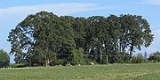
Garry Oak

Encyclopedia
Quercus garryana, the Garry Oak, Oregon White Oak or Oregon Oak, has a range from southern California
to extreme southwestern British Columbia
, particularly southeastern Vancouver Island
and the adjacent Gulf Islands
. It grows from sea level to 210 m altitude in the northern part of its range, and at 300-1800 m in the south of the range in California. The tree is named after Nicholas Garry, deputy governor of the Hudson's Bay Company
, 1822-35.
In Washington State, it grows on the west side of the Cascade Mountains, particularly in the Puget Sound lowlands, the northeastern Olympic Peninsula, Whidbey Island and the San Juan Islands. It also grows in the foothills of the southeastern Cascade Mountains and along the Columbia River Gorge
.
In Oregon, the Garry oak grows on the west side of the Cascade Mountains, primarily in the Willamette, Umpqua and Rogue River Valleys, and along the Columbia River Gorge.
In California, the garryana variety grows in the foothills of the Siskiyou and Klamath Mountains, the Coast Ranges of Northern California, and of the west slope of the Cascade Mountains. The semota variety grows in the Sierra Nevada and Coast Ranges as far south as Los Angeles County.
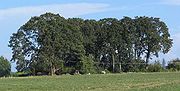 There are three varieties
:
, typically of medium height, growing slowly to around 20m (occasionally as high as 30m) or as a shrub
to 3-5 m tall. It has the characteristic oval profile of other oak
s when solitary, but is also known to grow in groves close enough together that crowns may form a canopy. The leaves
are deciduous
, 5-15 cm long and 2-8 cm broad, with 3-7 deep lobes on each side. The flower
s are catkin
s, the fruit
a small acorn
2-3 cm (rarely 4 cm) long and 1.5-2 cm broad, with shallow, scaly cups.
The Oregon White Oak is commonly found in the Willamette Valley
hosting the mistletoe
Phoradendron flavescens. It is also commonly found hosting galls created by wasps
in the family Cynipidae. 'Oak apples', green or yellow ball of up to 5 cm in size, are the most spectacular. They are attached to the undersides of leaves. One common species responsible for these galls is Cynips maculipennis. Other species create galls on stems and leaves. Shapes vary from spheres to mushroom-shaped to pencil-shaped.
In British Columbia, the Garry oak can be infested by three nonnative insects: the jumping gall wasp Neuroterus saltatorius, the oak leaf phylloxeran, and the gypsy moth
.
While the invasive plant disease commonly called Sudden Oak Death
attacks other Pacific Coast native oaks, it has not yet been found on the Garry oak. Most oak hosts of this disease are in the red oak group, while Garry oak is in the white oak group.
Garry oak woodlands in British Columbia and Washington state are critical habitats for a number of species that are rare or extirpated in these areas, plant, animal, and bryophyte:
(Hanna and Dunn IN Dunn and Ewing; T. Lea, Miles and McIntosh, GOERT Colloquium 2006).
Garry oak woodlands create a landscape mosaic of grassland, savanna, woodland, and closed-canopy forest. This mosaic of varied habitats, in turn, allows many more species to live in this area than would be possible in coniferous forest alone. Parks Canada states that Garry oak woodlands support more species of plants than any other terrestrial ecosystem in British Columbia. It grows in a variety of soil types, for instance, rocky outcrops, glacial gravelly outwash, deep grassland soils, and seasonally flooded riparian areas. (Hanna and Dunn IN Dunn and Ewing; T. Lea, GOERT Colloquium 2006).
The Donation Land Claim Act of 1850 encouraged Anglo settlement of Washington and Oregon, and marked the beginning of the end of regular burning by Indians of the area (Perdue IN Dunn and Ewing). With fire suppression and conversion to agriculture, Garry oak woodlands and bunch grass prairies were invaded by Douglas-fir, Oregon ash (Fraxinus latifolia}, and imported pasture grasses. Oaks were logged to clear land for pasture, and for firewood and fence posts. Livestock grazing trampled and consumed oak seedlings. By the 1990s, more than half the Garry oak woodland habitat in the South Puget Sound area of Washington State was gone. (Hanna and Dunn IN Dunn and Ewing. On Vancouver Island , more than 90% was gone. (T. Lea, GOERT Colloquium 2006). Remaining Garry oak woodlands are threatened by urbanization, conversion to Douglas-fir, and invasion by shrubs, both native and nonnative (Scotch broom Cytisus scoparius, sweetbriar rose Rosa eglanteria, snowberry Symphoricarpos albus, Indian plum Oemleria cerasiformis, poison-oak Toxicodendron diversilobum, English holly Ilex aquifolium, bird cherry Prunus avens).
Conversely, oak groves in wetter areas that historically had closed canopies of large trees are becoming crowded with young oaks that grow thin and spindly, due to lack of fires that would clear out seedlings.(Hanna and Dunn IN Dunn and Ewing;
, which is named after the tree, and Corvallis, Oregon
. Moreover, recently the wood
, which is similar to that of other white oaks, has been used experimentally in Oregon
for creating casks in which to age wine.
California
California is a state located on the West Coast of the United States. It is by far the most populous U.S. state, and the third-largest by land area...
to extreme southwestern British Columbia
British Columbia
British Columbia is the westernmost of Canada's provinces and is known for its natural beauty, as reflected in its Latin motto, Splendor sine occasu . Its name was chosen by Queen Victoria in 1858...
, particularly southeastern Vancouver Island
Vancouver Island
Vancouver Island is a large island in British Columbia, Canada. It is one of several North American locations named after George Vancouver, the British Royal Navy officer who explored the Pacific Northwest coast of North America between 1791 and 1794...
and the adjacent Gulf Islands
Gulf Islands
The Gulf Islands are the islands in the Strait of Georgia , between Vancouver Island and the mainland of British Columbia, Canada....
. It grows from sea level to 210 m altitude in the northern part of its range, and at 300-1800 m in the south of the range in California. The tree is named after Nicholas Garry, deputy governor of the Hudson's Bay Company
Hudson's Bay Company
The Hudson's Bay Company , abbreviated HBC, or "The Bay" is the oldest commercial corporation in North America and one of the oldest in the world. A fur trading business for much of its existence, today Hudson's Bay Company owns and operates retail stores throughout Canada...
, 1822-35.
Range
In British Columbia, the Garry oak occurs on the Gulf Islands and southeastern Vancouver Island, from west of Victoria along the east side of the island up to the Campbell River area. There are also small populations along the Fraser River on the British Columbia mainland.In Washington State, it grows on the west side of the Cascade Mountains, particularly in the Puget Sound lowlands, the northeastern Olympic Peninsula, Whidbey Island and the San Juan Islands. It also grows in the foothills of the southeastern Cascade Mountains and along the Columbia River Gorge
Columbia River Gorge
The Columbia River Gorge is a canyon of the Columbia River in the Pacific Northwest of the United States. Up to deep, the canyon stretches for over as the river winds westward through the Cascade Range forming the boundary between the State of Washington to the north and Oregon to the south...
.
In Oregon, the Garry oak grows on the west side of the Cascade Mountains, primarily in the Willamette, Umpqua and Rogue River Valleys, and along the Columbia River Gorge.
In California, the garryana variety grows in the foothills of the Siskiyou and Klamath Mountains, the Coast Ranges of Northern California, and of the west slope of the Cascade Mountains. The semota variety grows in the Sierra Nevada and Coast Ranges as far south as Los Angeles County.
Varieties
Variety (biology)
In botanical nomenclature, variety is a taxonomic rank below that of species: as such, it gets a three-part infraspecific name....
:
- Quercus garryana var. garryana – tree to 20 (30) m. British Columbia south along the Cascades to the California Coast Ranges.
- Quercus garryana var. breweri – shrub to 5 m; leaves velvety underneath. Siskiyou Mountains.
- Quercus garryana var. semota – shrub to 5 m; leaves not velvety underneath. Sierra Nevada.
Growth characteristics
It is a drought-tolerant treeTree
A tree is a perennial woody plant. It is most often defined as a woody plant that has many secondary branches supported clear of the ground on a single main stem or trunk with clear apical dominance. A minimum height specification at maturity is cited by some authors, varying from 3 m to...
, typically of medium height, growing slowly to around 20m (occasionally as high as 30m) or as a shrub
Shrub
A shrub or bush is distinguished from a tree by its multiple stems and shorter height, usually under 5–6 m tall. A large number of plants may become either shrubs or trees, depending on the growing conditions they experience...
to 3-5 m tall. It has the characteristic oval profile of other oak
Oak
An oak is a tree or shrub in the genus Quercus , of which about 600 species exist. "Oak" may also appear in the names of species in related genera, notably Lithocarpus...
s when solitary, but is also known to grow in groves close enough together that crowns may form a canopy. The leaves
Leaf
A leaf is an organ of a vascular plant, as defined in botanical terms, and in particular in plant morphology. Foliage is a mass noun that refers to leaves as a feature of plants....
are deciduous
Deciduous
Deciduous means "falling off at maturity" or "tending to fall off", and is typically used in reference to trees or shrubs that lose their leaves seasonally, and to the shedding of other plant structures such as petals after flowering or fruit when ripe...
, 5-15 cm long and 2-8 cm broad, with 3-7 deep lobes on each side. The flower
Flower
A flower, sometimes known as a bloom or blossom, is the reproductive structure found in flowering plants . The biological function of a flower is to effect reproduction, usually by providing a mechanism for the union of sperm with eggs...
s are catkin
Catkin
A catkin or ament is a slim, cylindrical flower cluster, with inconspicuous or no petals, usually wind-pollinated but sometimes insect pollinated . They contain many, usually unisexual flowers, arranged closely along a central stem which is often drooping...
s, the fruit
Fruit
In broad terms, a fruit is a structure of a plant that contains its seeds.The term has different meanings dependent on context. In non-technical usage, such as food preparation, fruit normally means the fleshy seed-associated structures of certain plants that are sweet and edible in the raw state,...
a small acorn
Acorn
The acorn, or oak nut, is the nut of the oaks and their close relatives . It usually contains a single seed , enclosed in a tough, leathery shell, and borne in a cup-shaped cupule. Acorns vary from 1–6 cm long and 0.8–4 cm broad...
2-3 cm (rarely 4 cm) long and 1.5-2 cm broad, with shallow, scaly cups.
The Oregon White Oak is commonly found in the Willamette Valley
Willamette Valley
The Willamette Valley is the most populated region in the state of Oregon of the United States. Located in the state's northwest, the region is surrounded by tall mountain ranges to the east, west and south and the valley's floor is broad, flat and fertile because of Ice Age conditions...
hosting the mistletoe
Mistletoe
Mistletoe is the common name for obligate hemi-parasitic plants in several families in the order Santalales. The plants in question grow attached to and within the branches of a tree or shrub.-Mistletoe in the genus Viscum:...
Phoradendron flavescens. It is also commonly found hosting galls created by wasps
Gall wasp
Gall wasps , also called Gallflies, are a family of the order Hymenoptera and are classified with the Apocrita suborder of wasps in the superfamily Cynipoidea...
in the family Cynipidae. 'Oak apples', green or yellow ball of up to 5 cm in size, are the most spectacular. They are attached to the undersides of leaves. One common species responsible for these galls is Cynips maculipennis. Other species create galls on stems and leaves. Shapes vary from spheres to mushroom-shaped to pencil-shaped.
In British Columbia, the Garry oak can be infested by three nonnative insects: the jumping gall wasp Neuroterus saltatorius, the oak leaf phylloxeran, and the gypsy moth
Gypsy moth
The gypsy moth, Lymantria dispar, is a moth in the family Lymantriidae of Eurasian origin. Originally ranging from Europe to Asia, it was introduced to North America in the late 1860s and has been expanding its range ever since...
.
While the invasive plant disease commonly called Sudden Oak Death
Sudden oak death
Sudden Oak Death is the common name of a disease caused by the oomycete plant pathogen Phytophthora ramorum. The disease kills oak and other species of tree and has had devastating effects on the oak populations in California and Oregon as well as also being present in Europe...
attacks other Pacific Coast native oaks, it has not yet been found on the Garry oak. Most oak hosts of this disease are in the red oak group, while Garry oak is in the white oak group.
Natural History
Garry oak is the only native oak species in British Columbia, Washington State, and northern Oregon. In these areas, Garry oak woodlands are seral, or early-successional - they depend on disturbance to prevent their being overtaken by Douglas-fir. The disturbance that allowed Garry oak to persist in an area that would otherwise succeed to coniferous forest was primarily fire. Natural wildfires are rare in the maritime Pacific Northwest, but early settler's records, soil surveys, and tribal histories indicate that deliberate burning was widely practiced by the First Nations people of these areas. Fire perpetuated the grasslands that produced food plants such as camas, chocolate lily, bracken fern, and oak; and that provided grazing and easy hunting for deer and elk. Mature Garry oaks are fire resistant, so would not be harmed by frequent, light intensity, grass fires. These fires prevented Douglas-fir, and most other conifer, seedlings from becoming established, allowing bunch grass prairie and Garry oak woodland to persist in a high-rainfall area otherwise dominated by conifers. Fire also kept oak woodlands on drier soils free of a shrub understory. Wetter oak woodlands historically had a substantial shrub understory, primarily snowberry. (Perdue IN Dunn and Ewing).Garry oak woodlands in British Columbia and Washington state are critical habitats for a number of species that are rare or extirpated in these areas, plant, animal, and bryophyte:
- Propertius duskywing butterfly Erynnis propertius, sole larval food plant is oak
- Bucculatrix zophopasta leaf-mining moth, sole larval food plant is oak
- Lewis woodpecker Melanerpes lewis
- Slender billed nuthatch Sitta carolinensis aculeata
- Sharp tailed snake Contia tenuis
- Western gray squirrel Sciurus griseus
- Western tanager Piranga ludoviciara
- Western wood peewee Contopus sordidulus
- Western bluebird Sialia mexicana
- Sessile trillium Trillium parviflorum
- Banded cord-moss Entosthodon fascicularis
- Apple moss Bartramia stricta
- (liverwort) Riccia ciliata
(Hanna and Dunn IN Dunn and Ewing; T. Lea, Miles and McIntosh, GOERT Colloquium 2006).
Garry oak woodlands create a landscape mosaic of grassland, savanna, woodland, and closed-canopy forest. This mosaic of varied habitats, in turn, allows many more species to live in this area than would be possible in coniferous forest alone. Parks Canada states that Garry oak woodlands support more species of plants than any other terrestrial ecosystem in British Columbia. It grows in a variety of soil types, for instance, rocky outcrops, glacial gravelly outwash, deep grassland soils, and seasonally flooded riparian areas. (Hanna and Dunn IN Dunn and Ewing; T. Lea, GOERT Colloquium 2006).
The Donation Land Claim Act of 1850 encouraged Anglo settlement of Washington and Oregon, and marked the beginning of the end of regular burning by Indians of the area (Perdue IN Dunn and Ewing). With fire suppression and conversion to agriculture, Garry oak woodlands and bunch grass prairies were invaded by Douglas-fir, Oregon ash (Fraxinus latifolia}, and imported pasture grasses. Oaks were logged to clear land for pasture, and for firewood and fence posts. Livestock grazing trampled and consumed oak seedlings. By the 1990s, more than half the Garry oak woodland habitat in the South Puget Sound area of Washington State was gone. (Hanna and Dunn IN Dunn and Ewing. On Vancouver Island , more than 90% was gone. (T. Lea, GOERT Colloquium 2006). Remaining Garry oak woodlands are threatened by urbanization, conversion to Douglas-fir, and invasion by shrubs, both native and nonnative (Scotch broom Cytisus scoparius, sweetbriar rose Rosa eglanteria, snowberry Symphoricarpos albus, Indian plum Oemleria cerasiformis, poison-oak Toxicodendron diversilobum, English holly Ilex aquifolium, bird cherry Prunus avens).
Conversely, oak groves in wetter areas that historically had closed canopies of large trees are becoming crowded with young oaks that grow thin and spindly, due to lack of fires that would clear out seedlings.(Hanna and Dunn IN Dunn and Ewing;
Uses
Although the wood has a beautiful grain, it is difficult to season without warping and therefore the Garry Oak has not historically been regarded as having any commercial value and is frequently destroyed as land is cleared for development. However, Garry Oaks and their ecosystems are the focus of conservation efforts, including in communities such as Oak Bay, British ColumbiaOak Bay, British Columbia
Oak Bay is a municipality located on the southern tip of Vancouver Island, in the Canadian Province of British Columbia, Canada. A member municipality of the Capital Regional District, it is a community east of and adjacent to the City of Victoria...
, which is named after the tree, and Corvallis, Oregon
Corvallis, Oregon
Corvallis is a city located in central western Oregon, United States. It is the county seat of Benton County and the principal city of the Corvallis, Oregon Metropolitan Statistical Area, which encompasses all of Benton County. As of the 2010 United States Census, the population was 54,462....
. Moreover, recently the wood
Wood
Wood is a hard, fibrous tissue found in many trees. It has been used for hundreds of thousands of years for both fuel and as a construction material. It is an organic material, a natural composite of cellulose fibers embedded in a matrix of lignin which resists compression...
, which is similar to that of other white oaks, has been used experimentally in Oregon
Oregon
Oregon is a state in the Pacific Northwest region of the United States. It is located on the Pacific coast, with Washington to the north, California to the south, Nevada on the southeast and Idaho to the east. The Columbia and Snake rivers delineate much of Oregon's northern and eastern...
for creating casks in which to age wine.
General references
- Garry Oak Ecosystems Recovery Team Information about native plant gardening, propagation, removing invasive plants and events for beginners to professionals.
- Flora of North America: Quercus garryana
- Plants of British Columbia: Quercus garryana
- Jepson Flora Project: Quercus garryana
- Province of British Columbia - Ministry of Environment: Garry Oak Ecosystem - [PDF]
- Tree Book: Garry Oak