


Ganz

Encyclopedia
Budapest
Budapest is the capital of Hungary. As the largest city of Hungary, it is the country's principal political, cultural, commercial, industrial, and transportation centre. In 2011, Budapest had 1,733,685 inhabitants, down from its 1989 peak of 2,113,645 due to suburbanization. The Budapest Commuter...
is probably best known for the manufacture of tramcars, but was also a pioneer in the application of three-phase
Three-phase
In electrical engineering, three-phase electric power systems have at least three conductors carrying voltage waveforms that are radians offset in time...
alternating current
Alternating current
In alternating current the movement of electric charge periodically reverses direction. In direct current , the flow of electric charge is only in one direction....
to electric railways
Railway electrification system
A railway electrification system supplies electrical energy to railway locomotives and multiple units as well as trams so that they can operate without having an on-board prime mover. There are several different electrification systems in use throughout the world...
. Ganz also made / makes: ships (Ganz Danubius), bridge steel structures (Ganz Acélszerkezet), high voltage equipment (Ganz Transelektro). Notable engineers employed by Ganz in the field were Kálmán Kandó
Kálmán Kandó
Kálmán Kandó de Egerfarmos et Sztregova was a Hungarian engineer, and a pioneer in the development of electric railway traction.-Education:...
and Ottó Bláthy
Ottó Bláthy
Ottó Titusz Bláthy was a Hungarian electrical engineer. In his career, he became the co-inventor of the modern electric transformer, the tension regulator, , the AC watt-hour meter, the single-phase alternating current electric motor, the turbo generator, and the high efficiency turbo...
. The company is named after Ábrahám Ganz
Ábrahám Ganz
Ábrahám Ganz was a Swiss-born Hungarian iron manufacturer, machine and technical engineer, father of the Ganz companies....
. In 2006, the power transmission and distribution sectors of Ganz Transelektro were acquired by Crompton Greaves
Crompton Greaves
Crompton Greaves is an Indian multinational engaged in design, manufacturing, and marketing of products related to power generation, transmission, and distribution based in Mumbai. Its part of Avantha Group. - History :...
, but still doing business under the Ganz brand name, while the unit dealing with electric traction (propulsion and control systems for electric vehicles) was acquired by Škoda Holding
Škoda Works
Škoda Works was the largest industrial enterprise in Austro-Hungary and later in Czechoslovakia, one of its successor states. It was also one of the largest industrial conglomerates in Europe in the 20th century...
and is now a part of Škoda Electric.
History
Before 1919, the company built ocean liners, dreadnoughtDreadnought
The dreadnought was the predominant type of 20th-century battleship. The first of the kind, the Royal Navy's had such an impact when launched in 1906 that similar battleships built after her were referred to as "dreadnoughts", and earlier battleships became known as pre-dreadnoughts...
type battleship and submarines, power plants, automobiles and fighter planes too.
The company was founded by Abraham Ganz in 1844. He created his work with so reputation that he has established his own iron foundry in Buda. Consequently this factory played an important role in building the infrastructure of Hungarian Kingdom. At this time the agricultural machines, steam-locomotives, pumps and the railway carriages were the main products. At the beginning of the 20th century 60-80% of the factory's products were sold for export. On this base there has developed the firm-group which companies assist continuously the development of the Hungarian Machinery Industry.
At the end of the 19th century, the development and production of the Ganz and Partner Iron Mill and Machine Factory (hereinafter referred to as Ganz Works) had tremendous expansion of alternating-current energy transfer.
In 1878, the company's general manager recognizing significance of electronic engineering András Mechwart (1853–1942) founded the Department of Electronic Engineering headed by Károly Zipernowsky
Károly Zipernowsky
Károly Zipernowsky was a Hungarian electrical engineer of Jewish descent. He was the co-inventor of the transformer and other AC technologies.-Biography:...
(1860–1939). Engineers Miksa Déri
Miksa Déri
Miksa Déri was a Hungarian electrical engineer. He was, with his partners Károly Zipernowsky and Ottó Bláthy, co-inventor of the closed iron core transformer and the ZBD model AC electrical generator....
(1854–1938) and Ottó Bláthy
Ottó Bláthy
Ottó Titusz Bláthy was a Hungarian electrical engineer. In his career, he became the co-inventor of the modern electric transformer, the tension regulator, , the AC watt-hour meter, the single-phase alternating current electric motor, the turbo generator, and the high efficiency turbo...
(1860–1939) also worked at the department producing direct-current machines and arc lamps.
In cooperation, Zipernovsky, Déri and Bláthy constructed and patented the transformer (see Picture 2). It is noteworthy, that the name "transformer" was created by Ottó Titusz Bláthy.
Besides gear ratio based on ratio of number of turns, in the patents of transformer (protected by two patents) the inventors generated two basic principles: they demanded the parallel connection of consumers and feeds on primary and secondary sides of the transformer that was not used generally until 1885. Additionally, they described the closed armature as essential constructional part of the transformer. Both factors assisted the stabilization of tension and introduction of standard voltage. Emphasizing the necessity of parallel connection made construction of energy systems possible and their economic investments.
It is noteworthy that the Ganz Works built the first transformers using iron cover of enameled mild iron wire, and started to use laminated core of today at the end of 1885.
Following introduction of transformer, the Ganz Works changed over to production of alternating-current equipments successfully. (For instance, Rome's electric supply was resolved by hydroelectric plant and energy transfer of long distance.)
The first specimen of the kilowatt-hour meter (electricity meter
Electricity meter
An electricity meter or energy meter is a device that measures the amount of electric energy consumed by a residence, business, or an electrically powered device....
) produced on the basis of Hungarian Ottó Bláthy
Ottó Bláthy
Ottó Titusz Bláthy was a Hungarian electrical engineer. In his career, he became the co-inventor of the modern electric transformer, the tension regulator, , the AC watt-hour meter, the single-phase alternating current electric motor, the turbo generator, and the high efficiency turbo...
's patent and named after him was presented by the Ganz Works at the Frankfurt Fair in the autumn of 1889, and the first induction kilowatt-hour meter was already marketed by the factory at the end of the same year. These were the first alternating-current wattmeters, known by the name of Bláthy-meters.
Engineers
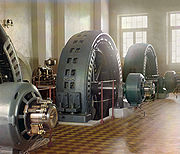
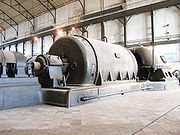
András Mechwart invented the hard cast rolling mill, which revolutionized the milling industry.
Miksa Déri
Miksa Déri
Miksa Déri was a Hungarian electrical engineer. He was, with his partners Károly Zipernowsky and Ottó Bláthy, co-inventor of the closed iron core transformer and the ZBD model AC electrical generator....
developed the repulsion motor for elevators of buildings with alternating current. He also participated in construction of Vienna's electric supply.
Whole his life, Ottó Titusz Bláthy worked at the Ganz Works. His basic job was the construction and patenting of induction flow meter of 1889 used today. (See Picture 3.) He invented the Turbogenerator in 1901. In the 1930s, he initiated the Hungarian production of turbogenerator known worldwide.
Invention of Serbian Nikola Tesla
Nikola Tesla
Nikola Tesla was a Serbian-American inventor, mechanical engineer, and electrical engineer...
, the short circuit rotary-field motor (induction motor) had significant importance in the field of alternating current. He patented it in the USA (1888), and he remembered that his idea had born during his activity in Budapest (1881–82).
Kálmán Kandó
Kálmán Kandó
Kálmán Kandó de Egerfarmos et Sztregova was a Hungarian engineer, and a pioneer in the development of electric railway traction.-Education:...
was the first who recognised that an electric train system can only be successful if it can use the electricity from public networks. After realising that, he also provided the means to build such a rail network by inventing a rotary phase converter suitable for locomotive usage. He developed high-voltage three phase alternating current motors and generators for electric locomotives; he is known as "the father of the electric train".
During World War I, Theodore Karman worked for Ganz Aeroplane factories as engineer, and eventually became head of research in the air force of Austria Hungary.
Theodore Karman (May 11, 1881 – May 7, 1963) was the inventor of the mathematical tools to study fluid flow, the mathematical background of supersonic flight, and the swept-back wing. He is often called "the father of Supersonic Flight" due to his work on the
stability of laminar flow
Laminar flow
Laminar flow, sometimes known as streamline flow, occurs when a fluid flows in parallel layers, with no disruption between the layers. At low velocities the fluid tends to flow without lateral mixing, and adjacent layers slide past one another like playing cards. There are no cross currents...
, turbulence
Turbulence
In fluid dynamics, turbulence or turbulent flow is a flow regime characterized by chaotic and stochastic property changes. This includes low momentum diffusion, high momentum convection, and rapid variation of pressure and velocity in space and time...
, airfoil
Airfoil
An airfoil or aerofoil is the shape of a wing or blade or sail as seen in cross-section....
s in steady and unsteady flow, boundary layer
Boundary layer
In physics and fluid mechanics, a boundary layer is that layer of fluid in the immediate vicinity of a bounding surface where effects of viscosity of the fluid are considered in detail. In the Earth's atmosphere, the planetary boundary layer is the air layer near the ground affected by diurnal...
s, and supersonic aerodynamics, largely taking place in the 1940s through 60s. He made additional contributions in other fields, including elasticity, vibration, heat transfer, and crystallography
Crystallography
Crystallography is the experimental science of the arrangement of atoms in solids. The word "crystallography" derives from the Greek words crystallon = cold drop / frozen drop, with its meaning extending to all solids with some degree of transparency, and grapho = write.Before the development of...
. His name appears in at least the following concepts:
- Foppl-von Kármán equations (large deflection of elastic plates)
- Born-von Kármán lattice modelBorn-von Karman boundary conditionThe Born–von Karman boundary condition is a set of boundary conditions which impose the restriction that a wave function must be periodic on a certain Bravais lattice....
(crystallography) - Chaplygin-Kármán-Tsien approximation (potential flow)
- Falkowich-Kármán equation (transonic flow)
- von Kármán constantVon Kármán constantIn fluid dynamics, the Von Kármán constant , named for Theodore von Kármán, is a dimensionless constant describing the logarithmic velocity profile of a turbulent fluid flow near a boundary with a no-slip condition...
(wall turbulence) - Kármán lineKarman lineThe Kármán line lies at an altitude of above the Earth's sea level, and is commonly used to define the boundary between the Earth's atmosphere and outer space...
(aerodynamics/astronautics) - Kármán-Howarth equationKármán-Howarth equationIn isotropic turbulence the Kármán-Howarth equation , which is derived from the Navier-Stokes equations, is used to describe the evolution of non-dimensional longitudinal autocorrelation.-See also:...
(turbulence) - Kármán-Nikuradse correlation (viscous flow; coauthored by Johann NikuradseJohann NikuradseJohann Nikuradse was a Georgia-born German engineer and physicist. His brother, Alexander Nikuradse, was also a Germany-based physicist and geopolitician known for his ties with Alfred Rosenberg and for his role in saving many Georgians during World War II.He was born in Samtredia, Georgia and...
) - Kármán-Pohlhausen parameter (boundary layers)
- Kármán-Treffz transformation (airfoil theory)
- Prandtl-von Kármán law (velocity in open channel flow)
- von Kármán integral equation (boundary layers)
- von Kármán ogive (supersonic aerodynamics)
- von Kármán vortex streetVon Kármán vortex streetA Kármán vortex street is a term in fluid dynamics for a repeating pattern of swirling vortices caused by the unsteady separation of flow of a fluid over bluff bodies...
(flow past cylinder) - von Kármán-Tsien compressibility correction
Internal combustion engines and vehicles
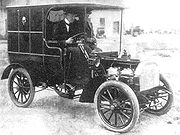
1889 the first four-stroke gas engine was built by the Ganz factory
1893 the manufacture of the paraffin- and petrol-fuelled engine with carburettor
1898 the start of the manufacture of the engines with the Bánki water injection system
1908 the introduction of a new petrol engine type, the series Am
1913 the manufacture of the Büssing petrol engines for truck vehicles
1914-1918 the manufacture of fighter plane engines
1916 the manufacture of petrol engines, type Fiat
1920 the usage of petrol engines for suction gas engine operation
1924 Mr. György JENDRASSIK started his engine development activity
1928 there was finished the first railway Diesel engine according to the plans of Ganz-Jendrassik
1929 the first export delivery of a railway engine according to the System of Ganz-Jendrassik
1934 there was an engine reliability World Competition in the USSR where the Ganz engine achieved the best consumption in its category
1944 the first application of the engine type XII JV 170/240 in the motor-train set
1953 modernization of the Diesel engines System Ganz-Jendrassik type
1959 the union of the Ganz factory and the MÁVAG company, establishing of the Ganz-MÁVAG
Railways
Évian-les-Bains
Évian-les-Bains or Évian is a commune in the northern part of the Haute-Savoie department in the Rhône-Alpes region in south-eastern France...
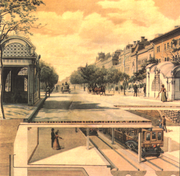
(Switzerland) with a 37 HP asynchronous traction system. The Ganz Works won the tender of electrification of railway of Valtellina Railways in 1897. Under the management and on the base of plans of Kálmán Kandó, three phase electric traction (two upper wires + rails) of feed 3 kV and 15 Hz - produced by a different power station - was realized for thirty years from 1902.
After World War I, in the frames of the Ganz Works, Kálmán Kandó constructed one-phase railway electric system of 16 kV and 50 Hz incipient all over the world. Its main attribute was the feed by normal network, so additional power station became unnecessary. Consequently, Hungarian electric traction could be formed according to the country's energy management. Kálmán Kandó adapted the speed-torque curve to electric traction through changing the phase number and pole number. Kálmán Kandó incorporated a phase shifter in the locomotives which governed speed levels.
Because of early death of Kálmán Kandó, László Verebély continued the work for the Hungarian Railways (MÁV). Moreover, he managed the construction of a nationwide power station (Bánhida) supplying as the railways as Budapest with electric power by transmission line of 110 kV. He elaborated the first plans of the nationwide cooperation of electric energy. In the 1930s he organized the Department of Electric Stations and Railways of the BMGE, so he became a professor of a significant branch of heavy current engineering.
In 1959 Ganz merged with the MÁVAG
MÁVAG
MÁVAG was a Hungarian rail vehicle producer. MÁVAG was the property of the Kingdom of Hungary. After the World War II MÁVAG was nationalized, and "Királyi" was removed from its name.The company employed thousands of workers. The buildings were in the VIII...
company and was renamed Ganz-MÁVAG.
Shipbuilding
World War I
World War I , which was predominantly called the World War or the Great War from its occurrence until 1939, and the First World War or World War I thereafter, was a major war centred in Europe that began on 28 July 1914 and lasted until 11 November 1918...
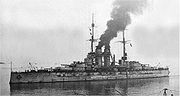
. Ganz was responsible for building the dreadnought Szent István
SMS Szent István
SMS Szent István was a dreadnought , the only one built in the Hungarian part of Austria-Hungary. The Ganz & Company's Danubius yard in Hungarian-owned Fiume was awarded the contract to build the battleship in return for the Hungarian government agreeing to the 1910 and 1911 naval budgets...
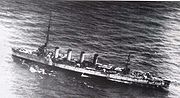
, supplied the machinery for the cruiser Novara
SMS Novara
Two ships of the Austro-Hungarian Navy have been named SMS Novara after the Battle of Novara :*SMS Novara , a sail frigate most noted for its 1857 - 1859 around-the-world scientific expedition, and also for carrying Archduke Maximillian to the Americas where he was proclaimed Maximilian I of...
, and built U-boat
U-boat
U-boat is the anglicized version of the German word U-Boot , itself an abbreviation of Unterseeboot , and refers to military submarines operated by Germany, particularly in World War I and World War II...
s at its shipyard in Budapest
Budapest
Budapest is the capital of Hungary. As the largest city of Hungary, it is the country's principal political, cultural, commercial, industrial, and transportation centre. In 2011, Budapest had 1,733,685 inhabitants, down from its 1989 peak of 2,113,645 due to suburbanization. The Budapest Commuter...
, for final assembly at Fiume. Several U-Boats of the U-27 class
U-27 class submarine (Austria-Hungary)
The U-27 class was a class of eight submarines or U-boats built for and operated by the Austro-Hungarian Navy during World War I. The class was based upon the German Type UB II design of the German Imperial Navy and was constructed under license in Austria-Hungary.After the Austro-Hungarian Navy...
were completed, and a number of other types were laid down, remaining incomplete at the war's end. The company built some ocean liners too.
Aircraft
The first Hungarian "aeroplane factory" was founded by Ganz Company and Weiss Manfréd Works in 1912.During World War I, the company made many types of Albatros and Fokker fighter planes. In 1917, the engineers of the company designed a radical motorized flying machine (named "P.K.Z.") to replace the dangerous hydrogen-filled balloons then being used to observe enemy positions. That early helicopter flew to a height of over 50 m. It was supported by 120 hp engines and two massive wooden propellers turning in opposite directions. It was intended to lift a pilot, observer, machine gun and fuel for an hour's flight. Because of great success and curious design, many specialists consider it as the world's first real helicopter.
The world's first turboprop jet was the Jendrassik Cs-1
Jendrassik Cs-1
The Jendrassik Cs-1 was the world's first working turboprop engine. It was designed by Hungarian engineer György Jendrassik in 1937, and was intended to power a Hungarian twin-engine heavy fighter, the RMI-1.-Design and development:...
designed by the Hungarian mechanical engineer György Jendrassik
György Jendrassik
György Jendrassik , Hungarian physicist and mechanical engineer.Jendrassik completed his education at Budapest's József Technical University, then at the University of Berlin attended lectures of the famous physicists Einstein and Planck. In 1922 he obtained his diploma in mechanical engineering in...
. It was produced and tested in the Ganz factory in Budapest between 1939 and 1942. It was planned to fit to the Varga RMI-1 X/H twin-engined reconnaissance bomber designed by László Varga in 1940, but the program was cancelled. Jendrassik had also designed a small-scale 75 kW turboprop in 1937.
Rail Rolling Stock
OnTrack
OnTrack was a regional rail line that operated in Syracuse, New York from 1994 to 2007. During its operation, Syracuse was the smallest city in the United States to have regional train service. The line ran from Colvin Street on the city's south side via Syracuse University and Armory Square to the...
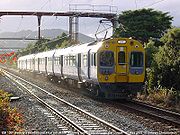
for Wellington suburban services. The order was made in 1979, and was for 44 powered units and 44 trailer units, see NZR EM class.
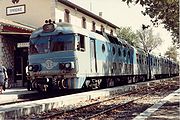
In 1976 Ganz-Mávag supplied ten (standard gauge
Standard gauge
The standard gauge is a widely-used track gauge . Approximately 60% of the world's existing railway lines are built to this gauge...
) 3-car diesel trainset to the Hellenic Railways Organisation (OSE), designated as Class AA-91 and four (metric gauge
Metre gauge
Metre gauge refers to narrow gauge railways and tramways with a track gauge of . In some African, American and Asian countries it is the main gauge. In Europe it has been used for local railways in France, Germany, and Belgium, most of which were closed down in mid 20th century. Only in Switzerland...
) 4-car trainsets, designated as Class A-6451. In 1981-82 Ganz-Mávag supplied to OSE 11 B-B diesel-hydraulic DHM7-9 locomotives, designated as class A-251. Finally, in 1983, OSE bought eleven 3-car metric gauge trainsets, designated as Class A-6461. All these locomotives and trainsets have been withdrawn with the exception of one standard and one metric gauge trainset.
After World War II
In 1946, the Ganz Works were nationalised and in 1949 they became independent and six big companies came into existence, e.g. the Ganz Transformer Factory. In 1959, Ganz Wagon and Machine Factory merged with the famous MÁVAG Locomotive and Machine Factory under the name of Ganz-MÁVAG Locomotive, Wagon and Machine Works. Of the products of the Works, outstanding results were born in the field of the manufacture of diesel motor-railcars and motor trains. Traditional products included tramcars as well, with which, first of all, the tramway network of Budapest was provided by the Works. In the meantime the Foundry workshop was closed down.In 1974, the locomotive and wagon Works were merged under the name of Railway Vehicle Factory and then the machine construction branch of went through significant developments. The production of industrial and apartment house lifts became a new branch. Ganz-MÁVAG took over a lot of smaller plants in the 1960s and 1970s and their product range was extended. Besides others, they increased their bridge-building capacity; they made iron structures for several Tisza Bridges, for the Erzsébet Bridge in Budapest, for public road bridges in Yugoslavia and for several industrial halls.
The Ganz Shipyard experienced its most stirring times during the four decades following nationalisation: in the course of this period 1100 ship units were produced, the number of the completed seagoing ships was 240 and that of floating cranes was 663. As a result of the great economic and social crises of the 1980s the Ganz-MÁVAG had to be reorganised. The company was transformed into seven independent Works and three joint ventures.
In 1989, the British company Telfos Holding gained a majority of the shares in Ganz Railway Vehicle Factory Co. Ltd. The name of the company was changed to Ganz-Hunslet Co. Ltd. In the course of 1991 and 1992, the Austrian company Jenbacher Werke obtained 100% of the companys shares and consequently the railway vehicle factory now is a member of the international railway vehicle manufacturing group, Jenbacher Transport Systeme. At present, the Ganz Electric Works, under the name of Ganz-Ansaldo is a member of the Italian industrial giant, Ansaldo. The Ganz Works were transformed into holdings. Ganz-Danubius was wound up in 1994. The Ganz Electric Meter Factory in Gödöllő became the member of the international Schlumberger group.