

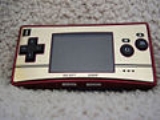
Game Boy Micro

Encyclopedia
is a handheld game console
developed and manufactured by Nintendo
. It was first released in September 2005 in the market. The system is the last console of the Game Boy line
. The Micro is very small in size and has a sleek design.
, but with an updated form factor. It is unable to play original Game Boy
and Game Boy Color
games, and is officially incompatible with the Nintendo e-Reader and some other peripherals due to design issues (the required Zilog Z80 chip is not included, as it was on the Game Boy Advance and Game Boy Advance SP). It is smaller than previous Game Boy systems. Additionally, it features a backlit screen with the ability to adjust the brightness so as to adapt to lighting. The shape itself is kept to a more simple oblong—similar to the style of the Nintendo Entertainment System
controller.
The Game Boy Micro features a removable face plate that allows consumers to purchase alternative designs.
The Game Boy Micro has a two-way switch on its right side for adjusting volume up or down. By holding down the L shoulder button, the switch can also be used to adjust the backlight between five levels of brightness.
Game Paks.
According to the Game Boy Micro's Instruction Manual, the following games/accessories are not compatible with the Game Boy Micro system:
While Game Boy or Game Boy Advance Game Link cables and the Game Boy Advance Wireless Adapter are not compatible with the Game Boy Micro system, adapters and a Game Boy Micro-compatible Wireless adapter have been released. Nintendo has also redesigned their Play-Yan
music/video adapter to better fit the Game Boy Micro. This device can play MP3 and digital video files from SD cards.
As with the Game Boy Advance and Game Boy Advance SP systems, there are no regional lockouts on software, so North American
games can be played on Japanese
or European
hardware and vice versa.
video game console
's controller, a blue bodied model with a faceplate based on Final Fantasy IV
, a red bodied and red faced edition for the release of the game Mother 3
and a red bodied model with a black faceplate containing the silhouette of the iconic Pikachu
from the Pokémon
franchise.
In the United States and Canada, the Game Boy Micro is available in two regular colors, each sold with three interchangeable faceplates included: silver with black, "Ammonite" and "Ladybug" faceplates, and black with silver, "Flame" and "Camouflage" faceplates. The "20th Anniversary" edition was released in December , which resembles the Famicom
controller.
In Europe the Game Boy Micro is available in four different colors, with one matching faceplate: silver, green, blue and pink. In Australia the colors are silver, black, blue, red and pink.
There are reportedly no plans to sell additional faceplates in the US retail locations (as indicated in the letter page in issue 200 of Nintendo Power
) or the UK. Nintendo of Europe cannot supply replacement faceplates of any kind, and the feature is omitted from the product's marketing, packaging, and manual in Europe. However, some third parties are manufacturing such faceplates for sale in the US and Europe, and some importers stock faceplates acquired from Japan. Nintendo of America sells some of the faceplates individually online.
Satoru Iwata
stated that the marketing of the Nintendo DS
"must have deprived the Game Boy Micro of its momentum" in the marketplace and he admitted that Game Boy Micro sales did not meet Nintendo's expectations, commenting it "failed to explain to consumers its unique value".
99, compared to US$79 for the Game Boy Advance SP
. The system was originally available in black and silver, and a red 20th Anniversary Edition was later released to commemorate the 20th anniversary of the Nintendo Entertainment system.
screen, which is superior to the original Game Boy Advance SP's (a later remodel added a similar high quality screen to SP systems), has been praised for its visibility. Due to a finer dot pitch
, the screen is more evenly lit, and the brightness is adjustable. The smaller dot pitch has also improved the apparent sharpness of the display.
The removable faceplates have also been praised because they allow for personalization and protect the high-resolution backlit screen."
Handheld game console
A handheld game console is a lightweight, portable electronic device with a built-in screen, game controls and speakers. Handheld game consoles are run on machines of small size allowing people to carry them and play them at any time or place...
developed and manufactured by Nintendo
Nintendo
is a multinational corporation located in Kyoto, Japan. Founded on September 23, 1889 by Fusajiro Yamauchi, it produced handmade hanafuda cards. By 1963, the company had tried several small niche businesses, such as a cab company and a love hotel....
. It was first released in September 2005 in the market. The system is the last console of the Game Boy line
Game Boy line
The line is a line of battery-powered handheld game console sold by Nintendo. It is one of the world's best-selling game system lines with a combined 200+ million units sold worldwide....
. The Micro is very small in size and has a sleek design.
History
The Game Boy Micro was officially unveiled by Nintendo of America's (then) vice president of sales and marketing, Reggie Fils-Aime, at the company's E3 press conference on May 17, 2005. The system was released in Japan on September 13, 2005 and in North America on September 19, 2005. It was released in Europe on November 4, 2005 and Australia on November 3, 2005. In China, it was marketed as "iQue Game Boy Micro" on October 1, 2005, and later released in South Korea on November 9, 2005. It is the final handheld console to use the Game Boy name.Design and specifications
The Game Boy Micro retains some of the functionality of the Game Boy Advance SPGame Boy Advance SP
The , released in February 2003, is an upgraded version of Nintendo's Game Boy Advance. The "SP" in Game Boy Advance SP stands for Special. The SP was marketed at US$99.99 at launch. In September 2004, Nintendo lowered the price to US$79.99...
, but with an updated form factor. It is unable to play original Game Boy
Game Boy
The , is an 8-bit handheld video game device developed and manufactured by Nintendo. It was released in Japan on , in North America in , and in Europe on...
and Game Boy Color
Game Boy Color
The is Nintendo's successor to the 8-bit Game Boy handheld game console, and was released on October 21, 1998 in Japan, November 19, 1998 in North America, November 23, 1998 in Europe and November 27, 1998 in the United Kingdom. It features a color screen and is slightly thicker and taller than...
games, and is officially incompatible with the Nintendo e-Reader and some other peripherals due to design issues (the required Zilog Z80 chip is not included, as it was on the Game Boy Advance and Game Boy Advance SP). It is smaller than previous Game Boy systems. Additionally, it features a backlit screen with the ability to adjust the brightness so as to adapt to lighting. The shape itself is kept to a more simple oblong—similar to the style of the Nintendo Entertainment System
Nintendo Entertainment System
The Nintendo Entertainment System is an 8-bit video game console that was released by Nintendo in North America during 1985, in Europe during 1986 and Australia in 1987...
controller.
The Game Boy Micro features a removable face plate that allows consumers to purchase alternative designs.
- Dimensions: 50×101×17.2 millimeters (2×4×0.7 in)
- Weight: 80 grams (2.8 ounces)
- Processor: 32-bit 16.8 MHz ARM processor (ARM7TDMI)
- Colors: various
- Screen: 51 mm / 2 inches, backlight with adjustable brightness.
- Resolution: 240×160 pixelPixelIn digital imaging, a pixel, or pel, is a single point in a raster image, or the smallest addressable screen element in a display device; it is the smallest unit of picture that can be represented or controlled....
s - Battery: built-in rechargeable lithium-ion battery, up to 5 hours of battery life with top brightness and sound or 8 hours with both features on default
- Headphones: standard 3.5mm headphone jack
The Game Boy Micro has a two-way switch on its right side for adjusting volume up or down. By holding down the L shoulder button, the switch can also be used to adjust the backlight between five levels of brightness.
Software and hardware
The Game Boy Micro is compatible with Game Boy Advance games, including Game Boy Advance VideoGame Boy Advance Video
Game Boy Advance Video is a format for putting video onto Game Boy Advance cartridges. The video is played using the game system's screen and sound hardware. These video cartridges are from Majesco Sales, but the Pokémon video cartridges were published by Nintendo. The video cartridges are colored...
Game Paks.
According to the Game Boy Micro's Instruction Manual, the following games/accessories are not compatible with the Game Boy Micro system:
- Original Game Boy Game Paks
- Game Boy Color Game Paks
- Game Boy or Game Boy Advance Game Link cables
- Game Boy Advance Wireless Adapter
- Game Boy Advance e-Reader
- Nintendo GameCube Game Boy Advance cable
- Game Boy Printer
- Game Boy Camera
While Game Boy or Game Boy Advance Game Link cables and the Game Boy Advance Wireless Adapter are not compatible with the Game Boy Micro system, adapters and a Game Boy Micro-compatible Wireless adapter have been released. Nintendo has also redesigned their Play-Yan
Play-Yan
The Play-Yan is a media player for the Nintendo DS/Game Boy Advance. It uses SD flash memory to play MP3 audio files and H.264/MPEG-4 AVC video files. It can also play 13 bonus mini-games, 12 of which are available freely on the Nintendo website in Japan and one is limited to ClubNintendo members...
music/video adapter to better fit the Game Boy Micro. This device can play MP3 and digital video files from SD cards.
As with the Game Boy Advance and Game Boy Advance SP systems, there are no regional lockouts on software, so North American
NTSC
NTSC, named for the National Television System Committee, is the analog television system that is used in most of North America, most of South America , Burma, South Korea, Taiwan, Japan, the Philippines, and some Pacific island nations and territories .Most countries using the NTSC standard, as...
games can be played on Japanese
NTSC-J
NTSC-J is an analog television system and video display standard for the region of Japan.While NTSC-M is an official standard, "J" is more a colloquial indicator as used in Marketing definition but not an official term.-Technical definition:...
or European
PAL
PAL, short for Phase Alternating Line, is an analogue television colour encoding system used in broadcast television systems in many countries. Other common analogue television systems are NTSC and SECAM. This page primarily discusses the PAL colour encoding system...
hardware and vice versa.
Packaging
In Japan, the handheld has been released in four colors and styles each. The four colors are black, blue, purple, and silver. The Game Boy Micro also has four limited edition styles: one based on the original FamicomNintendo Entertainment System
The Nintendo Entertainment System is an 8-bit video game console that was released by Nintendo in North America during 1985, in Europe during 1986 and Australia in 1987...
video game console
Video game console
A video game console is an interactive entertainment computer or customized computer system that produces a video display signal which can be used with a display device to display a video game...
's controller, a blue bodied model with a faceplate based on Final Fantasy IV
Final Fantasy IV
is a role-playing video game developed and published by Square in 1991 as a part of the Final Fantasy series. The game was originally released for the Super Famicom in Japan and has since then been rereleased for many other platforms with varying modifications. An enhanced remake with 3D graphics...
, a red bodied and red faced edition for the release of the game Mother 3
Mother 3
Mother 3 is a role-playing video game developed by Nintendo, Brownie Brown and HAL Laboratory, and published for the Game Boy Advance handheld game console. It has only been released in Japan, alongside a limited supply bundle. It is the third video game in the Mother series, following EarthBound...
and a red bodied model with a black faceplate containing the silhouette of the iconic Pikachu
Pikachu
is one of the species of Pokémon creatures from the Pokémon media franchise—a collection of video games, anime, manga, books, trading cards, and other media created by Satoshi Tajiri. As do all Pokémon, Pikachu fight other Pokémon in battles central to the anime, manga, and games of the series...
from the Pokémon
Pokémon
is a media franchise published and owned by the video game company Nintendo and created by Satoshi Tajiri in 1996. Originally released as a pair of interlinkable Game Boy role-playing video games developed by Game Freak, Pokémon has since become the second most successful and lucrative video...
franchise.
In the United States and Canada, the Game Boy Micro is available in two regular colors, each sold with three interchangeable faceplates included: silver with black, "Ammonite" and "Ladybug" faceplates, and black with silver, "Flame" and "Camouflage" faceplates. The "20th Anniversary" edition was released in December , which resembles the Famicom
Nintendo Entertainment System
The Nintendo Entertainment System is an 8-bit video game console that was released by Nintendo in North America during 1985, in Europe during 1986 and Australia in 1987...
controller.
In Europe the Game Boy Micro is available in four different colors, with one matching faceplate: silver, green, blue and pink. In Australia the colors are silver, black, blue, red and pink.
There are reportedly no plans to sell additional faceplates in the US retail locations (as indicated in the letter page in issue 200 of Nintendo Power
Nintendo Power
Nintendo Power magazine is a monthly news and strategy magazine formerly published in-house by Nintendo of America, but now run independently. As of issue #222 , Nintendo contracted publishing duties to Future US, the U.S. subsidiary of British publisher Future.The first issue published was...
) or the UK. Nintendo of Europe cannot supply replacement faceplates of any kind, and the feature is omitted from the product's marketing, packaging, and manual in Europe. However, some third parties are manufacturing such faceplates for sale in the US and Europe, and some importers stock faceplates acquired from Japan. Nintendo of America sells some of the faceplates individually online.
Release and sales
| Date | Japan | Americas | Other | Total |
|---|---|---|---|---|
| 2005-09-30 | 0.41 million | 0.29 million | 0 | 0.70 million |
| 2005-12-31 | 0.57 million | 0.47 million | 0.78 million | 1.82 million |
| 2006-03-31 | 0.58 million | 0.47 million | 0.79 million | 1.83 million |
| 2006-06-30 | 0.59 million | 0.47 million | 0.80 million | 1.86 million |
| 2006-09-30 | 0.59 million | 0.47 million | 0.80 million | 1.87 million |
| 2006-12-31 | 0.60 million | 0.96 million | 0.85 million | 2.40 million |
| 2007-03-31 | 0.61 million | 0.95 million | 0.87 million | 2.42 million |
- The Game Boy Micro sold over 170,000 units during its first days in JapanJapanJapan is an island nation in East Asia. Located in the Pacific Ocean, it lies to the east of the Sea of Japan, China, North Korea, South Korea and Russia, stretching from the Sea of Okhotsk in the north to the East China Sea and Taiwan in the south...
. - The North AmericaNorth AmericaNorth America is a continent wholly within the Northern Hemisphere and almost wholly within the Western Hemisphere. It is also considered a northern subcontinent of the Americas...
n release drew some criticism; with a formal release of September 19, 2005, many stores simply ignored it, some delaying it until September 26, 2005 or as late as September 30, 2005. - According to a Q1 2007 NintendoNintendois a multinational corporation located in Kyoto, Japan. Founded on September 23, 1889 by Fusajiro Yamauchi, it produced handmade hanafuda cards. By 1963, the company had tried several small niche businesses, such as a cab company and a love hotel....
earnings release, 2.42 million Game Boy Micro units had been sold worldwide as of March 31, 2007, including 610,000 units in Japan, 950,000 units in the Americas, and 870,000 in other territories such as EuropeEuropeEurope is, by convention, one of the world's seven continents. Comprising the westernmost peninsula of Eurasia, Europe is generally 'divided' from Asia to its east by the watershed divides of the Ural and Caucasus Mountains, the Ural River, the Caspian and Black Seas, and the waterways connecting...
and OceaniaOceaniaOceania is a region centered on the islands of the tropical Pacific Ocean. Conceptions of what constitutes Oceania range from the coral atolls and volcanic islands of the South Pacific to the entire insular region between Asia and the Americas, including Australasia and the Malay Archipelago...
. - On July 30, 2007, GameProGameProGamePro Media was a United States gaming media company publishing online and print content on the video game industry, video game hardware, and video game software developed for a video game console , a computer, and/or a mobile device . GamePro Media properties include GamePro magazine and...
.com ranked the Game Boy Micro (listed as "GB Micro") as #8 in its list of "The 10 Worst-Selling Handhelds of All Time". - As of July 30, 2007, the Game Boy Micro has sold 2.5 million units, according to GameProGameProGamePro Media was a United States gaming media company publishing online and print content on the video game industry, video game hardware, and video game software developed for a video game console , a computer, and/or a mobile device . GamePro Media properties include GamePro magazine and...
. - Generally, the Game Boy Micro did not sell well, and failed to reach the company's aim of units sold.
Satoru Iwata
Satoru Iwata
is the fourth president of Nintendo, succeeding the long-standing previous president of the company, Hiroshi Yamauchi in 2002. He was responsible in great part for defining Nintendo's strategy both before and during the release of its Nintendo GameCube video game console in 2001, a vision which...
stated that the marketing of the Nintendo DS
Nintendo DS
The is a portable game console produced by Nintendo, first released on November 21, 2004. A distinctive feature of the system is the presence of two separate LCD screens, the lower of which is a touchscreen, encompassed within a clamshell design, similar to the Game Boy Advance SP...
"must have deprived the Game Boy Micro of its momentum" in the marketplace and he admitted that Game Boy Micro sales did not meet Nintendo's expectations, commenting it "failed to explain to consumers its unique value".
Price history
The system retailed for US$United States dollar
The United States dollar , also referred to as the American dollar, is the official currency of the United States of America. It is divided into 100 smaller units called cents or pennies....
99, compared to US$79 for the Game Boy Advance SP
Game Boy Advance SP
The , released in February 2003, is an upgraded version of Nintendo's Game Boy Advance. The "SP" in Game Boy Advance SP stands for Special. The SP was marketed at US$99.99 at launch. In September 2004, Nintendo lowered the price to US$79.99...
. The system was originally available in black and silver, and a red 20th Anniversary Edition was later released to commemorate the 20th anniversary of the Nintendo Entertainment system.
Reception
The Game Boy Micro's backlitBacklight
A backlight is a form of illumination used in liquid crystal displays . As LCDs do not produce light themselves , they need illumination to produce a visible image...
screen, which is superior to the original Game Boy Advance SP's (a later remodel added a similar high quality screen to SP systems), has been praised for its visibility. Due to a finer dot pitch
Dot pitch
Dot pitch is a specification for a computer display, computer printer, image scanner, or other pixel-based device that describes the distance, for example, between dots of the same color on the inside of a display screen...
, the screen is more evenly lit, and the brightness is adjustable. The smaller dot pitch has also improved the apparent sharpness of the display.
The removable faceplates have also been praised because they allow for personalization and protect the high-resolution backlit screen."
External links
- Official North American website
- Game Boy Advance at Nintendo.com (archived versions at the Internet Archive Wayback Machine)
- Nintendo's Game Boy Micro FAQ