


GNU

Encyclopedia
GNU
is a Unix-like
computer operating system
developed by the GNU project
, ultimately aiming to be a "complete Unix
-compatible software system"
composed wholly of free software
. Development of GNU was initiated by Richard Stallman
in 1983 and was the original focus of the Free Software Foundation
(FSF), but no stable release of GNU yet exists as of September 2010. The latest alpha release of the GNU system is GNU 0.401, released on 1 April 2011, featuring GNU Hurd
as the system's kernel
. Other (non-GNU) kernels, most famously the Linux kernel
, can also be used with GNU. The FSF maintains that Linux
, when used with GNU tools and utilities, should be considered a variant of GNU
, and promotes the term GNU/Linux for such systems, (leading to the GNU/Linux naming controversy
).
GNU is a recursive acronym
for "GNU's Not Unix!", chosen because GNU's design is Unix-like
, but differs from Unix by being free software and containing no Unix
code. Programs released under the auspices of the GNU Project
are called GNU packages or GNU programs. The system's basic components include the GNU Compiler Collection
(GCC), the GNU Binary Utilities
(binutils), the bash shell, the GNU C library
(glibc), and GNU Core Utilities
(coreutils). GNU developers have contributed Linux ports of GNU applications and utilities, which are now also widely used on other operating systems such as BSD
variants, Solaris
and Mac OS X
.
The GNU General Public License
(GPL), the GNU Lesser General Public License
(LGPL), and the GNU Free Documentation License
(GFDL) were written for GNU, but are also used by many unrelated projects. A minority of the software used by GNU, such as the X Window System
, is licensed under permissive free software licenses.
Richard Stallman views GNU as a "technical means to a social end".
s by Richard Stallman
. Software development began on January 5, 1984, when Stallman quit his job at the Massachusetts Institute of Technology
(MIT) Artificial Intelligence Laboratory so that they could not claim ownership or interfere with distributing GNU as free software. Richard Stallman chose the name by using various plays on words, including the song The Gnu
.
The goal was to bring a wholly free software operating system into existence. Stallman wanted computer users to be "free", as most were in the 1960s and 1970s – free to study the source code of the software they use, free to share the software with other people, free to modify the behaviour of the software, and free to publish their modified versions of the software. This philosophy was later published as the GNU Manifesto
in March 1985.
Richard Stallman's experience with the Incompatible Timesharing System
(ITS), an early operating system written in assembly language
that became obsolete due to discontinuation of PDP-10
, the computer architecture for which ITS was written, led to a decision that a portable
system was necessary. It was thus decided that GNU would be mostly compatible with Unix. At the time, Unix was already a popular proprietary
operating system. The design of Unix had proven to be solid, and it was modular, so it could be reimplemented piece by piece.
Much of the needed software had to be written from scratch, but existing compatible third-party free software components were also used such as the TeX
typesetting system, the X Window System
, and the Mach
microkernel that forms the basis of the GNU Mach
core of GNU Hurd
(the official kernel of GNU). With the exception of the aforementioned third-party components, most of GNU has been written by volunteers of the GNU Project
; some in their spare time, some paid by companies, educational institutions, and other non-profit organizations. In October 1985, Stallman set up the Free Software Foundation
(FSF). In the late 1980s and 1990s, the FSF hired software developers to write the software needed for GNU.
As GNU gained prominence, interested businesses began contributing to development or selling GNU software and technical support. The most prominent and successful of these was Cygnus Solutions
, now part of Red Hat
.
Copyright law grants the copyright-holder significant control over the copying and distributing of a work, but FSF wrote a license for the GNU software which grant recipients permission to copy and redistribute the software under highly permissive terms. For most of the 80s, each GNU package had its own license: the Emacs General Public License, the GCC General Public License, et cetera. In 1989, FSF published a single license they could use for all their software, and which could be used by non-GNU projects: the GNU General Public License
(GPL).
This license is now used by most GNU programs, as well as a large number of free software programs that are not part of the GNU project; it is the most commonly used free software license. It gives all recipients of a program the right to run, copy, modify and distribute it, while forbidding them from imposing further restrictions on any copies they distribute. This idea is often referred to as copyleft
.
In 1991, the GNU Lesser General Public License
(LGPL), then known as the Library General Public License, was written for certain libraries. 1991 also saw the release of version 2 of the GNU GPL. The GNU Free Documentation License
(FDL), for documentation, followed in 2000. The GPL and LGPL were revised to version 3 in 2007, improving their international applicability, and adding protection for users whose hardware restricts software changes.
Most GNU software is distributed under the GPL. A minority is distributed under the LGPL, and a handful of packages are distributed under permissive free software licences.
(GCC), the GNU C Library
(glibc), the GNU Emacs text editor
, and the GNOME
desktop environment
.
Many GNU programs have been ported to a multitude of other operating systems, including various proprietary
platforms such as Microsoft Windows
and Mac OS X
. They are often installed on proprietary Unix systems as replacements for the proprietary utilities originally included. However, this practice is controversial: these GNU component programs were developed with the goal of replacing entire proprietary UNIX systems with free software, not enhancing these systems.
Many GNU programs have been tested against their proprietary Unix counterparts and shown as being more reliable.
As of 2007, there are a total of 319 GNU packages hosted on the official GNU development site.
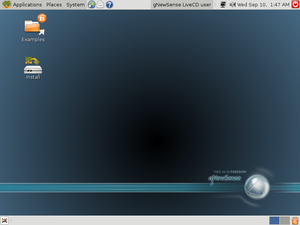 Although the official kernel of GNU is the GNU Hurd
microkernel, variants using other kernels have been developed. Usage with the Linux kernel
, a monolithic kernel
, is by far the most popular distribution-vector for GNU software, though unlike Hurd, the Linux kernel itself is not part of the GNU Project, though the GNU Project has endorsed variants using the Linux kernel, such as gNewSense
.
Other GNU variants which do not use the Hurd
as a kernel include Nexenta OS
(GNU plus the kernel of OpenSolaris
) and GNU-Darwin
. Debian GNU/kFreeBSD and Debian GNU/NetBSD from Debian
bring the early plan of GNU on a BSD kernel full circle. (The Debian project distributes GNU itself as Debian GNU/Hurd
.)
head. The well-known drawing was originally done by Etienne Suvasa. A bolder and simpler version designed by Aurelio Heckert is now preferred. It appears in GNU software and in printed and electronic documentation for the GNU project, and is also used in Free Software Foundation materials.
is a Unix-like
Unix-like
A Unix-like operating system is one that behaves in a manner similar to a Unix system, while not necessarily conforming to or being certified to any version of the Single UNIX Specification....
computer operating system
Operating system
An operating system is a set of programs that manage computer hardware resources and provide common services for application software. The operating system is the most important type of system software in a computer system...
developed by the GNU project
GNU Project
The GNU Project is a free software, mass collaboration project, announced on September 27, 1983, by Richard Stallman at MIT. It initiated GNU operating system development in January, 1984...
, ultimately aiming to be a "complete Unix
Unix
Unix is a multitasking, multi-user computer operating system originally developed in 1969 by a group of AT&T employees at Bell Labs, including Ken Thompson, Dennis Ritchie, Brian Kernighan, Douglas McIlroy, and Joe Ossanna...
-compatible software system"
composed wholly of free software
Free software
Free software, software libre or libre software is software that can be used, studied, and modified without restriction, and which can be copied and redistributed in modified or unmodified form either without restriction, or with restrictions that only ensure that further recipients can also do...
. Development of GNU was initiated by Richard Stallman
Richard Stallman
Richard Matthew Stallman , often shortened to rms,"'Richard Stallman' is just my mundane name; you can call me 'rms'"|last= Stallman|first= Richard|date= N.D.|work=Richard Stallman's homepage...
in 1983 and was the original focus of the Free Software Foundation
Free Software Foundation
The Free Software Foundation is a non-profit corporation founded by Richard Stallman on 4 October 1985 to support the free software movement, a copyleft-based movement which aims to promote the universal freedom to create, distribute and modify computer software...
(FSF), but no stable release of GNU yet exists as of September 2010. The latest alpha release of the GNU system is GNU 0.401, released on 1 April 2011, featuring GNU Hurd
GNU Hurd
GNU Hurd is a free software Unix-like replacement for the Unix kernel, released under the GNU General Public License. It has been under development since 1990 by the GNU Project of the Free Software Foundation...
as the system's kernel
Kernel (computing)
In computing, the kernel is the main component of most computer operating systems; it is a bridge between applications and the actual data processing done at the hardware level. The kernel's responsibilities include managing the system's resources...
. Other (non-GNU) kernels, most famously the Linux kernel
Linux kernel
The Linux kernel is an operating system kernel used by the Linux family of Unix-like operating systems. It is one of the most prominent examples of free and open source software....
, can also be used with GNU. The FSF maintains that Linux
Linux
Linux is a Unix-like computer operating system assembled under the model of free and open source software development and distribution. The defining component of any Linux system is the Linux kernel, an operating system kernel first released October 5, 1991 by Linus Torvalds...
, when used with GNU tools and utilities, should be considered a variant of GNU
GNU variants
GNU variants is a term used by the Free Software Foundation and others to refer to operating systems which use application software and system libraries from GNU.- Hurd variants :...
, and promotes the term GNU/Linux for such systems, (leading to the GNU/Linux naming controversy
GNU/Linux naming controversy
The GNU/Linux naming controversy is a dispute among members of the free and open source software community over how to refer to the computer operating system commonly called Linux....
).
GNU is a recursive acronym
Recursive acronym
A recursive acronym is an acronym or initialism that refers to itself in the expression for which it stands...
for "GNU's Not Unix!", chosen because GNU's design is Unix-like
Unix-like
A Unix-like operating system is one that behaves in a manner similar to a Unix system, while not necessarily conforming to or being certified to any version of the Single UNIX Specification....
, but differs from Unix by being free software and containing no Unix
Unix
Unix is a multitasking, multi-user computer operating system originally developed in 1969 by a group of AT&T employees at Bell Labs, including Ken Thompson, Dennis Ritchie, Brian Kernighan, Douglas McIlroy, and Joe Ossanna...
code. Programs released under the auspices of the GNU Project
GNU Project
The GNU Project is a free software, mass collaboration project, announced on September 27, 1983, by Richard Stallman at MIT. It initiated GNU operating system development in January, 1984...
are called GNU packages or GNU programs. The system's basic components include the GNU Compiler Collection
GNU Compiler Collection
The GNU Compiler Collection is a compiler system produced by the GNU Project supporting various programming languages. GCC is a key component of the GNU toolchain...
(GCC), the GNU Binary Utilities
GNU Binary Utilities
The GNU Binary Utilities, or binutils, comprise a collection of programming tools for the manipulation of object code in various object file formats. The current versions were originally written by programmers at Cygnus Solutions using the Binary File Descriptor library...
(binutils), the bash shell, the GNU C library
GNU C Library
The GNU C Library, commonly known as glibc, is the C standard library released by the GNU Project. Originally written by the Free Software Foundation for the GNU operating system, the library's development has been overseen by a committee since 2001, with Ulrich Drepper from Red Hat as the lead...
(glibc), and GNU Core Utilities
GNU Core Utilities
The GNU Core Utilities or coreutils is a package of GNU software containing many of the basic tools, such as cat, ls, and rm, needed for Unix-like operating systems...
(coreutils). GNU developers have contributed Linux ports of GNU applications and utilities, which are now also widely used on other operating systems such as BSD
Berkeley Software Distribution
Berkeley Software Distribution is a Unix operating system derivative developed and distributed by the Computer Systems Research Group of the University of California, Berkeley, from 1977 to 1995...
variants, Solaris
Solaris Operating System
Solaris is a Unix operating system originally developed by Sun Microsystems. It superseded their earlier SunOS in 1993. Oracle Solaris, as it is now known, has been owned by Oracle Corporation since Oracle's acquisition of Sun in January 2010....
and Mac OS X
Mac OS X
Mac OS X is a series of Unix-based operating systems and graphical user interfaces developed, marketed, and sold by Apple Inc. Since 2002, has been included with all new Macintosh computer systems...
.
The GNU General Public License
GNU General Public License
The GNU General Public License is the most widely used free software license, originally written by Richard Stallman for the GNU Project....
(GPL), the GNU Lesser General Public License
GNU Lesser General Public License
The GNU Lesser General Public License or LGPL is a free software license published by the Free Software Foundation . It was designed as a compromise between the strong-copyleft GNU General Public License or GPL and permissive licenses such as the BSD licenses and the MIT License...
(LGPL), and the GNU Free Documentation License
GNU Free Documentation License
The GNU Free Documentation License is a copyleft license for free documentation, designed by the Free Software Foundation for the GNU Project. It is similar to the GNU General Public License, giving readers the rights to copy, redistribute, and modify a work and requires all copies and...
(GFDL) were written for GNU, but are also used by many unrelated projects. A minority of the software used by GNU, such as the X Window System
X Window System
The X window system is a computer software system and network protocol that provides a basis for graphical user interfaces and rich input device capability for networked computers...
, is licensed under permissive free software licenses.
Richard Stallman views GNU as a "technical means to a social end".
History
The plan for the GNU operating system was publicly announced on September 27, 1983, on the net.unix-wizards and net.usoft newsgroupNewsgroup
A usenet newsgroup is a repository usually within the Usenet system, for messages posted from many users in different locations. The term may be confusing to some, because it is usually a discussion group. Newsgroups are technically distinct from, but functionally similar to, discussion forums on...
s by Richard Stallman
Richard Stallman
Richard Matthew Stallman , often shortened to rms,"'Richard Stallman' is just my mundane name; you can call me 'rms'"|last= Stallman|first= Richard|date= N.D.|work=Richard Stallman's homepage...
. Software development began on January 5, 1984, when Stallman quit his job at the Massachusetts Institute of Technology
Massachusetts Institute of Technology
The Massachusetts Institute of Technology is a private research university located in Cambridge, Massachusetts. MIT has five schools and one college, containing a total of 32 academic departments, with a strong emphasis on scientific and technological education and research.Founded in 1861 in...
(MIT) Artificial Intelligence Laboratory so that they could not claim ownership or interfere with distributing GNU as free software. Richard Stallman chose the name by using various plays on words, including the song The Gnu
The Gnu
"The Gnu" is a humorous song about a talking gnu by Flanders and Swann.The word gnu is consistently pronounced with two syllables as "g-noo", with the g clearly enunciated, and the n unpalatalised...
.
The goal was to bring a wholly free software operating system into existence. Stallman wanted computer users to be "free", as most were in the 1960s and 1970s – free to study the source code of the software they use, free to share the software with other people, free to modify the behaviour of the software, and free to publish their modified versions of the software. This philosophy was later published as the GNU Manifesto
GNU Manifesto
The GNU Manifesto was written by Richard Stallman and published in March 1985 in Dr. Dobb's Journal of Software Tools as an explanation and definition of the goals of the GNU Project, and to call for participation and support. It is held in high regard within the free software movement as a...
in March 1985.
Richard Stallman's experience with the Incompatible Timesharing System
Incompatible Timesharing System
ITS, the Incompatible Timesharing System , was an early, revolutionary, and influential time-sharing operating system from MIT; it was developed principally by the Artificial Intelligence Laboratory at MIT, with some help from Project MAC.In addition to being technically influential ITS, the...
(ITS), an early operating system written in assembly language
Assembly language
An assembly language is a low-level programming language for computers, microprocessors, microcontrollers, and other programmable devices. It implements a symbolic representation of the machine codes and other constants needed to program a given CPU architecture...
that became obsolete due to discontinuation of PDP-10
PDP-10
The PDP-10 was a mainframe computer family manufactured by Digital Equipment Corporation from the late 1960s on; the name stands for "Programmed Data Processor model 10". The first model was delivered in 1966...
, the computer architecture for which ITS was written, led to a decision that a portable
Porting
In computer science, porting is the process of adapting software so that an executable program can be created for a computing environment that is different from the one for which it was originally designed...
system was necessary. It was thus decided that GNU would be mostly compatible with Unix. At the time, Unix was already a popular proprietary
Proprietary software
Proprietary software is computer software licensed under exclusive legal right of the copyright holder. The licensee is given the right to use the software under certain conditions, while restricted from other uses, such as modification, further distribution, or reverse engineering.Complementary...
operating system. The design of Unix had proven to be solid, and it was modular, so it could be reimplemented piece by piece.
Much of the needed software had to be written from scratch, but existing compatible third-party free software components were also used such as the TeX
TeX
TeX is a typesetting system designed and mostly written by Donald Knuth and released in 1978. Within the typesetting system, its name is formatted as ....
typesetting system, the X Window System
X Window System
The X window system is a computer software system and network protocol that provides a basis for graphical user interfaces and rich input device capability for networked computers...
, and the Mach
Mach (kernel)
Mach is an operating system kernel developed at Carnegie Mellon University to support operating system research, primarily distributed and parallel computation. Although Mach is often mentioned as one of the earliest examples of a microkernel, not all versions of Mach are microkernels...
microkernel that forms the basis of the GNU Mach
GNU Mach
GNU Mach is an implementation of the Mach microkernel. It is the default microkernel in the GNU Hurd operating system. GNU Mach runs on IA-32 machines. GNU Mach is maintained by developers on the GNU project...
core of GNU Hurd
GNU Hurd
GNU Hurd is a free software Unix-like replacement for the Unix kernel, released under the GNU General Public License. It has been under development since 1990 by the GNU Project of the Free Software Foundation...
(the official kernel of GNU). With the exception of the aforementioned third-party components, most of GNU has been written by volunteers of the GNU Project
GNU Project
The GNU Project is a free software, mass collaboration project, announced on September 27, 1983, by Richard Stallman at MIT. It initiated GNU operating system development in January, 1984...
; some in their spare time, some paid by companies, educational institutions, and other non-profit organizations. In October 1985, Stallman set up the Free Software Foundation
Free Software Foundation
The Free Software Foundation is a non-profit corporation founded by Richard Stallman on 4 October 1985 to support the free software movement, a copyleft-based movement which aims to promote the universal freedom to create, distribute and modify computer software...
(FSF). In the late 1980s and 1990s, the FSF hired software developers to write the software needed for GNU.
As GNU gained prominence, interested businesses began contributing to development or selling GNU software and technical support. The most prominent and successful of these was Cygnus Solutions
Cygnus Solutions
Cygnus Solutions, originally Cygnus Support, was founded in 1989 by John Gilmore, Michael Tiemann and David Henkel-Wallace to provide commercial support for free software...
, now part of Red Hat
Red Hat
Red Hat, Inc. is an S&P 500 company in the free and open source software sector, and a major Linux distribution vendor. Founded in 1993, Red Hat has its corporate headquarters in Raleigh, North Carolina with satellite offices worldwide....
.
Copyright, licenses, and stewardship
The GNU Project suggests contributors assign the copyright for GNU packages to the Free Software Foundation, although this is not required.Copyright law grants the copyright-holder significant control over the copying and distributing of a work, but FSF wrote a license for the GNU software which grant recipients permission to copy and redistribute the software under highly permissive terms. For most of the 80s, each GNU package had its own license: the Emacs General Public License, the GCC General Public License, et cetera. In 1989, FSF published a single license they could use for all their software, and which could be used by non-GNU projects: the GNU General Public License
GNU General Public License
The GNU General Public License is the most widely used free software license, originally written by Richard Stallman for the GNU Project....
(GPL).
This license is now used by most GNU programs, as well as a large number of free software programs that are not part of the GNU project; it is the most commonly used free software license. It gives all recipients of a program the right to run, copy, modify and distribute it, while forbidding them from imposing further restrictions on any copies they distribute. This idea is often referred to as copyleft
Copyleft
Copyleft is a play on the word copyright to describe the practice of using copyright law to offer the right to distribute copies and modified versions of a work and requiring that the same rights be preserved in modified versions of the work...
.
In 1991, the GNU Lesser General Public License
GNU Lesser General Public License
The GNU Lesser General Public License or LGPL is a free software license published by the Free Software Foundation . It was designed as a compromise between the strong-copyleft GNU General Public License or GPL and permissive licenses such as the BSD licenses and the MIT License...
(LGPL), then known as the Library General Public License, was written for certain libraries. 1991 also saw the release of version 2 of the GNU GPL. The GNU Free Documentation License
GNU Free Documentation License
The GNU Free Documentation License is a copyleft license for free documentation, designed by the Free Software Foundation for the GNU Project. It is similar to the GNU General Public License, giving readers the rights to copy, redistribute, and modify a work and requires all copies and...
(FDL), for documentation, followed in 2000. The GPL and LGPL were revised to version 3 in 2007, improving their international applicability, and adding protection for users whose hardware restricts software changes.
Most GNU software is distributed under the GPL. A minority is distributed under the LGPL, and a handful of packages are distributed under permissive free software licences.
GNU software
Prominent components of the GNU system include the GNU Compiler CollectionGNU Compiler Collection
The GNU Compiler Collection is a compiler system produced by the GNU Project supporting various programming languages. GCC is a key component of the GNU toolchain...
(GCC), the GNU C Library
GNU C Library
The GNU C Library, commonly known as glibc, is the C standard library released by the GNU Project. Originally written by the Free Software Foundation for the GNU operating system, the library's development has been overseen by a committee since 2001, with Ulrich Drepper from Red Hat as the lead...
(glibc), the GNU Emacs text editor
Text editor
A text editor is a type of program used for editing plain text files.Text editors are often provided with operating systems or software development packages, and can be used to change configuration files and programming language source code....
, and the GNOME
GNOME
GNOME is a desktop environment and graphical user interface that runs on top of a computer operating system. It is composed entirely of free and open source software...
desktop environment
Desktop environment
In graphical computing, a desktop environment commonly refers to a style of graphical user interface derived from the desktop metaphor that is seen on most modern personal computers. These GUIs help the user in easily accessing, configuring, and modifying many important and frequently accessed...
.
Many GNU programs have been ported to a multitude of other operating systems, including various proprietary
Proprietary software
Proprietary software is computer software licensed under exclusive legal right of the copyright holder. The licensee is given the right to use the software under certain conditions, while restricted from other uses, such as modification, further distribution, or reverse engineering.Complementary...
platforms such as Microsoft Windows
Microsoft Windows
Microsoft Windows is a series of operating systems produced by Microsoft.Microsoft introduced an operating environment named Windows on November 20, 1985 as an add-on to MS-DOS in response to the growing interest in graphical user interfaces . Microsoft Windows came to dominate the world's personal...
and Mac OS X
Mac OS X
Mac OS X is a series of Unix-based operating systems and graphical user interfaces developed, marketed, and sold by Apple Inc. Since 2002, has been included with all new Macintosh computer systems...
. They are often installed on proprietary Unix systems as replacements for the proprietary utilities originally included. However, this practice is controversial: these GNU component programs were developed with the goal of replacing entire proprietary UNIX systems with free software, not enhancing these systems.
Many GNU programs have been tested against their proprietary Unix counterparts and shown as being more reliable.
As of 2007, there are a total of 319 GNU packages hosted on the official GNU development site.
GNU variants
GNU Hurd
GNU Hurd is a free software Unix-like replacement for the Unix kernel, released under the GNU General Public License. It has been under development since 1990 by the GNU Project of the Free Software Foundation...
microkernel, variants using other kernels have been developed. Usage with the Linux kernel
Linux kernel
The Linux kernel is an operating system kernel used by the Linux family of Unix-like operating systems. It is one of the most prominent examples of free and open source software....
, a monolithic kernel
Monolithic kernel
A monolithic kernel is an operating system architecture where the entire operating system is working in the kernel space and alone as supervisor mode...
, is by far the most popular distribution-vector for GNU software, though unlike Hurd, the Linux kernel itself is not part of the GNU Project, though the GNU Project has endorsed variants using the Linux kernel, such as gNewSense
GNewSense
gNewSense is a Linux distribution based on Ubuntu. Its goal is to maintain the user-friendliness of Ubuntu, but with all non FSF approved software and binary blobs removed. The Free Software Foundation considers gNewSense to be a Linux distribution composed entirely of free software.gNewSense takes...
.
Other GNU variants which do not use the Hurd
GNU Hurd
GNU Hurd is a free software Unix-like replacement for the Unix kernel, released under the GNU General Public License. It has been under development since 1990 by the GNU Project of the Free Software Foundation...
as a kernel include Nexenta OS
Nexenta OS
Nexenta OS, officially known as the Nexenta Core Platform, is a computer operating system based on OpenSolaris and Ubuntu that runs on IA-32- and x86-64-based systems. It emerged in fall 2005, after Sun Microsystems started the OpenSolaris project in June of that year. Version 1.0 was released in...
(GNU plus the kernel of OpenSolaris
OpenSolaris
OpenSolaris was an open source computer operating system based on Solaris created by Sun Microsystems. It was also the name of the project initiated by Sun to build a developer and user community around the software...
) and GNU-Darwin
GNU-Darwin
GNU-Darwin is a project to package applications for the Mac OS X and Darwin operating systems. They also distribute versions of the Darwin operating system and the OpenDarwin operating system which is based on Darwin, although the versions they distribute tend to lag behind the current releases...
. Debian GNU/kFreeBSD and Debian GNU/NetBSD from Debian
Debian
Debian is a computer operating system composed of software packages released as free and open source software primarily under the GNU General Public License along with other free software licenses. Debian GNU/Linux, which includes the GNU OS tools and Linux kernel, is a popular and influential...
bring the early plan of GNU on a BSD kernel full circle. (The Debian project distributes GNU itself as Debian GNU/Hurd
Debian GNU/Hurd
Debian GNU/Hurd is the Debian project's distribution of the GNU operating system, using the GNU Hurd microkernel. Its developers are hoping to be able to release Debian GNU/Hurd for the next major release of Debian, "wheezy"....
.)
GNU logo
The logo for GNU is a gnuWildebeest
The wildebeest , also called the gnu is an antelope of the genus Connochaetes. It is a hooved mammal...
head. The well-known drawing was originally done by Etienne Suvasa. A bolder and simpler version designed by Aurelio Heckert is now preferred. It appears in GNU software and in printed and electronic documentation for the GNU project, and is also used in Free Software Foundation materials.
See also
- Creative CommonsCreative CommonsCreative Commons is a non-profit organization headquartered in Mountain View, California, United States devoted to expanding the range of creative works available for others to build upon legally and to share. The organization has released several copyright-licenses known as Creative Commons...
- Free software movementFree software movementThe free software movement is a social and political movement with the goal of ensuring software users' four basic freedoms: the freedom to run their software, to study and change their software, and to redistribute copies with or without changes. The alternative terms "software libre", "open...
- GNU Compiler for Java
- History of Free SoftwareHistory of free softwareThis is a timeline-style look at how free and open-source software has evolved and existed from its inception.The phrase "free software" refers to software that is liberally licensed, allowing the end user more freedoms than conventional-software licences. This is not to be confused with software...
- List of GNU packages
- List of Linux distributions endorsed by the Free Software Foundation
External links
- Ports of GNU utilities for Microsoft Windows
- The daemon, the GNU and the penguin
- GNU User Groups
- [irc://irc.gnu.org/gnu #gnu] IRC channel