

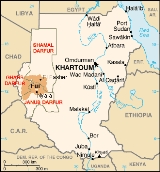
Fur language

Encyclopedia
All sounds are spelt with their IPA symbols except for the following: j = [ɟ], ñ = [ɲ] and y = [j]. Arabic consonants are sometimes used in loanword
s.
The vowels are as in Latin: a e i o u. There is dispute as to whether the –ATR vowels [ɛ], [ɔ], [ɪ], [ʊ] are phonetic variants or separate phonemes.
There are two underlying tonemes, L (low) and H (high); phonetically, L, H, mid, HL and LH are all found.
Metathesis
is an extremely common and regular, grammatical phenomenon in Fur; when a consonant pronoun prefix is prefixed to a verb that begins with a consonant, either the verb's first consonant is deleted or it changes places with the following vowel. Eg: lem- "lick" > -elm-; ba- "drink" > -ab-; tuum- "build" > -utum-. There are also a variety of assimilation rules.
Vowel-final adjectives can take a plural in -là, as well as -ŋa: lulla "cold" > lullalà or lullaŋà "cold (pl.)". A similar suffix (metathesized and assimilated to become -òl/-ùl/-àl) is used for the plural of the verb in some tenses.
A few CVV nouns take the plural suffix H-ta; ròò "river" > ròota "rivers"; rèi "field" > rèito "fields".
At least two nouns take the suffix -i: koor "spear" > koori "spears", dote "mouse" > kuuti "mice".
Nouns with the singular prefix d- (> n- before a nasal) take the plural k-; these are about 20% of all nouns. In some cases (mostly body parts) it is accompanied by L. Eg: dilo "ear" > kilo "ears"; nuŋi "eye" > kuŋi "eyes"; dagi "tooth" > kàgi "teeth"; dòrmi "nose" > kòrmì "noses".
can be expressed by the suffix -le or by reversing the noun's final tone, eg: tòŋ "house" > toŋ "at the house"; loo "place", kàrrà "far" > loo kàrrà-le "at a far place".
The genitive
(English 's) is expressed by the suffix -iŋ (the i is deleted after a vowel.) If the relationship is possessive, the possessor comes first; otherwise, it comes last. Eg: nuum "snake" > nuumiŋ tàbù "snake's head"; jùtà "forest" > kàrabà jùtăŋ "animals of the forest".
The object pronouns are identical apart from being low tone and having -ŋò added to the plural forms.
Prefixed subject pronouns:
Thus, for example, on the verb bu- "tire":
gi, described as the "participant object pronoun", represents first or second person objects in a dialogue, depending on context.
Possessives (singular; take k- with plural nouns):
Derivational suffixes include -iŋ (intransitive/reflexive; eg lii "he washes" > liiŋ "he washes himself) and gemination of the middle consonant plus -à/ò (intensive; eg jabi "drop" > jappiò/jabbiò "throw down".)
Negation is done with the marker a-...-bà surrounding the verb; a-bai-bà "he does not drink".
Adverbs can be derived from adjectives by addition of the suffix -ndì or L-n, eg: kùlle "fast" > kùllendì or kùllèn "quickly".
Abstract nouns can be derived from adjectives by adding -iŋ and lowering all tones, deleting any final vowel of the adjective, eg: dìrro "heavy" > dìrrìŋ "heaviness".
Loanword
A loanword is a word borrowed from a donor language and incorporated into a recipient language. By contrast, a calque or loan translation is a related concept where the meaning or idiom is borrowed rather than the lexical item itself. The word loanword is itself a calque of the German Lehnwort,...
s.
The vowels are as in Latin: a e i o u. There is dispute as to whether the –ATR vowels [ɛ], [ɔ], [ɪ], [ʊ] are phonetic variants or separate phonemes.
There are two underlying tonemes, L (low) and H (high); phonetically, L, H, mid, HL and LH are all found.
Metathesis
Metathesis (linguistics)
Metathesis is the re-arranging of sounds or syllables in a word, or of words in a sentence. Most commonly it refers to the switching of two or more contiguous sounds, known as adjacent metathesis or local metathesis:...
is an extremely common and regular, grammatical phenomenon in Fur; when a consonant pronoun prefix is prefixed to a verb that begins with a consonant, either the verb's first consonant is deleted or it changes places with the following vowel. Eg: lem- "lick" > -elm-; ba- "drink" > -ab-; tuum- "build" > -utum-. There are also a variety of assimilation rules.
Plurals
Noun, and optionally adjective, plurals can be formed with -a (-ŋa after vowels): àldi "story" > àldiŋa "stories", tòŋ "(a certain species of) antelope"> tòŋà "antelopes"; bàin "old" > bàinà "old (pl.)". This suffix also gives the inanimate 3rd person plural of the verb: lìiŋ "he bathes" > lìiŋa "they (inanimate) bathe", kaliŋa "they (animate) bathe".Vowel-final adjectives can take a plural in -là, as well as -ŋa: lulla "cold" > lullalà or lullaŋà "cold (pl.)". A similar suffix (metathesized and assimilated to become -òl/-ùl/-àl) is used for the plural of the verb in some tenses.
A few CVV nouns take the plural suffix H-ta; ròò "river" > ròota "rivers"; rèi "field" > rèito "fields".
At least two nouns take the suffix -i: koor "spear" > koori "spears", dote "mouse" > kuuti "mice".
Nouns with the singular prefix d- (> n- before a nasal) take the plural k-; these are about 20% of all nouns. In some cases (mostly body parts) it is accompanied by L. Eg: dilo "ear" > kilo "ears"; nuŋi "eye" > kuŋi "eyes"; dagi "tooth" > kàgi "teeth"; dòrmi "nose" > kòrmì "noses".
- In some cases the singular also has a suffix -ŋ, not found in the plural: daulaŋ "shoe" > kaula "shoes", dìroŋ "egg" > kìrò "eggs".
- Sometimes a further plural suffix from those listed above is added: nunùm "granary" > kunùmà "granaries", nuum "snake" > kuumi "snakes", dìwwo "new" > kìwwolà "new (pl.)"
- Sometimes the suffix -(n)ta, is added: dèwèr "porcupine" > kèwèrtà "porcupines"; dàwì "tail" > kàwìntò "tails".
- One noun, as well as the demonstratives and the interrogative "which", take a plural by simply prefixing k-L: uu "cow" > kùù; ei "which (one)?" > kèì "which (ones)?".
- Several syntactic plurals with no singulars, mostly denoting liquids, have k-L-a; kèwà "blood", kòrò "water", kònà "name, song".
Nouns
The locativeLocative case
Locative is a grammatical case which indicates a location. It corresponds vaguely to the English prepositions "in", "on", "at", and "by"...
can be expressed by the suffix -le or by reversing the noun's final tone, eg: tòŋ "house" > toŋ "at the house"; loo "place", kàrrà "far" > loo kàrrà-le "at a far place".
The genitive
Genitive case
In grammar, genitive is the grammatical case that marks a noun as modifying another noun...
(English 's) is expressed by the suffix -iŋ (the i is deleted after a vowel.) If the relationship is possessive, the possessor comes first; otherwise, it comes last. Eg: nuum "snake" > nuumiŋ tàbù "snake's head"; jùtà "forest" > kàrabà jùtăŋ "animals of the forest".
Pronouns
Independent subject:| I | ka | we | ki |
| you (sg.) | ji | you (pl.) | bi |
| he, she, it | ie | they | ìè-èŋ |
The object pronouns are identical apart from being low tone and having -ŋò added to the plural forms.
Prefixed subject pronouns:
| I | - (triggers metathesis) | we | k- |
| you (sg.) | j- | you (pl.) | b- |
| he, she, it | - (causes vowel raising; *i-) | they (animate) they (inanimate) | k- (+pl. suffix) (*i-) (+pl. suffix) |
Thus, for example, on the verb bu- "tire":
| I tired | ùmô | we tired | kùmô |
| you (sg.) tired | jùmô | you (pl.) tired | bùmô |
| he/she tired | buô | they tired | kùmul |
gi, described as the "participant object pronoun", represents first or second person objects in a dialogue, depending on context.
Possessives (singular; take k- with plural nouns):
| my | duiŋ | our | daìŋ |
| your (sg.) | diiŋ | you (pl.) | dièŋ |
| his, her, its | deeŋ | their | dièŋ |
Verbs
The Fur verbal system is quite complicated; verbs fall into a variety of conjugations. There are three tenses: present, perfect, and future. Subjunctive is also marked. Aspect is distinguished in the past tense.Derivational suffixes include -iŋ (intransitive/reflexive; eg lii "he washes" > liiŋ "he washes himself) and gemination of the middle consonant plus -à/ò (intensive; eg jabi "drop" > jappiò/jabbiò "throw down".)
Negation is done with the marker a-...-bà surrounding the verb; a-bai-bà "he does not drink".
Adjectives
Most adjectives have two syllables, and a geminate middle consonant: eg àppa "big", fùkka "red", lecka "sweet". Some have three syllables: dàkkure "solid".Adverbs can be derived from adjectives by addition of the suffix -ndì or L-n, eg: kùlle "fast" > kùllendì or kùllèn "quickly".
Abstract nouns can be derived from adjectives by adding -iŋ and lowering all tones, deleting any final vowel of the adjective, eg: dìrro "heavy" > dìrrìŋ "heaviness".
Sources
- A. C. Beaton. A Grammar of the Fur Language. Linguistic Monograph Series, No. 1. Khartoum: Sudan Research Unit, Faculty of Arts, University of Khartoum 1968 (1937).
- Angelika Jacobi, A Fur Grammar. Buske Verlag: Hamburg 1989.
- Constance Kutsch-Lojenga & Christine Waag, "The Sounds and Tones of Fur", in Occasional Papers in the Study of Sudanese Languages No. 9. Entebbe: SIL-Sudan 2004.